Categories
2 Gurus Talk Compliance

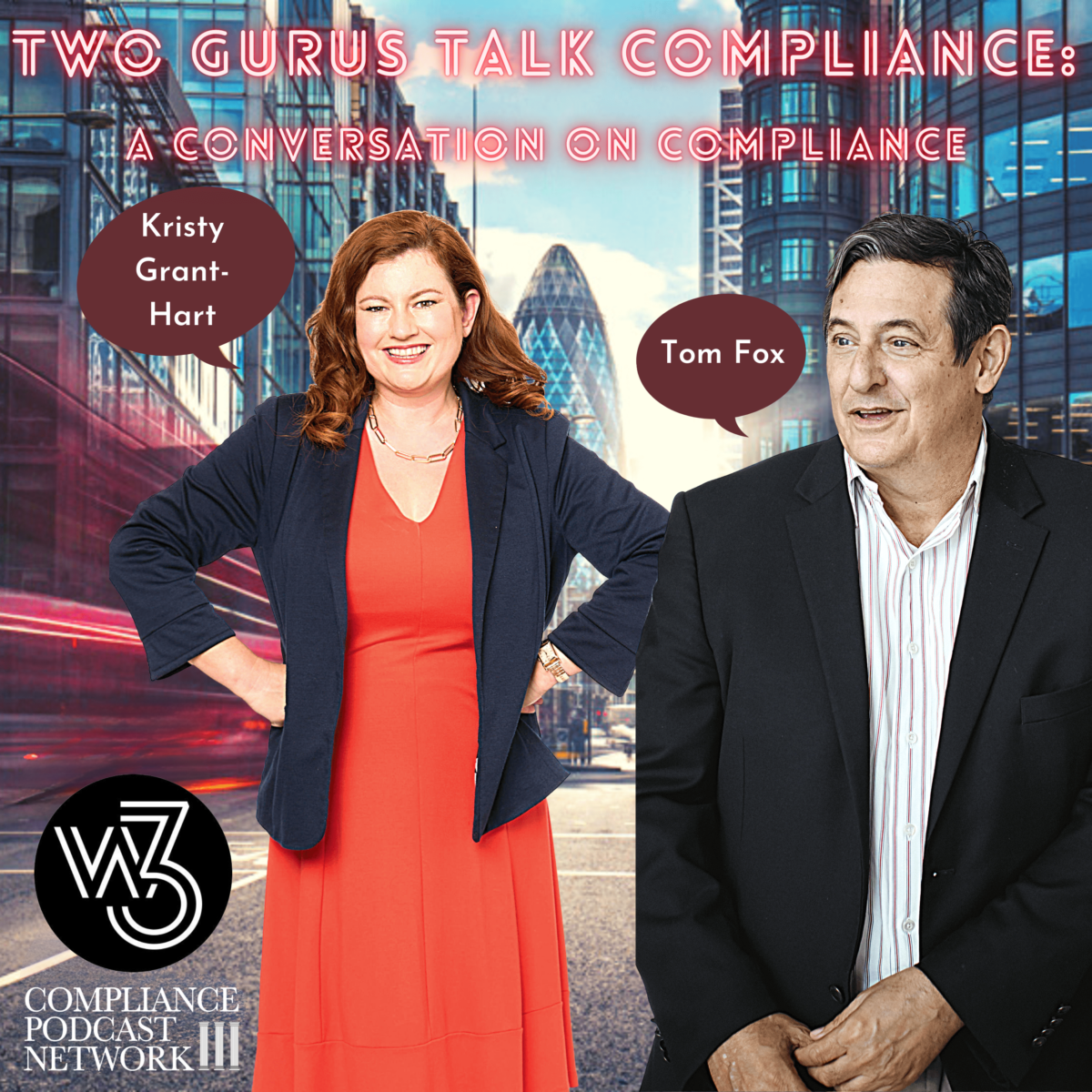
2 Gurus Talk Compliance – Episode 69 – The Wind Kristy Up Edition

What happens when two top compliance commentators get together? They talk compliance, of course. Join Tom Fox and Kristy Grant-Hart in 2 Gurus Talk Compliance as they discuss the latest compliance issues in this week’s episode!

Stories this week include:

  • Tim Leissner wants a pardon.
  • The Pope says watch out for an affectionate chatbot.
  • Discrimination against white males.
  • 9 AI Risks you should be aware of.
  • Compliance officers fired for failing to escalate investigative findings.
  • Tungston rod importer pays $54.4M to settle DOJ tariff fraud allegations
  • The EU AI Act Change That No One Is Talking About
  • Are We Losing Ground? The State of Ethics & Compliance Independence
  • Will Leaving My Terrible Job Make Me Look Flaky?
  • Florida man arrested after trying TikTok challenge inside Walmart

Resources:

Kristy Grant-Hart on LinkedIn

Prove Your Worth

Tom

Instagram

Facebook

YouTube

Twitter

LinkedIn

Categories
Blog

Greek Philosophers Week: Part 3 – Aristotle and the Daily Practice of Ethics & Compliance

In Part 3, we continue our exploration of the origins of the modern corporate compliance organization, tracing them back to the ancient Greek philosophers, including Aristotle. Plato teaches compliance professionals how to design ethical governance systems. But anyone who has ever operated a compliance program knows that structure alone does not guarantee ethical behavior. Policies exist. Committees meet. Reporting lines are drawn. And yet misconduct still occurs. That is where Aristotle becomes essential to the modern compliance conversation.

Aristotle was not interested in ideal societies. He was interested in how people actually behave. His philosophy focuses on habit, judgment, incentives, and purpose, all of which are central to daily compliance operations. The DOJ Evaluation of Corporate Compliance Programs (ECCP) reflects this Aristotelian realism. It asks not only whether a program is well designed, but also whether it is implemented in practice and works in reality.

If Plato is the architect of compliance, Aristotle is its operator.

Virtue as Habit, Not Aspiration

Aristotle rejected the idea that ethics is a matter of knowing the right thing. He argued that virtue is formed through repeated action. People become ethical by practicing ethical behavior until it becomes a habit. This insight aligns directly with the ECCP’s focus on implementation and effectiveness. Prosecutors do not evaluate what a company claims to value. They assess how employees actually behave under pressure. Training, policies, and controls matter only to the extent they shape habits.

In daily compliance work, this means moving beyond episodic interventions. Annual training does not create virtue. Consistent reinforcement does. Indeed, the DOJ specifically called out companies that “have invested in shorter, more targeted training sessions to enable employees to timely identify and raise issues to appropriate compliance, internal audit, or other risk management functions.”

Managers who model ethical decision-making, align incentives with values, and apply consequences fairly all shape behavior over time. Aristotle reminds us that culture is built one decision at a time.

Practical Wisdom and Gray-Area Decision Making

Aristotle distinguished between technical knowledge and phronesis, or practical wisdom. Rules cannot anticipate every situation. Judgment fills the gap. The ECCP implicitly recognizes this by emphasizing risk-based decision-making. A compliance program that relies solely on rigid rules will fail in complex environments. Investigations, third-party reviews, and transaction approvals all require judgment informed by experience and context.

For compliance professionals, this means embracing their role as ethical decision-makers rather than just rule enforcers. It also means documenting judgment. Regulators understand discretion, but they expect it to be principled, consistent, and explainable. Aristotle teaches that wisdom is demonstrated through action guided by reason.

The Golden Mean and Proportional Compliance

One of Aristotle’s most enduring ideas is the Golden Mean. Virtue lies between extremes. Courage sits between recklessness and cowardice. The same principle applies to compliance design and operations. The ECCP expects programs to be appropriately tailored to risk. Over-engineered compliance systems create fatigue, false positives, and cynicism. Under-resourced programs invite misconduct. Both extremes are failures.

Daily compliance operations must strike a balance. Monitoring should be robust but targeted. Controls should be strong but workable. Reporting requirements should capture risk without overwhelming employees. Aristotle reminds us that effectiveness lives in proportion, not excess.

Incentives Reveal Character

Aristotle believed character is revealed by what people pursue and what they are rewarded for achieving. This lesson is painfully relevant to compliance failures. This is also the basis for modern due diligence. The ECCP repeatedly asks how companies incentivize compliance and discipline amid misconduct. The ECCP states, “Another hallmark of effective implementation of a compliance program is the establishment of incentives for compliance and disincentives for non-compliance.” Compensation structures that reward results regardless of method undermine every policy on the books. Employees respond to what is rewarded, not what is written.

In practice, compliance professionals must engage with compensation, promotion, and performance management. Ethics cannot be siloed. When high performers are excused from consequences, the organization sends the message that virtue is optional. Aristotle would argue that such systems inevitably produce unethical outcomes, regardless of stated values.

Purpose and the Role of Compliance

Aristotle believed everything has a telos, an ultimate purpose. Understanding purpose guides action and gives coherence to effort. Compliance programs often struggle when their purpose is framed narrowly as avoiding fines or enforcement. The ECCP encourages companies to adopt a broader perspective, emphasizing risk management, trust, and sustainable operations.

In daily work, purpose shapes priorities. Is compliance positioned as a business partner or a policing function? Is it involved early in decision-making or consulted after damage is done? Aristotle teaches that clarity of purpose aligns behavior. When compliance understands and articulates its role as protecting the organization’s long-term health, its influence grows.

5 Key Takeaways for the Compliance Professional

1. Ethical behavior is formed through habit, not intention.

Aristotle teaches that virtue develops through repeated action. Compliance programs must therefore consistently reinforce ethical behavior, not just episodically. The ECCP emphasizes implementation because policies alone do not shape conduct. Daily reinforcement through leadership behavior, aligned incentives, and consistent consequences builds habits that endure. Compliance professionals should evaluate whether their programs influence how employees actually act under pressure, not just what they acknowledge in training.

2. Judgment is a core compliance competency.

Rules cannot anticipate every scenario. Aristotle’s concept of practical wisdom aligns with the ECCP’s expectation of risk-based decision-making. Compliance professionals must exercise and document judgment in investigations, approvals, and remediation. This requires experience, training, and independence. Ethical compliance is not mechanical. It is reasoned, contextual, and defensible when challenged by regulators or boards.

3. Proportion matters in compliance design.

The Golden Mean teaches that extremes undermine effectiveness. Overly burdensome controls create fatigue and workarounds. Weak controls invite abuse. The ECCP expects tailoring based on risk, geography, and business model. Compliance leaders must design right-sized programs that employees can follow and that management can support. Balance is not compromise. It is effective.

4. Incentives define culture more than policies.

Aristotle understood that character is shaped by what is rewarded. Compliance failures often stem from misaligned incentives. The ECCP scrutinizes compensation and discipline for this reason. Daily compliance operations must engage with HR and leadership to ensure ethics are embedded in performance evaluations, promotions, and bonuses. Culture follows incentives, not slogans.

5. Compliance must have a clear purpose.

Aristotle’s concept of telos reminds us that purpose guides action—compliance programs framed solely as legal defense lose credibility. The ECCP encourages a broader view of compliance as a risk-management and trust-building approach. When compliance professionals articulate their purpose clearly, they gain influence, resources, and early involvement in decisions that matter.

From Aristotle to Pythagoras: From Judgment to Measurement

Aristotle grounds compliance in habit, judgment, and proportion. But judgment alone is not enough in modern organizations operating at scale. As programs mature, leaders ask how to measure effectiveness, detect patterns, and anticipate risk.

That transition leads naturally to Pythagoras. Where Aristotle focuses on ethical action, Pythagoras focuses on number, proportion, and harmony. In compliance terms, this is the shift toward data analytics, metrics, and AI. If Aristotle teaches us how people should behave within ethical systems, Pythagoras teaches us how to observe, measure, and test whether they actually do.

Aristotle teaches us how ethical compliance is lived day to day. Pythagoras will push the conversation further, asking how data, analytics, and AI can measure, test, and strengthen those ethical systems without losing proportion or judgment. Join us tomorrow in Part 4 to find out how.


 

Categories
Blog

Negotiating Ethics at Warp Speed: Five E&C Lessons from Star Trek’s “Friday’s Child”

Star Trek has always been about more than adventure. It is often a mirror for our ethical challenges, especially for those tasked with steering organizations through the tricky space of corporate compliance. The original series episode “Friday’s Child” offers a compelling look at negotiation, trust, and ethics under fire. While set on the distant planet Capella IV, the dilemmas faced by Captain Kirk and his crew echo those in today’s boardrooms and compliance departments. Today, we set our phasers to “learn” and beam down five ethical lessons for compliance professionals, each tied to a defining scene from this classic episode.

Lesson 1: Respect Local Customs—Even When They Conflict With Your Own Values

Illustrated By: Upon arrival on Capella IV, Kirk and his landing party encounter the fiercely traditional Capellan society. The Capellans’ customs, particularly their views on leadership and the role of women, are in stark contrast to those of the Federation. Kirk and Dr. McCoy are forced to tread carefully, knowing that any misstep could lead to violence or destroy negotiations.

Compliance Lesson: Operating globally means working in environments where local laws and customs may clash with your organization’s values or home-country regulations. Compliance professionals must develop cultural intelligence and adapt without compromising core ethical standards. Kirk’s diplomacy demonstrates the importance of engaging with local practices respectfully, seeking understanding before judgment.

Provide training for teams working abroad, focusing on cultural sensitivity and practical ways to address conflicts between local customs and organizational policies. Create protocols for escalating issues when legal or ethical lines are at risk of being crossed.

Lesson 2: Integrity in Negotiation Is Non-Negotiable

Illustrated By: As the Federation seeks mining rights on Capella IV, the Klingons arrive to negotiate with the Capellans, bringing duplicity and manipulation. The Klingon emissary, Kras, offers bribes and deceit, but Kirk insists on transparency—even when it puts the mission at risk.

Compliance Lesson: Negotiations, whether with third parties or regulators, test ethical boundaries. While competitors may take shortcuts or resort to unethical tactics, a compliance-driven organization must prioritize integrity. Kirk’s refusal to engage in deception sets a tone of ethical leadership that earns the grudging respect of the Capellans.

Embed ethics in your negotiation strategy. Establish clear boundaries and a code of conduct for employees and third parties, making it clear that winning at any cost is not acceptable. Regularly audit negotiations for compliance with both law and company values.

Lesson 3: Protect the Vulnerable—Even When It’s Not Easy

Illustrated By: After the assassination of Akaar, the Capellan leader, his pregnant widow, Eleen, becomes the target of violence. Federation protocol would have Kirk and his team withdraw, but McCoy and Kirk insist on protecting Eleen and her unborn child, risking their safety and the mission.

Compliance Lesson: Organizations must safeguard those in vulnerable positions—whether whistleblowers, employees facing retaliation, or communities impacted by business decisions. The true ethical test is what you do when protecting the vulnerable is inconvenient, costly, or unpopular.

Establish robust whistleblower protection programs, anti-retaliation measures, and processes for identifying at-risk individuals or groups. Make it clear that ethical obligations to protect the vulnerable are not optional, but a core part of your compliance mission.

Lesson 4: Ethical Courage Means Making Unpopular Decisions

Illustrated By: When Eleen, following Capellan law, insists that she does not want her child, McCoy faces a stark ethical dilemma. He risks offending her and violating local tradition by insisting on the child’s birth, believing it to be in her and the child’s best interests. Ultimately, his actions save both Eleen and her child, who becomes the new heir.

Compliance Lesson: There are moments when ethical behavior demands standing alone, challenging consensus, or confronting deeply ingrained practices. McCoy’s “tough love” illustrates the courage required to make the right decision, even when it’s not the popular one.

Lesson 5: Transparency and Communication Build Trust in Crisis

Illustrated By: As Kirk, Spock, McCoy, and Eleen flee from the Capellans and Klingons, success depends on clear, honest communication. Kirk keeps his crew and even Eleen informed at every stage, which allows them to adapt quickly and survive the dangers they face together.

Compliance Lesson: During crises, be it a compliance investigation, regulatory challenge, or public scandal, transparency and timely communication are critical. Hiding information, even with good intentions, breeds suspicion and undermines trust. Kirk’s example shows that open communication is not a luxury but a necessity, especially under pressure.

Prepare crisis communication protocols in advance. Train leaders to communicate openly, honestly, and quickly during emergencies. Ensure employees know how, when, and where to report issues, and how updates will be provided as matters evolve.

Final ComplianceLog Reflections

“Friday’s Child” may be set on a planet of warriors, but its ethical lessons are universal. For compliance professionals, the episode is a case study in what it means to lead ethically when stakes are high, the rules are unclear, and the path is fraught with danger.

From respecting local customs to standing up for the vulnerable, even at great personal or professional cost, the crew of the Enterprise demonstrates that ethics is not a luxury, but the core of mission success. The compliance officer’s role is not unlike Kirk’s: to navigate complexity, negotiate with integrity, protect those at risk, summon courage in the face of unpopularity, and build trust through transparency.

In a world where every new market brings new challenges and every crisis tests our character, “Friday’s Child” offers this timeless guidance: set your course by your values, and let ethical leadership be your prime directive.

Resources:

Excruciatingly Detailed Plot Summary by Eric W. Weisstein

MissionLogPodcast.com

Memory Alpha

Categories
Great Women in Compliance

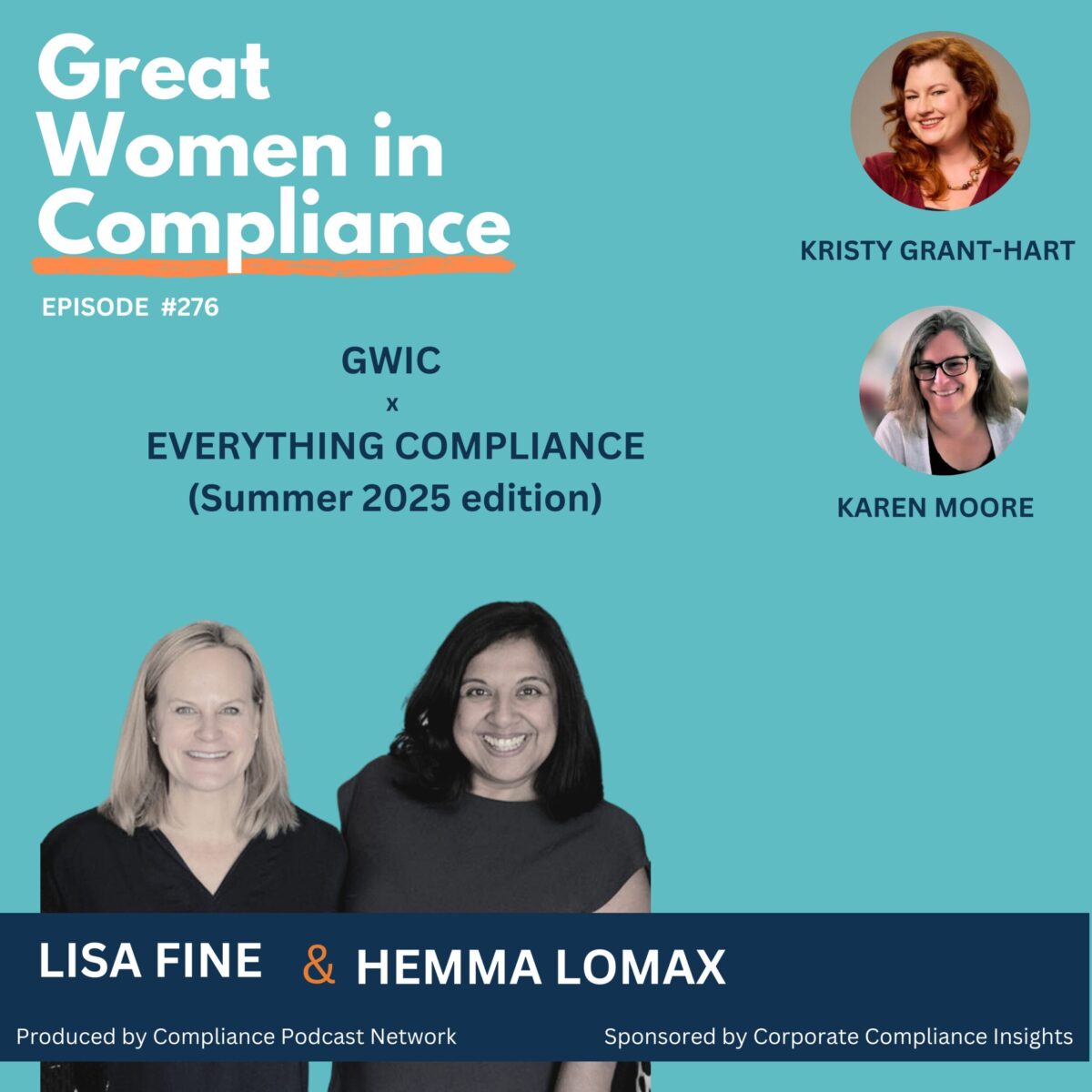
Great Women in Compliance: GWIC X EC Q2 2025 – Exploring Compliance Innovations

We’re back with another GWIC x EC crossover episode. Today, we have the quartet of Great Women in Compliance of Kristy Grant-Hart, Karen Moore, Lisa Fine, and Hemma Lomax.

The GWIC quartet discusses various intriguing topics related to compliance. Lisa Fine kicks off the conversation by discussing the new ‘failure to prevent fraud’ guidance in the UK, which places greater responsibility on companies to avoid engaging in fraud. The group delves into the implications of this law and its extraterritorial elements. Hemma Lomax shifts the conversation to changes in the False Claims Act in the US, highlighting its expanded use beyond fraudulent billing to areas like cybersecurity and diversity obligations. Karen Moore introduces the innovative ‘Karma’ rewards system by Revolut Bank in the UK, which incentivizes compliance behaviors through team performance multipliers. Kristy Grant-Hart wraps up with a fascinating discussion on AI, touching on AI’s potential as a whistleblower and whether AI could attain employment rights if it becomes sentient. They conclude by sharing their rants and raves, offering insights on topics ranging from the importance of local theaters to women’s leadership in compliance.

Join the Great Women in Compliance community on LinkedIn ⁠here⁠

Categories
Great Women in Compliance

Great Women in Compliance – GWIC X Everything Compliance

Welcome to the Great Women in Compliance podcast on the Compliance Podcast Network, sponsored by Corporate Compliance Insights. Today’s episode is a special episode cross-posted with Everything Compliance.

In this episode, host Kristy Grant-Hart joins Everything Compliance panelists Karen Moore and Karen Woody to team up with the Great Women in Compliance regulars Hemma Lomax and Lisa Fine to dissect current issues in the compliance landscape. They look into the implications of the U.S. Constitution’s 10th Amendment on state rights amidst federal executive action, affecting data privacy and ESG regulations. The panel also explores the shifting terrain of DEI programs under recent executive orders, shedding light on both opportunities and challenges for compliance officers in advocating for ethical practices and maintaining organizational morale during these turbulent times, considering the role of the SEC going forward and the current chaos coming out of Washington. The episode concludes with their signature rants and raves, highlighting frustrations and positive notes from the compliance field.

  • Karen Woody on change to require SEC Commission approval to launch investigations.
  • Karen Moore on the importance of the 10th
  • Lisa Fine on morale, destruction, and confusion.
  • Hemma Lomax on change management and employee engagement.
  • Rants and Raves

You can join the LinkedIn podcast community Or the Great Women in Compliance podcast community here.

Categories
Blog

Making Ethics & Compliance Training Memorable: Part 1 – What is the Problem?

There is not much I enjoy more than sitting down with one of the innovative thinkers in compliance, Carsten Tams, to find out what is on his mind regarding compliance. I recently had the opportunity to do so in making compliance training memorable. We explored this topic over this short five-part podcast series on the award-winning Innovation in Compliance on the award-winning Compliance Podcast Network.

Over the next five blog posts, I will also explore these topics in the blog format. I will introduce the problem and challenges and then provide you with four proven strategies for success in your compliance training. I deeply dive into why traditional E&C training often fails to engage employees and needs more impact on their behavior despite significant investments. This episode sets up the problem by exploring the historical context of E&C training, the difference between European values-focused and American rules-regulation approaches, and how these methods have evolved. In Part 1, I provide the lay of the land, explain when ethics training needs some fresh ideas, identify some of the challenges ethics training faces, and conclude with a summary of the solutions.

I think this topic still bedevils many compliance professionals: ethics and compliance training. 15 years ago, compliance training was written by lawyers for lawyers. There was a difference in the European approach, which focused more on values, as opposed to the American approach, which focused on rules and regulations. Hopefully, it has evolved past all of those, but there is still a problem with compliance training’s need to engage employees meaningfully.

Tams even further believes this issue of non-engagement by employees with compliance training is “the billion-dollar elephant in the room for ethics and compliance as a practice.” This problem is even made more critical as compliance training is one of the most important functions that ethics and compliance departments perform. “It is also important in terms of the size of the budget they spend on it. The training and compliance training industry is huge. It’s one of the biggest corporate learning sectors, if not the biggest. And yet here we are, and we have very little. After billions of dollars spent and millions of people going through compliance training, there’s very little evidence that it is working in terms of truly creating a better speak-up culture and truly affecting employee behaviors in any positive sense.”  Tams ended by noting that undoubtedly the thing such training does accomplish “is that we’re able to check that box and say, yes, we fulfilled our requirement to train people. However, I think it is lacking in terms of behavioral impact.”

There are some interesting data points on that. A study by Gallup in 2023 showed that three-quarters of compliance training showed little to no benefit. Another finding was that training only tended to benefit when the learner experienced it very positively. When the learner rated the training experience as excellent, the training positively impacted behaviors. This shows that training experience matters.

Compliance professionals must understand better what makes people engage in this type of training. Navex, in an article entitled Top 10 Reasons Why Compliance Training Fails,  asked why training programs often fail. The answer most frequently given was that training is uninspiring, unmemorable, and usually perceived as irrelevant to learners’ work.

There are four engagement killers in compliance training:

  1. Deficit-Focused Training: Compliance training tends to be delinquency-focused. The trainee is cast as someone about to commit a compliance mistake or misconduct.
  2. Passive Learning: Training is often passive and not experiential.
  3. Isolated Learning: Training is an isolated affair with little social interaction.
  4. Lack of Playfulness: Training is rigid and not playful.

One of the themes that will overlay all these podcasts is effectiveness. As far back as the original Evaluation of Corporate Compliance Programs in 2017, the Department of Justice (DOJ) said training should be adequate. How can we get companies to move off the check-the-box mentality so that they can enhance the user experience through some of the strategies I hope to explore throughout this series?

Four Strategies for Effective Training

  1. Strength-Based Training: Focus on employees’ strengths and capabilities. Training should engage people as effective partners in producing ethical outcomes and creating a more ethical organizational culture.
  2. Experiential Learning: Effective learning is experiential. It challenges people to bring their creative and problem-solving capabilities to the learning situations, think creatively, and address meaningful problems.
  3. Social Learning: Collaborative learning has unique benefits. Ethics training succeeds or fails between people. Effective ethics training should encourage communication and collaboration among employees.
  4. Playful Learning: Make ethics learning more playful. Engaging in play makes us much more deeply engaged and open to new information. Playful learning helps retain information and transfer learned information or skills to different scenarios.

In this blog post series, I will detail the several barriers to effective training, including training being seen as a checkbox exercise, the deficit-focused nature, passive learning methods, isolation, and a lack of playfulness. I will also detail the promising findings that training can be effective when it delivers a positive user experience, emphasizing the need for innovative approaches to improve engagement and behavioral impact. This blog post series explores solutions and strategies for making E&C training more engaging and effective, grounded in four proven learning design principles.

Tune in tomorrow, when I will explore strength-based training and how focusing on strengths can transform compliance training and engagement.

Categories
Principled Podcast

Principled Podcast – S10E10: What are the E&C Priorities for Companies in the Middle East?

What you’ll learn on this podcast episode

In the nearly 10 years of running our annual program effectiveness research, LRN has had the good fortune to discuss trends in E&C with leaders from across the world. The Middle East is one such region. How do business practices differ in this region compared to other parts of the world? Who are the like-minded professionals that E&C leaders can connect with in the Middle East? In this episode of LRN’s Principled Podcast, host Amy Hanan is joined by Elvis Angyiembe, the co-founder of the Middle East and Africa Compliance Association (MEACA). Listen in as they discuss Elvis’s experience working in the Middle East for various multinational companies, what led him to start MEACA, and what the E&C priorities are for companies in the Middle East. 

Are you an E&C professional based in the Middle East? Take this 10-minute survey and share your experiences for LRN’s 2024 E&C Program Effectiveness research. Results will be published in February.

Guest: Elvis Angyiembe

Elvis Angyiembe – Grayscale

Elvis Angyiembe is co-founder and co-chair of the Middle East and Africa Compliance Association (MEACA). He has significant experience working for multinational companies helping them manage significant legal and compliance matters. He has supported three companies under deferred prosecution agreements with the US Department of Justice. He has lived in Cameroon, Germany, US, South Africa, and currently in Dubai. He holds a Juris Doctorate (JD) from Thurgood Marshall School of Law in Houston, Texas, and a bachelor’s degree in criminology from the University of Maryland in College Park, Maryland.

Host: Amy Hanan

Amy Hanan – Grayscale

Amy Hanan is the chief marketing officer at LRN. A B2B digital marketing leader, Amy has a nearly 20-year track record in product, brand, lifecycle, and demand-generation marketing as well as corporate communications for media, professional services, and technology companies. One of her central areas of expertise is executing tech-enabled marketing initiatives for growth. Before joining LRN, Amy was the chief digital officer at Baretz+Brunelle, a marketing and communications agency serving the legal and financial services industries. Her previous experience includes Reorg Research, ALM Media, and The Associated Press. She holds a Bachelor of Arts degree from Northern Arizona University.

Categories
Blog

Navigating Transformational Changes: The Intersection of E&C and ESG

Today I would like to explore the intersection thought of ethics and compliance (E&C) and environmental, social, and governance (ESG) efforts. In a recent podcast on Report from IMPACT 2023, we explored the crucial role of ethics in guiding organizations through transformational changes. With data-driven insights and practical advice, considered the challenges, opportunities, and strategies for success in this evolving landscape.

In the face of rapid technological advancements, the importance of ethics cannot be understated. The need to build safeguards to prevent potential crashes or negative consequences. Much akin to car racing, this world has the need to moving forward with technology in a safe and responsible manner. Further and just like a skilled racer, organizations must navigate the track of progress while ensuring the ethical implications of their actions are considered. Finally always remember that brakes are not on a car to slow it down but so that you can drive fast.

As power dynamics shift and new technologies emerge, the establishment of checks and balances in this arena becomes paramount. This means that organizations need to distribute power internally both wisely and ensure ethical decision-making processes are in place. By doing so, they can safeguard against potential abuses and ensure that transformative changes are guided by integrity. I often use the visual of the billboard announcing the Eyes of Dr. T J Eckleburg from The Great Gatsby as the best way to think about having a second set of eyes on your process for process validation.

In a world undergoing rapid transformation, continuous education and expanding horizons are crucial for organizations and individuals alike. For Chief Compliance Officers (CCOs) and other compliance professionals, the importance of being adaptable and open to learning cannot be overstated. Our profession is changing as fast as any other corporate function and it is coupled with the needs of our customers changing. Who are the customers of a corporate compliance program? You can start with the multiple stakeholders identified by the Business Roundtable in their seminal Statement on the Purpose of a Corporation. It can be employees, shareholders, third-parties, vendors and business partners and those who may live in localities where your organization does business.  By embracing new perspectives and staying informed, CCOs, compliance professionals and corporate compliance functions can effectively navigate the challenges of a changing world.

A significant development highlighted in the podcast is the convergence of ESG and E&C. This integration presents a strategic risk and opportunity standpoint for organizations. By aligning environmental, social, and governance considerations with ethical and compliance practices, companies can create a holistic approach that benefits both their bottom line and society at large. Equally importantly is the mandate that the CCO and corporate compliance function should lead this effort. There is no other corporate function which has such a wide mandate, as set out by the regulators as the corporate compliance programs. One need only consider the 2019 Evaluation of Corporate Compliance Programs which led to the 2023 Evaluation of Corporate Compliance Programs to see that a corporate compliance function (and CCO) must have visibility literally across your entire corporate organization.

The demand for businesses to take positions on social issues is growing louder, both from employees and stakeholders. It well known within the compliance community and wider corporate world of the importance of both the CCO and compliance function not remaining silent on these matters. You may call this speaking truth to power but in the wider ESG world, businesses must recognize the power they hold to effect change and leverage it responsibly. By aligning their values with those of their workforce and society, they can build purpose-filled organizations that resonate with the younger generations.

I speak with many Human Resource (HR) and talent specialists and they all say that the acquisition and retention of talent will be the key market differentiator for business by mid-century. From Baby Boomers to through GenXers to Millennials and now Genders; the values and mindset of the current and upcoming workforce differ significantly from those of previous generations. To motivate and attract these individuals, organizations must listen to their ideas and incorporate them into the company’s values and purpose. By engaging with the younger generations and understanding their perspectives, board members can foster an environment that aligns with their aspirations. Businesses which try to enforce well-known and well-debunked tropes such as there is no such thing as climate change will be consigned to the dustbin of corporate failures.

Building transformative leadership and engaging forward-thinking board members pose challenges but are necessary for success. Just as talent acquisition and retention will be one of the most critical aspects of corporate survival, the importance of recruiting board members who understand current and future challenges and the need for an integrated approach will be equally critical. Critically this also means diversity on the Board. While seasoned experience is valuable, finding individuals who can bridge the gap between traditional values and the demands of a changing world is crucial. It also means new and different subject matter expertise will be critical. The Department of Justice (DOJ) has noted that a Board needs to have a compliance resource on it. The logical step is for a Board to have a Compliance Committee, chaired by a seasoned compliance professional.

It might even lead to a broader concept of a true risk management professional on the Board. Given the paradigm shift coming out of the Pandemic from disaster recovery to business resiliency to business as usually; a Board having the ability to have that strategic discussion  and lead through oversight will be a critical element as well.

Recognizing the pivotal role that ethics and compliance play in guiding organizations through transformational changes is something that is gaining traction in the corporate world. In a world that is evolving at an unprecedented pace, it is imperative to build ethical safeguards, establish checks and balances, provide appropriate oversight and adapt to the values and mindset of the younger generations. By embracing continuous education, converging ESG and E&C efforts, and taking a stand on social issues, organizations can navigate the inflection point we find ourselves in and thrive in the future.

Categories
Report from IMPACT 2023

Report from IMPACT 2023: ESG Panel on Ethics, Compliance, and the Future: Navigating Transformation

ECI’s IMPACT 2023 was one of the leading compliance events in 2023. At this conference, Tom Fox, the Voice of Compliance, was able to visit with several of the speakers, exhibitors, participants and one group of ethically minded Girl Scout Troop. In this limited podcast series, Report from IMPACT 2023, Tom explores many of the most cutting-edge topics in ethics and compliance through short podcast episodes. Check out the full series of interviews. You will be enlightened, informed and come away with a fuller and more thorough understanding of the most cutting-edge topics in ethics and compliance. In this episode, Tom visits with a panel of ESG experts including Jacqueline Brevard, former Chief Ethics and Compliance officer of Merck, Andrea Bonime-Blanc, CEO of GeC Risk Advisory and Jose Javier Guadalupe, Integrity Director for the Platform for Social Impact.

In a series of thought-provoking podcast episodes from ECI IMPACT 2023, Tom Fox explores the intersection of ethics and compliance with environmental, social, and governance efforts. These episodes stress the importance of an integrated approach to these areas, emphasizing that businesses prioritizing intangible risks and opportunities are more likely to succeed in the future. The speakers also discuss the challenges of implementing this approach at the board level and the need for forward-thinking board members aligned with the organization’s mission and values. Additionally, the podcasts explore the impact of generational change in the workforce, urging leaders to adapt to the values and mindset of younger generations and create space for their ideas. The importance of ethics as a fundamental part of the future is emphasized, with speakers stressing the need for continuous education and learning amidst rapid changes. Overall, these episodes underscore the relevance of ethics and compliance in guiding organizations through transformative changes.

 Highlights Include 

·      Transformative Integrity

·      Generational Change in the Workforce

·      The Importance of Ethics in a Changing World

Resources 

Jacqueline Brevard on LinkedIn

Andrea Bonime-Blanc on LinkedIn

GEC Risk Advisory

Jose Javier Guadalupe on LinkedIn

Platform for Social Impact

Categories
Creativity and Compliance

Training Jams – Using Music to Communicate E&C

Where does creativity fit into compliance? In more places than you think. Problem-solving, accountability, communication, and connection – all take creativity. Join Tom Fox and Ronnie Feldman on Creativity and Compliance, part of the award-winning Compliance Podcast Network.

Ronnie’s company, Learnings and Entertainment, utilizes people’s entertainment devices to consume information in their everyday, non-work lives and apply it to important topics around compliance and ethics. It is not only about being funny. It is about changing the tone of your compliance communications and messaging to make your compliance program, policies, and resources more accessible.

In this episode, Tom and Ronnie discuss a great new series of offerings by L&E, entitled ‘E&C Training Jams.’ E&C Training Jams are an offering by L&E using music as a non-traditional way to communicate with your employees and to build an overall culture of compliance in your organization. In Training Jams, a soulful singer banters about ethics & compliance, explaining policies, sharing examples, and debunking excuses. Ronnie goes so far as to say about E&C Training Jams, “quite frankly, the coolest thing that I’ve ever made because the music gets stuck in your head, and they leave you with a smile.”

Resources:

Check out  Ronnie Feldman on LinkedIn

Check out Learnings & Entertainments on LinkedIn

Follow Ronnie Feldman on Twitter

Learnings & Entertainments 

 L&E Offerings-E&C Training Jams

E&C Jams Sizzle Reel

E&C Jams Promo Reel Landing page

E&C Jams Web Page