Categories
Blog

Celebrating 300 Episodes of Great Women in Compliance: A Movement, Not Just a Podcast

Reaching 300 episodes is no small feat in the world of podcasting. It takes vision. It takes discipline. It takes community. Most of all, it takes purpose. The Great Women in Compliance (GWIC) podcast has reached that remarkable milestone, and it is worth pausing to celebrate what this achievement truly represents. This is not simply the longevity of a show. It is the sustained elevation of voices that has reshaped the compliance profession.

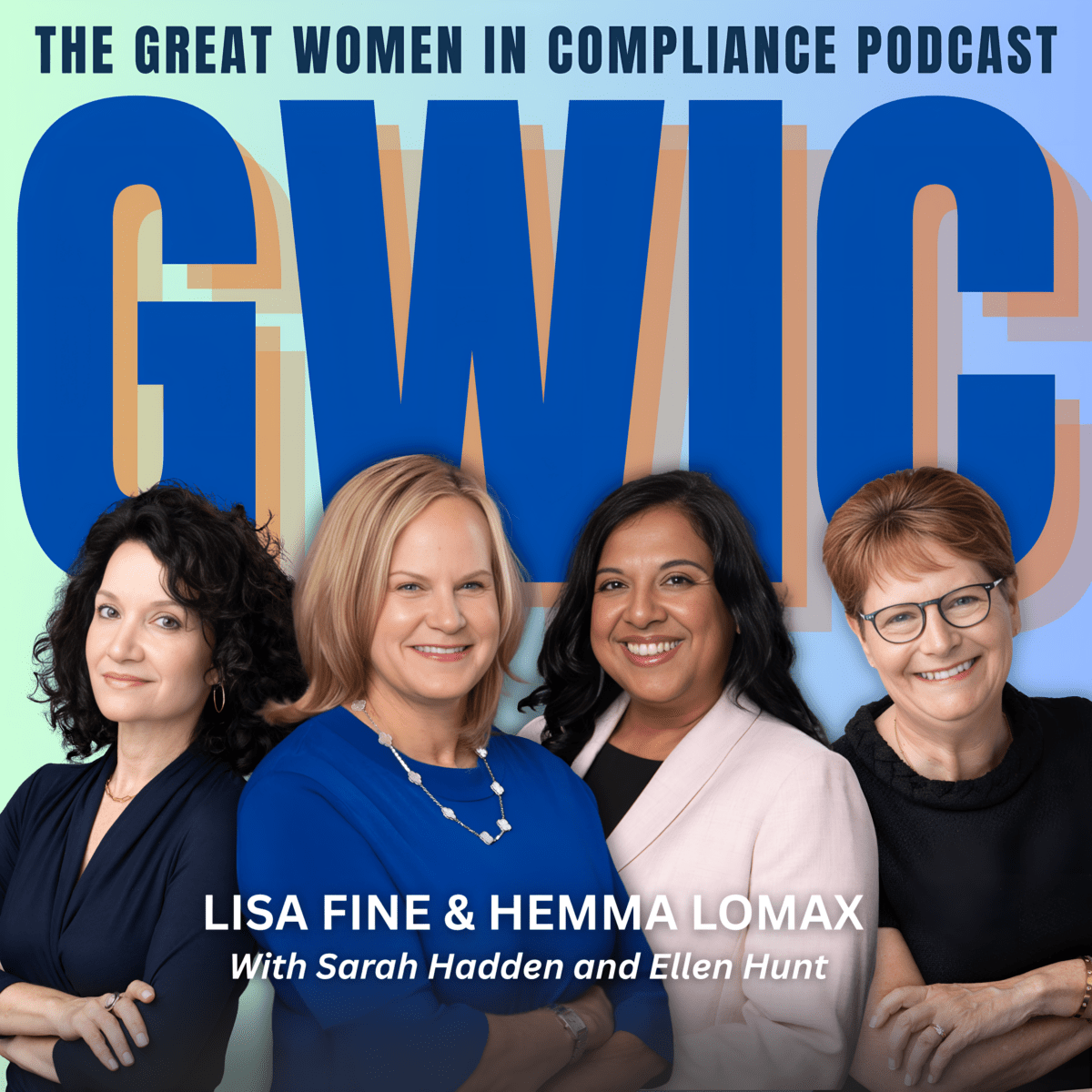
From its founding by Lisa Fine and Mary Shirley to its current hosting team of Lisa Fine, Hemma Lomax, Sarah Hadden, and Ellen Hunt, GWIC has become far more than a podcast. It has become a platform, a mentoring network, and a cornerstone of the compliance community. As part of the Compliance Podcast Network, I am proud to say it stands as one of the most impactful and influential voices in our profession.

The Vision of the Founders

When Lisa Fine and Mary Shirley launched GWIC, they did so with a simple but powerful idea: compliance needed more visible female leadership, more shared stories, and more authentic conversations. Compliance has long been a profession filled with talented, capable, and principled women. Yet historically, their voices were not always amplified equally. The founders recognized that gap and moved to close it.

They did not create a show focused narrowly on technical guidance. They created a forum for professional development, ethical leadership, resilience, career navigation, and community building. They humanized compliance. That matters because compliance is often framed in terms of policies, controls, investigations, and enforcement actions. Great Women in Compliance reframed the conversation around leadership journeys, decision-making under pressure, cultural intelligence, and personal growth. Three hundred episodes later, that founding vision continues to define the show.

The Evolution of Leadership

As the podcast matured, leadership transitioned in a way that mirrors the very principles the show promotes: succession, collaboration, and shared stewardship. Today, the podcast is hosted by Lisa Fine, joined by Hemma Lomax, Sarah Hadden, and Ellen Hunt. Each brings a distinct voice and perspective to the table.

Hemma Lomax contributes a global compliance lens, grounded in regulatory rigor and practical implementation. Sarah Hadden brings strategic governance insight and a board-facing perspective that resonates deeply with senior leaders. Ellen Hunt offers a powerful blend of ethics, integrity, and operational expertise that connects culture to controls. Lisa Fine is well, Lisa Fine, a woman who, along with Mary Shirley, changed the world of compliance.

This team dynamic demonstrates an important aspect of modern compliance leadership: it is not hierarchical. It is collaborative. The podcast models what strong compliance programs aspire to achieve internally: diverse voices, respectful dialogue, and shared accountability.

Why GWIC Matters

The question is not simply why the podcast has endured. The question is: why has it become essential listening for compliance professionals worldwide? There are several reasons.

1. It Elevates Role Models

You cannot be what you cannot see. Great Women in Compliance has consistently highlighted leaders at every stage of their careers, from emerging professionals to chief compliance officers. It has provided visibility to talent that might otherwise remain unseen outside corporate walls. That visibility matters for the next generation. Young professionals entering compliance hear real stories of career pivots, setbacks, ethical dilemmas, and leadership breakthroughs. They hear authenticity instead of perfection. That is empowering.

2. It Bridges Technical and Personal Development

Many compliance resources focus exclusively on regulations and enforcement trends. Those are important, but they are not sufficient. GWIC addresses the human dimension of compliance leadership. It tackles topics such as navigating difficult reporting lines, advocating for resources, handling burnout, negotiating compensation, and managing crises. In other words, it addresses the real-world challenges compliance professionals face daily. The result is a podcast that supports both competence and confidence.

3. It Strengthens Community

One of the most underappreciated aspects of compliance is its isolation. Many compliance officers operate in small teams or even as a “team of one.” They often carry heavy responsibility with limited internal allies. GWIC builds connections. Listeners hear their own experiences reflected to them. They gain practical advice. They gain reassurance that their challenges are shared. They gain community. In a profession defined by independence and integrity, community is a powerful counterbalance.

4. It Normalizes Ambition

There was a time when ambition in compliance, particularly among women, was often underplayed. GWIC normalizes aspiration. Guests openly discuss career advancement, executive presence, board interaction, and strategic leadership. They speak candidly about how to position compliance as a value driver rather than a cost center. That message aligns directly with where the profession is headed. Compliance is no longer confined to checking boxes. It is integrated into corporate strategy, enterprise risk management, and ESG initiatives. The podcast reflects that evolution.

A Platform Within the Compliance Podcast Network

GWIC is a proud part of the Compliance Podcast Network, and its success reflects the broader strength of that platform. The Compliance Podcast Network was built on the idea that compliance conversations should be accessible, practical, and forward-looking. GWIC exemplifies that mission. Within the network, the show occupies a unique space. It is simultaneously technical and personal, strategic and relatable. It broadens the conversation while deepening it. Three hundred episodes within a professional niche is not simply a number. It is evidence of sustained engagement, loyalty, and impact.

The Broader Impact on the Profession

Over 300 episodes, GWIC has done more than spotlight individual careers. It has shaped the culture of the compliance profession itself.

It has reinforced that:

  • Ethical leadership is not optional.
  • Diversity of perspective strengthens governance.
  • Mentorship is a professional obligation.
  • Authenticity enhances credibility.
  • Collaboration drives resilience.

These themes echo across boardrooms, regulatory agencies, and multinational corporations. The podcast has helped elevate compliance from a technical specialty to a leadership discipline.

The Power of Continuity

Longevity in podcasting requires consistency. It requires preparation, thoughtful interviewing, and disciplined production. It requires hosts who are willing to invest time week after week. Three hundred episodes represent years of commitment. The founders, Lisa Fine and Mary Shirley, established the tone and purpose. The current hosts, Lisa Fine, Hemma Lomax, Sarah Hadden, and Ellen Hunt, have carried that purpose forward with energy and professionalism. That continuity is itself a lesson for compliance programs. Strong initiatives endure when they are rooted in shared values and supported by collaborative leadership.

Looking Ahead

If the first 300 episodes were about visibility, empowerment, and connection, the next 300 will likely focus on influence. The compliance profession is evolving rapidly. Artificial intelligence, geopolitical instability, sanctions regimes, ESG reporting, and data privacy are reshaping risk landscapes. Compliance leaders must adapt while preserving integrity. GWIC is well-positioned to guide that conversation. The show will continue to highlight leaders who are not only responding to regulatory change but shaping organizational culture.

A Moment Worth Celebrating

Three hundred episodes is a milestone that deserves recognition.

It represents courage in launching something new.

It represents dedication to sustaining it.

It represents leadership in expanding it.

Most importantly, it represents community. GWIC has become essential listening because it speaks to the whole compliance professional, not just the regulator-facing expert, but the mentor, the strategist, the advocate, and the leader.

Congratulations to Lisa Fine and Mary Shirley for their vision. Congratulations to Lisa Fine, Hemma Lomax, Sarah Hadden, and Ellen Hunt for their stewardship. And congratulations to the broader compliance community for embracing a platform that has strengthened us all. Three hundred episodes in, the impact is clear. Great Women in Compliance is not simply a podcast. It is a movement.

Categories
FCPA Compliance Report

FCPA Compliance Report – Navigating Compliance in 2026: Trends and Transformations

Welcome to the award-winning FCPA Compliance Report, the longest-running podcast in compliance. In this episode, we replay a recent webinar Tom Fox participated in, hosted by EQS. The panel moderator was Steph Holmes, and the panelists were Tom Fox, Mary Shirley, and Matt Kelly.

The session focuses on six key 2026 trends for ethics and compliance programs:

(1) AI moving from experimentation to operational use, emphasizing deliberate scaling, human-in-the-loop oversight, governance frameworks, monitoring, and managing “shadow AI,” with practical use cases such as policy chatbots, gift/travel/entertainment reviews, and AI-enabled third-party risk lifecycle management;

(2) enforcement “volatility” and unpredictable regulatory signals, with emphasis on returning to fundamentals such as documenting program inputs and outcomes, and noting continued activity, including record FCA resolutions and a DOJ whistleblower program award leading to a rapid antitrust settlement;

(3) shifting employer–employee dynamics, including Gartner survey findings that 40% of employees would intentionally miss a compliance requirement to harm their organization, discussion of trust, employee sentiment, multi-generational communication differences, and the need to partner with HR while staying within organizational lanes;

(4) heightened third-party and supply chain risk expectations, including cybersecurity, tariffs/tariff evasion, export controls, and the need to unify siloed risk views into a holistic third-party risk assessment;

(5) anticipated increases in whistleblowing and investigation demands amid volatility, highlighting the importance of preventing retaliation, keeping reporters feeling heard through responsive communications, triage protocols, and anonymized case examples to build trust; and

(6) measuring program effectiveness through a shift from outputs to outcomes, including reviewing KPIs and key risk indicators, peer review of investigations, hotline “mystery shopping,” and gap analyses against the DOJ’s ECCP and compliance program hallmarks, with special emphasis on third-party documentation and ongoing monitoring.

Resources:

Mary Shirley on LinkedIn

Steph Holmes on LinkedIn

Matt Kelly at Radical Compliance

EQS

Tom Fox

Instagram

Facebook

YouTube

Twitter

LinkedIn

Returning to Venezuela on Amazon.com

Categories
Blog

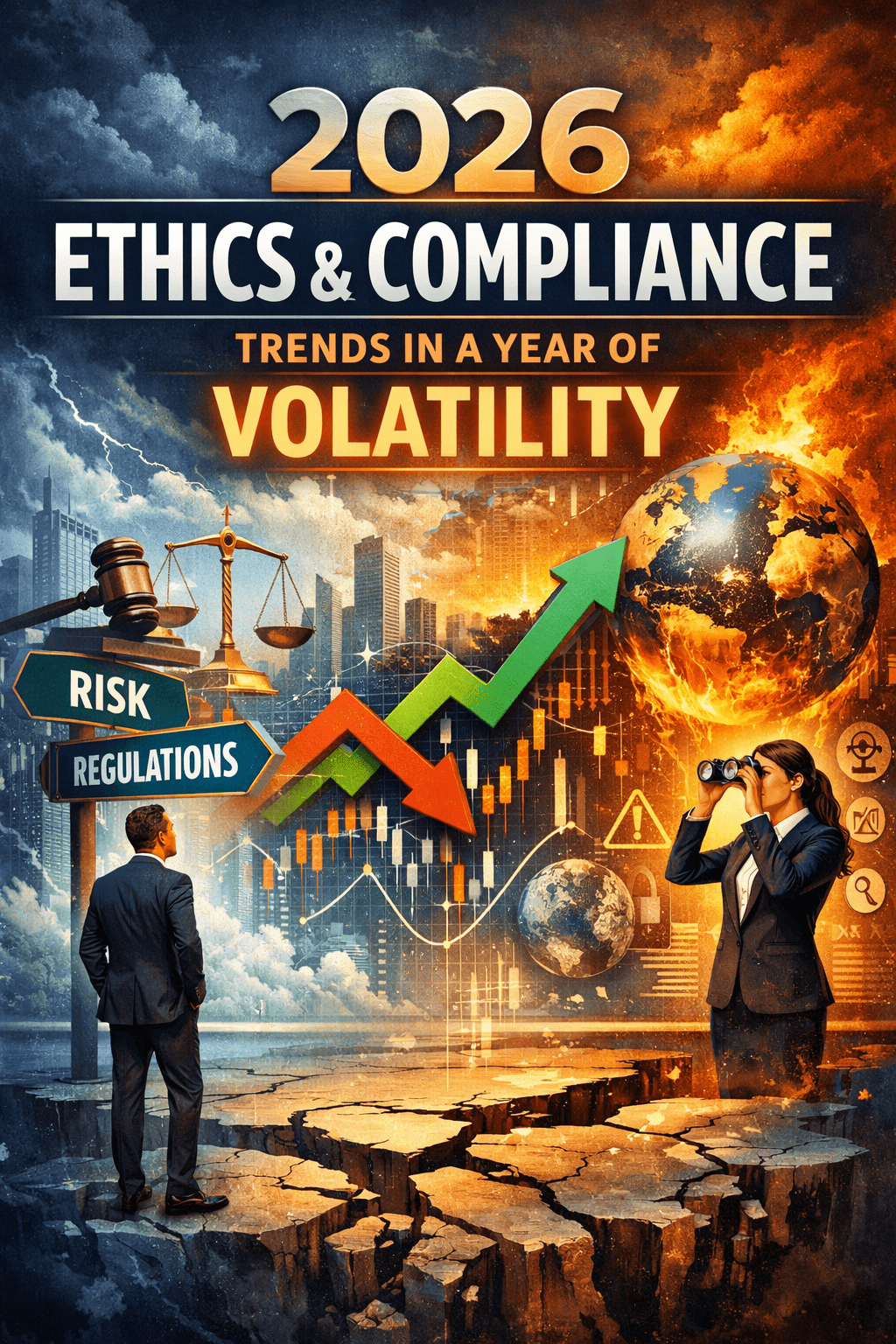
2026 Ethics & Compliance Trends in a Year of Volatility

Ethics and Compliance programs are entering 2026 under pressure from every direction at once. Enforcement signals are uneven and often contradictory. Regulatory expectations are evolving without clear glide paths. Boards are demanding proof of effectiveness, not just activity. Meanwhile, inside organizations, trust is fragile, employee engagement is strained, and ethical risk is increasingly driven by stress, uncertainty, and disengagement rather than overt malice.

I recently participated in the EQS-sponsored webinar, 2026 Ethics and Compliance Trends for Ethics and Compliance Programs: From Insights to Action. This webinar clearly framed the moment: the challenge is no longer simply identifying risk categories. The challenge is operating a compliance program that remains credible, defensible, and effective amid volatility. For compliance leaders, this is not a year for hype, shortcuts, or silver bullets. It is a year for disciplined execution.

This article distills the core themes emerging for 2026 that we explored in the webinar and explains why they demand a shift in how compliance programs are designed, governed, and measured. My co-panelists were Mary Shirley and Matt Kelly. Steph Holmes hosted us.

AI in Compliance: From Experimentation to Operational Reality

By 2026, artificial intelligence in compliance is no longer optional or novel. Most large organizations have already deployed AI in some form, such as intake triage, classification, translation, summarization, or search. What has changed is the expectation. Boards and executives now want results. This is where many programs will struggle.

AI works best today in structured, repeatable tasks. It can accelerate intake, reduce manual review, and surface patterns that humans might miss. But AI does not eliminate work; it rearranges it. Review, exception handling, governance, and oversight do not disappear. In many cases, they expand.

The real risk in 2026 is not AI itself. It is scaling too quickly without ownership, governance, or boundaries. Compliance teams that attempt to automate judgment-intensive decisions, such as investigations, escalations, or remediations, invite defensibility problems they cannot explain to regulators or boards. Successful programs will treat AI as an operational tool, not a strategic shortcut, and will clearly define where human judgment remains non-negotiable.

Regulatory Volatility, Not Regulatory Retreat

One of the most dangerous misreads in compliance today is the belief that shifting enforcement signals equals reduced risk. The reality is closer to the opposite. As the webinar materials emphasize, enforcement risk in 2026 is not disappearing; it is fragmenting. Political cycles, regional differences, and sector-specific priorities create uneven pressure, but exposure remains real. Whistleblower incentives continue to drive cases regardless of rhetoric. Cross-border cooperation persists even when domestic messaging softens.

The compliance mistake in volatile periods is overcorrection. Programs that scale back controls, staffing, or oversight in response to perceived deregulation weaken their defensibility. When enforcement inevitably resurfaces, documentation gaps and inconsistent standards become liabilities. The strongest programs in 2026 will not chase enforcement headlines. They will document risk assessments, decision rationales, and consistency of approach, building programs designed to withstand cycles, not react to them.

Employee Dynamics and the Rise of Ethical Drift

The most underappreciated risk heading into 2026 is internal. Employer–employee dynamics are shifting in ways that directly affect ethics and compliance. AI deployment, cost pressure, and political uncertainty are changing how employees perceive fairness, security, and leverage. According to research highlighted in the webinar, 40% of employees admit they would intentionally miss a compliance requirement to cause harm to their organization. That is not a culture problem waiting to happen. It is a present-tense compliance risk.

Ethical drift rarely announces itself through clear violations. It shows up as disengagement, silence, delayed reporting, rationalization, and erosion of trust. In this environment, compliance programs that rely solely on policies, training completion rates, or hotline volume are flying blind. In 2026, employee sentiment must be treated as a leading risk indicator, not a soft signal. Compliance teams must work more closely with HR and leadership to monitor stress points, manager behavior, and organizational pressure that create conditions for misconduct before it materializes.

Third-Party Risk as a Systemic Exposure

Third-party risk has outgrown its traditional boundaries. Vendors, distributors, technology partners, and AI service providers are now embedded across critical operations. When they fail, the failure rarely stays isolated. The webinar makes this point clearly: most third-party incidents expose internal governance gaps, not just vendor misconduct. Weak onboarding, poor segmentation, outdated contracts, and checklist-based monitoring all surface when something goes wrong.

In 2026, the compliance challenge is not perfect visibility. It is defensible prioritization. Not every third party requires the same level of scrutiny. Continuous monitoring and signal-based oversight are more effective than periodic reviews, which can provide a false sense of security. Compliance leaders should focus on materiality, lifecycle management, and resilience. The question regulators will ask is not whether every risk was identified, but whether the organization made reasonable, documented decisions based on the information available at the time.

Whistleblowing Surges Are Predictable And Test Credibility

Whistleblowing activity reliably increases during periods of economic stress, social disruption, and organizational change. 2026 will be no exception.

What matters is not volume alone. High reporting can reflect trust or fear. Employees use speak-up channels to test fairness, responsiveness, and safety. Programs designed only for steady-state conditions often buckle under surge conditions. The webinar emphasizes that timeliness, communication, and consistency matter more than outcomes in building trust. Mishandled cases during high-scrutiny periods carry amplified reputational and cultural risk. Retaliation concerns rise, and credibility erodes quickly if employees feel ignored or dismissed.

Compliance teams should plan for reporting spikes the same way they plan for crisis response. Capacity, triage protocols, communication standards, and leadership alignment must be stress-tested before volume hits.

Measuring What Matters: From Activity to Effectiveness

By 2026, boards and regulators are asking a harder question: Does the compliance program actually work? Activity-based reporting; training delivered, policies updated, and cases closed, is no longer sufficient. The expectation is outcomes. Are risks changing? Why? Where should resources move next? Data and analytics are essential, but only if they inform decisions. Overly complex dashboards and vanity metrics dilute clarity. The most effective programs use data to prioritize interventions, allocate resources, and identify emerging risk, not just to justify headcount.

Importantly, credible programs are willing to admit when initiatives fail. A compliance function that can point to lessons learned and course corrections demonstrates maturity. One that reports only success is unlikely to be testing itself hard enough.

Conclusion: 2026 Is a Year for Disciplined Compliance Leadership

The defining feature of 2026 will not be a single regulation, technology, or enforcement action. It will be volatility, both external and internal. In that environment, compliance programs cannot rely on legacy assumptions. AI must be governed, not glamorized. Enforcement signals must be contextualized, not chased. Employee disengagement must be monitored as a risk. Third-party exposure must be prioritized defensibly. Speak-up systems must be resilient. Metrics must drive action.

The compliance leaders who succeed in 2026 will be those who move from insight to action, building programs that are steady when everything else is not.

Categories
Great Women in Compliance

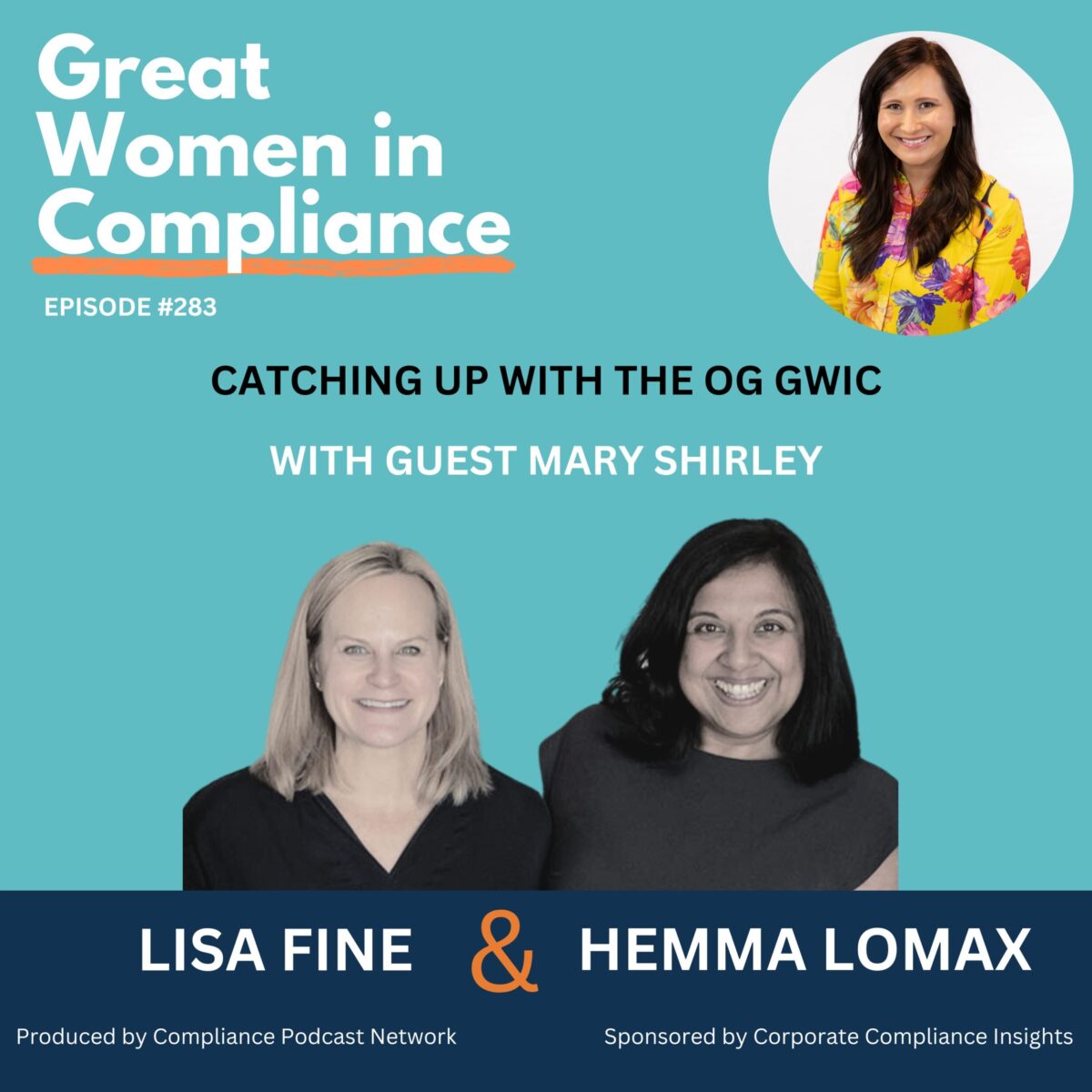
Great Women in Compliance – Catching Up with the OG GWIC with Mary Shirley

Welcome to the Great Women in Compliance podcast with Hemma Lomax and Lisa Fine, sponsored by Corporate Compliance Insight and a part of the Compliance Podcast Network.  My guest today isn’t really a guest; she’s so much more.  She is an architect of GWIC, my first partner in compliance, and my first compliance friend, who remains a dear friend to this day.  She coined the phrase “Send the Elevator Back Down,” taught me about tall poppy syndrome, and I am still using her cheat codes.  Of course, it’s Mary Shirley!

Mary, can you update everyone on all the cool things that have been happening since you became, as we call it, #GWICemerita?

As a global compliance leader who has lived in several countries and now three very different states in the US, what do you see as the principles of a “culture of integrity” that apply to any business, regardless of geography or industry?

  • While there have been changes in US laws, particularly the FCPA, and newer laws in the EU and the UK, among others, are you seeing any shifts in how to define – or communicate – a culture of integrity?
  • You have compiled a list of questions for job seekers to ask about the terms of compliance programs and a culture of integrity. What do you think is the most revealing one and why?
    • Mine is “Can I talk to my predecessor?”

I look forward to seeing you very soon at SCCE CEI.  You and Matt Kelly are presenting “AI Governance for N00bs: A Beginner’s Guide for the Non-Tech Compliance Practitioner” on Sunday to kick off the event.

  • What do you see as the biggest opportunities for compliance professionals to use AI and machine learning?
  • What challenges do you see for integrating AI and machine learning into their compliance program, and how should we approach it?
  • What about the algorithmic bias?
  • It seems like ethics and compliance are being welcomed as “partners” at the AI governance table. What do you think is the most significant reason for this shift, and what can a compliance professional do to ensure they maintain that strategic seat at the table?

When you think about the first 200 episodes, do you have a specific non-substantive, non-podcast memory that sticks out to you?  Besides the origin story – which I still tell!

Categories
Blog

Lisa and Mary Changed the World: The Great Women in Compliance Community

In the world of compliance, where incremental victories often measure progress against pervasive risks, it’s rare to witness a revolution. Yet Lisa Fine and Mary Shirley have achieved just that. Through their groundbreaking podcast, Great Women in Compliance (GWIC), they did not just host conversations; they redefined what it means to foster a community. Alongside their book Sending the Elevator Back Down, they have created a legacy of empowerment, collaboration, and celebration in a field that thrives on shared knowledge and collective strength.

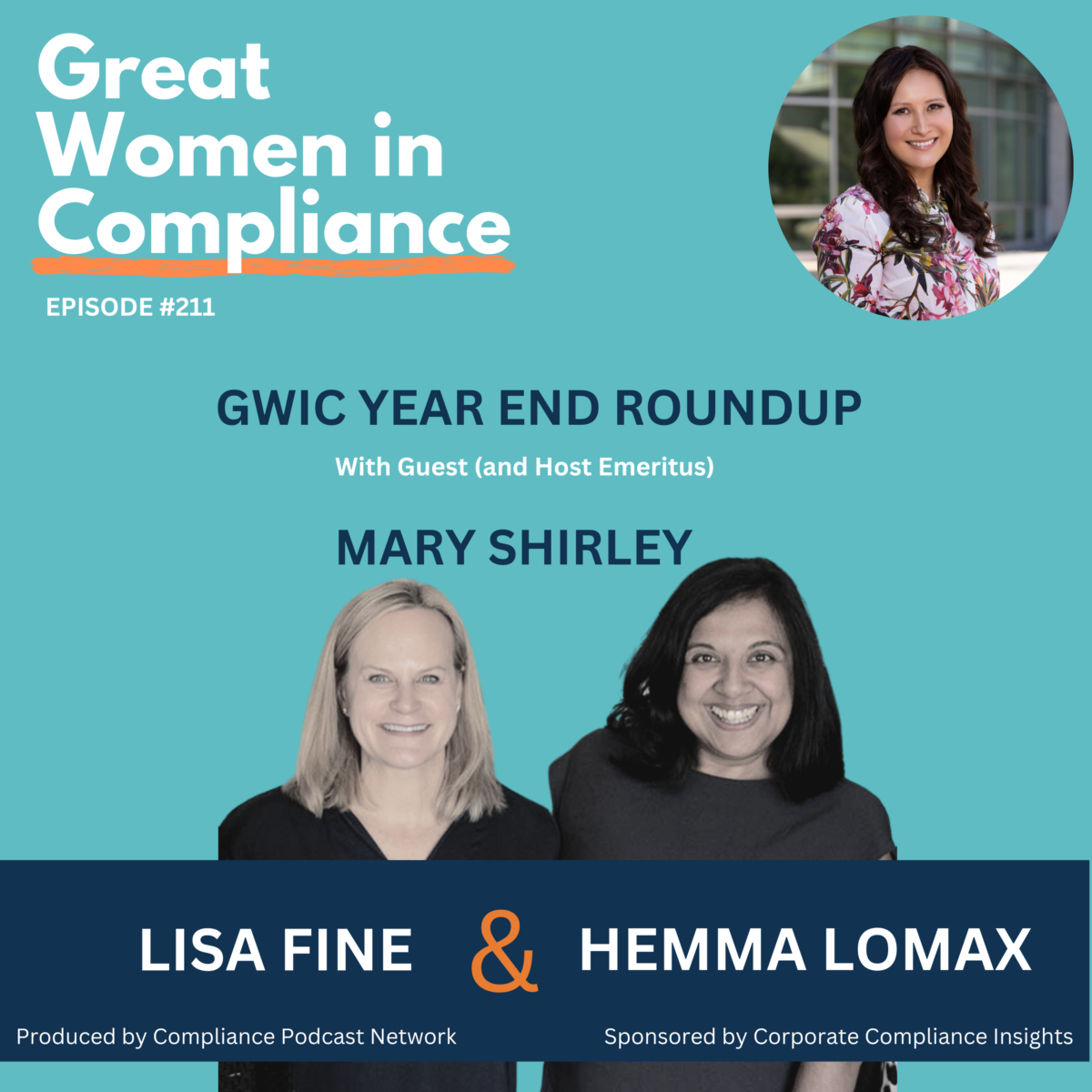
Lisa and Mary were recently honored for their work in creating GWIC, the GWIC community, and leading the development of an entire movement of women supporting other women in the worldwide compliance community. The Compliance Podcast Network named Lisa and Mary the co-winners of its first annual Agora Award for Excellence in Podcasting.
The Birth of Great Women in Compliance

The idea for Great Women in Compliance was sparked at an SCCE Society of Corporate Compliance and Ethics (SCCE) event in 2018. As the story goes, Lisa and Mary approached compliance podcasting veteran Tom Fox with a simple yet bold observation: the Compliance Podcast Network needed more diverse voices. Tom, true to form, responded with a challenge: “When will you start a podcast?”

The rest is history. With no prior experience in podcasting, Lisa and Mary leaped, driven by a shared vision of showcasing women’s stories, insights, and challenges in the compliance profession. With support from mentors like Matt Kelly and colleagues across the compliance community, the duo recorded their first episodes. What began as a grassroots effort quickly became a cornerstone of the compliance industry.

Building a Legacy: The Podcast, the Community, and the Book 

  • The GWIC Podcast: Amplifying Women’s Voices

From its inception, the GWIC podcast stood out for its authenticity and relatability. Lisa and Mary adopted an informal yet insightful interviewing style, allowing their guests to shine. The podcast featured diverse voices, from seasoned compliance leaders to rising stars, and explored various topics, including leadership, career development, and the unique challenges women face in compliance. Their approach was not simply about storytelling but about creating a platform for empowerment. The podcast became a hub for listeners to gain practical advice, discover new perspectives, and connect with a broader network of professionals.

  • The Community: A Network of Support

The GWIC podcast inspired not only listeners but also catalyzed a movement. Recognizing the need for a dedicated space for women in compliance, Lisa and Mary launched the Great Women in Compliance LinkedIn group. This online community became a vibrant forum for networking, mentorship, and resource sharing. Through this community, women found mentors, job opportunities, and a sense of belonging in an isolating field. It also spurred the creation of dedicated women in compliance sessions at significant conferences, highlighting the widespread impact of Lisa and Mary’s vision.

  • GWIC: The Book – Sending the Elevator Back Down

In October 2020, Lisa and Mary released Sending the Elevator Back Down, a book that encapsulated their philosophy and amplified women’s voices across the compliance field. The book featured stories of triumph, resilience, and lessons learned from compliance professionals worldwide. The book was published by Corporate Compliance Insights and headed by Sarah Hadden, an early supporter of GWIC who continues her support of and participation in GWIC to this day. The title reflects their core belief: success is most meaningful when shared. By “sending the elevator back down,” Lisa and Mary encouraged readers to uplift others as they rise, fostering a culture of collaboration and mutual support.

Overcoming Challenges: Lessons from the GWIC Journey 

Lisa and Mary’s journey has not been without its challenges. As they readily admit, neither had technical experience when they began podcasting. They leaned on mentors and allies to navigate the technical aspects, demonstrating the power of community in achieving ambitious goals. Additionally, their differing styles, Mary’s free-form conversational approach, and Lisa’s structured format might have posed a challenge in less harmonious partnerships. Instead, they embraced their differences, allowing their unique strengths to complement each other.

Their journey also highlights the importance of perseverance and adaptability. From launching the podcast to publishing the book during a global pandemic, Lisa and Mary consistently turned obstacles into opportunities.

The Impact: Changing the Compliance World

It is impossible to overstate the influence of Great Women in Compliance. Through representation and recognition, they have spotlighted the achievements of women in compliance. Lisa and Mary helped reshape perceptions of what leadership in this field looks like. GWIC has been a clearinghouse for professional development within the compliance community, as listeners and community members have reported finding mentors, gaining new insights, and even landing jobs thanks to connections made through GWIC.

Finally, GWIC, both the podcast and the community, has fostered a culture of inclusivity and support in compliance.

The Next Chapter

With 250 podcast episodes and a growing community, Great Women in Compliance shows no signs of slowing down. Mary has retired her co-host microphone and is now the ‘OG’ of GWIC. The GWIC podcast has expanded to include co-hosts Hemma Lomax, Ellen Hunt, and Sarah Hadden, ensuring the platform remains dynamic and inclusive. Lisa and Mary are also exploring the possibility of a second book, aiming to continue telling the stories that inspire and empower their community.

A Call to Action: Be the Change

For those who think you cannot change the world, I point you to Lisa Fine and Mary Shirley. They have proven that two women with a vision can. They built a legacy that empowers not just women in compliance but the entire industry worldwide. Their work serves as a reminder that creating meaningful change does not require a perfect plan, just passion, perseverance, and the courage to start.

Celebrating their achievements, we should all take their message to heart: success is amplified when shared. Whether through mentorship, advocacy, or simply lending a listening ear, we all have the power to lift others as we rise. Lisa and Mary have sent the elevator back down. Now, it’s up to the rest of us to ensure it keeps moving.

Categories
Blog

The Boston Consulting Group Declination: A Money Shot for Clawbacks

In a recent development that has garnered significant attention in the compliance community, the U.S. Department of Justice (DOJ) declined prosecution of Boston Consulting Group, Inc. (BCG) for violations of the Foreign Corrupt Practices Act (FCPA). Despite evidence of bribery involving BCG’s operations in Angola, the decision to forgo prosecution serves as a powerful reminder of the critical role that timely self-disclosure, cooperation, and effective remediation play in navigating the complexities of corporate compliance and, most significantly, clawbacks play in a decision to decline to prosecute. The decision was made public via a letter from the DOJ to BCG.

Between 2011 and 2017, BCG’s Lisbon, Portugal office engaged in a scheme to secure business contracts with Angolan government agencies, including the Ministry of Economy (MINEC) and the National Bank of Angola (BNA). BCG funneled approximately $4.3 million in commissions to an agent with close ties to Angolan government officials. These payments, made through offshore entities, helped BCG secure twelve contracts, resulting in revenues of $22.5 million and profits of $14.424 million.

The misconduct was serious: BCG employees in Portugal were aware of the agent’s ties to government officials and took deliberate steps to conceal the true nature of the agent’s work. This included backdating contracts and falsifying documents to cover up the corrupt activities. Such actions violated the FCPA, which prohibits U.S. companies from engaging in bribery of foreign officials to secure business advantages.

The money shot in this Declination was in the area of clawbacks. In the Wall Street Journal  (WSJ), Dylan Tokar wrote, “The consulting group’s disciplinary actions come amid pressure on companies by Justice Department officials to clawback compensation from employees involved in wrongdoing. Officials have said they want to shift the burden of penalties for corporate misconduct to those most responsible.” Mary Shirley, quoted by Tokar in the same article, noted, “That’s a strong message. While they’re not stated, the actual figures involved for individuals could be quite high.”

In his Radical Compliance piece on the Declination, Matt Kelly emphasized Shirley’s point: “That final point on surrendering equity — wow. That’s a punitive measure with real bite. Not only has BCG damaged the offenders’ future employment prospects by firing them and leaving a black mark on their records, but the loss of equity is a wallop to all their past employment with the firm. I have no idea how much that equity might have been worth, but BCG is a giant and prosperous business, so it’s entirely possible those offenders just lost millions of dollars.”

Given the severity of the misconduct, the DOJ’s decision to decline prosecution may seem surprising at first glance. However, more conduct was conducted by BSG after discovering the illegal conduct, which led to this superior result. The decline reveals that BCG’s response to finding the potential FCPA violation was exemplary, and equally importantly, it aligned with the DOJ’s Corporate Enforcement and Voluntary Self-Disclosure Policy. These factors included:

  • Timely and Voluntary Self-Disclosure: In a 2014 email, BCG uncovered evidence of the potential FCPA violation and promptly disclosed the misconduct to the DOJ. This proactive step is crucial in the DOJ’s assessment of whether to pursue prosecution, as it demonstrates the company’s commitment to transparency and accountability.
  • Full and Proactive Cooperation: BCG did not merely disclose the misconduct; the company fully cooperated with the DOJ’s investigation. This included providing all relevant facts, including information about the individuals involved in the bribery scheme. Cooperation of this magnitude significantly mitigates the risk of prosecution, as it aids the government in its investigation and potential prosecutions of individuals responsible for the wrongdoing.
  • Comprehensive Remediation: BCG’s response to the misconduct was swift and decisive. The company terminated the personnel involved, imposed compensation-based penalties, and required implicated partners to forfeit their equity in the company. BCG also denied these individuals the financial transitions typically accorded to departing employees, underscoring the seriousness of the misconduct.
  • Significant Compliance Improvements: Beyond addressing the immediate issue, BCG substantially enhanced its compliance program and internal controls. These improvements included formalized employee training, vendor and client screening protocols, and the establishment of local and global risk committees. Such measures demonstrate BCG’s commitment to preventing future misconduct and fostering a culture of compliance.
  • Absence of Aggravating Factors: The DOJ’s decision was also influenced by the absence of certain aggravating factors, such as executive management’s involvement in the misconduct, significant profit relative to the company’s size, or a history of criminal recidivism. These factors often weigh heavily in the decision to prosecute, but in BCG’s case, their absence worked in the company’s favor.
  • Disgorgement of Ill-Gotten Gains: BCG agreed to disgorge $14.424 million, representing the profits from the contracts secured through the corrupt scheme. This financial penalty further reinforced BCG’s commitment to addressing the consequences of its actions and aligning with legal and ethical standards.

The BCG case offers several critical lessons for compliance professionals. First and foremost, the importance of timely and voluntary self-disclosure cannot be overstated. When a company discovers potential misconduct, promptly bringing it to the authorities’ attention can significantly influence the outcome, potentially leading to a declination of prosecution.

Full cooperation with government investigations is essential. Compliance teams must be prepared to provide all relevant information, facilitate interviews, and support the investigation process. This cooperation demonstrates the company’s commitment to addressing the issue and helps build a collaborative relationship with the authorities.

Remediation is another crucial aspect. Companies must swiftly and meaningfully address the root causes of misconduct, including holding individuals accountable and implementing robust compliance measures to prevent future violations. A strong compliance program, reinforced by ongoing training and risk assessment, is vital in demonstrating a company’s commitment to ethical business practices.

Finally, the BCG case underscores the importance of avoiding aggravating factors. Companies should strive to cultivate a culture of integrity from the top down, ensuring compliance is embedded in every aspect of the organization. By doing so, they can reduce the likelihood of misconduct occurring in the first place and mitigate the impact if it does.

The DOJ’s decision to decline BCG’s prosecution is a powerful reminder of the value of self-disclosure, cooperation, and remediation in corporate compliance. For compliance professionals, the BCG case highlights the critical role they play in guiding their organizations through complex legal and ethical challenges. By fostering a culture of compliance, responding proactively to potential issues, and working closely with authorities, companies can navigate the difficult terrain of regulatory enforcement while upholding their commitment to ethical business practices.

Categories
Compliance Week Conference Podcast

Compliance Week 2024 Speaker Preview Podcasts – Mary Shirley on Living Your Best Compliance Life

In this episode of the Compliance Week 2024 Preview Podcasts series, Mary Shirley discusses her workshop at Compliance Week 2024, “Living Your Best Compliance Life,” based on her book of the same title. Some of the issues she will discuss in this podcast and her presentation are:

  • A session for rising stars;
  • How to position yourself to lead in compliance; and
  • Hearing more from government officials and more about FEPA.

I hope you can join me at Compliance Week 2024. This year’s event will be held April 2-4 at The Westin Washington, DC, Downtown. The line-up for this year’s event is first-rate, with some of the top ethics and compliance practitioners around.

Gain insights and make connections at the industry’s premier cross-industry national compliance event, offering knowledge-packed, accredited sessions and take-home advice from the most influential leaders in the compliance community. Back for its 19th year, join 500+ compliance, ethics, legal, and audit professionals who gather to benchmark best practices and gain the latest tactics and strategies to enhance their compliance programs. Compliance, ethics, legal, and audit professionals will gather safely face-to-face to benchmark best practices and gain the latest tactics and strategies to enhance their compliance programs, among many others, to:

  • Network with your peers, including C-suite executives, legal professionals, HR leaders, and ethics and compliance visionaries.
  • Hear from 80+ respected cross-industry practitioners who are CEOs, CCOs, regulators, federal officials, and practitioners to help inform and shape the strategic direction of your enterprise risk management program.
  • Hear directly from panels on leadership, fraud detection, confronting regulatory change, abiding by cross-border rules and regulations, and the always favorite fireside chats.
  • Bring actionable takeaways to your program from various session types, including cyber, AI, Compliance, Board obligations, data-driven compliance, and many others, for you to listen, learn, and share.
  • Compliance Week aims to arm you with information, strategy, and tactics to transform your organization and career by connecting ethics to business performance through process augmentation and data visualization.

I hope you can join me at the event. For information on the event, click here. As an extra benefit to listeners of this podcast, Compliance Week is offering a $200 discount on the registration price. Enter the discount code TFOX2024 for $200 off.

The Compliance Week 2024 Preview Podcast series is a production of the Compliance Podcast Network. Compliance Week is the sponsor of this series.

Categories
Great Women in Compliance

Great Women in Compliance – Mary Shirley Checks in with a GWIC Year End Wrap Up

Welcome to the Great Women in Compliance Podcast. Today Lisa and Hemma visited with GWIC co-founder Mary Shirley about her move to the West Coast, her new role, and what she sees down the road for compliance in 2024 and beyond.

Most recently, she wrote “Living Your Best Compliance Life: 65 Hacks & Cheat Codes to Level Up Your Ethics & Compliance Program (CCI Press 2023).” In “Level Up,” Mary utilized many of her experiences and others in putting together practical and insightful hacks to help new and experienced compliance professionals going forward.  Mary also shares some new “hacks” that have been shared with her since the book was published.

Mary is known for “sending the elevator back down,” as well as lifting our ethics and compliance community up. She emphasizes the importance of incorporating diverse perspectives into compliance programs and building a culture of compliance. She did that in the book by crowdsourcing ideas from the compliance community and sharing these ideas with all of us. By leveraging the knowledge and experiences of others, Mary helps compliance professionals continuously enhance their compliance programs.

Join Lisa Fine, Hemma Lomax, and Mary Shirley on this episode of the Great Women in Compliance podcast to delve deeper into these insights.

Key Highlights:

  • Practical Tools for Compliance Leadership
  • The Power of Collaboration for Personal Growth
  • Expanding Incentives for Team Recognition
  • Embracing New Challenges in Teaching
  • The Vibrant and Active Lifestyle of California

 Resources:

Join the Great Women in Compliance community on LinkedIn here.

Categories
Everything Compliance

Everything Compliance – Episode 122, The Auditors Edition

Welcome to the only roundtable podcast in compliance as we celebrate our second century of shows. Everything Compliance has been honored by W3 as the top podcast talk show. In this episode, the quartet of Jay Rosen, Jonathan Marks, Matt Kelly, and Karen Woody, with Tom Fox hosting, consider various topics that caught their collective interest and conclude with the fan favorite Shout Outs and Rants section.

1. Matt Kelly looks at the PCAOB proposal requiring auditors to look into fraud, compliance, and legal issues during an audit. Matt balances the charges against former Harvard professor Francesca Gino, who is charged with falsifying research.

2. Karen Woody looks at whether, when a corporation says litigation is ‘without merit’, this creates a securities law violation if it later loses at trial. Karen shouts out to the Women’s World Cup.

3. Tom Fox shouts out to Montana District Court Judge Kathy Seely for her opinion in Held v. Montana and Mary Shirley for her book Level Up.

4. Jay Rosen unpacks the recent push for an International Anti-Corruption Court. Rosen shouts out penalty kicks as the ultimate approach for ending a tie game, particularly as practiced in the Women’s World Cup.

5. Jonathan Marks considers key issues facing auditors in 2023. Marks shout out to both fruit and baseball in extolling the Savannah Bananas.

The members of the Everything Compliance are:

•       Jay Rosen– Jay is Vice President, Business Development Corporate Monitoring at Affiliated Monitors. Rosen can be reached at JRosen@affiliatedmonitors.com

•       Karen Woody – One of the top academic experts on the SEC. Woody can be reached at kwoody@wlu.edu

•       Matt Kelly – Founder and CEO of Radical Compliance. Kelly can be reached at mkelly@radicalcompliance.com

•       Jonathan Armstrong –is our UK colleague, who is an experienced data privacy/data protection lawyer with Cordery in London. Armstrong can be reached at jonathan.armstrong@corderycompliance.com

•       Jonathan Marks can be reached at jtmarks@gmail.com.

The host and producer, ranter (and sometimes panelist) of Everything Compliance is Tom Fox, the Voice of Compliance. He can be reached at tfox@tfoxlaw.com. Everything Compliance is a part of the Compliance Podcast Network.

Categories
SBR - Authors' Podcast

SBR Authors Podcast: Mary Shirley – Living Your Best Compliance Life: Hacks for Engaging Compliance Programs

Mary Shirley’s conversational and authentic writing style is the focus of this podcast episode. As a compliance officer, she strives to make compliance topics more engaging and relatable. The episode delves into important aspects of compliance, such as program assessment, team building, culture and communications, and enhancing compliance programs. Mary’s book, “Living Your Best Compliance Life: 65 Hacks and Cheat Codes to Level Up Your Ethics and Compliance Program,” offers practical tips and “hacks” for improving compliance programs. The conversation also highlights the value of Compliance Week as a tool for engagement and feedback. Overall, the episode emphasizes the importance of authenticity, engagement, and continuous improvement in compliance functions.

Key Highlights Include

·      Mary’s Writing Style

·      Compliance Program Assessment

·      Enhancing Compliance Programs

·      Utilizing Compliance Week

·      Compliance Week Insights

·      Putting Advice into Practice

Resources

Mary Shirley on Linkedin

Living Your Best Compliance Life: 65 Hacks and Cheat Codes to Level Up Your Compliance Program

Tom Fox

Instagram

Facebook

YouTube

Twitter

LinkedIn

Key Highlights Include

·      Mary’s Writing Style

·      Compliance Program Assessment

·      Enhancing Compliance Programs

·      Utilizing Compliance Week

·      Compliance Week Insights

·      Putting Advice into Practice

Resources

Mary Shirley on Linkedin

Living Your Best Compliance Life: 65 Hacks and Cheat Codes to Level Up Your Compliance Program

Tom Fox

Instagram

Facebook

YouTube

Twitter

LinkedIn