Categories
Blog

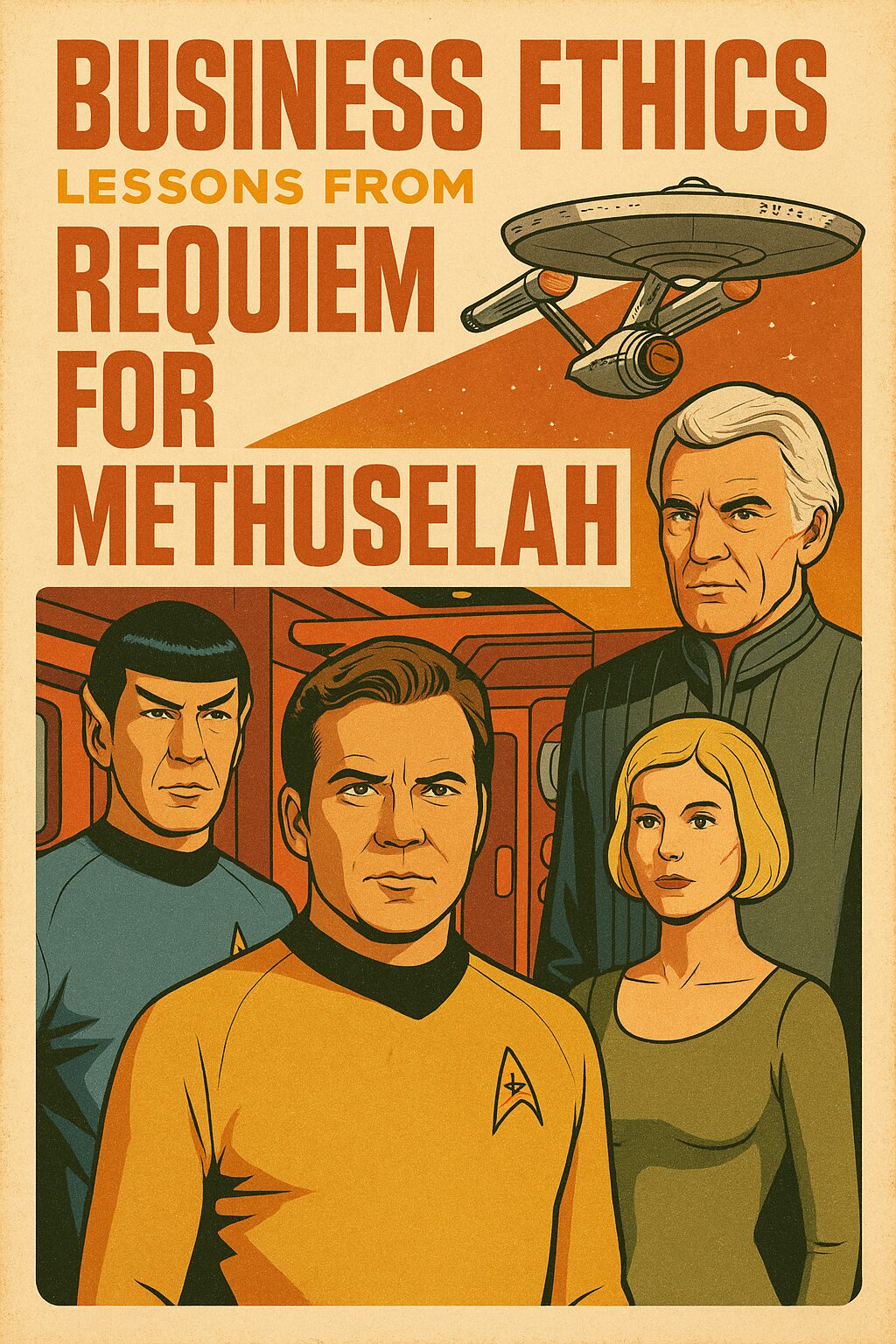
Business Ethics Lessons from Star Trek’s Requiem for Methuselah

In corporate life, ethical decision-making is not only a question of right and wrong. It is also a test of leadership, trust, and long-term vision. Missteps in ethics erode corporate culture, destroy reputations, and invite regulatory and shareholder scrutiny.

Few Star Trek episodes present an ethical crucible as layered as Requiem for Methuselah. In this episode, the Enterprise crew, seeking an urgently needed medical cure for a deadly illness sweeping the ship, beams down to a remote, seemingly uninhabited planet. There, they meet the enigmatic Flint, a man who turns out to be immortal, having lived for over 6,000 years under various identities, from Methuselah to Da Vinci. Flint lives with Rayna, a beautiful, brilliant young woman who, as the crew later learns, is not human but an android he has created.

The story unfolds into a complex web of secrecy, autonomy, manipulation, and unintended consequences, a rich territory for ethical reflection. From this episode, we can draw five business ethics lessons directly applicable to today’s corporate compliance environment.

Lesson 1: Transparency Is Essential to Trust

Illustrated By: Flint initially hides critical facts from Kirk, Spock, and McCoy: his true identity, the fact that Rayna is an android, and the location of the life-saving mineral ryetalyn they came to obtain. His secrecy stems from a desire to control the situation, but it breeds mistrust and escalating tension.

Ethics Lesson. In business, withholding material information, even with ostensibly good intentions, undermines trust—stakeholders, whether employees, customers, or regulators, expect honesty. Concealing facts creates suspicion, damages credibility, and can lead to decisions made on false assumptions. A compliance culture grounded in transparency prevents misunderstandings and reinforces stakeholder confidence.

What should you do?

  • Communicate openly about relevant facts, especially those impacting health, safety, or financial stability.
  • Establish disclosure protocols for potential conflicts of interest.
  • Recognize that partial truths can be as damaging as outright falsehoods.

Lesson 2: Autonomy Must Be Respected, Even with Good Intentions

Illustrated by Flint, Rayna was designed to be his companion, controlling her environment and limiting her exposure to the outside world. He claims to be protecting her, but in doing so, denies her agency. When she begins to form independent thoughts and feelings, particularly toward Kirk, Flint’s inability to let go leads to tragedy.

Ethics Lesson. Corporations sometimes restrict employee autonomy under the guise of protection, micromanaging, withholding career opportunities, or blocking external engagement. Even if the motive is to “protect” the employee or company, the result can stifle growth and foster resentment. Ethical leadership means equipping people to act responsibly, not controlling every move they make.

What should you do?

  • Empower individuals to make informed choices within ethical boundaries.
  • Provide access to opportunities and resources without paternalistic gatekeeping.
  • Respect the right of employees to voice concerns and explore options.

Lesson 3: Ends Do Not Justify the Means

Illustrated By: Flint’s primary objective, immortality, has allowed him to amass vast knowledge and wealth. Yet to achieve his goals in this episode, he manipulates the Enterprise crew, withholds the cure they need until his conditions are met, and engineers circumstances to force emotional outcomes for Rayna.

Ethics Lesson. In business, leaders may justify cutting corners or bending rules to achieve short-term results, winning a contract, securing market share, or hitting quarterly targets. But compromising ethics for results can cause long-term damage far outweighing the immediate gain. A sustainable corporate culture is built on the principle that ethical processes matter as much as business goals.

What should you do?

  • Evaluate not just what you achieve, but how you achieve it.
  • Build decision-making frameworks that weigh both outcomes and methods.
  • Reinforce that compliance and ethics are integral to success, not obstacles to it.

Lesson 4: Emotional Intelligence Is Critical in Ethical Decision-Making

Illustrated By: Kirk’s growing attachment to Rayna closes his eyes to the urgency of his mission. McCoy warns him about becoming too emotionally involved, but Kirk underestimates the impact on his judgment. Flint, likewise, fails to foresee that forcing Rayna to choose between him and Kirk will overwhelm her, leading to her breakdown.

Ethics Lesson. In corporate environments, emotions, whether loyalty, rivalry, or fear, can cloud ethical judgment. Leaders may overlook red flags, delay action, or make decisions based on personal feelings rather than principles. Ethical clarity often requires stepping back and separating personal attachment from professional responsibility.

What should you do?

  • Train leaders to recognize when emotions may be influencing decisions.
  • Encourage second opinions and peer review in high-stakes decisions.
  • Create safe spaces for voicing concerns about potential bias.

Lesson 5: Ethical Leadership Includes Considering Long-Term Impact

Illustrated By: Flint’s immortality has given him a unique long view of history, but in this episode, he fails to account for the long-term consequences of his actions toward Rayna and the Enterprise crew. His choices have immediate, tragic outcomes and lasting emotional scars.

Ethics Lesson. Businesses that focus solely on short-term gains, without assessing long-term impacts, risk harming their reputation, eroding stakeholder trust, and creating systemic problems. Ethical leaders anticipate not just the next quarter, but the next decade. Considering long-term consequences ensures ethical decisions hold up under the scrutiny of time.

What should you do?

  • Incorporate long-term risk and ethical impact into strategic planning.
  • Assess how today’s decisions will be perceived by future employees, customers, and regulators.
  • Prioritize sustainability, both in environmental and cultural terms.

Why “Requiem for Methuselah” Matters for Business Ethics

The drama in Requiem for Methuselah is driven not by alien threats or galactic battles, but by human (and android) ethical dilemmas: secrecy, autonomy, manipulation, emotional entanglement, and shortsightedness. These are the same challenges corporate leaders face when navigating business ethics in the modern era.

An ethical corporate culture:

  • Practices transparency to build trust.
  • Respects the autonomy of individuals.
  • Rejects “ends justify the means” thinking.
  • Recognizes and manages the role of emotions in decision-making.
  • Considers the long-term legacy of choices made today.

The compliance department is not just a rules enforcer. According to the DOJ, it is the ethics steward of the organization, ensuring that decisions at every level meet both legal and moral standards.

Final ComplianceLog Reflections

Requiem for Methuselah is ultimately a cautionary tale about the cost of ethical missteps, even for someone with the wisdom of centuries. Flint’s intellect and resources could not compensate for a failure to act with transparency, respect, and foresight.

For today’s corporate leaders, the lesson is simple: ethical decision-making is not a luxury—it is the foundation of sustainable success. The compliance function’s role is to embed these values so deeply into the corporate DNA that they guide every choice, from the boardroom to the front line.

Resources:

⁠⁠Excruciatingly Detailed Plot Summary by Eric W. Weisstein⁠⁠

⁠⁠MissionLogPodcast.com⁠⁠

⁠⁠Memory Alpha

Categories
Trekking Through Compliance

Trekking Through Compliance: Episode 72 – From Zetar to the C-Suite: Why Expertise Matters in Internal Investigations

In the corporate compliance world, an internal investigation is often the moment of truth. Whether triggered by a whistleblower complaint, a regulatory inquiry, or a suspicious transaction, the investigation’s quality can determine whether the organization resolves the matter cleanly or faces prolonged legal, financial, and reputational damage.

Star Trek: The Original Series’ “The Lights of Zetar” offers a surprisingly apt allegory for why skilled professionals must handle these investigations. The crew must conduct what is, in effect, a complex and high-stakes investigation. Their approach yields five lessons that every compliance professional should apply when running an internal investigation.

Lesson 1: Preserve and Protect Critical Evidence Immediately

Illustrated By. When the lights first strike, the Enterprise experiences sudden and unexplained system failures. The crew immediately records sensor data, secures operational logs, and isolates the damage.

Compliance Lesson. Without swift action, crucial evidence can be lost, whether through routine data overwrites, deliberate destruction, or simple mishandling.

Lesson 2: Bring in the Right Expertise Early

Illustrated By: Once Mira Romaine exhibits strange symptoms, Dr. McCoy, Spock, and Scotty each contribute their specialized knowledge, medical science, Vulcan telepathy, and engineering diagnostics, to piece together what is happening.

Compliance Lesson. A proper internal investigation is rarely a one-person job. Complex matters often require diverse expertise: forensic accounting, cybersecurity, HR policy, legal analysis, and industry-specific regulatory knowledge.

Lesson 3: Keep an Open Mind—The First Explanation May Be Wrong

Illustrated By: Only after gathering more evidence do they realize the lights are disembodied intelligences, survivors of the destroyed planet Zetar, seeking a human host.

Compliance Lesson. In corporate investigations, jumping to conclusions based on initial appearances can lead to flawed outcomes.

Lesson 4: Protect the People Involved Throughout the Process

Illustrated By: Mira Romaine is not treated merely as a subject of inquiry; she is a valued crew member whose well-being is a priority. The investigation’s goal is not just to “solve the problem” but to save her life.

Compliance Lesson. In internal investigations, individuals, whether complainants, witnesses, or subjects, must be treated with dignity and fairness. Mishandling these relationships can result in legal claims, loss of employee trust, and reputational harm.

Lesson 5: Deliver Actionable Solutions, Not Just Findings

Illustrated By: Once the crew determines that the Zetarians are inhabiting Lt. Romaine’s body, they devise a targeted plan to remove them using controlled atmospheric pressure in a medical isolation chamber.

Compliance Lesson. An investigation that ends with a report but no corrective action is a missed opportunity. The ultimate measure of success is not uncovering what happened but ensuring it does not happen again.

Final ComplianceLog Reflections

The Lights of Zetar reminds us that investigations are not abstract exercises; they are missions with real people, high stakes, and long-term consequences. The Enterprise crew approached their challenge with urgency, thoroughness, and empathy. For compliance officers, the lesson is clear: every internal investigation is an opportunity to demonstrate integrity, competence, and leadership. The quality of your investigative process will be remembered long after the incident itself fades from memory.

Resources:

⁠⁠Excruciatingly Detailed Plot Summary by Eric W. Weisstein⁠⁠

⁠⁠MissionLogPodcast.com⁠⁠

⁠⁠Memory Alpha

Categories
Blog

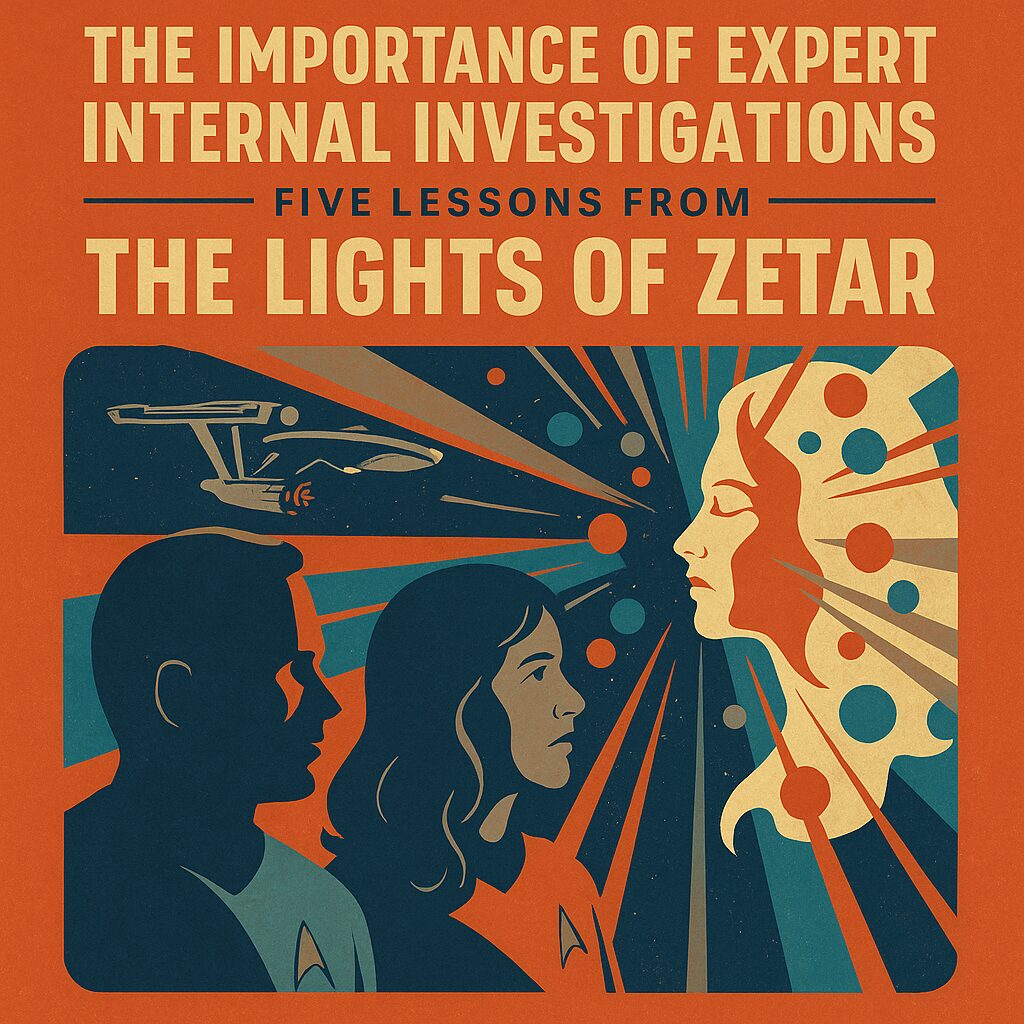
The Importance of Expert Internal Investigations: Five Lessons from Star Trek’s The Lights of Zetar

In the corporate compliance world, an internal investigation is often the moment of truth. Whether triggered by a whistleblower complaint, a regulatory inquiry, or a suspicious transaction, the investigation’s quality can determine whether the organization resolves the matter cleanly or faces prolonged legal, financial, and reputational damage.

Star Trek: The Original Series’ “The Lights of Zetar” offers a surprisingly apt allegory for why skilled professionals must handle these investigations. In this episode, the Enterprise is on its way to Memory Alpha, the Federation’s central library, when it encounters a mysterious, pulsating light phenomenon. The lights incapacitate crew members, damage ship systems, and, most dangerously, invade the mind of Lieutenant Mira Romaine, who is accompanying the mission.

The crew must determine what the lights are, what they want, and how to neutralize them before they destroy both Romaine and Memory Alpha’s priceless archives. In doing so, they conduct what is, in effect, a complex and high-stakes investigation. Their approach yields five lessons that every compliance professional should apply when running an internal investigation.

Lesson 1: Preserve and Protect Critical Evidence Immediately

Illustrated By. When the lights first strike, the Enterprise experiences sudden and unexplained system failures. The crew immediately records sensor data, secures operational logs, and isolates the damage.

Compliance Lesson. In corporate investigations, the “scene of the incident” may be a server containing emails, a ledger of transactions, or a manager’s office with physical records. Without swift action, crucial evidence can be lost, whether through routine data overwrites, deliberate destruction, or simple mishandling.

How to apply this to investigations?

  • Secure relevant electronic and physical records as soon as the investigation begins.
  • Suspend auto-delete protocols and ensure data preservation orders are issued.
  • Document the chain of custody for all materials.

In The Lights of Zetar, the crew’s rapid evidence capture gave them the information needed to trace the lights’ origins and capabilities. Without it, they would have been operating blind.

Lesson 2: Bring in the Right Expertise Early

Illustrated By: Once Mira Romaine exhibits strange symptoms, Dr. McCoy, Spock, and Scotty each contribute their specialized knowledge, medical science, Vulcan telepathy, and engineering diagnostics to piece together what is happening.

Compliance Lesson. A proper internal investigation is rarely a one-person job. Complex matters often require diverse expertise: forensic accounting, cybersecurity, HR policy, legal analysis, and industry-specific regulatory knowledge. Relying solely on generalists can miss critical nuances.

How to apply this to investigations?

  • Assemble a multidisciplinary team at the outset, including internal experts and outside specialists if needed.
  • Ensure each team member understands their role and investigative boundaries.
  • Involve counsel early to maintain privilege over sensitive findings.

Just as the Enterprise crew leveraged multiple skill sets to solve a problem no one discipline could crack alone, compliance officers should make strategic use of the right expertise from day one.

Lesson 3: Keep an Open Mind—The First Explanation May Be Wrong

Illustrated By: Initially, the crew assumes the lights are a natural space phenomenon. Only after gathering more evidence do they realize the lights are disembodied intelligences, survivors of the destroyed planet Zetar, seeking a human host.

Compliance Lesson. In corporate investigations, jumping to conclusions based on initial appearances can lead to flawed outcomes. What looks like simple employee misconduct may be part of a larger systemic control failure; what appears to be a minor accounting error may conceal intentional fraud.

How to apply this to investigations?

  • Form working hypotheses, but treat them as provisional until confirmed by evidence.
  • Explore alternative explanations, even if they seem less likely.
  • Allow the facts, not convenience or organizational pressure, to drive conclusions.

Expert investigators, like the Enterprise crew, pivot their theories as new facts emerge.

Lesson 4: Protect the People Involved Throughout the Process

Illustrated By: Mira Romaine is not treated merely as a subject of inquiry; she is a valued crew member whose well-being is a priority. The investigation’s goal is not just to “solve the problem” but to save her life. Kirk ensures she receives medical care and emotional support even as they work to understand her condition.

Compliance Lesson. In internal investigations, individuals, whether complainants, witnesses, or subjects, must be treated with dignity and fairness. Mishandling these relationships can result in legal claims, loss of employee trust, and reputational harm.

How to apply this to investigations?

  • Maintain confidentiality to the fullest extent possible.
  • Protect against retaliation for cooperation.
  • Provide updates when feasible to those affected, balancing transparency with investigative integrity.

A humane approach builds trust in the compliance function and encourages future reporting.

Lesson 5: Deliver Actionable Solutions, Not Just Findings

Illustrated By: Once the crew determines that the Zetarians are inhabiting Lt. Romaine’s body, they devise a targeted plan to remove them using controlled atmospheric pressure in a medical isolation chamber. They do not stop at identifying the cause; they implement the cure.

Compliance Lesson. An investigation that ends with a report but no corrective action is a missed opportunity. The ultimate measure of success is not uncovering what happened but ensuring it does not happen again.

How to apply this to investigations?

  • Pair findings with concrete, practical recommendations for remediation.
  • Address both the immediate problem and any systemic weaknesses uncovered.
  • Follow up to confirm that corrective actions are implemented and effective.

The Enterprise crew’s solution not only saved Mira but also prevented the Zetarians from posing a future threat, exemplifying the kind of preventive mindset compliance investigations should aim for.

Why “The Lights of Zetar” Resonates for Compliance

In The Lights of Zetar, the stakes were both personal and institutional: the survival of a crew member and the preservation of Memory Alpha’s vast knowledge. The investigation had to be thorough, rapid, multidisciplinary, and compassionate, precisely the hallmarks of a high-quality corporate internal investigation.

An expert investigation:

  • Safeguards evidence before it’s lost.
  • Leverages the right mix of skills.
  • Keeps the fact-finding process objective.
  • Protects people while uncovering the truth.
  • Produces actionable, lasting solutions.

When these principles are followed, the compliance function not only resolves incidents but also strengthens the organization’s overall resilience.

Final ComplianceLog Reflections

The Lights of Zetar reminds us that investigations are not abstract exercises—they are missions with real people, high stakes, and long-term consequences. The Enterprise crew approached their challenge with urgency, thoroughness, and empathy.

For compliance officers, the lesson is clear: every internal investigation is an opportunity to demonstrate integrity, competence, and leadership. The quality of your investigative process will be remembered long after the incident itself fades from memory.

In other words, be the Enterprise—methodical, humane, and relentless in pursuit of the truth.

Resources:

⁠⁠Excruciatingly Detailed Plot Summary by Eric W. Weisstein⁠⁠

⁠⁠MissionLogPodcast.com⁠⁠

⁠⁠Memory Alpha

Categories
Trekking Through Compliance

Trekking Through Compliance: Episode 71 – Surviving the Unknown: Risk Management Lessons from “That Which Survives”

In compliance, risk management is more than a checklist. It is the ongoing discipline of identifying threats, assessing their potential impact, and implementing measures to mitigate or neutralize them before they cause harm.

Few Star Trek episodes illustrate the escalating consequences of underestimated risks as effectively as That Which Survives. In it, the Enterprise crew encounters a seemingly lifeless planet guarded by Losira, an alien projection who can kill with a single touch. Her purpose is to protect the planet’s secrets, but her method is indiscriminate, deadly, and poorly aligned to the situation at hand.

For compliance professionals, this episode offers five important lessons on anticipating, assessing, and responding to risks, both known and unknown, within an organization.

Lesson 1: Identify Risks Before Engaging in New Ventures

Illustrated By: The Enterprise arrives at an uncharted planet. Within moments, a mysterious woman materializes and kills a crew member simply by touching him.

Compliance Lesson. Too often, companies rush into new markets, partnerships, or projects without conducting a thorough risk assessment. This can expose the organization to sanctions violations, corruption risks, cybersecurity vulnerabilities, or operational failures.

Lesson 2: Understand That Some Risks Are Intelligent and Adaptive

Illustrated By: Losira targets specific individuals and adapts her approach to their vulnerabilities.

Compliance Lesson. Not all risks are static. Fraudsters change tactics, cyber threats evolve, and corrupt third parties find new ways to conceal misconduct. A compliance program must anticipate that some risks will actively seek to bypass controls.

Lesson 3: Don’t Dismiss Low-Probability, High-Impact Threats

Illustrated By: At first, the crew assumes Losira’s appearances are isolated incidents, but they quickly realize she poses an existential threat.

Compliance Lesson. Rare events, such as a single high-value bribery transaction, a lone rogue employee, or a targeted cyberattack, can have catastrophic consequences. Organizations sometimes underprepare for these scenarios because they seem unlikely.

Lesson 4: Risk Mitigation Requires Cross-Functional Coordination

Illustrated By: The landing party on the planet and the Enterprise crew in orbit are each facing threats from Losira, but their survival depends on sharing information and coordinating responses. Without clear communication, both groups would be doomed.

Compliance Lesson. Compliance cannot manage risk in isolation. It must work with legal, internal audit, operations, IT, and HR to identify threats and implement controls.

Lesson 5: Address the Root Cause, Not Just the Symptoms

Illustrated By: The crew eventually discovers that Losira is an automated defense mechanism left behind by an extinct race. Once the crew understands her origin and purpose, they can neutralize the threat.

Compliance Lesson. In risk management, addressing surface-level problems without finding the underlying cause only delays future incidents. Compliance should integrate root cause analysis into all investigations.

Final ComplianceLog Reflections

That Which Survives is more than a suspense episode; it is a cautionary tale about the dangers of underestimating risk. Losira was not inherently evil; she was a misunderstood, unexamined part of an environment the crew did not fully assess before engagement.

The compliance officer’s mandate is to ensure the company doesn’t make the same mistake: to scan for threats before beaming in, to adapt to risks that evolve, to prepare for unlikely but devastating events, to coordinate across the enterprise, and to address the root cause when problems arise. Risk management is not just about surviving; it is about ensuring that your organization thrives in any environment, whether it’s an unexplored planet or a rapidly changing market.

Resources:

⁠⁠Excruciatingly Detailed Plot Summary by Eric W. Weisstein⁠⁠

⁠⁠MissionLogPodcast.com⁠⁠

⁠⁠Memory Alpha

Categories
Blog

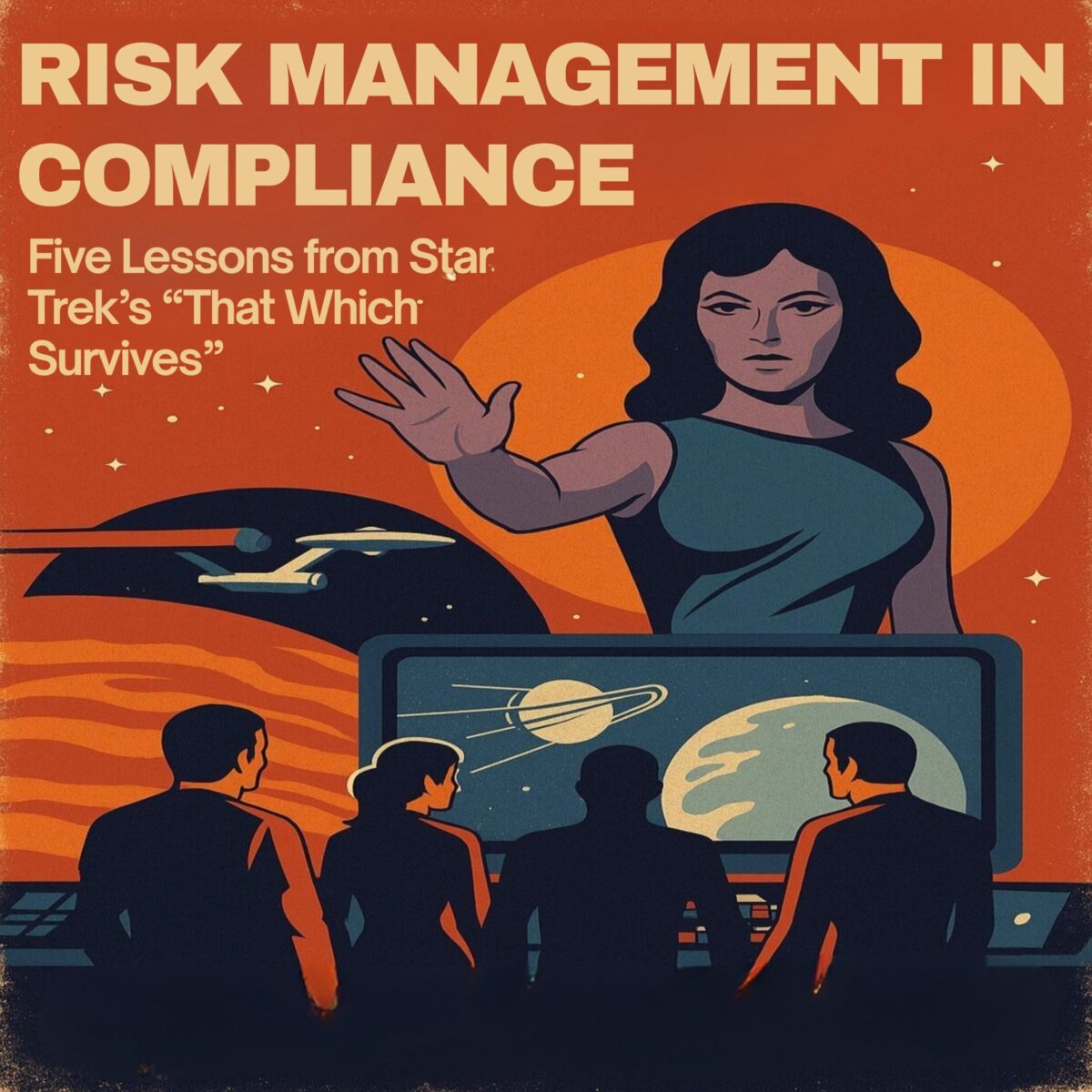
Risk Management in Compliance: Five Lessons from Star Trek’s That Which Survives

In compliance, risk management is more than a checklist. It is the ongoing discipline of identifying threats, assessing their potential impact, and implementing measures to mitigate or neutralize them before they cause harm.

Few Star Trek episodes illustrate the escalating consequences of underestimated risks as effectively as That Which Survives. In it, the Enterprise crew encounters a seemingly lifeless planet guarded by Losira, an alien projection who can kill with a single touch. Her purpose is to protect the planet’s secrets, but her method is indiscriminate, deadly, and poorly aligned to the situation at hand.

For compliance professionals, this episode offers five important lessons on anticipating, assessing, and responding to risks, both known and unknown, within an organization.

Lesson 1: Identify Risks Before Engaging in New Ventures

Illustrated By: The Enterprise arrives at an uncharted planet, scans it briefly, and beams down a landing party. Within moments, a mysterious woman materializes and kills a crew member simply by touching him.

Compliance Lesson. Too often, companies rush into new markets, partnerships, or projects without conducting a thorough risk assessment. This can expose the organization to sanctions violations, corruption risks, cybersecurity vulnerabilities, or operational failures. Compliance should lead or be deeply involved in pre-engagement risk assessments. Before “beaming down” into a new business environment, map potential threats—regulatory, operational, reputational—and identify safeguards. Skipping this step can lead to preventable harm and costly remediation.

Lesson 2: Understand That Some Risks Are Intelligent and Adaptive

Illustrated By: Losira’s ability to appear anywhere, both on the planet and aboard the Enterprise, shows she is not a passive hazard. She targets specific individuals and adapts her approach to their vulnerabilities.

Compliance Lesson. Not all risks are static. Fraudsters change tactics, cyber threats evolve, and corrupt third parties find new ways to conceal misconduct. A compliance program must anticipate that some risks will actively seek to bypass controls. Build adaptive monitoring into your compliance systems. Use continuous transaction monitoring, real-time alerts, and data analytics to detect changes in patterns. A one-time risk assessment is not enough—ongoing vigilance is essential.

Lesson 3: Don’t Dismiss Low-Probability, High-Impact Threats

Illustrated By: At first, the crew assumes Losira’s appearances are isolated incidents, but they quickly realize she poses an existential threat. Even though she is only one individual, her capabilities could destroy the Enterprise if not addressed.

Compliance Lesson. Rare events, such as a single high-value bribery transaction, a lone rogue employee, or a targeted cyberattack, can have catastrophic consequences. Organizations sometimes underprepare for these scenarios because they seem unlikely. Compliance departments should incorporate low-probability, high-impact risks into the risk register. Conduct tabletop exercises to simulate rare but potentially devastating events, ensuring the organization has both prevention and response plans in place.

Lesson 4: Risk Mitigation Requires Cross-Functional Coordination

Illustrated By: The landing party on the planet and the Enterprise crew in orbit are each facing threats from Losira, but their survival depends on sharing information and coordinating responses. Without clear communication, both groups would be doomed.

Compliance Lesson. Compliance cannot manage risk in isolation. It must work with legal, internal audit, operations, IT, and HR to identify threats and implement controls. Silos breed blind spots, and blind spots breed crises. Establish cross-functional risk committees or working groups. Ensure that incident reporting and escalation procedures are well understood across departments. Make compliance the hub of a collaborative risk network, not a separate spoke.

Lesson 5: Address the Root Cause, Not Just the Symptoms

Illustrated By: The crew eventually discovers that Losira is an automated defense mechanism left behind by an extinct race. She’s not malicious—she’s simply executing a program without context or adaptability. Once the crew understands her origin and purpose, they can neutralize the threat.

Compliance Lesson. In risk management, addressing surface-level problems without finding the underlying cause only delays future incidents. For example, punishing an employee for violating a policy without examining why the policy was ignored leaves the organization vulnerable to repeat violations. Compliance should integrate root cause analysis into all investigations. Whether it’s a process flaw, cultural issue, or oversight gap, solving the real problem is the only way to reduce recurrence.

The Enterprise as a Risk Management Model

Captain Kirk and his crew succeed not because they are lucky, but because they adapt quickly, share intelligence, and dig deeper to understand the nature of the threat. These are precisely the attributes a corporate compliance department needs to lead risk management:

  • Proactive assessment before engagement.
  • Adaptive controls that respond to evolving risks.
  • Preparation for rare but high-impact events.
  • Collaboration across organizational functions.
  • Root cause remediation for lasting solutions.

Practical Compliance Takeaways

From That Which Survives, compliance professionals can draw these operational insights:

  1. Integrate Compliance Early—Risk management starts before contracts are signed or operations begin, not after.
  2. Invest in Technology—Data analytics, AI monitoring, and continuous auditing tools make adaptive risk management possible.
  3. Conduct Scenario Planning—Practice responding to “Losira-like” threats: targeted, intelligent, and hard to predict.
  4. Build Risk Alliances—Partner with all departments to create a unified threat picture.
  5. Close the Loop—Use each incident to strengthen your program against future threats.

Final ComplianceLog Reflections

That Which Survives is more than a suspense episode; it is a cautionary tale about the dangers of underestimating risk. Losira was not inherently evil; she was a misunderstood, unexamined part of an environment the crew did not fully assess before engagement.

The compliance officer’s mandate is to ensure the company doesn’t make the same mistake: to scan for threats before beaming in, to adapt to risks that evolve, to prepare for unlikely but devastating events, to coordinate across the enterprise, and to address the root cause when problems arise.

In other words, risk management is not just about surviving; it is about ensuring that your organization thrives in any environment, whether it’s an unexplored planet or a rapidly changing market.

Resources:

⁠⁠Excruciatingly Detailed Plot Summary by Eric W. Weisstein⁠⁠

⁠⁠MissionLogPodcast.com⁠⁠

⁠⁠Memory Alpha

Categories
Trekking Through Compliance

Trekking Through Compliance: Episode 70 – Beaming Down Blind: Compliance Lessons on Third-Party Due Diligence from “The Mark of Gideon”

Few pop culture moments capture the risks of blind engagement as vividly as Star Trek: The Original Series’ “The Mark of Gideon.” In this episode, Captain Kirk beams down to what he believes is the planet Gideon for diplomatic talks—only to find himself aboard what appears to be an empty Enterprise. What follows is a masterclass in the dangers of walking into a deal without verifying the facts. For compliance professionals, Gideon’s deception is the perfect allegory for the hazards of onboarding a third party without a thorough vetting process. Let’s break down five key lessons.

Lesson 1: Verify the True Identity of Your Counterparty

Illustrated By: When Kirk believes he is beamed down to Gideon, he is actually inside a replica of the Enterprise. The Gideonites have created this fake environment to isolate him for their purposes.

Compliance Lesson. If you do not confirm the true identity of a third party, you may find yourself dealing with a façade. Shell companies, undisclosed beneficial owners, and entities with misleading corporate registrations are the corporate world’s “empty Enterprise.”

Lesson 2: Understand the Real Motives Behind the Partnership

Illustrated By: The Gideonites present their plan as a noble solution to their problem, but it’s built on deception and exploitation.

Compliance Lesson. Third parties sometimes have agendas that differ sharply from what they present. They may seek access to your brand to legitimize questionable practices, gain entry to restricted markets, or launder illicit funds.

Lesson 3: Never Rely Solely on What the Other Party Tells You

Illustrated By: Kirk repeatedly asks the Gideonites to explain what is happening, but their answers are vague, evasive, and occasionally contradictory. They hope his lack of information will keep him compliant long enough to serve their plan.

Compliance Lesson. Self-reported information from a potential third party should be viewed as one data point, not the whole picture. Misrepresentations are common, whether deliberate or due to internal ignorance.

Lesson 4: Assess the Operating Environment Before Engagement

Illustrated By: The Gideonites hide the actual conditions on their planet. Kirk learns later that Gideon is overcrowded to the point of people standing shoulder-to-shoulder, unable to move freely.

Compliance Lesson. Entering into a business relationship without assessing this environment is akin to beaming down blind.

Lesson 5: Build Exit Strategies Into the Relationship

Illustrated By: Once Kirk understands the Gideonites’ true intentions, he must escape the replica Enterprise to stop their plan.

Compliance Lesson. Some third-party relationships turn sour, and you need a plan to disengage without disrupting your operations. Include termination clauses tied to compliance breaches in your contracts.

Final ComplianceLog Reflections

In The Mark of Gideon, the Enterprise crew’s lack of verified intelligence before Kirk’s “beam down” mirrors what happens when companies rush into a third-party relationship to seize a perceived opportunity. The Gideonites knew how to manipulate the Federation’s diplomatic eagerness. Likewise, unscrupulous partners today exploit companies’ urgency to enter new markets or secure rare supply chains.

The lesson? Due diligence is not a delay; it is a safeguard. The few extra weeks spent vetting a partner can prevent years of litigation, regulatory penalties, and reputational damage.

Resources:

⁠⁠Excruciatingly Detailed Plot Summary by Eric W. Weisstein⁠⁠

⁠⁠MissionLogPodcast.com⁠⁠

⁠⁠Memory Alpha

Categories
Blog

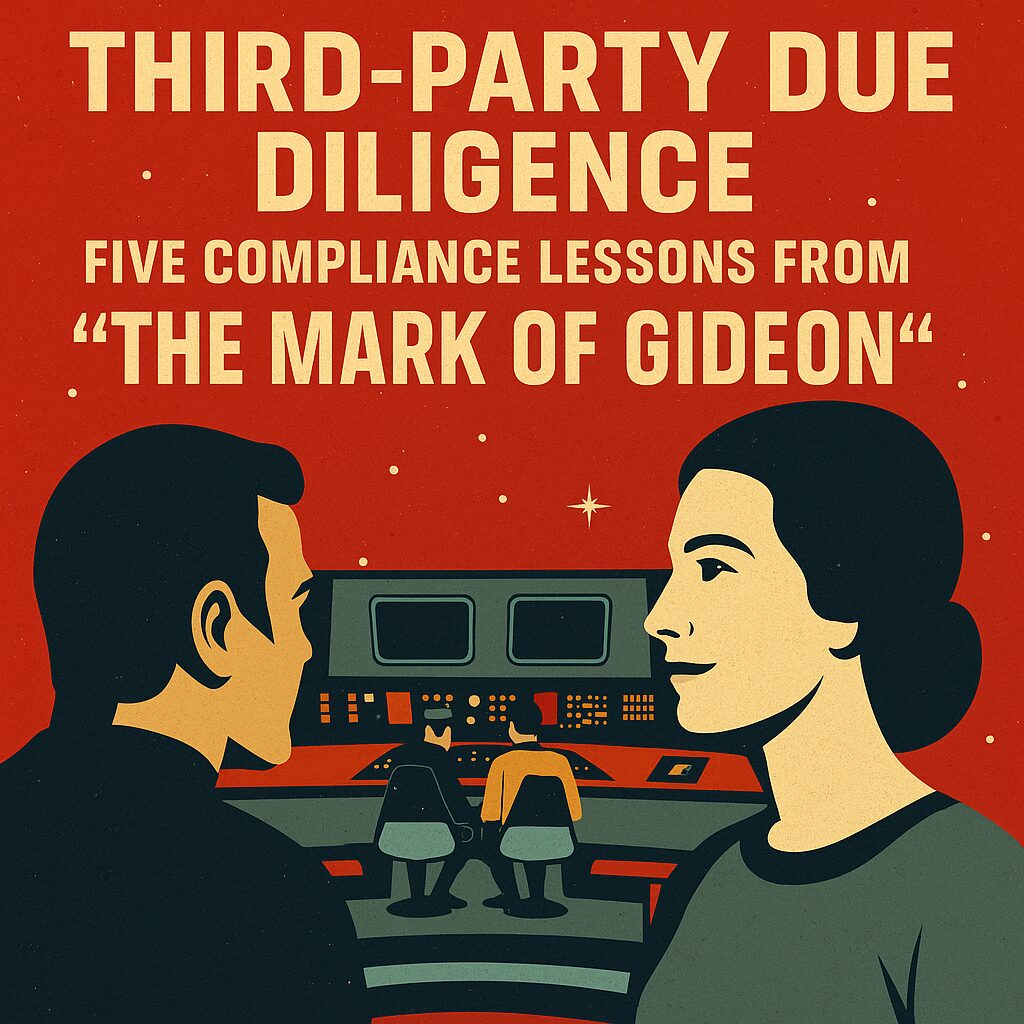
Third-Party Due Diligence: Five Lessons from Star Trek’s The Mark of Gideon

In the modern compliance landscape, third-party due diligence is not optional but essential. Regulators from the DOJ to the SFO have made it clear: if your business partner is involved in misconduct, you are on the hook if you did not take reasonable steps to know who you were dealing with.

Few pop culture moments capture the risks of blind engagement as vividly as Star Trek: The Original Series’ “The Mark of Gideon.” In this episode, Captain Kirk beams down to what he believes is the planet Gideon for diplomatic talks—only to find himself aboard what appears to be an empty Enterprise. What follows is a masterclass in the dangers of walking into a deal without verifying the facts. For compliance professionals, Gideon’s deception is the perfect allegory for the hazards of onboarding a third party without a thorough vetting process. Let’s break down five key lessons.

Lesson 1: Verify the True Identity of Your Counterparty

Illustrated By: When Kirk believes he is beamed down to Gideon, he is actually inside a replica of the Enterprise. The Gideonites have created this fake environment to isolate him for their purposes.

Compliance Lesson. If you do not confirm the true identity of a third party, you may find yourself dealing with a façade. Shell companies, undisclosed beneficial owners, and entities with misleading corporate registrations are the corporate world’s “empty Enterprise.”Always confirm a third party’s corporate existence and ownership through independent sources. This means checking official registries, using reliable due diligence databases, and, when needed, engaging investigative firms to trace beneficial ownership. Without these checks, you risk contracting with a front for illicit activity.

Lesson 2: Understand the Real Motives Behind the Partnership

Illustrated By: The Gideonites’ true purpose is not peaceful diplomacy; instead, they want to infect their overpopulated planet with a deadly virus carried by Kirk. They present their plan as a noble solution to their problem, but it’s built on deception and exploitation.

Compliance Lesson. Third parties sometimes have agendas that differ sharply from what they present. They may seek access to your brand to legitimize questionable practices, gain entry to restricted markets, or launder illicit funds. Beyond standard questionnaires, compliance teams should assess the commercial rationale for the relationship. Why do they want to work with you? Who else do they do business with? Are their financials consistent with the scale of the deal? If their motives don’t align with your values and compliance commitments, that is a red flag.

Lesson 3: Never Rely Solely on What the Other Party Tells You

Illustrated By: Kirk repeatedly asks the Gideonites to explain what is happening, but their answers are vague, evasive, and occasionally contradictory. They hope his lack of information will keep him compliant long enough to serve their plan.

Compliance Lesson. Self-reported information from a potential third party should be viewed as one data point, not the whole picture. Misrepresentations are common, whether deliberate or due to internal ignorance. Cross-verify all claims with independent checks, customer references, industry reputation research, litigation and sanctions screening, and on-site visits when possible. If the only source for a claim is the counterparty itself, your risk exposure rises dramatically.

Lesson 4: Assess the Operating Environment Before Engagement

Illustrated By: The Gideonites hide the actual conditions on their planet. Kirk learns later that Gideon is overcrowded to the point of people standing shoulder-to-shoulder, unable to move freely. Had this been disclosed, he would have understood the real risks before arriving.

Compliance Lesson. A third party’s operating environment, political stability, corruption levels, and regulatory enforcement directly affect your compliance risk. Entering into a business relationship without assessing this environment is akin to beaming down blind. Incorporate country risk analysis into your process. Use resources like Transparency International’s Corruption Perceptions Index, U.S. State Department human rights reports, and local legal counsel. An otherwise legitimate partner in a high-risk jurisdiction requires enhanced due diligence and monitoring.

Lesson 5: Build Exit Strategies Into the Relationship

Illustrated By: Once Kirk understands the Gideonites’ true intentions, he must escape the replica Enterprise to stop their plan. Without a clear route back to his crew, he risks being trapped indefinitely.

Compliance Lesson. Some third-party relationships turn sour despite your best due diligence efforts. Whether due to leadership changes, shifts in political conditions, or the surfacing of previously hidden misconduct, you need a plan to disengage without disrupting your operations. Include termination clauses tied to compliance breaches in your contracts. Maintain operational flexibility so you can pivot to alternate suppliers or partners if needed. Regularly re-screen third parties to ensure ongoing compliance, not just a one-time check at onboarding.

Final ComplianceLog Reflections

In The Mark of Gideon, the Enterprise crew’s lack of verified intelligence before Kirk’s “beam down” mirrors what happens when companies rush into a third-party relationship to seize a perceived opportunity. The Gideonites knew how to manipulate the Federation’s diplomatic eagerness. Likewise, unscrupulous partners today exploit companies’ urgency to enter new markets or secure rare supply chains.

The lesson? Due diligence is not a delay; it is a safeguard. The few extra weeks spent vetting a partner can prevent years of litigation, regulatory penalties, and reputational damage.

The Mark of Gideon” is not just a quirky Star Trek morality tale. It is a warning for every compliance professional. Without thorough third-party due diligence, you risk waking up in a corporate “replica Enterprise,” surrounded by partners whose true motives only become clear when it’s too late.

Your job as a compliance officer is to ensure the company doesn’t act blindly. By verifying identities, probing motives, cross-checking information, assessing environments, and building exit strategies, you safeguard your organization’s reputation and operational integrity. In short: trust, but verify, especially when the other side is as smooth-talking as the people of Gideon.

Resources:

⁠⁠Excruciatingly Detailed Plot Summary by Eric W. Weisstein⁠⁠

⁠⁠MissionLogPodcast.com⁠⁠

⁠⁠Memory Alpha

Categories
Trekking Through Compliance

Trekking Through Compliance: Episode 69: Lessons from Let That Be Your Last Battlefield: Building Justice and Fairness into Corporate Culture

Few episodes capture the destructive power of bias, systemic injustice, and the refusal to see common humanity as vividly as Star Trek: The Original Series’ “Let That Be Your Last Battlefield.” From a compliance perspective, the episode provides an unflinching mirror: organizations that fail to ensure fairness in their systems—whether in investigations, promotions, whistleblower treatment, or discipline—risk breeding internal hostilities just as destructive as Cheron’s. Today, we unpack five key compliance lessons for embedding institutional justice and fairness into the corporate DNA.

Lesson 1: Bias—Even When Invisible to Some—Can Destroy Organizational Cohesion

Illustrated By: When Bele first encounters Lokai aboard the Enterprise, he describes him as “obviously inferior.”

Compliance Lesson. Bias often hides in plain sight to those not affected by it. In corporate settings, decision-makers may not recognize that promotion patterns, discipline rates, or resource allocations favor certain groups until a whistleblower, audit, or public scandal exposes it.

Lesson 2: Enforcement Must Be Fair, Consistent, and Transparent

Illustrated By: Bele claims the right to arrest Lokai for crimes committed on Cheron. Lokai, in turn, accuses Bele of genocide. Neither offers verifiable evidence; instead, both rely on their moral certainty.

Compliance Lesson. Internal enforcement that rests on vague accusations or uneven application destroys trust in compliance systems.

Lesson 3: Leaders Must Refuse to Be Drawn into Partisan Vendettas

Illustrated By: Kirk insists on the Enterprise’s code of conduct and rules of evidence.

Compliance Lessons. Senior leaders are often pressured, subtly or overtly, to “pick a side” in internal disputes.

Lesson 4: Systemic Injustice Can Persist Until It Consumes the Organization

Illustrated By: When Bele and Lokai finally return to Cheron, they find their planet in ruins, destroyed by centuries of hatred. Yet, even faced with the extinction of their people, they continue their pursuit, consumed by the need to destroy the other.

Compliance Lesson. Corporate cultures that allow systemic injustice, favoritism in promotions, discriminatory pay structures, retaliation against whistleblowers, risk not only reputational harm but the destruction of the organization’s ability to function cohesively. Over time, injustice becomes normalized, making reform nearly impossible without significant disruption.

Lesson 5: Without a Shared Framework for Fairness, Conflict Has No Resolution

Illustrated By: Spock, ever the voice of logic, tries to point out that the two aliens are more alike than different. To them, justice is entirely defined by the defeat of the other.

Compliance Lesson. In corporations, the absence of a clear, visible framework for fairness, along with policies, expectations, and trusted reporting channels, leads to conflicts that devolve into zero-sum games.

Final ComplianceLog Reflections

Let That Be Your Last Battlefield ends on a tragic note: the two survivors beam down to a dead world, still locked in mutual hatred. It’s a cautionary tale for corporate life. Without institutional justice and fairness, even the most advanced organizations can collapse into destructive internal conflict.

Resources:

⁠⁠Excruciatingly Detailed Plot Summary by Eric W. Weisstein⁠⁠

⁠⁠MissionLogPodcast.com⁠⁠

⁠⁠Memory Alpha

Categories
Blog

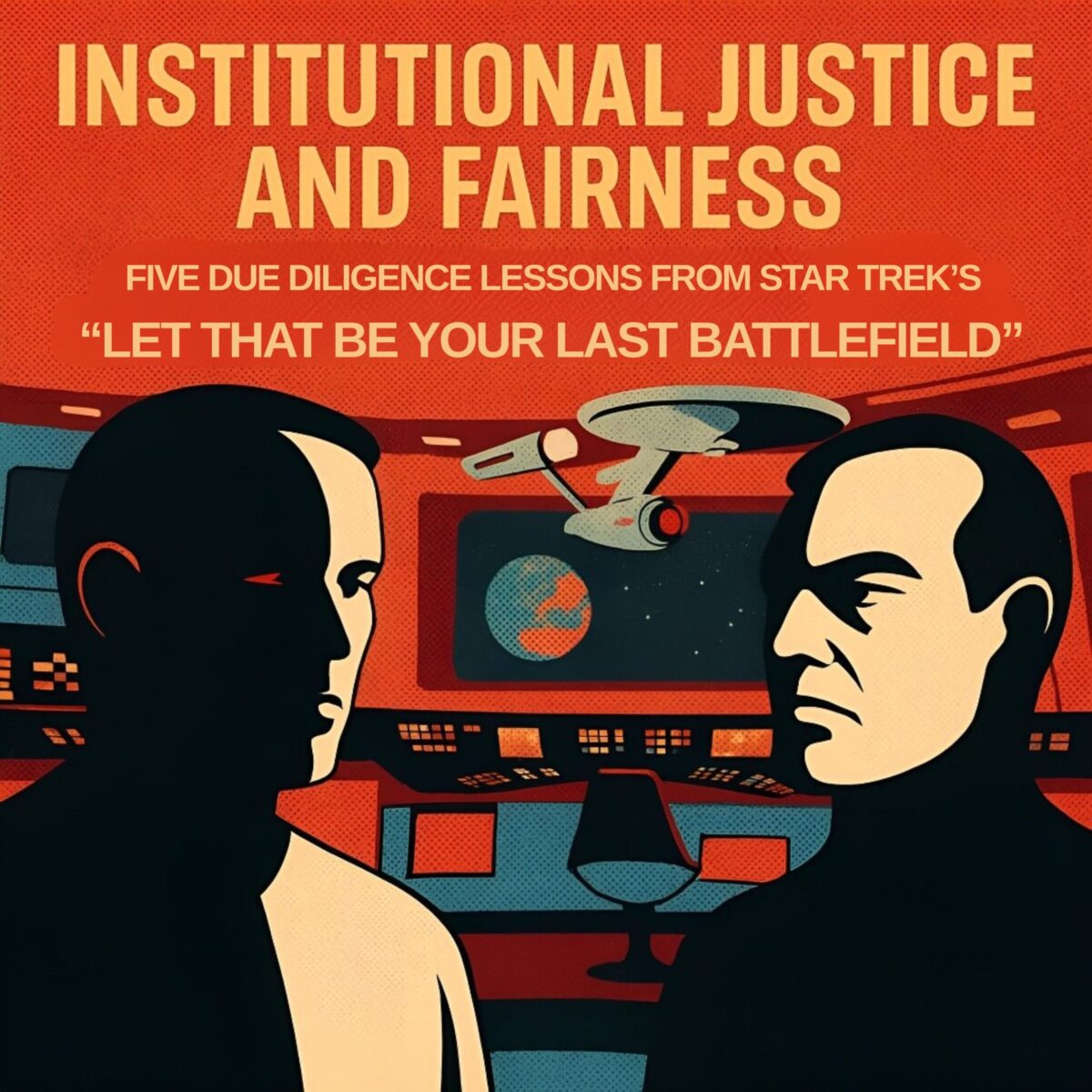
Institutional Justice and Fairness: Five Compliance Lessons from Let That Be Your Last Battlefield

In the realm of corporate compliance, institutional justice and fairness are not mere aspirational slogans; they are operational imperatives. These principles govern how decisions are made, how investigations are conducted, how employees are treated, and how corporate culture sustains itself over time.

Few pop culture allegories capture the destructive power of bias, systemic injustice, and the refusal to see common humanity as vividly as Star Trek: The Original Series’ “Let That Be Your Last Battlefield.”

In the episode, the Enterprise rescues Bele and Lokai, two survivors from the planet Cheron, each half black and half white, split vertically, but on opposite sides. To them, this difference is not a curiosity but the basis for deep-seated hatred. Their mutual enmity has destroyed their planet, leaving only the two of them to perpetuate the feud.

From a compliance perspective, the episode provides an unflinching mirror: organizations that fail to ensure fairness in their systems—whether in investigations, promotions, whistleblower treatment, or discipline—risk breeding internal hostilities just as destructive as Cheron’s. Let’s unpack five key compliance lessons for embedding institutional justice and fairness into the corporate DNA.

Lesson 1: Bias—Even When Invisible to Some—Can Destroy Organizational Cohesion

Illustrated By: When Bele first encounters Lokai aboard the Enterprise, he describes him as “obviously inferior.” Captain Kirk and the crew, however, are baffled. To them, both aliens appear the same, half black, half white. The difference only matters to Bele because, in his mind, the “correct” coloration is black on the right side.

Compliance Lesson. Bias often hides in plain sight to those not affected by it. In corporate settings, decision-makers may not recognize that promotion patterns, discipline rates, or resource allocations favor certain groups until a whistleblower, audit, or public scandal exposes it.

What should you do now? Compliance departments must proactively identify and address these “invisible” biases. This means collecting and analyzing workforce data by role, pay, and demographics, conducting blind résumé reviews where appropriate, and building bias-awareness training into leadership development. A fair institution does not wait for bias to erode morale. It works to neutralize it before it becomes a fault line.

Lesson 2: Enforcement Must Be Fair, Consistent, and Transparent

Illustrated By: Bele claims the right to arrest Lokai for crimes committed on Cheron. When Kirk asks what those crimes are, Bele offers only vague accusations about theft and rebellion. Lokai, in turn, accuses Bele of genocide. Neither offers verifiable evidence; instead, both rely on their moral certainty.

Compliance Lesson. Internal enforcement that rests on vague accusations or uneven application destroys trust in compliance systems. If some employees are disciplined harshly for minor infractions while others escape consequences for major violations, especially if those others are high performers or senior executives, perceptions of injustice spread quickly.

What should you do now? Enforcement must be rule-based, not personality-based. Compliance should establish clear investigation protocols, document evidence, and apply sanctions proportionately and consistently. Transparency, within the limits of privacy and confidentiality, builds credibility. Employees are more likely to accept outcomes they disagree with if they understand the process was impartial.

Lesson 3: Leaders Must Refuse to Be Drawn into Partisan Vendettas

Illustrated By: Bele demands that Kirk turn Lokai over to him, citing his authority as a law enforcer from Cheron. Kirk, recognizing the apparent personal animosity, refuses to take sides without due process. He insists on the Enterprise’s code of conduct and rules of evidence.

Compliance Lessons. Senior leaders are often pressured, subtly or overtly, to “pick a side” in internal disputes. This may come from managers trying to protect their teams, high-value employees attempting to shield themselves from accountability, or executives wanting to “make a problem go away” by sacrificing someone quickly.

What should you do now? A compliance function must stand apart from internal politics. Its legitimacy rests on applying the same standards to all, regardless of power, popularity, or tenure. This requires independence, direct reporting lines to the board, and documented procedures that prevent political influence from steering outcomes.

Lesson 4: Systemic Injustice Can Persist Until It Consumes the Organization

Illustrated By: When Bele and Lokai finally return to Cheron, they find their planet in ruins, destroyed by centuries of hatred. Yet, even faced with the extinction of their people, they continue their pursuit, consumed by the need to destroy the other.

Compliance Lesson. Corporate cultures that allow systemic injustice, favoritism in promotions, discriminatory pay structures, retaliation against whistleblowers, risk not only reputational harm but the destruction of the organization’s ability to function cohesively. Over time, injustice becomes normalized, making reform nearly impossible without significant disruption.

What should you do now? Compliance must act early and decisively when patterns of inequity appear. This requires the courage to challenge entrenched practices and the authority to recommend systemic changes, whether in hiring pipelines, procurement policies, or leadership evaluations. Just as Cheron’s destruction was preventable had action been taken earlier, organizations that ignore inequity may find themselves fighting to save something already beyond repair.

Lesson 5: Without a Shared Framework for Fairness, Conflict Has No Resolution

Illustrated By: Spock, ever the voice of logic, tries to point out that the two aliens are more alike than different. Bele and Lokai, however, reject any suggestion of commonality because they lack a shared concept of fairness. To them, justice is entirely defined by the defeat of the other.

Compliance Lesson. In corporations, the absence of a clear, visible framework for fairness, along with policies, expectations, and trusted reporting channels, leads conflicts to devolve into zero-sum games. Each side seeks to “win” rather than to resolve issues constructively.

What should you do now? Compliance departments must provide that shared framework. Review, update if appropriate, and retrain on your

  • Code of Conduct.
  • Independent investigation procedures.
  • A commitment to non-retaliation.
  • Mechanisms for appeal and review.

When fairness is institutionalized, disputes have a pathway to resolution that doesn’t rely on destroying the other side.

The Enterprise Model: Compliance as the Guardian of Fairness

Captain Kirk’s approach in the episode offers a leadership model for compliance officers. He listens, gathers facts, refuses to be drawn into personal vendettas, applies established rules, and seeks to uphold the Enterprise’s standards above external political pressures.

That’s the role compliance must play in institutional justice:

  • Guardian of fairness, ensuring that rules apply equally to all.
  • Protector of process, resisting shortcuts for expediency.
  • Champion of independence, immune to political or personal influence.

When these principles are embedded in an organization, they do more than prevent misconduct; they create a culture where employees believe in the integrity of the system itself.

Final ComplianceLog Reflections

Let That Be Your Last Battlefield ends on a tragic note: the two survivors beam down to a dead world, still locked in mutual hatred. It’s a cautionary tale for corporate life. Without institutional justice and fairness, even the most advanced organizations can collapse into destructive internal conflict.

The compliance department’s mandate is clear: be the Enterprise, not Cheron. Build systems that see beyond superficial differences, enforce rules fairly, resist partisan pressures, confront systemic inequity, and provide a shared framework for fairness. In doing so, you give your organization something Bele and Lokai never had: a future worth fighting for together.

Resources:

⁠⁠Excruciatingly Detailed Plot Summary by Eric W. Weisstein⁠⁠

⁠⁠MissionLogPodcast.com⁠⁠

⁠⁠Memory Alpha

Categories
Blog

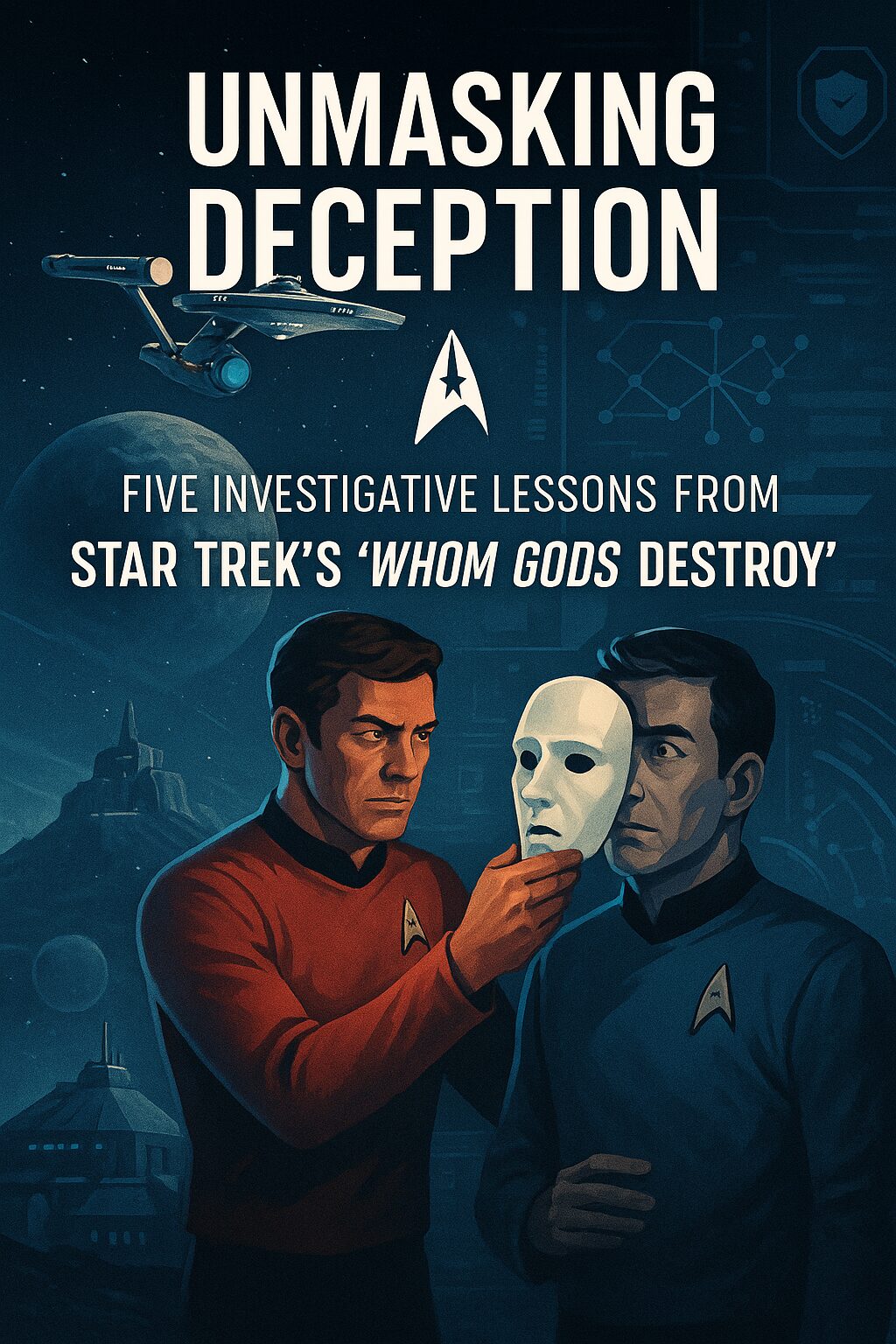
Unmasking Deception: Five Investigative Lessons from Star Trek’s “Whom Gods Destroy”

Today, let’s take a journey to one of Star Trek: The Original Series’ most intense psychological dramas: “Whom Gods Destroy.” On its surface, this episode is a tale of madness, manipulation, and peril. But for the vigilant compliance professional, it’s a trove of investigative lessons on dealing with deception, managing risk, and safeguarding your organization in an unpredictable world.

In “Whom Gods Destroy,” Captain Kirk and Mr. Spock arrive at the maximum-security facility on Elba II to deliver a new medicine. They quickly fall prey to the cunning Garth of Izar, a former starship fleet captain now criminally insane. Garth seizes control of the asylum using his shapeshifting ability and manipulates everyone around him with a series of deceptions, impersonations, and psychological games. For Kirk and Spock, survival means uncovering the truth in a maze of misdirection.

Let’s beam down to Elba II, a remote asylum for the galaxy’s most dangerous criminally insane, to examine what this wild ride can teach us about effective corporate investigations.

1. Never Accept Surface Appearances—Verify, Then Trust

Illustrated By: Kirk and Spock are greeted by what appears to be the asylum’s director, Governor Cory. He acts normally and reassures them that all is well. Only later do they discover that Garth, using his ability to alter his appearance, is impersonating Cory and is, in fact, in control of the facility.

Compliance Lesson. In investigations, never accept things at face value. Documents can be forged, credentials fabricated, and even trusted individuals may act under duress or with hidden motives. Just as Garth’s impersonation deceived Kirk, compliance investigators must independently verify facts, corroborate stories, and challenge what seems obvious. Assume nothing—always test the evidence.

What should you do now? Establish robust protocols for evidence verification. Don’t simply trust, but verify, using multiple sources, forensic tools, and independent witness interviews. Always be alert to the possibility that someone may be playing a role.

2. Psychological Manipulation: Beware the Power of Charisma

Illustrated By: Garth, in his guise as both himself and others, uses his charisma and manipulation to sow confusion and loyalty among the other inmates. He persuades them to join his rebellion through promises, threats, and appeals to their egos.

Compliance Lesson. In many investigations, the most dangerous individuals are those who wield psychological influence. Charismatic leaders, managers, or employees can persuade others to cover up wrongdoing, falsify records, or sabotage investigative efforts. Investigators must be wary of undue influence and remember that even the most likable or persuasive people may have something to hide.

What should you do now?  Train your investigative team to recognize and resist psychological manipulation. Always seek independent corroboration and never let charm or status cloud your objectivity.

3. The Importance of Access Controls and Segregation of Duties

Illustrated By: Garth gains control over the asylum’s security systems, disabling communications and trapping Kirk and Spock. By centralizing control, he can manipulate everyone in the facility and thwart any rescue attempt.

Compliance Lesson: A key safeguard against fraud and misconduct is the principle of segregation of duties and strict access controls. If one individual or a small group can manipulate systems without oversight, your organization is vulnerable to abuse. Garth’s control of Elba II mirrors what can happen in a business when there are weak internal controls: a single rogue actor can wreak havoc before anyone notices.

What should you do now? Regularly review and test your access controls and segregation of duties. Ensure that no single person has unchecked power and regularly audit system logs to detect unusual activity. Prevent the “Garth scenario” by building multiple layers of oversight.

4. Recognize Red Flags and Act on Them Swiftly

Illustrated By: Despite several warning signs, unusual behavior from the “director,” cryptic comments from the staff, and security lapses, Kirk and Spock hesitate before taking decisive action. Only after the deception becomes undeniable do they shift into crisis mode.

Compliance Lesson. Every investigation reveals red flags. The question is: will your team recognize them early and act decisively? All too often, subtle signals, changes in behavior, delayed responses, or gaps in documentation are ignored until the situation escalates. In “Whom Gods Destroy,” the cost of delay is nearly fatal.

What should you do now? Create a culture where red flags are escalated and investigated immediately. Encourage open reporting and ensure investigators are empowered to follow up on their instincts. Quick action can prevent a minor issue from becoming a crisis.

5. Collaboration Is the Key to Outwitting Deception

Illustrated By: Ultimately, Kirk and Spock overcome Garth’s deceptions through close teamwork, communication, and the use of a prearranged security code that only the honest Kirk would know. Spock’s skepticism and methodical approach are essential to cutting through the confusion and revealing the truth.

Compliance Lesson. Investigations should never be a solo endeavor. Collaboration, clear communication, and checks and balances are essential to unmasking sophisticated schemes. Like Spock and Kirk, compliance teams must establish protocols—such as “safe words,” confirmation codes, or independent review processes—to prevent impersonation, collusion, or false confessions.

What should you do now? Build cross-functional investigative teams with diverse skill sets. Foster a culture of transparency, and ensure all findings are independently reviewed and validated. Teamwork and process discipline are your best defenses against deception.

Final ComplianceLog Reflections

“Whom Gods Destroy” may be set in a galaxy far away, but its lessons are as relevant to the compliance investigator as they are to any starship captain. In a world where deception can take many forms, such as charisma, forged documents, technological manipulation, or even trusted colleagues, your best defense is disciplined skepticism, rigorous process, and a commitment to the truth above all else.

In corporate investigations, the price of being deceived is high, but the rewards of vigilance, skepticism, and teamwork are higher. So, as you face your own “Elba II,” remember the lessons of Kirk and Spock: Trust the process, trust your team, and always keep your eyes open for the masks that others might wear.

Resources:

⁠⁠Excruciatingly Detailed Plot Summary by Eric W. Weisstein⁠⁠

⁠⁠MissionLogPodcast.com⁠⁠

⁠⁠Memory Alpha