Categories
Blog

Returning to Venezuela: Part 1 – Bribery, Corruption and the Risks You Must Confront Before You Enter

When US energy companies talk about returning to Venezuela, the conversation almost always starts with opportunity. Yet the CEO of Exxon has said Venezuela is ‘uninvestible’. There is another set of problems that every corporate compliance team will face if their company decides to enter the Brazilian market. For the compliance professional, it must start with corruption. Not episodic corruption. Not bad actors at the margins. Systemic, embedded, institutionalized corruption that touches government agencies, state-owned enterprises, procurement systems, and the judiciary. This is not a theoretical risk. It is the operating environment.

The Department of Justice (DOJ) has made clear in the Evaluation of Corporate Compliance Programs (ECCP) that high-risk jurisdictions require tailored, well-resourced, and empowered compliance programs. Venezuela is the textbook example of why. Over the next several blog posts, we will explore key issues every company and CCO will face when considering whether to enter (or re-enter) Venezuela. In Parts 1 and 2, I will consider the top 10 anti-bribery/anti-corruption (ABC) risks a compliance professional will face. (Part 1, risks 1-5; Part 2, risks 6-10). We will then consider AML risk, export control and trade sanctions, security risks, and end with operational risks.

1. Systemic Corruption Is the Baseline Condition

Risk

Venezuela is not a market where corruption appears as an exception. It is the default condition against which all business activity must be measured. For compliance professionals, this means risk assessments cannot ask whether corruption exists. They must assume it does and ask where pressure will arise. Licensing, customs, inspections, labor issues, utilities, and currency all present opportunities for improper advantage. Boards must understand this upfront. Entering Venezuela without acknowledging systemic corruption is not optimism. It is a governance failure.

Compliance Framework Response

Before addressing individual risks, the compliance function must establish baseline principles governing how risk is assessed and managed in Venezuela.

  1. Assume corruption pressure exists. The risk assessment does not ask if corruption will arise, but where and how.
  2. Controls must be operational, not theoretical. Policies without authority, monitoring, and escalation are not controls.
  3. Risk ownership must be explicit. Every risk category has a business owner, a compliance owner, and a board oversight hook.
  4. Boards govern risk; they do not run operations. Oversight is mandatory. Tactical interference is prohibited.

2. PdVSA as a Prominent and Persistent Risk

Risk

Any discussion of bribery risk in Venezuela must begin with Petróleos de Venezuela S.A. (PdVSA), which has been at the center of some of the most significant corruption schemes in modern enforcement history, involving contracts, invoices, intermediaries, and payment routing. Indeed, 10 years ago, I wrote that it would cost a fortune to schedule and confirm a meeting. But companies make the mistake of treating PdVSA as a single risk node. In reality, it is a network risk. Joint ventures, service contracts, maintenance agreements, and procurement relationships all radiate outward, exposing the organization to corruption. If your counterparty touches PdVSA, you have inherited PdVSA risk.

Compliance Framework Response

The starting point is a Venezuela-specific bribery and corruption risk assessment, refreshed whenever business scope, counterparties, or operating conditions change.

This assessment must:

  • Map all government touchpoints.
  • Identify all third parties by function, not just by name;
  • Distinguish systemic risk from transactional risk; and
  • Flag PdVSA exposure explicitly.

Outputs are not static reports. They are control design inputs.

3. Joint Ventures and Service Contracts: Shared Risk, Shared Liability

Risk

Joint ventures are often framed as risk mitigation tools. In Venezuela, they frequently do the opposite. Local partners may be politically connected. Governance structures may be opaque. Control rights may be illusory. Compliance professionals must scrutinize who appoints management, who controls procurement, and who interacts with government officials. Under the ECCP, regulators ask whether compliance has authority commensurate with risk. In a Venezuelan JV, symbolic compliance oversight is not enough.

Compliance Framework Response

1. Assessment Controls

  • Government interaction mapping by function and frequency
  • Identification of pressure points where discretion exists
  • Historical analysis of delays, denials, or unexplained variability

2. Management Controls

  • Pre-approval requirements for all government-facing interactions
  • Clear prohibitions on facilitation payments
  • Mandatory escalation for any demand tied to speed, access, or discretion

Monitoring

  • Trend analysis of approvals and delays
  • Comparison of processing times across regions or projects

1. Board Oversight Questions

  • Where do we face the highest government discretion risk?
  • What interactions cannot proceed without a compliance sign-off?

4. Procurement as the First Corruption Flashpoint

Risk

Procurement is where corruption pressure materializes fastest. Vendors expect to be paid for access. Officials expect influence. Intermediaries promise to “make things happen.” This is even more true in Venezuela. This is where third parties begin to matter and where compliance must be in place before contracts are signed. Retrospective diligence does not cure a corrupted procurement process. Boards should demand visibility into how vendors are selected, not just who they are.

Compliance Framework Response

1. Assessment Controls

  • Explicit identification of direct and indirect PdVSA touchpoints
  • Mapping of PdVSA influence over pricing, approvals, and payments
  • Review of historical enforcement patterns tied to similar structures

2. Management Controls

  • Enhanced due diligence for any counterparty touching PdVSA
  • Compliance approval of all PdVSA-facing contract terms
  • Segregation of duties around invoicing and change orders

Monitoring

  • Continuous review of intermediaries interacting with PdVSA
  • Red flag monitoring for unusual invoice timing or routing
  1. Board Oversight Questions
  2. How are PdVSA’s risks different from those of other SOEs we engage with?
  3. What controls exist beyond standard third-party diligence?

5. The Illusion of “Routine” Government Interaction

Risk

Companies often underestimate corruption risk by labeling interactions as routine: inspections, permits, customs clearances, utilities, and labor approvals. And yes, the DOJ has said it will back off on enforcement of small payments, which may be traditionally made, but in Venezuela, routine functions are often monetized.  Compliance programs must draw hard lines early and firmly.

Compliance Framework Response

1. Assessment Controls

  • Governance and control-rights analysis
  • Identification of who appoints management and controls procurement
  • Mapping of partner government relationships

2. Management Controls

  • Contractual compliance rights with audit and termination authority
  • Compliance veto power over high-risk activities
  • Mandatory training for JV-appointed personnel

Monitoring

  • Periodic compliance audits of JV operations
  • Review of partner interactions with officials

1. Board Oversight Questions

  • Where do we lack real compliance leverage in our JVs?
  • Are control rights aligned with our risk exposure?

Join us tomorrow as we look at ABC risks 6-10, including third parties, extortion, organized crime, currency issues, and a weak rule of law.
Categories
2 Gurus Talk Compliance

2 Gurus Talk Compliance – Episode 65 – The This Is Nuts Edition

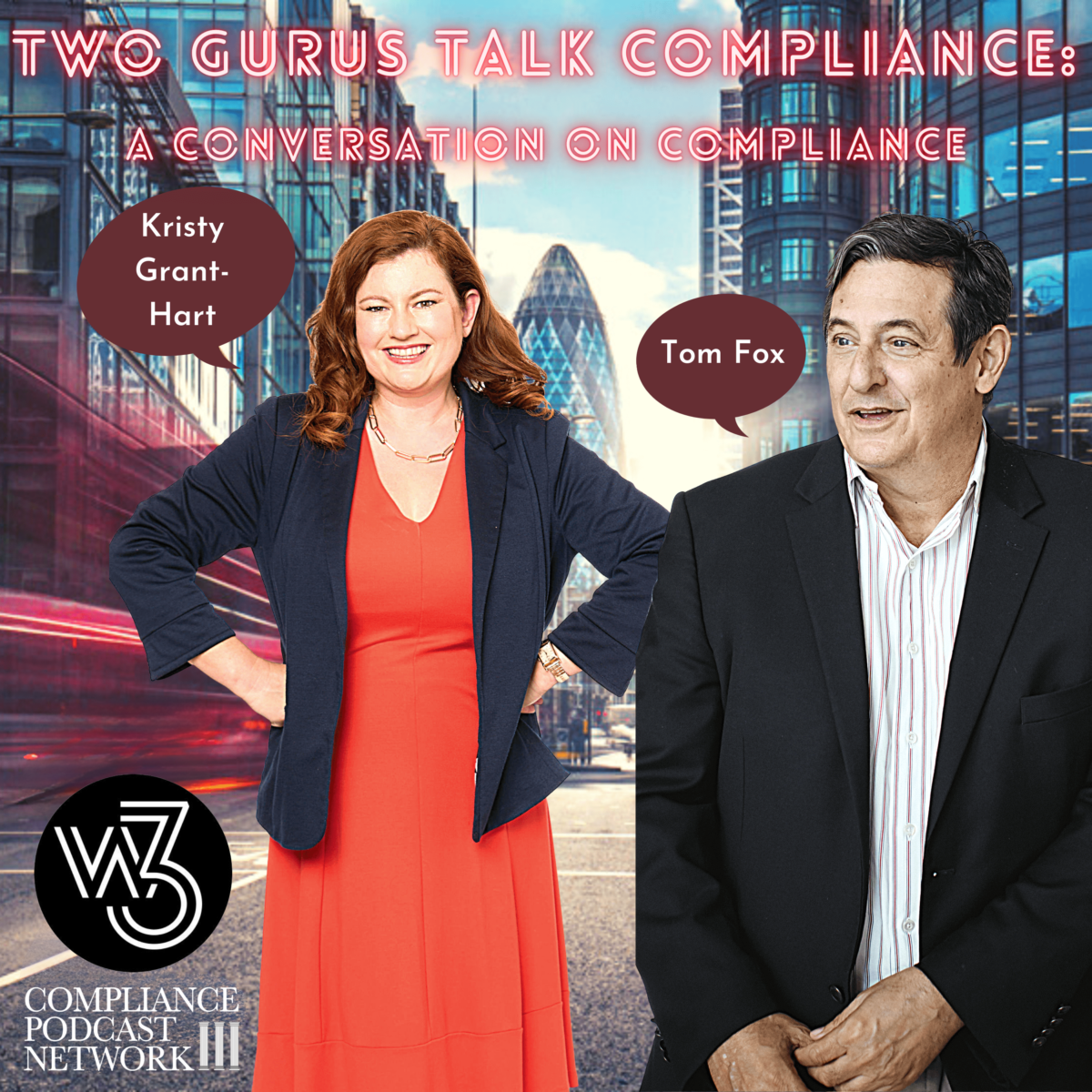
What happens when two top compliance commentators get together? They talk compliance, of course. Join Tom Fox and Kristy Grant-Hart in 2 Gurus Talk Compliance as they discuss the latest compliance issues in this week’s episode! ABC protests topple the Bulgarian government, a French tennis player is suspended for 20 years over corruption, a UM coach is fired over an affair with a staffer, and Trump puts the DOJ in a no-win position over Warner Bros.

Stories this week include:

  • NY state could be a battleground for AI regulation. NYT
  • Massive fraud in aircraft parts uncovered in the UK. TheTimes
  • Switzerland charges Credit Suisse over Tuna Bond fraud. ACAMS
  • Former Labour PM convicted of corruption in Bangladesh. Independent
  • Lane Kiffin should be nowhere near Ole Miss football. WSJ
  • U.S. Supply Chains Deemed Vulnerable to Chinese Exploitation – WSJ
  • Europe Aimed to Set Standards for Tech Rules; Now It Wants to Roll Them Back – WSJ
  • Campbell Soup executive called its products food for “poor people,” lawsuit claims – CBS News
  • I Made an Offensive Joke. But So Did Everyone Else! Why Did I Get Fired? – NYT
  • Florida Man Stops Paying for Rental Car, Uses It to Give Uber Rides – FloridaMan.com

Connect with the Hosts:

Resources:

Kristy Grant-Hart on LinkedIn

Prove Your Worth

Tom

Instagram

Facebook

YouTube

Twitter

LinkedIn

Categories
Blog

Ethical AI Is Built in Procurement, Not Posters

In the ongoing conversation about AI, companies are increasingly highlighting their ethical principles. They publish responsible AI statements, share aspirational values, and post impressive slide decks. However, any experienced compliance professional knows that ethics does not live in posters. It lives in systems. It lives in contracts. It lives in the infrastructure choices that decide who holds power, who can be audited, and who is accountable when things go wrong.

When you pull back the curtain on most modern AI deployments, you find a hard truth. Ethical outcomes depend less on high-level values and more on the mundane details of compute access, data governance, vendor resilience, and transparency. Those details are not glamorous, but they are decisive. They are also exactly where the compliance function must lead. The companies that treat AI as a technical problem will struggle. The companies that understand AI as a governance problem will succeed. Compliance should be at the center of that governance effort.

The Infrastructure Beneath Ethical AI

The most important element of ethical AI is the part no one sees. The infrastructure decisions made today are the ethical outcomes of tomorrow. Consider four core factors that determine the integrity of an AI system long before it begins making predictions.

a. Compute Access

The amount of compute you grant, the regions in which it can be used, and the failover plan for outages are not IT decisions. They are about fairness, safety, and continuity. If only certain business units have access to the most powerful models, you have created inequities inside your own walls. If you cannot maintain operations during a provider outage, you have made a resilience gap that regulators will notice.

b. Data Governance

AI systems amplify the quality and cleanliness of your data practices. Data lineage, retention schedules, classification levels, and access controls determine who can see what, when, and under what safeguards. If the data is flawed, every model output built on it is flawed. Compliance already governs data privacy, confidentiality, and use restrictions. AI raises the stakes.

c. Vendor Resilience

The more an organization invests in a single AI provider, the more dependent it becomes on that provider’s risk posture. Multi-cloud strategies, vendor exit rights, and enforceable SLAs are not operational niceties. They are governance tools to prevent concentration risk. Compliance has long experience managing third-party risk; AI vendors are simply the newest category.

d. Model Operations

Model versioning, approval workflows, rollback procedures, and audit trails determine how quickly an organization can detect harm and correct it. These operational controls map almost perfectly onto compliance best practices. They reflect the same principles that underpin any effective risk management program: evidence, traceability, and documented decision-making.

Where Compliance Must Lead

Most organizations underestimate the extent to which AI governance requires the same discipline found in mature compliance programs. The compliance function knows how to operationalize policies, create audit trails, and embed accountability. These strengths translate directly into AI. Below are the areas where compliance should play the lead role.

1. Embedding Ethical Standards Into Procurement

Ethical AI begins with ethical procurement. RFPs should require model documentation, bias testing, data ownership guarantees, audit logs, content filtering, and evidence of secure development practices. A vendor that cannot demonstrate its internal controls will not protect your ethical commitments. Compliance is uniquely positioned to identify those red flags.

2. Contracting for Power, Not Promises

Every compliance professional knows that a vendor promise without contractual force is aspiration, not assurance. AI contracts must include termination for harm, financially meaningful remedies, data portability, and clear assignment of responsibilities. Regulators will expect companies to demonstrate that they negotiated governance into their agreements.

3. Designing for Resilience

AI systems break in unfamiliar and sometimes spectacular ways. Multi-region deployment, validated failover paths, and regular stress testing are mandatory. Resilience is an ethical value because it protects customers, employees, and stakeholders from foreseeable harm. Compliance should insist on documented resilience planning as part of deployment approval.

4. Governing the Data Layer

Data minimization, differential access, immutable lineage, and standard retention schedules must be embedded across AI use cases. AI does not excuse a company from its privacy or data-governance obligations. It heightens them. Compliance should ensure that every AI initiative begins with a data governance review before a single line of code is written.

5. Operationalizing Oversight

AI oversight is not a once-a-year assessment. It is a living discipline. Compliance should push for model risk reviews, red-team exercises, change-control approvals, and clearly defined escalation pathways. When issues arise, there must be a time-boxed rollback plan in place. Clearly assigned control owners must be accountable for results.

6. Measuring What Matters

Without metrics, oversight is performance art. Companies should measure false positives and false negatives for each AI use case, especially across protected classes. They should track incident rates, drift detection outcomes, model approval times, and vendor SLA performance. These indicators form a dashboard that demonstrates whether AI governance is real or merely decorative.

7. Funding Ethics as an Operational Requirement

Ethical AI is not free. It requires a budget for monitoring, red teaming, data curation, and external verification. Compliance should push for these resources and make the case that ethics is a form of operational continuity. A company that cannot demonstrate that it has funded its governance model will struggle in any regulatory examination.

8. Building Exit Capability

Most companies underestimate how difficult it is to transition away from an AI vendor. Compliance should require that every material AI system have an exit plan that includes timelines, data-migration standards, and a documented process to ensure continuity. Only an exit tested under realistic conditions qualifies as a real control.

9. Clarifying Accountability

AI governance fails when accountability is diffuse. Every operational risk must have an owner. Compliance should map each AI risk to a responsible executive and require quarterly reviews. Regulators do not want to know who wrote the policy. They want to know who owns the risk.

10. Training the Front Line

AI governance is not the exclusive domain of data scientists. Product teams, procurement staff, and engineers must understand their responsibilities. Compliance should provide scenario-based training and reward early escalation. Culture determines how quickly issues surface, and AI issues must surface fast.

Closing Thoughts

Ethical AI is not an aspirational project. It is a systems problem, a contracting problem, a data problem, and an accountability problem. Compliance has the experience and discipline to lead the organization through these challenges. When procurement, contracts, and architecture embody the company’s values, ethical outcomes follow. When they do not, no principle statement on a website will save you.

Categories
Innovation in Compliance

Innovation in Compliance – Navigating the Future of Supply Chain Compliance with Travis Miller

Innovation is present in many areas, and compliance professionals must not only be prepared for it but also actively embrace it. Join Tom Fox, the Voice of Compliance, as he visits with top innovative minds, thinkers, and creators in the award-winning Innovation in Compliance podcast. In this episode, host Tom welcomes Travis Miller, Chief Strategy Officer and General Counsel at Source Intelligence, to discuss major developments in supply chain compliance.

Miller outlines his recent job transition from Google, where he was the Head of Supply Chain Compliance and Social Responsibility. He delves into the complexities and innovations of Source Intelligence, a company focused on supply chain transparency and compliance. He also talks about his book ‘Guide to Supply Chain Compliance Laws and Regulations’ and highlights the growing significance of supply chain mapping due to new regulations. The conversation examines the pivotal roles of data accuracy, supplier collaboration, and AI in enhancing supply chain compliance. Miller predicts a more technical and relationship-driven future for supply chain professionals, stressing the importance of strategic partnerships. The discussion also explores four market realities that companies can’t ignore, emphasizing the pitfalls of outdated metrics and manual processes. Finally, Travis shares his insights on balancing automation with human judgment to optimize compliance operations.

Key highlights:

  • The Importance of Supply Chain Compliance
  • Supply Chain Mapping and Regulations
  • Full Material Declarations and Their Significance
  • AI in Supply Chain Compliance
  • The Future Role of Supply Chain Professionals
  • The Compliance Playbook and Market Realities

Resources:

Travis Miller on LinkedIn

‘Guide to Supply Chain Compliance Laws and Regulations

The Compliance Playbook is Broken on LinkedIn

Innovation in Compliance was recently honored as the number 4 podcast in Risk Management by 1,000,000 Podcasts.

Categories
ACI FCPA Conference 2025

ACI-FCPA Conference Speaker Preview Series – Ricardo Wagner de Araujo on Potential Trouble in your (Latin American) Supply Chain

In this episode of the ACI-FCPA and Global Anti-Corruption Conference Speaker Podcasts series, Ricardo Wagner de Araujo discusses his panel at the event, “Managing New Risks in Latin America: A Look at the Biggest Ways Cartels/TCOs Are Infiltrating Businesses and Supply Chains, and How Companies Are Responding.”

Some of the issues the panel will discuss are:

    • The changing risks in Latin America.
    • How TCOs and cartels exploit 3rd party relationships.
    • Tips for adapting your compliance programs in Latin America.

I hope you can join me at the ACI–FCPA Conference. This year’s event will take place on December 3-4 at the Gaylord National Resort & Convention Center in National Harbor, Maryland, near Washington, D.C. The lineup of this year’s event is simply first-rate, featuring some of the top FCPA professionals, white-collar attorneys, and compliance practitioners in the field.

The 2025 program is being completely redesigned to help your organization stay agile, responsive, and ahead of the curve. Expect a dynamic agenda shaped by real-world priorities, practical takeaways, and the most cutting-edge thinking in compliance—led by a faculty of global practitioners with boots on the ground, encountering the very risks that come across your desk.

Please join me at the event. For information on the event, click here. Listeners of this podcast will receive a discount by using the code D10-999-CPN26.

Categories
Blog

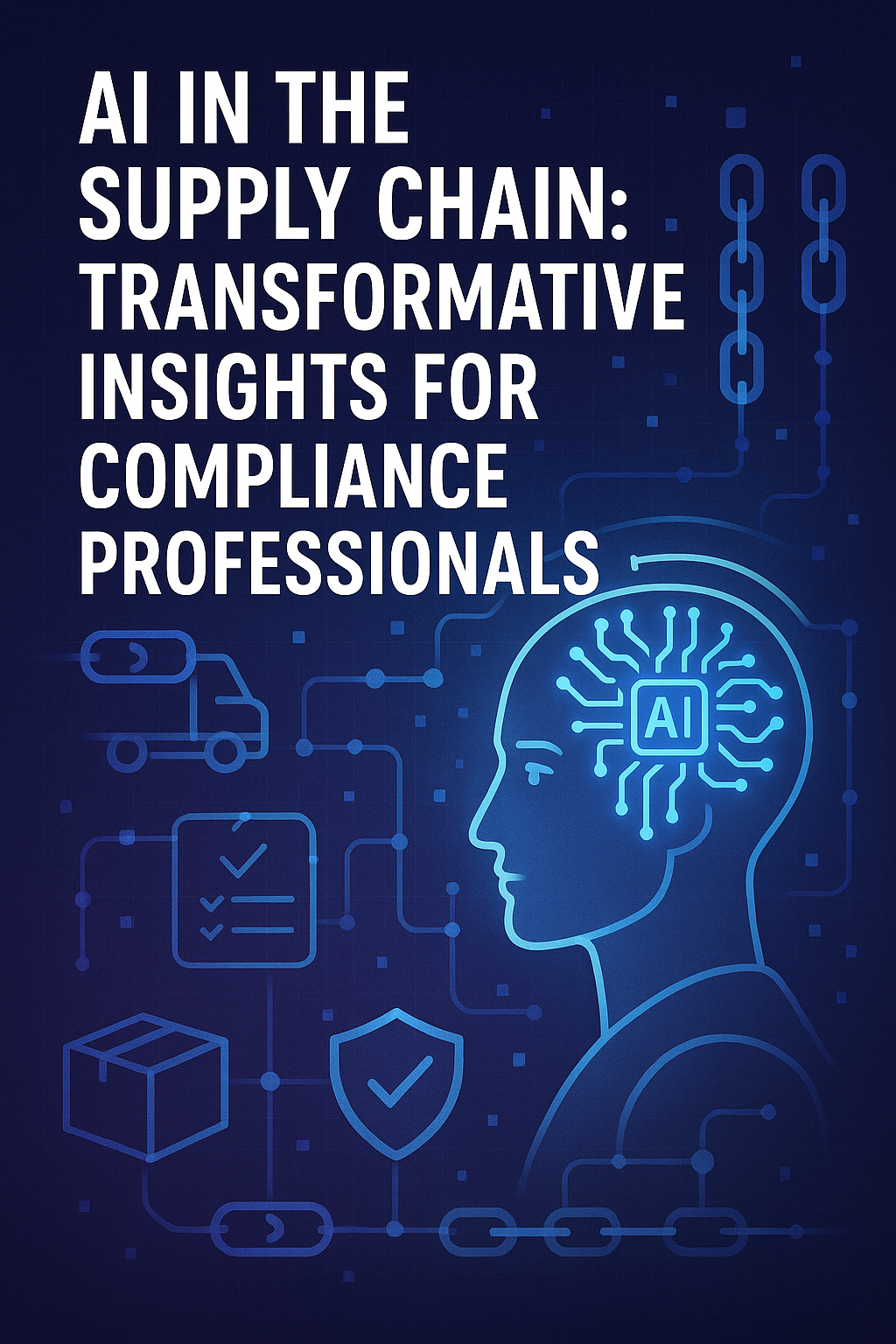
AI in the Supply Chain: Transformative Insights for Compliance Professionals

Compliance professionals responsible for managing risk, regulatory adherence, and organizational integrity must understand how AI technologies are being integrated into supply chains to effectively manage compliance obligations and leverage these advancements for optimal business outcomes. The integration of AI technologies within supply chain operations provides organizations with substantial advantages, including enhanced efficiency, reduced costs, and improved decision-making. From demand forecasting and supplier risk management to customs clearance and sustainability, AI is transforming every facet of the supply chain. Compliance professionals must navigate this technological evolution with careful understanding and deliberate strategy. In an article in Reuters, László Serester explored these issues. I have adapted his article for a corporate compliance audience.

Enhanced Demand Forecasting

Accurate demand forecasting is crucial for maintaining optimal inventory levels and preventing costly stockouts or overstocking situations. The use of machine learning algorithms enables businesses like Walmart and Amazon to analyze vast datasets, including historical sales data, market trends, seasonal patterns, and economic indicators. This granular analysis allows organizations to predict product demand with unprecedented accuracy.

For instance, companies such as Unilever and Pfizer utilize AI-driven forecasts to proactively adjust production schedules and ensure the continuous availability of raw materials. The introduction of autonomous agentic AI systems capable of independently adjusting production schedules without human approval signifies a leap towards greater operational autonomy, demanding vigilant compliance oversight to ensure appropriate checks and balances remain robustly in place.

Proactive Supplier Risk Management

Procurement processes are inherently complex, with multiple suppliers contributing to a single supply chain. AI systems, like SAP Ariba’s machine learning solutions, streamline supplier risk management by providing real-time insights into supplier performance. This capability enables quicker and more informed procurement decisions, significantly mitigating the risks associated with unreliable suppliers.

During crises, rapid vendor selection and thorough due diligence are paramount. AI-driven software, utilized by corporations like Unilever and Siemens, automates the identification and evaluation of potential new suppliers by analyzing diverse data sources, including financial health, sustainability practices, and compliance history. This systematic evaluation not only enhances operational resilience but also ensures adherence to ethical sourcing standards and regulatory requirements.

Manufacturing and Quality Assurance

AI’s contribution extends deeply into manufacturing processes, improving operational efficiency from design through commercialization. Companies like Siemens, GE, and Bosch harness big data analytics and IoT technologies for real-time monitoring, predictive maintenance, and automation. These innovations reduce downtime, extend equipment lifespan, and minimize operational risks.

AI’s role in quality control, particularly through advanced computer vision, enables companies to inspect products for defects with greater accuracy and speed, thereby significantly enhancing compliance with stringent quality standards. For example, electronics manufacturers utilize AI-driven inspections to detect circuit board defects, directly contributing to higher compliance standards and reduced regulatory risk.

Inventory and Warehousing Optimization

AI-powered inventory management solutions dramatically enhance warehouse operations. Predictive analytics, based on sales history, market trends, and real-time inventory data, enables companies to manage stock replenishment precisely. Organizations like Gather AI have deployed drone technology integrated with AI to perform inventory audits rapidly and accurately, drastically reducing human error and associated compliance risks.

Automation within warehouses, exemplified by Ocado’s autonomous mobile robots and Amazon Robotics’ warehouse solutions, optimizes storage efficiency, minimizes manual labor, and reduces the incidence of workplace injuries. The integration of deep-learning algorithms for recommending suitable alternatives when products are out of stock further illustrates AI’s profound impact on operational compliance and customer satisfaction.

Transportation and Logistics Efficiency

In logistics, AI-driven predictive analytics optimize transportation routes by analyzing traffic patterns, weather conditions, and real-time scheduling data to enhance efficiency. Companies like Maersk and UPS deploy AI systems to significantly enhance delivery efficiency, reduce costs, and improve environmental sustainability through optimized fuel usage.

AI’s capacity to manage freight matching and load optimization minimizes empty truck miles, directly contributing to sustainability goals and compliance with environmental regulations. Autonomous trucking initiatives, such as those from startups like Gatik, demonstrate AI’s transformative potential in the logistics sector, necessitating rigorous compliance oversight to address emerging safety and regulatory concerns.

Streamlined Customs Clearance and Regulatory Compliance

Compliance with customs regulations is greatly enhanced through AI technologies that automate document processing, accurately classify goods, and predict duties and taxes. Systems like ClearMetal’s predictive logistics and Descartes Systems Group’s AI solutions expedite customs declarations, significantly reducing errors and delays.

Moreover, AI-driven cargo screening technologies employed by U.S. Customs and Border Protection officials enhance inspection efficiency, focusing resources on high-risk shipments. Such applications underscore the essential role AI plays in maintaining robust regulatory compliance in international trade.

AI in Legal and Compliance Support

Legal departments supporting supply chain functions can utilize AI to streamline processes ranging from document review to contract management. Solutions like Thomson Reuters’ HighQ and Westlaw Edge facilitate efficient document analysis and rapid identification of potential compliance risks or contract deviations.

AI-enhanced legal research and drafting tools further empower legal professionals by automating repetitive tasks, allowing them to focus on strategic compliance advisory roles that require nuanced judgment and business acumen. This integration highlights the utility of AI in enhancing legal and compliance capabilities, ensuring the precise and efficient management of compliance obligations.

Promoting Sustainability through AI

Finally, sustainability practices benefit significantly from AI technologies that enable comprehensive evaluation and monitoring of supplier sustainability credentials. Platforms like EcoVadis and SupplyShift utilize AI-driven data analytics to rate suppliers on ESG criteria, empowering organizations to uphold rigorous sustainability standards and meet regulatory expectations.

The widespread integration of AI into supply chain operations presents both opportunities and obligations for compliance professionals. Mastery of AI tools and methodologies enables enhanced risk management, regulatory adherence, and organizational resilience. As supply chain operations continue to advance technologically, compliance teams must remain vigilant and adaptive, leveraging AI’s capabilities responsibly to protect organizational integrity and promote sustainable, compliant business practices.

Embracing AI strategically positions compliance professionals not only as guardians of regulatory adherence but also as key facilitators of organizational innovation and sustainability. The thoughtful application of AI within the supply chain thus becomes a cornerstone of a robust compliance strategy, essential for thriving in an increasingly complex regulatory environment.

Categories
Compliance Tip of the Day

Compliance Tip of the Day – Using Supply Chain to Innovate in Compliance

Welcome to “Compliance Tip of the Day,” the podcast where we bring you daily insights and practical advice on navigating the ever-evolving landscape of compliance and regulatory requirements. Whether you’re a seasoned compliance professional or just starting your journey, we aim to provide bite-sized, actionable tips to help you stay on top of your compliance game. Join us as we explore the latest industry trends, share best practices, and demystify complex compliance issues to keep your organization on the right side of the law. Tune in daily for your dose of compliance wisdom, and let’s make compliance a little less daunting, one tip at a time.

How to use your supply chain partners to innovate for your compliance program.

For more on this topic, check out The Compliance Handbook, a Guide to Operationalizing Your Compliance Program, 6th Edition, which LexisNexis recently released. It is available here.

Categories
Compliance Tip of the Day

Compliance Tip of the Day – The Role of Supply Chain and Compliance in Tariffs

Welcome to “Compliance Tip of the Day,” the podcast where we bring you daily insights and practical advice on navigating the ever-evolving landscape of compliance and regulatory requirements. Whether you’re a seasoned compliance professional or just starting your journey, we aim to provide bite-sized, actionable tips to help you stay on top of your compliance game. Join us as we explore the latest industry trends, share best practices, and demystify complex compliance issues to keep your organization on the right side of the law. Tune in daily for your dose of compliance wisdom, and let’s make compliance a little less daunting, one tip at a time.

In this episode, we consider how compliance can support your company’s Supply Chain in this era of tariff hikes and their suspensions.

Categories
Blog

Tariff Week, Part 5 – The Supply Chain and Compliance in the Age of Trump Tariffs

We conclude our 5-part series on the macroeconomic implications of President Trump’s recent tariff hikes and suspensions. Business leaders and compliance professionals are grappling with navigating this unprecedented landscape, and understanding the nuances of this evolving situation is crucial for corporate strategy and compliance preparedness. For today’s concluding Part 5, we consider how compliance can support your company’s supply chain in this era of tariff hikes and their suspensions.

Today’s discussion is based on the Harvard Business Review (HBR) article entitled The Tariff Wars Just Upended Your Supply Chain. Here’s How to Adapt by Willy C. Shih and Veronica Chua. By adapting this article for a compliance audience, I hope to show compliance professionals that the complexities introduced by recent tariff fluctuations are not confined to supply chain managers alone; compliance professionals are also grappling with unprecedented challenges. Understanding and responding to these challenges fortifies your compliance framework and empowers your business to adapt swiftly and smartly.

Lesson 1: Precision and Preparedness with Documentation

Supply chain disruptions underline the critical importance of maintaining accurate country-of-origin documentation. Tariff wars remind compliance professionals that documentation must not be treated as a mere formality. Rigorous attention to the accuracy and completeness of documentation mitigates risks of customs delays, penalties, or even seizure of goods. For instance, when President Trump’s administration suddenly eliminated the de minimis exemption, chaos ensued due to inadequate preparation for increased tariff documentation and customs scrutiny​.

Compliance professionals must proactively ensure thorough, timely, and precise documentation, verifying every link in the supply chain. Enforcing rigorous documentation standards gives your organization the agility needed during sudden regulatory shifts.

Lesson 2: Strategic Location Assessment and Risk Management

The article stresses that managers must reconsider their manufacturing locations strategically, examining feasibility, costs, and potential alternatives​. Compliance professionals play an instrumental role by assessing regulatory risks tied to specific locations and advising management on tariffs, customs compliance, local regulatory changes, and potential geopolitical disruptions.

Your role extends beyond merely following guidelines; you’re a strategic advisor who helps your business navigate complex global trade scenarios. The heightened tariff environment necessitates proactive, detailed compliance risk assessments, ensuring location decisions align with long-term business resilience and regulatory expectations.

Lesson 3: Enhancing Trade Bloc Awareness

Shih and Chua suggest revisiting trading bloc strategies, emphasizing a move toward diversified sourcing and regionalization. The economic implications of retaliatory tariffs underscore that overdependence on specific markets can significantly amplify compliance risks​.

Understanding international trade agreements, regional regulations, and bloc-specific requirements is vital as a compliance professional. Guiding your organization towards a diversified sourcing model reduces susceptibility to single-market fluctuations and enhances your regulatory compliance framework, creating more robust operational resilience.

Lesson 4: Supporting Infrastructure Modernization

A significant lesson from recent disruptions is that the existing U.S. infrastructure for customs and tariffs is severely strained under sudden regulatory shifts. The elimination of the de minimis exemption demonstrated glaring inefficiencies and capacity shortfalls, notably overwhelming customs operations at airports​.

Compliance professionals can play a crucial advocacy role by supporting and lobbying internally for investment in infrastructure modernization. Championing advanced technological systems and automated compliance solutions improves customs clearance processes, reduces human error, and accelerates the flow of goods through complex tariff environments. Your forward-looking compliance perspective keeps the business agile and protects it from potentially severe operational disruptions.

Lesson 5: Anticipating the Ripple Effects of Regulatory Changes

The proposed Section 301 fees exemplify unintended consequences arising from regulatory changes. By failing to account for standard container shipping rotations, proposed tariffs significantly disrupted logistics plans and increased costs for exporters, particularly in agriculture

The lesson for compliance professionals is clear: anticipate and evaluate broader implications beyond immediate regulatory compliance. Conduct scenario planning and impact assessments, forecasting regulatory ripple effects throughout the supply chain. Your predictive compliance strategies, including regular horizon scanning, ensure that your business remains compliant and strategically prepared for operational continuity.

Supporting Your Supply Chain Through Turbulent Times

Compliance professionals are key to navigating the complexities and uncertainties introduced by tariff wars. Your strategic input is not merely about adherence to rules; it is about understanding and mitigating risk, anticipating regulatory shifts, and providing strategic advice to senior leadership.

During these volatile times, compliance is elevated from a back-office function to a critical strategic partner in global operations. By taking charge of meticulous documentation, rigorously assessing location-related risks, understanding trade bloc dynamics, supporting infrastructure advancements, and anticipating the ripple effects of regulatory changes, compliance professionals safeguard their companies and help guide them confidently through the stormy waters of tariff fluctuations.

Moreover, compliance’s value lies in preparedness and strategic anticipation. The unpredictable landscape highlighted by the current tariff war emphasizes why proactive compliance is not merely advisable but imperative. Companies that leverage their compliance teams’ strategic capabilities will find themselves uniquely positioned to weather the storms of international trade and capitalize on the opportunities these shifts create.

As the HBR article underscores, compliance and operational leaders must collaborate closely to effectively handle the shocks from tariff wars. Embrace this partnership as an opportunity. In uncertain times, your role as a compliance professional becomes pivotal, not just to manage risks but to lead strategically, enabling your business to adapt, thrive, and emerge stronger in a challenging global trade environment.

Categories
Compliance Tip of the Day

Compliance Tip of the Day – Compliance, Ethics and Your Supply Chain

Welcome to “Compliance Tip of the Day,” the podcast where we bring you daily insights and practical advice on navigating the ever-evolving landscape of compliance and regulatory requirements. Whether you’re a seasoned compliance professional or just starting your journey, we aim to provide bite-sized, actionable tips to help you stay on top of your compliance game. Join us as we explore the latest industry trends, share best practices, and demystify complex compliance issues to keep your organization on the right side of the law. Tune in daily for your dose of compliance wisdom, and let’s make compliance a little less daunting, one tip at a time.

Today, we will consider how compliance can improve your supply chain.

For more information on the Ethico Toolkit for Middle Managers, available at no charge, click here.