Categories
Daily Compliance News

Daily Compliance News: January 14, 2026, The Ghost of Odebrecht Edition

Welcome to the Daily Compliance News. Each day, Tom Fox, the Voice of Compliance, brings you compliance-related stories to start your day. Sit back, enjoy a cup of morning coffee, and listen in to the Daily Compliance News. All, from the Compliance Podcast Network. Each day, we consider four stories from the business world, compliance, ethics, risk management, leadership, or general interest for the compliance professional.

Top stories include:

  • Why didn’t Trump think of this? (Haaretz) sub req’d
  • Former Panamanian President goes on trial for corruption. (KTBS)
  • What is a COI (Part 359)? (FT)
  • SEC punts on yet another fraud case. (Reuters)
Categories
Compliance Into the Weeds

Compliance into the Weeds: The Department of Retribution

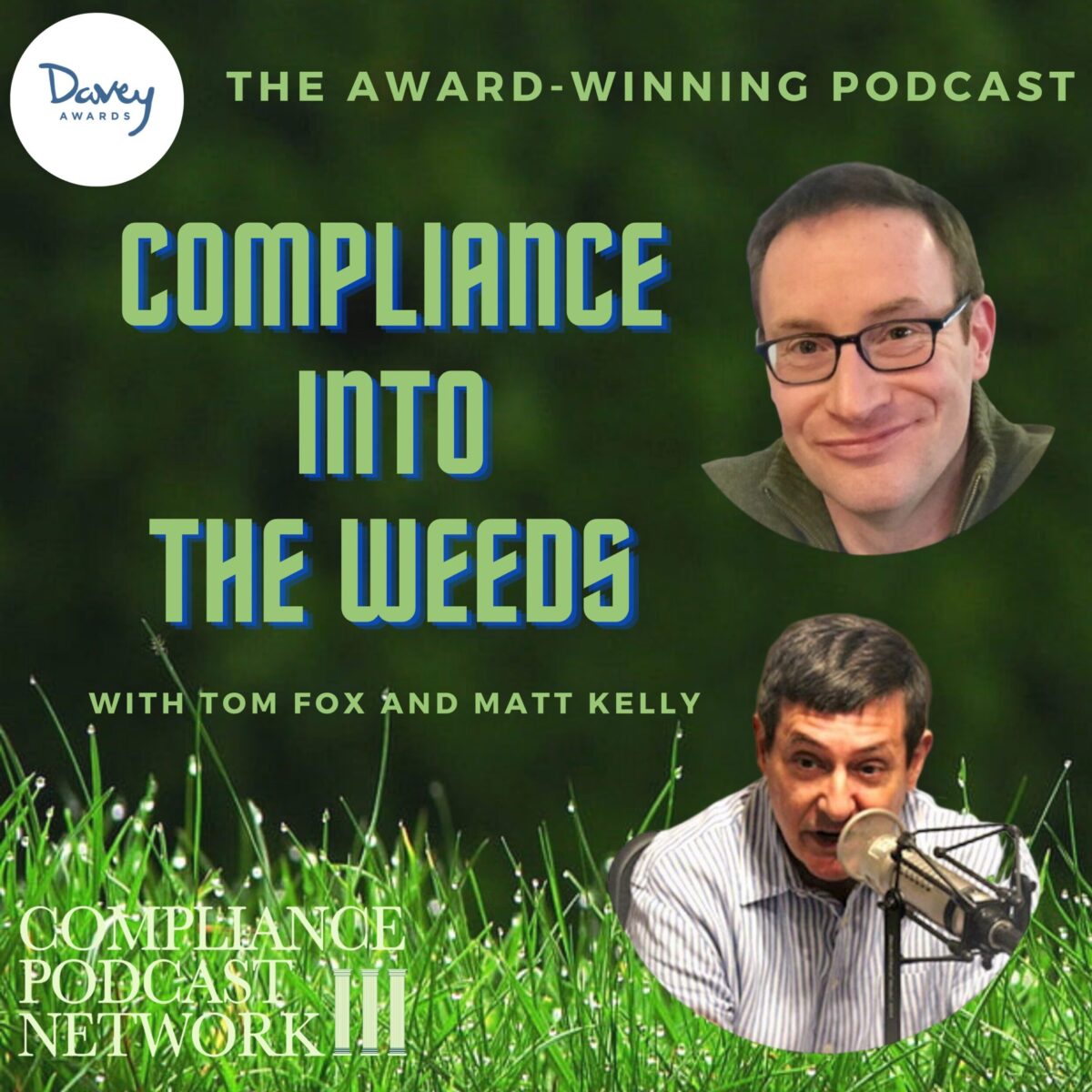
The award-winning Compliance into the Weeds is the only weekly podcast that takes a deep dive into a compliance-related topic, literally going into the weeds to explore it more fully. Looking for some hard-hitting insights on compliance? Look no further than Compliance into the Weeds! In this episode, Tom Fox and Matt Kelly look at the new DOJ AAG position, which will report directly to the White House.

They also explore the implications of this move, the regulatory chaos it may create, and the potential for politically motivated enforcement actions. The conversation emphasizes the uncertainty facing compliance professionals, the need for robust risk management strategies in light of these changes, and the chaos that capitalism has introduced into American business.

Key highlights:

  • Introduction to the Department of Retribution
  • The New Assistant Attorney General for Fraud
  • Political Implications of Fraud Enforcement
  • Potential Targets of Enforcement
  • Navigating Chaos Capitalism
  • Risk Management Strategies for Compliance Professionals

Resources:

Matt in Radical Compliance

Tom

Instagram

Facebook

YouTube

Twitter

LinkedIn

A multi-award-winning podcast, Compliance into the Weeds was most recently honored as one of the Top 25 Regulatory Compliance Podcasts, a Top 10 Business Law Podcast, and a Top 12 Risk Management Podcast. Compliance into the Weeds has been conferred a Davey, a Communicator Award, and a W3 Award, all for podcast excellence.

Categories
Daily Compliance News

Daily Compliance News: January 12, 2026, The Corruption is Free Speech Edition

Welcome to the Daily Compliance News. Each day, Tom Fox, the Voice of Compliance, brings you compliance-related stories to start your day. Sit back, enjoy a cup of morning coffee, and listen in to the Daily Compliance News. All, from the Compliance Podcast Network. Each day, we consider four stories from the business world, compliance, ethics, risk management, leadership, or general interest for the compliance professional.

Top stories include:

  • FirstEnergy defendants in Ohio say corruption is simply ‘free speech’. (Ohio Capitol Journal)
  • Corruption allegations rock Cyprus. (Politico)
  • Venezuelans say Trump ‘too corrupt’. (Fortune)
  • Florida MAGA ‘queasy’ over Trump corruption. (AlterNet)
Categories
Blog

Will Trump Suspend FCPA Enforcement in Venezuela?

Now that I have your attention with this clickbait title, I want to explore today what the Venezuelan imbroglio may mean for compliance professionals and energy companies who are looking at either entering the Venezuelan market or, in many cases, re-entering it after the not invasion (since it was not a military action authorized by Congress); not a police action (that the Korean War takes the moniker); but the capture of President Maduro and his wife to purloin Venezuela’s oil. As noted by New York Times (NYT) columnist Thomas Friedman today, “It is now clear that Trump’s priority in capturing President Nicolás Maduro of Venezuela was not to make that country safe for the restoration of democracy but to make it safe for the restoration of American oil companies’ dominance over Venezuelan oil extraction.”

But there are multiple obstacles to the US getting to and removing Venezuelan oil. As the Wall Street Journal (WSJ) noted, “But getting foreign companies to flock back to Venezuela will be a massive challenge. Chevron is the only major U.S. oil company and the country’s largest foreign investor. Other oil executives will be forced to gauge the stability on the ground in a country where the industry has fallen into disarray after more than two decades of mismanagement and corruption.” Economically, it may make little to no sense.

Corruption and PDVSA

But from the compliance perspective, there is the issue of corruption. As I wrote back in 2017, “Of all the stench from corruption, not much is more odious than that from the Venezuelan state oil company Petróleos de Venezuela SA (PDVSA). Whether it is shaking down contractors for Rolex watches to schedule a meeting, requiring a bribe to get payments on outstanding invoices, or simply good old-fashioned cash to get on a bid list, PDVSA is perceived to be one of the most institutionally corrupt energy companies around.”

How President Trump plans to get the Venezuelan oil out of the country is not known at this point. But unless he orders US energy companies to put boots on the ground to rebuild PdVSA’s decrepit infrastructure, those same companies will have to deal with the same corrupt PdVSA officials.

In the context of Venezuela’s reopening to Western energy investment, President Trump’s decision to pause enforcement of the Foreign Corrupt Practices Act (FCPA) reflected a broader strategic pivot toward what his administration calls economic competitiveness and national security. His Executive Order issued in early 2025 directed the Department of Justice (DOJ) to halt new FCPA investigations for at least 180 days while it reviewed enforcement priorities on the premise that strict anti-bribery enforcement, as it has traditionally been applied, “impedes U.S. foreign policy objectives” and disadvantages American companies relative to global competitors. The policy rationale was that, in markets perceived as corrupt or opaque, rigorous FCPA enforcement has historically dissuaded US firms from competing effectively, particularly against foreign rivals who do not face the same legal constraints. This argument, which resonated with a strand of populist economic nationalism, frames FCPA enforcement as a barrier to energy companies securing strategic resources, such as Venezuelan oil, rather than as a purely ethical safeguard.

From a compliance professional’s lens, this recalibration had two implications. On one hand, it might reduce the immediacy of DOJ scrutiny for conduct in jurisdictions like Venezuela, where corruption risk is endemic. On the other hand, the suspension does not abolish the law; FCPA remains on the books, and enforcement priorities can flip with the political winds or through congressional action. Moreover, the suspension could embolden local partners or intermediaries to push for irregular payments under the assumption that US enforcement is weak, creating significant red-flag risks for energy companies seeking to operationalize robust controls aligned with the DOJ’s Evaluation of Corporate Compliance Programs (ECCP) standards. Even under a relaxed enforcement regime, a strong compliance program grounded in the ECCP’s emphasis on risk-based design, continuous monitoring, and senior-management accountability remains a critical commercial and legal hedge.

Compliance Going Forward

One of the most important takeaways for compliance professionals confronting Venezuela is the necessary shift from reflexive risk avoidance to disciplined risk management. Mike DeBernardis told me that the modern compliance mandate “is no longer to say ‘no’ when risk is high; it is to say ‘yes, if’ the risk can be identified, structured, and controlled.” This is not a philosophical shift. It is explicitly embedded in the ECCP, which does not reward companies for avoiding difficult markets but instead evaluates how effectively they manage risk in precisely those environments.

In the Venezuelan energy context, this means compliance must be deeply embedded in the business strategy from the outset. Compliance professionals must fully understand the proposed energy project, including its commercial objectives, operational footprint, and timelines. They must map every anticipated interaction with the Venezuelan state, particularly with state-owned enterprises, regulators, customs authorities, and security services.

From there, compliance professionals must identify where corruption pressure is most likely to arise, not in theory but in practice, based on how the business will actually operate. Only then can bespoke controls be designed to address those specific risks. The ECCP repeatedly emphasizes that effective compliance programs are well-designed, adequately resourced, and genuinely empowered. This is where compliance earns its seat at the strategy table. If compliance is engaged only after contracts are signed and capital committed, its ability to influence outcomes is sharply diminished, and the program is far more likely to fail under real-world pressure.

If initial program design is the foundation, continuous monitoring is the load-bearing structure. Energy operations in Venezuela will not tolerate static compliance approaches built around annual certifications or periodic check-the-box reviews. The ECCP explicitly asks whether companies test the effectiveness of their controls and whether they respond promptly and meaningfully to issues as they arise. In a high-risk jurisdiction like Venezuela, corruption risk will evolve rapidly as political conditions, counterparties, and regulatory expectations shift. Compliance programs must therefore be dynamic.

This requires live monitoring of payments, invoices, and reimbursements, particularly those involving third parties and state-linked entities. It requires regular compliance check-ins with project teams operating on the ground and under real-time pressure. It also requires targeted audits that focus narrowly on high-risk transactions rather than broad, generic reviews that miss the point. When red flags appear, swift remediation is essential, including the authority to pause transactions or relationships when necessary. Friction with the business is inevitable in this environment. Under the ECCP, however, that friction is not evidence of failure. It is evidence of independence, effectiveness, and seriousness of purpose.

For energy companies, Venezuela may well be worth the risk. The size of the opportunity, particularly in hydrocarbons, may make disengagement an increasingly unrealistic option. For compliance professionals, however, the mandate is clear and unforgiving. Programs must be designed with the assumption that pressure will occur, that shortcuts will be suggested, and that local counterparts may view compliance as negotiable.

Effective programs anticipate misconduct rather than react to it, and they are built to withstand scrutiny not only from local stakeholders but also from US enforcement authorities looking back months or years later. This requires compliance professionals to think and act as strategic risk managers, not policy custodians. They must insist on visibility into business decisions, demand resources commensurate with risk, and maintain the authority to intervene when necessary.

In the Venezuelan context, success will not be defined by the absence of issues but by how quickly and credibly the organization detects and addresses them. That approach is not merely about satisfying regulatory expectations. It is about protecting the company’s people, assets, and reputation in one of the most challenging operating environments in the world. That is not just compliance. That is strategic risk management at its purest and most demanding.


Categories
2 Gurus Talk Compliance

2 Gurus Talk Compliance – Episode 67 – Our Favorite Stories Edition

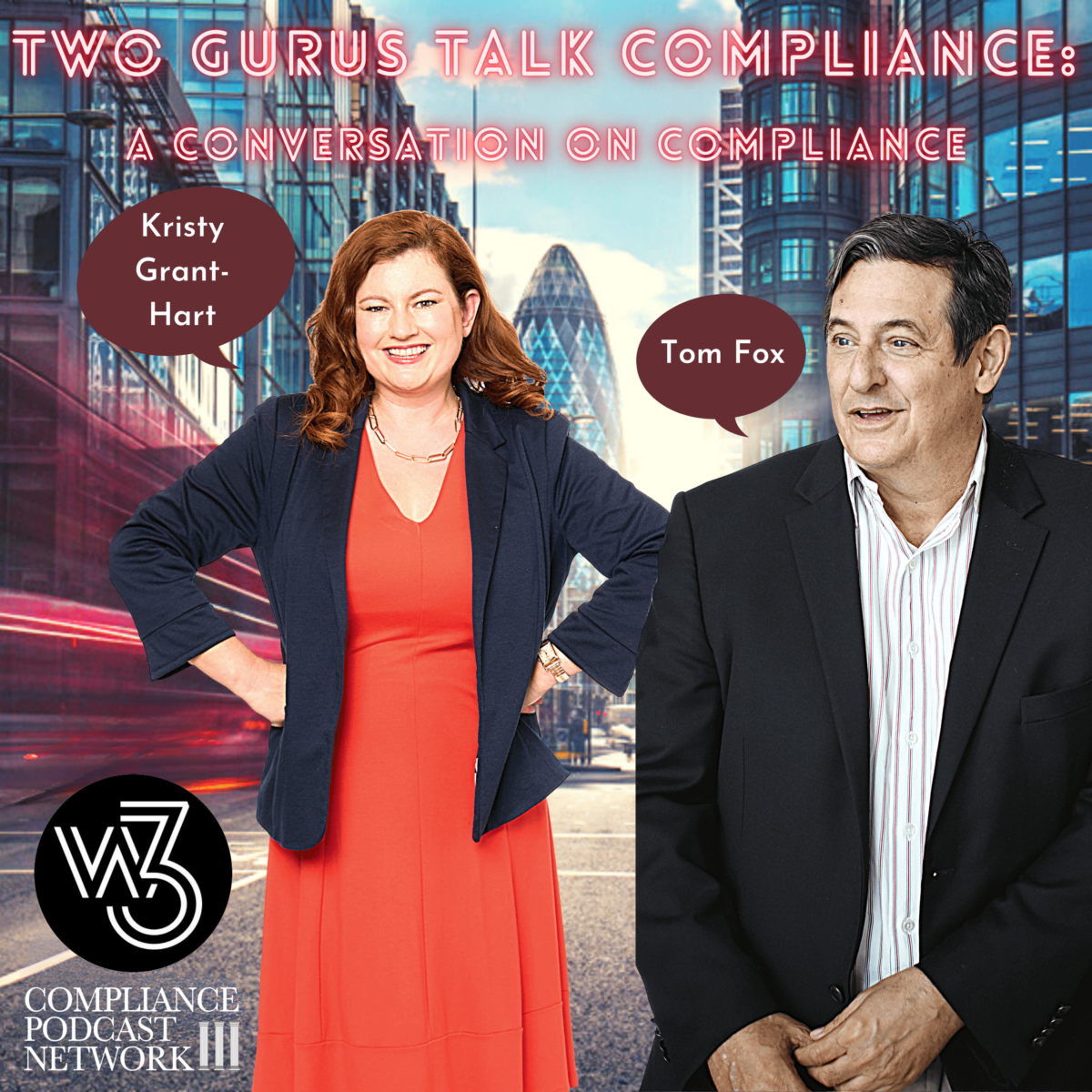
What happens when two top compliance commentators get together? They talk compliance, of course. In this episode, Kristy Grant-Hart and Tom Fox delve into their top ten most compelling compliance stories from 2025. The discussion includes controversial presidential pardons, the impact of the Trump administration on the American justice system, and shifts in the EU’s regulatory landscape. They also explore the complexities of managing a multigenerational workforce, the implications of AI as a potential whistleblower, and reflections on the importance of maintaining trust in safety protocols at organizations like NASA. The episode wraps up with an amusingly bizarre ‘Florida Man’ story. Tune in for a blend of compliance insights and entertaining anecdotes.

Our Favorite Stories:

  • Top Story: Presidential Pardons and Their Impact
  • Geopolitical Turmoil and Business Risks
  • Trump as CEO: Implications for US Corporations
  • Shifts in EU Legislation and Regulation
  • Generational Differences in the Workplace
  • AI in Compliance: Risks and Ethical Considerations
  • Engagement Surveys and Corporate Culture
  • NASA Safety Concerns and Compliance
  • Florida Man: The Best Story of 2025

Resources:

Kristy Grant-Hart on LinkedIn

Prove Your Worth

Tom

Instagram

Facebook

YouTube

Twitter

LinkedIn

Categories
Daily Compliance News

Daily Compliance News: November 5, 2025, The Sex Dolls in Paris Edition

Welcome to the Daily Compliance News. Each day, Tom Fox, the Voice of Compliance, brings you compliance-related stories to start your day. Sit back, enjoy a cup of morning coffee, and listen in to the Daily Compliance News. All, from the Compliance Podcast Network. Each day, we consider four stories from the business world, including compliance, ethics, risk management, leadership, or general interest, relevant to the compliance professional.

Top stories include:

  • Trump threw a temper tantrum over corruption Q. (Daily Beast)
  • SBF says trial ‘fundamentally unfair’. (FT)
  • State capture and corruption. (The Guardian)
  • Sex dolls, compliance, and Shein. (WSJ)

The Daily Compliance News has been honored as the No. 2 in the Best Regulatory Compliance Podcasts category.

Categories
Daily Compliance News

Daily Compliance News: October 23, 2025, The Stay in Your Lane Edition

Welcome to the Daily Compliance News. Each day, Tom Fox, the Voice of Compliance, brings you compliance-related stories to start your day. Sit back, enjoy a cup of morning coffee, and listen in to the Daily Compliance News. All, from the Compliance Podcast Network. Each day, we consider four stories from the business world, compliance, ethics, risk management, leadership, or general interest for the compliance professional.

Top stories include:

  • More on BCG protocols. (WSJ)
  • Avoiding AI slop at work. (FT)
  • No Conflict of Interest here. (Reuters)
  • Belgian-EU prosecutor’s cross swords. (Euractiv)

The Daily Compliance News has been honored as the No. 2 in the Best Regulatory Compliance Podcast category.

Categories
2 Gurus Talk Compliance

2 Gurus Talk Compliance – Episode 57 – The Tom on His Highhorse Edition

What happens when two top compliance commentators get together? They talk compliance, of course. Join Tom Fox and Kristy Grant-Hart in 2 Gurus Talk Compliance as they discuss the latest compliance issues in this week’s episode!

Stories this week include:

  • Thoughts on the Compliance Job Market (Radical Compliance)
  • A Shadow AI Crisis Is Brewing in the GC’s Office (Corporate Compliance Insights)
  • I built a company that broke people. Now I’m choosing capitalism with love (Fast Company)
  • European Union: Specific regulation of technological impact on the workforce
  • Trump is now the CEO of all US corps. (WSJ)
  • Trump tells Intel to fire CEO. Are you next? (WSJ)
  • Uber picked business over customer safety. (NYT)
  • 9th Circuit upholds SEC gag rule. (Reuters)
  • To Regulate or Not To Regulate. (Bloomberg)
  • Florida man posed as flight attendant to score dozens of free flights: officials – Fox 35 Orlando

Resources:

Kristy Grant-Hart on LinkedIn

Prove Your Worth

Tom

Instagram

Facebook

YouTube

Twitter

LinkedIn

Categories
Daily Compliance News

Daily Compliance News: August 6, 2025, The Spanking Banks Edition

Welcome to the Daily Compliance News. Each day, Tom Fox, the Voice of Compliance, brings you compliance-related stories to start your day. Sit back, enjoy a cup of morning coffee, and listen in to the Daily Compliance News. All, from the Compliance Podcast Network. Each day, we consider four stories from the business world, compliance, ethics, risk management, leadership, or general interest for the compliance professional.

Stories include:

  • Trump wants to punish banks. (WSJ)
  • When ABC becomes corrupted. (FT)
  • Is the Comic Sans font evil? (FT)
  • Microsoft is going RTO. (Business Insider)

You can donate to flood relief for victims of the Kerr County flooding by going to the Hill Country Flood Relief here.

Categories
Daily Compliance News

Daily Compliance News: May 22, 2025, The Trump and Dump Edition

Welcome to the Daily Compliance News. Each day, Tom Fox, the Voice of Compliance, brings you compliance-related stories to start your day. Sit back, enjoy a cup of morning coffee, and listen in to the Daily Compliance News—all from the Compliance Podcast Network. Each day, we consider four stories from the business world: compliance, ethics, risk management, leadership, or general interest for the compliance professional.

Top stories include:

  • When is a bribe a gift? (FT)
  • Export controls for chips have backfired. (NYT)
  • Matt Levine on the ‘Trump and Dump’ strategies used by cryptos. (Bloomberg)
  • More corruption allegations against ex-Malaysia PM. (Bloomberg)