The curse of the House of Atreus did not begin and end with Tantalus. Like many toxic corporate cultures, it passed from one generation to the next a legacy of moral shortcuts disguised as clever strategy.
We continue our look at lessons from the House of Atreus for the 21st-century compliance profession, focusing on the key stories and mining them for valuable insights. In today’s Part 2, we consider the myth of Pelops and Myrtilus, an ancient fable about corruption, betrayal, and the fatal cost of winning the wrong way. In this story, we look at Pelops, who was Tantalus’s son. Having been literally restored to life by the gods, he had the chance to rebuild his house on a foundation of integrity. Instead, he reached for the easy win, and in doing so, repeated his father’s error: he traded ethics for expedience.
For modern compliance professionals, it is a reminder that bribery and ethical compromise never end where you think they will. They will always come back to haunt you.
The Chariot Race for a Kingdom
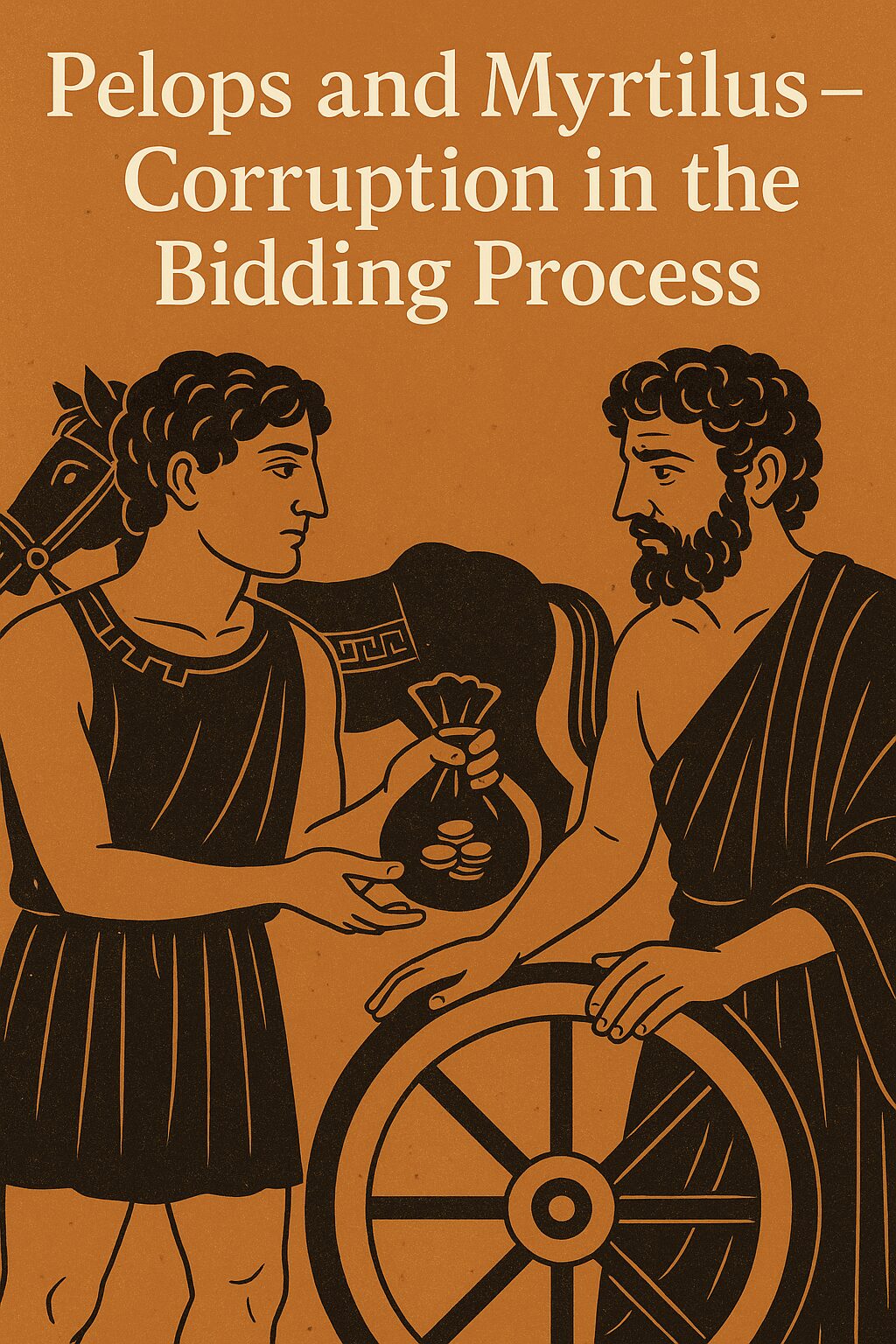
According to Greek legend, King Oenomaus of Pisa received a prophecy that he would die at the hands of his son-in-law. To prevent this, he devised a deadly test for any man seeking to marry his daughter, Hippodamia, a chariot race from Pisa to Corinth. If the suitor won, he gained Hippodamia’s hand. If he lost, he died. Pelops, ambitious and determined, entered the race. But he knew Oenomaus’ horses were divine and unbeatable. So he sought an advantage, not through skill or preparation, but through corruption.
He approached the king’s charioteer, Myrtilus, and offered a bribe: riches, favor, and a promise of reward. Myrtilus agreed to sabotage Oenomaus’ chariot by replacing the bronze linchpins with wax. During the race, the wax melted, the chariot crashed, and the king was killed.
But when Myrtilus came to claim his reward, Pelops betrayed him, either pushing him off a cliff or ordering his death. As he fell, Myrtilus cursed Pelops and his descendants, ensuring the family’s cycle of corruption and vengeance would continue.
The First Procurement Fraud
Strip away the mythic trappings, and Pelops’ race looks remarkably modern.
This was a procurement process, a competition for something of value (in this case, marriage and a kingdom), corrupted by bribery and fraud. Pelops did not win on merit; he won by manipulating a key insider in the process.
That’s the same dynamic at play in so many real-world scandals:
- A contractor bribing a government official for an unfair advantage.
- A vendor is rigging bids through inside information.
- A company turning a blind eye to its agents’ actions abroad, so long as they deliver results.
In each case, the underlying temptation is the same as Pelops’: the belief that “winning is what matters.”
The Illusion of a “Victimless” Bribe
Pelops might have rationalized his actions. He could have told himself that everyone cheats in such races or that Oenomaus’ divine horses made the contest unfair to begin with, that the ends justified the means.
Modern compliance officers hear versions of this rationalization every day:
- “It’s just a facilitation payment.”
- “That’s how business is done in this region.”
- “We’re not bribing; we’re just showing appreciation.”
But as Pelops learned, there is no such thing as a victimless bribe. His corruption did not end with a single race; unfortunately, it defined generations. Myrtilus’ curse became symbolic of the reputational and ethical taint that lingers long after the bribe is paid.
Third-Party Risk: Myrtilus as the First “Agent”
In compliance terms, Myrtilus represents the classic third-party intermediary, the local fixer, the consultant, the distributor. He was not a direct employee, but his actions became Pelops’ liability. When Pelops bribed Myrtilus, he created not just moral exposure, but third-party risk. Once you involve a third party in your scheme, you lose control over the outcome. Myrtilus could expose him, blackmail him, or turn witness.
Modern compliance programs have learned this lesson the hard way. Nearly every major FCPA enforcement action, from Siemens to Petrobras to Deere, involves third-party intermediaries. These individuals promise results, grease local wheels, and leave the company holding the bag when the investigation begins. Pelops thought he could control Myrtilus. He could not. No one ever can.
The Cost of Betrayal: When Corruption Destroys Trust
After the race, Pelops killed Myrtilus to eliminate a liability. But in doing so, he destroyed something even more valuable: trust.
Once an organization uses deception as a tool, it cannot sustain authentic relationships with employees, partners, regulators, or the public. Each act of concealment breeds another, until deception becomes standard operating procedure.
We’ve seen this pattern again and again:
- A company that falsifies quality reports must falsify safety audits next.
- A firm that manipulates bid data must suppress whistleblowers who question it.
- A leader who lies externally must eventually lie internally.
In the end, Pelops did not just kill a man; he killed his organization’s capacity for integrity. That’s the same fate that awaits companies that treat compliance as expendable.
Culture Eats Compliance for Breakfast
The myth of Pelops is not about one race or one bribe; it is about the cultural rot that follows. Once Pelops normalized deceit, his descendants followed suit.
In corporate life, this manifests as a culture of winning at any cost, the most dangerous culture there is. It’s what drives salespeople to falsify data, procurement officers to overlook red flags, and executives to manipulate books.
Culture eats compliance for breakfast because if the unspoken rule of your organization is “get the deal,” no policy manual will save you. Pelops’ court would have had a Code of Ethics printed in gold, and it still wouldn’t have mattered. The only antidote is integrity built into incentives, recognition, and leadership behavior.
Lessons for Modern Compliance Professionals
What can we learn from Pelops’ fall? Quite a lot. His story offers five timeless lessons for those charged with safeguarding ethics and integrity in complex organizations.
1. Corruption Always Starts Small
The first step down the wrong path rarely looks like a scandal. It seems like a shortcut. A “favor.” A small gift. Pelops’ race was just one event, yet it came to define an entire dynasty. The concept of broken windows has demonstrated that you should treat every minor ethical compromise as a potential precedent. Small acts of misconduct become cultural habits faster than anyone realizes.
2. Third-Party Due Diligence Is Non-Negotiable
Myrtilus’ betrayal highlights why vetting, monitoring, and auditing third parties is critical. Companies must know who they’re partnering with and what incentives drive their actions. This means that compliance must have a robust third-party risk management process in place. You should require a business justification, a questionnaire, documented due diligence, risk-based screening, compliance terms and conditions in your contract, and ongoing monitoring for all third parties after the contract is signed. Finally, transparency is not optional; it is mandatory.
3. Ethical Procurement Builds Long-Term Value
In the rush to “win” contracts, companies often forget that ethical procurement protects more than reputation; it protects relationships. A tainted bid can lead to debarment, litigation, and loss of trust from clients and governments alike. For the compliance professional, you must embed integrity in procurement policy. Make ethics a competitive advantage, not a compliance burden.
4. Retaliation Destroys Cultures
Pelops’ murder of Myrtilus was the ancient equivalent of whistleblower retaliation. Myrtilus knew too much, and instead of managing the risk ethically, Pelops eliminated the witness. The result? A curse or, in modern terms, a scandal that never dies. Every compliance professional must work diligently to protect those who speak up. Encourage reporting. Make it clear that retaliation is a firing offense, not a survival tactic.
5. Integrity Outlasts Every Shortcut
Pelops won his race but lost his legacy. The true measure of success for individuals and organizations alike is sustainability. Ethical wins last; corrupt ones collapse. This requires corporate cultures where ethical behavior and business success are aligned. When values drive results, not the other way around, compliance becomes self-sustaining.
The Curse of the Easy Win
Every compliance professional has faced their “Pelops moment”; that pressure to deliver results faster, cheaper, or more impressively than the rules allow. The temptation is powerful because it is wrapped in the language of success. But as Pelops shows, every unethical win carries a hidden invoice. The ancient Greeks would call it nemesis, the inescapable reckoning that follows hubris. We call it enforcement. Whether through regulators, prosecutors, or public outrage, the bill always comes due.
The challenge for modern compliance leaders is to help their organizations see beyond the race. Winning today is not worth cursing tomorrow.
Join us tomorrow for Part 3 — Atreus and Thyestes: Internal Rivalry and the Dangers of Retaliation. We will explore how infighting, revenge, and the weaponization of leadership destroyed the next generation and how modern organizations can prevent internal culture wars from becoming compliance catastrophes.