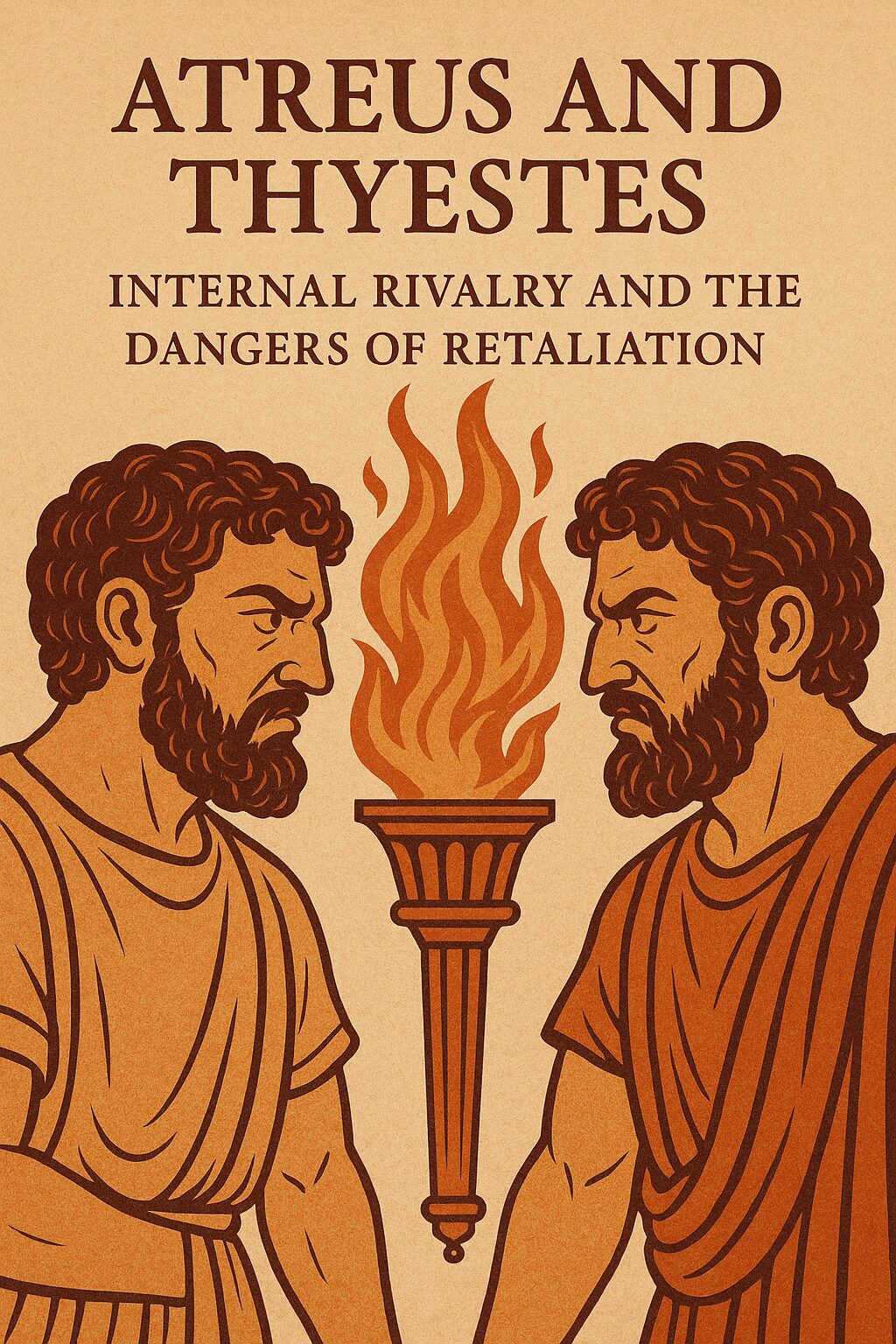
We continue to look at the lessons from the House of Atreus for the 21st-century compliance profession, focusing on the key stories and mining them for insights. In today’s Part 3, we take up the feud between Atreus and Thyestes, sons of Pelops and heirs to his poisoned legacy. Their myth is not just about murder and betrayal; it is about what happens when leaders weaponize authority for vengeance rather than stewardship.
Every organization eventually faces conflict within its own ranks. Disagreements over power, vision, and credit are inevitable. But when rivalry turns to revenge, governance collapses, trust erodes, and compliance becomes collateral damage. Today, we take a deep dive into this issue from the 21st-century compliance perspective.
The Feast of Vengeance
After Pelops’ death, his sons Atreus and Thyestes fought over the throne of Mycenae. They began like many corporate siblings, ambitious, capable, and determined to lead. But soon ambition turned into envy. Thyestes seduced Atreus’ wife and stole a prized golden lamb that symbolized kingship.
Atreus, humiliated, plotted revenge. Pretending reconciliation, he invited Thyestes and his sons to a grand banquet. During the feast, Atreus served them a meal of Thyestes’s own children. (Shakespeare used this story much later.) When the truth was revealed, horror swept the hall. Thyestes cursed his brother, and the curse carried through the next generation, consuming Atreus’ son Agamemnon and his grandson Orestes. It is a horrifying tale, but beneath the gore lies a familiar truth: internal retaliation destroys organizations from the inside out.
When Leadership Turns on Itself
Atreus’ banquet is not simply a mythic horror story fit for my classic monster movie month; rather, it is a 21st-century metaphor for every leadership team that devours its own. In terms of compliance, Atreus and Thyestes represent toxic internal politics. They illustrate how leadership rivalries, unchecked ego, and personal vendettas can dismantle governance systems faster than any external scandal.
Modern organizations suffer the same fate when:
- Executives undermine each other publicly.
- Managers retaliate against whistleblowers or rivals.
- Compliance officers are punished for doing their jobs.
When leaders use their authority to punish rather than protect, culture collapses into fear. Employees stop reporting misconduct, colleagues turn on one another, and the compliance function becomes an instrument of control instead of accountability. Atreus’ feast might look extreme, but we have all seen versions of it in the workplace.
The Corporate Equivalent of the Cannibal Feast
Let’s translate the myth into modern terms.
- Atreus’ “banquet” = a retaliatory campaign designed to humiliate a rival or critic.
- Thyestes’ seduction = internal manipulation, gossip, or theft of credit.
- The curse = the lingering culture of distrust that infects every successor.
Retaliation rarely ends with the original act. Once one leader weaponizes power, everyone learns the same lesson: “You’re safe only when you’re silent.” That’s how once-strong organizations become silos of fear. Compliance reports decline not because misconduct has ended, but because employees no longer believe reporting is safe. Like the House of Atreus, the company devours itself while pretending to feast.
The Dangers of Internal Retaliation
From the compliance perspective, retaliation is one of the clearest indicators of cultural rot. It’s also one of the DOJ’s most serious red flags. The 2024 Evaluation of Corporate Compliance Programs (ECCP) explicitly asks prosecutors to evaluate:
- Whether employees are protected from retaliation.
- Whether complaints lead to timely investigations.
- Whether leadership promotes a speak-up culture.
If your organization punishes dissent, even quietly, you may well find yourself already on the DOJ’s radar. Atreus’ actions were the ultimate act of retaliation: gruesome, personal, and destructive. But the underlying pattern is timeless, leadership vengeance disguised as discipline. The lesson is as modern as it is mythic: a compliance program without psychological safety is a compliance program in name only.
Case Study Parallels: When Modern Leaders Feast on Their Own
- Uber (2017): Retaliation against employees who raised harassment claims led to executive resignations and a cultural overhaul.
- Wells Fargo: Whistleblowers reported retaliation after flagging fraudulent account practices, compounding reputational damage.
- Boeing (737 MAX): Internal dissent on safety concerns was suppressed, leading to tragedies that reshaped regulatory scrutiny.
Each of these companies faced its own version of Atreus’ banquet, consuming credibility and trust in the process.
The Role of Compliance in Preventing Organizational Cannibalism
The compliance function exists not just to catch misconduct, but to defend integrity against internal retaliation. A strong compliance culture ensures that ethical leadership trumps personal rivalry. Here’s how to do it:
1. Build governance that transcends personalities. Authority should rest on process, not proximity to power.
2. Separate investigative authority from reporting lines. Compliance officers must have autonomy to act without interference.
3. Educate leadership on the cost of retaliation. Retaliation isn’t just a legal risk — it’s a culture killer.
When leaders understand that internal war erodes value faster than external threats, they start behaving more like guardians than gladiators.
Creating a Culture of Trust After Betrayal
Atreus’ kingdom fell because no one could trust anyone. In business terms, that’s what happens when transparency dies. To rebuild trust, companies must do three things:
1. Acknowledge Harm. Pretending internal feuds never happened only deepens cynicism. Compliance leaders must publicly reinforce that retaliation and toxicity are violations of corporate values. Acknowledgment is the first step toward cultural repair.
2. Reinforce Transparency. Regular reporting on investigations, outcomes, and disciplinary measures builds credibility. Employees must see that misconduct is addressed fairly, not selectively.
3. Model Ethical Reconciliation. Where conflict exists, leaders must model resolution through dialogue, not vengeance. A modern compliance culture is one where accountability coexists with forgiveness, where mistakes are corrected, not avenged.
Leadership Ego and the Compliance Cost
The rivalry between Atreus and Thyestes began with ego, the same ego that drives many corporate meltdowns. Ego tells leaders that compliance is optional, that their moral compass is self-calibrated. It convinces them that retaliation is justified, that “he started it,” or that removing a critic will restore order.
But as every compliance professional knows, ego is expensive. It costs credibility, cooperation, and often millions in remediation and fines. The only sustainable leadership model values humility over hubris. In compliance terms: replace ego with ethics, and rivalry with responsibility.
The Compliance Evangelist’s Reflection: The Curse of the Retaliator
Atreus believed vengeance would bring closure. Instead, it ensured endless conflict. In organizations, retaliation operates the same way. It may silence the critic today, but it guarantees more fear and more silence tomorrow.
The DOJ, SEC, and whistleblower programs worldwide have made one thing clear: protecting those who speak up is not just the right thing to do; it is the smart business approach. The companies that thrive in the modern regulatory landscape are those that treat every internal voice as an asset, not a threat. Atreus’ downfall shows what happens when leaders fail to learn that lesson. His house became a case study in the cost of ignoring culture. For compliance professionals, that’s the real moral: you cannot achieve ethical stability through punishment alone.
From Retaliation to Redemption
The saga of Atreus and Thyestes teaches us that retaliation is never a solution; it is a multiplier of risk. The only way to end the cycle is through structural and cultural change: transparency, accountability, and empathy in leadership. For compliance professionals, that means moving from enforcement to enlightenment, helping leaders understand that the true power of compliance is not control, but trust. Because when leaders stop feeding on their own and start feeding their culture with integrity, the curse finally breaks.
I hope you will join me tomorrow for Part 4 — Agamemnon and Clytemnestra: When Power Breeds Entitlement. In it, we will explore how Agamemnon’s moral compromises and Clytemnestra’s revenge illuminate the modern dangers of performance pressure, ethical trade-offs, and the corruption of power at the top.