If you work in compliance, you know the easiest slogan in the world is “we follow the law.” It is also one of the most dangerous. The law is a floor, not a ceiling. And in fast-moving technology, the law can be late, incomplete, and, at times, bent to serve the priorities of whoever holds power.
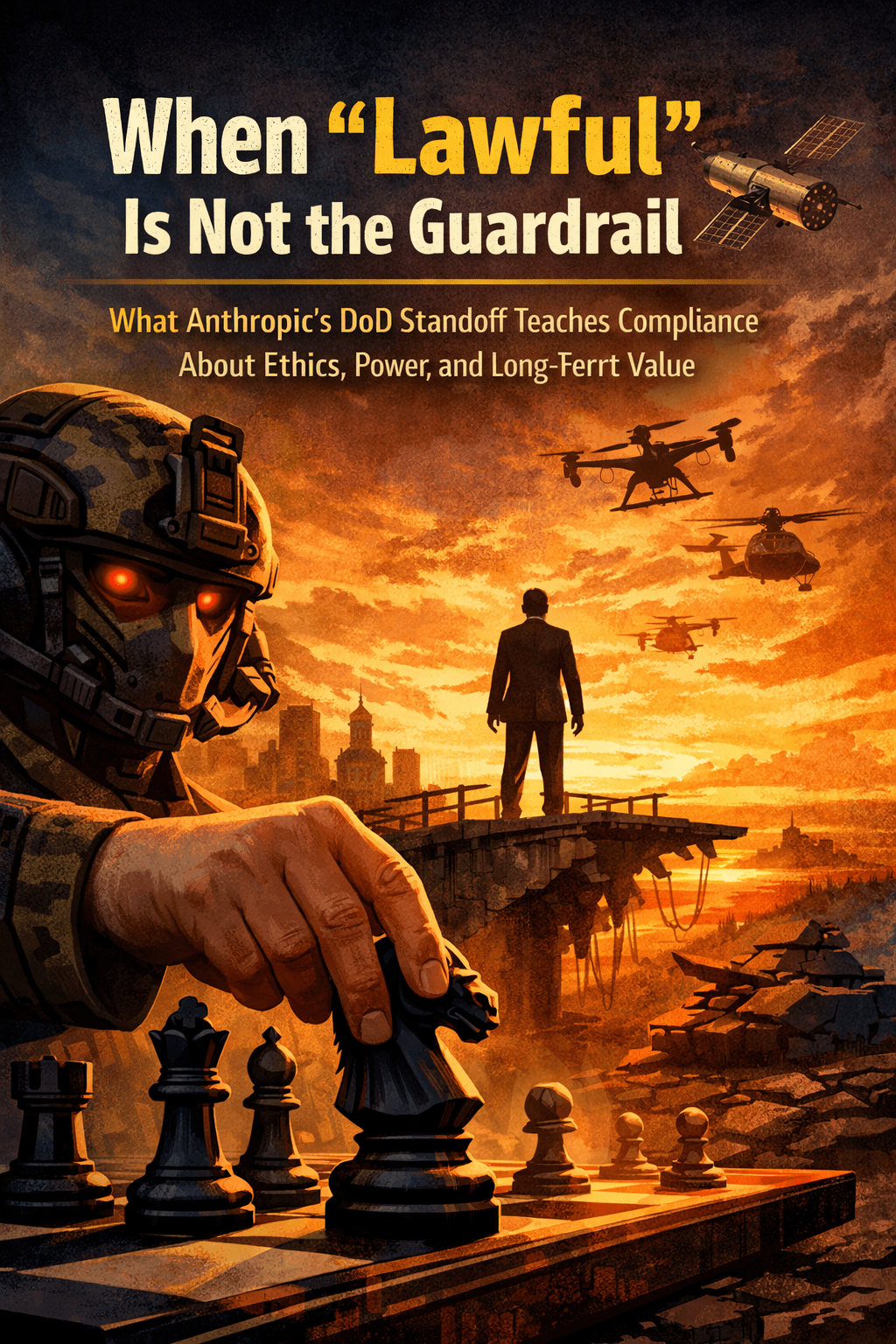
That is why the Anthropic decision to hold the line on two AI guardrails in its work with the US Department of Defense (DoD) deserves a close look by every Chief Compliance Officer. This is not only a tech story. It is an ethics story. It is also a governance story. And it is a business story about whether values are real when money and political pressure show up in the same room.
The facts that matter for compliance
According to Fortune, the DoD contract allowed use of Anthropic’s Claude model with two explicit limits: it could not be used to power fully autonomous weapons, and it could not be used for mass surveillance of American citizens. Those are not vague, feel-good commitments. They are operational guardrails tied to specific high-risk use cases.
The political blowback was immediate and personal. Fortune reports that President Donald Trump and Defense Secretary Pete Hegseth were “livid,” and that Undersecretary Emil Michael accused CEO Dario Amodei of having a “god complex”. Fortune also notes that “AI czar” David Sacks had been publicly agitated by Anthropic, accusing it of being run by “woke” AI alarmists. The message to business leaders was clear: do not constrain executive power, even with contract terms.
The Financial Times reported the government’s position as a demand for “any lawful use” of the model, with safeguards removed. Anthropic’s response, in Amodei’s public statement, was equally direct: “we cannot in good conscience accede to their request”.
Now, here is the compliance point that should stop you cold: “any lawful use” sounds reasonable until you remember what Anthropic argues in the same statement. On mass domestic surveillance, Anthropic says the practice is incompatible with democratic values and that, if it is legal today, it is only because “the law has not yet caught up with the rapidly growing capabilities of AI.” In other words, legality is not the ethical test. It is a lagging indicator.
Anthropic also laid out its second red line: fully autonomous weapons. The company said frontier AI systems “are simply not reliable enough” for that use and that it “will not knowingly provide a product that puts America’s warfighters and civilians at risk”. That is not politics. That is a duty of care.
Why this is really a “tone at the top” case study
Compliance professionals talk about the tone at the top because it is measurable in moments like this. When the pressure is existential, ethics is no longer a poster on the wall. It is a choice.
Anthropic’s founder framed the company’s posture as both mission and restraint. He wrote that some uses of AI can “undermine, rather than defend, democratic values,” and he identified mass domestic surveillance and fully autonomous weapons as two categories that “should not be included” in DoD contracts. He also emphasized that Anthropic had acted in ways “against the company’s short-term interest,” including foregoing revenue to cut off use tied to adversary-linked firms.
That is what tone at the top looks like when it costs money.
And as Alison Taylor put it, Amodei is making a bet that many leaders will not make: that the company’s “biggest source of long-term, intangible advantage, is being more trustworthy than the other AI firms”. That is a business thesis built on ethics, not ethics as decoration.
The compliance friction point: “Any lawful use” under a permissive executive
Every compliance officer has lived some version of this conversation:
- Business: “It is legal.”
- Compliance: “Legal does not mean acceptable.”
- Business: “If we do not do it, someone else will.”
- Compliance: “Then we should be the company that can explain our decision to a regulator, a court, our employees, and the public.”
Anthropic goes further and makes the key argument explicitly: powerful AI changes the risk profile so dramatically that existing surveillance rules are not a meaningful guardrail. For the compliance professional, this is the same principle you apply to third parties and bribery. You do not ask whether a payment can be papered as legal. You ask whether it violates your values, creates unacceptable risk, and will look indefensible when facts are laid bare.
Under the Trump administration, the “any lawful use” standard carries a sharper edge because the executive branch may interpret “lawful” aggressively, and because enforcement priorities can shift. That is exactly when companies need internal red lines that are not dependent on the political weather.
Five ethics-first lessons for the compliance professional
Lesson 1: Ethics must be contractual, not aspirational.
Anthropic did not merely publish principles. It embedded guardrails into the deal structure: no mass domestic surveillance; no fully autonomous weapons. Compliance should treat high-risk AI use cases the same way you treat anti-corruption controls: you operationalize them in contract terms, audit rights, and enforceable restrictions, not in marketing language.
Lesson 2: “Lawful” is not a control when the law is behind the technology.
Anthropic’s statement is blunt: surveillance might be legal only because the law has not caught up. That is your cue to stop using legality as your ethical compass. For AI, the pace of capability growth means the compliance function must define internal standards that anticipate harm rather than merely react to statutes.
Lesson 3: Tone at the top is proven when it is expensive.
This episode illustrates the real test: will leadership accept short-term pain to preserve long-term integrity? Anthropic says threats and pressure do not change its position, concluding, “we cannot in good conscience” comply. If your leadership supports ethics only when it is convenient, you do not have a tone at the top. You have tone in the brochure.
Lesson 4: Political retaliation risk is now part of the ethics calculus.
The Financial Times describes an unprecedented move to treat the company as a supply-chain risk, coupled with pressure on contractors. Fortune frames the response as an effort to crush a business for refusing to accept terms. Compliance leaders must plan for the modern reality: ethical stands can trigger political and commercial blowback. Your program has to be resilient enough to survive it.
Lesson 5: Ethics can be a competitive strategy, but it requires discipline.
Rivals moved quickly. The Financial Times reported that OpenAI signed a deal and publicly highlighted safety principles, including prohibitions on domestic mass surveillance and on human responsibility for the use of force. That is competition reacting to an ethics-driven market signal. Alison Taylor’s point is that the strategic frame is: trust is a durable advantage. The lesson for compliance is not to chase slogans. It is to build credibility through consistent decisions that align governance, product design, and customer commitments.
The business implications of standing on your ethics
Let us be clear: ethical leadership can hurt in the short run. Fortune notes the scale of federal contracting and its potential impact on business prospects. The Financial Times describes immediate restrictions and the scramble for alternatives. This is what it looks like when ethical constraints collide with power.
But the long-term business value is not hypothetical. In regulated and high-stakes markets, trust is currency. Customers want to know whether your controls can withstand pressure. Employees want to know whether leadership will protect the mission when it is unpopular. Regulators and courts want to know whether your governance is real.
Ethics is not the opposite of business. Ethics is risk management, reputation, retention, and resilience. Or, put more bluntly: ethics is what keeps you in business when the next crisis hits.
Compliance call to action: three moves to make this real
- Review your AI vendor contracts now. Identify and hard-code your red lines for high-risk uses, audit rights, incident reporting, and termination triggers. If your contract says “any lawful use,” you have not done your job.
- Update your AI use policy with explicit prohibitions and escalation paths. Do not rely on general language about “responsible use.” Name the use cases you will not support and build a governance process for exceptions.
- Run a tabletop exercise on an “any lawful use” demand. Put your leadership team in the scenario: a major customer pressures you to remove safeguards. Practice your decision rights, communications plan, and offboarding strategy before you face them in real time.
Anthropic’s decision is a reminder that compliance is not only about controls. It is about character. And when the DoD-sized spotlight hits your company, character is the only guardrail that never fails.