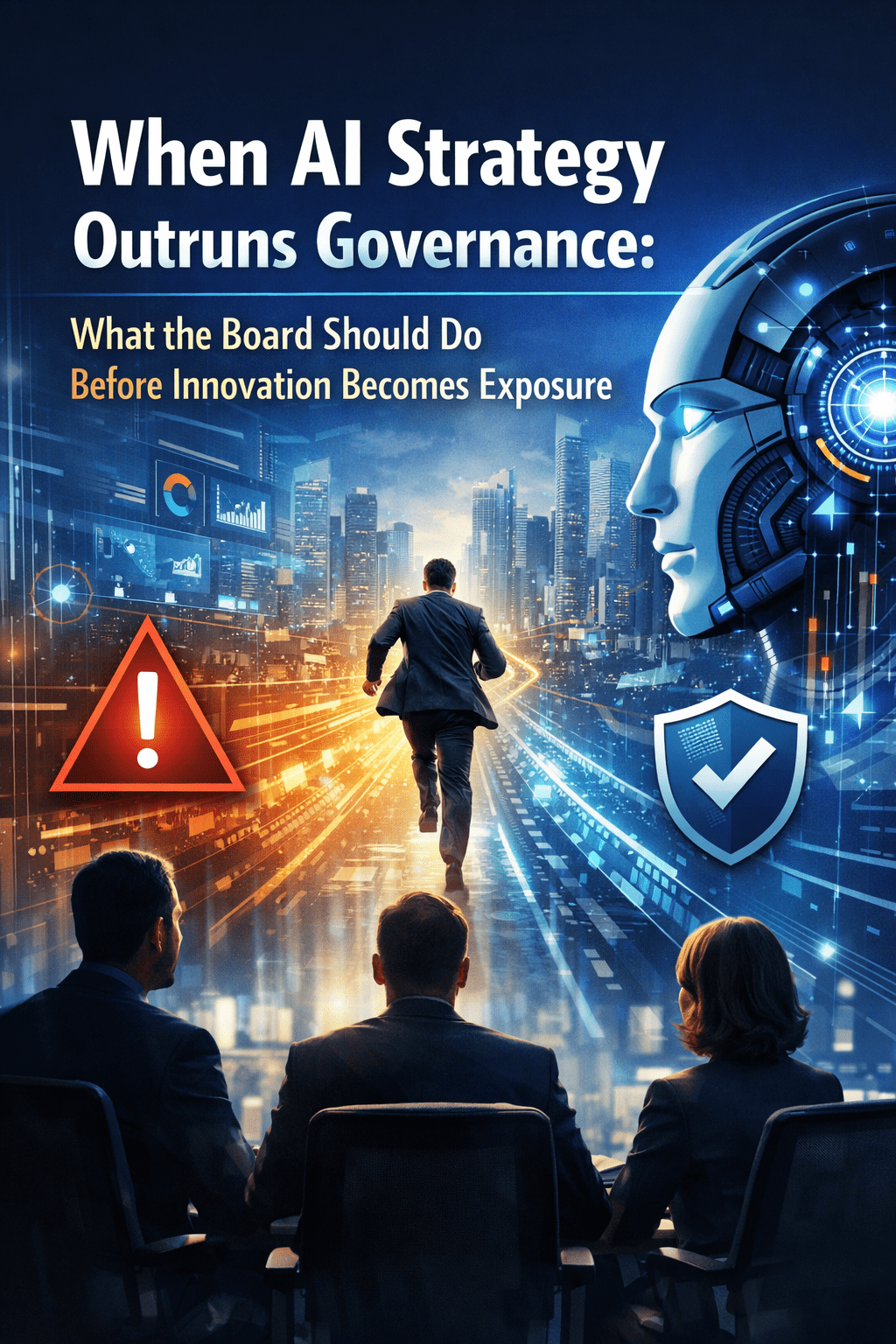
A scene is playing out in companies across the globe right now. Innovation teams are moving fast. Procurement is signing contracts. Business units are experimenting with copilots, workflow agents, and internal knowledge tools. Marketing is testing generative content. HR is evaluating AI for talent processes. Finance wants forecasting help. Security is watching from the corner. Legal is asking pointed questions. Compliance is handed the bill for governance after the train has already left the station. But the reality is that it is a board governance issue.
The problem is not that companies are moving too slowly on AI. In many organizations, the opposite is true. AI strategy is moving faster than the governance structure designed to oversee it. When that happens, the gap creates risk in ways boards understand very well: unmanaged decision-making, unclear accountability, inconsistent controls, fragmented reporting, and blind spots around operational resilience, ethics, and trust.
If you are a Chief Compliance Officer (CCO), this is your moment. Not to say no to AI. Not to become the Department of Technological Misery. But to help the board and senior leadership understand that AI governance is about capturing upside without swallowing avoidable downside. That is the central lesson. Strategy without governance is aspiration. Strategy with governance is a business discipline.
Why This Is a Board Issue
Boards are not expected to code models, evaluate vector databases, or decide which prompt library a business unit should use. They are expected to oversee risk, culture, controls, and management accountability. AI now sits squarely in that lane.
Once AI touches business processes, it can affect decision rights, data usage, customer interactions, employee treatment, financial reporting inputs, records management, and reputation. That means the board does not need to manage the machinery, but it must ensure a management system is in place for it.
This is where compliance can bring real value. Ethisphere’s latest work on the Ethics Premium makes a useful point for governance professionals: leading programs improve board reporting practices, including more frequent meetings with directors to ensure they receive the information needed for effective oversight, and they are also pushing documentation to be ready for AI-driven assistance so employees can find answers when they need them. In other words, mature governance is not static. It evolves as technology evolves.
That same report also reminds us that strong ethics and compliance systems are associated with higher returns, less downside, and faster recoveries, which is exactly the language boards understand when evaluating strategic risk and resilience.
So let us translate that lesson into the AI context. The board’s task is not to bless every shiny new tool. Its task is to ensure management has built an operating system for responsible AI use.
What a Board Should Do
The first thing a board should do is insist on a clear AI governance architecture. That means management should be able to answer basic questions cleanly and quickly. Who owns the enterprise AI strategy? Who approves high-risk use cases? Who validates controls before deployment? Who monitors incidents, exceptions, and drift? Who reports to the board? If five executives give five different answers, you do not have governance. You have a theater.
Second, the board should require a risk-based inventory of AI use cases. I am continually amazed at how many organizations start with policy language before they know where AI is actually being used. That is backwards. Boards should ask for a current inventory of internal, customer-facing, employee-facing, and vendor-enabled AI use cases. The inventory should distinguish between low-risk productivity tools and higher-risk uses involving sensitive data, regulated processes, legal judgments, employment decisions, or customer outcomes. If management cannot map the use cases, it cannot credibly manage the risk.
Third, the board should demand decision-use discipline. Not every AI output deserves the same level of trust. Some uses are advisory. Some are operational. Some may influence consequential business judgments. Boards should ask management where AI outputs are being relied upon, who reviews them, and what level of human oversight is required before action is taken. The issue is not whether humans are “in the loop” as a slogan. The issue is whether human review is meaningful, documented, and tied to the use case’s risk.
Fourth, the board should require intelligible reporting, not merely technical. Board oversight fails when management delivers either fluff or jargon. Directors need reporting that answers practical questions: What are our top AI use cases? Which ones are classified as high risk? What incidents or near misses have occurred? What controls were tested? What third parties are material to our AI stack? What changed this quarter? What needs escalation? Good board reporting turns AI from mystique into management.
That point is entirely consistent with what Ethisphere identifies in leading ethics and compliance programs: improved board reporting practices that provide directors with the information they need for effective oversight.
Where Compliance Officers Can Help the Board Most
This is where the CCO earns their seat at the table.
First, the compliance function can help management create the classification framework. Compliance professionals know how to tier risk, define escalation paths, and build governance around business reality. You have been doing it for years with third parties, gifts and entertainment, investigations, and training. AI is a new technology, but the governance muscle memory is familiar.
Second, compliance can help build the policy-to-practice bridge. A glossy AI principles statement is not governance. Governance is what happens when procurement uses approved clauses, HR knows what tools it can use, managers understand escalation triggers, training is tailored to real workflows, and documentation supports decision-making. Ethisphere’s report notes that best-in-class programs are investing in clear, compelling documentation and training approaches designed for actual employee use, not simply for formal compliance completion. That is precisely the model AI governance needs.
Third, compliance can help the board by translating operational signals into governance signals. A rejected deployment, a data-permission problem, a hallucinated output in a sensitive workflow, a vendor change notice, a policy exception, or a spike in employee questions may each seem isolated. They are not. They are governance indicators. The CCO can aggregate them into trend lines that the board can actually use.
Fourth, compliance can help define the cadence and content of board reporting. Directors do not need every technical detail. They do need a disciplined dashboard and escalation protocol. Compliance is often the right function to help standardize that process, because it lives at the intersection of risk, policy, training, speak-up culture, investigations, and controls.
The Operational Reality Boards Must Understand
One reason AI governance lags strategy is that AI adoption is not happening in one place. It is happening everywhere. That decentralization is what makes governance hard. The legal team may be reviewing one contract while a business leader is piloting another tool within budget. An employee may paste sensitive information into a system that was never intended to accept it. A vendor may quietly add AI functionality to an existing platform. A manager may begin relying on generated summaries as if they are verified facts. None of this requires malicious intent. It only requires speed, convenience, and a little ambiguity. Corporate history teaches that those ingredients are often enough.
Boards, therefore, need to understand a simple truth: AI risk is not only model risk. It is a workflow risk. It is a data risk. It is governance risk. It is a cultural risk. But culture matters here. Ethisphere found that nearly every honoree equips managers with toolkits and talk tracks to discuss ethical dilemmas with their teams, and 51% require managers to do so. That should be a flashing neon sign for AI governance. If managers are not talking with employees about responsible use, escalation expectations, and when not to trust the machine, the company is relying on hope as a control. Hope is not a control. It is a prayer.
Final Thoughts
When AI strategy outruns governance, the problem is not innovation. The problem is unmanaged innovation. Boards should not respond by slamming on the brakes. They should respond by insisting on lanes, guardrails, dashboards, and accountability.
For compliance officers, the opportunity is enormous. You can help the board ask better questions. You can help management build a governance operating system. You can help the business adopt AI faster, smarter, and more defensibly.
That is the larger point. Compliance is not there to suffocate strategy. Compliance is there to make the strategy sustainable.
Here are the questions I would leave you with:
- Does your board receive meaningful AI oversight reporting, or only periodic reassurance?
- Can your company identify its highest-risk AI use cases today, not next quarter?
- If a director asked tomorrow who owns AI governance end-to-end, would the answer be immediate and credible?
- If not, your AI strategy may already be outrunning your governance.