Categories
Hill Country Authors

Hill Country Authors – Reinvention at 84: Margie Seaman on Writing

Welcome to a new season of award-winning Hill Country Authors Podcast, sponsored by Stoney Creek Publishing. In this podcast, Hill Country resident Tom Fox visits with authors who live in and write up the Texas Hill Country.  Host Tom Fox welcomes author Margie Seaman about reinvention, resilience, and her writing career that began at age 84 after a 40-year marketing and training career at Foley’s Department Stores starting in 1968.

Seaman discusses her romance novel series, including Someday Belongs to Us and Someday Is Our Horizon, a “book within a book” featuring a 72-year-old writer protagonist and an 18th-century pirate storyline alongside a Panama Canal cruise narrative, emphasizing researched historical facts and humor while keeping content family-appropriate. She describes overcoming fear through age-based confidence, her nocturnal, movie-like writing process, and her commitment to continuous learning and technology, including AI as a tool without emotion or “soul.” She reflects on Foley’s cultural and civic impact in Houston, retail changes after mergers, and her collaboration with publisher Lauren Steffy at Stoney Creek Publishing. Seaman also previews a forthcoming AI-themed novel and shares where to find her work online.

Key Highlights

  • Starting to Write at 84
  • Reinvention and Learning with AI
  • AI as Tool Not Soul
  • Writing Process and Style
  • Seniors and Tech Adoption
  • Next Book AI Love Story

Resources

Margie Seaman on Stoney Creek Publishing

Someday is Our Horizon

Social Media


Instagram

X

Bluesky

Threads


Podcast Cover Art

Nancy Huffman Fine Art

Tom Fox

Instagram

Facebook

YouTube

Twitter

LinkedIn

Categories
Student Voices of the Hill Country

Student Voices of the Hill Country: A Schreiner Student Pod Series: Season 2- Division III Student-Athlete Experience at Schreiner University

Welcome to Season 2 of the Student Voices of the Hill Country: A Schreiner Student Pod Series. In this series we continue to explore the lives, views and observations of Schreiner Students. In this Episode 2 we look at the Student-Athlete Experience at Schreiner University, how to balance time, facilities, academics, and NIL.

Our hosts today are Cody who plays soccer, JT who is also on the soccer team and, and Amari who runs track. They  discuss the Division III student-athlete experience at Schreiner University versus Division I/II, emphasizing that DIII is a major commitment but less like a “job,” with athletics secondary to academics. They contrast smaller-scale facilities and medical support at Schreiner with large D1 resources, including multiple training areas, fields, and athlete-focused nutrition options; Amari notes track practices at local high schools due to limited facilities. They highlight DIII’s close-knit community and easier connection with coaches and professors due to small classes, while noting D1 athletes may receive more structured academic support (e.g., tutors) but face heavier schedules and stress. They describe NIL as minimal at DIII (e.g., about $150 earned) versus potentially massive at D1 and note pathways can exist from DIII to higher levels and even professional opportunities.

Key Highlights

  • Money And Facilities Gap
  • Small School Community
  • Team Culture and Competition
  • D1 Grind Versus D3

Other Hill Country Focused Podcasts

⁠⁠Hill Country Authors Podcast⁠⁠

⁠⁠Hill Country Artists Podcast⁠⁠

⁠⁠Texas Hill Country Podcast Network

Categories
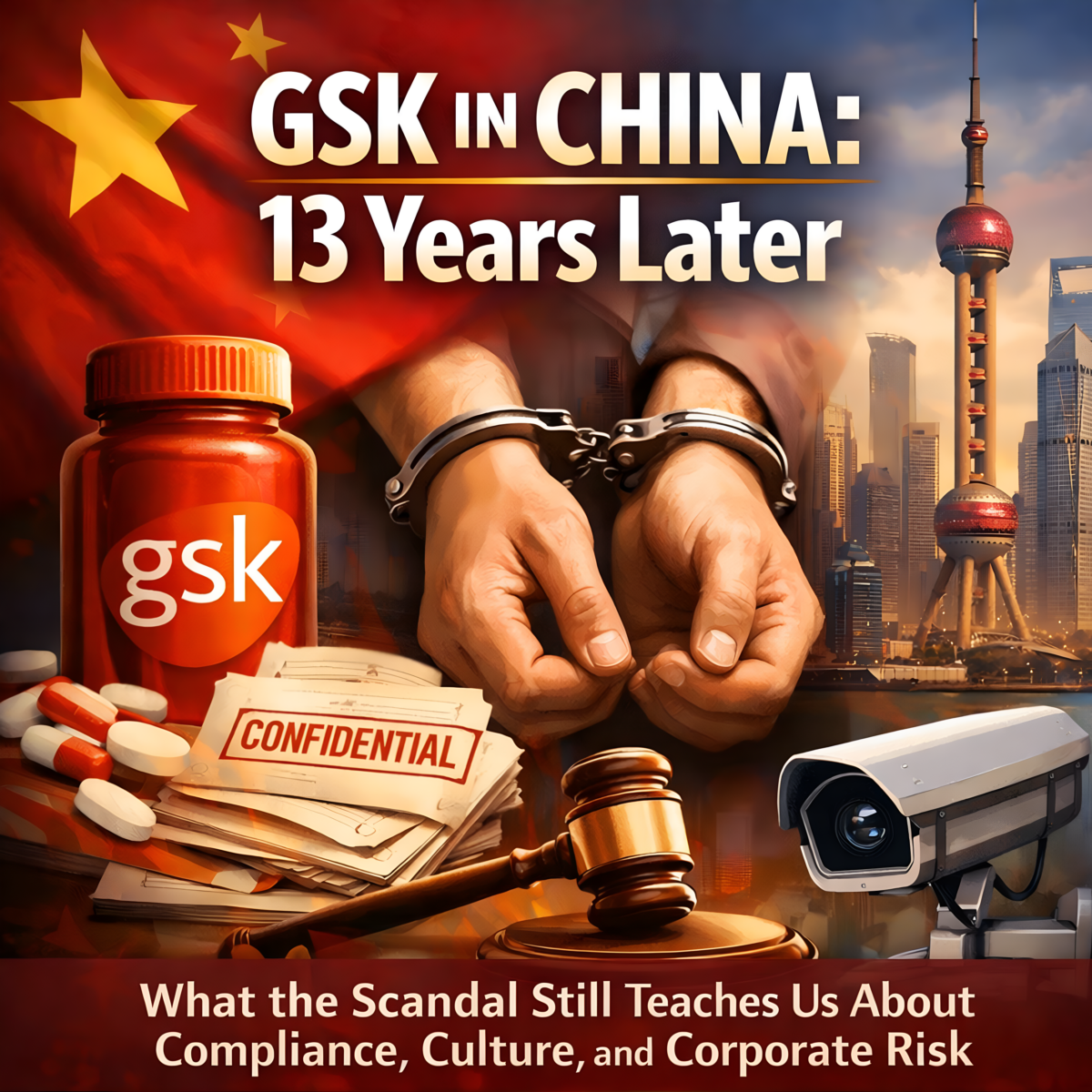
GSK in China: 13 Years Later

GSK In China: 13 Years Later – Compliance Lessons Learned

Thirteen years after the GSK China scandal exploded onto the global stage, its lessons remain as urgent as ever for compliance professionals and business leaders. In this podcast series, we revisit the case not simply as corporate history, but as a living cautionary tale about culture, incentives, third parties, investigations, and governance. Each episode explores what went wrong, why it went wrong, and how those failures still echo in today’s compliance and ethics landscape. Join me as we unpack the scandal and draw practical lessons for building stronger, more resilient organizations. In this inaugural episode, we take a deep dive into the 2013 GSK China bribery scandal and examine why it still stands as one of the most important case studies in corporate compliance, governance, and culture. Our hosts are Timothy and Fiona.

In this episode we dissect corporate compliance lessons from GSK’s corruption scandal in China. We consider GSK’s flawed response to anonymous whistleblower reports, the an “Inspector Clouseau imitation” and situates it against an earlier whistleblower case. The discussion explains how bribery was operationalized through a targeted Botox marketing plan (“Vasili”) and the use of travel agencies as cash conduits via fake conferences, and why frequent internal audits and PwC still missed it due to financial-audit “materiality” versus zero materiality under the FCPA. It outlines needed controls such as proper approval level, legitimate business purpose, enforcement, and preventive design; warns about siloed “functional trap” risk management, critiques “Olympian pronouncements” undermined by “tone in the middle” and unofficial messaging, and distinguishes auditing from real-time monitoring, including relationship-monitoring software that flags anomalous communication patterns, raising a final question about preventing corruption without creating a surveillance state.

Key Highlights

  • GSK China Scandal Setup
  • Why Investigations Fail
  • Travel Agencies as ATMs
  • Auditing Materiality Trap
  • Unofficial Messaging
  • Monitoring vs Auditing

Resources

GSK in China: A Game Changer for Compliance on Amazon.com

GSK in China: Anti-Bribery Enforcement Goes Global on Amazon.com

Tom Fox

Instagram

Facebook

YouTube

Twitter

LinkedIn

Ed. Note-the voices of the hosts, Timothy and Fiona were created by Notebook LM based upon text written by Tom Fox

Categories
Daily Compliance News

Daily Compliance News: May 7, 2026 the CNN News Edition

Welcome to the Daily Compliance News. Each day, Tom Fox, the Voice of Compliance brings to you compliance related stories to start your day. Sit back, enjoy a cup of morning coffee and listen in to the Daily Compliance News. All, from the Compliance Podcast Network. Each day we consider four stories from the business world, compliance, ethics, risk management, leadership or general interest for the compliance professional.

  • Farewell to Ted Turner.  (CNN)
  • Lessons from agentic AI trailblazers. (FT)
  • JPMorgan rejects claim but offered $1MM settlement. (WSJ)
  • Phishing with fake compliance emails. (InfoSecurityMagazine)

To learn about the intersection of Sherlock Holmes and the modern compliance professional, check out my latest book, The Game is Afoot-What Sherlock Holmes Teaches About Risk, Ethics and Investigations on Amazon.com

Categories
Blog

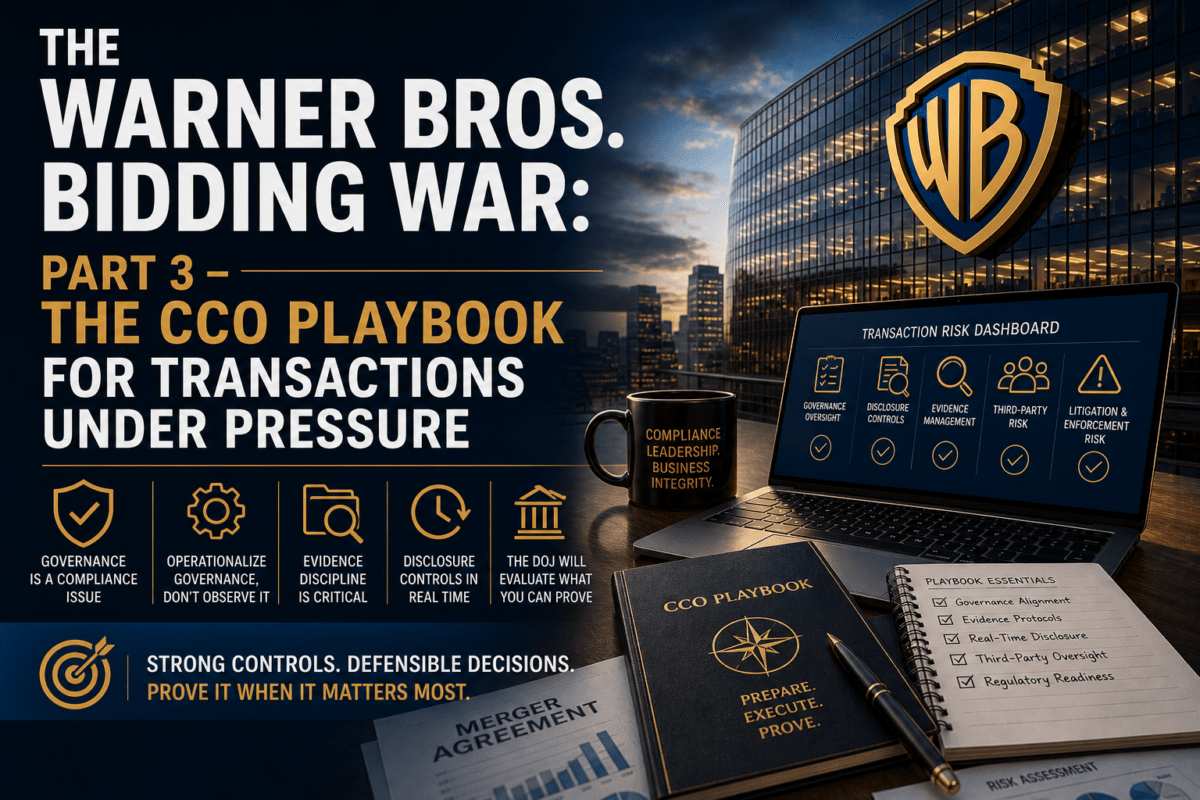
The Warner Bros. Bidding War: Part 3 – The CCO Playbook for Transactions Under Pressure

The Warner Bros. Bidding War: Part 3 – The CCO Playbook for Transactions Under Pressure

The Warner Bros. (WBD) bidding war is not simply a Board story. It is a compliance operating model test. When a superior proposal emerges, the Chief Compliance Officer (CCO) must move from program design to execution discipline. Today we conclude our short review of the Warner Bros./Netflix/Paramount dance and sale with a consideration of lessons for the compliance professional.

In Part 1, we focused on the deal mechanics that led Warner Bros. Discovery to move from an agreed transaction with Netflix to a superior proposal from Paramount Skydance. In Part 2, the focus shifted to Board governance and fiduciary duty. This final Post 3 answers the operational question. What must the Chief Compliance Officer do when the process accelerates and governance must be proven in real time?

The answer is grounded in the DOJ’s Evaluation of Corporate Compliance Programs (ECCP). The core question remains constant. Is the program working in practice? A live transaction provides the answer.

Move Compliance Into the Transaction Control Room

Too many compliance functions treat M&A as a legal and finance activity. That approach fails when the transaction becomes contested. Once a superior proposal is identified, the compliance function must:

  • Participate in transaction governance meetings
  • Map control risks across disclosure, communications, and decision-making
  • Establish escalation pathways for new information

This is consistent with the expectations embedded in the DOJ’s Corporate Enforcement Policy, which rewards companies that demonstrate real-time awareness, escalation, and action. A compliance function that is not present during the decision-making process cannot later demonstrate that controls were effective.

Build and Execute an Evidence Protocol

The most significant compliance failure point in transactions is not misconduct. It is the absence of a reliable evidentiary record. In the WBD process, multiple streams of information were created simultaneously:

  • Board materials
  • Banker communications
  • Draft proposals and revisions
  • Internal analyses and emails

The CCO must ensure that the company has an evidence protocol that includes:

  • Centralized collection of transaction-related materials
  • Defined custodians for document integrity
  • Time-stamped records of key decisions and communications

Under the DOJ’s framework, this directly ties to the question of whether the company can demonstrate effectiveness through data and documentation. If the company cannot reconstruct its decision-making process, it cannot defend it.

Treat Disclosure Controls as a Real-Time Compliance System

Post 2 emphasized that disclosure is a governance issue. For the CCO, it is a control system. The compliance function should validate that:

  • The disclosure committee is activated and functioning continuously
  • There is a clear trigger matrix for Form 8-K filings and proxy updates
  • All external communications are coordinated and controlled

This is not theoretical. In a contested transaction, the volume and speed of information create a risk of selective disclosure, inconsistent messaging, or delayed filings. The CCO must ensure that disclosure controls meet the same standard as financial controls. They must be tested, documented, and operational.

Control Third-Party and Advisor Risk

Transactions introduce intense third-party engagement. Investment banks, legal advisors, consultants, and communications firms all operate at speed. In the WBD scenario, third-party actions included:

  • Structuring revised proposals
  • Communicating deal terms
  • Interacting with market participants

The CCO must ensure:

  • Clear protocols for third-party communications
  • Defined boundaries on who can speak on behalf of the company
  • Documentation of all material third-party interactions

This aligns with long-standing expectations under the Foreign Corrupt Practices Act (FCPA) and the broader third-party risk principles embedded in compliance programs. Even in a domestic transaction, third-party risk remains a control issue.

Align Governance With Internal Controls Frameworks

The events described in Parts 1 and 2 map directly onto internal control frameworks such as COSO Internal Controls Framework. For the CCO, this means:

  • Control Environment: Tone at the top regarding disciplined decision-making
  • Risk Assessment: Identification of disclosure, litigation, and regulatory risks
  • Control Activities: Implementation of approval processes and documentation protocols
  • Information and Communication: Real-time disclosure and coordination
  • Monitoring: Ongoing review of transaction-related controls

This mapping is not academic. It is how the company demonstrates that governance is structured, repeatable, and effective.

Prepare for Day Two Risk

The transaction does not end with signing or closing. It creates a new risk profile. The CCO must plan for:

  • Integration of compliance programs across entities
  • Review of legacy decisions made during the transaction process
  • Preservation of records for litigation or regulatory review

This is where the DOJ’s focus on continuous improvement becomes critical. The company must show that it learns from the transaction and strengthens its program.

Connecting the Lessons Across the Series

Part 1 showed that deal terms, including termination fees and superior proposal mechanics, can change outcomes. Part 2 demonstrated that the Board must govern those changes through documented, disciplined processes. In this Part 3, we demonstrated the connections between the two. The compliance function is the mechanism that allows the company to prove that governance worked. Without compliance execution, governance is an assertion. With compliance execution, governance becomes evidence.

Practical Action Steps for CCOs

  1. Embed compliance into the transaction governance structure at the outset of any deal.
  2. Implement an evidence protocol that captures all material transaction activity in real time.
  3. Test disclosure controls under accelerated conditions, including mock 8-K scenarios.
  4. Define and enforce third-party communication protocols.
  5. Map transaction governance to COSO and DOJ ECCP requirements before a contested situation arises.

Questions for the CCO

  1. If a regulator requested the full decision record tomorrow, could the company produce it?
  2. Are disclosure controls capable of operating continuously under transaction pressure?
  3. Is there a single source of truth for transaction-related documentation?
  4. Are third-party interactions fully documented and controlled?
  5. Has the compliance program been stress-tested in a high-speed governance scenario.

Final Thoughts

The Warner Bros. Discovery bidding war is not unique. What is unique is how clearly it illustrates the modern role of the Chief Compliance Officer. Compliance is no longer limited to preventing misconduct. It is responsible for enabling the company to act, decide, and disclose with integrity under pressure and then prove it. That is the standard set by the DOJ. That is the expectation of Boards. And that is the future of the compliance profession.