Categories
AI Today in 5

AI Today in 5: June 29, 2026 the Farmers Embracing AI Edition

Welcome to AI Today in 5, the newest edition to the Compliance Podcast Network. Each day, I will bring to you 5 stories about AI stories to start your day. Sit back, enjoy a cup of morning coffee and listen in to the AI Today In 5. All, from the Compliance Podcast Network. Each day we consider four stories from the business world, compliance, ethics, risk management, leadership or general interest about AI.

  1. AI governance in commercial insurance. (FinTechGlobal)
  2. Farmers embracing AI.  (NYT)
  3. China matches Anthropic in AI cybersecurity. (WSJ)
  4. Tackling AI compliance through a multipart framework. (BloombergLaw)
  5. Make AI regs more patient centered.  (NewsMedical)

For more information on the use of AI in Compliance programs, my new book, Upping Your Game. You can purchase a copy of the book on Amazon.com. To learn about the intersection of Sherlock Holmes and the modern compliance professional, check out my latest book, The Game is Afoot-What Sherlock Holmes Teaches About Risk, Ethics and Investigations on Amazon.com

Categories
FCPA Compliance Report

FCPA Compliance Report – Managing Compliance and National Security Risks When Doing Business in the DRC, Part 2

In this episode, Tom Fox welcomes David Simon, Partner at Foley & Lardner, and Jack Korba Of Counsel at Foley & Lardner, and Olivier Bustin a Partner at Pinsent Masons about doing business in and with the Democratic Republic of the Congo (DRC). This is the first part of a two-part series on this topic. The guests present a detailed manner to evaluate  and manage going into a high-risk country or region.

We discuss how companies investing in high-risk jurisdictions like the Democratic Republic of the Congo should treat diligence as ongoing risk management, using tailored controls, audits, and continuous monitoring informed by geopolitical developments and government/regulatory priorities (including signals such as announcements and sector focus like critical minerals). The speakers emphasize pragmatism: accepting some ambiguity while designing jurisdiction-specific compliance frameworks rather than placing standard programs on “autopilot,” with active C-suite and board engagement. They stress building and documenting a rational, risk-tolerant decision process that can be explained to regulators (e.g., DOJ/SEC), including knowing counterparties and local dynamics, implementing real controls, and escalating decisions appropriately. Key pitfalls to avoid include overcommitting to projects beyond risk tolerance and entering transactions without sufficient preparation. The panel also urges compliance leaders not to be paralyzed by fear, to shape opportunities early, and notes market opportunities and signals of U.S. engagement such as financing for the Lobito railway corridor.

Key Highlights

  • Ongoing Risk Controls
  • Pragmatism In High Risk
  • Regulator Ready Diligence
  • Mistakes To Avoid
  • Where To Start

Resources

David Simon

Jack Korba

Olivier Bustin

Foley & Lardner

Pinsent Masons

The Democratic Republic of the Congo as a Near-Term Strategic Opportunity for U.S. Companies Part 1

Part 2

Part 3


Tom Fox

Instagram

Facebook

YouTube

Twitter

LinkedIn

To learn about the intersection of Sherlock Holmes and the modern compliance professional, check out my latest book, The Game is Afoot-What Sherlock Holmes Teaches About Risk, Ethics and Investigations on Amazon.com

Categories
Daily Compliance News

Daily Compliance News: June 29, 2026, The Judge Wants More Edition

Welcome to the Daily Compliance News. Each day, Tom Fox, the Voice of Compliance, brings you compliance-related stories to start your day. Sit back, enjoy a cup of morning coffee, and listen in to the Daily Compliance News. All, from the Compliance Podcast Network. Each day, we consider four stories from the business world, compliance, ethics, risk management, leadership, or general interest for the compliance professional.

Top stories include:

  • Top Milei official resigns over corruption allegations. (FT)
  • Judge wants more info on DOJ’s dismissal of Adani. (NYT)
  • Corruption crackdown in Iraq. (Reuters)
  • China removes 6 generals in additional corruption crackdown. (SCMP)

To learn about the intersection of Sherlock Holmes and the modern compliance professional, check out Tom’s latest book, The Game is Afoot-What Sherlock Holmes Teaches About Risk, Ethics and Investigations on Amazon.com.

Categories
Blog

Cartels, TCOs, and Compliance in Latin America: Why 2026 Is a Watershed Moment

For compliance professionals, some years mark an evolution. Others mark a turning point. In 2026, corporate compliance in Latin America has reached that turning point. For the past two decades, most companies approached regional risk through a familiar lens: anti-corruption. The focus was on government touchpoints, customs interactions, licensing, permits, state-owned enterprises, and third-party intermediaries. That framework is still important. But it is no longer sufficient.

Today, the risk landscape has expanded dramatically. Cartels, transnational criminal organizations, foreign terrorist organization designations, sanctions, anti-money laundering exposure, and supply chain infiltration have all moved to the center of the compliance conversation. What was once a specialized concern has become a board-level issue.

That is why the upcoming ACI Forum on Cartels, TCOs, and Compliance in Latin America is so timely. It is also why compliance officers need to understand that this is not simply another enforcement trend. It is a structural change in how risk must be assessed, governed, and managed. I recently had to opportunity to visit with Matt Ellis, Member at Miller & Chevalier and co-Chair of the Forum. You can listen to Ellis’ remarks on this episode of the FCPA Compliance Report on the Compliance Podcast Network.

The New Risk Equation

The Trump administration has made clear that cartels, fentanyl trafficking, organized crime, and the influence of China in Latin America are policy priorities. That focus has brought multiple enforcement tools to bear, including sanctions, anti-money laundering authorities, FTO designations, and a broader integration of these issues into the compliance and enforcement landscape.

Ellis said that companies, the old model of regional compliance risk must be rethought. The issue is no longer limited to whether a payment touched a foreign official. The question now is whether a company’s supply chain, transportation provider, security arrangement, or local commercial partner could create exposure under anti-terrorism, sanctions, or AML frameworks.

Mexico Is the Opening Chapter, Not the Whole Book

Much of the current focus is on Mexico, and for good reason. That is where the enforcement spotlight is currently brightest. But compliance professionals should not make the mistake of thinking this challenge begins and ends there.

The risks extend across Latin America, including Central America, Venezuela, Colombia, Brazil, Panama, and other markets where cartel activity, organized crime influence, sanctions risk, or opaque commercial structures may create significant exposure. Each country carries its own risk profile, but the common lesson is clear. Mexico may be the first chapter, but it will not be the last.

For boards and executive teams, that means regional strategy must be reviewed through a broader lens. Market entry, third-party engagement, logistics routes, security providers, and local partnerships all need to be reassessed.

Why the Supply Chain Has Become a Compliance Flashpoint

One of the most important lessons from this discussion is that cartel risk can be embedded in the supply chain. This is where compliance professionals need to recalibrate their thinking. In the anti-corruption world, companies typically focus on agents, distributors, customs brokers, and third parties with direct government interaction. In the cartel and TCO context, risk can sit inside ordinary business operations. Transportation vendors, warehouse providers, local suppliers, labor relationships, and security services may all present hidden risk if they are controlled by, connected to, or exploited by organized crime.

That changes the role of compliance. Procurement, logistics, operations, and security can no longer be treated as peripheral functions. They are now front-line participants in risk identification and mitigation. This is where the compliance function must show leadership. The CCO must bring these disciplines together and translate legal and enforcement developments into practical operational controls.

Due Diligence Must Move Beyond Check-the-Box

If there is one message compliance professionals should take from Ellis’ podcast, it is this: traditional due diligence is not enough. In anti-corruption compliance, companies have become skilled at identifying common red flags. They know how to screen for politically exposed persons, government connections, unusual payment terms, and opaque ownership structures. Those tools still matter, but they will not always surface cartel-linked risk. Organized crime does not announce itself in a database hit.

Instead, companies need a more nuanced and operationally grounded approach. Are there local security concerns being raised by employees? Are there unusual labor dynamics in a region where those patterns do not make commercial sense? Is there persistent chatter about a vendor, route, or business partner that cannot be ignored? Are operations in a community producing concerns that legal and compliance have not fully explored? These are not traditional diligence questions, but they are increasingly the right ones.

Under the DOJ’s Evaluation of Corporate Compliance Programs (ECCP), regulators continue to ask whether a company’s program is designed, implemented, and tested in a manner that addresses actual risk. This is precisely where program effectiveness will now be measured in high-risk Latin American operations.

The Importance of Listening to the People on the Ground

One of the most practical insights from the interview was the emphasis on local intelligence. Employees who live and work in these communities often know far more than any desktop diligence report will reveal.

That point should resonate deeply with compliance professionals. A company’s speak-up culture is not simply about hotline metrics or case closure rates. It is about whether employees trust the organization enough to raise concerns that may not yet fit into a neat legal category. It is about whether the company listens when local personnel say that something does not add up. This is where compliance, culture, and internal controls intersect.

If a company has not built mechanisms to capture and escalate local concerns, then it is not simply missing information. It is missing one of the most effective risk detection tools available to it. These are not abstract governance questions. They go directly to program effectiveness, risk ownership, and business sustainability.

A Whole-of-Government Enforcement Model

Another important takeaway is the multidimensional nature of this risk environment. In the FCPA era, companies often focused on DOJ and the SEC. That framework no longer captures the full picture. Now the compliance professional must think across Treasury, OFAC, FinCEN, Homeland Security, DEA, and other agencies, all of which may have an interest in the same underlying conduct. This level of coordination matters because it means the government’s expectations are no longer siloed. Enforcement, intelligence, sanctions, and AML concerns can converge quickly. For compliance officers, this demands a more integrated model of risk management. Silos inside the company will not work when the government itself is operating in a coordinated manner.

Is There More Room for Government Engagement?

One of the more interesting themes from the discussion was whether companies may have more room to engage with government than they traditionally would in the anti-corruption context. That does not mean every issue should be self-disclosed. It does mean that in high-risk environments, thoughtful engagement may sometimes be part of a sound compliance strategy.

The key is judgment. No company should rush into a conversation with the government without understanding the facts and the implications. But where risks are ambiguous, stakes are high, and the legal regimes overlap, strategic dialogue may help demonstrate good faith, show the absence of criminal intent, and allow a company to explain the reasonable steps it is taking. That is not leniency. That is credibility.

The Bottom Line

This is the next generation of Latin America compliance risk. It does not replace anti-corruption compliance. It expands it, hardens it, and operationalizes it. The lesson for compliance professionals is clear. You cannot address cartel and TCO risk with yesterday’s playbook. You need broader risk assessments, deeper third-party diligence, stronger local reporting channels, tighter cross-functional coordination, and more informed board oversight.

In 2026, the companies that succeed will not be the ones with the longest policy manuals. They will be the ones that can demonstrate a compliance program built for the reality of where they operate. For the CCO, that is the challenge. For the board, that is the oversight mandate. For the business, that is the cost of operating responsibly in a changed enforcement environment. The future of compliance in Latin America is already here. The only question is whether your program is ready for it.

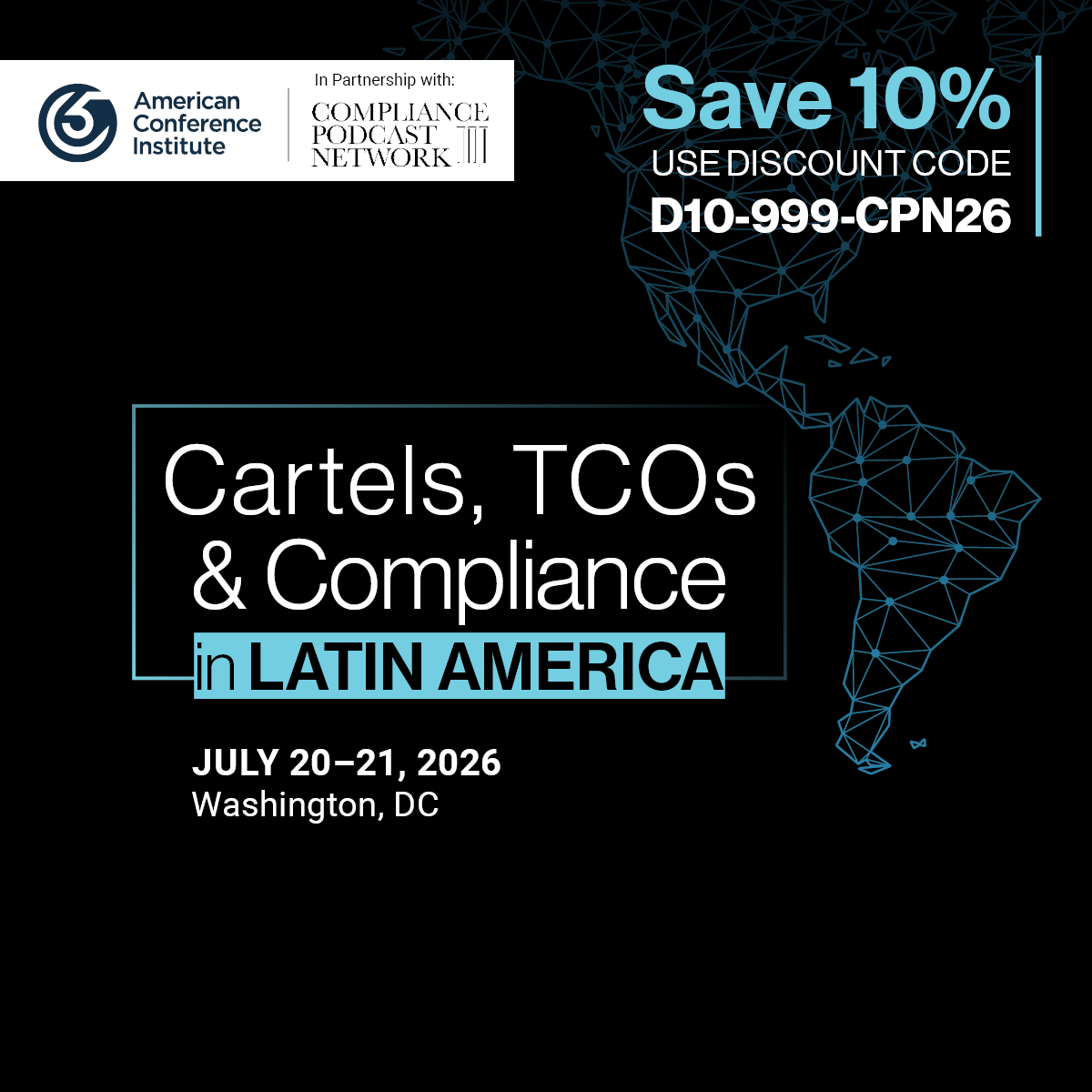
Check out the ACI Forum on Cartels, TCOs, and Compliance in Latin America by clicking here. You can receive a 10% off the price by using the Discount Code is D10-999-CPN26.

Categories
Blog

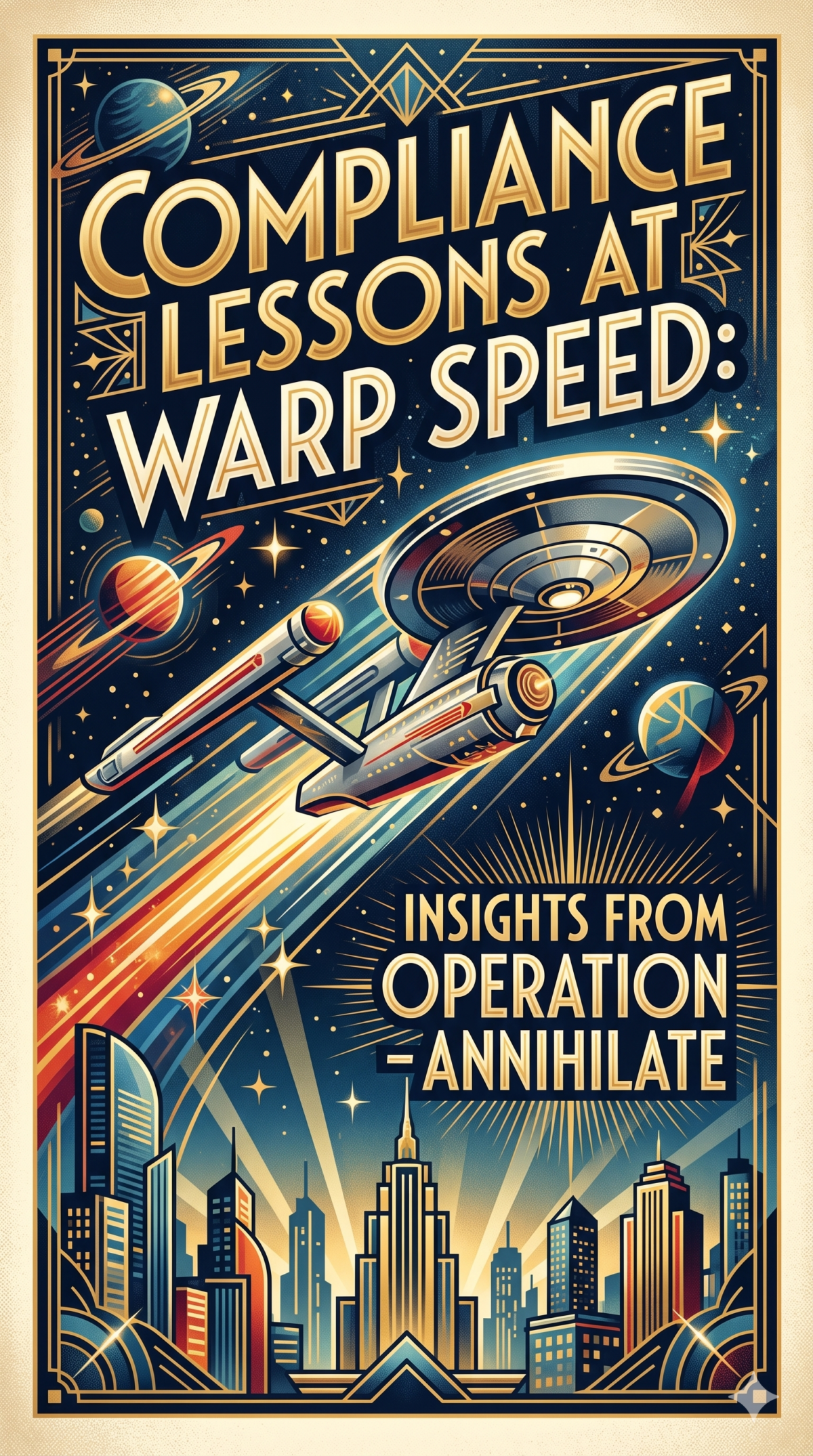
Compliance Lessons at Warp Speed: Insights from Operation – Annihilate

In corporate compliance, investigative techniques are not merely about uncovering facts; they’re about discerning patterns, identifying root causes, and mitigating risks effectively. Surprisingly, we can glean powerful investigative insights from unexpected sources, including the classic Star Trek TOS episode “Operation—Annihilate!” This iconic episode sees Captain Kirk and the crew of the Enterprise arrive at the planet Deneva, only to discover it has been gripped by mass hysteria, violence, and suffering triggered by a parasitic infestation. These creatures induce unbearable pain and extreme aggression, driving the population toward chaos and destruction. The crew faces an immense challenge: to quickly identify, analyze, and neutralize the threat before it spreads beyond control.

For compliance professionals, this storyline provides compelling parallels to real-world investigative scenarios. The episode emphasizes the importance of swift and precise identification of underlying issues, comprehensive evidence gathering, objective validation of findings, courageous decision-making in crises, and clear, transparent communication throughout the investigation. Mastering these investigative lessons ensures that compliance teams can effectively manage risks, uphold integrity, and maintain organizational stability. Let’s delve deeper into these five critical investigative lessons from “Operation—Annihilate!” and see how compliance officers can leverage these insights in their daily practice.

Lesson 1: Rapid Identification and Response

Illustrated By: Upon arriving at Deneva, the Enterprise crew finds widespread hysteria, confusion, and aggressive behavior among the inhabitants. The source? A mysterious parasite is causing intense pain and erratic behavior.

In compliance investigations, rapid identification and response are crucial. Much like the Enterprise crew swiftly pinpointing the cause of the planet’s chaos, compliance officers must quickly ascertain the origin of any compliance violation. Time is of the essence in containing the problem, mitigating risks, and preventing escalation.

Lesson 2: Holistic Evidence Gathering

Illustrated By: Dr. McCoy examines infected individuals and conducts meticulous tests to understand the parasite’s biological impact. Spock, despite personal risk, also subjects himself to the parasite’s influence to gather essential firsthand evidence.

A rigorous compliance investigation requires the collection of holistic evidence. Like Dr. McCoy and Spock, compliance officers must go beyond surface appearances, collecting a diverse range of evidence, including interviews, financial records, and digital data, to piece together an accurate narrative. Comprehensive data collection is essential in determining the full scope and impact of any compliance issue.

Lesson 3: Objective Analysis and Validation

Illustrated by: The Enterprise team initially hypothesizes that the parasites must be eradicated through extreme measures, including potentially destructive ones. However, through disciplined testing and validation, they discovered that high-intensity light effectively neutralizes the parasites without destroying the host organisms.

Objectivity in analysis and validation is a cornerstone of effective compliance investigations. Compliance professionals must rigorously test assumptions and hypotheses against facts and evidence to ensure that remedial actions are both effective and proportionate to the issue at hand. This disciplined approach prevents unnecessary collateral damage and ensures ethical responses.

Lesson 4: Courage in the Face of Difficult Decisions

Illustrated by: Captain Kirk faces an agonizing choice: risk Spock’s eyesight or delay action that could save millions. Kirk makes the tough call, and although Spock is temporarily blinded, the decision ultimately saves countless lives.

Compliance investigations often present challenging ethical and professional dilemmas. Compliance leaders, like Kirk, must demonstrate courage and decisiveness, recognizing that hesitation or indecision can exacerbate the situation. Though difficult decisions may carry significant implications, courageous leadership ensures that integrity and organizational trust remain intact.

Lesson 5: Clear and Transparent Communication

Illustrated By: Throughout the crisis, Captain Kirk maintains open and transparent communication with his crew, explaining strategies, risks, and expectations clearly and candidly.

Effective communication is vital in compliance investigations. Transparency fosters trust among stakeholders and ensures clarity on investigative processes and outcomes. Compliance officers must regularly communicate investigative findings and recommendations to facilitate understanding, cooperation, and organizational alignment.

Final ComplianceLog Reflections

The Star Trek TOS episode “Operation—Annihilate!” may seem an unconventional source of compliance wisdom. Yet, its lessons in rapid response, holistic evidence collection, objective analysis, courageous decision-making, and transparent communication are profoundly relevant. These insights underscore the universal nature of investigative best practices, applicable across disciplines and eras. Compliance professionals, like the Enterprise crew, frequently operate under pressure, confronting unpredictable challenges that demand innovative thinking and swift, informed decisions.

By internalizing these lessons, compliance officers can enhance their ability to manage investigations effectively, mitigate risks, and strengthen their organization’s resilience. Ultimately, these principles reinforce the importance of preparedness, adaptability, and ethical integrity. Compliance teams that embrace these lessons will be well-positioned to safeguard their organizations, foster a culture of transparency, and uphold the highest standards of conduct, boldly going where responsible and proactive governance dictates they must.

Resources:

Excruciatingly Detailed Plot Summary by Eric W. Weisstein

MissionLogPodcast.com

Memory Alpha