Categories
Blog

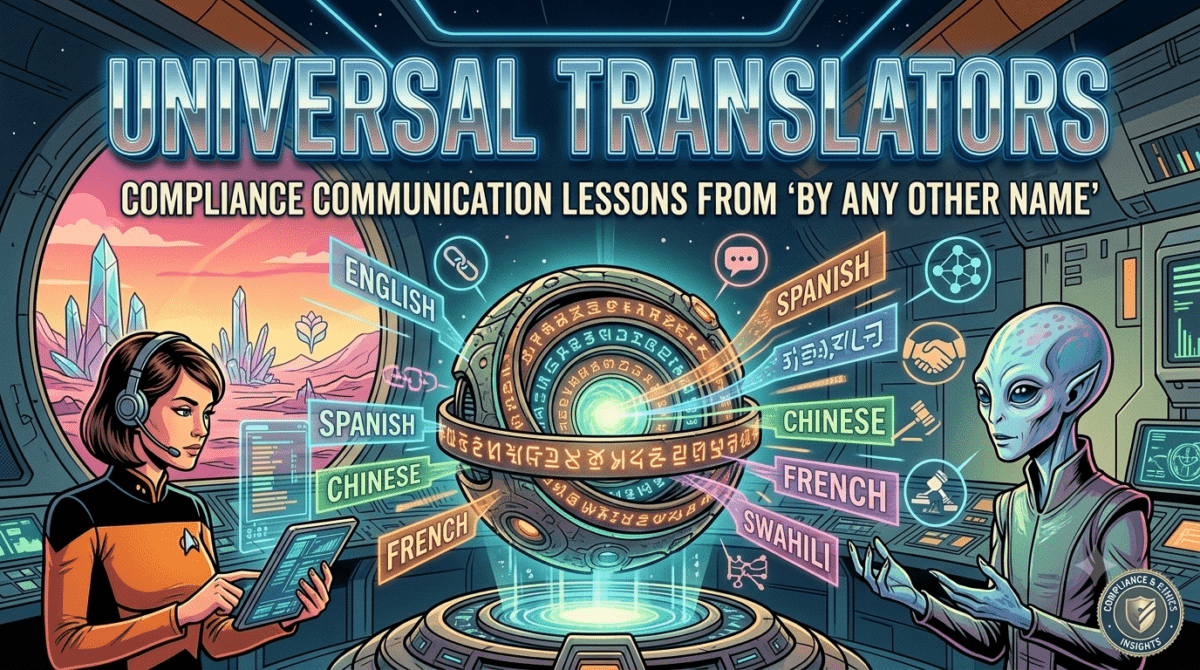
Universal Translators: Compliance Communication Lessons from ‘By Any Other Name’

If you have been around the compliance world long enough, you have heard the refrain, “It all comes down to communication.” Whether you are launching a new code of conduct, rolling out an anti-bribery initiative, or navigating the choppy waters of a compliance investigation, your message, how it is crafted, delivered, and received, often determines your success.

There may be no better pop culture exploration of communication under pressure than Star Trek’s “By Any Other Name.” This episode, from Star Trek: The Original Series, places the crew of the Enterprise under the control of the Kelvans, alien beings with immense power, cold logic, and a total misunderstanding of what it means to be human. To survive, Kirk and his crew must out-communicate and outwit their captors, relying on every tool in their communication toolkit.

For the compliance professional, “By Any Other Name” offers a master class in the nuances of compliance communications, what works, what fails, and why the human element can never be discounted. Today, we explore five compliance communication lessons from this Star Trek classic.

Lesson 1: Know Your Audience—Tailor Your Message

Illustrated by: The Kelvans, led by Rojan, initially communicate only through blunt, logical directives. They expect total obedience from the Enterprise crew, failing to appreciate the crew’s emotional and cultural complexity. Their attempts at control falter because they don’t understand (or even attempt to understand) human motivation.

Compliance Lesson: Compliance messages cannot be one-size-fits-all. The Kelvans’ failure to adapt to their audience is a mistake compliance professionals should avoid. Employees come from diverse backgrounds, cultures, and generations; each absorbs messages differently. What motivates a finance executive in London may not resonate with a front-line worker in Houston or a vendor in Mumbai.

Effective compliance communication requires deep knowledge of your audience, their roles, their pressures, and their “language.” Avoid legalese and boilerplate. Instead, translate compliance requirements into practical, relevant, and relatable guidance. Segment your compliance communications. Use examples, languages, and platforms tailored for different employee groups and geographies. Regularly solicit feedback to ensure your message is landing as intended.

Lesson 2: Use Storytelling and Emotion—Facts Alone Don’t Move People

Illustrated by: Kirk and his crew realize the Kelvans, now in human form, are struggling with unfamiliar emotions and senses. Scotty, McCoy, and Kirk use humor, stories, and emotional appeals—not just facts—to disrupt the Kelvans’ cold logic. Scotty, famously, distracts one by sharing stories over drinks; McCoy pushes another to experience irritability and frustration.

Compliance Lesson: Compliance isn’t just about rules and policies; it’s about influencing behavior. Facts and regulations are essential, but they rarely inspire change on their own. Human beings respond to stories, emotions, and narratives. Scotty doesn’t just explain; he engages. Kirk doesn’t just threaten; he empathizes.

For compliance professionals, this means using storytelling, scenarios, and case studies in your communications. Connect compliance to employees’ values, experiences, and aspirations.

Incorporate real-world examples, ethical dilemmas, stories, successes, and failures into your training and communications. Show how compliance makes a positive impact, not just what rules to follow.

Lesson 3: Active Listening and Feedback Loops—It’s Not Just About Talking

Illustrated by: While under Kelvan control, the Enterprise crew quietly listens, observes, and learns. They pay attention to subtle cues—the Kelvans’ confusion, discomfort, and shifting attitudes. Kirk’s plan only succeeds because he listens actively and adapts his approach based on feedback and changes in the Kelvans’ behavior.

Compliance Lesson: Too often, compliance communication is a one-way street, where policies are announced, emails are sent, and training is assigned without follow-up. But honest communication is two-way. Kirk’s ability to adapt is rooted in active listening, a skill compliance teams must master.

Effective compliance programs create channels for feedback and respond to what they learn. This can be achieved through hotlines, surveys, focus groups, or informal conversations. When employees see that their input leads to change, they become more engaged and are more likely to trust the compliance function. Establishing feedback loops for every major compliance communication is also crucial. Track participation, collect questions, and respond publicly to common concerns. Use what you learn to refine your message and program continually.

Lesson 4: Adapt Communication Styles Under Pressure—Agility Matters

Illustrated by: Throughout the episode, the crew is under intense stress. Their regular routines are disrupted, and the stakes are existential. Yet Kirk and company adapt rapidly, sometimes using humor, occasionally confrontation, and sometimes empathy, to keep lines of communication open and exploit cracks in Kelvan unity.

Compliance Lesson: In crises, such as investigations, enforcement actions, or cyber incidents, your standard communications playbook may not be practical. Employees will be anxious, distracted, or fearful. The best compliance communicators are agile: they adjust tone, content, and delivery to fit the moment.

This may involve more frequent updates, simpler language, or a more empathetic tone. It may also require new channels such as video messages from leadership, town halls, or direct conversations with affected teams. Develop a crisis communication plan as part of your compliance program. Practice scenario planning: How will you communicate if the unexpected happens? Build templates and train your team in flexible, adaptive messaging.

Lesson 5: Build Trust and Relationships—Compliance is Ultimately Human

Illustrated by: In the end, the crew’s success comes not from outgunning or outwitting the Kelvans through brute force but from forging relationships. They appeal to the Kelvans’ newly awakened humanity, earn their trust, and ultimately persuade Rojan to abandon conquest in favor of collaboration.

Compliance Takeaway:

All the policies and training in the world are ineffective without trust. Compliance communication is not just about transmitting information; it’s about building relationships, credibility, and psychological safety. Employees must believe that compliance is there to help them succeed, not to police or punish.

Trust is built over time, through transparency, consistency, and authenticity. It is maintained by owning up to mistakes, sharing “the why” behind decisions, and treating employees as partners in compliance. Empower compliance champions in every business unit. Provide them with the tools and support they need to model ethical behavior, answer questions, and cultivate a culture of trust. Regularly spotlight these champions and celebrate examples of “doing the right thing.”

Final ComplianceLog Reflections

By Any Other Name” is a Star Trek episode that explores boundaries between worlds, cultures, and even species. For the compliance professional, it’s a reminder that communication is our own Universal Translator: it connects people, overcomes obstacles, and paves the way for shared understanding.

In our world, the stakes are just as high. The “aliens” we face may not come from Andromeda but from new markets, new regulations, or emerging technologies. To navigate these challenges, compliance professionals must master the art and science of communication.

So, as you chart your course through your organization’s next compliance initiative, remember that it is not just what you say but also how you say it, whom you say it to, and how you listen that makes all the difference.

Resources:

Excruciatingly Detailed Plot Summary by Eric W. Weisstein

MissionLogPodcast.com

Memory Alpha

Categories
Trekking Through Compliance

Trekking Through Compliance: Episode 51 – Breaking Barriers: Compliance Communication Strategies from ‘By Any Other Name’

There may be no better pop culture exploration of compliance communication under pressure than Star Trek’s “By Any Other Name.” This episode, from Star Trek: The Original Series, places the crew of the Enterprise under the control of the Kelvans, alien beings with immense power, cold logic, and a total misunderstanding of what it means to be human. To survive, Kirk and his crew must out-communicate and outwit their captors, relying on every tool in their communication toolkit.

For the compliance professional, “By Any Other Name” offers a master class in the nuances of compliance communications, what works, what fails, and why the human element can never be discounted. Today, we explore five compliance communication lessons from this Star Trek classic.

Lesson 1: Know Your Audience—Tailor Your Message

Illustrated by: The Kelvans initially communicate only through blunt, logical directives. Their attempts at control falter because they don’t understand human motivation.

Compliance Lesson: Compliance messages cannot be one-size-fits-all. The Kelvans’ failure to adapt to their audience is a mistake compliance professionals should avoid.

Lesson 2: Use Storytelling and Emotion—Facts Alone Don’t Move People

Illustrated by: Kirk and his crew realize the Kelvans, now in human form, are struggling with unfamiliar emotions and senses.

Compliance Lesson: Compliance is not just about rules and policies; it is rather about influencing behavior.

Lesson 3: Active Listening and Feedback Loops—It’s Not Just About Talking

Illustrated by: While under Kelvan control, the Enterprise crew quietly listens, observes, and learns. They pay attention to subtle cues, the Kelvans’ confusion, discomfort, and shifting attitudes.

Compliance Takeaway:

Too often, compliance communication is a one-way street: policies are announced, emails are sent, training is assigned. But honest communication is two-way. Kirk’s ability to adapt is rooted in active listening, a skill compliance teams must master.

Lesson 4: Adapt Communication Styles Under Pressure—Agility Matters

Illustrated by: Kirk and company, they adapt rapidly, sometimes using humor, occasionally confrontation, and sometimes empathy, to keep lines of communication open and exploit cracks in Kelvan unity.

Compliance Lesson: The best compliance communicators are agile: they adjust tone, content, and delivery to fit the moment.

Lesson 5: Build Trust and Relationships—Compliance is Ultimately Human

Illustrated by: In the end, the crew’s success comes not from outgunning or outwitting the Kelvans through brute force but from forging relationships.

Compliance Takeaway:

All the policies and training in the world are ineffective without trust.

Final ComplianceLog Reflections

By Any Other Name” is a Star Trek episode about boundaries—between worlds, cultures, and even species. For the compliance professional, it’s a reminder that communication is our own Universal Translator: it connects people, overcomes obstacles, and paves the way for shared understanding.

Resources:

Excruciatingly Detailed Plot Summary by Eric W. Weisstein

MissionLogPodcast.com

Memory Alpha

Fiona is an AI-generated voice

Categories
AI Today in 5

AI Today in 5: July 21, 2026, The ChatBot Love is in the Air Edition

Welcome to AI Today in 5, the newest addition to the Compliance Podcast Network. Each day, Tom Fox will bring you 5 stories about AI to start your day. Sit back, enjoy a cup of morning coffee, and listen in to AI Today In 5. All, from the Compliance Podcast Network. Each day, we consider five stories from the business world, compliance, ethics, risk management, leadership, or general interest about AI.

Top AI stories include:

  1. Digital supply chains and cybersecurity. (CySecurity News)
  2. Dating apps have an AI problem. (Bloomberg)
  3. AliExpress fined $629MM by EU. (WSJ)
  4. AI as catalyst for compliance innovation. (Law.com)
  5. Worrying about hallucinations. (FinTechGlobal)

For more information on the use of AI in compliance programs, Tom Fox’s new book, Upping Your Game, is available. You can purchase a copy of the book on ⁠Amazon.com⁠.

To learn about the intersection of Sherlock Holmes and the modern compliance professional, check out Tom’s latest book, The Game is Afoot-What Sherlock Holmes Teaches About Risk, Ethics and Investigations on ⁠Amazon.com⁠.

Categories
Innovation in Compliance

Innovation in Compliance: Governing AI Well Deepens Enterprise Risk Strategy

Welcome to the award-winning Innovation in Compliance. In this episode, Tom welcomes back Gerry Zack, and they discuss the growing use of AI in compliance and the launch of Eastward AI.

Gerry Zack brings a practical, cautionary perspective to AI-powered compliance and risk management, shaped by 18 months of advising organizations on how AI is being used in real compliance programs. He sees AI already embedded in functions like hotline support, policy-to-risk mapping, website scanning, behavioral analytics, transaction monitoring, and even parts of investigations, while warning against overreliance on it in sensitive investigative work. As one of the architects of Eastward AI, he helped evolve the platform from a CSRD and double-materiality tool into a flexible compliance and enterprise risk management solution that supports frameworks such as COSO ERM, DOJ guidelines, ISO 37301, and ISO 31000. Overall, Zack believes the real opportunity lies in reducing organizational paralysis, using AI responsibly, and connecting compliance more closely with HR, IT, and other risk functions to strengthen leadership and decision-making.

Resources:

Gerry Zack on LinkedIn

RiskTrek

Eastward AI

Tom Fox

Instagram

Facebook

YouTube

Twitter

LinkedIn

Categories
Daily Compliance News

Daily Compliance News: July 21, 2026, The Merger Paused Edition

Welcome to the Daily Compliance News. Each day, Tom Fox, the Voice of Compliance, brings you compliance-related stories to start your day. Sit back, enjoy a cup of morning coffee, and listen in to the Daily Compliance News. All, from the Compliance Podcast Network. Each day, we consider four stories from the business world, compliance, ethics, risk management, leadership, or general interest for the compliance professional.

Top stories include:

  • Judge pauses Paramount/Warner Bros merger.  (NYT)
  • Digital supply chains and cybersecurity. (CySecurity News)
  • AliExpress fined $629MM by EU. (WSJ)
  • Indonesia losing the fight against corruption. (Bloomberg)

To learn about the intersection of Sherlock Holmes and the modern compliance professional, check out Tom’s latest book, The Game is Afoot-What Sherlock Holmes Teaches About Risk, Ethics and Investigations on Amazon.com.

Categories
Red Flags Rising

Red Flags Rising: S01 E42: The De Minimis Rule and the Challenge of “Weathervane” Regulatory Language

Mike and Brent tackle the “de minimis” rule under the U.S. Export Administration Regulations (EAR), which would exempt certain below-threshold-value U.S. items from EAR requirements. Three recent enforcement actions, all in 2026 and collectively imposing just under $300 million in penalties, underscore the perils of potentially misapplying the rule. Mike and Brent introduce the concept of “weathervane” regulatory language that can sway with the geopolitical and enforcement winds (2:59); the potential relevance of companies’ approaches to transfer pricing and country-of-origin (4:40); the relevance of old-fashioned arithmetic to identifying common numerator and denominator pitfalls (9:10); the recent enforcement action that included an unusually lengthy exposition by the U.S. Bureau of Industry & Security (BIS) of its interpretation of the de minimis rule (15:38); and the parallels to BIS’s rediscovery of the “high probability” standard (18:56). Mike and Brent conclude with the latest installment of Brent Carlson’s “Managing Up” segment (24:41).

BIS “Guidelines for De Minimis Rules”

Contact Brent: brent@redflagsrising.com

More about Brent: www.redflagsrising.com/founder

Connect with Brent on LinkedIn

Contact Mike: michael.huneke@morganlewis.com

More about Mike

Connect with Mike on LinkedIn

The enforcement actions can all be found at www.bis.gov

Categories
Blog

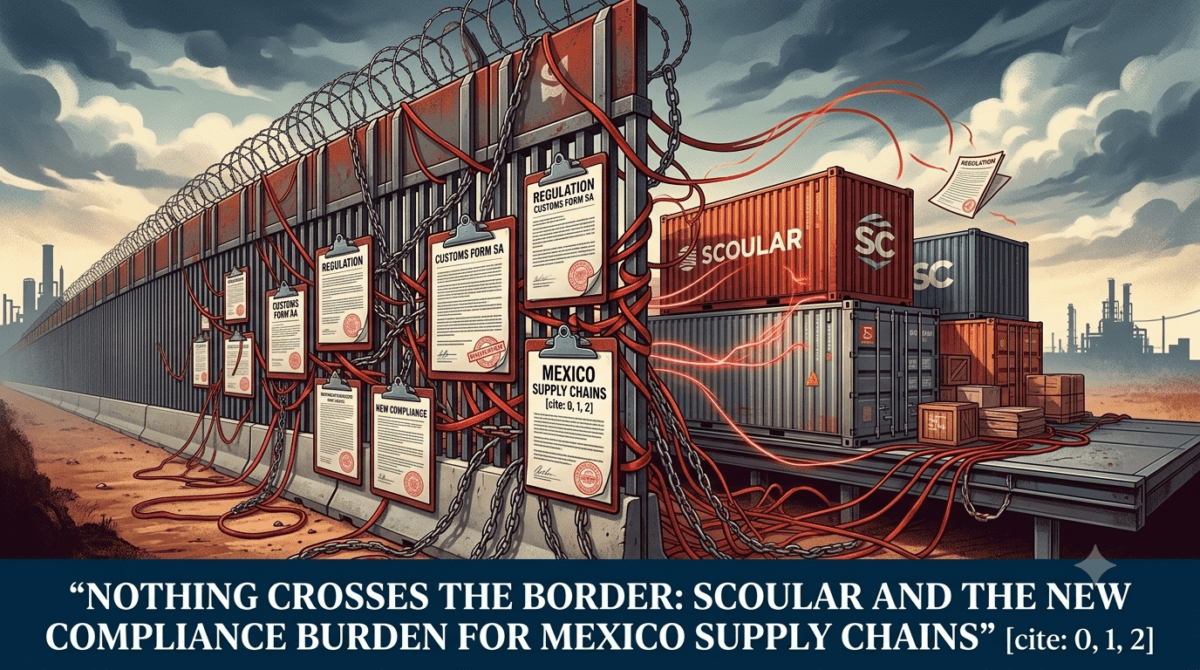
Nothing Crosses the Border: Scoular and the New Compliance Burden for Mexico Supply Chains

“Nothing crosses into or out of Mexico without the approval and payment to Mexican drug cartels. American businesses that engage in any cross-border trade bear a significant amount of responsibility to do so without benefitting those cartels and without threatening our national security,” said U.S. Attorney Justin R. Simmons for the Western District of Texas. “The bribery scheme in which the Scoular Company engaged demonstrates the dangerous corporate corruption we in the Western District of Texas are committed to fighting on behalf of the American people.”

This is not a quote from The Onion, but it is an extraordinary statement from a United States Attorney. It is not confined to companies that knowingly pay cartels. It is not limited to businesses operating in cartel-controlled industries. It speaks broadly to American companies engaged in cross-border trade with Mexico.

The statement appeared in the Department of Justice’s Press Release announcing that The Scoular Company would pay more than $10 million to resolve an FCPA investigation involving payments to Mexican officials. According to the DOJ, customs brokers paid approximately $2,000 per train to allow shipments of corn and other products to cross the border despite inspections identifying dirt, soil, and other impurities. The payments were invoiced back to Scoular as “reinspection fees.” The enforcement message extends far beyond Scoular. Every U.S. company importing goods from Mexico should take notice.

Cartels and the UFLPA

One of the few laws that demands such an approach is the Uyghur Forced Labor Prevention Act (UFLPA), which targets goods made, whole or in part, by forced labor in the Xinjiang region of China or made by forced labor in other parts of China by Uighurs or other minorities. It is designed to operate as a de facto trade ban on goods from China’s Jing Jang region. US businesses will face a heavy burden to overcome the presumption of forced labor. It is perhaps the most significant US law addressing forced labor, and it has the most tangible repercussions companies can face. Under the UFLPA, the key is your documentation for US Customs and Border Protection. Travis Miller has noted that this means if you are “asking companies to look back into where the actual sand came from that got turned into the silica, that got turned into the semiconductor, that got turned into the circuit board, that got turned into the device that finds its way into your laptop. There’s just never been anything like it.”

The UFLPA and its guidance weave together existing business processes. The UFLPA emerged from the America Supply Chain Executive Order in the US/China trade war, which focused on semiconductors, critical raw materials, and elements that are the subject of the extractives. To comply with it, you could not actually start unless you already had a product compliance program in place. This means that if you do not know the bill of materials, do not have an approved vendor list, or do not know where your components are manufactured, you cannot prove compliance. This may well be the approach the Trump Administration takes under FTOs in Mexico and other locations in Central and Latin America.

Is Every Cross-Border Company Benefiting a Cartel?

In my podcast discussion with Matt Ellis, Latin America Practice Lead at Miller & Chevalier, Ellis challenged the literal breadth of the government’s statement. He noted that companies move legitimate goods between the United States and Mexico every hour without knowingly benefiting drug cartels. It would be inaccurate to conclude that every cross-border transaction involves a cartel payment.

Nevertheless, Ellis called the statement striking. He raised the question every CCO should now be considering: Is the DOJ establishing a new compliance standard for companies doing business across the U.S.-Mexico border? The statement does not create a new statute, regulation, or formal presumption of liability. Yet prosecutorial statements communicate enforcement expectations. Here, the expectation appears to be that American businesses must understand not only who their immediate third parties are, but also whether their supply chain activities could provide economic benefits to organized crime.

That puts pressure on importers in three ways. First, companies may face greater scrutiny over customs brokers, logistics providers, trucking companies, warehouses, security providers, labor organizations, and other parties supporting Mexican operations. Second, companies may be expected to investigate the downstream destination of payments, even when there is no obvious cartel connection. Third, the government may examine whether compliance programs integrate anti-corruption controls with sanctions, anti-money laundering, trade compliance, supply chain security, and organized-crime risk.

The question will no longer be limited to whether the company intended to pay a bribe. Prosecutors may also ask whether the company reasonably understood the environment in which its money and goods were moving.

Traditional Third-Party Due Diligence May Not Be Enough

Ellis made one of the most important observations of our discussion: standard third-party screening may not identify cartel connections. Conventional anti-corruption due diligence focuses heavily on government-facing intermediaries. Companies screen owners and principals, search adverse media, identify politically exposed persons, review government relationships, obtain certifications, and include anti-corruption language in contracts. Those measures remain necessary. They may not be sufficient for organized-crime risk.

Cartel affiliations are rarely disclosed in a corporate registry. A logistics provider may appear legitimate while making payment for protection. A trucking company may operate in a region controlled by a criminal organization. A supplier may use subcontractors with undisclosed local connections. A customer, warehouse, labor group, or security provider may be vulnerable to criminal infiltration.

This means companies should broaden the universe of third parties subject to risk-based review. For Mexican supply chains, that universe may include:

  • Suppliers
  • Customers
  • Customs brokers
  • Freight forwarders
  • Trucking companies
  • Warehouses
  • Security companies
  • Local consultants
  • Port and terminal service providers
  • Labor contractors
  • Union representatives
  • Subcontractors
  • Last-mile transportation providers

The legal requirement to use a licensed customs broker should not reduce scrutiny. As Ellis noted, mandatory licensing can sometimes create a false sense of security. A government license does not replace a company’s responsibility to understand how the broker operates.

Contextual Due Diligence Becomes Essential

If database screening cannot reliably identify cartel connections, companies need a contextual approach. This begins by examining where the third party will operate and what criminal activity is associated with that region. Relevant questions include:

  • Is the location known for cartel activity?
  • Are particular highways or transportation corridors subject to roadblocks or protection payments?
  • Is the region associated with fentanyl production, human trafficking, fuel theft, cargo theft, or smuggling?
  • Are unusual labor or union arrangements present?
  • Does the vendor use subcontractors that have not been disclosed?
  • Are payment requests made in cash or to unrelated accounts?
  • Is the third party reluctant to explain its security or transportation arrangements?
  • Does the third party promise an unrealistic customs clearance rate?
  • Are employees instructed not to ask questions about local payments?

Companies must also listen to their employees on the ground. Local personnel may understand risks that do not appear in formal databases. They know the regional rumors, transportation practices, local power structures, and third parties that other companies avoid.

This presents another compliance challenge. Local employees may fear retaliation if they report suspected cartel connections. A company’s speak-up system must provide credible confidentiality, escalation, and protection measures. A hotline is not enough if employees believe that raising a concern will endanger them or their families.

The New Standard Is Demonstrable Reasonableness

Companies cannot guarantee that no peso in a complex Mexican supply chain will ever reach a cartel-affiliated person. Prosecutors should not expect the impossible. They can expect companies to identify their risks, conduct reasonable diligence, monitor high-risk transactions, respond to warning signs, preserve relevant communications, and improve controls when new information emerges.

That is the pressure created by the Scoular resolution. Companies must be able to demonstrate that they made a serious, documented, and risk-based effort to prevent their operations from benefiting criminal organizations. The compliance burden is moving from a narrow inquiry into government-facing intermediaries toward a broader examination of the entire supply chain ecosystem.

Actions for CCOs

CCOs should consider five immediate steps:

  1. Expand Mexico-related risk assessments beyond traditional FCPA intermediaries.
  2. Map the complete supply chain, including subcontractors and transportation routes.
  3. Test customs-broker invoices and recurring border-related payments.
  4. Incorporate regional cartel intelligence and local employee knowledge into due diligence.
  5. Brief the board on the convergence of corruption, sanctions, organized crime, and national security risk.

The Scoular resolution does not establish that every company importing goods from Mexico is paying a cartel. It does put every such company on notice that the DOJ may ask what it did to make sure it was not. That is a significant change in compliance expectations. But look to your response to the UFLPA and see if you can find guidance from that compliance issue. Regardless, companies need to respond accordingly.