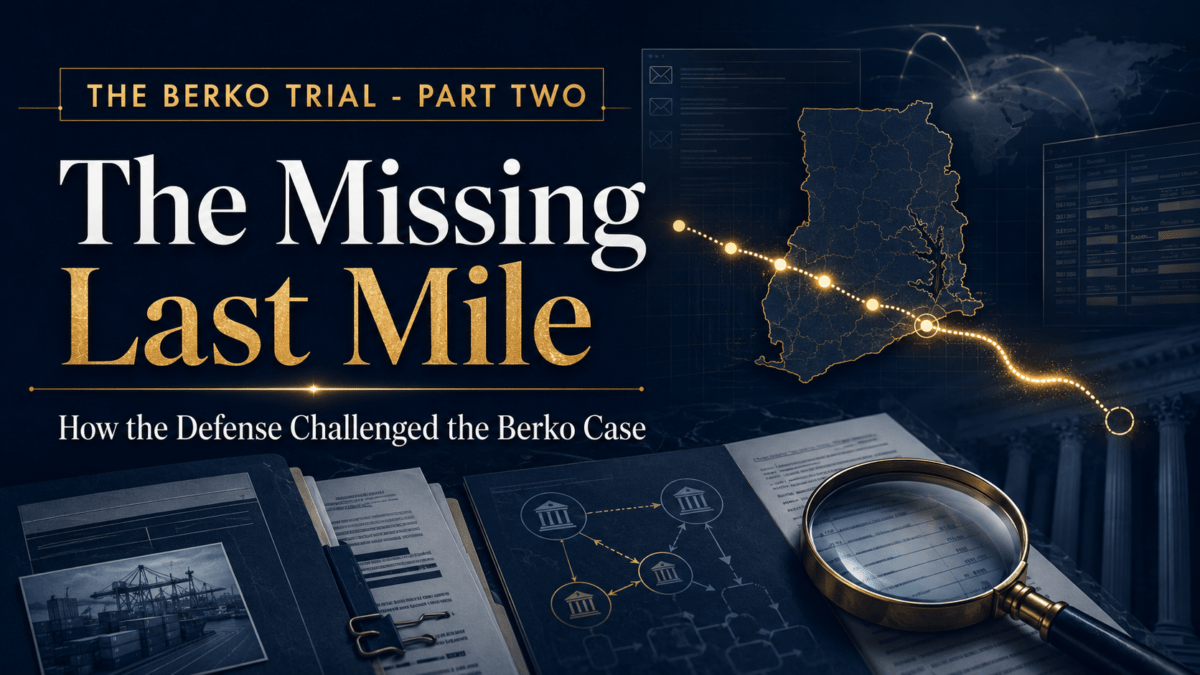
Yesterday in Part One of our series on the Asante Berko FCPA trial and conviction, we examined the prosecution’s mosaic. Today in Part 2, we ask the defense question that cut across every category of proof: Where was the bribe?
The Department of Justice (DOJ) had more than 300 emails, payments to intermediaries, financial-flow charts, compliance concerns, and a secretly recorded lunch. The defense argued that the case still lacked its last mile. No alleged recipient testified. No Ghanaian witness took the stand. No eyewitness described a bribe. No bank record showed money reaching a public official. None of the participants in the email chains explained their meaning to the jury.
That position did not prevail. Only after approximately three hours of deliberation did the jury convict Asante Kwaku Berko on conspiracy to violate the FCPA, a substantive FCPA violation, and a money laundering conspiracy. But a fair account of the trial requires more than repeating the result. It requires understanding why the defense believed suspicious conduct and compliance red flags did not add up to proof beyond a reasonable doubt.
Red Flags Are Not the Elements of a Crime
The defense began with the burden of proof. A high-risk intermediary, personal email, opaque invoices, and cash discussions may justify enhanced diligence, an internal investigation, or a decision to exit a transaction. They do not, standing alone, prove corrupt intent or participation in a bribery agreement. Defense attorney Robert Boone told jurors that the government had years to find a witness or record connecting the money to an official. The courtroom presentation, he argued, was impressive, but the underlying proof was missing. The government’s financial charts traced money from Aksa accounts in Turkey to Tricorp, Berko, and others. According to the defense, those charts stopped before showing a transfer to any alleged public-official recipient.
Prosecutors answered that cash completed the path and concealed the payments. The defense response was that an explanation for missing evidence is not the same as the evidence itself. The last-mile gap was not necessarily a claim that a bank receipt was required for every charged theory. It was an attack on the inferences the government asked the jury to draw about agreement, knowledge, purpose, and authorization.
A Scam, Not a Conspiracy
The defense supplied an alternative explanation for the intermediaries’ demands. Tricorp’s principals, Boone argued, saw outsiders pursuing a valuable project and used claims of political access and urgent payment needs to extract money. They were running a shakedown, not carrying out a bribery agreement.
The emails gave that theory something to work with. In one April 2015 message, a Tricorp principal demanded $500,000 immediately and insisted that unspecified necessities had to be handled. Other exchanges reflected disagreements over amounts, timing, and what had supposedly been promised. Boone characterized the demands as exaggerated and unreliable, comparing them to familiar advance-fee scams.
That distinction was critical. If an intermediary falsely claimed that officials had been or needed to be paid, an email repeating that claim might document the intermediary’s sales pitch rather than an actual bribe. Even the reported statement that Berko had paid Parliament came from a Tricorp principal. The defense asked the jury to consider whether the speaker was reporting a fact or using the language of a scam to justify another reimbursement.
The prosecution had a powerful answer: Berko was not merely copied on one stray message. His communications, payment negotiations, channel choices, and recorded statements appeared throughout the chronology. Still, the defense theory targeted an important evidentiary question. Before accepting an intermediary’s statement as proof, who made it, why, and with what first-hand knowledge?
A Legitimate Project With Commercial Logic
The underlying project was real. Ghana was confronting serious electricity shortages and wanted to add 1,000 megawatts of generating capacity quickly. Aksa later obtained financing from Barclays and a Turkish bank after Goldman withdrew, and its 370-megawatt plant entered commercial operation.
The defense used those facts to challenge motive. Ghana needed available power, Aksa could supply it, and other financial institutions ultimately supported the project. Boone put the point bluntly: Why would a qualified company need to bribe a government that was desperate for electricity?
Commercial merit is not a defense to bribery. Legitimate projects can still be advanced through corrupt means. Yet the project’s reality gave the defense a noncriminal explanation for meetings, urgency, large fees, and intense communications. The government had to prove that the conduct crossed the line from hard-driving project execution into corrupt payment activity.
Hundreds of Emails, but No Voice From the Chain
The prosecution treated the emails as the scheme speaking for itself. The defense treated them as fragments without context. FBI Special Agent Ryan Collins introduced much of the correspondence, but Boone emphasized that Collins did not participate in the exchanges and did not know what the writers meant. No participant in the chains took the stand to explain the language.
That allowed the defense to challenge words such as “payment,” “millions,” “fees,” and “cash.” Depending on purpose and recipient, those terms can describe legitimate compensation, reimbursement, or financing. Similarly, using Gmail for business after acknowledging that a Goldman account was monitored could demonstrate poor judgment, policy evasion, or concealment. The defense argued that the criminal inference depended on what the communications concerned, not the platform alone. This was also the weakness in the defense position. The messages were numerous, contemporaneous, and aligned with transaction milestones. An alternative interpretation had to explain the full pattern, not merely establish that individual phrases were ambiguous.
Testing the Recorded Lunch
The recorded lunch carried the drama of a direct conversation, but the defense attacked its context and origin. The unnamed source first approached the SEC, later assisted the FBI, and was described at trial as the genesis of the investigation. The defense argued that possible eligibility for an SEC whistleblower award created a financial incentive. According to the reporting, the source did not testify, and defense filings asserted that the source had supplied false information to investigators.
The FBI also identified subjects for the source to raise before the November 2016 meeting. One was cash. The resulting video was grainy, the restaurant was noisy, and the conversation moved among English, Twi, and Ghanaian Pidgin English. Jurors relied in part on a translated transcript.
The defense emphasized that the cash exchange arose during an apparently hypothetical discussion involving investors, Ghanaian stock, and a botanical garden. Berko initially said paying the people under discussion was not a good thing. Only after the source asked for the best way to pay did Berko answer that cash could be used.
The government’s strongest response was Berko’s own reported language, including his statement that “KD got one million” and his assurance that he could obtain a large amount of cash.[4] Source motive did not erase those words. The defense attack went to whether the source’s prompting, translation, and hypothetical setup changed their meaning.
Corporate Withdrawal Was Not a Criminal Verdict
Goldman’s review produced genuine concerns. Amandine Martin testified that Aksa’s explanations for payments to Tricorp did not match earlier information and that months of questions did not produce satisfactory answers. Goldman withdrew and earned nothing from the contemplated financing. For the defense, that corporate decision showed a risk-control judgment, not proof of Berko’s guilt. Businesses act before uncertainty is resolved because they do not apply the criminal standard of proof. Other lenders later financed the project, reinforcing the defense position that the transaction had commercial substance.
The distinction matters. A company may properly stop a transaction when diligence cannot resolve serious red flags. A jury must decide whether the government proved the charged crime beyond a reasonable doubt. Those are different decisions made for different purposes.
The Missing Link and the Complete Pattern
The jury rejected the defense position and returned guilty verdicts on all three counts. The general verdict does not disclose why. It does not tell us whether jurors found the emails decisive, credited the cash explanation, accepted the recorded statements at face value, or concluded that all of the evidence corroborated itself.
The defense nevertheless framed the trial’s central proof contest. The government had to turn red flags into criminal evidence. The defense had to offer an innocent explanation capable of accounting for the complete record: the emails, milestone timing, intermediary payments, off-channel communications, compliance interactions, financial flows, and recorded lunch. Identifying a missing link can create reasonable doubt. But the alternative theory must also explain why every other link appears to point in the same direction. In Berko, the jury concluded that the government carried its burden.
Join us tomorrow for Part 3, where we will consider what those three guilty verdicts legally established, what a general verdict leaves unresolved, and why compliance professionals should resist turning a verdict into factual findings the jury never made.
Resources:
United States v. Berko, No. 1:20-cr-00328-DG, Indictment, ECF No. 3 (E.D.N.Y. filed Aug. 26, 2020)
Stewart Bishop, “Goldman Jury Sees Cash Talk in Energy Deal Email Deluge,” Law360, Aug. 1, 2026; Stewart Bishop, “Goldman Exec Was Linchpin to Ghana Bribery Ploy, Jury Told,” Law360, Aug. 5, 2026.
Stewart Bishop, “Ex-Goldman Exec Convicted of Ghana Bribery Plot,” Law360, Aug. 6, 2026. Supplied trial reporting.
U.S. Attorney’s Office for the Eastern District of New York, “Former Goldman Sachs Investment Banker Convicted of Foreign Bribery and Money Laundering,” Aug. 6, 2026, DOJ Press Release.
Stewart Bishop, “Goldman Jury Sees Undercover Video as Bribe Trial Nears End,” Law360, Aug. 4, 2026—supplied trial reporting.
Stewart Bishop, “Shady Power Deal Used in Goldman Compliance Prep, Jury Told,” Law360, July 29, 2026
Stewart Bishop, “Like Milli Vanilli, Goldman FCPA Case Is a Ruse, Jury Told,” Law360, July 28, 2026.
SEC Final Judgment against Asante Berko
SEC Complaint against Asante Berko