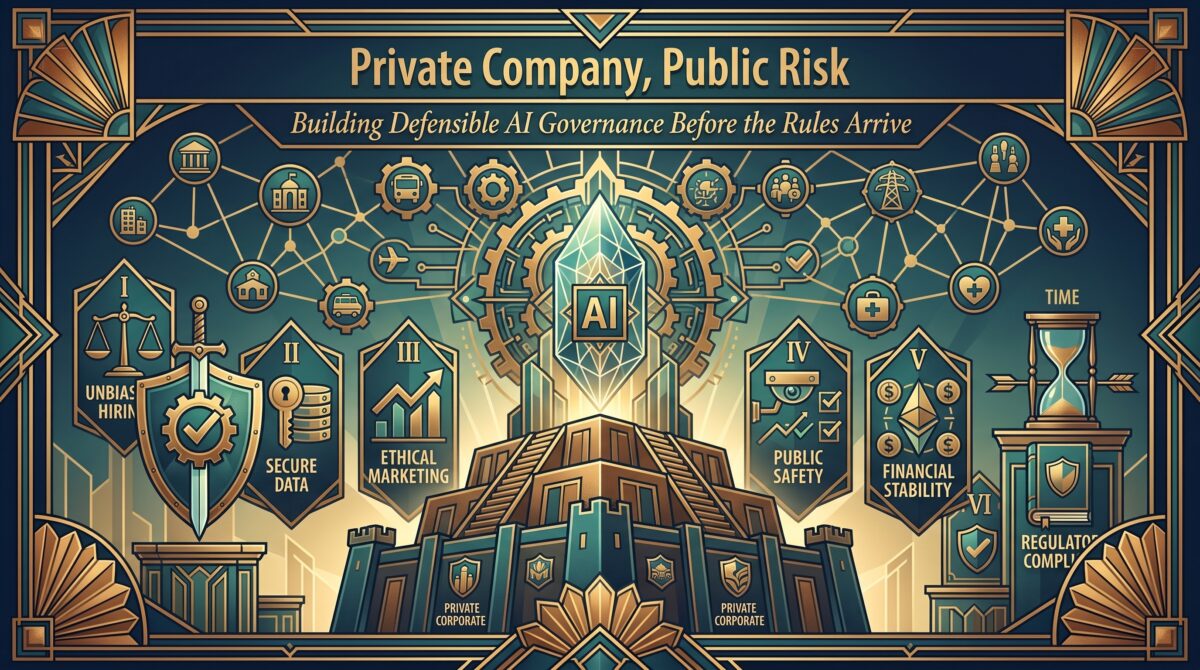
For private companies, the central question about artificial intelligence is no longer whether the technology is in the business. It is whether anyone can explain where it is, what it does, what data it touches, and who is accountable when it fails.
That is the warning in “AI Governance for Private Companies,” by Hillary Flynn, Drew Morales, and Courtney Hugger of Wellington Management, which was recently posted in the Harvard Law School Forum on Corporate Governance. The authors report that nearly three in four companies plan to deploy agentic AI within two years, while only one in five has a mature governance model for autonomous agents. That is not merely a technology gap. It is a governance gap.
Private ownership does not make AI risk private. The consequences arrive through customers, employees, regulators, investors, lenders, insurers, and business partners. A company may not yet face a single comprehensive AI law, but it can still face a privacy complaint, contract dispute, cyber incident, customer loss, or damaged valuation. For compliance professionals, governance should precede scale.
Private Does Not Mean Exempt
Private companies are moving quickly because AI can increase productivity, improve customer service, accelerate analysis, support coding, and help a growing company scale. The article also identifies a critical lesson from Wellington’s portfolio companies: the largest barriers are often organizational, not technical. Companies making the strongest progress combine AI investment with employee training, clear governance, and defined expectations.
This is where the Chief Compliance Officer can reframe the discussion. AI governance is the discipline that allows useful experimentation without unmanaged legal and business exposure. The goal is not a thick policy on a shared drive. The goal is an operating system for accountable decisions.
The European Union AI Act is being implemented in phases through 2027, with expectations around transparency, human oversight, documentation, risk management, monitoring, and AI literacy. In the United States, NIST guidance, ISO standards, sector rules, state laws, and customer requirements are shaping expectations, even without a federal AI statute. A private company can therefore face AI governance demands through a contract or transaction long before a regulator knocks on the door.
Begin With the Business Objective
One of the article’s strongest recommendations is also one of the simplest: start with the business problem, not the AI tool. This is precisely what Carl Hahn has consistently maintained: always ask, “What is the Business Value?”Teams should define the desired outcome before selecting a model or vendor. Is it lower cost, faster response, better quality, increased revenue, fewer errors, or reduced risk?
Governance cannot evaluate an undefined promise. A measurable objective gives management a basis for deciding whether the use case works and whether its benefits justify its risks. It also creates stopping rules. Approval should identify what failure, customer impact, control breakdown, or scope change will trigger redesign, escalation, suspension, or retirement.
Compliance should insist on this discipline, particularly when an AI use case affects payments, eligibility, claims, pricing, employment, healthcare, education, financial products, or customer communications. Those are not ordinary software deployments. They are decisions and interactions with consequences for real people.
Inventory First, Then Tier the Risk
A company cannot govern what it cannot see. The foundation is an inventory of models, vendors, internal tools, embedded features, customer-facing systems, employee-built applications, and known shadow AI. It does not need to be perfect. It needs an owner, an update process, and enough information to support risk decisions.
Each use case should then be placed into a risk tier. Relevant factors include data sensitivity, degree of autonomy, importance of the business process, impact on customers or employees, regulatory exposure, ability to explain the result, and ease of reversing an error. Low-risk uses can follow a streamlined path. High-impact uses should receive enhanced testing, documented approval, human oversight, monitoring, and senior-level escalation.
Risk tiering prevents two failures. Treating every use as equally dangerous overwhelms review and encourages employees to route around it. Treating every use as ordinary technology leaves consequential applications without meaningful controls. Good governance applies greater rigor where potential harm is greater.
Put a Name Next to the Risk
Every AI system should have a business owner who remains accountable for its outcome. Accountability cannot be delegated to the model, the data science team, or the vendor. The owner should understand the intended purpose, approved users, permitted data, performance standard, escalation route, and circumstances under which the system must be paused.
Higher-risk applications should receive cross-functional review involving the business, product, engineering, legal, compliance, privacy, cybersecurity, procurement, and risk functions. This does not require a new bureaucracy. It requires a repeatable process with recorded approvals and clear responsibility.
Agentic AI raises the stakes because the risk moves from a wrong answer to a wrong action. Permissions should be limited, high-stakes actions should require human approval, and activity should be logged. Test override and shutdown mechanisms. The chatbot manipulated into agreeing to sell a vehicle for one dollar shows how weak boundaries turn a novelty into an operational event.
Treat Vendors as Part of the System
Most private companies will rely on external models, platforms, and software. That makes AI governance inseparable from third-party risk management. Traditional security questionnaires are not enough. Diligence should address how vendors use data, whether customer data trains models, how model changes are communicated, what transparency is available, how performance is tested, who bears liability, and whether data and workflows can be moved if the relationship ends.
The company should monitor model updates, service degradation, changes in terms, and features that expand access or autonomy. A tool approved for summarization should not silently become authorized to send messages, approve transactions, or alter customer records.
Monitor the System in Practice
AI governance does not end at approval. Model updates, new data, and user behavior can alter performance. Companies should monitor accuracy, reliability, bias, drift, misuse, repeated failures, and customer impact. An incident protocol should define how to pause the system, preserve evidence, escalate, remediate harm, and communicate with affected stakeholders.
This is where AI governance meets familiar compliance principles. The DOJ’s Evaluation of Corporate Compliance Programs asks whether a program works in practice. COSO emphasizes control activities, information, monitoring, and accountability. NIST’s AI Risk Management Framework helps organizations govern, map, measure, and manage AI risk. ISO/IEC 42001 offers a management-system approach. A company should select a coherent baseline and produce evidence that its controls operate.
A Practical Agenda for Boards and CCOs
Establish ownership. Name an executive accountable for AI governance and identify the board committee that will oversee material AI risk.
Build the inventory: capture sanctioned tools, embedded vendor capabilities, customer-facing uses, agentic applications, and known shadow AI.
Tier the use cases. Apply enhanced review where AI affects sensitive data, consequential decisions, critical operations, or autonomous action.
Strengthen the vendor process. Add AI-specific diligence, contractual protections, change controls, exit planning, and ongoing monitoring.
Test the failure plan. Confirm that the company can detect a harmful outcome, stop the system, preserve evidence, assign responsibility, and remediate the impact.
The author’s bottom line is the right one for compliance leaders: the winners will not necessarily be the companies that deploy AI fastest. They will be the companies that combine innovation with accountability, customer awareness, and disciplined execution. For a private company, defensible AI governance is not preparation for some distant regulatory future. It is how management protects value today.