Categories
It's art

It’s Art, Let’s Talk About It: The Enchanted West: Adrienne Stein on Building a Breakout Museum Show, Craft, and Finding the West

The Museum of Western Art is dedicated to excellence in collecting, preserving, and promoting Western Heritage, and in educating and culturally enriching our diverse audiences. The Museum bridges the past and the present, ensuring the legacy of the American West endures for future generations. Western Art is as engaging and important as ever. In this award-winning podcast series, Museum Executive Director and host Darrell Beauchamp interviews artist Adrienne Stein after the opening weekend of her Museum of Western Art exhibition, “The Enchanted West of Adrienne Stein,” noting record crowds and strong sales; images and catalogs are available at museumofwesternart.com, and the show runs through November 7.

Stein recounts her path from York, Pennsylvania, to the American West through her relationship with her husband, artist Quang Ho, and explains how Darrell discovered her work in Ho’s studio, prompting comparisons to Georgia O’Keeffe and Agnes Pelton. She details rigorous early training with mentor Richard House, art education at Laguna College of Art and Design, The Art Students League of New York, and an MFA at Boston University that pushed her toward experimentation and imagination. The conversation covers balancing parenthood with producing 50 paintings, her materials and palette, framing by Brian Smith, upcoming work for the Briscoe Western Art Museum: Night of Artists, and her advice to young artists: paint from observation, keep a journal, and paint what you know.

Key highlights:

  • Meeting Quang Ho
  • Born or Learned Artist
  • New York and Portrait Hustle
  • MFA and Finding Voice
  • Mechanic Dreams and Trades
  • Family Life and Road Trip Muse
  • New Series Western Skies

Resources:

Museum of Western Art

Darrell Beauchamp on LinkedIn

Contact Adrienne at:

Categories
AI Today in 5

AI Today in 5: September 10, 2026 the Channel Problem Edition

Welcome to AI Today in 5, the newest edition to the Compliance Podcast Network. Each day, I will bring to you 5 stories about AI stories to start your day. Sit back, enjoy a cup of morning coffee and listen in to the AI Today In 5. All, from the Compliance Podcast Network. Each day we consider four stories from the business world, compliance, ethics, risk management, leadership or general interest about AI.

  1. AI risk assessments are missing the channel problem.(FinTechGlobal)
  2. Meta designs personal agent. (WSJ)
  3. FTC fines for ‘AI-hype’. (CW)
  4. AI causing toe-treading at work. (FT)
  5. What is the bot crime problem? (Bloomberg)

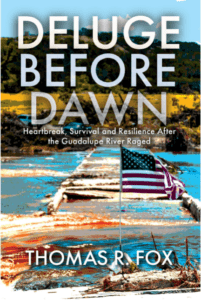
My first work of general non-fiction is now out: Deluge Before Dawn, the story of the 2025 flood in Kerr County Texas which killed 119 people and devastated a county. It is a story of tragedy, heartbreak, survival and resilience. It is available on the following sites:

 Amazon.com

Stoney Creek Publishing

Barnes and Noble

Texas A&M University Press

Bookshop.org

Google.Books

Walmart

This week only, the e-book Kindle version is available for $0.99 on Amazon

Categories
Daily Compliance News

Daily Compliance News: September 10, 2026 the Toe-Treading Trial Edition

Welcome to the Daily Compliance News. Each day, Tom Fox, the Voice of Compliance brings to you compliance related stories to start your day. Sit back, enjoy a cup of morning coffee and listen in to the Daily Compliance News. All, from the Compliance Podcast Network. Each day we consider four stories from the business world, compliance, ethics, risk management, leadership or general interest for the compliance professional.

  • Judge’s COI nixes award.(Reuters)
  • Ex-head of Swiss banking association convicted of corruption. (SwissInfo)
  • Iranian airlines still flying. (WSJ)
  • AI causing toe-treading at work. (FT)

My first work of general non-fiction is now out: Deluge Before Dawn, the story of the 2025 flood in Kerr County Texas which killed 119 people and devastated a county. It is a story of tragedy, heartbreak, survival and resilience. It is available on the following sites:

 Amazon.com

Stoney Creek Publishing

Barnes and Noble

Texas A&M University Press

Bookshop.org

Google.Books

Walmart

This week only, the e-book Kindle version is available for $0.99 on Amazon

Categories
FCPA Compliance Report

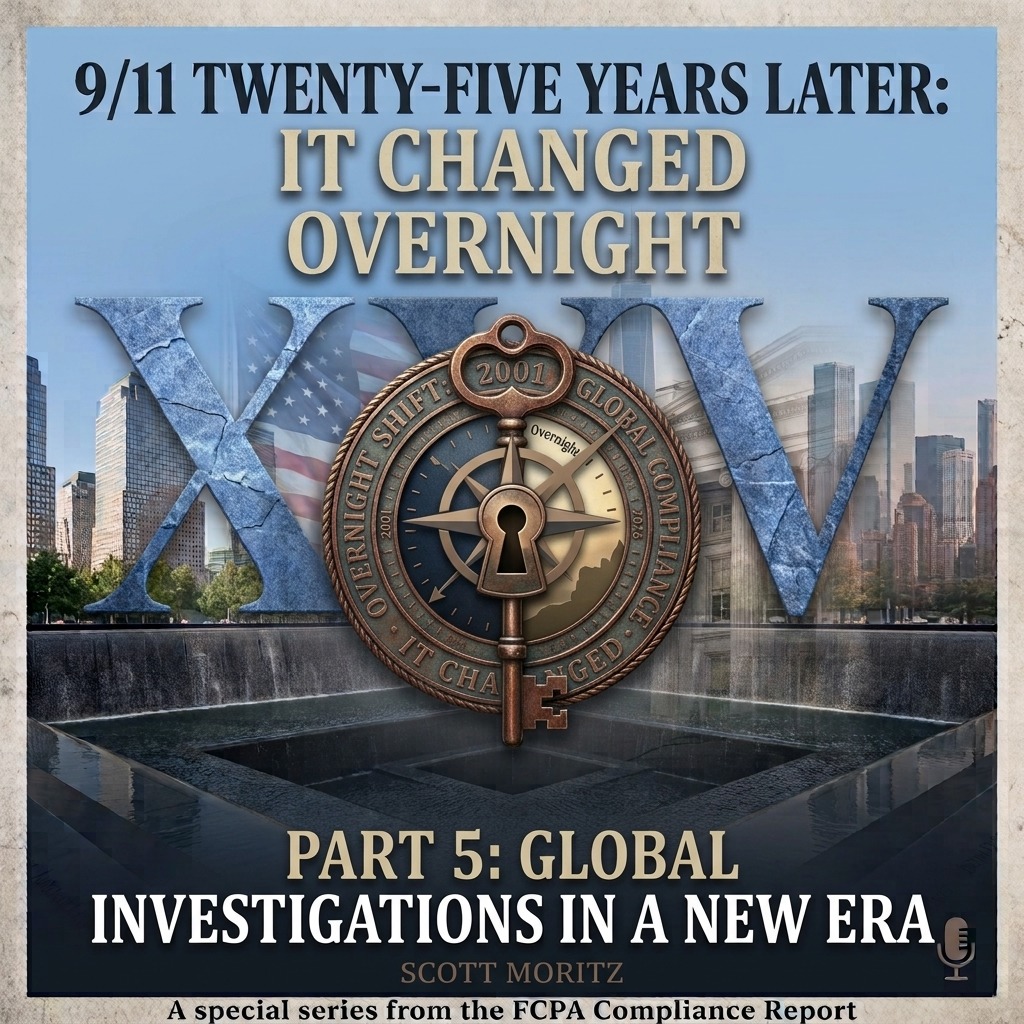
9/11 Twenty-Five Years Later: Part 5: Scott Moritz – It Changed Overnight

Ed. Note-Five years ago, I looked back on 9/11 in a 20 year retrospective. This week is the 25th anniversary of that event. I am rerunning this award winning podcast series so that we never forget.

On the 20th anniversary of the 9/11 terrorist attack, Tom Fox and guests look back on the tragic event and what it meant for them personally, as well as how it impacted the world of compliance. Today Tom’s guest is Scott Moritz. Scott Moritz is Tom Fox’s guest on this episode of Looking Back at 9/11. Scott joins Tom to talk about how the events of 9/11 impacted the FBI.

How 9/11 Changed The FBI: Structural and Cultural Ambidexterity

9/11 fundamentally changed the FBI overnight. Scott remarks that for a long time after 9/11, the FBI was primarily focused on the attack on the Trade Center. That was the Bureau’s main investigation, and it was being worked on by all the FBI field offices, and virtually every foreign attaché office in the world. Many scholars, through various organizational studies and surveys, assumed that the FBI would have created simultaneous frontline structures and processes to balance their two competing missions: national security and law enforcement. The scholars also posited that perhaps the FBI would engage in cultural ambidexterity, which would be to refuse to take on the mission of national security altogether. The FBI did something altogether unexpected and tackled both. 

The Benefit of One Agency

“There was this rapid emergence of two clear, but distinct, identities, and eventually, you know, one new unified identity FBI, but some changes where, terrorism cases were centralized at headquarters…This was a big departure from the way that the FBI normally operated,” Scott tells Tom. By staying as a single agency, the FBI had better access to local law enforcement agencies and could take better advantage of defendants with information that could advance the national security mission.

A Shift In The Private Sector

Tom asks Scott to talk about any changes in the private sector he was personally involved in. The major change in the private sector post-9/11, especially with respect to financial institutions, was the induction of the Patriot Act which also paved the way for other significant changes. Financial Institutions and broker dealers had to harden the security of buildings and supply chains across the country’s infrastructure. There was also the explosion of no fly lists, watch lists and terrorist watch lists. Banks, building owners and brokerage companies had to navigate these systems often, and quickly. Scott was very involved in helping these institutions in their anti money laundering obligations, as well as their security obligations. 

Looking To The Future

Tom asks Scott to share some reflections on 9/11, and for the future. Scott remarks that post-9/11, the country was more united and people were more compassionate to one another. The best of humanity in forms of kindness and outpouring of love was seen not just from Americans to each other, but from the rest of the world to America. He hopes that someday he can see that kind of love and unity again. 

Resources

Scott Moritz | LinkedIn | Twitter

Fraud Eats Strategy

Categories
Magnificent 7 Rides Again

The Magnificent 7 Rides Again: Laura Williams – Recent Public Art Projects

Welcome to The Magnificent 7 Rides Again, a captivating podcast series that delves into the vibrant world of seven talented female artists painting amidst the breathtaking landscapes, wildlife and vistas of the Texas Hill Country. Join us as we explore their creative journeys, uncover the inspirations behind their work, and celebrate their unique perspectives on art and life. In this Season 3, we visit with the artists about their 2026 exhibit The Magnificent Seven Rides Again at the Kerrville Art and Culture Center. In this episode, host Tom Fox welcomes back Laura Willams to discuss her recent work and preparations for the fourth Magnificent Seven Rides Again show.

Williams recounts completing a memorial mural in Austin’s Easton Park on a repurposed shipping container, incorporating layered steel to add depth and honoring a colleague who died of cancer. She also mentions private commissions in Beeville and Hunt, selling work at LJ’s reopening, and her board service with the Houston Area Parkinson’s Society, including donating a plein air oak tree painting (“Hermosa Prima”) to its Leaders and Legends program. For the upcoming show, she plans to exhibit Hill Country plein air works, a claret cup cactus painting, a nocturne roadrunner in acrylic, and a large textured purple thistle. She credits Magnificent Seven marketing and camaraderie for audience growth and professional development, shares that she will miss the demo day due to travel, and provides her website and social channels.

Key Highlights

  • Memorial Mural Austin
  • Show Preview New Works
  • Oil Versus Acrylic
  • What Magnificent Seven Means

Resources

Laura Williams Gallery

Texas Hill Country Podcast Network

The Hill Country Artists Facebook Page

The Hill Country Artists Facebook Page

Categories
Trekking Through Compliance

Trekking Through Compliance: The Science of Star Trek TOS: Warp Speed and Einstein

Welcome to Trekking Through Compliance. We recently finished Season 8, where we reviewed all 79 episodes from Star Trek-the Original Series (TOS) for compliance, ethics and leadership lessons. This year we had additional analysis from Timothy and Fiona, two AI generated voices which added yet another perspective. I had so much fun this Season I decided to extend it by adding episodes on the science of and science issues from Star Trek TOS. I am joined in this exploration by my good friend Dr. Ben Locwin, a healthcare futurist and astrophysicist, who brings a scientific perspective to the discussion of Star Trek’s technology. In each episode we use one or more TOS episodes to introduce topics such as warp drive, wormholes, phasers, the practice of medicine. In the second episode in this series, we look at warp speed and the warp drive. It is ton of fun and I know you will enjoy it.

Locwin presents the speed of light as a fundamental limit in physics and says there is no current evidence that anything can exceed it. He explains that warp drive is an exciting idea for entertainment, but in real physics it faces major barriers because objects with mass cannot go faster than light and require ever more energy as they approach that limit. Locwin also uses thought experiments and the confirmed effects of time dilation to make relativity easier to understand, while acknowledging the ongoing challenge of reconciling quantum mechanics with relativity. Overall, he sees light speed as the universe’s current ultimate speed limit, though he leaves open the possibility that future discoveries could change our understanding.

Highlights

  • Time Dilation Near Light Speed Travel
  • Controlled matter-antimatter collisions release massive energy
  • Einstein’s Hand Mirror and the Speed of Light

Resources:

⁠⁠Excruciatingly Detailed Plot Summary by Eric W. Weinstein⁠⁠

⁠⁠MissionLogPodcast.com⁠⁠

⁠⁠Memory Alpha

Ben Locwin on LinkedIn

Categories
Beyond the Label

Beyond the Label Podcast: Suicide Prevention, Asking the Hard Question, and Finding Anchors with Lee Ann Lindroth

Hosts Kelsi Wilmot and Tyler Townsend welcome Lee Ann Lindroth, Director of Integrated Care and Prevention at Hill Country MHDD Centers, for National Suicide Awareness Month to discuss suicide as a preventable public health issue and why everyone has a role in prevention.

Lee Ann shares her background and wide-ranging responsibilities, then explains how to talk to someone at risk: ask directly about suicide, don’t leave them alone, and increase distance from lethal means (medications, firearms). Tyler shares lived experience with suicidal ideation and the “anchors” that helped him stay. They review statistics (48,824 U.S. deaths; 4,490 in Texas; higher rates in the Hill Country region), warning signs, and high-risk factors, including ages 35–45 and firearm involvement. Resources include 988, 988lifeline.org, Hill Country’s 24/7 line (877-466-0660), and trainings like ASK, Mental Health First Aid, ASIST, and CALM, plus guidance on saying “died by suicide” instead of “committed suicide.”

Key highlights:

  • How to Ask About Suicide
  • Suicide Awareness Month Focus
  • Means Safety and Time Buffer
  • Personal Anchors and Lived Experience
  • Suicide Warning Signs
  • Surviving an Attempt
  • Crisis Resources: 988

Resources: 

Hill Country MHDD

Categories
Blog

The Clippers Investigation: Part 4- Consequence Management at the Top

The Clippers penalties demonstrate that discipline is not the end of a compliance process. It is the public test of whether rules apply to powerful people. The Clippers investigation demonstrates why conflict controls must follow influence, economic benefit, and interconnected transactions, not merely financial ownership. In this Part 3 of a five-part series we consider what the consequences of cheating and not following the rules and regulations your organization agrees to comply with going forward. Every organization claims that no one is above the rules. Consequence management determines whether that statement is true.

The test does not come when a junior employee commits an obvious policy violation. It comes when the conduct involves a founder, controlling owner, senior executive, star performer, or other person viewed as essential to the business. The investigation into the LA Clippers and Kawhi Leonard presents that test in unusually clear terms. The independent investigators’ report of the Clipper’s NBA salary cap circumvention (Wachtell Report) attributed primary responsibility to Clippers owner Steve Ballmer, President of Business Operations Gillian Zucker, and President of Basketball Operations Lawrence Frank. It also found violations by Leonard through the conduct of his uncle and then-business manager, Dennis Robertson (Uncle Dennis).

The NBA responded with organizational, financial, individual, competitive, and monitoring consequences. For compliance professionals, the case provides a framework for considering who should be held accountable, for what conduct, and through what mechanism.

From Punishment to Consequence Management

Punishment looks backward. It asks what sanction should follow a violation. Consequence management is broader. It identifies misconduct, investigates responsibility, calibrates discipline, addresses supervisory failures, remediates control weaknesses, and communicates the organization’s expectations. All of this brings this to one of my favorite phrases in compliance Consequence Management.

The DOJ’s Evaluation of Corporate Compliance Programs (ECCP) introduces consequence management procedures as procedures to identify, investigate, discipline, and remediate violations of law, regulation, or policy in place. It goes on to state that every organization must enforce them consistently across the organization, and ensures that the procedures are commensurate with the violations. It then concludes this introduction with the following Prosecutors should also assess the extent to which the company’s communications convey to its employees that unethical conduct will not be tolerated and will bring swift consequences, regardless of the position or title of the employee who engages in the conduct. 

Consequence Calibration

The report provides several categories for assessing responsibility.

  1. Direct participation. Investigators concluded that Zucker initiated, facilitated, and induced endorsement agreements involving Leonard and four Clippers business partners. They found that Ballmer knowingly sought to help Leonard obtain outside income and approved the Forum agreement after learning that Aspiration had tied it to Leonard’s endorsement arrangement. Frank conveyed Robertson’s demands and approved impermissible personal expenses.
  2. Supervisory responsibility. The report concluded that Ballmer failed to supervise the organization’s most senior business executive and failed to create conditions supporting compliance with the circumvention rules.
  3. Reporting responsibility. Investigators found that Ballmer, Zucker, and Frank did not report Robertson’s improper demands, despite an NBA rule requiring those reports even when the solicitation was rejected.
  4. Personal or represented conduct. The report concluded that Leonard, through Robertson, pressured the team to help obtain outside income and failed to reimburse certain personal expenses. Robertson was the person who allegedly made the demands and applied the pressure.

A defensible consequence decision should map each individual to the conduct, knowledge, authority, benefit, supervisory obligation, and missed opportunity to intervene. Titles alone should neither establish nor eliminate responsibility.

Credibility and Cooperation Matter

The report did something particularly useful for compliance officers: it distinguished among witness behavior. Investigators wrote that Zucker made statements inconsistent with contemporaneous documents and other witnesses, professed limited recollection on significant issues, placed responsibility on subordinates, and provided inconsistent versions of events.

By contrast, they reported that Frank discussed his conduct openly, recalled important details, accepted responsibility for subordinates, and remained generally consistent across interviews. The investigators expressly stated that cooperation and credibility, or their absence, should be considered when consequences were determined.

Cooperation does not erase underlying conduct. It should, however, affect consequence calibration. An employee who preserves documents, provides candid information, accepts responsibility, and assists remediation presents a different risk from one who misleads investigators or shifts blame.

The organization should define cooperation before an investigation begins. Employees should understand that cooperation requires truthful, complete, and timely responses; preservation of relevant information; correction of prior inaccuracies; and no retaliation or interference. It does not require surrendering legitimate legal rights.

Prior Misconduct Changes the Analysis

The Clippers had previously been penalized for a salary-cap circumvention violation involving an endorsement opportunity. The NBA had also investigated demands made during Leonard’s 2019 free agency and provided specific training to Clippers leaders.

Prior history matters because it changes what the organization and its leaders reasonably should have done. A first incident may reveal an unrecognized risk. A repeated incident following investigation, rule clarification, and training raises questions about culture, supervision, remediation, and willingness to comply.

The Sentencing Guidelines identify prior organizational history as relevant to culpability and direct organizations to consider similar misconduct when designing an effective program. DOJ likewise asks whether policies, training, controls, and risk assessments incorporate lessons from prior incidents.

Remediation that ends with training is incomplete. The organization must test whether behavior, decision rights, escalation pathways, and controls changed.

The NBA’s Consequence Framework

The NBA’s official action included multiple forms of individual accountability. The Box Score of individual consequences reads as follows:

Person Relationship Consequence
Steve Ballmer Owner LA Clippers Fine and one year ban
Gillian Zucker Clippers President of Business Operations One Year Unpaid Suspension
Lawrence Frank Clippers President of Basketball Operations 6-month Unpaid Suspension
Kawhi Leonard Clipper Player $700K fine
Uncle Dennis Leonard Representative 5 Year Ban from NBA

These measures address different risks. For corporate compliance programs, the equivalent toolkit may include termination, suspension, bonus reduction, clawbacks where legally available, promotion restrictions, written warnings, removal of approval authority, enhanced supervision, vendor termination, and mandatory remediation. Consequences do not need to be identical, but the process must be consistent. Consistency means applying the same decision factors to similarly situated people. It does not mean imposing the same outcome regardless of role, intent, cooperation, history, or responsibility.

Practical Takeaways

CCOs, human resources leaders, and boards should consider the following:

  • Adopt written consequence-management procedures before a significant investigation occurs.
  • Use a consistent decision matrix covering conduct, intent, seniority, authority, benefit, cooperation, prior history, and supervisory responsibility.
  • Separate factual findings from disciplinary decisions, while ensuring that decision-makers understand the evidentiary record.
  • Document why similarly situated individuals received similar or different outcomes.
  • Apply financial consequences where permitted and align future compensation with compliance performance.
  • Communicate substantiated outcomes internally with enough detail to reinforce expectations while respecting legal and privacy constraints.
  • Track disciplinary data by level, function, geography, and type of misconduct to identify inconsistency.
  • Require independent board oversight when senior management is implicated.

Consequence management is where culture becomes measurable. If the organization protects its most powerful people, employees will understand that performance outranks integrity. If it applies a fair, independent, and proportionate process, employees will understand that compliance is part of how the business operates.

In our final blog post, we will bring the series together and develop a practical framework for CCOs, boards, and risk leaders seeking to build a compliance program capable of saying no to the star.

Categories
Everything Compliance

Everything Compliance: DEI Backlash, Executive Orders, and When “Tone at the Top” Needs Resources

Welcome to a revamped Everything Compliance. Host Adam Turteltaub and panelists Karen Moore, Matt Kelly, Rebecca Walker, and Jonathan Armstrong discuss compliance issues spanning DEI, executive orders, leadership support, and new EU sustainability rules.

  • Karen Moore reviews rapid corporate reversals on DEI and cites a Stanford/UC Berkeley study, “Markets Do Not Punish Firms for Maintaining DEI,” finding no statistically significant investor, consumer, or revenue penalties for S&P 500 firms that maintained DEI after the January 2025 executive order, while noting differing risk profiles for smaller or contracting-heavy businesses.
  • Matt Kelly uses the “Lake Ontario to Lake America” renaming to argue executive orders aren’t laws binding companies and that choosing to comply reflects corporate values and policy-override decisions.
  • Rebecca Walker argues “tone at the top” is insufficient without resources and real trade-offs, citing NAVEX data on gaps between encouraging, modeling, and persisting in ethics under pressure.
  • Jonathan Armstrong outlines a new EU law limiting the destruction of unsold apparel and footwear, along with practical compliance steps.

The members of Everything Compliance are:

The award-winning Everything Compliance is a part of the Compliance Podcast Network.