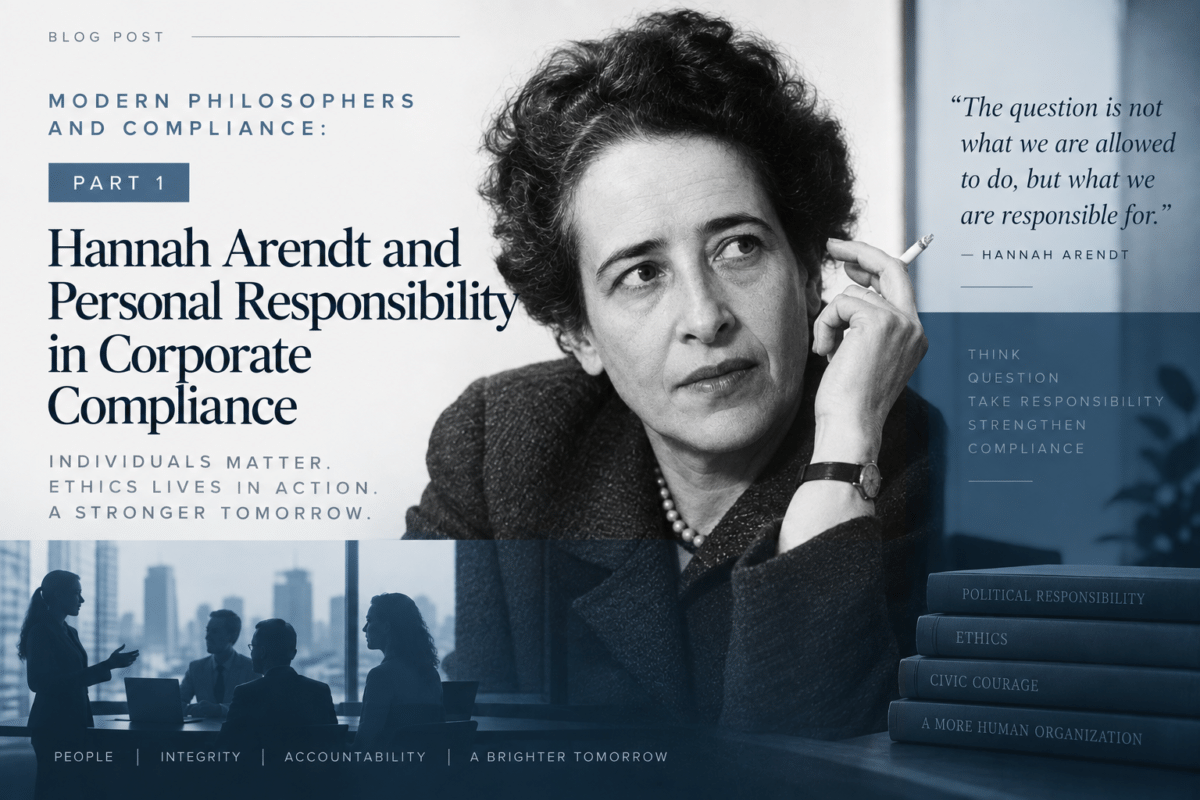
This week we will conclude our lengthy exploration of the philosophical underpinnings of the modern corporate compliance program. We will examine Simone de Beauvoir and the conditions for ethical action in a corporation; John Rawls and institutional justice and fairness in a corporate compliance program; Jürgen Habermas and the governance of speaking up; and Hans Jonas and responsibility for the future of corporate compliance. Today we begin with Hannah Arendt and her concepts of personal responsibility and how they relate to the modern compliance program.
Every approval in a compliance process represents a decision. Someone accepts an explanation, authorizes a payment, resolves a concern, or allows business to proceed. The central question is whether that person understands and takes responsibility for the decision. Hannah Arendt gives compliance professionals a powerful way to examine what happens when organizational routines weaken that connection.
Our examination of ancient and Enlightenment thinkers established the importance of inquiry, ethical habits, institutional order, and evidence. We now turn to twentieth-century philosophy, beginning with responsibility inside complex organizations. Arendt asks us to consider the individual who operates within the system. What happens when that person stops examining the meaning and consequences of the work?
For a Chief Compliance Officer, this question reaches directly into third-party approvals, internal investigations, management conduct, and board oversight. A company can assign responsibilities in a policy while its employees learn to defer judgment to someone else. An effective compliance program must address that gap.
Thinking and Judgment as Compliance Responsibilities
Arendt was a German-born Jewish political thinker who fled Nazi Germany and eventually settled in the United States. Her experiences of persecution and displacement informed her examination of totalitarianism, political life, and personal responsibility. In essays including “Personal Responsibility Under Dictatorship” and “Thinking and Moral Considerations,” she explored the relationship between independent thought, moral judgment, and conduct.
Her account of Adolf Eichmann and the phrase “banality of evil” remain controversial, if not one of the most well-known phrases to describe Nazi Germany. The phrase did not mean that the crimes were ordinary or insignificant. Her interpretation emphasized his failure to think critically about what he was doing, although scholars have challenged her assessment of his motivations. The historical crimes she examined must retain their specificity and gravity.
The compliance application is narrower: institutional roles do not eliminate the need for personal judgment. Arendt was not writing a corporate governance manual. Her work nevertheless provides a basis for asking whether employees examine what their actions enable, particularly when organizational language makes questionable conduct appear routine.
That question builds on Socrates. Socratic inquiry tests assumptions through questioning. Arendt directs our attention to the person who must decide whether to accept the answer and participate in the conduct. For compliance professionals, that is where inquiry becomes responsibility.
When Approvals Divide Responsibility
Consider this hypothetical. A multinational manufacturer proposes hiring an intermediary to help secure business with a state-owned customer. The commission is unusually high. The service description is vague, and the intermediary requests payment to an account outside its home jurisdiction.
Sales confirms the commercial opportunity. Procurement verifies that the vendor record is complete. Legal reviews contractual provisions. Finance checks that the required approvals appear in the payment system. Compliance previously reviewed the intermediary, but the proposed payment arrangement has changed since that review. Each function assumes another has addressed the remaining concern—the payment proceeds.
No single feature establishes bribery. Together, these facts warrant further inquiry. The governance failure is that nobody takes responsibility for obtaining a satisfactory explanation before payment. Each participant can describe a completed task. The organization cannot explain who assessed the unresolved risk.
This is where Arendt becomes useful to the CCO. Division of labor is necessary in a large company. It must be accompanied by clear obligations to recognize concerns, communicate them, and seek an appropriate decision. Otherwise, specialization can allow important facts to disappear between functions.
The practical response is to specify what each approval means. Does the approver confirm budget availability, verify services, resolve due diligence findings, or authorize an exception? What changes require renewed review? Who owns the decision when concerns remain? These questions turn personal responsibility into an operating requirement.
The DOJ Connection Through Gatekeepers and Escalation
The Department of Justice’s Evaluation of Corporate Compliance Programs (ECCP) addresses this issue directly. Under policies and procedures, the ECCP asks about guidance and training for gatekeepers with approval or certification responsibilities. It examines whether they recognize misconduct and understand when and how to escalate concerns.
This is a substantive connection to Arendt’s work, rather than a claim of philosophical influence on DOJ. The compliance question concerns whether an employee’s assigned role includes meaningful judgment. An approval control weakens when its operator understands the mechanics but cannot identify the circumstances that require further review.
Return to our hypothetical. The finance employee should understand whether the changed bank account requires renewed diligence. The business sponsor should explain the services and commercial rationale. Compliance should receive material changes to the information on which its earlier review depended. The final decision should record how identified concerns were resolved.
The CCO can test this through a sample of actual transactions. Interview the approvers. Ask what they believed their approval represented, what information they reviewed, and what would have caused them to stop. Compare those answers with the procedure. The gap between intended and understood responsibility is a control issue that requires attention.
Training Employees to Recognize the Decision
Arendt’s emphasis on thinking also offers a practical lesson for training. Employees need opportunities to examine a situation before organizational habit supplies the answer. A course can explain a prohibition accurately while leaving participants uncertain about how to respond when a manager presents a questionable request as urgent and routine.
The ECCP examines whether training is tailored to relevant employees and risks, whether employees can ask questions, and how the company evaluates learning and training’s effect on behavior or operations.[4] Those inquiries support training that develops judgment within defined responsibilities.
Use the hypothetical intermediary payment as an exercise. Give participants the initial facts, then introduce the changed bank account after approval. Ask them to identify what requires renewed attention, which function should act, and what must happen before payment. Require an explanation for the proposed response.
Include the manager who says the transaction has already been approved. That intervention tests whether employees understand the limits of an earlier decision. The training should leave them with a usable escalation route and a clear account of their authority. Asking people to exercise judgment carries a corresponding obligation to equip them to act.
Leadership Determines Whether Judgment Is Welcome
Employees learn what management expects by watching what happens when someone raises a concern. A company may encourage questions in training while a business leader treats delay as disloyalty. Over time, employees may conclude that completing the transaction is safer than examining it.
The ECCP assesses how senior and middle management demonstrate commitment to compliance. It also examines whether employees feel comfortable reporting concerns and whether the company maintains an effective approach to preventing retaliation.[5] These are relevant tests of the environment in which personal judgment operates.
For the CCO, the practical inquiry should include decisions under pressure. When did a manager support an employee who paused a transaction? What happened to an unresolved concern near quarter-end? Did a policy exception receive appropriate scrutiny when the business sponsor was influential? Such examples help explain whether the stated expectations survive commercial pressure.
Boards also have a role here. The ECCP examines compliance access to governing authorities and opportunities for private discussions. It also cites the Sentencing Guidelines’ expectations concerning governing authority knowledge and oversight.[5] Directors should use that access to ask where management pressure is weakening escalation and whether the compliance function can obtain timely decisions on unresolved concerns.
Investigations Must Examine the Approval Chain
When misconduct emerges, Arendt’s focus on personal responsibility should sharpen the investigation without prejudging anyone’s culpability. The inquiry must establish what individuals knew, what their roles required, what authority they possessed, and how they responded. Participation in a process alone does not establish intentional wrongdoing.
In our hypothetical, investigators should trace the changed payment instructions through the approval chain. Who received them? Did the system alert compliance? Did anyone ask for an explanation? Was a concern overridden, misunderstood, or never transmitted? Those facts distinguish deliberate avoidance from inadequate training, poor system design, or reasonable reliance on incomplete information.
The ECCP asks whether investigations identify system vulnerabilities and accountability failures, including those involving supervisory managers and senior executives. Its remediation questions address failed controls, missed opportunities, and accountability for supervisory failures.[6] An investigation that stops at the person who released the payment may leave the conditions that enabled the problem intact.
Fair accountability therefore requires attention to both conduct and context. Discipline should reflect facts and relevant responsibilities. Remediation should repair the information flows, authority gaps, and incentives that shaped the decision. The organization must be able to explain what it learned and how that learning changes future approvals.
Five Key Arendt Takeaways for the Compliance Professional
- Define the responsibility within each approval. Identify what the approver must assess, the evidence required, and the conditions that trigger escalation. Test whether employees understand these obligations in actual transactions.
- Train for judgment under realistic pressure. Use scenarios involving changed facts, urgent requests, and influential sponsors. Assess whether employees can explain a concern and identify the appropriate response.
- Make challenge operationally possible. Give employees clear escalation routes and appropriate authority to pause decisions. Examine how managers respond when employees use those mechanisms, including whether adverse consequences follow.
- Follow accountability through the management chain. Investigate who knew what, who exercised authority, and where supervision failed. Apply fair standards to senior leaders and high performers as well as frontline employees.
- Give the board evidence of independent judgment. Report material overrides, unresolved concerns, and lessons from investigations. Explain where employee challenge changed a decision and where management action is still required.
Arendt helps us see that personal responsibility must remain visible inside institutional processes. The CCO’s task includes designing controls that preserve that responsibility and creating conditions in which employees can exercise it. A useful board question follows: Where could our processes allow every participant to believe that someone else was responsible for examining the risk?
Join us tomorrow in Part 2, as we turn to Simone de Beauvoir and discuss the conditions that make ethical action possible. If Arendt asks individuals to exercise judgment, Beauvoir helps us examine how unequal power, dependence, and vulnerability affect their ability to act on it. That inquiry leads directly to reporting culture, retaliation prevention, and the lived experience of corporate compliance.