A compliance program is tested when someone identifies a risk that the business would prefer not to address. The question is not whether compliance can produce a memorandum. The question is whether the organization makes a timely, supportable decision and implements controls that address the concern.
The Bank of America enforcement record provides a detailed examination of that problem. FinCEN (Consent Order) describes repeated internal warnings, testing that identified weaknesses, and customer relationships that continued without controls commensurate with the risks. Its findings place management decisions about revenue and resources at the center of the compliance failure.
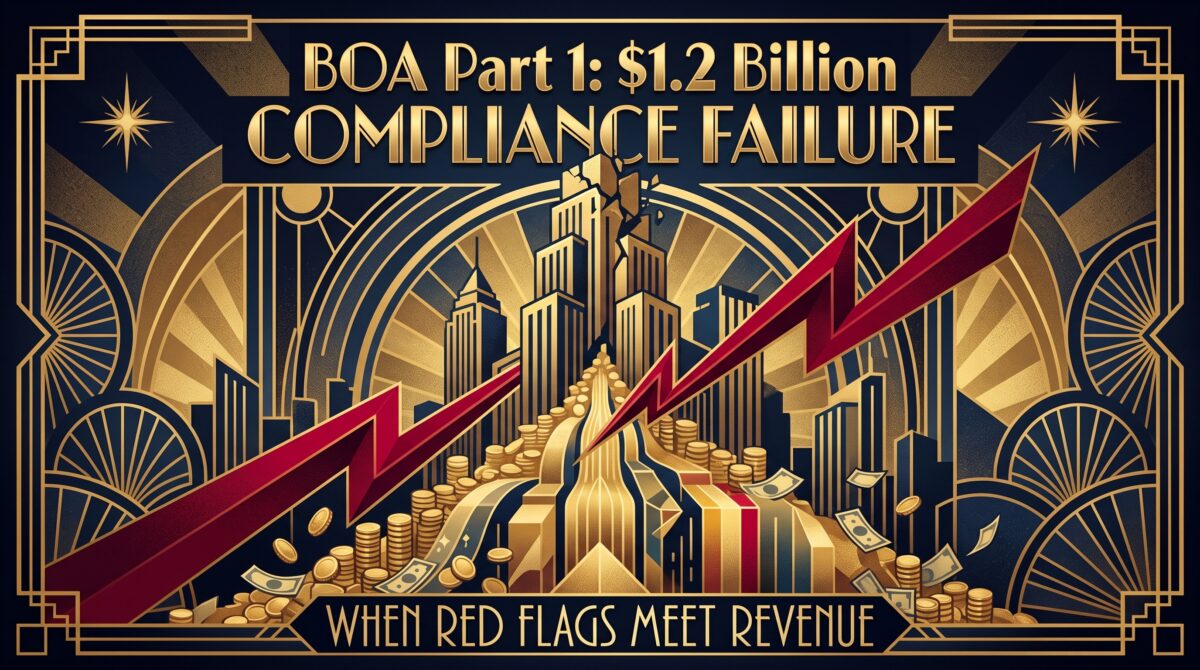
For chief compliance officers, the central lesson is straightforward: Identifying a material risk is the beginning of compliance work, not its completion. Over this four-part blog series, we will review the FinCEN Consent Order, OFAC’s Enforcement Release, and the Department of the Treasury’s Press Release to mine each for how this was allowed to occur, how it continued, the governance failures, the marginalization of compliance, and the penalties assessed. Today in Part 1, we examine the governance failure at the heart of the Bank of America enforcement actions: compliance personnel identified significant risks, but management did not ensure those concerns led to timely, effective corrective action.
Understanding the Enforcement Actions
On October 13, 2026, the Department of the Treasury announced enforcement actions involving FinCEN, the Office of the Comptroller of the Currency, and the Office of Foreign Assets Control. Treasury described combined penalties exceeding $1.21 billion for anti-money laundering and sanctions failures.
The penalty structure matters. FinCEN assessed $1.2 billion but credited the bank’s $750 million OCC payment, leaving $450 million payable under the FinCEN Consent Order. OFAC’s separate Enforcement Release states a settlement of $11,662,930. Adding the full FinCEN and OCC assessments together would therefore overstate the combined financial penalty.
The legal posture also matters. Bank of America admitted the facts and violations in the FinCEN Consent Order. It expressly limited its admission of willfulness to the civil Bank Secrecy Act enforcement standard. By contrast, OFAC resolved potential civil liability for apparent violations. These documents should not be characterized as a criminal guilty plea.
The Warnings Were Already Inside the Organization
Consider the relationship identified in the FinCEN Consent Order as Customer A, an online marketplace connecting sellers of salvaged vehicles with domestic and international buyers. The bank had maintained accounts for this customer since 1995. By 2022, compliance personnel had identified concerns involving third-party payments, limited visibility into the source of funds, and repeated fraud-related investigations. In July, compliance recommended that the customer’s accounts be considered for closure. Subsequent internal analysis identified more than 100 customer-related cases between 2020 and August 2022.
This was not simply a disagreement about a customer’s reputation. Compliance was identifying a weakness in the bank’s ability to understand the funds moving through the relationship. An important distinction must remain clear. The Consent Order records that no evidence shows Customer A orchestrated the underlying fraud. The concern was that its accounts appeared to have received and moved fraud proceeds, creating risks the bank needed to address. Suspicion concerning transactions is not proof that the customer knowingly participated in the underlying misconduct.
That distinction makes the compliance lesson more useful. An organization does not need to prove a business partner is a criminal before deciding the relationship requires stronger controls.
When Commercial Importance Becomes the Answer to a Different Question
Following an internal meeting in September 2022, the relationship manager prepared a memorandum describing Customer A as a “large and valued client” generating approximately $6 million in annual revenue. The memorandum emphasized the broader commercial relationship and the business line’s support for retaining it. Compliance personnel continued asking how the underlying risks were being mitigated. FINCEN consent order
Here is the governance problem: commercial value and risk mitigation answer different questions. Revenue explains why the business wants to retain a relationship. It does not establish that the relationship can be maintained within an effective control environment.
Nor does compliance independence require that every recommendation to terminate a relationship prevail. FinCEN expressly states that account closure is not the only appropriate response to heightened financial crime risk. Enhanced monitoring, restrictions on products or services, and other risk-based controls may be appropriate. The real question is whether the alternative works.
A defensible decision to retain a high-risk customer should explain what will change, who will implement it, what evidence will show it works, and what happens if the customer does not meet the agreed conditions. Without those elements, an alternative mitigation plan can become a way to defer the original decision.
A Mitigation Plan Is Not the Same as Mitigation
In March 2023, more than six months after compliance recommended closure, the relationship manager summarized proposed measures, including limiting payments to registered buyers or dealers. Compliance withdrew its closure recommendation based on the communication and implementation of those measures, while reserving the possibility of revisiting the decision.
However, Customer A continued processing third-party payments through its Bank of America account until June 2025. The bank did not adequately update the customer’s risk profile, ongoing monitoring, or other due diligence measures to address the continuing practice. Some other changes were implemented, but the central payment risk persisted.
This is where compliance activity and compliance effectiveness separate. A meeting is an activity. A mitigation plan is an activity. A customer assurance is information. None, standing alone, establishes that the risk has been reduced. For the CCO, the missing discipline is verification. When the organization decides to continue a relationship subject to conditions, those conditions need an owner, an implementation date, evidence requirements, and consequences for nonperformance.
Resources Are Also a Governance Decision
FinCEN found that management’s approach to transaction monitoring was influenced by the resources required to investigate additional cases. When remediation began, the bank estimated that investigative volumes would double and that approximately 750 additional personnel would be needed. FinCEN concluded that the bank had likely avoided hundreds of millions of dollars in compliance-related expenditures during the relevant period. That was FinCEN’s assessment, not a separately calculated figure of realized profit.
The business lesson is not that every compliance function should receive every requested dollar. Resource decisions need to address the actual risk. Management should not resolve a capacity problem by treating the activity that exceeds capacity as less important without a supportable risk basis.
What the CCO and Board Should Ask
As a comparison framework, the DOJ’s Evaluation of Corporate Compliance Programs (ECCP) examines whether a program is well designed, adequately resourced and empowered, and effective in practice. It also asks whether managers tolerate greater compliance risks to pursue revenue and how the company responds when compliance raises concerns. These are useful analytical questions here, not the legal standards under which FinCEN resolved this case.
Board oversight provides another comparison. In Marchand v. Barnhill, the Delaware Supreme Court emphasized the need for a good-faith effort to establish board-level monitoring of a critical compliance risk. Caremark liability involves a demanding bad-faith standard, not automatic liability whenever a control fails. The Bank of America documents discussed here are not Caremark judgments against its directors.
The practical board questions nevertheless follow naturally. Which material compliance recommendations remain unresolved? Which business decisions depend on mitigation that has not been verified? Which deficiencies have appeared repeatedly without an effective response? Those questions move oversight beyond receiving presentations to examining whether management is controlling the risk.
Three Key Takeaways
First, require decisions, not indefinite escalation. Material concerns need accountable decision-makers, documented reasoning, deadlines, and follow-through.
Second, separate commercial justification from control effectiveness. A valuable relationship may be retained, but its revenue does not demonstrate that its risks are mitigated.
Third, verify the conditions supporting the decision. Keep an approved remediation plan open until the organization has evidence that the relevant controls work.
The CCO question: When the business rejects or modifies a compliance recommendation, can you demonstrate that the alternative actually reduced the risk?
Today we examined the governance failure at the heart of the Bank of America enforcement actions: compliance personnel identified significant risks, but management did not ensure that those concerns produced timely, effective corrective action. FinCEN’s findings describe an organization that prioritized customer revenue and resource considerations while known risks persisted without commensurate controls.
The central lesson is not that compliance must prevail in every disagreement or that every high-risk relationship must be terminated. Decisions to retain those relationships must rest on demonstrable risk mitigation, not commercial importance alone. For CCOs, this means establishing accountable decision-makers, deadlines, documented reasoning, and verification that agreed measures work. For boards, it means examining unresolved exposure rather than merely receiving reports of completed activities. A mitigation plan does not establish that a risk has been mitigated. The organization must verify the result.
Join us Tomorrow
Management decisions about compliance don’t stay confined to committee meetings and customer relationship discussions. They also shape the technology that determines which risks receive attention and which remain uninvestigated. In Part 2, we turn to Bank of America’s Event Processor transaction monitoring system and FinCEN’s findings concerning unsupported design choices, investigative thresholds, alert suppression, gaps in monitoring coverage, and inadequate responses to testing.
Our focus shifts from whether management acted on known concerns to whether its automated controls could identify and escalate the relevant activity. We will examine the difference between reducing investigative workload and improving compliance effectiveness, with practical applications for data governance, model validation, and AI oversight. Every CCO must ask whether your technology addresses the intended risk, not simply whether it operates according to its configuration.