Categories
All Things Investigations

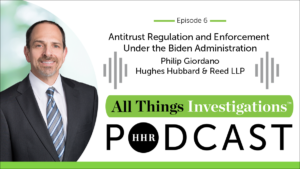
All Things Investigations: Episode 6 – Antitrust Regulation and Enforcement Under the Biden Administration with Philip Giordano


Welcome to the Hughes Hubbard Anti-Corruption and Internal Investigations Practice Group’s Podcast, All Things Investigations. In this podcast, host Tom Fox and members of the Hughes Hubbard Anti-Corruption & Internal Investigations Practice Group will highlight some of the key legal issues involved in white-collar and other investigations, both domestically and internationally. In this episode, I speak with Philip Giordano, a partner at Hughes Hubbard, about the Biden administration’s antitrust regulation and enforcement.


Philip Giordano is a partner in the firm’s Antitrust Group, focusing on a variety of national and international antitrust matters, including complex criminal antitrust investigations and litigation, civil non-merger government investigations, and mergers and acquisitions. Philip also personally practices in the area of criminal defense.
Key areas we discuss on this podcast are:

  • The biggest changes in the Department of Justice over the last 18 months. 
  • An expected area of expanded enforcement and guidance is going to be in the area of potential competitors and acquisition of potential competitors and of nascent competitors.
  • It’s likely that merger reviews are going to take longer.
  • Expanding the reach of antitrust laws.
  • You typically do not see wage agreements in no-poach clauses.
  • Whether Philip expects the Biden administration to maintain their aggressive enforcement and review of mergers and acquisitions.

 
Resources
Hughes Hubbard & Reed website 
Philip Giordano on LinkedIn
 

Categories
The ESG Report

The Legal Side of ESG with Christian Perez Font


Christian Perez Font has appeared on many of Tom Fox’s podcasts. He is the managing partner of Thinkeen Legal, a revolutionary law firm that specializes in corporate and commercial law, domestic and cross-border transactions, and compliance with a focus on startups, and small and mid-sized companies. He specializes in using data to help clients do traditional legal tasks. Thinkeen Legal’s main focus is the healthcare industry. In this episode, Christian and Tom discuss organizations’ legal approach to ESG. 


Compliance Through The ESG Lens
Tom asks Christian how he approaches M&A and compliance from an ESG perspective. Christian responds that when he looks at data and legal projects, he thinks about the data from two perspectives. “First you need to think of data as fuel because it’s what keeps your compliance cycle going on, your business cycle going on; but also as a measure of progress towards a certain goal.” The same goes for a company’s ESG program, he says. He explains that it is crucial to have fixed goals for each part of your ESG program as well as a way to measure your progress toward those goals. In an ESG program, you may have to analyze large sums of data in some cases, and in other cases the data may be very limited. He tells Tom, “When we talk about data in the governance side of things, you’re probably going to have fewer amounts of data to track than if you’re thinking about social responsibility.” 
 
The Nexus Between Healthcare Compliance and ESG
Thinkeen Legal is known for its work in the healthcare compliance industry, so Tom asks how data, healthcare, compliance, and ESG intersect. Christian explains that there’s a big intersection of ESG and compliance on the social responsibility side and governance sides.  He remarks, “When looking at acquisition as an investor, one of the things you want to look at is the social responsibility program to know if this is the company you want to invest in from a corruption standpoint… In the healthcare sector, we’ve seen some companies use social responsibility initiatives for improper purposes.” Therefore, he advises that good asset management – which is a part of a governance system – can provide you with useful information from a compliance perspective about what is happening in relation to ESG in the company. 
 
ESG and Data Analytics 
Tom asks Christian about the importance of ESG audits and the importance of the data you collect. Christian replies that auditors play a crucial role in data tacking by having to intimately understand the trends the company is tracing. “Data analytics and tracking play a major role in business acquisitions,” he points out. “Know as much as you can about the other. Understand the company’s ESG program and have a clear grasp of its social responsibility and environmental footprint.”
 
Resources 
Christian Perez Font | LinkedIn | Twitter 
Thinkeen Legal | Twitter | Instagram  
 

Categories
FCPA Compliance Report

Loren Steffy on Putin’s Oil Heist Podcast


In this episode of the FCPA Compliance Report I welcome Loren Steffy, now podcast host. Steffy is in the middle of a limited series on the theft by Russian President Putin on the publicly traded Yukos Oil Company back in 2007.  Key areas we discuss on this podcast are:

  •  Why this series and why now.
  •  What is the genesis of this story?
  • Who is Bruce Misamore and what was his role in Yukos.
  • Where can listeners find this podcast.

Resources
Putin’s Oil Heist on Stoney Creek Publishing
Loren Steffy on LinkedIn
Putin’s Oil Heist on the Compliance Podcast Network

Categories
Daily Compliance News

June 20, 2022 the Juneteenth Edition


In today’s edition of Daily Compliance News:

  • Corruption in China still severe and complicated. (YaHooNews)
  • 3 ABC takeaways from Ukraine war. (WEF)
  • Banking while black. (Bloomberg)
  • Tesla investor sues over company’s toxic workplace culture. (Reuters)
Categories
Blog

Never the Same: Part 1 – Why Supply Chain Will Never Be the Same After the Russian Invasion

After the Russian invasion of Ukraine, the world of business will never be the same again. Deputy Attorney General (DAG) Lisa Monaco recently said that the world’s “geopolitical landscape is more challenging and complex than ever. The most prominent example is of course Russia’s invasion of Ukraine.” It is “nothing less than a fundamental challenge to international norms, sovereignty and the rule of law that underpins our society.” This is even more so in the current business climate.
Over this five-part series, I will consider how business will never again be the same and how a confluence of events has changed business forever. I am joined in this exploration by Brandon Daniels, Chief Executive Officer (CEO) of Exiger. We will explore the irrevocable changes in Supply Chain, trade and economic sanctions, anti-corruption, cyber-security and environmental, social and governance (ESG). In Part 1, we begin with changes in the supply chain as there may well be no area of businesses which has experienced the tectonic shifts that have occurred in the marketplace over the past couple of years than in Supply Chain.
Daniels identified three key reasons for these shifts. The first began with the realization of the untenable actions of the major player on the US supply chain, China. This realization had begun pre-pandemic, when it became clear of the massive theft of US intellectual property by Chinese businesses which led to a huge counterfeit goods problem coming out of China. Daniels estimated that “70% of the world’s counterfeit market is driven by China.” The second was the slave labor issue with China, particularly the Uyghurs. This extensive use of slave labor gave China an economic advantage which in many cases could not be overcome. It was economic warfare by another name.
All of this was exacerbated by the pandemic and we saw what it meant to have an economic and geopolitical adversary as one of your key suppliers during a true worldwide healthcare crisis. This confluence of events led to several key changes in thinking about supply chain. First, supply chain efficacy is not about weather events, it is not about logistics, it is not about just in time. There are much broader sets of issues for supply chain that had not come to the fore previously but came much more clearly into focus, such as geopolitical tensions. According to Daniels, “we realized that supply chain is multifaceted in terms of issues.”
Next came the recognition of the need for more and greater government oversight and regulation. The need to stamp out modern slavery led to the passage of the Uyghur Forced Labor Prevention Act. This law significantly expanded compliance requirements for companies to certify that goods made with forced labor in the Xinjiang Uyghur Autonomous Region of the People’s Republic of China do not enter the United States. Interestingly, the law created the presumption that all goods produced in Xinjiang were produced using forced labor, with the burden of proof resting on companies to demonstrate that materials, parts, and goods originating in China were not mined, produced, or manufactured wholly or in part in Xinjiang. There was also a business and government realization that many of the key rare earth elements and minerals widely used in US manufacturing process came from China and now Russia.
Daniels put all of this into perspective when he said, “you had this big earthquake in the pandemic, but then you had all these fault lines that we didn’t realize that were on the edge of a precipice. We were in these really brittle places and just all fell apart with the Russian invasion of Ukraine. From rare earth elements like neodymium which is used in securing a F35 to electric car batteries, to metals and heavy metals used in standard manufacturing processes such as aluminum, iron and neon; supply chain disruptions were all acerbated by the Russian invasion of Ukraine on top of the ongoing disruptions from the pandemic and beyond.”
Finally, was a new element to the supply chain calculus, what Daniels termed “the ethical conundrum.” Russia has engaged in a brutal unjustified war that has disrupted the flow of goods and services from both Russia and Ukraine. Neon, a key element for processing chips, is heavily concentrated in Ukraine as are some of our largest outsourced engineering software companies. As the US and EU governments have responded with a series of harsher and more robust economic and trade sanctions the pressures on supply chain have increased. You must look at greater and more ongoing due diligence and greater sustainability.
These issues have moved beyond simply national security issues in the governmental and public sector. As DAG Monaco said, “Increasingly, you and your clients are on the front lines in responding to these geopolitical realities…our goal is not only to hold people accountable, but to disrupt these threats using all the tools available to us.” Private companies must understand they are now a part of what Daniels characterized as “continuous non-kinetic warfare.”
But in addition to this new type of warfare of which every business is now a part of going forward, it all ties back to US economic prosperity. While this was clear in the US adversarial relationship with China pre-pandemic; it accelerated during the pandemic and now after the Russian invasion of Ukraine. If you could not get a mask so that you could go to work during the pandemic, that health issue became an economic issue. If you were doing business with a Russian oligarch, the reputational damage to your top line will negatively impact your company, perhaps in a material manner.
Tomorrow we consider why economic and trade sanctions will never be the same.

Categories
Sunday Book Review

June 19, 2022 – the Assassinations Attempt edition


In today’s edition of Sunday Book Review:

  • The Manchurian Candidate by Richard Condon
  • Day of the Jackal by Frederick Forsythe
  • Pursuit by James Stewart Thayer
  • Three Hours in Paris by Cara Black
  • Night Work by David C. Taylor

Resources
Missed Targets: Seven Attempted Assassination Thrillers by William Martin

Categories
Popcorn and Compliance

MCU Series – Avengers-End Game


In this podcast series, two complete MCU fans, Tom Fox, founder of the Compliance Podcast Network, and Megan Dougherty, co-founder of One Stone Creative, indulge in a passion for all things in the Marvel Cinematic Universe by re-watching each movie and then podcasting on every movie in the MCU. If you want to indulge in your love for the MCU with two fans passionate about all things MCU, this is the podcast series for you. For this offering, we consider MCU Series Avengers-End Game.
Some of the highlights include:
Ø  The story synopsis.
Ø  What are the key plot points?
Ø  What were some of our favorite cookies?
Ø  How does this movie fit into the overall MCU?
Ø  How is this movie a homage to prior non-MCU movies?
**Next up in our series Avengers-Wandavision**

Categories
Daily Compliance News

June 18, 2022 the MD Dishes on Goldman Edition


In today’s edition of Daily Compliance News:

  • Vince McMahon steps down as head of WWE. (NYT)
  • The current Peruvian President is under investigation for corruption. (WaPo)
  • Former Goldman MD attacks firm in an upcoming book. (Bloomberg)
  • DOJ wants companies to self-report sanctions violations. (WSJ)
Categories
Corruption, Crime and Compliance

Episode 237 – The Tenaris SEC FCPA Settlement


The SEC announced another FCPA settlement in 2022. FCPA enforcement, in general, is picking up. Tenaris, a global supplier of steel pipes and related services for the energy industry, agreed to pay the SEC $78 million to resolve FCPA violations in Brazil. The US Department of Justice closed its investigation without bringing charges. In this episode, Michael Volkov reviews the SEC settlement.

Categories
Greetings and Felicitations

Ulysses at 100-Lessons for the 21st Century Compliance Professional – Bloomsday and Storytelling


Matt Kelly once challenged me to write a blog post for Bloomsday. Well aware of my great love for Joyce’s magnum opus, I accepted the challenge. This year is the 100th anniversary of the publication of the book. To celebrate this event, James Joyce’s novel at 100 and the compliance profession, I have decided to do a 5-part podcast series on Ulysses. Over this podcast series, I will highlight some of the books and commentary and tie what Joyce, Dublin, Leopold Bloom and his wife Molly, together with his mentor Stephen Daedalus, can teach the modern compliance professional. I hope you will join me in the short celebration and trip through Dublin 1904 for the 100th anniversary of Bloomsday. In Part 5, Bloomsday and storytelling.
 Resources
The Teaching Compliance-James Joyce Ulysses, by James Heffernan
The Politicians Who Love Ulysses by Kevin Dettmar
“Ulysses” and the Moral Right to Pleasure by Dan Chiasson in the New Yorker
The Moral of Ulysses by Charles Cosby
Ethics and the Modernist Subject in James Joyce’s “Ulysses,” Virginia Woolf’s “The Waves,” and Djuna Barnes’s “Nightwood” by AnnKatrin Jonsson
The Ethical Reader in Ulysses by Stephen Gilbert