Categories
Compliance Tip of the Day

Compliance Tip of the Day: How to Use AI and ML in Risk Assessments

Welcome to “Compliance Tip of the Day,” the podcast where we bring you daily insights and practical advice on navigating the ever-evolving landscape of compliance and regulatory requirements.

Whether you’re a seasoned compliance professional or just starting your journey, our aim is to provide you with bite-sized, actionable tips to help you stay on top of your compliance game.

Join us as we explore the latest industry trends, share best practices, and demystify complex compliance issues to keep your organization on the right side of the law.

Tune in daily for your dose of compliance wisdom, and let’s make compliance a little less daunting, one tip at a time.

In today’s episode, we consider how you can use AI and ML in your risk assessments.

For more information on the Ethico ROI Calculator and a free White Paper on the ROI of Compliance, click here.

Categories
FCPA Survival Guide

FCPA Survival Guide: Step 5 – Data Analytics

How can you survive an FCPA enforcement action? In this special podcast series, Tom Fox and Nick Gallo lay out the Top 10 things you can do to reduce your overall fine and penalty, perhaps down to a full declination. All of the actions you can take come from recent DOJ prosecutions under the FCPA and speeches from DOJ representatives. This podcast, sponsored by Ethico, is the companion series to the book The FCPA Survival Guide: Surviving and Thriving a Foreign Corrupt Practices Act Enforcement Action. Today, we discuss the importance of data analytics as a key part of any remediation and in today’s compliance regimes.

Tom Fox and Nick Gallo are back to discuss the evolving role of data analytics in compliance, highlighting its transition from a cutting-edge tool to a best practice and soon-to-be table-stakes requirement. They review the SAP and Albemarle FCPA  enforcement actions to illustrate points where data analytics played a pivotal role in remediation efforts. They look at the foundational aspects of data analytics, paralleling personal finance management to underline its fundamental importance in both personal and professional contexts. Some of the key uses of data analytics are risk identification, response, compliance program testing, and reporting, as outlined by Andrew McBride, a recently retired chief ethics and compliance officer. They conclude by stressing the importance of data analytics in demonstrating program effectiveness and underscore the DOJ’s interest in data-driven evidence of compliance program remediation.

Key Highlights and Issues

  • The Evolution and Importance of Data Analytics
  • Understanding Data Analytics Through Everyday Examples
  • Practical Approaches to Implementing Data Analytics
  • The Role of Data Analytics in Compliance Program Testing and Reporting
  • Personalizing Data Analytics for Program Effectiveness

Resources:

Nick Gallo on LinkedIn

Ethico

The FCPA Survival Guide: Surviving and Thriving a Foreign Corrupt Practices Act Enforcement Action

Tom

Instagram

Facebook

YouTube

Twitter

LinkedIn

Categories
Daily Compliance News

Daily Compliance News: June 27, 2024 – The Green Light for Corruption Edition

Welcome to the Daily Compliance News. Each day, Tom Fox, the Voice of Compliance, brings you compliance-related stories to start your day. Sit back, enjoy a cup of morning coffee and listen to the Daily Compliance News. All from the Compliance Podcast Network.

Each day, we consider four stories from the business world: compliance, ethics, risk management, leadership, or general interest for the compliance professional.

In today’s edition of Daily Compliance News:

  • Supreme Court green lights corruption.  (Rolling Stone)
  • Two Adidas China employees depart amid corruption probe. (CNN)
  • More lax safety at BP. (WSJ)
  • Whose your Daddy? (FT)

For more information on the Ethico ROI Calculator and a free White Paper on the ROI of Compliance, click here.

Categories
Blog

Elevating Your Risk Assessment Game with AI and Machine Learning, Part I

I am on a mission to explore how AI and machine learning (ML) can impact the compliance profession, the compliance profession, and the corporate compliance function. Today, I want to explore using AI and ML in risk assessment. I believe that they both have the potential to transform the way we approach risk identification, analysis, and mitigation. By harnessing the capabilities of AI and ML, compliance teams can elevate their risk assessment game and position their organizations for long-term success. Today, in Part I, we consider why you should utilize AI and ML in your risk assessment process and the first steps to take.

For years, organizations have relied on manual, human-driven risk assessment approaches. This often involves painstaking data gathering, expert interviews, document reviews, and applying risk frameworks and methodologies. While these time-tested methods have their merits, they are inherently limited in several ways:

  • Subjectivity and Bias: Human risk assessors bring their own experiences, perspectives, and biases to the table, which can lead to inconsistent or skewed risk evaluations.
  • Scalability Challenges: As businesses grow in size and complexity, manually assessing every risk factor becomes overwhelming and resource-intensive.
  • Reactivity vs. Proactivity: Traditional risk assessment tends to be retrospective, focusing on known or historical risks. Anticipating emerging threats requires a more forward-looking, proactive approach.
  • Lack of Real-Time Responsiveness: The pace of change in today’s business environment means that risk profiles can shift rapidly. Manual processes may need help to keep up with these dynamic conditions.

AI and ML offer promising solutions to overcome the limitations of manual risk assessment. By leveraging these technologies, compliance teams can identify a more significant overall set of risks. AI-powered systems can scour vast internal and external datasets to uncover potential risk factors that human analysts may have overlooked. Machine learning algorithms can identify patterns, anomalies, and correlations, providing a more comprehensive, data-driven view of the risk landscape.

However, it is not simply the ability to uncover more risks through greater data sets but also the ability to use AI and ML tools. Compliance professionals can quantify and model risk variables with greater precision, considering a broader range of factors and their interdependencies. This allows for more accurate risk scoring, prioritization, and scenario planning. This leads directly to anticipating emerging threats and vulnerabilities, empowering organizations to take proactive measures.

Consistency and objectivity are critical for any risk assessment. In this area, AI and ML-based systems can apply consistent, standardized risk assessment methodologies, reducing the impact of individual biases and subjectivity. Automated risk assessment powered by AI and ML can also process large volumes of data and handle complex risk evaluation tasks, freeing compliance professionals to focus on strategic decision-making. The goal is to move towards a more continual monitoring system, and here,  AI-driven risk assessment can be integrated into real-time monitoring and alert systems, allowing organizations to quickly identify and respond to changes in their risk profiles.

How does a compliance function implement all of this AI and ML? There are several steps you should consider.

  • Assess Your Data Readiness: Effective AI and ML-powered risk assessment relies on high-quality, structured data availability. The DOJ mandates that you have access to your company’s data, including identifying any gaps or limitations and developing a plan to enhance data governance and management.
  • Identify Use Cases and Prioritize: Conduct a thorough analysis of your risk assessment needs and pain points. In other words, what are your high-risk areas? Determine which specific areas – such as fraud detection, vendor risk management, or third parties – could benefit the most from AI and ML-driven solutions.
  • Evaluate and Select the Right Tools: Research and evaluate a range of AI and ML-powered risk assessment platforms and solutions. Consider factors like integration capabilities, user-friendliness (it’s all about the UX), scalability, and the provider’s track record in compliance and risk management.
  • Pilot and Iterate: Start with a targeted pilot project to test the viability and effectiveness of your chosen AI and ML-based risk assessment approach. (Hint: Start small with a low-risk target.) Closely monitor the results, gather feedback, and continuously refine the solution to optimize its performance.
  • Train Your Team: Ensure compliance and risk management professionals have the necessary skills and knowledge to effectively leverage AI and ML technologies. Invest in training, workshops, and collaboration with data science and technology experts.
  • Establish Governance and Oversight: Develop robust governance frameworks to ensure the responsible and ethical use of AI and ML in risk assessment. This includes addressing algorithm bias, data privacy, and human oversight.
  • Foster a Culture of Innovation: Encourage a mindset of continuous improvement and experimentation within your compliance function. Empower team members to explore new ways of leveraging emerging technologies to enhance risk assessment and drive organizational resilience.

Join us tomorrow to consider implementation and some compliance use cases.

Categories
Trekking Through Compliance

Trekking Through Compliance – Episode 26 – Business Leadership Lessons from Errand of Mercy

In this Trekking Through Compliance episode, we consider the episode Errand of Mercy, which aired on March 16, 1967, with a Star Date of 3194.8.

The Enterprise is sent to Organia, a non-aligned planet near the Klingon border, to prevent the Klingons from taking advantage of its strategic location. Upon arriving on the planet’s surface, Kirk and Spock find a peaceful but technologically primitive town. When a Klingon fleet appears in orbit, Kirk orders the Enterprise to withdraw, which strands him and Spock on the planet.

Kirk and Spock are captured by the Klingons but are released. They are both subsequently apprehended and released. As the Federation and Klingon fleets ready themselves for a confrontation in the system, Kirk and Spock raid the Klingon headquarters, hoping to rouse the population into resistance. They capture Kor and prepare to make a last stand. The Organians then reveal their true nature: highly advanced incorporeal beings. They instantly incapacitate both sides, forcing them to agree to a cessation of hostilities. Foreshadowing TNG, the Organians predict that the two sides will work together.

Commentary

With a backdrop of war between the Federation and the Klingon Empire, the narrative emphasizes the importance of adaptability, recognizing limits of authority, prioritizing diplomacy, embracing neutrality, anticipating unintended consequences, and fostering collaboration. By examining how the Organians, advanced non-corporeal beings, manage the conflict, Fox provides invaluable insights for business leaders aiming to develop nimble, diplomatic, and ethically grounded strategies.

Key Highlights

  • Mission to Organia
  • Klingon Conflict and Organian Response
  • Revelation of the Organians’ True Nature
  • Business Leadership and Ethics Lessons

Resources

Excruciatingly Detailed Plot Summary by Eric W. Weisstein

MissionLogPodcast.com

Memory Alpha

Categories
Trekking Through Compliance

Trekking Through Compliance – Episode 25 – Ethical Lessons from Devil in the Dark

In this episode of Trekking Through Compliance, we consider the compliance lessons from the episode ‘Devil in the Dark’, which occurred on Star Date 3196.1.

The Enterprise arrives at the pergium mining colony with an unknown creature that has killed 50 miners and engineers and destroyed equipment with a strong corrosive substance. Kirk and his security team search for the creature. Spock suspects it may be a silicon-based lifeform. They encounter the creature and fire upon it, breaking a piece of it off. The creature flees by burrowing through a rock wall. Spock adjusts his tricorder to scan for silicon-based life and confirms that the creature is the only lifeform for miles.

They find the creature, and Spock’s mind melds with it. The miners arrive and attempt to attack the creature. Kirk and Spock stop them, explaining that it only protected its eggs when it killed humans. Kirk convinces them that the Horta are peaceful and could collaborate by tunneling for the miners.

Kirk, Spock, and McCoy return to the Enterprise, prepare to leave orbit, and learn from Vanderberg that the eggs have hatched and that the new Horta have already uncovered rich veins of pergium and other valuable metals.

Commentary

The Enterprise crew investigates murders on Janus VI and discovers the Horta, a misunderstood silicon-based life form. The episode offers valuable lessons for compliance professionals on promoting cross-cultural understanding, ethical considerations beyond humans, avoiding rushed judgments, fostering transparent communication, balancing objectives, and cultivating adaptability.

Key Highlights

  • Episode Overview
  • The Mysterious Sabotages and Murders
  • Investigating the Creature
  • The Horta’s True Nature Revealed
  • Fun Facts and Behind the Scenes
  • Ethical Lessons from Devil in the Dark

Resources

Excruciatingly Detailed Plot Summary by Eric W. Weisstein

MissionLogPodcast.com

Memory Alpha


Categories
Compliance Tip of the Day

Compliance Tip of the Day: Why Use Ai and ML in Risk Assessments?

Welcome to “Compliance Tip of the Day,” the podcast where we bring you daily insights and practical advice on navigating the ever-evolving landscape of compliance and regulatory requirements.

Whether you’re a seasoned compliance professional or just starting your journey, our aim is to provide you with bite-sized, actionable tips to help you stay on top of your compliance game.

Join us as we explore the latest industry trends, share best practices, and demystify complex compliance issues to keep your organization on the right side of the law.

Tune in daily for your dose of compliance wisdom, and let’s make compliance a little less daunting, one tip at a time.

In this episode, we consider why you should move away from human-driven risk assessment to AI and ML-assisted risk assessments.

For more information on the Ethico ROI Calculator and a free White Paper on the ROI of Compliance, click here.

Categories
Daily Compliance News

Daily Compliance News: June 26, 2024 – The $182, 300 Edition

Welcome to the Daily Compliance News. Each day, Tom Fox, the Voice of Compliance, brings you compliance-related stories to start your day. Sit back, enjoy a cup of morning coffee and listen to the Daily Compliance News. All from the Compliance Podcast Network.

Each day, we consider four stories from the business world: compliance, ethics, risk management, leadership, or general interest for the compliance professional.

In today’s edition of Daily Compliance News:

  • Corruption costs shippers $182,300 per shipment.  (Cyprus Shipping News)
  • Absence of honesty in UK elections. (FT)
  • The DOJ says criminal charges are coming against Boeing. (BBC)
  • Hungary launches an investigation of TI. (Bloomberg)

For more information on the Ethico ROI Calculator and a free White Paper on the ROI of Compliance, click here.

Categories
Compliance Into the Weeds

Compliance into the Weeds: Navigating DOJ’s Boeing Dilemma Under DPA Violations

The award-winning Compliance into the Weeds is the only weekly podcast that takes a deep dive into a compliance-related topic, literally going into the weeds to more fully explore a subject.

Looking for some hard-hitting insights on compliance? Look no further than Compliance into the Weeds!

In this episode, Tom Fox and Matt Kelly take a deep dive into the complexities surrounding the Department of Justice’s potential decision to criminally prosecute Boeing under its Deferred Prosecution Agreement (DPA) related to the 737 MAX crashes.

They explore the various facets of corporate justice, including retribution, remediation, and societal interests, as well as the challenges in balancing justice for the victims and the broader implications for public safety and corporate culture.

The discussion also covers the FAA’s role, the potential for new operational limits on Boeing, the impact and structure of compliance monitorships, and what compliance officers can learn from this high-stakes scenario.

Key Highlights:

  • DOJ and Boeing: The 737 MAX Dilemma
  • Corporate Justice: Individuals vs. Corporations
  • Balancing Justice and Corporate Interests
  • Deferred Prosecution Agreements: Compliance Challenges
  • Financial Penalties vs. Operational Limits
  • The Potential of Monitorships
  • FAA’s Role and Challenges
  • Compliance Lessons and Future Considerations

Resources:

Matt on Radical Compliance

 Tom 

Instagram

Facebook

YouTube

Twitter

LinkedIn

Categories
Great Women in Compliance

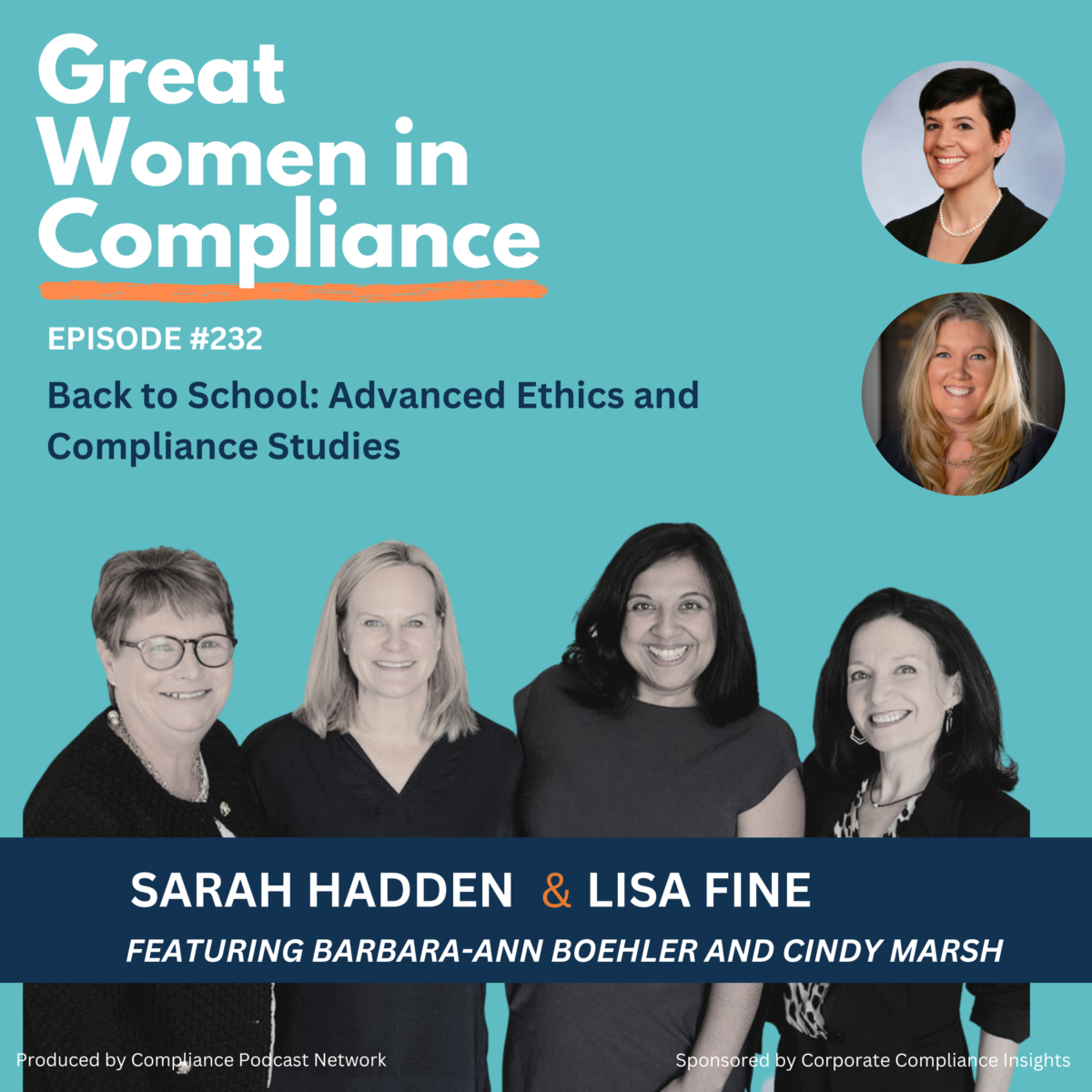
Great Women in Compliance: Back to School – Advanced Ethics and Compliance Studies

Welcome to the Great Women in Compliance podcast on the Compliance Podcast Network, sponsored by Corporate Compliance Insights.

One of the themes amongst Ethics and Compliance professionals is how we “fell into compliance.”  Once that happens, how do we learn the skills we need?

In this episode, Lisa and Sarah Hadden are talking about advanced compliance studies. Their guests are Barbara-Ann Boehler, Senior Director, Compliance & Ethics at Fordham Law and Cindy Marsh, who is a Senior Manager, Global Trade and Compliance at Victaulic and received her Masters in Studies of Law in Corporate Ethics and Compliance in 2022 from Fordham.

Barbara talks about her experience leading the program, as well as being a faculty member, and how they put together and structure this program.  Cindy enrolled at Fordham to grow her expertise from trade sanctions work into compliance and talks about her ongoing relationship with peers and how these are built.

The group also talks about all of the other resources for compliance learning if an advanced degree program is not the right path, and how the ethics and compliance community has so many avenues for learning and networking.

Cindy is also an experienced improv performer, and she also leads a program to bring improv to corporate settings. Lisa has just started to do improv, so that was an unexpected and shared part of the episode.

Topics include:

  • Different types of continuing education programs to learn ethics and compliance
  • The benefits of getting an advanced compliance degree and the types of programs
  • The community and network that can be built through compliance education programs
  • The impact of continuing compliance education

You can join the LinkedIn podcast community.
Join the Great Women in Compliance podcast community here.