Categories
Data Driven Compliance

Data Driven Risk Management and Fraud Prevention

Are you struggling to keep up with the ever-changing compliance programs in your business? Look no further than Tom Fox’s award-winning podcast, Data-Driven Compliance. This podcast features an in-depth conversation about the uses of data and data analytics in compliance programs. Data-Driven Compliance is back with another exciting episode. Today, I take a solo turn to explore how data-driven compliance has moved from cutting-edge compliance to part of a best practices compliance program to becoming table stakes to do business in a multi-national world.

AI and data-driven compliance solutions are revolutionizing risk management and fraud prevention practices, offering advanced analytics, machine learning, and automation to enhance decision-making processes, improve efficiency, and proactively address compliance risks. These tools are essential for companies to navigate the complex regulatory landscape. Understanding the transformative power of data-driven approaches in compliance and risk management is critical for every compliance professional. User adoption is critical, for even the most advanced technology will not be effective if not embraced and utilized by compliance professionals. There is also a need to balance automation and human judgment to ensure the effectiveness of these tools in risk management.

Key Highlights:

  • Data-Driven Compliance Tools for Risk Management
  • Optimizing Decision-Making with AI-Driven Compliance Tools
  • Transformative Data-Driven Fraud Detection and Prevention

Tom Fox

Connect with me on the following sites:

Instagram

Facebook

YouTube

Twitter

LinkedIn

Categories
Daily Compliance News

Daily Compliance News: February 27, 2024 – The He Lied Edition

Welcome to the Daily Compliance News. Each day, Tom Fox, the Voice of Compliance, brings you compliance related stories to start your day. Sit back, enjoy a cup of morning coffee and listen to the Daily Compliance News. All from the Compliance Podcast Network. Each day, we consider four stories from the business world: compliance, ethics, risk management, leadership, or general interest for the compliance professional.

In today’s edition of Daily Compliance News:

For more information on Ethico and a free White Paper on top compliance issues in 2024, click here.

Categories
SBR - Authors' Podcast

SBR – Author’s Podcast: Estelle Erasmus on Author Branding: Building Trust Through Consistent Content

Welcome to the Sunday Book Review and the Authors Podcast! Don’t miss out on this episode of SBR-Author’s Podcast, where Tom sits down with Estelle Erasmus, who talks about the craft of writing and her passion for helping writers ‘get noticed’.

Estelle Erasmus is a highly experienced magazine editor, journalist, and award-winning educator with over three decades in the industry. She has served as the editor in chief of five national consumer publications and is recognized for her teaching excellence at NYU. Erasmus strongly emphasizes the importance of honing one’s writing craft, whether it be essays, articles, or books. She believes in learning from experts, attending conferences, and utilizing resources such as books and podcasts to improve her writing skills. Drawing from her own experiences, she highlights the value of seeking guidance from seasoned individuals to effectively engage readers and enhance storytelling techniques. Through her book “Writing That Gets Noticed,”  her podcast “Freelance Writing Direct,”  and her coaching services, Erasmus aims to empower writers to find their voice, become better storytellers, and ultimately get published. Her dedication to helping writers succeed is evident in her commitment to providing valuable resources and personalized feedback to aspiring authors.

Key Highlights Include:

  • Crafting Compelling Writing for Publication Success
  • Building Trust Through Consistent Author Content
  • Crafting Unique Stories to Connect with Readers
  • Mentorship and Craft: Estelle Erasmus’s Influence

Resources:

Estelle Erasmus on Linkedin

Writing That Gets Noticed

Freelance Writing Direct Podcast


Tom Fox

Instagram

Facebook

YouTube

Twitter

LinkedIn

Categories
Compliance Tip of the Day

Compliance Tip of the Day: Investment Models for The Compliance Professional

Welcome to “Compliance Tip of the Day,” the podcast where we bring you daily insights and practical advice on navigating the ever-evolving landscape of compliance and regulatory requirements.

Whether you’re a seasoned compliance professional or just starting your journey, our aim is to provide you with bite-sized, actionable tips to help you stay on top of your compliance game.

Join us as we explore the latest industry trends, share best practices, and demystify complex compliance issues to keep your organization on the right side of the law. Tune in daily for your dose of compliance wisdom, and let’s make compliance a little less daunting, one tip at a time.

In this episode, we explore how a compliance professional or CCO should think through an investment model for your corporate compliance program.

For more information on Ethico and a free White Paper on top compliance issues in 2024, click here.

Categories
Blog

Self-Disclosure is Now the Key

The Department of Justice (DOJ) has been making significant strides in emphasizing the importance of voluntary self-disclosure in corporate enforcement cases, particularly in the Foreign Corrupt Practices Act (FCPA) realm. This shift in approach is evident in recent policy announcements and enforcement actions, beginning with the 2022 ABB Foreign Corrupt Practices Act (FCPA) settlement to the 2023 Albemarle FCPA resolution and continuing to the 2024 SAP Foreign Corrupt Practices Action settlement. Through these three resolutions,  the DOJ clarified that its most important criteria for evaluating a company for a fine under the FCPA is whether or not it self-discloses.

Representatives of the DOJ Kenneth Polite and Lisa Monaco further discussed this incentive in speeches in 2023. In announcing a revision to the 2017 FCPA Corporate Enforcement Policy, which became the 2023 Corporate Enforcement Policy, Kenneth Polite emphasized the ‘need for speed’ both in self-disclosure and during the pendency of any FCPA or compliance real compliance-related involving the DOJ.

The DOJ’s focus on incentivizing self-disclosure is a strategic move to encourage companies to come forward with violations and cooperate with authorities. The new Corporate Enforcement Policy offered up to a 75% reduction in penalties for voluntary disclosure. This discount is available even if there were ‘aggravating factors’ in the matter, such as C-Suite involvement in bribery and corruption. The DOJ could not send a more precise signal and be more transparent about what they want and will incent. This approach reflects a broader trend toward rewarding companies that proactively address compliance issues and work collaboratively with law enforcement agencies.

One of the key factors influencing the DOJ’s enforcement actions is the impact of recidivism. In October 2021, the DOJ, through a speech by Lisa Monaco and memorialized in the 2023 Evaluation of Corporate Compliance Programs (2023 ECCP), made it clear that it will not tolerate repeat offenders and is prepared to impose harsh penalties on companies that fail to self-disclose violations. However, even recidivist companies are encouraged to come forward and address compliance issues head-on, with the potential for significant penalty reductions if they demonstrate genuine cooperation and remediation efforts. The ABB resolution, in which the company was the first three-time FCPA recidivist yet received a superior outcome, once more demonstrated the DOJ’s current focus. The attempted self-disclosure fell short by only a day or two, as ABB had scheduled a meeting with the DOJ to self-disclose but had not formally done so. In the interim, a news story broke in South Africa about ABB’s systemic bribery and corruption in that country.

Although this factor was absent from the SAP enforcement action, the DOJ’s message regarding the benefits of self-disclosure and the DOJ’s expectation of self-disclosure could not have been clearer. Under the Corporate Enforcement Policy, SAP’s failure to self-disclose costs it an opportunity of at least 50% and up to a 75% reduction off the low end of the acceptable range of the US Sentencing Guidelines. Its actions as a criminal recidivist resulted in it not receiving a reduction of at least 50% and up to 75% from the low end of the USSG acceptable range but rather at 40% from above the low back. SAP’s failure to self-disclose cost it an estimated $20 million under the Sentencing Guidelines. Its inability to self-disclose and recidivism cost it a potential $94.5 million in discounts under the Corporate Enforcement Policy. The DOJ’s message could not be any clearer.

There was a significant discussion in the NPA around Albemarle’s voluntary self-disclosure to the DOJ. However, NPA noted that “the disclosure was not “reasonably prompt” as defined in the Criminal Division Corporate Enforcement and Voluntary Self-Disclosure Policy and the US Sentencing Guidelines.” The NPA reported that Albemarle learned of allegations regarding possible misconduct in Vietnam approximately 16 months before disclosing them to the DOJ. Interestingly, the SEC Order only stated, “Albemarle made an initial self-disclosure to the Commission of potential FCPA violations in Vietnam after completing an internal investigation of such conduct and, simultaneously, self-reported potential violations it was investigating in India, Indonesia, and China. Albemarle later self-disclosed potential violations in other jurisdictions to the Commission as part of an expanded internal investigation.”

This meant the self-disclosure “was not within a reasonably prompt time after becoming aware of the misconduct in Vietnam,” which means that Albemarle did not meet the standard for voluntary self-disclosure under the Criminal Division Corporate Enforcement and Voluntary Self-Disclosure Policy. While the DOJ “gave significant weight” to the Company’s voluntary disclosure, even if untimely, disclosure of the misconduct is undoubtedly cautionary.

The tradeoffs involved in balancing different factors, such as self-disclosure, cooperation, and remediation, can present challenges for companies navigating the complex landscape of FCPA enforcement. While the DOJ’s emphasis on self-disclosure offers potential benefits regarding penalty reductions and monitoring requirements, companies must carefully weigh the risks and rewards of voluntary disclosure against the possible consequences of non-disclosure.

The importance of considering the impact of decisions about the DOJ’s FCPA enforcement actions cannot be overstated. Companies that prioritize a culture of compliance, proactive monitoring, and data-driven analytics are better positioned to detect and address potential violations before they escalate into costly enforcement actions. By aligning their compliance programs with the DOJ’s expectations and demonstrating a commitment to ethical business practices, companies can mitigate the risks associated with FCPA violations and build a strong foundation for long-term success.

What the DOJ wants is self-disclosure as soon as possible. One only needs to recall the case of Cognizant Technologies, where the company received a complete declination, and there were allegations of C-Suite involvement in the bribery schemes. This Declination was provided mainly because the company self-disclosed only two weeks after the information was filtered to the Board of Directors. While Cognizant Technologies may be the gold standard, a company’s timely self-disclosures can be considered for a full Declination.


Categories
Principled Podcast

S11E1 | The Foundational Importance of Risk: E&C Program Effectiveness in 2024

What you’ll learn on this podcast episode

As geopolitical events, new technology, and regulatory developments increase the severity and frequency of risks, E&C programs are focused on their risk mitigation efforts. At LRN, a central lesson from over 10 years of primary research is that values-based programs are not only the most effective, but also correlate strongly with reduced risk and better business outcomes. But how exactly are E&C programs evolving in response to this increasingly complex risk landscape? And what do global best practices look like going into 2024? In this episode of the Principled Podcast, host Amy Hanan discusses key findings from the 2024 global edition of LRN’s annual Ethics & Compliance Program Effectiveness Report with Juliana Rodrigues, the global chief compliance officer at Coty.

Get a copy of the global edition of LRN’s 2024 Ethics & Compliance Program Effectiveness Report

Guest: Juliana Rodrigues

Juliana Rodrigues – Grayscale

Juliana Rodrigues is the global chief compliance officer at the beauty and personal care product manufacturing organization Coty. In this role, she deploys, controls, and defines strategies for the company’s global ethics and compliance program—including a global data privacy program—across the Americas, APAC, and EMEA regions. Juliana has over a decade of experience working in multinational companies with an emphasis on leadership of regional E&C areas, reporting to C-suite executives, and providing strategic support and advice on compliance matters. Prior to joining Coty, Juliana spent seven years at Louis Dreyfus Company as a compliance officer, responsible for the trade compliance and regulatory compliance issues for the company in Latin America. She holds a Master of Laws from the University of California, Davis School of Law and a MBA from Brazil’s Fundação Getulio Vargas (FGV).  

Host: Amy Hanan

Amy Hanan – Grayscale

Amy Hanan is the chief marketing officer at LRN. A B2B digital marketing leader, Amy has a nearly 20-year track record in product, brand, lifecycle, and demand-generation marketing as well as corporate communications for media, professional services, and technology companies. One of her central areas of expertise is executing tech-enabled marketing initiatives for growth. Before joining LRN, Amy was the chief digital officer at Baretz+Brunelle, a marketing and communications agency serving the legal and financial services industries. Her previous experience includes Reorg Research, ALM Media and The Associated Press. She holds a Bachelor of Arts degree from Northern Arizona University.

Categories
Compliance Tip of the Day

Compliance Tip of the Day: Investment Models for Compliance

Welcome to “Compliance Tip of the Day,” the podcast where we bring you daily insights and practical advice on navigating the ever-evolving landscape of compliance and regulatory requirements.

Whether you’re a seasoned compliance professional or just starting your journey, our aim is to provide you with bite-sized, actionable tips to help you stay on top of your compliance game.

Join us as we explore the latest industry trends, share best practices, and demystify complex compliance issues to keep your organization on the right side of the law. Tune in daily for your dose of compliance wisdom, and let’s make compliance a little less daunting, one tip at a time.

In this episode, we explore what investment models compliance professional or CCO, should consider for a corporate compliance program.

For more information on Ethico and a free White Paper on top compliance issues in 2024, click here.

Categories
Daily Compliance News

Daily Compliance News: February 26, 2024 – The Guilty Edition

Welcome to the Daily Compliance News. Each day, Tom Fox, the Voice of Compliance, brings you compliance-related stories to start your day. Sit back, enjoy a cup of morning coffee and listen to the Daily Compliance News. All from the Compliance Podcast Network. Each day, we consider four stories from the business world: compliance, ethics, risk management, leadership, or general interest for the compliance professional.

In today’s edition of Daily Compliance News:

  • Ex-Vitol Trading trader was found guilty of bribery.  (WSJ)
  • Exec’s husband pleads guilty to insider trading. (WSJ)
  • UAE removed from the Global Watch List for AML. (WSJ)
  • Ukraine still has more work to do on the corruption front. (Fortune)

For more information on Ethico and a free White Paper on top compliance issues in 2024, click here.

Categories
Corruption, Crime and Compliance

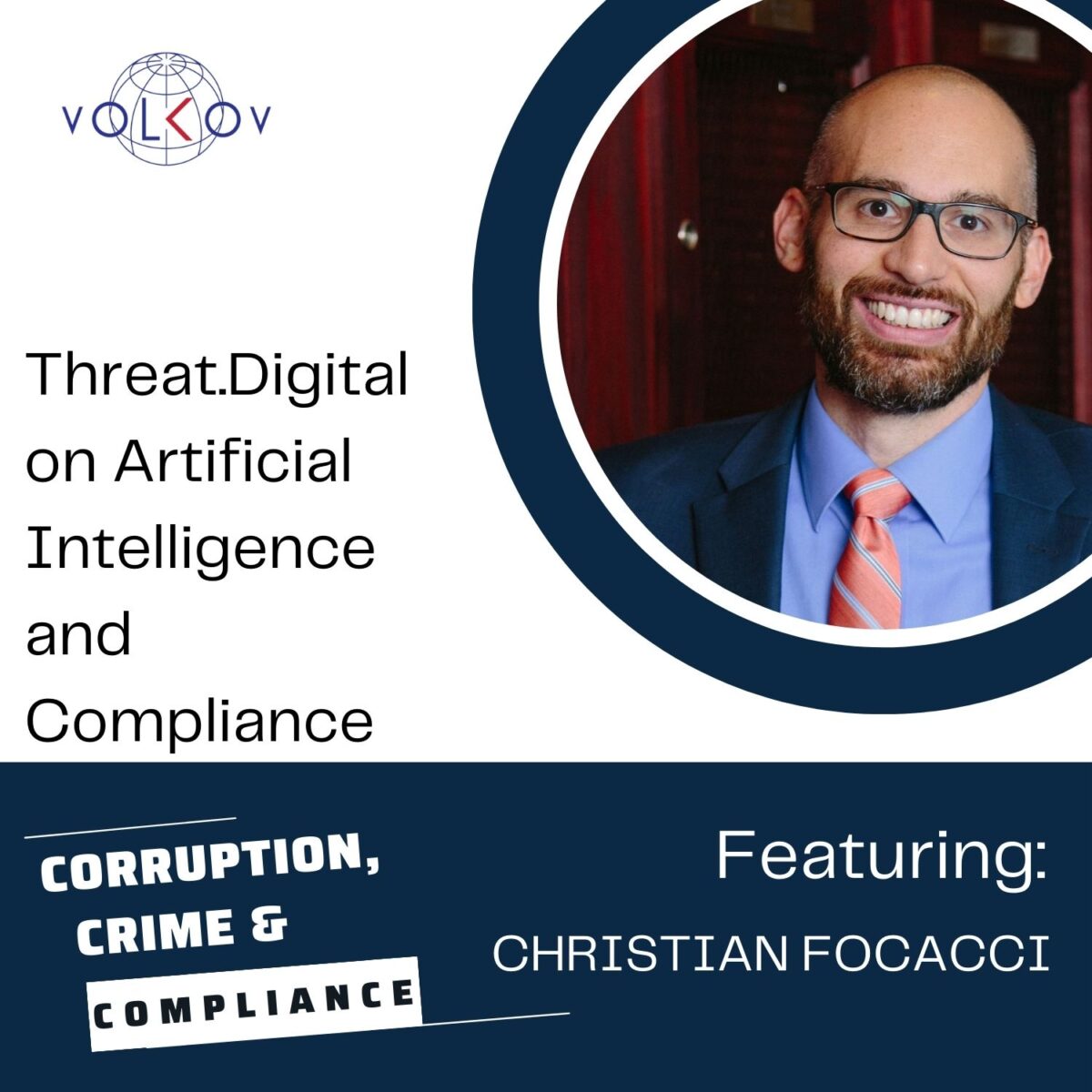
Christian Focacci, Founder and CEO, Threat.Digital, on Artificial Intelligence and Compliance

Christian Focacci is a leader in the artificial intelligence world and harnesses the capabilities for risk management. He is the founder and CEO of Threat.Digital, which has launched a new product, DiligenAI.  Threat.Digital is leveraging large language models and real-time data feeds to empower organizations to identify risk information confidently and efficiently, setting a new standard in risk intelligence. Mike and Christian discuss AI and its use in compliance and third-party risk management.

You’ll hear them discuss:

  • AI should be viewed as a tool to enhance decision-making processes rather than a replacement for human judgment. It highlights the importance of leveraging AI to process vast amounts of data efficiently.
  • Organizations must strike a balance between recognizing the risks associated with AI, such as generative AI, and harnessing its potential benefits to improve productivity and decision-making within organizations.
  • Advancements in language models, particularly large language models like Chat GPT, have revolutionized the processing and understanding of unstructured text data, enabling more accurate and context-aware analysis.
  • Companies can use AI to significantly enhance due diligence processes, risk assessment, and compliance efforts by efficiently summarizing and analyzing vast amounts of information to support decision-making.
  • The use of AI in due diligence and compliance is a tool meant to empower human decision-makers by providing them with comprehensive and distilled information, allowing them to focus on critical analysis and decision-making rather than mundane tasks.
  • One major strength of AI, particularly large language models, is to improve monitoring processes by reducing false positives and providing real-time alerts based on predefined criteria, enabling more efficient risk identification and management.
  • AI has a bright future, including the expansion of context windows in language models, the rise of open-source models, and the potential for running AI models on personal devices, indicating a shift towards decentralized and accessible AI technology.

Resources:

Michael Volkov on LinkedIn | Twitter

The Volkov Law Group

Christian Focacci on LinkedIn | Threat.Digital

Categories
All Things Investigations

All Things Investigations – Huneke and Carlson on Directors’ Accountability for Compliance and Risk Management

Welcome to the Hughes Hubbard Anti-Corruption & Internal Investigations Practice Group’s podcast, All Things Investigation. In this podcast, I was joined by HughesHubbardReed partner Mike Huneke and Brent Carlson, Director at BRG, to discuss the concepts around their recent paper, Boards of Directors Lovin’ It after McDonald’s? A Fresh Look at Directors’ Duty of Oversight in the New Era of Sanctions & Export Control Corporate Enforcement.

Mike Huneke and Brent Carlson are seasoned professionals specializing in fraud compliance, corruption issues, sanctions, and export control enforcement. Huneke’s perspective on the duties of directors in sanctions and export controls is that boards need to be proactive and engaged in understanding and addressing these risks, emphasizing the importance of caution, skepticism, and diligence in overseeing these critical areas of compliance. His views are shaped by his experience in investigating, litigating, remediating, and preventing fraud, as well as his belief in the importance of good corporate governance and risk management. Carlson emphasizes the significance of understanding geopolitics in the context of company operations and advocates for a return to fundamental principles amidst rapid regulatory changes. His perspective is shaped by his experience in assisting companies navigate the complexities of sanctions and export controls, and his belief in the importance of boards actively engaging with management, asking questions, and ensuring thorough investigations are conducted.

Key Highlights:

  • Directors’ Role in Export Control Compliance
  • McDonald’s Case: Duty of Oversight Emphasis
  • Dynamic Compliance Monitoring for Export Controls
  • Directors’ Accountability for Compliance and Risk Management
  • Proactive Board Oversight for Compliance Excellence

Resources:

Hughes Hubbard & Reed website

Brent Carlson on Linkedin

This podcast is based on: 

Brent & Mike’s blog post on directors’ duty of oversight can be found here: Boards of Directors Lovin’ It after McDonald’s? A Fresh Look at Directors’ Duty of Oversight in the New Era of Sanctions & Export Control Corporate Enforcement (Jan. 12, 2024).

For more on sanctions and export control compliance in the new era of FCPA-like corporate enforcement, see Brent’s and Mike’s prior posts here:

— Brent’s piece that launched the seriesWhen Loopholes Create Liability Pitfalls: A Fresh Look at Export Controls (Aug. 25, 2023).

— How can you assess your risk of sanctions violations?  Know Your Customer, But Also Yourself: A Fresh Look at Sanctions & Export Controls Risk Assessments in the Era of the “New FCPA” (Sept. 28, 2023).

— If you discover a sanctions problem, how can you efficiently investigate and remediate it?  Slow is Smooth, Smooth is Fast: A Fresh Look at Planning and Executing Internal Investigations into Allegations of Sanctions or Export Controls Evasion (Oct. 30, 2023).

— What does that mean for future fines and penalties for export control evasion?  From Peanuts to Prison Time – A Fresh Look at the Evolution of Export Controls Penalties (Nov. 14, 2023).

— Why is an FCPA “mindset” required for sanctions and export control compliance, and how to apply one?  The Blind Men and the Elephant (Dec. 18, 2023).