

Categories
Blog

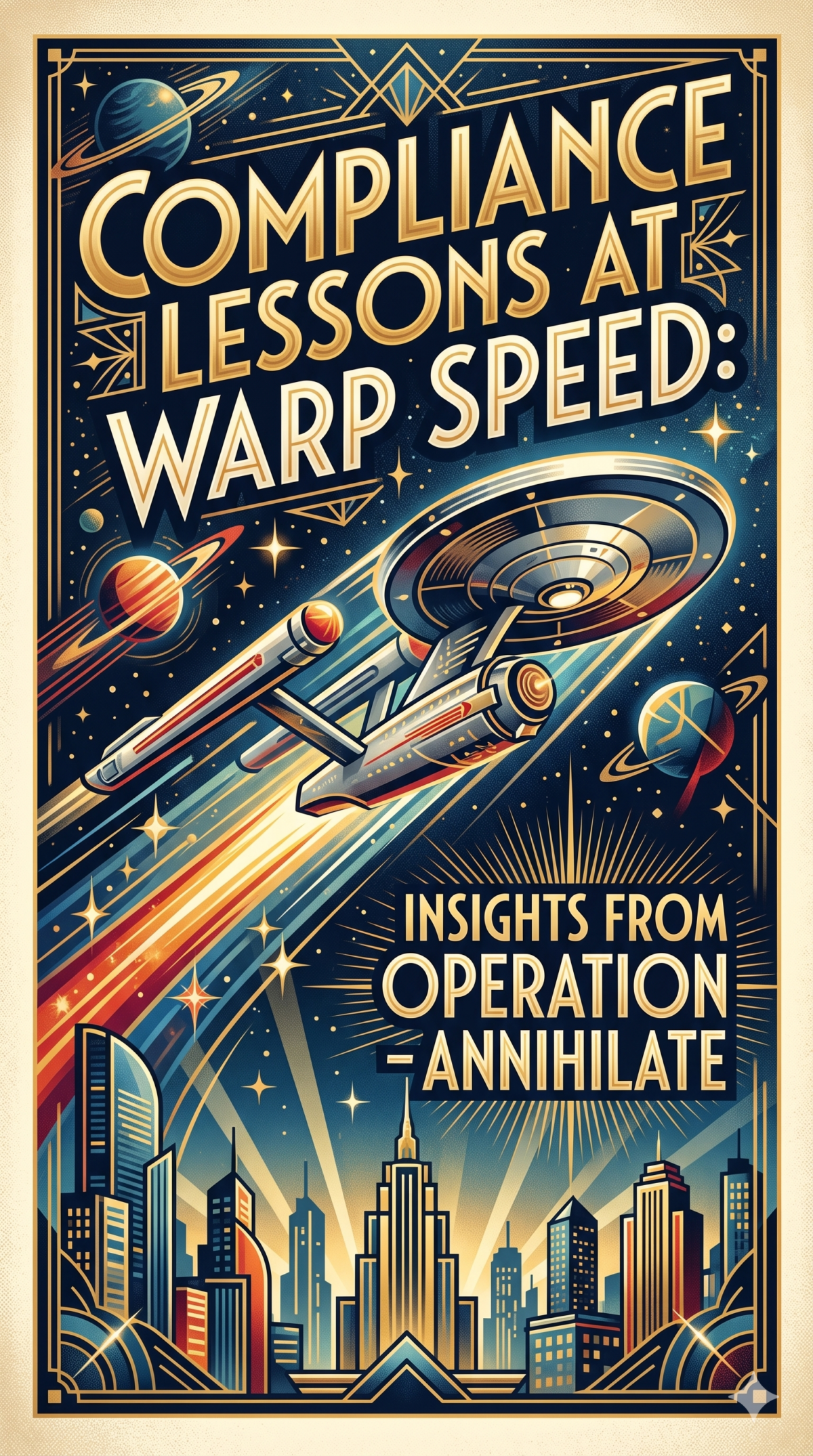
Compliance Lessons at Warp Speed: Insights from Operation: Annihilate!

In corporate compliance, investigative techniques are not merely about uncovering facts; they’re about discerning patterns, identifying root causes, and mitigating risks effectively. Surprisingly, we can glean powerful investigative insights from unexpected sources, including the classic Star Trek TOS episode “Operation: Annihilate!” This iconic episode sees Captain Kirk and the crew of the Enterprise arrive at the planet Deneva, only to discover it has been gripped by mass hysteria, violence, and suffering triggered by a parasitic infestation. These creatures induce unbearable pain and extreme aggression, driving the population toward chaos and destruction. The crew faces an immense challenge: quickly identifying, analyzing, and neutralizing the threat before it gets out of control.

For compliance professionals, this storyline provides compelling parallels to real-world investigative scenarios. The episode emphasizes the importance of swift and precise identification of underlying issues, comprehensive evidence gathering, objective validation of findings, courageous decision-making in crises, and clear, transparent communication throughout the investigation. Mastering these investigative lessons ensures that compliance teams can effectively manage risks, uphold integrity, and maintain organizational stability. Let’s delve deeper into the five critical investigative lessons from “Operation: Annihilate!” and see how compliance officers can leverage them in their daily practice.

Lesson 1: Rapid Identification and Response

Illustrated by: Upon arriving at Deneva, the Enterprise crew finds widespread hysteria, confusion, and aggressive behavior among the inhabitants. The source? A mysterious parasite is causing intense pain and erratic behavior.

In compliance investigations, rapid identification and response are crucial. Much like the Enterprise crew swiftly pinpointing the cause of the planet’s chaos, compliance officers must quickly ascertain the origin of any compliance violation. Time is of the essence in containing the problem, mitigating risks, and preventing escalation.

Lesson 2: Holistic Evidence Gathering

Illustrated by: Dr. McCoy examines infected individuals and conducts meticulous tests to understand the parasite’s biological impact. Spock, despite personal risk, also subjects himself to the parasite’s influence to gather essential firsthand evidence.

A rigorous compliance investigation requires the collection of holistic evidence. Like Dr. McCoy and Spock, compliance officers must go beyond surface appearances, collecting a diverse range of evidence, including interviews, financial records, and digital data, to piece together an accurate narrative. Comprehensive data collection is essential in determining the full scope and impact of any compliance issue.

Lesson 3: Objective Analysis and Validation

Illustrated by: The Enterprise team initially hypothesizes that the parasites must be eradicated through extreme measures, including potentially destructive ones. However, through disciplined testing and validation, they discovered that high-intensity light effectively neutralizes the parasites without destroying the host organisms.

Objectivity in analysis and validation is a cornerstone of effective compliance investigations. Compliance professionals must rigorously test assumptions and hypotheses against facts and evidence to ensure that remedial actions are both effective and proportionate to the issue at hand. This disciplined approach prevents unnecessary collateral damage and ensures ethical responses.

Lesson 4: Courage in the Face of Difficult Decisions

Illustrated by: Captain Kirk, who faces an agonizing choice: risk Spock’s eyesight or delay action that could save millions. Kirk makes the tough call, and although Spock is temporarily blinded, the decision ultimately saves countless lives.

Compliance investigations often present challenging ethical and professional dilemmas. Compliance leaders, like Kirk, must demonstrate courage and decisiveness, recognizing that hesitation or indecision can exacerbate the situation. Though difficult decisions may carry significant implications, courageous leadership ensures that integrity and organizational trust remain intact.

Lesson 5: Clear and Transparent Communication

Illustrated by: Throughout the crisis, Captain Kirk maintains open and transparent communication with his crew, explaining strategies, risks, and expectations clearly and candidly.

Effective communication is vital in compliance investigations. Transparency fosters trust among stakeholders and ensures clarity on investigative processes and outcomes. Compliance officers must regularly communicate investigative findings and recommendations to facilitate understanding, cooperation, and organizational alignment.

Final ComplianceLog Reflections

The Star Trek TOS episode “Operation: Annihilate!” may seem an unconventional source of compliance wisdom. Yet, its lessons in rapid response, holistic evidence collection, objective analysis, courageous decision-making, and transparent communication are profoundly relevant. These insights underscore the universal nature of investigative best practices, applicable across disciplines and eras. Compliance professionals, like the Enterprise crew, frequently operate under pressure, confronting unpredictable challenges that demand innovative thinking and swift, informed decisions.

By internalizing these lessons, compliance officers can enhance their ability to manage investigations effectively, mitigate risks, and strengthen their organization’s resilience. Ultimately, these principles reinforce the importance of preparedness, adaptability, and ethical integrity. Compliance teams that embrace these lessons will be well-positioned to safeguard their organizations, foster a culture of transparency, and uphold the highest standards of conduct, boldly going where responsible and proactive governance dictates.

Resources:

Excruciatingly Detailed Plot Summary by Eric W. Weisstein
MissionLogPodcast.com

Memory Alpha

Categories
Blog

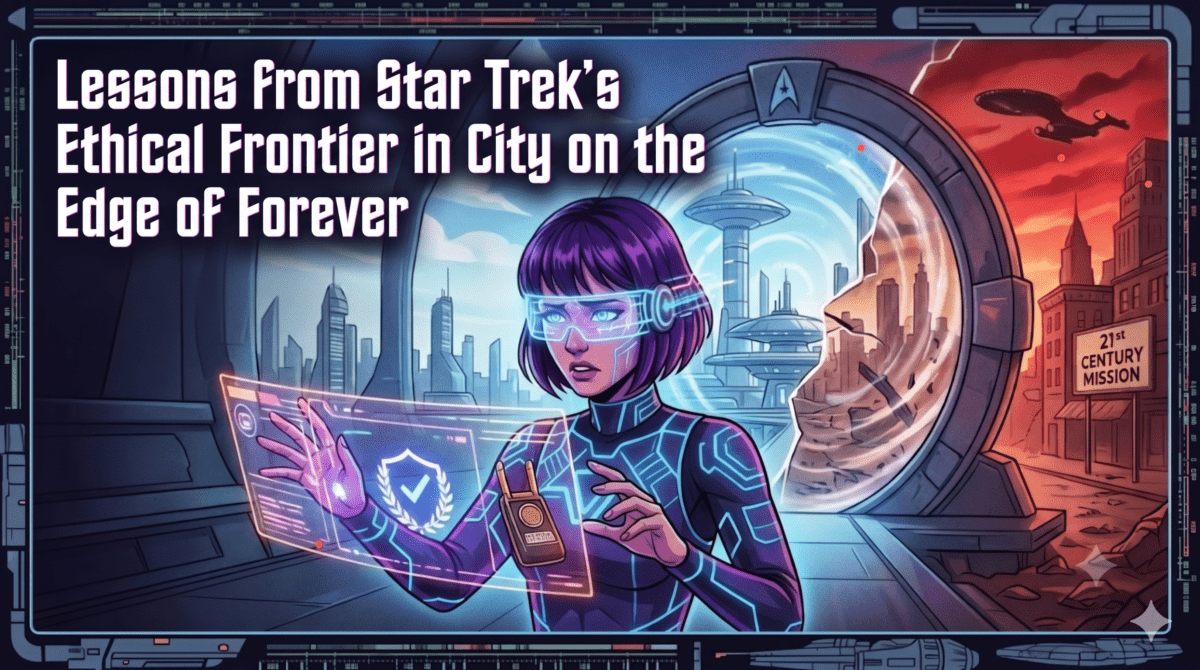
Compliance on the Edge: Lessons from Star Trek’s Ethical Frontier in City from the Edge of Forever

Today, we delve into perhaps the most iconic Star Trek: The Original Series episode, “The City on the Edge of Forever.” Doubling as my favorite Star Trek episode of all time (not just TOS), the episode not only represents a pinnacle in science fiction storytelling but also provides timeless lessons for corporate compliance professionals.

In this episode, the USS Enterprise crew encounters the Guardian of Forever, a mysterious gateway to the past. A temporarily insane Dr. McCoy alters history, and Captain Kirk and Mr. Spock must follow him to restore the timeline, ultimately facing profound moral dilemmas. Let’s dive into five compliance lessons from this episode, using scenes to illuminate essential insights into corporate ethics and compliance.

Lesson 1: The Importance of Immediate Response

Illustrated by: Dr. McCoy leaps through the Guardian of Forever, drastically altering history, and Captain Kirk immediately decides to follow him.

Compliance Lesson. One of the first critical lessons from the episode is the importance of a prompt response in crisis management. When Dr. McCoy leaps through the Guardian of Forever, drastically altering history, Captain Kirk immediately decides to follow him. Kirk recognizes that swift action is required to mitigate and correct the risk posed by McCoy’s actions to the timeline.

In compliance, the ability to react swiftly and decisively can prevent minor compliance issues from becoming significant crises. Compliance officers must cultivate readiness and decisive leadership, ensuring teams are prepared to act promptly and effectively when compliance risks emerge.

Lesson 2: Understanding the Root Cause

Illustrated by: Mr. Spock constructs a rudimentary device using primitive 1930s technology to identify the critical historical alteration that would have led to Edith Keeler’s survival.

Compliance Lesson. Mr. Spock, using a rudimentary yet effective device built with 1930s technology, painstakingly investigates and identifies the critical historical alteration—Edith Keeler’s survival —which inadvertently allows a catastrophic global conflict to occur. By clearly identifying the root cause, Kirk and Spock can focus their remediation strategy effectively.

Root cause analysis remains central in compliance programs. Without accurately identifying the source of compliance issues, organizations risk implementing ineffective solutions that fail to address the root cause. Compliance teams must rigorously investigate incidents, understand underlying causes, and ensure that corrective actions address the genuine drivers of non-compliance.

Lesson 3: Ethical Decision-Making

Illustrated by: Kirk realizes that Edith Keeler, a compassionate woman with whom he has fallen in love, must die to restore the timeline.

Compliance Lesson. Arguably, the most poignant compliance lesson emerges when Kirk realizes that Edith Keeler, a compassionate and visionary woman with whom he has fallen in love, must die to restore the timeline. Kirk’s agonizing decision underscores a critical ethical compliance lesson: adherence to principles must transcend personal emotions and relationships.

Compliance officers frequently face challenging ethical dilemmas that require difficult decisions. Upholding integrity might sometimes mean making unpopular choices. Like Kirk, compliance professionals must prioritize ethical commitments, understanding that integrity and moral responsibility are paramount.

Lesson 4: Clear Communication and Collaboration

Illustrated by: Kirk and Spock, they demonstrate teamwork and clear communication, effectively navigating their challenging environment and limited resources.

Compliance Lesson. Throughout the episode, Kirk and Spock demonstrate extraordinary teamwork and clear communication. Despite their challenging environment and limited resources, their consistent collaboration ensures effective decision-making and the implementation of strategic plans. Their communication is concise, targeted, and based on mutual understanding and respect.

Effective compliance programs similarly depend on transparent communication and seamless collaboration across departments. Compliance officers must foster a culture where team members communicate openly, share vital information promptly, and collaborate cohesively to uphold compliance standards.

Lesson 5: Proactive Monitoring and Preventive Measures

Illustrated by: The Enterprise first encounters the Guardian of Forever, which provides glimpses into historical events, illustrating its monitoring capabilities.

Compliance Lesson. When the Enterprise first encounters the Guardian of Forever, it provides glimpses into various historical events, demonstrating its ability to monitor and foresee critical junctures in history. This scene symbolizes the value of proactive monitoring and preventive measures.

Compliance professionals must adopt proactive monitoring strategies, leveraging technology and analytics to anticipate and mitigate risks before they materialize. Compliance programs should include continuous monitoring mechanisms to ensure the early identification of potential issues and swift corrective actions.

Final ComplianceLog Reflections

“The City on the Edge of Forever” delivers profound insights into ethical dilemmas, crisis response, communication, root cause analysis, and proactive monitoring. Captain Kirk’s heart-wrenching decision to prioritize the greater good, despite the personal cost, epitomizes the ethical resolve compliance professionals must emulate.

By integrating these Star Trek lessons into your compliance program, you can strengthen your organization’s ability to navigate complex ethical landscapes and maintain robust compliance standards. After all, as the Guardian of Forever reminds us, understanding and respecting history and ethics help shape a more stable and compliant future.

Resources:

Excruciatingly Detailed Plot Summary by Eric W. Weisstein
MissionLogPodcast.com

Memory Alpha

Categories
Sunday Book Review

Sunday Book Review: June 28, 2026, The Books on the Declaration of Independence Edition

In the Sunday Book Review, Tom Fox considers books that would interest compliance professionals, business executives, or anyone curious about the subject. It could be books about business, compliance, history, leadership, current events, or any other topic that might interest Tom.

Today, we begin a look at America’s founding, running up to the 250th birthday of America next weekend. This week, we start a two-part series examining the Declaration of Independence and the history of July 5th. Today, we review five books on the Declaration of Independence, and next week, we will review four books on July 4th. ⁠


  1. Inventing America by Garry Wills
  2. Signing Their Lives Away  by Denise Kiernan and Joseph D’Agnese
  3. Declaration: The Nine Tumultuous Weeks When America Became Independent, May 1-July 4, 1776, by William Hogeland
  4. 1776 by David McCullough
  5. Declaration of Independence

The Sunday Book Review was recently honored as one of the ⁠Top 100 Book Podcasts⁠.

Categories
Trekking Through Compliance

Trekking Through Compliance: Lessons from Star Trek’s Ethical Frontier in City from the Edge of Forever

Today, we delve into perhaps the most iconic Star Trek: The Original Series episode, “The City on the Edge of Forever.” Doubling as my favorite Star Trek episode of all time (not just TOS), the episode not only represents a pinnacle in science fiction storytelling but also provides timeless lessons for corporate compliance professionals.

In this episode, the USS Enterprise crew encounters the Guardian of Forever, a mysterious gateway to the past. A temporarily insane Dr. McCoy alters history, and Captain Kirk and Mr. Spock must follow him to restore the timeline, ultimately facing profound moral dilemmas. Let’s explore five key compliance lessons from this episode, using scenes to illuminate essential insights into corporate ethics and compliance.

Lesson 1: The Importance of Immediate Response

Illustrated by: Dr. McCoy leaps through the Guardian of Forever, drastically altering history, and Captain Kirk immediately decides to follow him.

Compliance Lesson. In compliance, the ability to react swiftly and decisively can prevent minor compliance issues from becoming significant crises.

Lesson 2: Understanding the Root Cause

Illustrated by: Mr. Spock constructs a rudimentary device using primitive 1930s technology to identify the critical historical alteration that would have led to Edith Keeler’s survival.

Compliance Lesson. Root cause analysis remains central in compliance programs. Without accurately identifying the source of compliance issues, organizations risk implementing ineffective solutions that fail to address the root cause.

Lesson 3: Ethical Decision-Making

Illustrated by: Kirk realizes that Edith Keeler, a compassionate woman with whom he has fallen in love, must die to restore the timeline.

Compliance Lesson. Compliance officers frequently face challenging ethical dilemmas that require difficult decisions. Upholding integrity sometimes means making unpopular choices.

Lesson 4: Clear Communication and Collaboration

Illustrated by Kirk and Spock, teamwork and clear communication effectively navigate their challenging environment and limited resources.

Compliance Lesson. Effective compliance programs similarly depend on transparent communication and seamless collaboration across departments.

Lesson 5: Proactive Monitoring and Preventive Measures

Illustrated by: The Enterprise first encounters the Guardian of Forever, which provides glimpses into historical events, illustrating its monitoring capabilities.

Compliance Lesson. Compliance professionals must adopt proactive monitoring strategies, leveraging technology and analytics to anticipate and mitigate risks before they materialize.

Final ComplianceLog Reflections

“The City on the Edge of Forever” delivers profound insights into ethical dilemmas, crisis response, communication, root cause analysis, and proactive monitoring. Captain Kirk’s heart-wrenching decision to prioritize the greater good, despite the personal cost, epitomizes the ethical resolve compliance professionals must emulate.

By integrating these Star Trek lessons into your compliance program, you can strengthen your organization’s ability to navigate complex ethical landscapes and maintain robust compliance standards. After all, as the Guardian of Forever reminds us, understanding and respecting history and ethics all help to shape a more stable and compliant future.

Resources:

Excruciatingly Detailed Plot Summary by Eric W. Weisstein
MissionLogPodcast.com

Memory Alpha

Timothy and Fiona are AI-generated voices.

Categories
Trekking Through Compliance

Trekking Through Compliance: The Alternative Factor: Navigating Compliance Through Pattern Recognition Across Realities

Today, let’s boldly delve into “The Alternative Factor,” a peculiar episode from the original Star Trek series (TOS), to extract valuable lessons on pattern recognition and compliance. This often-overlooked episode presents a compelling study of chaos, confusion, and dual realities. The crew faces Lazarus, a mysterious character embroiled in a battle with his counterpart from an alternate universe. The crew initially struggles to recognize and interpret patterns of events, highlighting the critical role of clarity and vigilance in compliance processes. For the compliance professional, this offers lessons in pattern recognition for identifying and resolving anomalies.

Lesson 1: Recognize the Anomalies Early

Illustrated by: Early in the episode, the Enterprise experiences unexplained phenomena, a sudden disruption of reality described as a “blinking” of the universe. This early anomaly, quickly dismissed as sensor errors, turns out to be a crucial indicator of a deeper problem.

Compliance Lesson: Small discrepancies in financial reports, unusual behavior patterns in email communications, or irregularities in procurement data could indicate significant underlying compliance issues.

Lesson 2: Clarify Data and Information Sources

Illustrated by: Captain Kirk and Spock encounter difficulty obtaining clear information from Lazarus. His inconsistent and confusing explanations led to further uncertainty and wasted resources.

Compliance Lesson: Compliance programs rely heavily on clear, accurate, and consistent data. A pattern-recognition issue arises when compliance professionals rely on ambiguous or unreliable information sources.

Lesson 3: Understand Context to Identify Patterns

Illustrated by: Spock eventually recognizes a key pattern—that Lazarus seems to exist as two distinct entities, each from a parallel universe. Only when the Enterprise crew understands the context can they effectively respond.

Compliance Lesson: Compliance professionals must understand the broader context of their operational environments to manage compliance effectively.

Lesson 4: Clear Communication Amidst Confusion

Illustrated by: During moments of intense confusion, effective communication becomes challenging. Captain Kirk’s decisive actions and clear communication ultimately helped resolve the crisis despite initial confusion.

Compliance Lesson: Clear and effective communication is vital, especially during compliance incidents or investigations. A pattern recognition breakdown often occurs in environments with poor communication, leading to misunderstandings and exacerbating the problem. Encourage clear, transparent, and regular communication practices within your compliance program to ensure alignment and swift action.

Lesson 5: Proactive Risk Mitigation

Illustrated by: Once understanding the threat Lazarus poses, Kirk proactively acts, sealing the passage between the two universes, preventing further catastrophic disruptions.

Compliance Lesson: Compliance programs should adopt a proactive rather than reactive approach. Recognizing patterns early and proactively addressing risks protects your organization from severe compliance breaches.

Final ComplianceLog Reflections

“The Alternative Factor” presents an intriguing allegory for the complex world of compliance, highlighting the importance of pattern recognition. In compliance, aboard the Enterprise, early recognition of unusual patterns, accurate data interpretation, contextual awareness, clear communication, and proactive response strategies are vital.

Compliance professionals must remain vigilant and responsive, continuously refining their ability to identify and interpret emerging patterns. Adopting these strategies not only ensures organizational integrity and regulatory compliance but also equips compliance teams to navigate uncertain and challenging scenarios effectively. Just as Captain Kirk steered his crew safely through the chaotic Alternative Factor, compliance professionals can lead their organizations confidently through compliance uncertainties by mastering these crucial lessons.

Resources:

Excruciatingly Detailed Plot Summary by Eric W. Weisstein

MissionLogPodcast.com

Memory Alpha

Timothy and Fiona are AI-generated voices from Notebook LM

Categories
Blog

The Alternative Factor: Navigating Compliance Through Pattern Recognition Across Realities

Today, let’s boldly delve into “The Alternative Factor,” a peculiar episode from the original Star Trek series (TOS), to extract valuable lessons on pattern recognition and compliance. This often-overlooked episode presents a compelling study of chaos, confusion, and dual realities. The crew faces Lazarus, a mysterious character embroiled in a battle with his counterpart from an alternate universe. The crew initially struggles to recognize and interpret patterns of events, highlighting the critical role of clarity and vigilance in compliance processes. For the compliance professional, this offers lessons in pattern recognition for identifying and resolving anomalies.

Lesson 1: Recognize the Anomalies Early

Illustrated by: Early in the episode, the Enterprise experiences unexplained phenomena, a sudden disruption of reality described as a “blinking” of the universe. This early anomaly, quickly dismissed as sensor errors, turns out to be a crucial indicator of a deeper problem.

Compliance Lesson: Compliance teams must be vigilant for anomalies, regardless of how minor or easily dismissed they may initially appear. Small discrepancies in financial reports, unusual behavior patterns in email communications, or irregularities in procurement data could indicate significant underlying compliance issues. Encourage your team to trust instincts, verify anomalies, and treat each irregularity seriously.

Lesson 2: Clarify Data and Information Sources

Illustrated by: Captain Kirk and Spock encounter difficulty obtaining clear information from Lazarus. His inconsistent and confusing explanations led to further uncertainty and wasted resources.

Compliance Lesson: Compliance programs rely heavily on clear, accurate, and consistent data. A pattern-recognition issue arises when compliance professionals rely on ambiguous or unreliable information sources. It is essential to verify the integrity and accuracy of data sources. Establish rigorous data-validation protocols to avoid confusion and misdirected resources.

Lesson 3: Understand Context to Identify Patterns

Illustrated by: Spock eventually recognizes a key pattern—that Lazarus seems to exist as two distinct entities, each from a parallel universe. Only when the Enterprise crew understands the context can they effectively respond.

Compliance Lesson: Compliance professionals must understand the broader context of their operational environments to manage compliance effectively. For instance, unusual financial transactions might only appear suspicious when viewed in the context of recent organizational changes, geopolitical shifts, or evolving regulations. Without context, patterns can be misleading. Educate your compliance teams to understand and evaluate patterns within the broader organizational and industry context.

Lesson 4: Clear Communication Amidst Confusion

Illustrated by: During moments of intense confusion, effective communication becomes challenging. Captain Kirk’s decisive actions and clear communication ultimately helped resolve the crisis despite initial confusion.

Compliance Lesson: Clear and effective communication is vital, especially during compliance incidents or investigations. A pattern recognition breakdown often occurs in environments with poor communication, leading to misunderstandings and exacerbating the problem. Encourage clear, transparent, and regular communication practices within your compliance program to ensure alignment and swift action.

Lesson 5: Proactive Risk Mitigation

Illustrated by: Once understanding the threat Lazarus poses, Kirk proactively acts, sealing the passage between the two universes and preventing further catastrophic disruptions.

Compliance Lesson: Compliance programs should adopt a proactive rather than reactive approach. Recognizing patterns early and proactively addressing risks protects your organization from severe compliance breaches. Establish a robust system for continuous monitoring, regular audits, and proactive risk assessments to ensure effective risk management. Training employees to identify and report early-stage anomalies effectively can prevent larger compliance disasters.

Final ComplianceLog Reflections

“The Alternative Factor” presents an intriguing allegory for the complex world of compliance, highlighting the importance of pattern recognition. In compliance, aboard the Enterprise, early recognition of unusual patterns, accurate data interpretation, contextual awareness, clear communication, and proactive response strategies are vital.

Compliance professionals must remain vigilant and responsive, continuously refining their ability to identify and interpret emerging patterns. Adopting these strategies not only ensures organizational integrity and regulatory compliance but also equips compliance teams to navigate uncertain and challenging scenarios effectively. Just as Captain Kirk steered his crew safely through the chaotic Alternative Factor, compliance professionals can lead their organizations confidently through compliance uncertainties by mastering these crucial lessons.

Resources:

Excruciatingly Detailed Plot Summary by Eric W. Weisstein
MissionLogPodcast.com

Memory Alpha

Categories
Blog

Compliance Analytics at Warp Speed: Lessons in Proactivity from Errand of Mercy

Star Trek’s “Errand of Mercy” has long captivated viewers with its profound examination of conflict, diplomacy, and the limitations of perception. While it might not seem immediately apparent, this episode is rich in insights for the corporate compliance community, particularly in data analytics. Let’s delve into five key data analytics lessons derived from this timeless story, specifically tailored for today’s compliance professionals.

Lesson 1: Data-Driven Awareness Prevents Miscalculations

Illustrated by: Captain Kirk and Mr. Spock initially underestimate the Organians, perceiving them as primitive due to surface-level observations. Only later do they realize that Organians possess profound power and knowledge far beyond initial assessments.

Compliance Lesson: Compliance professionals must avoid superficial analyses and surface-level assessments, just as Kirk and Spock learned not to judge the Organians by outward appearances. Too often, organizations base critical decisions on incomplete or surface-level information. In compliance, this can lead to overlooking systemic risks, misjudging third-party partners, or misunderstanding evolving regulatory threats.

Data-driven awareness is the antidote to this danger. Leveraging advanced analytics, compliance teams can dig deeper into transactional data, employee behavior, vendor histories, and external market signals. Analytics allow organizations to uncover patterns and anomalies that the naked eye might miss, providing early warnings of compliance gaps, fraud, or ethical blind spots. Importantly, robust analytics mitigate the impact of human bias, reducing over-reliance on gut instinct or anecdotal evidence.

By developing dashboards, risk heatmaps, and tailored reporting tools, compliance professionals empower themselves and business leaders to make better, evidence-based decisions. The ultimate lesson: Only through continuous data-driven vigilance can organizations prevent costly miscalculations and ensure their compliance posture is based on reality, not perception.

Lesson 2: Real-Time Analytics Facilitate Prompt Intervention

Illustrated by: During their initial stay, the Organians repeatedly attempt to deflect Federation and Klingon aggression, intervening subtly and promptly as conflicts arise.

Compliance Lesson: In an era of rapid digital transactions and globalized operations, waiting for quarterly or annual compliance reviews is no longer sufficient. Real-time data analytics is transforming the compliance function from a reactive, after-the-fact process to a dynamic, proactive engine for risk prevention. By monitoring financial transactions, communication patterns, and operational workflows in real time, compliance teams can identify red flags, policy breaches, or suspicious activity as soon as they arise.

This enables immediate investigation, escalation, or remediation long before minor issues escalate into major violations or regulatory crises. Advanced alert systems and AI-powered monitoring platforms now allow the simultaneous tracking of thousands of compliance data points, prioritizing high-risk incidents for human review. Furthermore, real-time analytics support a culture of ongoing accountability, where employees and leaders understand that compliance is not just a box to check but a living, breathing part of business operations. The lesson from the Organians: Subtle, timely intervention can often prevent conflict, just as prompt, real-time analytics can avert disaster in the compliance landscape.

Lesson 3: Predictive Analytics Enhance Proactive Compliance

Illustrated by: Ultimately, the Organians demonstrate foresight and predictive awareness, recognizing the likely outcomes of Federation and Klingon hostilities and intervening proactively to avoid widespread disaster.

Compliance Lesson: The best compliance programs don’t just react to problems—they anticipate them. Predictive analytics is the frontier of proactive compliance, empowering teams to leverage historical data, risk modeling, and machine learning to forecast future threats. By analyzing trends in internal investigations, audit findings, whistleblower reports, and external regulatory actions, compliance professionals can identify emerging risk patterns before they fully materialize. This capability allows organizations to adjust controls, update training, and allocate resources with maximum impact.

For example, predictive models can highlight geographic regions or business units with an elevated risk profile, enabling preemptive audits or targeted messaging. Predictive analytics also supports dynamic risk scoring, enabling compliance teams to reassess exposure as new data becomes available continually. In the same way that the Organians foresaw and diffused conflict before it erupted, compliance professionals equipped with predictive analytics can guide their organizations around regulatory minefields, reducing both the likelihood and the impact of violations. The key takeaway: In compliance, as in diplomacy, foresight is a powerful tool.

Lesson 4: The Value of Integrating Diverse Data Sources

Illustrated by Kirk and Spock initially relying primarily on their direct observations and Federation reports, neglecting potentially valuable alternative perspectives and data points that might have informed a more nuanced understanding of the Organians.

Compliance Lesson: Siloed data is the enemy of effective compliance. In a world of complex operations, no single data source can provide the complete picture of an organization’s compliance risk. Integrating diverse data streams, including financial records, employee activity logs, whistleblower submissions, market intelligence, third-party assessments, and even social media, enables compliance teams to connect the dots that might otherwise remain isolated. Modern compliance analytics platforms are designed to ingest, normalize, and cross-reference multiple data types, revealing relationships and outliers that static spreadsheets cannot.

By triangulating information from various internal and external sources, organizations enhance the accuracy of their risk assessments, refine investigative outcomes, and identify root causes more quickly. Integration also breaks down barriers between business units, legal, audit, and compliance, fostering a culture of transparency and shared responsibility. The failure to consider alternative perspectives, as demonstrated by Kirk and Spock, is a cautionary tale: Only by synthesizing the broadest possible range of data can compliance leaders ensure that their risk management strategies are as robust and adaptive as the business environment demands.

Lesson 5: Ethical Data Use and Transparency Build Trust

Illustrated by: In the episode’s resolution, the Organians reveal their true nature transparently, clearly communicating their intentions and reasons for their actions, which ultimately earns the trust and respect of both Federation and Klingon representatives.

Compliance Lesson: In an age of big data, artificial intelligence, and heightened regulatory scrutiny, ethical stewardship of data is both a legal requirement and a business imperative. Compliance teams must ensure that their use of data analytics adheres to the highest standards of privacy, security, and fairness. This includes not only complying with applicable regulations (such as GDPR, CCPA, and others) but also establishing clear policies around consent, data retention, and access controls.

Transparency is key; organizations should be open with employees, customers, and regulators about what data is collected, how it is analyzed, and for what purposes. Regular communication and training reinforce trust and demonstrate a commitment to responsible data governance. When stakeholders understand and believe in the integrity of an organization’s data practices, the credibility of the compliance program is strengthened. The Organians’ transparent reveal is a reminder: Trust is earned through clarity and honesty, both in science fiction and in today’s data-driven compliance world.

Final ComplianceLog Reflections

“Errand of Mercy” offers a valuable allegory for contemporary compliance professionals, highlighting the importance of thorough analysis, real-time intervention capabilities, predictive insights, diverse data integration, and ethical transparency. By embracing these data analytics lessons, compliance teams can significantly enhance their organization’s ability to proactively manage and mitigate risks. In today’s complex regulatory landscape, harnessing sophisticated analytics capabilities is not merely advantageous; it is essential. As Kirk and Spock’s ultimate realization in “Errand of Mercy” shows, understanding beyond surface appearances and leveraging deep analytical insights can make all the difference in navigating compliance challenges effectively.

Resources:

Excruciatingly Detailed Plot Summary by Eric W. Weisstein

MissionLogPodcast.com

Memory Alpha

Categories
TechLaw10

TechLaw10: Episode 300 with Special Guest Tom Fox

In this special episode of TechLaw10, Punter Southall Law’s Jonathan Armstrong and Eric Sinrod, Professor and Duane Morris LLP attorney, chat with special guest Tom Fox. This is episode 300 in the popular TechLaw10 series. You can listen to earlier podcasts here. 

Tom Fox is the founder of the Compliance Podcast Network. He has been a leading litigation lawyer, a General Counsel, and a Chief Compliance Officer. He is now an Independent Consultant, assisting companies with anti-corruption and anti-bribery compliance and international transaction issues. He specializes in bringing business solutions to compliance problems. Tom is the author of the award-winning FCPA Compliance and Ethics Blog and the international best-selling book “Lessons Learned on Compliance and Ethics.” His podcasts have won numerous awards, including the W3, Davey, Communicator, and Webby awards for podcasting excellence.

He is the author of the seminal text The Compliance Handbook, now in its 3rd edition, published by LexisNexis. He is a well-known and frequent speaker on compliance and ethics issues, social media use, and corporate leadership.

Jonathan, Eric, & Tom discuss several issues, including the following:

  • The use of data analytics & data science
  • The use of data & tech in investigations
  • The ITA Airways case and the need to conduct investigations properly and in compliance with GDPR
  • The issues with bribery & corruption
  • The regulation of AI
  • Italy’s AI law
  • A new case in Munich on AI liability
  • How podcasting has changed the legal profession
  • The changes in education & how people learn

Jonathan talks about the EU AI Act. There are FAQs on that here: https://bit.ly/euaifaq. There is also a glossary of AI terms here.

Jonathan also talks about Italy’s AI law—the details for that are here

You can find out more about Tom Fox here.

Eric Sinrod’s details can be found here, and Jonathan Armstrong’s details are available here.

Categories
AI Today in 5

AI Today in 5: June 26, 2026, The GenZ in the C-Suite Edition

Welcome to AI Today in 5, the newest addition to the Compliance Podcast Network. Each day, Tom Fox will bring you 5 stories about AI to start your day. Sit back, enjoy a cup of morning coffee, and listen in to AI Today In 5. All, from the Compliance Podcast Network. Each day, we consider five stories from the business world, compliance, ethics, risk management, leadership, or general interest about AI.

Top AI stories include:

  1. An AI arms race in AML. (FinTechGlobal)
  2. Easing AI-induced workforce disruptions.  (NYT)
  3. When AI puts Gen Z in the C-Suite. (WSJ)
  4. New security operating model. (Rapid7)
  5. AI is moving from automation to transformation in healthcare.  (HealthcareITNews)

For more information on the use of AI in compliance programs, Tom Fox’s new book, Upping Your Game, is available. You can purchase a copy of the book on ⁠Amazon.com⁠.

To learn about the intersection of Sherlock Holmes and the modern compliance professional, check out Tom’s latest book, The Game is Afoot-What Sherlock Holmes Teaches About Risk, Ethics and Investigations on ⁠Amazon.com⁠.

Categories
2 Gurus Talk Compliance

2 Gurus Talk Compliance – Episode 79 – The Future of Compliance Associations Edition

What happens when two top compliance commentators get together? They talk compliance, of course. Join Tom Fox and Kristy Grant-Hart in 2 Gurus Talk Compliance as they discuss the latest compliance issues in this week’s episode!

Stories This Week Include:

  • Corporate BS Goes Mainstream
  • Directors Using AI Unguided
  • Perps and Prediction Markets Fight
  • Future of Compliance Associations
  • SFO Setback in UK Corruption Trial
  • Compliance Pay Gap Reality Check
  • Companies Betting on Themselves
  • Work From Home and Boss Narcissism
  • Cigar Photo Punishment and Fairness
  • Florida Man Steals a Helicopter

Resources:

Kristy

Kristy Grant-Hart on LinkedIn

Order Kristy’s updated, 10-year new edition of How to Be a Wildly Effective Compliance Officer by clicking here.

Tom

Check out the top compliance handbook, The Compliance Handbook, 7th edition, published by LexisNexis. Visit the LexisNexis® Store at https://lexisnexis.com/fox20

To save 20% on The Compliance Handbook: A Guide to Operationalizing Your Compliance Program, please reference or enter promotion code: FOX20.

Offer expires December 31, 2026. Offer applies to new orders only, before shipping and taxes are calculated and shipped to a U.S. address. A discount will be applied to each applicable product after the code FOX20 is entered. Discount does not apply to current subscriptions, renewals, or updates. Certain exclusions and other restrictions may apply. Void where prohibited. View full terms here.

Instagram

Facebook

YouTube

Twitter

LinkedIn