Categories
Blog

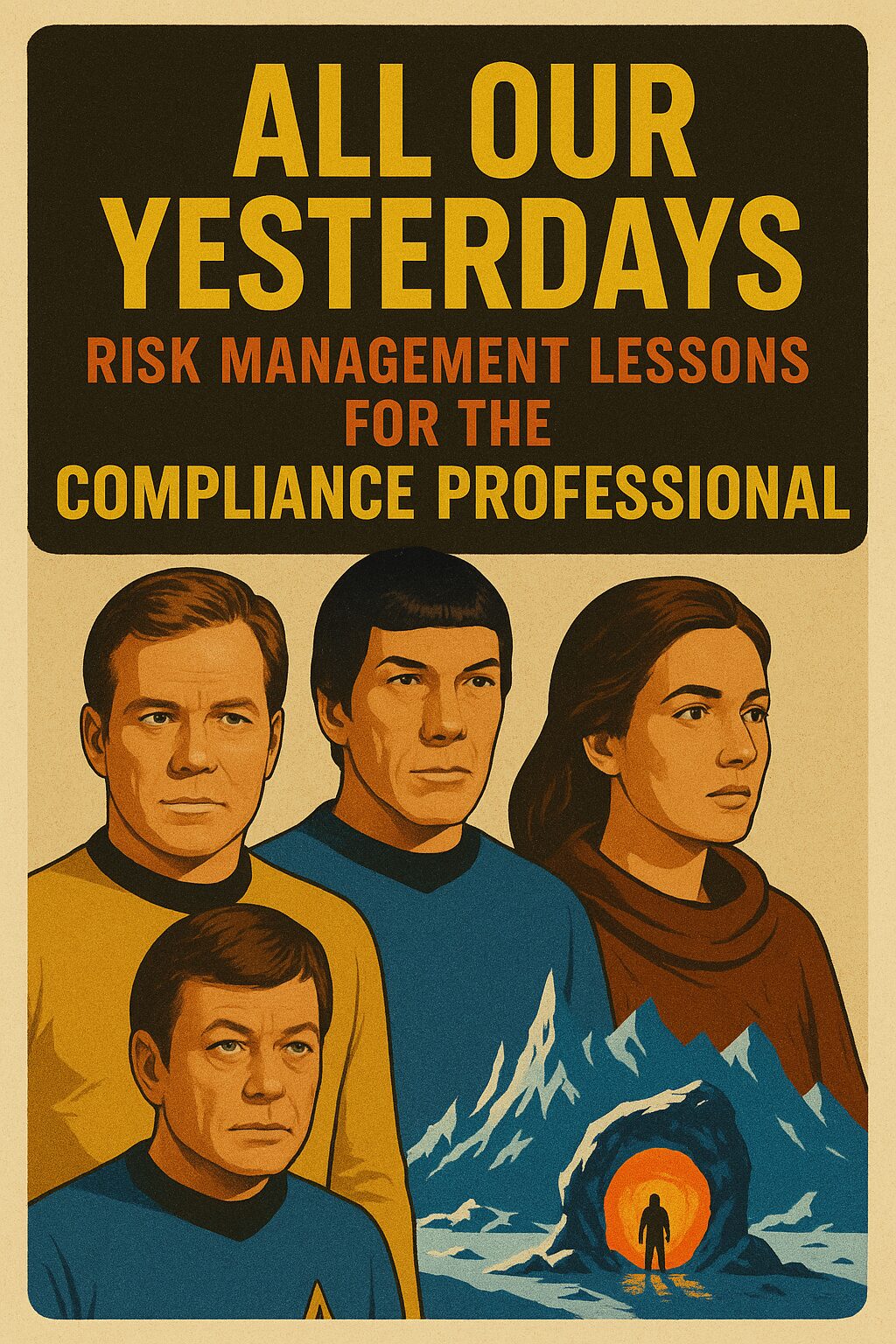
All Our Yesterdays:Risk Management Lessons for the Compliance Professional

When you think of Star Trek: The Original Series, certain episodes stand out for their moral clarity, exploration of ethics, and leadership lessons. Others, like All Our Yesterdays, are more subtle but no less rich in compliance and risk management insights.

In this episode, Captain Kirk, Mr. Spock, and Dr. McCoy beam down to the planet Sarpeidon just before its sun is about to go nova. They find the planet seemingly deserted except for a mysterious librarian named Mr. Atoz. He explains that the people have escaped into the planet’s past using a time travel device called the Atavachron. Unfortunately, in true Star Trek fashion, the landing party becomes separated; Kirk into a duel-filled era resembling the late Middle Ages, and Spock and McCoy into a frozen prehistoric wilderness.

As the story unfolds, the episode reveals more than just a sci-fi adventure; it presents a compelling case study in the importance of preparation, situational awareness, adaptability, and decision-making under pressure. For the compliance professional, All Our Yesterdays offers five key risk management lessons that are as relevant in the boardroom as they are in a time-portal crisis.

Lesson 1: Understand the Operating Environment Before You Act

Illustrated by: When Kirk, Spock, and McCoy first arrive, they assume the library is a static place in the present day. They don’t fully grasp that the Atavachron sends people into different periods, permanently altering them to survive there, until after they have stepped through the portals.

Compliance Lesson. One of the most preventable compliance failures happens when leaders act without fully understanding the operational landscape. Just as Kirk should have gathered more intelligence before stepping through the portal, compliance officers must conduct thorough due diligence before making high-impact decisions, especially in new markets or with new business models.

Jumping into a jurisdiction with unfamiliar regulatory structures or cultural norms without advance research can leave your compliance program operating with blind spots. A robust risk assessment, stakeholder mapping, and regulatory scan are your “Atavachron briefing”; without them, you’re walking through the wrong portal unprepared.

Lesson 2: Know the Long-Term Consequences of Your Decisions

Illustrated by: Atoz explains that once a traveler passes through the Atavachron, they undergo physiological changes to survive in the chosen period. Returning without those adaptations can be fatal. This means each journey into the past is not just a visit—it’s a permanent commitment.

Compliance Lesson. Compliance decisions, especially around risk tolerance, often have long-term and sometimes irreversible consequences. For example, approving a high-risk third party because “we need them for this deal” can embed systemic vulnerabilities that are difficult to unwind later.

Spock and McCoy’s plight in the ice age is a reminder that once certain paths are chosen, backing out may be impossible or costly. Before green-lighting any strategy or business partner, ask: What will be the long-term compliance footprint? Are we setting ourselves up for future exposure? Risk management is not just about the next quarter; it’s about the next decade.

Lesson 3: Adapt Your Strategy to Changing Conditions

Illustrated by Spock, under the influence of the prehistoric era, begins to revert to the more emotional mindset of ancient Vulcans, displaying anger, impatience, and even affection for Zarabeth, a woman trapped in that time. McCoy, ill from the cold, must rely on Spock’s shifting judgment to survive.

Compliance Lesson. Risk environments are dynamic. Market conditions shift, laws change, counterparties evolve, and cultural contexts can reshape behavior, sometimes subtly, sometimes dramatically. The compliance officer must be alert to these shifts and recalibrate strategies accordingly.

Like Spock, even seasoned professionals can find themselves influenced by their environment in ways they don’t immediately recognize. Compliance teams need to build monitoring systems that not only track external risk factors but also assess how those factors may be affecting decision-makers internally. Adaptation is not a sign of weakness—it’s a core competency in sustainable risk management.

Lesson 4: Factor in Human Behavior When Assessing Risk

Illustrated by: Zarabeth tells Spock and McCoy they can never return to their own time, a claim that at first appears to be based on Atoz’s rules but is also shaped by her emotional motives. Her loneliness influences how she frames the “facts.”

Compliance Lesson. Risk management isn’t just about numbers, metrics, or legal frameworks—it’s about people, their incentives, and their biases. Vendors may hide problems to protect their contracts. Employees may omit details in self-reporting to avoid blame. Executives may downplay risk to push through a deal.

Zarabeth’s well-intentioned but self-serving misinformation underscores the need for independent verification of claims. Compliance programs should be designed to collect and validate facts from multiple sources, reducing the risk of being swayed by the partial truths of a single stakeholder.

Lesson 5: Time Is a Critical Risk Variable

Illustrated by: The central urgency in All Our Yesterdays comes from the imminent nova of Sarpeidon’s sun. The people had to evacuate into the past before the moment of destruction; anyone left behind would perish. For Kirk, Spock, and McCoy, the clock is ticking.

Compliance Lesson. In compliance risk management, timing is often the difference between proactive control and reactive crisis. Delaying a decision, such as suspending a suspicious transaction, escalating a whistleblower report, or halting engagement with a questionable vendor, can mean the difference between a manageable incident and a reputational disaster.

The episode reinforces the importance of early detection and swift action. Compliance teams should have rapid-response protocols, much like an evacuation plan, that can be activated the moment credible risk signals appear. The longer you wait, the narrower your options become.

Final Compliance Reflections

All Our Yesterdays may be set in a science fiction universe, but its lessons are firmly grounded in the reality of corporate compliance. Every compliance officer will, at some point, face the equivalent of a ticking sun about to go nova, a high-stakes situation where incomplete information, shifting conditions, human bias, and the relentless march of time intersect.

The episode reminds us that effective risk management is not simply about having a well-written policy. It’s about equipping yourself and your team to:

  • Anticipate the terrain.
  • Weigh long-term consequences before stepping through the “portal.”
  • Stay agile under environmental pressures.
  • Test assumptions and verify information.
  • Act decisively when the moment demands it.

In All Our Yesterdays, Kirk, Spock, and McCoy return to the present just in time, thanks to quick thinking, adaptability, and the ability to work within and around constraints. In the corporate compliance world, those same skills can mean the difference between a controlled risk event and a full-blown regulatory disaster.

Remember, you may not have an Atavachron in your compliance toolkit, but you do have the power to choose which “yesterday” you’ll prepare for today. The right risk management approach ensures that, when the heat is on, your organization is not scrambling for the exit portal as it’s already where it needs to be.

 Resources:

⁠⁠Excruciatingly Detailed Plot Summary by Eric W. Weisstein⁠⁠

⁠⁠MissionLogPodcast.com⁠⁠

⁠⁠Memory Alpha

Categories
10 For 10

10 For 10: Top Compliance Stories For the Week Ending August 16, 2025

Welcome to 10 For 10, the podcast that brings you the week’s Top 10 compliance stories in one podcast each week. Tom Fox, the Voice of Compliance, brings to you, the compliance professional, the compliance stories you need to be aware of to end your busy week. Sit back, and in 10 minutes, hear about the stories every compliance professional should be aware of from the prior week. Every Saturday, 10 For 10 highlights the most important news, insights, and analysis for the compliance professional, all curated by the Voice of Compliance, Tom Fox. Get your weekly filling of compliance stories with 10 for 10, a podcast produced by the Compliance Podcast Network.

  • Attorney-client privilege is protected in the FirstEnergy litigation. (Reuters)
  • BCG’s Gaza project is so offensive that 4 staffers quit the company. (FT)
  • Albania (of all countries) turns to AI to fight corruption. (Politico)
  • 5th ex-Peruvian President jailed for corruption. (Al Jazeera)
  • The human cost of corruption. (Just Security)
  • The bribe-based bill remains the law in Ohio. (Brennan Center for Justice)
  • Musk threatens to sue over bad Apple App Store rankings. (FT)
  • South Korea’s ex-First Lady arrested for corruption. (NYT)
  • CZ pushes for a pardon. (NYT)
  • Piston’s Malik Beasley is facing gambling allegations. (NYPost)

You can check out the Daily Compliance News for four curated compliance- and ethics-related stories each day, here.

Connect with Tom 

Instagram

Facebook

YouTube

Twitter

LinkedIn

You can purchase a copy of my new book, Upping Your Game, on Amazon.com

Categories
Trekking Through Compliance

Trekking Through Compliance: Episode 76 – Compliance Lessons from The Savage Curtain

“Risk is our business.” That famous Star Trek line could have been the mission statement for the crew of the USS Enterprise, but in The Savage Curtain, the stakes go beyond exploration. In this third-season episode, Captain Kirk and Mr. Spock find themselves on an alien world where the inhabitants are exceedingly powerful rock-like beings called the Excalbians. They wish to understand the human concept of “good” versus “evil.”

For compliance professionals, this episode is not simply entertaining television. It is a cautionary tale about strategy, values, and decision-making under artificial constraints. Let’s break down five key compliance lessons drawn from specific scenes in this episode.

Lesson 1: Don’t Let Others Define Your Risk Framework

Illustrated by: The Excalbians set the rules: neither side chooses the battle or the stakes; an outside force imposes the game. 

Compliance Lesson. In corporate compliance, outside parties, whether regulators, counterparties, or even internal leadership, will often try to define the rules of engagement for you. The DOJ, SEC, or FCA may issue guidance, but how you operationalize compliance must be tailored to your actual risk environment.

Lesson 2: Values Are Not Negotiable—Even in Crisis

Illustrated by: Surak refuses to fight, insisting on diplomacy, even in the face of certain danger.

Compliance Lesson. Surak’s actions remind us that integrity is not situational. Compliance officers are often tested during crises, such as internal investigations, regulatory inquiries, or public scandals.

Lesson 3: Understand the Motivation of Counterparties

Illustrated by: Colonel Green’s playbook is deception, appearing cooperative while preparing for betrayal.

Compliance Lesson. Whether in third-party due diligence or merger negotiations, understanding your counterpart’s motivations is critical. Many compliance failures stem from taking partners at their word without sufficient verification.

Lesson 4: Artificial Constraints Can Lead to Poor Decision-Making

Illustrated by: The Excalbians insist on the “fight to the death” framework, creating an artificial zero-sum game.

Compliance Lesson. In corporate life, artificial constraints abound, such as budgets, headcount limits, and executive impatience, which can all restrict compliance’s ability to operate effectively. But as in Kirk’s case, the right move may be to challenge the premise rather than just optimize within it.

Lesson 5: Your Team Matters as Much as Your Tactics

Illustrated by: Kirk’s team, himself, Spock, Lincoln, and Surak are thrown together without preparation. The balance between them becomes the key to surviving long enough to disrupt the “game.”

Compliance Lesson. A compliance program’s strength is often determined by the diversity and capability of the team executing it. You need investigators who can dig into allegations, trainers who can communicate policy effectively, and analysts who can interpret data for early risk detection.

Final ComplianceLog Reflections 

The Savage Curtain is a study in imposed frameworks, moral steadfastness, and tactical adaptability. It challenges the viewer and the compliance professional to think beyond the rules handed down by external forces and to operate from a foundation of values and strategic thinking.

Compliance is not a spectator sport. One cannot simply sit back and hope “good” will automatically prevail over “evil.” Like Kirk, you must assess the terrain, understand your adversaries, hold fast to your principles, and adapt your strategy as the situation evolves.

Resources:

⁠⁠Excruciatingly Detailed Plot Summary by Eric W. Weisstein⁠⁠

⁠⁠MissionLogPodcast.com⁠⁠

⁠⁠Memory Alpha

Categories
Blog

Risk, Values, and Strategy: Compliance Lessons from Star Trek’s The Savage Curtain

“Risk is our business.” That famous Star Trek line could have been the mission statement for the crew of the USS Enterprise, but in The Savage Curtain, the stakes go beyond exploration. In this third-season episode, Captain Kirk and Mr. Spock find themselves on an alien world where the inhabitants are exceedingly powerful rock-like beings called the Excalbians. They wish to understand the human concept of “good” versus “evil.”

Their method? Stage a brutal live-fire exercise. Kirk and Spock are joined by simulacra of Abraham Lincoln and Vulcan philosopher Surak to face off against history’s worst villains, including Genghis Khan, Colonel Green, and the infamous Kahless the Unforgettable. The “experiment” is framed as an even match: good versus evil, winner takes all.

For compliance professionals, this episode is not simply entertaining television. It is a cautionary tale about strategy, values, and decision-making under artificial constraints. Let’s break down five key compliance lessons drawn from specific scenes in this episode.

Lesson 1: Don’t Let Others Define Your Risk Framework 

Illustrated by: The Excalbians set the rules: “Good” and “Evil” must fight to the death to determine which is stronger. Neither side chooses the battle or the stakes; an outside force imposes the game. 

Compliance Lesson. In corporate compliance, outside parties, whether regulators, counterparties, or even internal leadership, will often try to define the rules of engagement for you. The DOJ, SEC, or FCA may issue guidance, but how you operationalize compliance must be tailored to your actual risk environment.

Just as Kirk recognizes that the “good versus evil” frame is oversimplified, compliance officers must resist one-size-fits-all risk frameworks. For example, your anti-bribery program should be proportionate to your industry, geographic exposure, and transaction types, not simply modeled after someone else’s checklist. Engage in your risk assessment rather than allowing external expectations to be your sole guide. If you let others set the terms without challenge, you may fight the wrong battle.

Lesson 2: Values Are Not Negotiable—Even in Crisis

Illustrated by: Surak refuses to fight, insisting on diplomacy, even in the face of certain danger. He walks into the enemy camp to seek peace, believing in the Vulcan principle that violence is never the solution.

Compliance Lesson. Compliance officers are often tested during crises, such as internal investigations, regulatory inquiries, or public scandals. It’s tempting to compromise core values for short-term survival, but history shows that cutting ethical corners rarely pays off.

Surak’s actions remind us that integrity is not situational. If your code of conduct says zero tolerance for harassment, then “business necessity” cannot be used as an excuse to retain a high-revenue-producing employee who violates policy. Upholding your organization’s stated values during pressure situations is what gives a compliance program credibility. Abandoning them for expediency sends the message that values are negotiable. 

Lesson 3: Understand the Motivation of Counterparties

Illustrated by Colonel Green, a historical war criminal known for treachery, tries to lure Surak into a trap under the guise of negotiation. His playbook is deception, appearing cooperative while preparing betrayal.

Compliance Lesson. Whether in third-party due diligence or merger negotiations, understanding your counterpart’s motivations is critical. Many compliance failures stem from taking partners at their word without sufficient verification. Colonel Green’s tactics mirror real-world fraud: a vendor may present clean paperwork while secretly using sub-vendors in high-risk jurisdictions. A merger target may tout strong compliance policies while quietly ignoring them in practice. Always conduct independent verification. Trust, but verify, and if the counterpart has a history of misconduct, verify twice.

Lesson 4: Artificial Constraints Can Lead to Poor Decision-Making 

Illustrated by: The Excalbians insist on the “fight to the death” framework, creating an artificial zero-sum game. Kirk must operate under these imposed constraints, but he constantly probes for alternatives, looking for ways to change the rules rather than just playing along.

Compliance Lesson. In corporate life, artificial constraints abound—budgets, headcount limits, and executive impatience can all restrict compliance’s ability to operate effectively. But as in Kirk’s case, the right move may be to challenge the premise rather than optimize within it.

If management tells you, “We can only afford bare-minimum training,” the compliance leader’s job is to show why more robust training mitigates costly enforcement risk, potentially saving multiples of its cost. Don’t let imposed constraints blind you to creative solutions. Sometimes, the most compliant and most business-savvy move is to reframe the problem.

Lesson 5: Your Team Matters as Much as Your Tactics

Illustrated by: Kirk’s team, himself, Spock, Lincoln, and Surak are thrown together without preparation. Each has different skills: Kirk’s tactical thinking, Spock’s logic, Lincoln’s leadership, and Surak’s diplomacy. The balance between them becomes the key to surviving long enough to disrupt the “game.”

Compliance Lesson. A compliance program’s strength is often determined by the diversity and capability of the team executing it. You need investigators who can dig into allegations, trainers who can communicate policy effectively, and analysts who can interpret data for early risk detection.

In the episode, when Surak is lost, the team becomes less effective, underscoring how the absence of one skillset can weaken the whole effort. In compliance, losing your data analytics capacity or your investigative lead without a succession plan can leave your program vulnerable. Build a multidisciplinary compliance team and invest in cross-training to ensure no single point of failure.

Final ComplianceLog Reflections 

The Savage Curtain is a study in imposed frameworks, moral steadfastness, and tactical adaptability. It challenges the viewer and the compliance professional to think beyond the rules handed down by external forces and to operate from a foundation of values and strategic thinking.

Compliance is not a spectator sport. One cannot simply sit back and hope “good” will automatically prevail over “evil.” Like Kirk, you must assess the terrain, understand your adversaries, hold fast to your principles, and adapt your strategy as the situation evolves.

In the end, the Excalbians learn little from their experiment, but the audience knows a lot. For compliance professionals, the lesson is that our “games” are not staged for the benefit of alien observers; they’re real, with real consequences for people, businesses, and reputations. And unlike Kirk, we can choose the rules we operate under, if we dare to assert them.

Resources:

⁠⁠Excruciatingly Detailed Plot Summary by Eric W. Weisstein⁠⁠

⁠⁠MissionLogPodcast.com⁠⁠

⁠⁠Memory Alpha

Categories
Career Can D0

Building Leaders, Not Bosses with Ken Smith

What if the secret to great leadership wasn’t about having all the answers – but knowing the right questions to ask? In this episode of Career Can Do, host Chris Sandland sits down with Ken Smith, executive and leadership coach, founder of Bel Air Leadership, and a firm believer that leadership is less about telling and more about listening. Ken’s approach flips the old-school command-and-control style on its head, showing how “ask more, tell less” can transform not only the way you lead, but the way your team responds to you.

Ken makes the case that true leadership isn’t about being born with some mystical charisma, it’s about building a toolkit of skills, and then putting them into practice. Whether you’re guiding a seasoned team through challenges or stepping into your very first management role, the same core principles apply: earn trust by giving trust, create accountability by setting clear expectations, and lean on feedback as the gift it truly is. As Ken puts it, “trust is gained by the inch and lost by the mile,” and the little moments – your consistency, your follow-through, your empathy – add up to big leadership wins.

One of the most compelling parts of this conversation is Ken’s perspective on tough times. Anyone can lead when business is booming, but real leaders show up when the pressure’s on. He shares how staying deliberate, prioritizing people over busywork, and making space for meaningful one-on-one conversations can steady a team even in the middle of chaos. And for those who think they don’t need a coach? Ken draws a clear line between looking back to unpack the past and looking forward to sharpen your skills, making the case that even the best performers – from star athletes to seasoned executives – need someone in their corner.

If you’ve ever wondered how to stop micromanaging without losing control, how to turn feedback into fuel for growth, or how to step up from “doing the work” to truly leading, this episode is packed with insight you can put into practice right now.

Resources

Ken Smith on Belair Leadership | LinkedIn | Email: ken@belairleadership.com.

Chris Sandland on LinkedIn

Mary Ann Faremouth on the Web | X (Twitter)

Categories
2 Gurus Talk Compliance

2 Gurus Talk Compliance – Episode 57 – The Tom on His Highhorse Edition

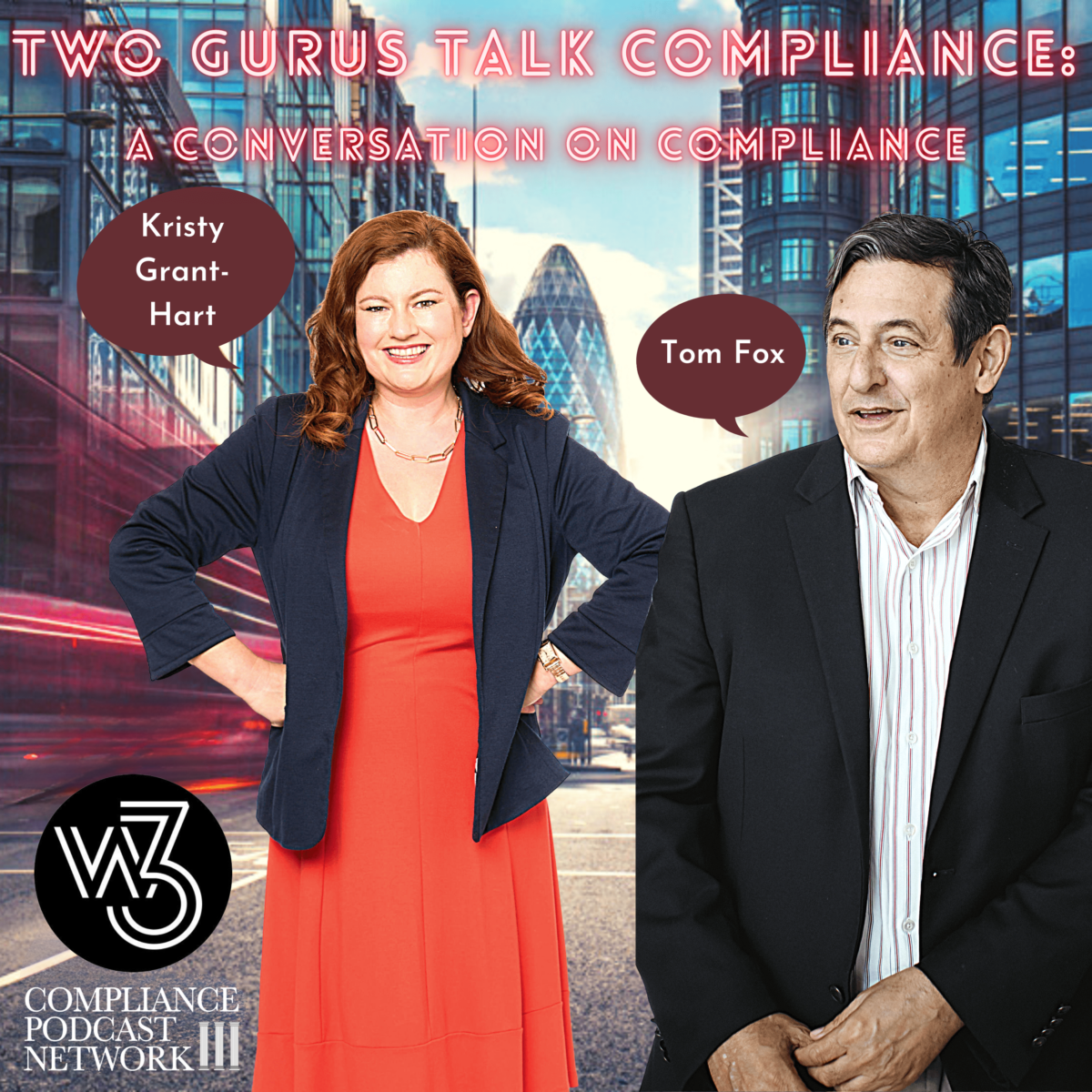
What happens when two top compliance commentators get together? They talk compliance, of course. Join Tom Fox and Kristy Grant-Hart in 2 Gurus Talk Compliance as they discuss the latest compliance issues in this week’s episode!

Stories this week include:

  • Thoughts on the Compliance Job Market (Radical Compliance)
  • A Shadow AI Crisis Is Brewing in the GC’s Office (Corporate Compliance Insights)
  • I built a company that broke people. Now I’m choosing capitalism with love (Fast Company)
  • European Union: Specific regulation of technological impact on the workforce
  • Trump is now the CEO of all US corps. (WSJ)
  • Trump tells Intel to fire CEO. Are you next? (WSJ)
  • Uber picked business over customer safety. (NYT)
  • 9th Circuit upholds SEC gag rule. (Reuters)
  • To Regulate or Not To Regulate. (Bloomberg)
  • Florida man posed as flight attendant to score dozens of free flights: officials – Fox 35 Orlando

Resources:

Kristy Grant-Hart on LinkedIn

Prove Your Worth

Tom

Instagram

Facebook

YouTube

Twitter

LinkedIn

Categories
Data Driven Compliance

Data Driven Compliance – James Tillen on the Importance of Cross-Functional Collaboration in Complying with the FTPF Offense

Welcome to Season 2 of the award-winning Data Driven Compliance. In this new season, we will look at the new Failure to Prevent Fraud offense. Join host Tom Fox as we explore this new law and how to comply with it through the lens of data driven compliance. This podcast is sponsored by konaAI. In this episode of Season 2, Tom Fox is joined by James Tillen, a member at Miller & Chevalier.

James emphasizes the critical need for cross-functional collaboration within organizations for compliance professionals. It explains that simply focusing on one’s compliance program is insufficient. Instead, engaging with various internal departments and possibly external experts is essential to effectively manage compliance risks, including those associated with the failure to prevent fraud.

Key highlights:

  • Why US multinationals need to pay attention
  • Cross-Functional Collaboration
  • Identifying Key Internal Collaborators
  • Engaging Internal and External Experts
  • Jurisdiction

Resources:

Miller & Chevalier

James Tillen on LinkedIn

New Considerations for Companies with U.K. Ties: Home Office Issues Guidance to Organisations on the Offence of Failure to Prevent Fraud

konaAI, a Covasant company

Click here for the konaAI White Paper Rethinking Compliance: Practical Steps for Adapting to the UK’s New Fraud Legislation.

Connect with Tom Fox on LinkedIn

Categories
Daily Compliance News

Daily Compliance News: August 15, 2025, The Privilege Protected Edition

Welcome to the Daily Compliance News. Each day, Tom Fox, the Voice of Compliance, brings you compliance-related stories to start your day. Sit back, enjoy a cup of morning coffee, and listen in to the Daily Compliance News. All, from the Compliance Podcast Network. Each day, we consider four stories from the business world, compliance, ethics, risk management, leadership, or general interest for the compliance professional.

Top stories include:

  • Attorney-client privilege is protected in the FirstEnergy litigation. (Reuters)
  • BCG’s Gaza project is so offensive that 4 staffers quit the company. (FT)
  • Albania (of all countries) turns to AI to fight corruption. (Politico)
  • 5th ex-Peruvian President jailed for corruption. (Al Jazeera)

You can donate to flood relief for victims of the Kerr County flooding by going to the Hill Country Flood Relief here.

Categories
Compliance Tip of the Day

Compliance Tip of the Day – How a CFO Views Compliance and Risk

Welcome to “Compliance Tip of the Day,” the podcast where we bring you daily insights and practical advice on navigating the ever-evolving landscape of compliance and regulatory requirements. Whether you’re a seasoned compliance professional or just starting your journey, we aim to provide you with bite-sized, actionable tips to help you stay on top of your compliance game. Join us as we explore the latest industry trends, share best practices, and demystify complex compliance issues to keep your organization on the right side of the law. Tune in daily for your dose of compliance wisdom, and let’s make compliance a little less daunting, one tip at a time.

Today, we conclude our multipart look at thinking through the ROI of your compliance program by considering how a CFO might well view compliance.

For more on this topic, check out The Compliance Handbook, a Guide to Operationalizing Your Compliance Program, 6th edition, which LexisNexis recently released. It is available here.

Categories
Trekking Through Compliance

Trekking Through Compliance: Episode 75 – Bridging the Gap: Compliance Lessons on Justice and Fairness from “The Cloud Minders”

Institutional justice and institutional fairness are not abstract ideals. They are operational requirements in a corporate compliance program. They define how policies are enforced, how decisions are made, and how employees perceive the integrity of their workplace. One of the most vivid illustrations of the dangers of systemic injustice and perceived unfairness comes from Star Trek: The Original Series in “The Cloud Minders.”

From this story, we can extract five compliance lessons on institutional justice and institutional fairness.

Lesson 1: Consistency in Standards Is Non-Negotiable

Illustrated by:  The leaders of Stratos apply rules differently depending on social status.

Compliance Lesson. The DOJ has repeatedly emphasized that policies and disciplinary measures must be applied consistently.

Lesson 2: Address Root Causes, Not Just Symptoms

Illustrated by: The Troglytes’ performance and health are impaired because mining zenite exposes them to toxic vapors. The elites interpret this as proof of inferiority, ignoring the environmental cause.

Compliance Lesson. Organizations sometimes treat compliance failures as isolated misconduct rather than symptoms of deeper issues, such as inadequate training, unrealistic sales targets, or flawed incentive structures.

Lesson 3: Perceived Fairness Matters as Much as Actual Fairness

Illustrated by: Even when Kirk offers protective gear to the Troglytes, they are slow to trust his intentions. Years of mistreatment have convinced them that promises from the elites are empty.

Compliance Parallel: Employees judge compliance programs not only by their design but by how fair they feel in practice. If people believe investigations are biased or that whistleblowers will be punished, they will avoid reporting, even if the official policy says otherwise.

Lesson 4: Leadership Must Model Ethical Behavior

Illustrated by: Stratos’s leaders speak about justice and stability, but are unwilling to live under the same risks or hardships as the Troglytes. Their detachment from the reality of mining life fuels the unrest.

Compliance Lesson. Leaders who preach ethics but cut corners for themselves undermine institutional fairness. Employees take cues from the top; if executives are exempt from rules, the rest of the organization will follow suit.

Lesson 5: Dialogue and Inclusion Are Tools for Justice

Illustrated by: Spock approaches the Troglytes with genuine respect, listening to their grievances and acknowledging their intelligence. His willingness to engage earns him credibility that Stratos leaders lack.

Compliance Parallel: Institutional fairness is strengthened when employees feel heard and included in shaping solutions.

Final ComplianceLog Reflections

The Cloud Minders is more than a parable about class division; it is a warning for any institution that neglects fairness and justice. In Ardana, injustice created resentment, distrust, and rebellion. In a corporation, those same dynamics can lead to silent disengagement, hidden misconduct, and public scandal.

The DOJ’s message is clear: fairness and justice are not optional add-ons to compliance; they are the foundation of a program that works. As compliance leaders, our role is to be the “Spock” in the room, listening, respecting, and bridging divides while ensuring that the rules are fair, transparent, and consistently applied.

When we do that, we do not just comply with the DOJ’s expectations; we build organizations where people trust the system enough to make it work.

Resources:

⁠⁠Excruciatingly Detailed Plot Summary by Eric W. Weisstein⁠⁠

⁠⁠MissionLogPodcast.com⁠⁠

⁠⁠Memory Alpha