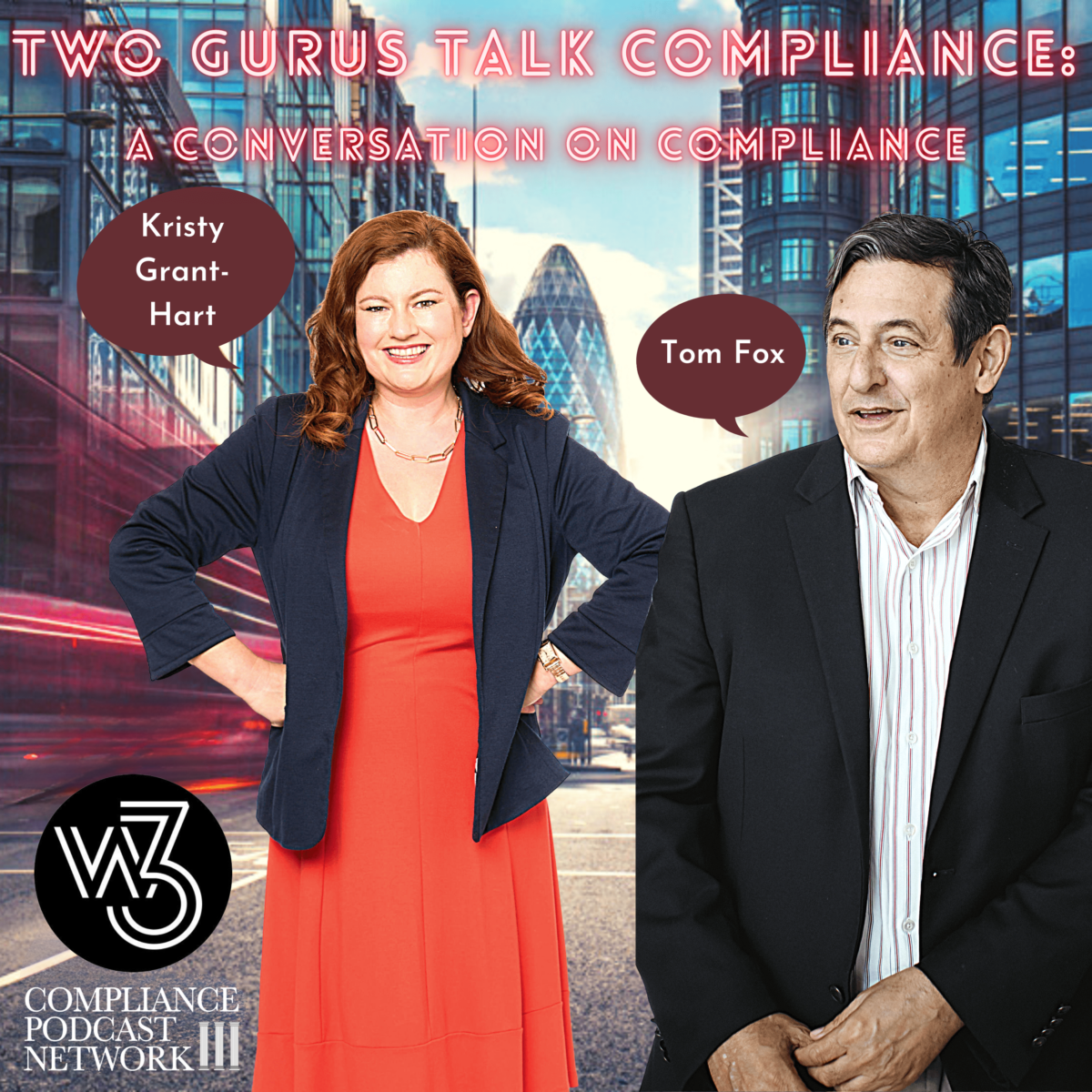
What happens when two top compliance commentators get together? They talk compliance, of course. Join Tom Fox and Kristy Grant-Hart in 2 Gurus Talk Compliance as they discuss the latest compliance issues in this week’s episode!
Welcome to Rotary Voices of Kerrville, the podcast series that shines a spotlight on the Rotary Club of Kerrville, Texas—a club with a rich community service, leadership, and dedication history. For nearly 100 years, the Rotary Club of Kerrville has been at the heart of initiatives that make a real difference locally and globally. Through this podcast, we’ll explore the club’s incredible projects, hear from its inspiring members, and learn about the values driving their commitment to “Service Above Self.” In this episode, host Tom Fox speaks with Rotary Club Program Chair Clint Morse about his professional career and longstanding involvement with the Rotary Club.
Clint shares his journey from attending the University of Texas Law School and joining the Navy’s JAG program during the Vietnam War to practicing labor law at prestigious law firms such as Andrews Kurth and Ogletree Deakins. Clint also discusses his move to Kerrville, Texas, in 2015 and his impactful work with the local Rotary Club, including his role as program chair and his efforts to bring diverse speakers to the club. Clint emphasizes the importance of community service over business networking in Rotary and reflects on some meaningful projects, including basketball tournaments and Salvation Army fundraising. He also discusses the balance required in inviting speakers and maintaining non-political stances within the Rotary Club. The conversation concludes with Clint sharing what Rotary means to him, highlighting the community service opportunities and the lasting friendships formed.
Welcome to a new season of the award-winning Hill Country Authors Podcast, sponsored by Stoney Creek Publishing. In this podcast, Hill Country resident Tom Fox visits with authors who live in and write about the Texas Hill Country. In this episode, Tom visits with Johnnie Alicia Bernhard, a native Texan, prolific writer, and part-time hill country resident.
Johnnie delves into her deep Texas roots and how her family’s history as German immigrants inspires her novels, all set in Texas. She shares insights into her professional journey from journalism to teaching high school English and eventually becoming a traditionally published author. The conversation covers the importance of Texas history in her writing, the craft of storytelling, and Johnnie’s experiences teaching writing classes to aspiring authors. Her novels, including ‘A Good Girl’ and ‘Hannah and Ariela,’ explore themes of family, immigration, human trafficking, and the immigrant experience in America. Tune in for an engaging discussion on the art of writing and Texas’s unique stories.
Welcome to the Daily Compliance News. Each day, Tom Fox, the Voice of Compliance, brings you compliance-related stories to start your day. Sit back, enjoy morning coffee, and listen to the Daily Compliance News. All, from the Compliance Podcast Network. Each day, we consider four stories from the business world: compliance, ethics, risk management, leadership, or general interest for the compliance professional. Yesterday, Trump rolled back almost all tariffs he had imposed 48 hours earlier. We look at four stories on that issue from the compliance angle.
Get ready for an exciting new season of Because That’s What Heroes Do. This season, they take a deep dive into their favorite episodes of Deep Space 9. In this exploration, Tom and Megan are joined by Star Trek maven Alex Murphy (Murphy) from Montreal, a local historian and a cinema and TV fan who loves weird foreign films, horror, and obscure media. He has been watching Trek since he was a tiny punk, and it’s been a lifelong love. In this episode, the team concludes an exploration of the introduction of a new character for DS9’s final season. Today, they review the episode When it Rains.
The gang is back to look into the complexities of character dynamics and ethical tensions portrayed in the episode ‘When It Rains.’ Our hosts discuss Kira’s appointment as a liaison teaching Cardassians resistance tactics and how this creates a multifaceted web of moral and personal conflicts. We also dive into the tragic reveal of Odo’s disease, the challenges faced by Dr. Bashir in uncovering the truth, and the implications of the Federation’s malfeasance. The episode is rich with character growth and moral dilemmas, compelling and thought-provoking. Highlights include Gowron’s contentious takeover of Klingon forces, the deteriorating intrapersonal relationships, and the unexpectedly poignant moments, such as Quark’s heartfelt gesture to Odo. Join us as we dissect these elements and explore how they resonate with broader loyalty, duty, and ethical complicity themes.
Mike & Brent connect the dots between the Administration’s signals regarding U.S. export control enforcement, recent media reports, and how trade compliance teams can best prepare for what comes next. They discuss the overall climate of uncertainty (01:03), an April 8, 2025 report by Reuters about a potential large U.S. export controls fine in the works (01:35), how companies can best respond to a counterparty being put on the U.S. Bureau of Industry & Security’s “Entity List” (05:47), how to respond to U.S. government outreach or administrative subpoenas (07:27), an April 10, 2025 report by Export Compliance Daily about a potential uptick in administrative subpoenas (11:39), their prior “Fresh Looks” post on responding to government inquiries (13:51), and conclude with another installment of Brent Carlson’s “Managing-Up” (17:38).
The theme of today’s episode is the recent decision by US President Donald J. Trump’s administration to scale back enforcement of anti-money laundering via the Corporate Transparency Act—specifically, about beneficial ownership. The administration claims the act, which was passed under the Biden presidency, poses an onerous compliance burden for small and medium firms (SMEs).
In our initial Spotlight segment, we will speak with the renowned counter-money laundering specialist Nigel Morris-Cotterill on the implications of the Trump administration’s move for Asia and why the CTA was ultimately doomed to fail.
Following that, we will chat with former US Naval intelligence officer Malcolm Nance and compliance maven Oonagh Vandenberg, the founder of the RAW Compliance consultancy, about what Washington’s recent action means from a policy perspective for the world more broadly.
Nigel Morris-Cotterill
Nigel Morris-Cotterill was a solicitor in London. Over the course of his career, he dealt with a wide range of matters, including contracts, property company law, litigation, international trade, criminal law, intellectual property, family law, and financial services compliance.
In 1994, he brought all of those areas together to address what was then a new field: financial crime risk and compliance. As a strategist, he identifies and discusses trends long before they become fashionable.
Nigel is the author of How Not to Be a Money Launderer, which in 1996 described all the areas that would, in some cases decades later, become topics for international groups and regulators to prioritize. He also authored the only book on Understanding Suspicion in Financial Crime.
He has also written a book entitled Safe Word: No for families and others to help start discussions about online safety and fraud for young people and the elderly. As of April 2025, he will publish the second volume of Trade Based Financial Crime—Beyond TBML.
Additionally, Nigel provides training and consultancy services, though he admits to becoming jaundiced by the prevalence of superficiality and a lack of attention to the fundamentals. He has experience in technology since the 1980s and advises caution over the fashion of so-called “artificial intelligence,” frequently demonstrating its failures in the simplest tasks.
Oonagh van den Berg
Oonagh van den Berg founded the compliance consultancy and training firm Raw Compliance. She grew up in Northern Ireland during the tumultuous 1980s and is a compliance industry veteran. A lawyer by training and an entrepreneur by vocation, she grew up in Northern Ireland during “The Troubles” and went on to become a lawyer, compliance officer, recruiter, and later, a consultant and educator. She has been based in Asian financial hubs such as Singapore and Hong Kong and is currently based in Portugal.
Malcolm Nance
Malcolm Nance joins us from upstate New York. He was a 20-year veteran of the US Navy, where he was an intelligence officer specializing in counter-terrorism, intelligence, and violent extremism as an advisor for the US government’s law enforcement, homeland security, and intelligence agencies. As an Arabic-speaking special intelligence collections operator and field interrogator, he provided top-secret anti- and counter-terrorism support to national intelligence agencies while on numerous reconnaissance and combat operations in the Balkans, Middle East, and sub-Saharan Africa.
Now a member of the Board of Advisors at the International Spy Museum in Washington, DC, Mr. Nance was honored as one of the “Noteworthy African-Americans in American Espionage History.”
He’s best known for his appearances on MSNBC, where he warned about Russian interference in the run-up to the 2016 and 2020 US Presidential elections. Malcolm is also a best-selling author—with his books The Plot to Hack America, The Plot to Destroy Democracy, The Plot to Betray America, and most recently, They Want to Kill Americans: The Militias, Terrorists, and Deranged Ideology of the Trump Insurgency.
You can discover more from Malcolm at his Substack and his podcast Black Man Spy on YouTube.
Discussion:
The US Treasury Department announced in early March that it would halt enforcing “any penalties or fines associated with the beneficial ownership information reporting rule under the existing regulatory deadlines, but it will further not enforce any penalties or fines against U.S. citizens or domestic reporting companies or their beneficial owners after the forthcoming rule changes take effect either.”
The net result: the US government will no longer require shell companies to disclose their owners and beneficiaries, allowing wealthy corporations and individuals to hide their profits from the public. The rule was part of the 2021 CTA, which required some businesses to report information on people who own or control a company, indirectly or directly, to the department’s Financial Crimes Enforcement Network, or FinCEN.
President Trump took to Truth Social after the Treasury announcement to post, almost gloatingly, “This Biden rule has been an absolute disaster for small businesses nationwide,” Trump’s post read.
“Furthermore, the Treasury is formally finalizing an emergency regulation to suspend this rule for American businesses. The economic menace of [beneficial ownership information] reporting will soon be no more.”
Republicans had long opposed the act, claiming its requirements were too complex for SMEs. The rule on beneficial ownership was supposed to go into effect in January, but a federal court order froze enforcement of the rule. The Biden administration passed the CTA to tackle tax evasion and corporate cronyism, which the Trump administration views very differently.
Following his second inauguration on January 20, Trump has targeted financial regulation and governmental agencies seeking to limit corporate and banking power, such as the Consumer Financial Protection Bureau. In early March, the president also issued an executive order halting enforcement of the nearly half-century-old Foreign Corrupt Practices Act for at least a year, pending revised guidelines from the Department of Justice. The FCPA prohibits any person or company tied to the United States from paying money or offering gifts to foreign officials to help their business.
The Spotlight portion of today’s broadcast commences with Nigel sharing his thoughts on what the Trump administration’s actions will mean for the fight against AML and financial crime in the APAC region with Regulatory Ramblings host Ajay Shamdasani. He explains his reasons why the CTA was doomed to fail and whether to expect more enforcement against money laundering and financial crime lapses by regional governments such as China, South Korea, Japan, and Singapore.
Nigel is unequivocal in his view that compliance officers and in-house counsel at banks or multinational corporations in Asia, particularly those based in key financial hubs like Hong Kong and Singapore, not slack off.
He also shares his views on the FCPA as a powerful legislative tool to ensure international compliance and acknowledges that, given the current president’s transactional nature, selective extraterritorial enforcement of the anti-corruption and AML rules can be expected.
Malcolm and Oonagh then share their impressions on the Trump administration’s move to expand AML and financial crime compliance worldwide.
Oonagh notes genuine concerns amongst SMEs about how difficult it was to comply with the CTA. What this means for the global battle against financial crime and related matters such as bribery, terrorist financing, sanctions, and tax evasion remains to be seen.
Malcolm and Oonagh note that while regulation is important, blind and excessive regulation can be counterproductive.
The conversation concludes with a discussion of how data points and AI might aid AML/CTF/KYC compliance.
Regulatory Ramblings podcasts is brought to you by The University of Hong Kong—Reg/Tech Lab, HKU-SCF Fintech Academy, Asia Global Institute, and HKU-edX Professional Certificate in Fintech, with support from the HKU Faculty of Law.
This week, we are continuing our deep dive into a critical issue reverberating across boardrooms globally: the macroeconomic implications of President Trump’s recent tariff hikes and suspensions. Business leaders and compliance professionals are grappling with navigating this unprecedented landscape, and understanding the nuances of this evolving situation is crucial for corporate strategy and compliance preparedness. For today’s Part 4, we consider what the research shows about companies that have weathered trade wars in the past better than others.
My discussion today is based on an article in the Harvard Business Review (HBR) entitled Research: Why Some Companies Weather Trade Wars Better Than Others by Di Fan, Daphne W. Yiu, Pengcheng Ma, and Lin Cui. By adapting this article for a compliance audience, I hope to show compliance professionals that there are models in the business world you can adapt for your organization to survive and even thrive in the era of Trump’s trade wars.
Lesson 1: Prioritize Innovation to Mitigate Risks
The first lesson underscored by the research is the significant role innovation plays in ensuring corporate resilience during trade wars. Companies with robust innovation strategies, marked notably by their intellectual property (patents), demonstrated substantially greater resilience. For instance, Huawei significantly ramped up its R&D efforts following the U.S.-imposed restrictions, which enabled the company to reduce its reliance on external technology and bolster its market position through self-developed solutions. The compliance takeaway is clear: Compliance teams must support innovative efforts by ensuring robust intellectual property protections, facilitating compliance with local and international patent laws, and ensuring that R&D investments align with regulatory requirements. Building resilience means actively collaborating with business units to proactively identify regulatory hurdles in innovative technologies, ensuring compliance processes keep pace with innovation.
Lesson 2: Champion Corporate Social Responsibility (CSR)
CSR emerged as a crucial attribute for resilience, highlighting a company’s commitment to sustainability, community engagement, ethical practices, and governance transparency. Companies demonstrating high CSR standards saw notably smaller trade volume reductions than peers. Lenovo’s effective integration of environmental sustainability practices in its production processes and Alibaba’s impactful community engagement initiatives stand as strong examples. Compliance professionals should thus actively promote and enforce robust CSR policies that exceed mere regulatory compliance. This involves stringent oversight of environmental practices, labor conditions, community engagement, and ethical governance across global supply chains, fostering transparent CSR reporting and compliance.
Lesson 3: Cautious Navigation of Political Ties
The research shows that politically entangled companies experienced significant trade value declines during geopolitical conflicts. For instance, entities closely tied to government ownership or influence faced higher trade disruptions. China Unicom and NIO took strategic steps to diminish perceptions of political entanglement through ownership restructuring and transparent governance. Compliance professionals must critically evaluate and mitigate the compliance risks associated with political entanglements. This involves comprehensive risk assessments, transparent reporting, and proactive restructuring where necessary to ensure corporate independence and reduce perceived political risks.
Lesson 4: Diversify and Decentralize Supply Chains
One explicit recommendation from the analysis for buyers is the importance of diversifying supply chains to mitigate risks inherent in geopolitical disruptions. Organizations relying on multiple geographically dispersed suppliers exhibit enhanced resilience. Compliance professionals should advocate for robust supply chain risk management frameworks, emphasizing diversified sourcing strategies. This includes rigorous compliance checks for suppliers, comprehensive due diligence, ongoing monitoring of geopolitical risks, and contingency planning. Ensuring compliance frameworks support decentralized supply chain strategies is critical to managing risks effectively.
Lesson 5: Comprehensive Regulatory Engagement
Lastly, the role of regulators in promoting innovation and CSR initiatives to bolster economic resilience cannot be overstated. Policies supporting technological advancement, environmental sustainability, and transparent governance greatly aid local firms. Compliance professionals must proactively engage with regulatory developments, ensuring timely adaptations in compliance programs. It is vital to effectively leverage governmental incentives and regulations, aligning compliance efforts closely with governmental priorities, including ESG initiatives and innovation support mechanisms.
Navigating the turbulent waters of trade wars demands more than mere reaction; it requires strategic foresight and comprehensive preparedness from compliance professionals. Recent research has outlined that businesses equipped with robust innovation strategies, an ingrained culture of corporate social responsibility, and the ability to navigate political complexities fare significantly better amidst trade conflicts. These attributes serve as safeguards and competitive advantages, enhancing resilience and positioning companies to capitalize on opportunities even during uncertain times.
Additionally, supply chain diversification emerges as a critical strategic imperative. Compliance professionals play a pivotal role here, ensuring that organizations identify and mitigate risks associated with concentrated supplier reliance and foster relationships across multiple regions and partners. Proactive management and diligent due diligence are essential to keep operations agile and responsive to sudden geopolitical shifts.
Moreover, a proactive engagement with regulatory landscapes allows compliance teams to anticipate changes and align business practices accordingly. Compliance professionals who keep a finger on the pulse of regulatory developments can swiftly adapt to new incentives and requirements, ensuring that their organizations remain compliant, resilient, and poised for sustainable growth. This ongoing engagement underscores the evolving role of compliance—from reactive gatekeeper to strategic partner and business enabler.
Ultimately, the lessons drawn from navigating trade wars extend beyond immediate conflicts. They represent a comprehensive compliance and risk management approach emphasizing innovation, sustainability, independence, agility, and proactive regulatory alignment. Compliance professionals adopting these practices protect their organizations from present disruptions and equip them with the strategic resilience necessary to thrive in an increasingly interconnected and geopolitically complex global market. As we look to the future, embracing these lessons will be crucial for compliance leaders determined to turn challenges into opportunities for long-term success.
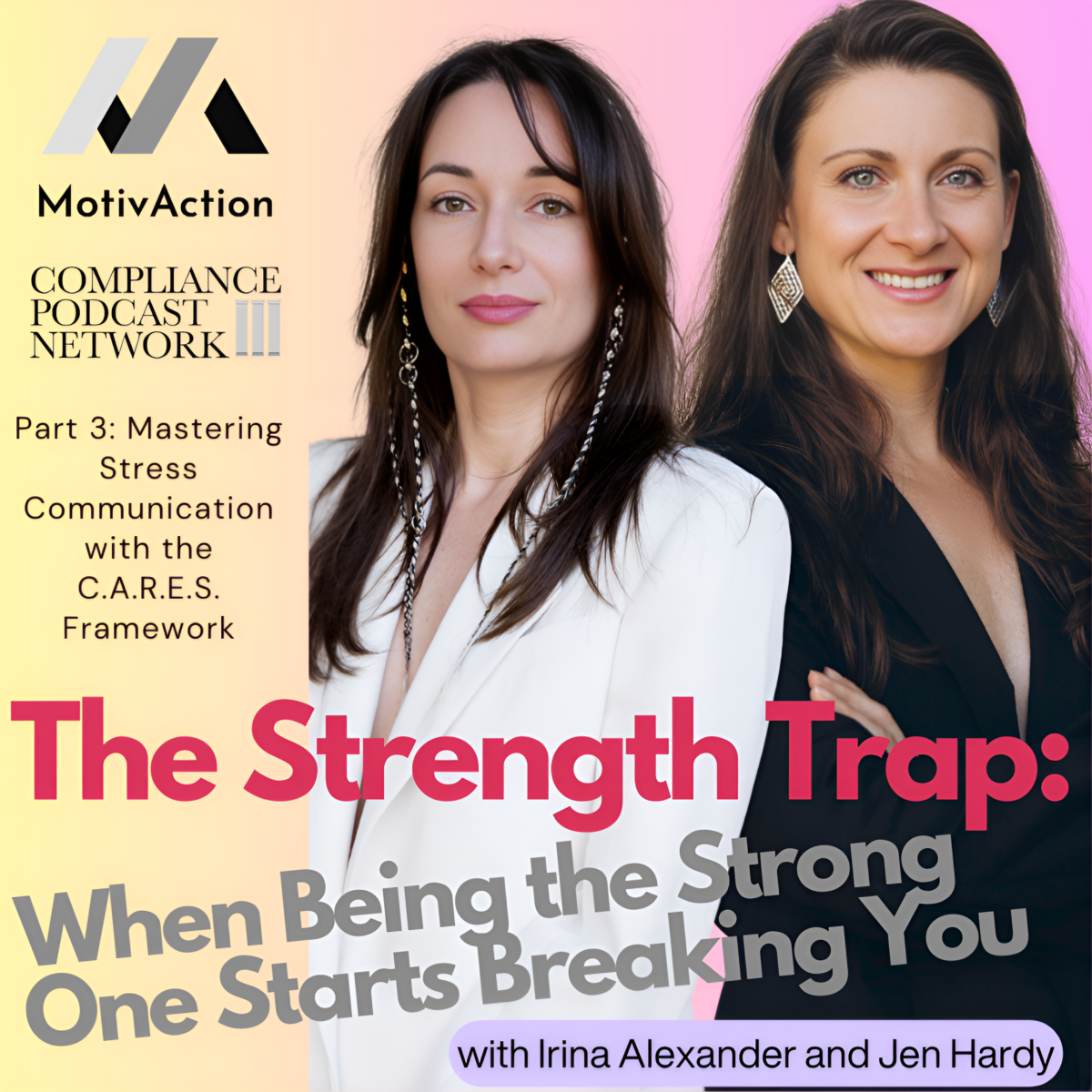
Innovation comes in many areas, and compliance professionals must be ready for and embrace it. Join Tom Fox, the Voice of Compliance, as he visits with top innovative minds, thinkers, and creators in the award-winning Innovation in Compliance podcast. In this concluding episode of a three-part series, Tom Fox visits with Jen Hardy, Chief Operations Officer at the Academy Of MotivAction, to discuss how stress affects communication and delve into why communication often breaks down under stress.
They highlight the role of psychological safety and emotional regulation. Jen shares a personal story illustrating the importance of self-awareness and self-regulation in maintaining effective communication during stressful times. She also introduced the C.A.R.E.S. framework, which provides practical tools for managing tough conversations and establishing trust. Irina Alexander, founder & CEO of the Academy of MotivAction, joins to give a call to action, emphasizing the significance of their approach to improving professional and personal relationships through enhanced communication strategies.
Key highlights:
Understanding Communication Breakdown
Personal Story: Handling Stressful Conversations
The Importance of Psychological Safety
The C.A.R.E.S. Framework for Effective Communication
Welcome to “Compliance Tip of the Day,” the podcast where we bring you daily insights and practical advice on navigating the ever-evolving landscape of compliance and regulatory requirements. Whether you’re a seasoned compliance professional or just starting your journey, we aim to provide bite-sized, actionable tips to help you stay on top of your compliance game. Join us as we explore the latest industry trends, share best practices, and demystify complex compliance issues to keep your organization on the right side of the law. Tune in daily for your dose of compliance wisdom, and let’s make compliance a little less daunting, one tip at a time.
In this episode, Tom Fox explores some of the economic data compliance professionals should consider during these tumultuous times, which is outside data typically considered by a compliance professional.