Categories
The Ethics Experts

Episode 189 – Kerri Salata

In this episode of The Ethics Experts, Nick welcomes Kerri Salata.

Kerri Salata is a lawyer, ethics, and compliance professional who advises companies on how to meet their legal and regulatory requirements using creative, design-driven strategies. She is the founder of Kerri A. Salata, a legal professional corporation, and holds the CEO position at Comply With Me, a compliance consultancy firm known for its innovative approach to regulator-accredited compliance education.

http://www.linkedin.com/in/kerrisalata

Categories
Corruption, Crime and Compliance

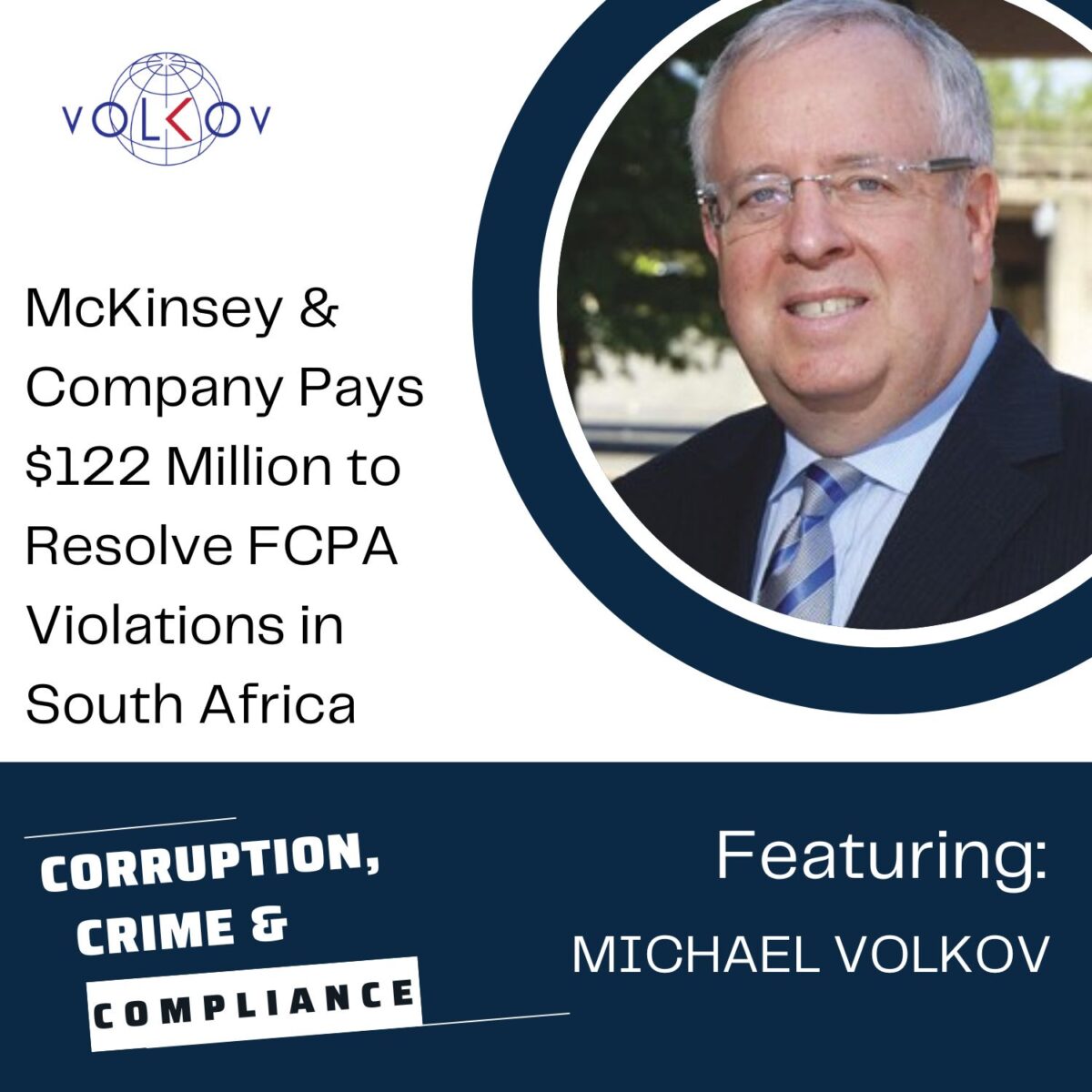
McKinsey & Company Pays $122 Million to Resolve FCPA Violations in South Africa

What went wrong when McKinsey paid bribes to secure consulting contracts with South Africa’s state-owned enterprises? In this episode, Michael Volkov dives into the December 2024 DOJ settlement with McKinsey & Company, which paid $122 million after being found guilty of paying bribes to officials at Transnet and Eskom to secure valuable consulting contracts. The case involved significant violations of the Foreign Corrupt Practices Act (FCPA) and highlights the risks companies face when failing to implement effective compliance programs.

You’ll hear him discuss:

  • The details of McKinsey’s settlement with the DOJ for $122 million, including the 35% discount and the cooperation credits granted by the government.
  • The role of Vikas Sagar, McKinsey’s former senior partner, and his guilty plea in 2022 for orchestrating bribery payments.
  • How McKinsey Africa used sensitive, non-public information obtained through bribes to secure multi-million dollar contracts with Transnet and Eskom.
  • The ongoing issue of engaging third-party intermediaries and the importance of conducting thorough due diligence before entering into business relationships.
  • The lessons learned from McKinsey’s lack of proper oversight and controls allowed a small group of corrupt executives to facilitate bribery schemes.
  • The broader impact of local content requirements in international business and the associated risks of partnering with unqualified entities with ties to corrupt government officials.

Resources:

Michael Volkov on  LinkedIn |Twitter

The Volkov Law Group

Categories
31 Days to More Effective Compliance Programs

31 Days to a More Effective Compliance Program: Day 6 – M&A Safe Harbor Policy

Welcome to a special podcast series on the Compliance Podcast Network, 31 Days to a More Effective Compliance Program. Over these 31 days of the series in January 2025, Tom Fox will post a key part of a best practices compliance program daily. By the end of January, you will have enough information to create, design, or enhance a compliance program. Each podcast will be short, at 6-8 minutes, and will include three key takeaways you can implement at little or no cost to help update your compliance program. I hope you will join us each day in January for this exploration of best practices in compliance.

This episode delves into the Department of Justice’s mergers and acquisitions (M&A) Safe Harbor Policy, as Deputy Attorney General Lisa Monaco explained. This policy encourages companies to voluntarily self-disclose criminal conduct discovered during acquisition. If a company promptly discloses such misconduct, cooperates with the ensuing investigation, and engages in appropriate remediation, restitution, and disgorgement, it can receive a presumption of a criminal declination. Key deadlines include disclosing misconduct within six months of the closing date and fully remediating within one year. The DOJ aims to incentivize acquiring companies to perform robust pre- and post-acquisition due diligence and self-disclosure to mitigate risks and de-risk transactions effectively.

Key highlights:

  • New DOJ Mergers and Acquisitions Safe Harbor Policy
  • Key Requirements and Deadlines
  • Historical Context and Clarifications

Resources:

Click here to receive a 20% discount on The Compliance Handbook, 5th edition, for listeners to this podcast.

Categories
FCPA Compliance Report

FCPA Compliance Report – Episode 740 – Jonathan Wilson on the Current Status of CTA Litigation

Welcome to the award-winning FCPA Compliance Report, the longest-running podcast in compliance. In the first episode of the 2025 FCPA Compliance Report, Tom welcomes back Jonathan Wilson, founder and CEO of the FinCEN Report, to discuss recent legal machinations surrounding the Corporate Transparency Act (CTA). They delve into a December court ruling by the Eastern District of Texas, which issued a universal injunction against the CTA, claiming it oversteps Congress’s authority under the Commerce Clause. The Fifth Circuit stay panel initially stayed this ruling but was later reinstated by the merits panel, leading the government to appeal to the Supreme Court. The episode also covers historical context, potential impacts on businesses, and predictions for future court actions regarding the CTA.

Key highlights:

  • Texas Top Cop Shop Case Overview
  • Court Rulings and Injunctions
  • Supreme Court Involvement
  • Government Response and Filing Process
  • Implications of Administration Change

Resources:

Jonathan Wilson on LinkedIn

FinCEN Report

Tom Fox

Instagram

Facebook

YouTube

Twitter

LinkedIn

For more information on the Ethico Toolkit for Middle Managers, available at no charge, click here.

Categories
Daily Compliance News

Daily Compliance News: January 6, 2025 – The Lady MacBeth in 2025 Edition

Welcome to the Daily Compliance News. Each day, Tom Fox, the Voice of Compliance, brings you compliance-related stories to start your day. Sit back, enjoy a cup of morning coffee, and listen to the Daily Compliance News—all from the Compliance Podcast Network. Each day, we consider four stories from the business world: compliance, ethics, risk management, leadership, or general interest for the compliance professional.

  • Lady MacBeth lives. (Greek Reporter)
  • Is CFIUS corrupt? (WSJ)
  • Auditing firms call the value of metrics ‘speculative.’ (FT)
  • Treasury department sanctions Beijing-based cybersecurity company. (NYT)

For more information on the Ethico Toolkit for Middle Managers, available at no charge, click here.

Check out the entire 3-book series, The Compliance Kids, on Amazon.com.

Categories
Blog

The Character Imperative in Leadership: A Lesson for Compliance Professionals

When discussing leadership transitions at troubled organizations, one recurring theme is often overlooked: character’s pivotal role in shaping culture and outcomes. In an MIT Sloan Management Review article entitled “Make Character Count in Hiring and Promoting,” Mary Crossan posited, “Most managers focus on competencies when evaluating candidates—but it’s a character that will transform the DNA of the organization.”

The recent challenges faced by Boeing serve as a cautionary tale for compliance professionals worldwide. Despite their technical prowess and storied history, Boeing’s leadership failures, rooted in compromised decision-making and a lack of character-driven judgment, led to catastrophic consequences for safety, public trust, and, ultimately, their bottom line.

The leadership debate at Boeing has focused narrowly on whether the next CEO should be an engineer or an accountant, emphasizing competencies over character. This approach underscores a persistent failure across industries to recognize that strong character-based judgment is a cornerstone of ethical leadership and compliance success.

This offers a critical lesson for compliance professionals: character matters as much as, if not more than, competence. The organizational culture we build reflects the character of the individuals we hire, promote, and retain. Compliance leaders must champion character as a vital element in talent development and how to embed this principle into their practices.

Competence vs. Character: Understanding the Difference 

Competence concerns what someone can do, their technical skills, knowledge, and experience. It varies by organization, role, and level within the hierarchy. In contrast, the character is about who someone is. It’s universal and intrinsic, shaped over a lifetime, and critical to ethical decision-making.

Research shows that character comprises 11 interconnected dimensions, each manifesting in observable behaviors. These dimensions include courage, humility, temperance, accountability, and judgment. Importantly, character isn’t static; it’s a habit that can be developed and refined over time.

When organizations equate character with a narrow set of qualities, such as drive and accountability, they risk embedding toxicity and poor judgment into their culture. For example, a leader with unrestrained courage may veer into reckless decision-making without the tempering force of humility. Such imbalances ripple through the organization, driving disengagement and turnover among those with stronger, more balanced character.

This interplay between character and culture is a leverage point for compliance professionals. We can foster ethical cultures prioritizing accountability, transparency, and trust by elevating character assessments to the same level as competence evaluations. 

Character Interviews: A Tool for Compliance Leaders

Traditional interviews focus on competencies through structured questions and rubrics. Character interviews, however, require a more nuanced approach. They are conversational and personalized, designed to explore a candidate’s life story and reveal their character dimensions.

Here are key considerations for conducting effective character interviews:

  1. Prepare by Developing Your Own Character. To assess the character of others, interviewers must first reflect on their biases and imbalances. For instance, understanding the dimension of justice requires recognizing how systemic privileges and inequities shape perceptions of fairness.
  2. Engage in Genuine Conversations. A character interview should feel less like a formal assessment and more like exploring the candidate’s experiences, motivations, and values. This approach uncovers the layers of their character organically.
  3. Probing Questions and Observational Insights. Start with broad, open-ended questions and follow the threads of the candidate’s responses. For example, if candidates emphasize their innovative drive, explore how they’ve balanced it with temperance or collaboration.
  4. Cluster Dimensions to Identify Strengths and Weaknesses .Character dimensions are interconnected and should be evaluated holistically. A candidate with strong accountability and courage but weak temperance might struggle to balance ambition with thoughtful decision-making.
  5. Assess the Interviewer’s Character. Character interviews reveal the interviewee’s strengths and weaknesses as well as the interviewer’s. Candidates often assess organizations based on the character of those conducting the interviews.

Character in Promotions and Talent Development

Promotions signal what qualities an organization values most. When those decisions prioritize competence over character, they risk elevating individuals whose imbalances could undermine ethical culture.

One effective approach is integrating character assessments into 360-degree reviews for promotion candidates. For example, an organization identified a highly competent leader whose humility and collaboration needed development. By assigning him to an unfamiliar overseas role, they created an environment where he had to rely on others and build relationships, strengthening his weaker character dimensions.

Compliance professionals can advocate for similar strategies, ensuring that promotions are about past performance and readiness for ethical leadership.

Building Character-Based Cultures in Compliance

Embedding character into hiring and promotion decisions isn’t just about individual roles; it’s about shaping organizational DNA. Here is how compliance teams can lead this transformation:

  1. Educate on the Importance of Character. Host workshops or training sessions on the 11 dimensions of character and their relevance to compliance and ethical decision-making.
  2. Develop Character Assessment Tools. Create structured yet flexible frameworks for evaluating character in interviews, performance reviews, and succession planning.
  3. Provide Feedback for Development. Constructive feedback helps individuals recognize and address character imbalances. Compliance leaders can normalize character development as an ongoing process.
  4. Model Character-Driven Leadership. Compliance teams should exemplify the values they seek in others, demonstrating integrity, transparency, and humility in their interactions and decision-making.

The Compliance Professional’s Role

Character-driven leadership is essential to navigating today’s complex ethical landscape. For compliance professionals, this means advocating for systems that value character alongside competence. It means challenging the status quo in talent management and championing leaders who embody integrity, humility, and balanced judgment.

Boeing’s leadership failures are a stark reminder of what happens when a character is sidelined. By prioritizing character in our organizations, we can mitigate risk and build cultures that inspire trust, accountability, and long-term success.

Your corporate compliance function’s future and your entire organization depend on it.

Categories
31 Days to More Effective Compliance Programs

31 Days to a More Effective Compliance Program: Day 5- Enhancing Compliance Through Automation

Welcome to a special podcast series on the Compliance Podcast Network, 31 Days to a More Effective Compliance Program. Over these 31 days series in January 2025, I will post a key part a best practices compliance program each day. By the end of January, you will have enough information to create, design or enhancement a compliance program. Each podcast will be short, at 6-8 minutes with three key takeaways that you can implement at little or no cost to help update your compliance program. I hope you will plan to join each day in January for this exploration of best practices in compliance.

In this episode, we explore how automation can revolutionize traditional compliance reporting, which is often manual, time-consuming, and error-prone. By leveraging data-driven solutions, compliance professionals can achieve near real-time reporting, improving decision-making and efficiency across their organizations. Reg Ops (regulatory operations) plays a key role in this transformation by focusing on automating compliance artifact creation and integrating existing security and compliance tools. This helps provide a comprehensive, real-time view of the company’s compliance status. However, organizations must carefully balance the need for real-time reporting with data accuracy, security, and cultural adaptation to realize these benefits. Tune in as we highlight three key takeaways: the critical role of automation in improving compliance effectiveness, the necessity of near real-time reporting, and the importance of balancing data accuracy and security in compliance programs. Join us tomorrow to discuss the impact of privacy regulations on data-driven compliance programs and analytics.

Key Highlights

  • Challenges in Traditional Compliance Reporting
  • Integrating Tools for Real-Time Compliance
  • Balancing Real-Time Reporting with Data Security
Categories
31 Days to More Effective Compliance Programs

31 Days to a More Effective Compliance Program: Day 4- Building Effective Data Analytics Programs for Compliance

Welcome to a special podcast series on the Compliance Podcast Network, 31 Days to a More Effective Compliance Program. Over these 31 days series in January 2025, I will post a key part a best practices compliance program each day. By the end of January, you will have enough information to create, design or enhancement a compliance program. Each podcast will be short, at 6-8 minutes with three key takeaways that you can implement at little or no cost to help update your compliance program. I hope you will plan to join each day in January for this exploration of best practices in compliance.

In today’s business environment, compliance professionals leverage data analytics to adhere to regulatory requirements and ethical standards. This episode focuses on the importance of defining specific risks an organization wants to monitor, capturing relevant data creatively, and utilizing internal expertise to build effective data analytics programs. By starting small and focusing on one risk at a time, compliance officers can demonstrate their dedication to improving compliance despite limited resources. Additionally, a data-driven approach helps shift focus from individual policy violations to identifying systemic issues, enhancing overall organizational compliance. Key takeaways include understanding multiple factors in creating data-driven compliance programs, recognizing the value of shifting focus to systemic issues, and gradually building analytics capabilities.

Key Highlights

  • Defining and Identifying Risks
  • Innovative Data Capture and Internal Collaboration
  • Demonstrating Value to Senior Management

Resources

Listeners to this podcast can receive a 20% discount to The Compliance Handbook, 5th edition by clicking here.

Categories
31 Days to More Effective Compliance Programs

31 Days to a More Effective Compliance Program: Day 3- Key Updates in the ECCP: Messaging Apps, Internal Controls, and Compensation

Welcome to a special podcast series on the Compliance Podcast Network, 31 Days to a More Effective Compliance Program. Over these 31 days series in January 2025, I will post a key part a best practices compliance program each day. By the end of January, you will have enough information to create, design or enhancement a compliance program. Each podcast will be short, at 6-8 minutes with three key takeaways that you can implement at little or no cost to help update your compliance program. I hope you will plan to join each day in January for this exploration of best practices in compliance.

In today’s episode, we delve into the significant updates in the evaluation of corporate compliance programs, focusing on messaging apps, internal controls, and adequate compensation. The revised language in the ECCP highlights the DOJ’s increased scrutiny on the use of messaging apps, emphasizing the need for tailored policies that align with a company’s specific risks and business needs. We also discuss the critical importance of internal controls as minimum expectations set by the DOJ, and the necessity of continuous monitoring to manage these risks effectively. Lastly, we examine the newly added provisions related to adequate compensation, ensuring that compliance teams are empowered and protected against retaliation. The episode concludes by summarizing three key takeaways for compliance professionals: the growing importance of communications compliance, the need for robust and functional internal controls, and the imperative of adequately compensating compliance personnel.

Key Highlights

  • Messaging Apps and Compliance
  • Internal Controls and Risk Management
  • Adequate Compensation for Compliance Teams

Resources

Listeners to this podcast can receive a 20% discount to The Compliance Handbook, 5th edition by clicking here.

Categories
Classroom Insiders

Classroom Insiders, Season 2- Exploring Insider Trading and Cryptocurrencies: SEC v. Wahi

Welcome to Season 2 of Classroom Insiders, a podcast with Professor Karen Woody and her Insider Trading Seminar students from Washington and Lee University. They explore the arc and evolution of insider trading over the last century. Each episode will feature a discussion between Karen Woody and students about insider trading and regulation. Find out what the future lawyers of the university think about past and current legislation and learn more about this fascinating area of law.

In this episode of Classroom Insider, Professor Woody discusses insider trading with law students Cody and Kevin. The trio takes a deep dive into the SEC v. Wahi case. The case involves the Coinbase crypto trading platform, where insider information about cryptocurrency listings was leaked by an employee to friends, enabling them to trade and profit before the information became public. The discussion underscores the intertwining of classical and misappropriation theories of insider trading, especially in the novel context of cryptocurrencies.

The episode further delineates how the securities regulation landscape is adapting to new financial instruments like cryptocurrencies and NFTs, referencing cases like Chiarella, Carpenter, and Chastain to provide a comparative analysis. The conversation evokes critical thoughts on the SEC’s jurisdiction in crypto markets and whether such activities should be classified under insider trading laws. As the legal boundaries expand, the trio anticipates continuous evolution in regulatory approaches towards insider trading and cryptocurrencies.

Key Highlights

  • Case Introduction: SEC vs. Wahi
  • Details of the Case
  • Legal Theories and Jurisdiction
  • Opinions and Takeaways

Resources

Washington and Lee School of Law

Professor Karen Woody