Categories
Corruption, Crime and Compliance

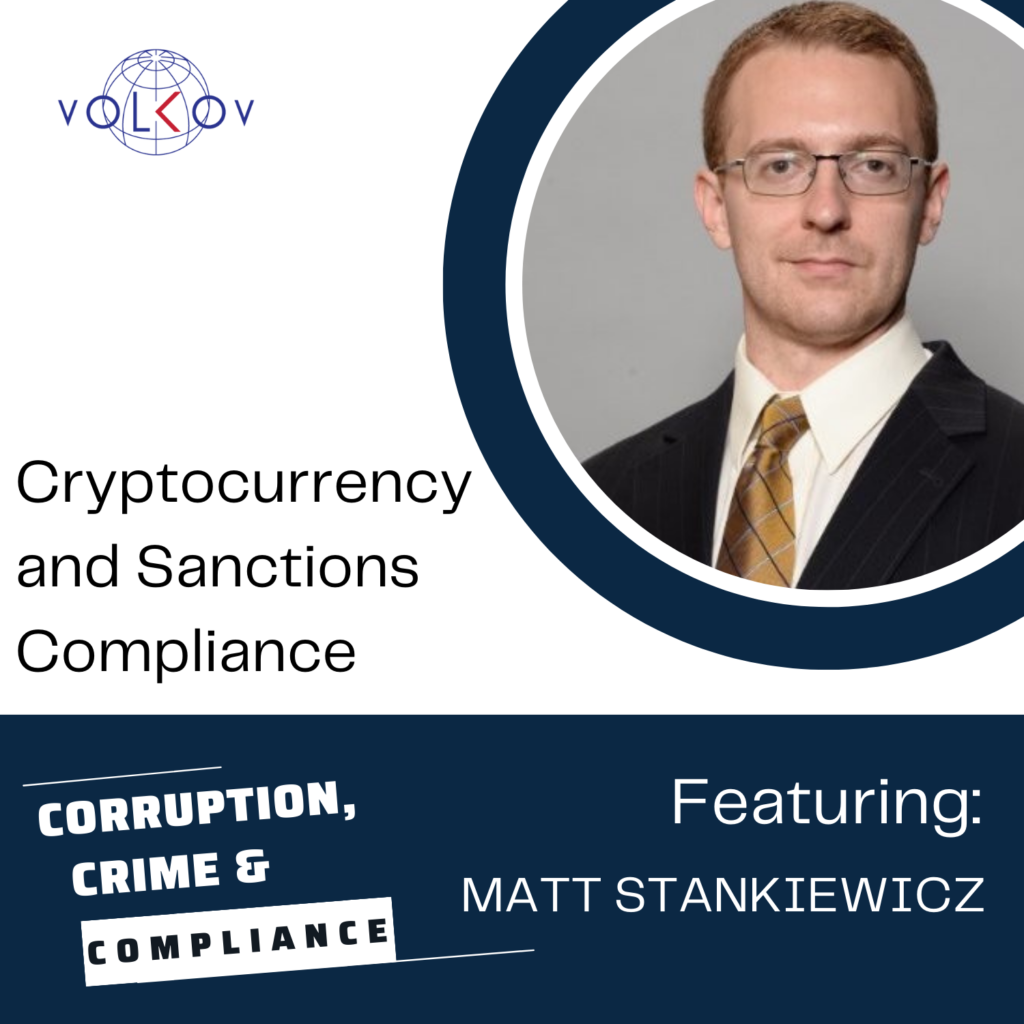
Cryptocurrency and Sanctions Compliance with Matt Stankiewicz

Cryptocurrency has become a popular way to invest and transact, but with that comes the need for sanctions compliance. In this episode, Michael Volkov and Matt Stankiewicz discuss the recent enforcement actions against Poloniex, Bittrex, and Kraken for violating US sanctions regulations with cryptocurrency transactions. Matt is a Partner at Volkov Law and a leading cryptocurrency expert. He and Michael dive into the common themes and basic failures that led to these enforcement actions, including IP blocking, transaction monitoring, and the use of screening tools. They also explore the challenges of compliance when dealing with regions like Crimea and Ukraine, as well as the importance of voluntary disclosure.

You’ll hear Michael and Matt talk about:

  • Cryptocurrency companies are struggling to implement KYC and geo-blocking controls, which is leading to violations involving sanctioned jurisdictions.
  • OFAC is taking an aggressive stance against cryptocurrency companies. Companies in the cryptocurrency industry need to implement effective sanctions compliance programs to avoid hefty fines and enforcement actions from regulatory authorities.
  • There is no materiality requirement for sanctions violations, and even small transactions can result in multimillion-dollar fines.
  • Retroactively applying controls to existing customers is important, and failing to do so can lead to violations.
  • Companies need to have a comprehensive and automated system in place to detect and prevent violations.
  • Companies need to be vigilant about screening individuals and transactions against the relevant sanctions lists, including screening field text, addresses, and ID cards.
  • Geo-blocking for IP addresses is a crucial compliance control, but it is not perfect and can be circumvented by VPNs.
  • Voluntary disclosure of violations can lead to more favorable outcomes and lower fines from regulatory authorities.
  • OFAC and other regulatory authorities are using analytical tools to monitor transactions and flag potential violations, so cryptocurrency companies should not assume they can go under the radar.
  • Companies can use the public blockchain to monitor transactions and identify potential sanctions risks.
  • Sanctions compliance programs should be regularly reviewed and updated to address new risks and changes in regulations.


KEY QUOTES
“There are a lot of tools available to these companies to monitor transactions, maybe better than in the traditional finance world, just because everything on the blockchain is public record essentially.” – Matt Stankiewicz


“It’s just interesting to see OFAC go so aggressively against these companies. Not too surprising considering the extreme sanctions risk that cryptocurrency poses. Very importantly, there’s still a lot of takeaways that really any industry can take away from these enforcement actions.” – Matt Stankiewicz


“If you find problems, obviously you want to remediate them, but figure out what you need to do in terms of voluntary disclosures, because typically you’ll be much better off than if OFAC figures it out on their own, which they usually do.” – Matt Stankiewicz


Resources:

Matt Stankiewicz on LinkedIn | Twitter 
Michael Volkov on LinkedIn | Twitter

The Volkov Law Group

Categories
Daily Compliance News

Daily Compliance News: May 15, 2023 – The Like a Cancer Edition

Welcome to the Daily Compliance News. Each day, Tom Fox, the Voice of Compliance, brings you compliance-related stories to start your day. Sit back, enjoy a cup of morning coffee, and listen to the Daily Compliance News. All from the Compliance Podcast Network. Each day we consider four stories from the business world, compliance, ethics, risk management, leadership, or general interest for the compliance professional.

Stories we are following in today’s edition:

  • PwC is facing potential criminal actions in Australia. (The Guardian)
  • Binance to UK-regulate us.  (FT)
  • FIFA corruption witness gets no jail time. (Reuters)
  • Who wants to be a CEO. (NYT)
Categories
FCPA Compliance Report

FCPA Compliance Report – Virginia Newman on Enhancing UFLPA Compliance: Solutions for Forced Labor Prevention

Welcome to the award-winning FCPA Compliance Report, the longest-running podcast in compliance. In the latest episode of FCPA Compliance Report, Tom Fox visits Virginia Newman from Miller & Chevalier, an expert on the Uyghur Forced Labor Prevention Act (UFLPA) and supply chain ESG work. Together, they discuss the UFLPA, its affirmative obligation on companies to comply with US import laws, and the burden of proof on businesses to prove their goods were not made using forced labor. Virginia shares valuable insight into the CBP’s enforcement efforts and how companies can exercise reasonable care to avoid having their goods detained. They also delve into trade compliance and third-party screening, predictive mapping, and the long-term changes companies must make to their compliance and sourcing programs. Thomas recommends Virginia as a source of knowledge on the subject because of her passion. Listen to this engaging and informative podcast to better understand the UFLPA and its impact on businesses.

Key Highlights:

  • Virginia’s background and UFLPA
  • US Law Prohibiting Import of Xinjiang-made Goods
  • US Customs’ Role in Enforcing UFLPA
  • CBP’s Forced Labor Technical Expo Solutions
  • Types of Companies for Supply Chain Mapping
  • Impact of a trade war on supply chain compliance

Notable Quotes:

“The US government had an import prohibition for any goods made in whole or in part with forced labor.

“The US import prohibition is one of the longstanding ones that has had the most effect on companies, but it wasn’t enforced too much until about 3 years ago.”

“If your goods are coming from Xinjiang, and you accept that they’re coming from Xinjiang, Then, really, the burden is on you to prove that they’re not made with any forced labor, which is an incredibly high burden and to our knowledge importers have not been trying meet it.”

“Customs put together this enforcement dashboard that contains all of these statistics on how they’ve been enforcing the UFLPA.”

Resources

Virginia Newman on LinkedIn

Miller & Chevalier

Tom Fox

Instagram

Facebook

YouTube

Twitter

LinkedIn

Categories
Blog

Phillips FCPA Enforcement Action: The Risks with Distributors – Part 1

Last week the Amsterdam based Koninklijke Philips N.V. (Philips) agreed pay more than $62 million to the Securities and Exchange Commission (SEC) to resolve charges that it violated the Foreign Corrupt Practices Act (FCPA) with respect to conduct related to the sales of medical diagnostic equipment in China. This case is yet another recent FCPA enforcement matter involving distributors. It demonstrates once again some of the inherent risks in a distributor sales model, as opposed to the model traditionally seen as the highest risk, the commissioned sales-agent. (Shout out to Harry Cassin at the FCPA Blog for breaking the story to the compliance community.)

According to the SEC Press Release announcing the matter, “Philips’ subsidiaries in China, cumulatively referred to in the order as Philips China, used special price discounts with distributors that created a risk that excessive distributor margins could be used to fund improper payments to government employees.” Equally significant was that the “SEC’s Order also found that employees, distributors, or sub-dealers of Philips’ subsidiaries in China engaged in improper conduct to influence hospital officials to draft technical specifications in public tenders to favor Philips’ products.” The SEC pointed to two examples, “in one instance, a district sales manager at Philips China provided funds to a hospital director in return for the director’s assistance in the procurement process, and, in another instance, Philips China employees discussed tailoring technical specifications for a public tender with hospital directors so that only Philips China and two other manufacturers would qualify for the bid.” As a result of its conduct, Philips was unjustly enriched by approximately $41 million.

I. Introduction

According to the Order, in “China the majority of hospitals and other healthcare providers are state-owned enterprises. These government-owned entities purchase the majority of their diagnostic imaging equipment through public tenders. By 2016, the majority of Philips China’s sales were made indirectly through authorized distributors or sub-dealers engaged by the authorized distributors. By 2018, 91% of Philips’ diagnostic imaging revenue in China was earned through this indirect sales channel.”

Philips China aggressively grew its diagnostic imaging business, winning public tenders in an increasingly competitive market. Phillips was aggressive in its pricing discounts to do so. According to the Order, “in some transactions, at the request of distributors, Philips China provided special pricing discounts on the health technology equipment that it sold to its distributors. However, Philips China’s approval processes and its recording of the special pricing discounts were not subject to sufficient internal accounting controls to ensure appropriate management authorization of the discounts.”

II. The Corruption Schemes

  1. The Hospitals

The Order related that in multiple transactions between 2014 through 2019, Philips China employees, distributors, or sub-dealers engaged in improper bidding practices to increase the likelihood that Philips China’s distributors or their sub-dealers were awarded public tenders to sell medical equipment to government-owned hospitals. There were three general prongs to these bribery schemes. The employee responsible for writing the technical specifications, in consultation with a bidder such as Phillips would provide that same bidder “with a competitive advantage in the public tender prior to the opening of the bidding period” by providing the information to the bidder prior to the formal beginning of the bidding process.

Another scheme was to draft specifications which would meet that bidder’s equipment “to increase the likelihood that the selected manufacturer would qualify for the winning bid.” In the final bribery scheme the “hospital employee directed the winning bidder or its distributor or sub-dealer to prepare the manufacturer’s bid and also two additional accompanying bids to meet the three-bid requirement of public tenders and give the appearance of legitimacy.” Further, “Phillips China employees who participated in the conduct described above included district sales managers, sales employees, and employees in the technical group that supported sales.”

  1. Phillips Responses

The SEC Order pointed to three examples of bribery schemes engaged in by Philips in response to the corruption perpetrated by the health care providers.

a. Bribes for Inside Information

In one example a Philips China district sales manager for Hainan Province delivered approximately $14,500 directly to the home of a director of the hospital’s radiology department in return for the director’s assistance in the procurement process. With the inside information obtained through this payment, “the sales team discussed the specifications to be included in the bid with the relevant hospital director, and its distributor prepared an accompanying bid with another manufacturer’s products.” It ended with a “procurement award for two Philips devices valued at $4.6 million.”

b. Bribes to Obtain Unlawful Influence

In another example, the decision-making directors at a hospital discussed tailoring the technical specifications with Philips China employees so that only Philips China and two other manufacturers would qualify to compete in the bidding process. In October 2017, a Philips China distributor won the bid to sell two Philips devices to the hospital. This tender was won as a result of inappropriately influencing the tender specifications, netting Philips a tender valued at $475,000.

c. Excessive Discounts Provided to Distributors

In perhaps the most classic distributor bribery model, Philips China’s use of special price discounts with distributors created the risk that excessive distributor margins could be used to fund improper payments to employees of government-owned hospitals. The SEC Order did not specify the amount of the discounts or how it differed from the standard (if any) discount provided to Philips distributor.

Join us tomorrow where we consider Philips lack of internal controls, the fine and penalty, the recidivism of Philips and any potential Department of Justice (DOJ) enforcement action.

Categories
Sunday Book Review

Sunday Book Review – May 14, 2023 – The Corruption Press Edition

In the Sunday Book Review, I consider books that interest the compliance professional, the business executive, or anyone curious. It could be books about business, compliance, history, leadership, current events, or anything else that might interest me. In today’s edition of the Sunday Book Review, we look at books on corruption in a variety of disciplines and times:

Categories
Compliance Week Conference Podcast

Compliance Week 2023 Speaker Series – Crystal Jezierski on Developing Resilient Frameworks for Evolving Compliance Risks

In this episode of the Compliance Week 2023 Speaker Preview Podcasts series, Crystal Jezierski discusses her panel at Compliance Week 2023, “Developing Resilient Frameworks for Evolving Compliance Risks.” 

Some of the topics she and her panelists will discuss are:

  • Methods to incorporate issues of increasing societal importance into your compliance program;
  • Getting practical tips on integrating emerging standards into your compliance program; and
  • Learning tactics for tracking the progress of non-traditional compliance issues.

I hope you can join me at Compliance Week 2023. This year’s event will be May 15-17 at the JW Marriott in Washington, DC. The line-up of this year’s event is simply first-rate, with some of the top ethics and compliance practitioners around.

Gain insights and make connections at the industry’s premier cross-industry national compliance event offering knowledge-packed, accredited sessions and take-home advice from the most influential leaders in the compliance community. Back for its 18th year, compliance, ethics, legal, and audit professionals will gather safely face-to-face to benchmark best practices and gain the latest tactics and strategies to enhance their compliance programs. And many others to:

  • Network with your peers, including C-suite executives, legal professionals, HR leaders, and ethics and compliance visionaries.
  • Hear from 75+ respected cross-industry practitioners who are CEOs, CCOs, regulators, federal officials, and practitioners to help inform and shape the strategic direction of your enterprise risk management program.
  • Hear directly from the two SEC Commissioners, gain insights into the agency’s enforcement areas, and walk away with guidance on remaining compliant within emerging areas such as ESG disclosure, third-party risk management, cybersecurity, cryptocurrency, and more.
  • Bring actionable takeaways from your program from various session types, including ESG, Human Trafficking, Board obligations, and many others, for you to listen, learn and share.
  • Compliance Week aims to arm you with information, strategy, and tactics to transform your organization and career by connecting ethics to business performance through process augmentation and data visualization.

For information on the event, click here. Listeners of this podcast will receive a discount of $200 by using code TF200 on the link here.

Categories
Daily Compliance News

Daily Compliance News: May 13, 2023 – The Mike Lynch Extradited Edition

Welcome to the Daily Compliance News. Each day, Tom Fox, the Voice of Compliance, brings you compliance-related stories to start your day. Sit back, enjoy a cup of morning coffee, and listen to the Daily Compliance News. All from the Compliance Podcast Network. Each day we consider four stories from the business world, compliance, ethics, risk management, leadership, or general interest for the compliance professional.

Stories we are following in today’s edition:

  • Recidivist Koninklijke Philips N.V. settles another FCPA enforcement action. (FCPA Blog)
  • Mike Lynch was extradited to the US. (BBC)
  • Key FIFA corruption witness to be sentenced. (Reuters)
  • Supreme Court overturns yet another corruption conviction. (CNN)
Categories
Because That's What Heroes Do

Because That’s What Heroes Do – Picard, Season 3, Episode 8 – Surrender

Get ready for an exciting new season of Because That’s What Heroes Do. In it, Tom and Megan review Picard, Season 3, Episode 8, Surrender. In this episode, the hosts delve into the character development of Jack and his mind-bending powers, comparing them to the actions of the Borg. They share their surprise at Deanna Troi’s unconventional parenting decision and reflect on the unsettling scene of the bridge surrender. The hosts also discuss emotional character deaths and the anticipation of discovering what is behind the red door. They appreciate the message of surrender and how it applies to regular life. Take advantage of the final stretch of this exciting podcast series! Listen now to uncover the secrets of Picard.

Highlights:

  • Jack’s Mind Power Development and Ethical Implications
  • The Evolving Dynamics of Riker and Troi
  • Killing by Airlock: Discussing Effectiveness and Emotions
  • Reflections on the Surrender Theme
  • Easter Eggs

 Resources

Megan Dougherty 

LinkedIn

One Stone Creative

Twitter

Tom 

Instagram

Facebook

YouTube

Twitter

LinkedIn

Categories
Kerrville Weekly News Roundup

Kerrville Weekly News Roundup: May 12, 2023

Welcome to the Kerrville Weekly News Roundup. Each week, veteran podcaster Tom Fox and his colleagues Andrew Gay and Gilbert Paiz get together to go over a couple of their favorite stories from the past week from Kerrville and the greater Hill Country. Sit back, enjoy a cup of morning coffee and listen in to get a wrap up of the Kerrville Weekly News. We each consider two of our favorite stories and talk about the upcoming weekend’s events which will enjoy or participate in this weekend.

In this episode, Tom and Andrew discuss the following stories which caught their attention over the past week.

·      Tom talks about the Harvey Belew and the Kerrville Library forum of mystery writers on Saturday May 13. He concludes with an admonition to be careful out there with the severe weather predicted for the weekend.

·      Andrew talks Killdeer Manufacturing receiving a special supplier designation from Boeing, an agreement for a 3-year public arts project in Kerrville and that the Place 2 City Council Race has not yet been decided. Andrew concludes with an admonition to ‘Turn Around, Don’t Drown’ if you see high water while driving.

Resources

Tom Fox on LinkedIn

Gilbert Paiz on LinkedIn

Andrew Gay on LinkedIn

Texas Hill Country Podcast Network

Categories
31 Days to More Effective Compliance Programs

One Month to a More Effective Compliance Program in Training and Communications – Communication Through Persuasion

Such small gestures can make a difference. I recently read a biography of Dale Carnegie by Steven Watts, entitled  “Self-Help Messiah: Dale Carnegie and Success in Modern America”, penned by Ian Frazier. Carnegie is of course well known for his seminal work “How to Win Friends and Influence People” first published in 1936. I was somewhat surprised to learn that the text was largely drawn up as transcripts to lectures Carnegie was giving in New York City in the mid-1903s. Carnegie’s main thesis was to provide concrete steps on how ordinary people could help master the art of persuasion. While it has been some time since I read this book, what I recall is that to influence people, one has to listen to them. For me, the book was about how to become a better listener.

I cannot say enough about this skill for a CCO. If you hear any long-term CCO speak about their job, they will tell you it is largely about listening to people; whether those people are employees, senior management or the Chief Executive Officer (CEO) and Board members. By listening to others you not only hear, and hopefully will come to understand their concerns, but you allow them to come to decisions themselves and you are not in the position of telling them what to do. It is a skill that has served many CCOs very well for many years.
Three key takeaways:

  1. A little can mean a lot.
  2. One of the primary keys to influencing people is to listen to them.
  3. A CCO can enhance their communications by using the six principals of persuasion.