Welcome to the Daily Compliance News. Each day, Tom Fox, the Voice of Compliance, brings you compliance-related stories to start your day. Sit back, enjoy a cup of morning coffee, and listen in to the Daily Compliance News. All, from the Compliance Podcast Network. Each day, we consider four stories from the business world, compliance, ethics, risk management, leadership, or general interest for the compliance professional.
Top stories include:
Big tech is revising AI claims on its products. (WSJ)
The release of “America’s AI Action Plan” by the White House represents a monumental stride in positioning the United States as the global leader in artificial intelligence (AI). This detailed document not only sets forth America’s strategic path but also underscores essential compliance considerations that every corporate compliance professional should keenly understand. In today’s post, we will summarize the central compliance themes of this document and outline 5 key lessons for corporate compliance professionals.
Key Compliance Issues from America’s AI Action Plan
America’s AI Action Plan, structured around three key pillars—Innovation, Infrastructure, and International Diplomacy and Security—presents significant compliance considerations:
Regulatory Streamlining and Innovation. A clear mandate emerges to reduce bureaucratic hurdles. Actions include revoking overly restrictive AI regulations imposed previously and promoting open-source AI to ensure accessibility and innovation. Regulatory streamlining will involve actively reviewing and revising current rules to foster a more conducive environment for technological advancement and competitiveness. This process will require compliance professionals to stay informed and adaptable, ensuring their organizations are aligned with new regulatory expectations swiftly. Furthermore, compliance teams must support a culture of innovation within the company, fostering practices that not only comply with the regulatory framework but also capitalize on opportunities presented by reduced bureaucracy.
Bias and Ideological Neutrality. AI systems should uphold free speech and objectivity, steering clear of ideological biases. Compliance teams must monitor AI implementations to ensure alignment with these principles. Organizations must establish clear policies and procedures to prevent ideological bias in AI systems, ensuring fairness and neutrality in automated decision-making. Continuous training and awareness initiatives should be provided to technical and non-technical staff alike to recognize and mitigate biases proactively. Regular audits and reviews of AI outputs are essential to detect and correct biases early, thus safeguarding against reputational harm and regulatory scrutiny while promoting ethical standards in AI usage.
Infrastructure Security and Cybersecurity. AI demands significant infrastructure investment, notably data centers and energy sources, to operate securely and efficiently. Compliance teams must ensure robust cybersecurity and resilience in these critical infrastructures. This involves implementing comprehensive security frameworks, ensuring adherence to national and international cybersecurity standards, and fostering organizational preparedness against cyber threats. Compliance professionals must coordinate closely with cybersecurity experts to assess vulnerabilities, implement robust security measures, and conduct regular testing and training to maintain resilience. Proactive engagement with cybersecurity communities and participation in intelligence-sharing forums are also vital strategies to preempt emerging threats effectively.
AI Adoption Governance. The slow adoption of AI by critical sectors due to complex regulatory environments necessitates transparent governance and risk management frameworks. Compliance professionals must facilitate understanding and proper usage of these technologies. It is crucial to establish governance frameworks that define clear roles, responsibilities, and processes for AI adoption. Compliance professionals should collaborate with various stakeholders to develop risk assessment methodologies, regulatory sandboxes, and Centers of Excellence, which enable controlled experimentation and rapid deployment of AI technologies. Continuous education and clear communication strategies must be employed to enhance organizational understanding of AI benefits, risks, and regulatory expectations, fostering broader acceptance and responsible adoption.
International Collaboration and Export Controls. Strong emphasis is placed on international alliances and strict export controls to manage the proliferation of sensitive AI technologies. Compliance must rigorously adhere to export control regulations and manage international data-sharing practices effectively. Navigating international compliance requirements involves a comprehensive understanding and adherence to varied jurisdictional rules and agreements. Compliance teams must establish robust internal controls, monitoring mechanisms, and training programs to ensure regulatory compliance in international transactions. Active engagement in international compliance forums and collaboration with regulatory authorities enhance an organization’s ability to adapt swiftly to changing international regulatory landscapes. This ensures that organizations can effectively manage compliance risks while promoting international partnerships and market opportunities.
Five Key Lessons for Compliance Professionals
1. Proactively Engage in Regulatory Adaptation and Innovation Enablement.
Corporate compliance teams must actively engage in the regulatory review and revision process. With the federal government prioritizing the reduction of bureaucratic hurdles, compliance professionals should regularly audit existing organizational practices against evolving regulations. They should implement agile compliance frameworks that allow quick adaptation to regulatory changes. Compliance teams should also foster and support internal innovation by creating clear compliance guidelines that allow creative experimentation within safe boundaries. Promoting a proactive rather than reactive approach enables the organization to capitalize on emerging opportunities in AI, ensuring competitive advantage while staying compliant with the evolving regulatory landscape.
2. Maintain Vigilance in Preventing Bias and Upholding Objectivity.
Compliance professionals must rigorously enforce standards, ensuring AI systems uphold principles of free speech and ideological neutrality. Establishing clear internal policies against bias in automated decision-making is critical. Compliance teams should implement ongoing educational initiatives, ensuring all staff understand the ethical and regulatory implications of bias in AI. Additionally, routine audits and bias-detection protocols should be embedded into AI systems development processes. Through vigilant monitoring and continuous training, compliance officers play a crucial role in safeguarding their organizations from reputational harm, regulatory infractions, and maintaining public trust in the responsible use of AI technologies.
3. Implement Robust Cybersecurity and Infrastructure Protection Measures.
Given the critical role of secure infrastructure in AI deployment, compliance professionals must ensure that robust cybersecurity measures are in place across data centers, computing resources, and energy systems. They must collaborate closely with cybersecurity experts to develop comprehensive security frameworks that align with national and international cybersecurity standards. Continuous risk assessment, vulnerability scanning, and regular training exercises should be implemented to maintain readiness against cyber threats. Furthermore, compliance officers should engage proactively with cybersecurity communities and industry-specific intelligence-sharing platforms to stay ahead of emerging threats, effectively safeguard critical infrastructure, and ensure regulatory compliance.
4. Foster Effective AI Governance and Accelerate Adoption.
The compliance team plays a pivotal role in facilitating and accelerating the adoption of AI within their organizations. This requires the establishment of clear governance frameworks, specifying roles, responsibilities, and structured processes for the safe and responsible deployment of AI technologies. Compliance professionals should actively collaborate with various organizational stakeholders, including legal, IT, operations, and executive teams, to develop comprehensive risk management frameworks and regulatory sandboxes, which allow controlled experimentation and implementation of AI solutions. Communication and educational initiatives led by compliance teams are essential in bridging knowledge gaps, addressing regulatory concerns, and enhancing organizational confidence in adopting innovative AI technologies.
5. Strengthen Compliance with International Standards and Export Control Regulations.
International collaboration and strict adherence to export control regulations are essential in managing the proliferation risks associated with AI technologies. Compliance teams must develop and enforce rigorous internal control systems, ensuring compliance with varied international jurisdictions and regulatory frameworks. This involves continuous monitoring of international regulatory changes, providing targeted compliance training for relevant employees, and establishing clear data-sharing protocols that align with international data protection standards. Additionally, compliance professionals should actively engage with international compliance forums and regulatory bodies, maintaining open communication channels to swiftly adapt to changing international norms and ensure their organization’s global operations remain compliant and competitive.
America’s AI Action Plan represents not just a technological vision but a compliance roadmap. Corporate compliance professionals are now uniquely positioned to lead their organizations through this transformative period, turning strategic initiatives into actionable compliance practices. By internalizing these five lessons, compliance teams can ensure their organizations thrive within America’s strategic AI trajectory while safeguarding compliance, ethics, and governance standards.
Welcome to “Compliance Tip of the Day,” the podcast where we bring you daily insights and practical advice on navigating the ever-evolving landscape of compliance and regulatory requirements. Whether you’re a seasoned compliance professional or just starting your journey, we aim to provide you with bite-sized, actionable tips to help you stay on top of your compliance game. Join us as we explore the latest industry trends, share best practices, and demystify complex compliance issues to keep your organization on the right side of the law. Tune in daily for your dose of compliance wisdom, and let’s make compliance a little less daunting, one tip at a time.
Today, we consider how AI can give your compliance program continuous monitoring going forward.
For more on this topic, check out The Compliance Handbook, a Guide to Operationalizing your Compliance Program, 6th edition, which LexisNexis recently released. It is available here.
Welcome to “Compliance Tip of the Day,” the podcast where we bring you daily insights and practical advice on navigating the ever-evolving landscape of compliance and regulatory requirements. Whether you’re a seasoned compliance professional or just starting your journey, we aim to provide you with bite-sized, actionable tips to help you stay on top of your compliance game. Join us as we explore the latest industry trends, share best practices, and demystify complex compliance issues to keep your organization on the right side of the law. Tune in daily for your dose of compliance wisdom, and let’s make compliance a little less daunting, one tip at a time.
Today, we consider how you can bring predictive analytics into your program to make it proactive rather than reactive.
For more on this topic, check out The Compliance Handbook, a Guide to Operationalizing your Compliance Program, 6th edition, which LexisNexis recently released. It is available here.
Welcome to “Compliance Tip of the Day,” the podcast where we bring you daily insights and practical advice on navigating the ever-evolving landscape of compliance and regulatory requirements. Whether you’re a seasoned compliance professional or just starting your journey, we aim to provide you with bite-sized, actionable tips to help you stay on top of your compliance game. Join us as we explore the latest industry trends, share best practices, and demystify complex compliance issues to keep your organization on the right side of the law. Tune in daily for your dose of compliance wisdom, and let’s make compliance a little less daunting, one tip at a time.
Today, we consider how you can bring predictive analytics into your program to make it proactive rather than reactive.
For more on this topic, check out The Compliance Handbook, a Guide to Operationalizing your Compliance Program, 6th edition, which LexisNexis recently released. It is available here.
Welcome to “Compliance Tip of the Day,” the podcast that brings you daily insights and practical advice on navigating the ever-evolving landscape of compliance and regulatory requirements. Whether you’re a seasoned compliance professional or just starting your journey, our goal is to provide you with bite-sized, actionable tips to help you stay ahead in your compliance efforts. Join us as we explore the latest industry trends, share best practices, and demystify complex compliance issues to keep your organization on the right side of the law. Tune in daily for your dose of compliance wisdom, and let’s make compliance a little less daunting, one tip at a time.
Today, what are some key strategies for embedding compliance into your organization?
For more information on this topic, refer to The Compliance Handbook: A Guide to Operationalizing Your Compliance Program, 6th edition, recently released by LexisNexis. It is available here.
What is the role of Artificial Intelligence in compliance? What about Machine Learning? Are you using ChatGPT? These questions are just three of the many we will explore in this cutting-edge podcast series, Compliance and AI, hosted by Tom Fox, the award-winning Voice of Compliance. In this episode, Tom Fox speaks with Gaurav Kapoor, Vice Chairman, Co-Founder, and Board Member of MetricStream.
Kapoor shares his extensive professional background and the evolving landscape of risk management and compliance, emphasizing the growing importance of cybersecurity, geopolitical risks, climate impacts, and regulatory changes, all within the context of AI advancements. He also discusses how AI can streamline GRC processes, enhance decision-making capabilities, and transform traditional compliance frameworks into more strategic risk management approaches. The conversation also explores the evolving role of Chief Risk Officers and the need for a resilient, risk-aware corporate culture.
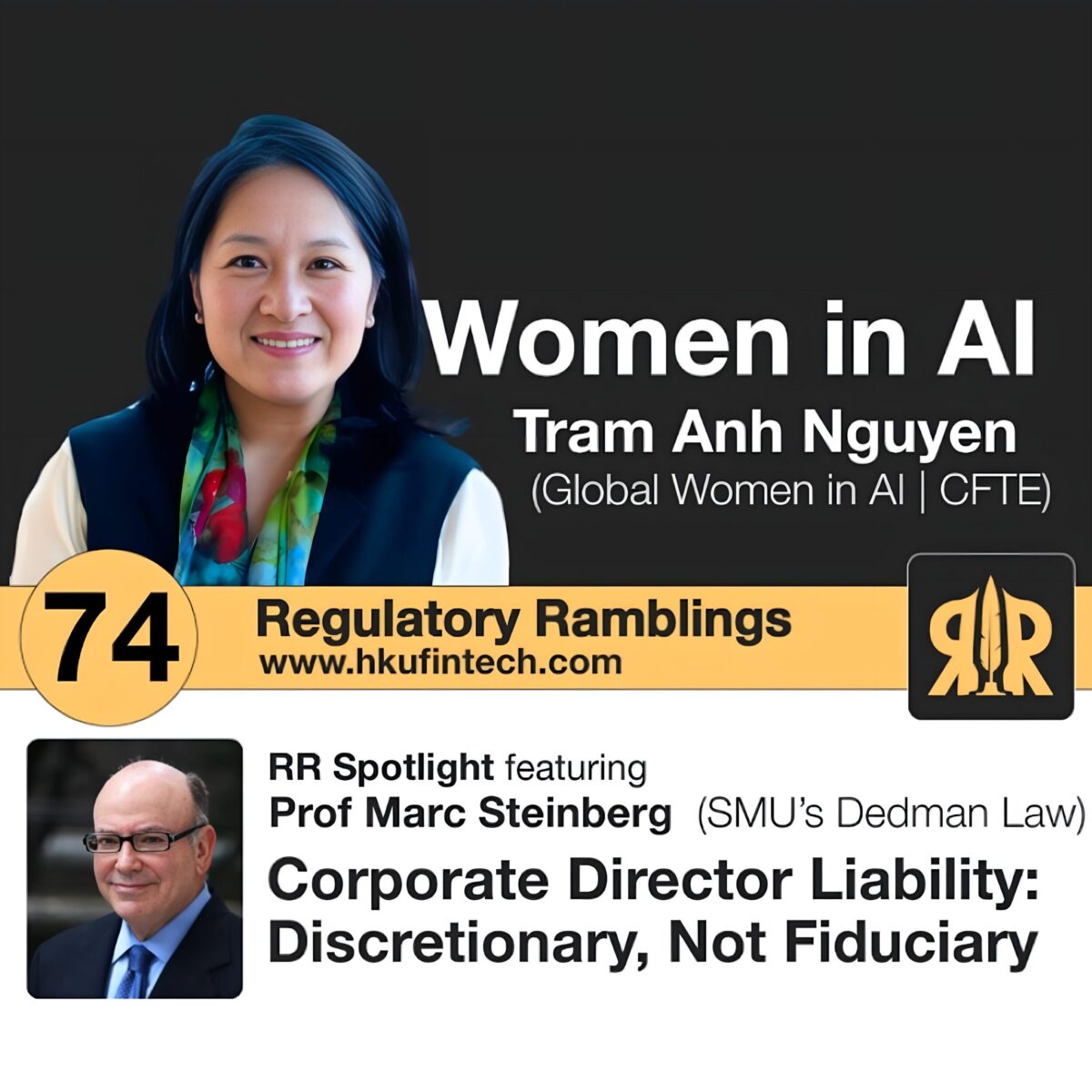
In this episode, we feature two conversations exploring different frontiers of finance and technology.
In our opening Spotlight, we welcome back Marc Steinberg, professor at Southern Methodist University’s Dedman School of Law and a leading voice in securities and corporate law. His latest book, Corporate Director and Officer Liability: Discretionary, Not Fiduciary (Oxford University Press), challenges the long-standing view that corporate directors and officers should be labeled as “fiduciaries.” Steinberg examines why current liability standards — from the duty of care to the business judgment rule — are too lenient to support that label and why adopting “discretionary” as a neutral, accurate term could restore clarity and investor trust.
In the second segment, we speak with Tram Anh Nguyen, co-founder of the global digital finance education platform CFTE and Chairwoman of Global Women in AI (GWAI). She shares GWAI’s mission to close gender gaps in AI by equipping women across industries with technical knowledge, leadership skills, and mentorship. She discusses GWAI’s mission to empower women across industries to lead in AI innovation by building skills, networks, and visibility. Tram Anh emphasizes the importance of AI literacy, the barriers that hinder women from accessing AI-driven opportunities, and how GWAI facilitates connections among students, professionals, and policymakers to foster an inclusive ecosystem that shapes the future of technology.
Prof. Marc I. Steinberg is a leading expert and prodigious scholar in the field of US securities and corporate law. He is the Rupert and Lillian Radford Chair in Law and Professor of Law at SMU’s Dedman School of Law. He has served as a professor, fellow, or lectured at several other prominent universities, including HKU, the University of Cambridge, Oxford University, King’s College-University of London, Moscow State University, University of Sydney, UCLA, and the University of Pennsylvania.
Earlier in his career, he served as an attorney for the U.S. Securities and Exchange Commission (SEC) in its Division of Enforcement and Office of General Counsel. He has also been retained as an expert witness in several high-profile cases, including Enron, Martha Stewart, Mark Cuban, and the National Prescription Opioid Litigation.
Professor Steinberg is a prolific author of scholarship on US securities law, having authored approximately 150 law review articles and 50 books.
One of his recent books, Rethinking Securities Law (Oxford University Press, 2021), was awarded the Best Law Book in the United States category for 2021 by American Book Fest.
He is also editor-in-chief of The International Lawyer and The Securities Regulation Law Journal, in addition to being a member of The American Law Institute.
Tram Anh Nguyen is the chairwoman of the Global Women in AI (GWAI) group and co-founder of the London-headquartered Centre for Finance, Technology and Entrepreneurship (CFTE). GWAI is best thought of as a global community empowering women to shape the future of artificial intelligence. Its mission is to equip women across industries with the skills, networks, and visibility they need to thrive in an AI-driven world.
From aspiring professionals to seasoned leaders, the GWAI connects a diverse network of innovators, learners, and changemakers. The group offers hands-on learning experiences, leadership development, mentorship opportunities, and access to global forums—all to empower women to lead with purpose, power, and passion.
Before launching the CFTE in 2017, she had spent nearly two decades with Standard Chartered Bank in New York and Dresdner Kleinwort and UBS Wealth Management in London, advising ultra-high-net-worth clients and family offices. A recognized voice when it comes to the ‘future of work,’ Tram Anh partners with governments, central banks, and tier-one institutions worldwide to deliver large-scale reskilling programs.
She has also co-authored the world’s largest Fintech Job Report. As the founder of the Future Skills Forum, under her leadership, the forum has positioned itself as a global convener of thought leaders, policymakers, educators, and industry innovators to drive forward the agenda of human capital transformation in the age of artificial intelligence.
A champion of lifelong learning in digital finance, Tram Anh works closely with governments, regulators, and financial institutions to build future-ready workforces.
She leads initiatives that bring industry and public sector stakeholders together to design large-scale education strategies, develop forward-looking curricula, and ensure the financial sector is equipped to thrive in an AI-driven economy. Under her leadership, CFTE has expanded its global impact, educating over 260,000 alumni in more than 130 countries and collaborating with over 1,000 industry experts to accelerate the transformation of finance through education.
Discussion:
The conversation begins with some background information on Prof. Steinberg’s book. As he puts it, “For centuries, directors and officers have been identified as fiduciaries, bearing a legal and ethical duty to act in the best interests of those they represent. However, the liability standards that ordinarily exist are too lenient to be characterized as fiduciary. This misrepresentation is detrimental to the rule of law, contravenes reasonable investor expectations, and impairs the integrity of the financial markets.”
Therefore, his book, Corporate Director and Officer Liability—‘Discretionaries’ Not Fiduciaries, argues for removing a fiduciary status for corporate directors and officers, instead favoring adoption of a new, more accurate term: “Corporate directors and officers are, instead, ‘discretionaries.’” Such a term, he says, more accurately portrays the status of corporate directors and officers who are held to varying standards of liability depending on the applicable facts and circumstances.”
With such a new model in mind, “the book addresses a wide range of key issues, including the duty of care, the business judgment rule, exculpation statutes, the duty of good faith, interested director transactions, derivative litigation, mergers and acquisitions, and closely held corporations.”
A thought-provoking addition to the field, Prof. Steinberg’s book provides an alternative framework that enhances corporate governance standards while protecting corporate fiduciaries from undue liability exposure.
He shares with Regulatory Ramblings host Ajay Shamdasani what prompted him to write such a book on the topic now, as well as why it is essential to reframe the role of corporate directors and officers as “discretionaries” rather than “fiduciaries,” and what purpose it serves. As Prof. Steinberg acknowledges, it will change the legal analysis and consequently, the responsibilities and liabilities of the parties concerned. He also comments on what he believes his treatise adds to the preexisting scholarship on the matter.
Following that, we chat with Tram Anh about her background and her rationale for creating the GWAI—especially when similar such bodies already seem to exist.
Looking ahead, she sees GWAI going far and believes its best days are yet to come. As she put it, GWAI is where inspiration meets action—creating pathways for women to lead in AI, together.
From its inception, CFTE has been concerned about inclusive education—that those who want to master the vital technologies of tomorrow should be able to do so without fearing the barriers of cost, class, or their current educational, professional, or social standing. Tram Anh said that GWAI’s creation was part of a larger, longer-term goal; the same motivation that compelled her and her partner and co-founder, Huy Nguyen Trieu.
Indeed, Tram Anh believes the CFTE has come a long way, with offices on multiple continents and numerous groups and individuals receptive to its mission of democratizing the learning of fintech and related topics.
Ultimately, she believes that more needs to be done to encourage women to enter STEM fields, enabling them to contribute to the development of AI and Web3.
Regulatory Ramblings podcasts is brought to you by The University of Hong Kong – Reg/Tech Lab, HKU-SCF Fintech Academy, Asia Global Institute, and HKU-edX Professional Certificate in Fintech, with support from the HKU Faculty of Law.
Yesterday, I began a two-part review of the article “What Is a Designed Intelligence Environment?” in which authors Michael Schrage and David Kiron examine how enterprises must rethink their intelligence and compliance strategies to survive and thrive in the new world of AI-rich operations. I found their insights for compliance professionals both practical and transformative. Previously, we considered what is Designed Intelligence. Tomorrow, we take a deeper dive into what it means for compliance.
For decades, we have approached compliance through policies, procedures, and periodic reviews, trusting that careful planning and diligent oversight would guide us through the challenges of regulatory change and operational risk. However, the rise of artificial intelligence has forever altered this equation. Now, the decisions that shape our organizations are made not just by people, but by increasingly autonomous machines and systems that learn, adapt, and interact in ways that can outpace human comprehension.
This new reality demands a new approach to compliance, one that goes beyond enforcing existing rules and begins to architect the very environments in which human and machine intelligence operate. The article “What Is a Designed Intelligence Environment? ” offers a timely and robust framework for this challenge. Rather than treat AI as just another tool in the compliance toolbox, it urges us to rethink how knowledge, reasoning, and governance are structured across the enterprise. For the compliance professional, this shift is as profound as it is practical: our mission is no longer to control risk but to orchestrate intelligence itself.
Five Key Takeaways for the Compliance Professional
1. Observability Over Prediction: Embrace Real-Time Monitoring
Traditional compliance programs often rely on the classic cycle of predict, plan, execute, and measure. However, as the article emphasizes, Stephen Wolfram’s principle of computational irreducibility suggests that in highly complex, AI-rich environments, outcomes cannot be predicted; they must be observed as they occur. This is not a theoretical point; rather, it is a practical call to action for compliance.
In a world where both human and machine agents make critical decisions, compliance leaders need to build systems that provide real-time visibility into these interactions. The case of the pharmaceutical R&D pipeline illustrates this vividly: instead of forcing premature rankings of drug candidates, the company built a computational observatory, allowing emergent patterns to drive decision-making. For compliance, this means investing in tools and processes that enable continuous monitoring, immediate detection of anomalies, and dynamic feedback loops, moving from static after-the-fact audits to active, ongoing oversight.
2. Semantic Formalization: Make Compliance Computable
If your compliance program still relies on lengthy policy manuals and inconsistent training, it’s time to elevate it. The article introduces the concept of semantic formalization, defining key business and compliance concepts in a manner that enables both humans and machines to execute and reason with them. This isn’t just data management; it’s about ensuring every stakeholder and system shares a common, computable language for compliance.
For example, a multinational retailer struggling with customer experience (CX) consistency turned things around by building a semantic kernel, a shared ontology for complaints, resolutions, and metrics. Compliance teams must similarly formalize definitions for key terms, including risk, conflict of interest, and reporting obligations. This creates a foundation where both human and AI agents can interpret and act on compliance requirements, ensuring consistency, auditability, and scalability.
3. Translate Between Multiple Realities
Every department, human expert, and AI system in your organization “computes” reality differently. Financial models assess risk through simulations, operations utilize failure analysis, and AI identifies statistical correlations. The article’s exploration of real space, the idea that these are not just different perspectives but fundamentally different computational rule sets, changes the compliance game.
Instead of forcing alignment through top-down mandates, compliance officers must become expert translators and orchestrators of change. The aerospace design review case proves the point: rather than punishing disagreement between engineers and AI, leadership created a real mediator, mapping and reconciling the underlying rules of each party. Compliance professionals should develop frameworks and protocols to make these internal logics explicit, resolve conflicts, and coordinate decision-making without imposing artificial consensus.
4. Do Not Simply Deploy Smarter Tools, But Architect Intelligence Environments
Throwing advanced AI or analytics at compliance problems is not enough. The article argues forcefully that intelligence, whether human or machine, must be designed into the very infrastructure of the enterprise. Most organizations still treat intelligence as an emergent property of tools, rather than an intentional product of environment design.
For compliance, this means working proactively with IT, legal, and operational leaders to design systems where intelligence (learning, reasoning, and adaptation) is orchestrated by default. Real-time observability, semantic formalization, and rule-based mediation must be built into the core of your compliance framework, not added as afterthoughts. This approach enables faster, higher-quality decisions, reduces systemic risk, and enhances organizational agility.
5. From Enforcer to Orchestrator: Redefine the Compliance Role
The most important takeaway is the redefinition of what it means to be a compliance professional in the era of AI. The future of compliance is not just about enforcing standards and conducting audits; it is about orchestrating intelligence across human and machine systems. This means guiding the translation between different rules and perspectives, architecting environments for safe collaboration, and ensuring ethical execution in a world of real-time, adaptive agents.
Compliance officers must expand their skill sets by learning the basics of AI, systems engineering, and data science, developing fluency in semantic modeling, and building cross-functional relationships with technology and business leaders. By leading the design of intelligence environments, compliance professionals can become strategic partners in innovation, not just gatekeepers of risk.
As we enter a new era defined by AI, the compliance profession finds itself at a crossroads. The systems we govern are no longer straightforward, linear, or purely human—they are dynamic, adaptive, and built from the collaboration between people and machines. The article “What Is a Designed Intelligence Environment? ” makes clear that our old tools—checklists, policy manuals, and after-the-fact audits—are no longer sufficient for the task ahead. Instead, we must build environments where intelligence itself is orchestrated, monitored, and governed by design.
This transformation is not about abandoning the core values of compliance, integrity, transparency, and accountability; it is about embracing new methods to uphold them in a complex world. We must shift from prediction to observability, from description to formalization, and from enforcement to orchestration. We must learn to translate and mediate between diverse ways of thinking and design infrastructures that enable human and machine intelligence to flourish safely and ethically.
Welcome to “Compliance Tip of the Day,” the podcast where we bring you daily insights and practical advice on navigating the ever-evolving landscape of compliance and regulatory requirements. Whether you’re a seasoned compliance professional or just starting your journey, our aim is to provide you with bite-sized, actionable tips to help you stay on top of your compliance game. Join us as we explore the latest industry trends, share best practices, and demystify complex compliance issues to keep your organization on the right side of the law. Tune in daily for your dose of compliance wisdom, and let’s make compliance a little less daunting, one tip at a time.
Today we consider how enterprises must rethink their compliance strategies to survive and thrive in the new world of AI-rich operations.
For more on this topic, check out The Compliance Handbook, a Guide to Operationalizing your Compliance Program, 6th edition which was recently released by LexisNexis. It is available here.





 Prof. Marc I. Steinberg is a leading expert and prodigious scholar in the field of US securities and corporate law. He is the Rupert and Lillian Radford Chair in Law and Professor of Law at SMU’s Dedman School of Law. He has served as a professor, fellow, or lectured at several other prominent universities, including HKU, the University of Cambridge, Oxford University, King’s College-University of London, Moscow State University, University of Sydney, UCLA, and the University of Pennsylvania.
 Tram Anh Nguyen is the chairwoman of the Global Women in AI (GWAI) group and co-founder of the London-headquartered Centre for Finance, Technology and Entrepreneurship (CFTE). GWAI is best thought of as a global community empowering women to shape the future of artificial intelligence. Its mission is to equip women across industries with the skills, networks, and visibility they need to thrive in an AI-driven world.