Categories
Compliance Into the Weeds

Compliance into the Weeds: Amex AML Enforcement: Credit Card Risk, SAR Failures, and Board Accountability

The award-winning Compliance into the Weeds is the only weekly podcast that takes a deep dive into compliance topics, literally going into the weeds. Looking for hard-hitting compliance insights? Look no further than Compliance into the Weeds! In this episode of Compliance into the Weeds, Tom Fox and Matt Kelly discuss the recent OCC and Federal Reserve enforcement actions against American Express.

The penalties included a $350 million civil penalty, cease-and-desist orders, and extensive compliance obligations tied to weaknesses in customer due diligence, suspicious activity reporting, staffing, and risk assessment. Tom highlighted that Amex processed billions of transactions, many ordinary credit-card transactions, showing banks must know all customers, not just high-dollar activity, and noted regulators’ broader pattern of similar actions across the industry as financial innovation outpaced compliance investment.

Matt noted that regulators depend on SARs as critical inputs for broader enforcement “mosaics,” explaining why SAR failures draw intense scrutiny. The orders’ notable feature is direct board involvement, requiring a board-level compliance committee and action plan to hold management accountable, with a strong focus on end-to-end documentation and evidence trails; they see no facts suggesting the egregious, employee-involved criminality seen in TD Bank.

Key highlights:

  • Industry Pattern and Root Causes
  • Innovation as Compliance Risk
  • Board Oversight Mandates
  • Why SARs Matter
  • DOJ Risk and TD Bank Comparison
  • Disjointed Compliance and Fixes

Resources:

Tom in the FCPA Compliance Report, Part 1 and Part 2

Tom

Instagram

Facebook

YouTube

Twitter

LinkedIn

A multi-award-winning podcast, Compliance into the Weeds, was recently named one of the Top 25 Regulatory Compliance Podcasts, Top 10 Business Law Podcasts, and Top 12 Risk Management Podcasts. Compliance into the Weeds has been awarded a Davey, Communicator, and W3 Award, all for podcast excellence.

Categories
Blog

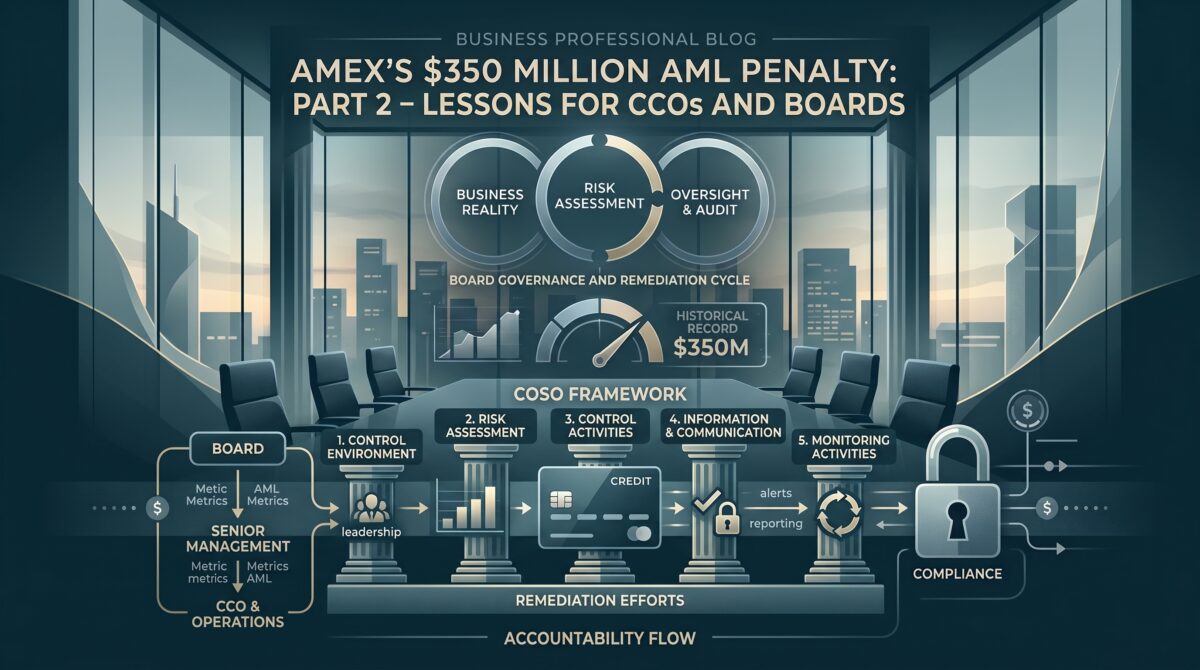
AMEX’s $350 Million AML Penalty: Part 2 – Lessons for CCOs and Boards

Paying a penalty and demonstrating an effective compliance program are different tasks. The AMEX enforcement actions make that distinction concrete.

In Part 1, we examined the OCC’s $350 million civil money penalty and findings concerning risk assessment, customer information, suspicious activity reporting, resources, training, and independent testing. The Federal Reserve’s Order focuses on enterprise-level change. Its starting point is board oversight.

For compliance professionals across industries, that is the opportunity: use the remediation requirements to challenge your own governance and controls. The orders bind the named entities. The broader applications below are recommendations, not claims that banking-specific obligations apply to every company.

Board oversight must produce accountable decisions

Within 90 days of the order’s effective date, AMEX’s board must submit a written oversight plan to the Federal Reserve. The plan must explain how directors will hold senior management accountable for remediation, ensure adequate resources, oversee an effective enterprise-wide BSA/AML compliance risk management program, and secure effective reporting and escalation. The board’s responsibilities expressly encompass remediation under both the Federal Reserve order and the OCC order.

Notice the allocation of responsibility. The board oversees. Senior management executes. Neither role should disappear into an instruction that “compliance will handle it.” For another company applying this lesson, I recommend that each material remediation item identify an accountable executive, responsible business owner, required resources, completion criteria, and independent reviewer. The CCO should help coordinate and challenge the work without becoming the default owner of every operational control.

COSO’s Internal Control–Integrated Framework provides a corresponding board-oversight benchmark. Under Principle 2, directors should independently oversee internal control development and performance. Translate that principle into board practice. Record the questions directors asked, the evidence management provided, resource decisions, and the follow-up required. A presentation should support an oversight decision, not substitute for one.

Make enterprise-wide compliance operational

The Federal Reserve requires AMEX to submit an acceptable plan within 90 days to improve enterprise-wide BSA/AML compliance risk management. Required content includes business-line and legal-entity policies, customer due diligence, cross-business-line suspicious activity reporting, and transaction-monitoring methodologies. Establish, analyze, test, and document monitoring rules and thresholds, paying attention to factors such as customer, product, or service, and geography.

That requirement suggests a practical exercise for any CCO: select a significant risk and trace how the organization treats it. Who collects the relevant information? Who assesses it? What triggers review? Which team investigates? When does senior management receive the issue? What reaches the board? But do not stop at the organization chart. The order calls for risk-based oversight of BSA/AML systems and the use of information from network partnerships, ATM partners, and third parties supporting compliance.

For a nonfinancial company, a comparable review could follow a high-risk distributor relationship from onboarding through orders, payments, exceptions, and termination. Test the handoffs, including information held by outside providers. The Federal Reserve also requires the travel-related services subsidiary to submit an acceptable Office of Foreign Assets Control (OFAC) compliance plan within 90 days. It must address risk assessment, ongoing job-appropriate training, and enhanced policies and screening procedures. This is a distinct sanctions-compliance remediation requirement; it should not be recast as a finding of a particular prohibited transaction.

Use COSO to examine the connections between controls

COSO organizes internal control around five components: control environment, risk assessment, control activities, information and communication, and monitoring activities. The framework emphasizes that these components must work together, not exist as separate administrative exercises. Applied to the AMEX findings, I recommend testing a connected chain of evidence.

Begin with the commercial activity and its risk assessment. Identify the resulting control, the person responsible, the information required, the escalation decision, and the independent test. Then examine what happens when one element fails. For example, don’t accept a customer-risk rating as useful just because a system has a completed field. Ask whether supporting information is reliable, whether the rating changes monitoring, and whether testing confirms that the resulting controls address the assessed risk.

COSO’s Principles 16 and 17 reinforce evaluating controls and promptly communicating deficiencies to those responsible for correction, including senior management and directors where appropriate. The practical point is to test relationships between controls, not merely their individual existence. Otherwise, management may demonstrate that every department completed its task without demonstrating that the overall risk was addressed.

Resource commitments need an operational explanation

The Federal Reserve requires the board to ensure senior management has adequate resources for required remediation. Make that discussion more useful than a comparison of this year’s compliance budget with last year’s. You should perform a capacity assessment for each critical control. Identify the workload, expertise, systems, quality-review capacity, and unresolved dependencies. Where management proposes automation, require evidence that the tool handles the relevant risk and that someone owns exceptions.

The DOJ’s 2024 ECCP provides a useful cross-check: evaluate program design, resources and authority, and effectiveness in practice. Its resource analysis should also examine personnel qualifications and compliance’s access to the board.

A board paper should therefore explain what a resource request will accomplish and what risk remains without it. Ask management to identify work that cannot be completed to the required standard, rather than presenting an unexplained staffing total.

Accountability must survive changes in personnel

Paragraph 4 of the Federal Reserve order deserves careful attention. Based on the firm’s investigative record compiled from 2024 to the order’s issuance, it prohibits the firm from directly or indirectly retaining individuals who meet all three specified conditions: participation in the underlying misconduct, formal disciplinary action connected to it, and separation or legal termination connected to that misconduct. The restriction covers retention as an officer, employee, agent, consultant, or contractor within the firm or its subsidiaries or affiliates.

This is not a blanket prohibition covering everyone who was investigated. The conditions are cumulative. The order also requires continued cooperation and substantial assistance with Federal Reserve investigations of parties affiliated with the involved institution.

For other CCOs, the lesson is to connect substantiated investigation outcomes with hiring, contracting, and vendor controls. Subject to applicable employment and privacy requirements, test whether a person excluded through one channel could return through another. Require documented review rather than allowing a change in job title or engagement structure to bypass accountability.

Remediation requires evidence, not just a timetable

The Federal Reserve requires implementation timelines with specific component deadlines. Approved plans must be adopted within ten days of approval and then promptly implemented. Amendments or rescissions require prior approval from the Reserve Bank. Board or authorized committee progress reports are due within 45 days after the end of the first full calendar quarter following the order and each quarter thereafter, addressing actions, schedules, and results. The 90-day submissions are plan deadlines, not requirements to complete every remediation measure within 90 days. For your program, distinguish a completed task from a corrected risk. A revised procedure is a deliverable. Evidence that employees apply it correctly is a different milestone.

The ECCP similarly examines root-cause analysis, control testing, lessons learned, and whether improvements can prevent or detect similar misconduct. The ECCP asks, “What methodology has the company used to identify, analyze, and address the particular risks it faces? What features of the company reduce its exposure to such risks? Is the company’s approach to risk management proactive or reactive? What information has the company identified and collected to help detect the type of misconduct in question? How has that information informed the company’s compliance program?” Use those questions to challenge proposed closure evidence.

The bottom line is that you must demonstrate implementation and an appropriately independent reviewer to evaluate operating effectiveness. Define the testing period, evidence, and acceptable results before the item is marked complete.

CCO actions and board questions

  • For the CCO: build one end-to-end evidence trail. Select a material risk and connect the assessment, controls, information, decisions, escalation, testing, and corrective action. Identify exactly where evidence is missing.
  • For the board: challenge ownership and capability. Which executive owns the unresolved risk? What resources are missing? What decision does management need from directors now?
  • For both: define success before declaring completion. What independent evidence supports closure? Have the underlying causes been addressed? What would alert us that the problem has returned?

Summary

The bottom line is that a compliance program must reflect the business’s actual risks and demonstrate that its controls work. The OCC’s central finding was a mismatch between the bank’s risk assessment and its operations: the assessment emphasized relatively narrow deposit activities while inadequately addressing dominant credit and charge card products. Weak customer identification, due diligence, suspicious activity reporting, independent testing, staffing, and job-specific training compounded that failure.

AMEX processed about $13 billion in suspected trade-based money laundering activity between June 2014 and May 2025 without timely identifying and reporting its full scope. It carefully distinguishes those findings from a conclusion that AMEX itself laundered that amount. The broader lesson is that completing assessments, filing reports, and delivering training do not, by themselves, establish program effectiveness.

We next considered the shift from compliance failures to governance and remediation, emphasizing that directors must oversee the work while senior management remains accountable for execution. Remediation should have identifiable executive and business owners, adequate resources, clear completion criteria, and independent review, rather than becoming an undefined assignment for the compliance department.

Drawing on COSO’s Internal Control Framework and the DOJ’s Evaluation of Corporate Compliance Programs, we reviewed how risk assessments, controls, information, escalation, and monitoring work together, and whether personnel and systems can perform the required work. The practical message for CCOs and boards is to distinguish a completed task from a corrected risk: a revised procedure is not proof of effective remediation. Leaders should require evidence that underlying causes have been addressed, controls operate effectively, and recurring problems will be detected. Risk alignment, accountability, and demonstrated effectiveness must become part of how the business is governed.

Categories
Blog

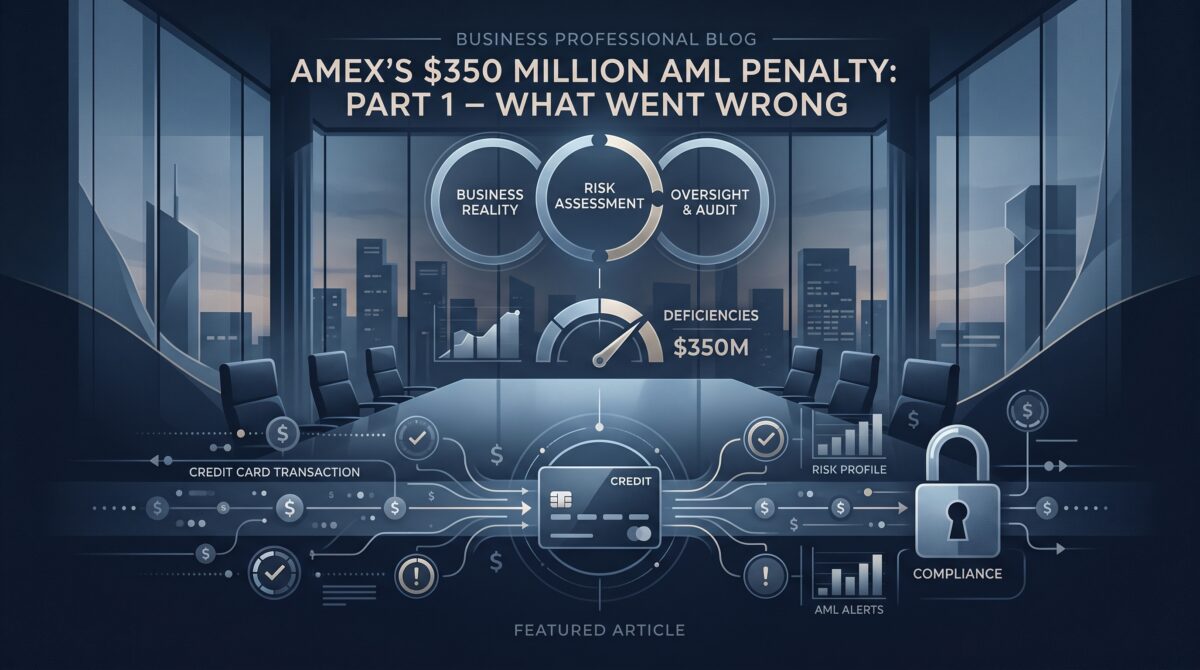
AMEX’s $350 Million AML Penalty: Part 1 – What Went Wrong

A compliance risk assessment should describe the business the company actually conducts. What happens when it does not?

The AMEX enforcement actions provide a consequential answer. On October 8, 2026, the Office of the Comptroller of the Currency (OCC) announced a $350 million civil monetary penalty (OCC Penalty) and a cease-and-desist order(OCC Order) against American Express Company and American Express Travel Related Services Company, Inc. (collectively, AMEX) for Bank Secrecy Act and anti-money laundering deficiencies. The Federal Reserve separately issued a cease-and-desist order (FED Order) against AMEX. The OCC Press Release noted that the monetary penalty was imposed by the OCC, not both agencies.

For Chief Compliance Officers, directors, counsel, and internal auditors, the central lesson extends beyond banking: a compliance program must reflect the business’s actual risks, and oversight must demand evidence that it works. Over the next couple of blog posts, we will explore the Orders and Penalties. Today, we’ll start with what went wrong at AMEX.

What the enforcement record establishes

The OCC found violations involving the BSA/AML program, suspicious activity reporting, customer due diligence, and customer identification. According to the OCC Order, from approximately June 2014 through May 2025, the bank processed approximately $13 billion in suspected trade-based money laundering activity. That figure includes suspicious card charges and associated repayments. In some cases, the activity passed through accounts linked to bank insiders. The bank periodically reported suspicious activity but lacked the controls and monitoring capabilities to identify and report its full scope promptly.

Precision matters. The $13 billion figure does not mean AMEX laundered that amount, nor should it be described as $13 billion in distinct criminal proceeds. The findings concern suspected activity and failures in detection, evaluation, and reporting. The reference to insider-associated accounts also does not establish that every associated individual knowingly participated in misconduct.

The risk assessment did not match the business

The OCC’s most instructive finding concerns the program’s starting point. The bank’s risk assessment focused on its relatively narrow demand deposit products and services while giving insufficient attention to its more dominant credit and charge card products. This was a mismatch between the business being conducted and the risks being assessed.

For a CCO, the question should be immediate: does our assessment accurately represent how our company generates revenue, moves money, serves customers, and uses intermediaries?

The DOJ’s 2024 Evaluation of Corporate Compliance Programs (ECCP) begins its risk-assessment analysis by understanding the company’s business and examining how compliance scrutiny and resources address its risks. The ECCP asks “how the company has identified, assessed, and defined its risk profile, including specific factors that mitigate the company’s risk, and the degree to which the program devotes appropriate scrutiny and resources to the remaining spectrum of risks.” That provides a useful comparison here, not an additional finding against AMEX or the legal basis for these orders.

Consider a hypothetical manufacturer that rigorously reviews employee expenses but inadequately evaluates high-risk distributor payments. The expense controls may function exactly as designed. They still do not answer the more consequential risk question. The lesson is that the largest business line does not always present the greatest compliance risk. Management should demonstrate a defensible relationship between business activities, assessed risks, and control coverage. Completing an assessment is not the same as assessing the right business.

Customer information failures undermined monitoring

The OCC identified weaknesses in two distinct functions. Customer identification procedures did not adequately support a reasonable belief that the bank knew each customer’s true identity. Ongoing customer due diligence did not effectively establish the nature and purpose of customer relationships, undermining risk ratings and monitoring. Read together, these findings describe more than incomplete onboarding files. They connect customer knowledge to the ability to recognize transactions that warrant further investigation.

For businesses outside banking, the useful analogy is the difference between collecting a distributor’s documents and understanding what the distributor actually does. Who is involved? What commercial purpose does the relationship serve? What activity would fall outside that purpose?

The OCC also found systemic breakdowns in suspicious activity monitoring, investigation, and reporting, resulting in late, missed, or incomplete suspicious activity reports (SARs). Those failures extended beyond suspected trade-based money laundering to other suspicious activity. Importantly, the bank did file some reports. The OCC criticized the bank for failing to promptly identify and report the full scope of the activity.

That distinction should change how a compliance committee evaluates performance. Ask what the reporting process covered, what it missed, and how those conclusions were tested. A report count alone does not establish the answer. The same challenge should be applied to investigation totals, due diligence completions, and training statistics.

Audit, resources, and training did not provide effective safeguards

The OCC found that the internal audit did not effectively monitor BSA/AML compliance. Independent testing was neither appropriately scoped nor effective relative to the bank’s risk profile, contributing to delayed detection and remediation of deficiencies. The key takeaway is that an audit plan should challenge the compliance program’s assumptions, not simply confirm that documented procedures were followed. Testing a process against an incomplete view of risk can leave the underlying problem untouched.

The findings also addressed staffing and capability. Historically, the bank has not supported its BSA/AML program with appropriate resources, including personnel with the necessary skills, expertise, and training. Employee training did not adequately address job-specific responsibilities, impairing identification, escalation, and reporting of risks and suspicious activity.

For compliance leadership, those findings support a practical distinction: headcount, competence, and operational capacity should be assessed separately. Hiring more people should not substitute for determining which expertise a control requires.

Likewise, training should be evaluated against decisions employees must make. Can an investigator recognize a relevant pattern? Can an account manager identify a concern and route it correctly? Can a director challenge an explanation of control effectiveness? These are better questions to bring to the next program review than whether everyone completed the assigned course.

The Federal Reserve extended the concern to the enterprise

The FED Order identified significant deficiencies in the enterprise-wide financial crimes risk management program, including transaction monitoring, fraud referral processes, third-party risk assessment, and financial crimes risk management. Its order directs the AMEX board to address management accountability, remediation resources, program effectiveness, and reporting and escalation.

The broader governance lesson is not that the compliance department alone must work harder. Management responsibilities and board information should be examined alongside the technical controls. A remediation plan should identify who must act, what resources are required, and how directors will know whether the action worked.

AMEX’s public response

In its October 8 public statement, AMEX said internal and external reviews identified areas for improvement. It described investments in people, technology, training, governance, and oversight, as well as cooperation with regulators and law enforcement. Chairman and Chief Executive Officer Stephen J. Squeri stated, “While we have made meaningful progress, we know there is more work to do.”

The company also said the penalty would not affect full-year 2026 guidance, that the orders imposed no asset cap, and that anticipated remediation costs would not affect 2027 guidance. These are company statements, including forward-looking expectations, not regulatory findings about remediation effectiveness. The Federal Reserve separately acknowledged cooperation and remedial actions already undertaken. Progress deserves recognition, but corrective work should not be confused with demonstrated completion.

Three practical takeaways

  1. Start with business reality. Compare the risk assessment with actual products, transaction flows, customer relationships, and third-party arrangements. Require explanations for significant gaps in coverage.
  2. Challenge evidence of effectiveness. Ask the internal audit to test whether controls identify the risks that matter, not merely whether staff follow procedures. Examine decision quality and timeliness alongside activity counts.
  3. Make capability a governance discussion. Bring the board a clear account of required expertise, unresolved resource constraints, and the risks those constraints leave exposed.

The question for the next board meeting is straightforward: What evidence demonstrates that our compliance program addresses the business we actually operate?

Join us tomorrow, in Part 2, as we examine how the Federal Reserve’s remediation requirements can help CCOs and directors turn that question into accountable action.