Categories
Regulatory Ramblings

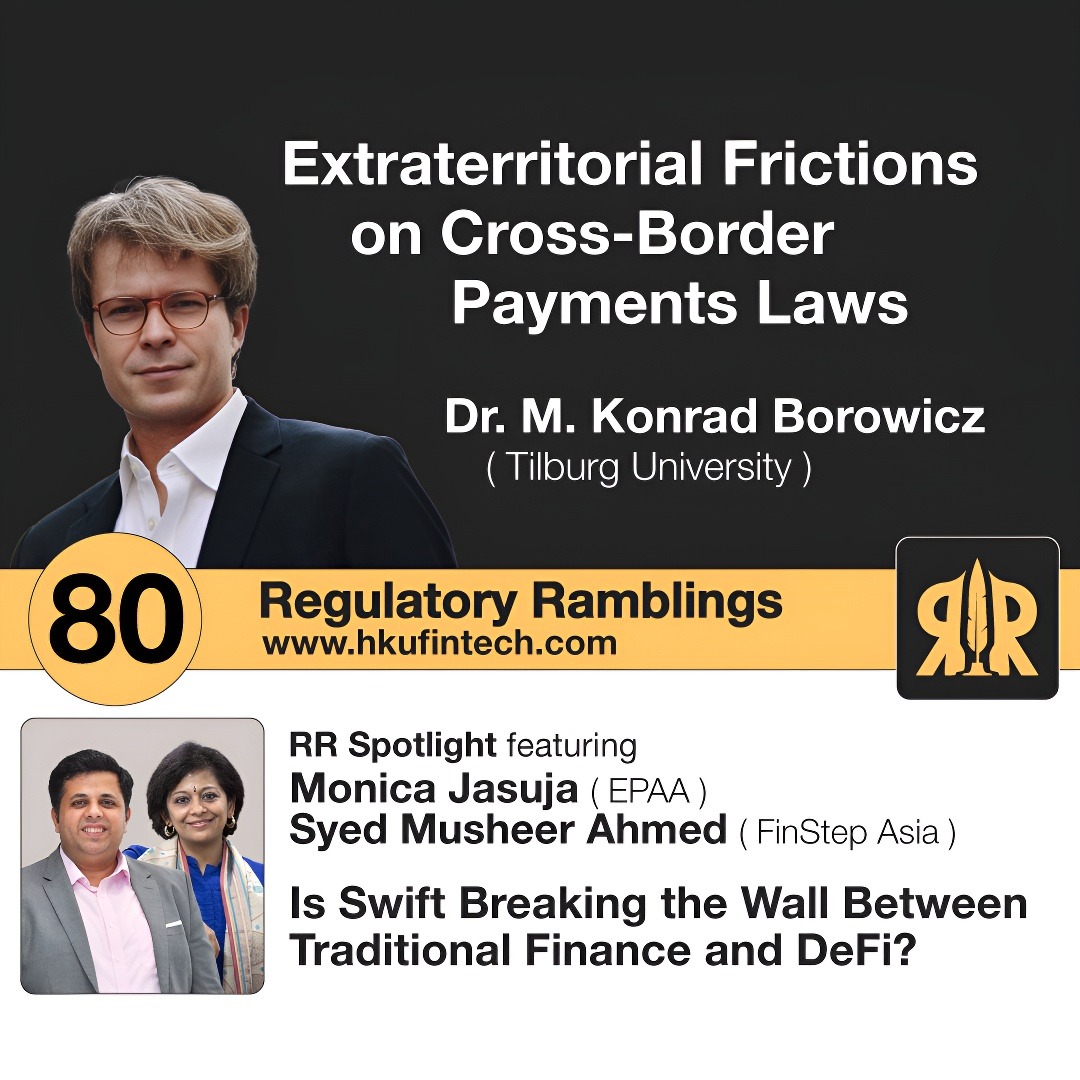
Regulatory Ramblings: Episode 80 – Extraterritorial Frictions on Cross-Border Payments Laws // Spotlight on: Does Swift’s Recent Decision to Embrace the Blockchain Mean There’s No Barrier Between Traditional Finance and Decentralized Finance (DeFi)?

Today’s podcast commences with a brief discussion with Syed Musheer Ahmed of FinStep Asia and Monica Jasuja of the Emerging Payments Association on a recent LinkedIn post1 of Musheer’s stating that the lines between traditional finance and decentralized finance, or DeFi, have not just blurred but have merged thanks to SWIFT’s announcement at its annual conference in late-September that it will add a Blockchain based ledger to its infrastructure stack to hasten and scale the benefits of across over 200 countries and territories worldwide.

Following that, we chat with finance and technology lawyer M. Konrad Borowicz, an assistant professor at Tilburg Institute for Law, Technology and Society in the Netherlands, about a paper he recently presented entitled “Extraterritorial Frictions in the Law of Cross-Border Payments”2 at the European Central Bank’s Legal Research Program seminar in Frankfurt.

Please see the links in the footnotes.

Biography:

Syed Musheer Ahmed has over 18 years of extensive experience as an ecosystem builder in the realms of capital markets, fintech, and virtual assets. This includes a decade as a global markets trader before he came to Hong Kong to attain his MBA from the University of Hong Kong and London Business School’s joint program.

Since 2016, Musheer has contributed extensively to building the region’s fintech and virtual assets ecosystem, particularly as the co-founder, concurrent board member, and inaugural general manager of the Fintech Association of Hong Kong.

For almost five years, he has been the managing director of FinStep Asia, a firm that he founded. In the interim, from October 2022 until January 2024, he served as a financial markets risk assurance lead with the Virtual Assets Regulatory Authority in Dubai.

Monica Jasuja is the chief expansion & innovation officer of the Emerging Payments Association Asia, and is the advisory board chair of the India-based Fintech Fusion. She is a veteran digital business executive with over two decades of global experience in strategizing, defining, leading, building, and deploying commercially viable innovative software products and solutions, primarily in financial services.

She has a passion for solving consumer problems in the areas of digital payments and consumer products. She says that continuously learning to help businesses grow and disrupt is “both my strength and a key driver.”

Monica is also an accomplished product leader, having managed multi-year strategic initiatives across the fields of design, development, deployment, and go-to-market (primarily for the financial services sector). She has ample international exposure in markets such as the US, Singapore, Taiwan, and India.

Since 2017, she has spearheaded a new vertical for large digital players and emerging fintech initiatives across sales, business development, product, and other cross-functional areas (legal, marketing, and policy) to create new revenue and expansion opportunities for payment rails across India.

M. Konrad Borowicz is a finance and technology lawyer whose research focuses on the regulation of credit, payments, and open data. Currently, he is an assistant professor at Tilburg Institute for Law, Technology and Society in the Netherlands, and a research coordinator at the Tilburg Law and Economics Center.

He has held visiting research and teaching positions at HKU, FGV São Paulo in Brazil, and Nova University in Lisbon, Portugal. Konrad’s work has appeared in the Journal of Financial Regulation, Capital Markets Law Journal, and the New York University Journal of Law and Business, among other publications. He is currently developing a book on EU Payments Law and Regulation, together with Emanuel van Praag, for Oxford University Press. Before coming to academia, Konrad was a finance lawyer at Ropes & Gray in London.

Discussion:

Why does the Swift organization’s action matter? The Swift network is used by over 11,500 financial institutions in more than 220 countries, making it the backbone of international finance. Essentially, every corner of the world: “It facilitates the transfer of value between banks globally underpinned by its messaging service, and roughly every three days, the world’s GDP passes over their network.”

Suppose a bank or financial institution already has SWIFT rails. In that case, they are likely to continue to leverage this TradFi institution – usually owned and run by the banks as a collective – to underpin their tokenized finance initiatives.”

Swift and a group of more than 30 financial institutions globally will develop a shared digital ledger, with the initial focus on real-time 24/7 cross-border payments. Specifically, Swift will work with Consensys (founded by the Cofounder of Ethereum) on a conceptual prototype of the ledger, which will leverage Swift’s unmatched resiliency, security, and scalability to facilitate transactions using any form of regulated tokenized value.

The initiative will see Swift partner up with Bank of America, Citigroup, NatWest, and others to develop a shared digital ledger for tokenized assets, including stablecoins.

It will combine straight-through processing and value+messaging capabilities on a single platform that every major bank uses.

The conversation starts with Musheer and Monica explaining why they believe the lines between TradFi and DeFi no longer hold the same significance. They also talk about the stablecoin implications of Swift building its own blockchain to enable transactions between banks worldwide, with HKU’s Regulatory Ramblings host Ajay Shamdasani.

Critics have dismissed correspondent banking as slow and outdated while praising stablecoins as faster and superior. But that narrative shifts the moment Swift brings blockchain into its rails, leading to improvement.

Separately, building on earlier pilots, Swift will also add the capability to support interoperability across existing and emerging systems for various use cases. “Developments are part of Swift’s strategy to power a best-in-class experience through innovation on parallel tracks – upgrading existing rails while creating future digital rails to maximize infrastructure choice for the industry.”

Monica and Musheer then share their thoughts on whether this can unlock interoperable tokenized bank deposits alongside other tokenized assets on SWIFT’s ledger. It is an open question as to whether the impact on global payments will be transformational or just a modification.

We then turn to Konrad to discuss his recently written paper. It is currently under review at Law and Geoeconomics and is closely related to the work done by HKU Law’s very own—and Regulatory Ramblings’ team leader—Prof. Douglas Arner—on the regionalization of payment systems.

Konrad’s paper discusses the extraterritorial frictions arising when policymakers seek to reconcile the payment systems of different countries. The main areas of friction are settlement finality, data protection, AML, and governance. In the paper, he proposes several institutional reforms aimed at reducing those frictions, namely – a model law on cross-border payment finality, narrowly tailored safe harbors for data sharing and an international payments forum under the auspices of august global bodies such as the Bank of International Settlements or the Financial Stability Board, though, as Ajay asks him: “Given that the BIS and FSB are legacy organizations that are slow to change, is that likely or prudent?”

The abstract to Konrad’s paper reads: “In 2020, the G20 placed cross-border payments at the top of the global financial agenda, spurring experiments to make transfers faster, cheaper, and more inclusive. Many build on instant or fast payment systems (FPS), yet linking infrastructures is as much a legal and geopolitical challenge as a technological one. When systems interconnect, they project domestic law across borders, generating extraterritorial frictions and giving rise to sovereignty concerns. This article compares three models of FPS interlinking—bilateral links, multilateral hubs, and direct access arrangements—showing how each produces frictions around settlement finality, AML/CFT and sanctions compliance, data protection, and governance. It then considers various policy proposals aimed at reducing these frictions, such as prefunding of accounts and the use of privacy-enhancing technologies. The analysis shows that technical fixes cannot resolve the structural frictions of cross-border payments, supporting the view that payment infrastructures embody sovereignty and that integration will likely proceed through regional blocs rather than a single global framework.”

He shares with Ajay why he chose to write his article now and what he thinks it adds to the existing literature on payments. Konrad elaborates on the three interlinking models of FPS — bilateral links, multilateral hubs, and direct access arrangements — delineated in his piece. He discusses how each produces frictions around settlement finality, AML/CFT and sanctions compliance, data protection, and governance.

Konrad acknowledges there are drawbacks to the multilateral model. That harmonization of law is often impeded because everyone must agree to the rules, which sometimes come up against rigid notions of sovereignty and regulatory ‘turf wars’ for some countries.

He concludes by saying that regional payment blocks will likely define the future, and how these different blocks interact will be key as regional payment infrastructures continue to improve.

“Regional payment blocks seem to be a way to circumvent sanctions, which are geopolitical weapons,” Konrad says. “That is why regional blocks will emerge, [because] people will disagree on what will be sanctioned. Ultimately, it is a political question, not a technical fix.”

Regulatory Ramblings podcasts is brought to you by The University of Hong Kong – Reg/Tech Lab, HKU-SCF Fintech Academy, Asia Global Institute, and HKU-edX Professional Certificate in Fintech, with support from the HKU Faculty of Law.

Useful links in this episode:

You might also be interested in:

Connect with RR Podcast at:

LinkedIn: https://hk.linkedin.com/company/hkufintech 
Facebook: https://www.facebook.com/hkufintech.fb/
Instagram: https://www.instagram.com/hkufintech/ 
Twitter: https://twitter.com/HKUFinTech 
Threads: https://www.threads.net/@hkufintech
Website: https://www.hkufintech.com/regulatoryramblings 

Connect with the Compliance Podcast Network at:

LinkedIn: https://www.linkedin.com/company/compliance-podcast-network/
Facebook: https://www.facebook.com/compliancepodcastnetwork/
YouTube: https://www.youtube.com/@CompliancePodcastNetwork
Twitter: https://twitter.com/tfoxlaw
Instagram: https://www.instagram.com/voiceofcompliance/
Website: https://compliancepodcastnetwork.net

Categories
Compliance Tip of the Day

Compliance Tip of the Day – Use of Blockchain in Compliance

Welcome to “Compliance Tip of the Day,” the podcast where we bring you daily insights and practical advice on navigating the ever-evolving landscape of compliance and regulatory requirements. Whether you’re a seasoned compliance professional or just starting your journey, we aim to provide bite-sized, actionable tips to help you stay on top of your compliance game. Join us as we explore the latest industry trends, share best practices, and demystify complex compliance issues to keep your organization on the right side of the law. Tune in daily for your dose of compliance wisdom, and let’s make compliance a little less daunting, one tip at a time.

Today, we examine how blockchain can revolutionize compliance in various ways, from payments to third parties to contracts.

Categories
Compliance Tip of the Day

Compliance Tip of the Day – Decentralized Compliance with Blockchain Technology

Welcome to “Compliance Tip of the Day,” the podcast where we bring you daily insights and practical advice on navigating the ever-evolving landscape of compliance and regulatory requirements. Whether you’re a seasoned compliance professional or just starting your journey, we aim to provide bite-sized, actionable tips to help you stay on top of your compliance game. Join us as we explore the latest industry trends, share best practices, and demystify complex compliance issues to keep your organization on the right side of the law. Tune in daily for your dose of compliance wisdom, and let’s make compliance a little less daunting, one tip at a time.

Today, we look at how blockchain can be a game-changer for compliance.

For more information on the Ethico Toolkit for Middle Managers, available at no charge, click here.

Categories
Blog

AI Game-Changing Compliance: Part 3 – Decentralized Compliance with Blockchain Technology

Last week, I looked at five things a Chief Compliance Officer (CCO) or compliance professional could do at little or no cost to ‘Up Their (Compliance) Game.’ I want to continue this theme this week but want to tackle it differently. I will look at five innovations for compliance professionals around Artificial Intelligence (AI). AI has moved from an emerging trend to a fundamental component of modern corporate compliance programs. Today, I want to examine how blockchain can be a game-changer for compliance.

Today, organizations leverage blockchain to enhance transparency, ensure data integrity, and strengthen regulatory adherence. While compliance professionals have historically relied on centralized data repositories and traditional audit methods, blockchain offers a decentralized, tamper-proof alternative that reshapes compliance monitoring. This innovation is crucial in industries where data security, fraud prevention, and ethical sourcing are non-negotiable.

Regulators are increasingly scrutinizing how businesses manage their compliance data, with expectations rising for real-time reporting, immutable record keeping, and enhanced due diligence. Blockchain provides a solution by creating an unalterable digital ledger, enabling compliance teams to verify transactions, track supply chains, and show adherence to environmental, social, and governance (ESG) standards with unprecedented accuracy. Below, we explore how companies across industries utilize blockchain for decentralized compliance, lessons learned for compliance professionals, and important points for corporate leadership.

How Blockchain Enhances Compliance

One of blockchain’s most compelling benefits is its ability to create immutable audit trails. This immutability makes blockchain so revolutionary for compliance. It is not a technological novelty; it has profound implications for all manner of financial reporting, regulatory compliance, and corporate governance. Corporate leaders and compliance professionals must recognize that the traditional data management methods and audit trails are no longer sufficient in an era where every error, manipulation, or fraudulent activity can have dramatic financial and reputational consequences.

The immutable nature of blockchain means that every transaction or piece of data recorded on the chain is permanently etched into the ledger. Unlike traditional databases, which can be subject to human error or deliberate tampering, blockchain uses cryptographic principles to ensure that records remain unchanged once verified. This creates an audit trail that is transparent and verifiable in real-time. For compliance officers, this is a game changer. It fundamentally changes from periodic, retrospective audits to continuous, real-time oversight—a fundamental transformation in how businesses manage risk and adhere to regulatory standards.

The implications are enormous for industries subject to stringent compliance requirements, such as finance, healthcare, and manufacturing. Regulations like the Sarbanes-Oxley Act (SOX), the General Data Protection Regulation (GDPR), and various anti-money laundering (AML) directives demand precise, accurate record-keeping and transparent reporting. Blockchain tamper-proof ledger directly addresses these demands. By integrating blockchain into their compliance frameworks, companies can automatically enforce rules and ensure that all required records are accurate, complete, and accessible to auditors and regulators. This level of reliability reduces the risk of non-compliance and streamlines the entire audit process, saving time and reducing costs.

The decentralization inherent in blockchain technology provides additional layers of security and transparency. A central database may be vulnerable to cyber-attacks or internal manipulation in traditional systems. Blockchain distributes data across a network of nodes. Each node holds a copy of the ledger, meaning tampering with one record would require altering the entire network—a near-impossible feat with current technology. This distributed nature reinforces trust among stakeholders, ensuring that every participant—from internal auditors to external regulatory bodies—can rely on the integrity of the data. For compliance professionals, this translates to a robust, reliable system that minimizes human error and operational risk.

Another significant advantage of blockchain is its capacity to support continuous compliance monitoring. Instead of waiting for end-of-quarter reviews or annual audits, companies can now access real-time data. Regulators, for example, could be granted access to a live, immutable ledger that provides instantaneous insights into financial transactions, supply chain movements, or any other regulated activity. This proactive approach means potential issues can be identified and addressed before they escalate into full-blown compliance breaches. The result is a more agile, responsive compliance system that can adapt to changes in the regulatory landscape almost as soon as they occur.

Blockchain also facilitates automated compliance through smart contracts and self-executing digital agreements where the contract terms are written into code. These contracts can be programmed to enforce compliance rules automatically. For example, a smart contract might automatically trigger a compliance review if a transaction exceeds a predetermined threshold, or it could enforce that certain conditions are met before a transaction is finalized. This automation reduces the administrative burden on compliance teams and ensures that rules are applied consistently without the variability introduced by manual processes. For corporate leaders, this means fewer errors, faster processing times, and a more secure regulatory environment.

The Future is Now in AI-Blockchain as a Compliance Imperative

A prime example of blockchain’s efficacy in this arena is illustrated by the World Bank’s Blockchain-Based Financial Transparency Initiative. This initiative leverages blockchain to fortify transparency in government contracts and aid disbursements. Utilizing blockchain’s inherent qualities, the World Bank can ensure that funds are allocated and tracked in real-time, significantly reducing the risk of mismanagement. Every disbursement, every contractual change, and every transaction is logged on the blockchain, creating a tamper-proof audit trail that meets stringent anti-corruption and financial accountability standards. For organizations engaged in high-stakes financial operations, mainly those subject to intense regulatory scrutiny, such an initiative serves as both a preventive measure against corruption and a robust tool for regulatory compliance.

Using blockchain in anti-corruption strategies extends far beyond the realm of government aid. In regions where corruption is endemic, companies can employ blockchain to monitor financial flows and contractual obligations with unprecedented precision. The technology is a powerful deterrent against illicit behavior because it leaves no room for the discreet manipulation of records. The decentralized ledger enhances internal controls and fosters a culture of transparency that is difficult to subvert. With blockchain, every stakeholder—from auditors and compliance officers to regulators and investors—can access a clear, real-time snapshot of all transactions. This visibility is crucial for building trust and ensuring that every participant in the financial ecosystem adheres to ethical and legal standards.

For compliance teams, blockchain’s real-time monitoring capability is a game changer. Instead of relying on periodic audits that may only uncover discrepancies after the fact, organizations can continuously track financial activities as they occur. This proactive monitoring helps identify suspicious activities almost instantly, enabling swift remedial action before potential violations escalate. By automating routine compliance processes through smart contracts, blockchain minimizes human intervention, reducing the risks associated with manual errors or intentional tampering.

In summary, blockchain’s ability to improve anti-corruption and fraud prevention significantly advances corporate compliance. Its decentralized nature ensures that every transaction is transparent, verifiable, and resistant to tampering—a feature especially valuable in high-risk environments. The World Bank’s initiative is a compelling example of how blockchain can be harnessed to enforce rigorous financial transparency and accountability standards. For companies worldwide, embracing blockchain technology is not merely an option but an essential step toward fostering a secure, compliant, and ethical operational framework in an increasingly complex regulatory environment.

The benefits of blockchain also extend to fostering greater trust between companies and their regulators. By providing a transparent, real-time audit trail, blockchain diminishes the adversarial nature of regulatory inspections. Instead of a scenario where regulators must rely on a company’s internal reports, they have direct access to an independent, tamper-proof ledger. This shared transparency builds confidence in the integrity of the data and encourages a more collaborative relationship between businesses and regulatory authorities. In today’s highly scrutinized regulatory environment, such trust is invaluable.

Blockchain technology is revolutionizing corporate compliance by providing a secure, immutable record-keeping system that directly addresses many of the challenges associated with traditional audit and reporting practices. Its decentralized, tamper-proof ledger ensures data integrity and supports continuous, real-time monitoring and automated compliance through smart contracts. These capabilities help reduce fraud, human error, and the overall cost of compliance while enhancing transparency and trust among stakeholders.

The message for compliance professionals and corporate leaders is clear: embracing blockchain is no longer optional but a strategic imperative. As regulatory frameworks become more demanding and the risks associated with non-compliance increase, blockchain offers a powerful tool to meet and exceed these challenges. It empowers organizations to move away from outdated manual processes and toward a more efficient, proactive compliance model. In doing so, companies safeguard their operations and build a foundation of trust and reliability that can drive long-term success in an increasingly complex regulatory landscape.

Categories
Compliance Tip of the Day

Compliance Tip of the Day – Building Trust in AI with Blockchain

Welcome to “Compliance Tip of the Day,” the podcast where we bring you daily insights and practical advice on navigating the ever-evolving landscape of compliance and regulatory requirements. Whether you’re a seasoned compliance professional or just starting your journey, we aim to provide bite-sized, actionable tips to help you stay on top of your compliance game. Join us as we explore the latest industry trends, share best practices, and demystify complex compliance issues to keep your organization on the right side of the law. Tune in daily for your dose of compliance wisdom, and let’s make compliance a little less daunting, one tip at a time.

Today, we review how compliance professionals can build trust for AI through blockchain.

For more information on the Ethico Toolkit for Middle Managers, available at no charge, click here.

Categories
Regulatory Ramblings

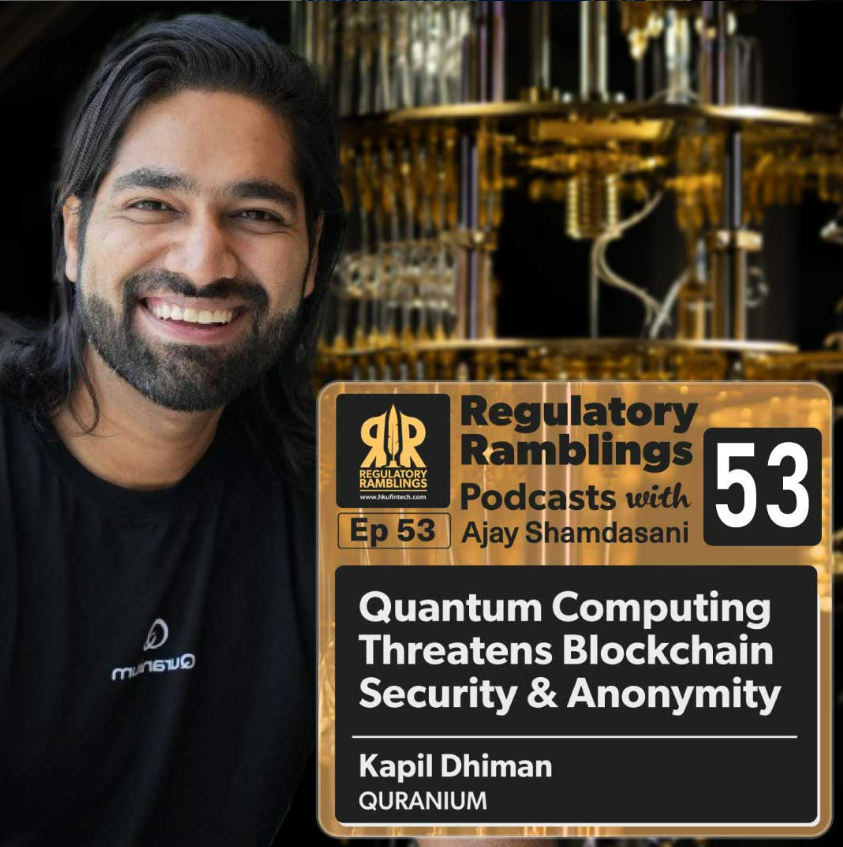
Regulatory Ramblings: Episode 53 – Advanced Quantum Computing Threatens Blockchain Transactional Security and Anonymity with Kapil Dhiman (Quranium)

Mumbai-based Kapil Dhiman is the co-founder and CEO of Quranium. An entrepreneur to his core with a creative and artistic side—coupled with a passion for problem-solving—Kapil is a seasoned leader with 12 years of diverse international consulting experience in dealing with enterprises, startups, and funds.

He is also a former Web 3.0 leader at PwC India and an award-winning CEO who crafted the Metaverse Startup of the Year 2023 from scratch. Kapil, a distinguished global speaker and author, has helped over 20 startups in the Web3 ecosystem with their go-to-market (GTM) and product strategies.

In this episode of Regulatory Ramblings, Kapil chats with host Ajay Shamdasani on how advances in quantum computing can compromise Blockchain transactional security and anonymity.

Much has been said about quantum computing and how it will revolutionize the world—and part of that is reflected in the new Cold War between the US and China. Beijing is constantly eager to tout its advances in the field, and the American and European mainstream press clamor about how the collective West is falling behind—in a manner almost reminiscent of the US response to the USSR’s 1957 Sputnik launch.

Some, such as Kapil, contend that quantum computing can breach the security of cryptocurrency transactions, notwithstanding the much touted ‘National Security Agency (NSA)-level encryption’ that Polish virtual asset advocates say exists when using a Blockchain.

Kapil shares a bit about his background and the challenges of growing up in a military family with a father he was very temperamentally different from. He recounts the difficulties of starting his firm, the joys and hurts of following an entrepreneurial path, and what he envisages for Quranium.

The discussion defines quantum computing, whether it should be regulated globally, and whether each industry using such computers should devise its own rules. Kapil concludes that each country must decide for itself—in the same way artificial intelligence is regulated globally.

Kapil also shares his thoughts on the notion that AI will come alive once quantum computing reaches a mature state. He addresses the issue of whether there is a mismatch between computing power and the ability to use AI to its fullest potential.

A lingering concern is that AI in its current state is not ‘ real AI’ and that the purest version of AI will require more advanced quantum computing.

The conversation concludes with Kapil commenting on what Web 3.0 means on a practical level. He dispels the cliché that creative and artistic types like himself are not practical and business-savvy, stating that such things can be learned if one is diligent and motivated enough.

We are bringing you the Regulatory Ramblings podcasts with assistance from the HKU Faculty of Law, the University of Hong Kong’s Reg/Tech Lab, HKU-SCF Fintech Academy, Asia Global Institute, and HKU-edX Professional Certificate in Fintech.

Useful links in this episode:

You might also be interested in:

Connect with RR Podcast at:

LinkedIn: https://hk.linkedin.com/company/hkufintech 
Facebook: https://www.facebook.com/hkufintech.fb/
Instagram: https://www.instagram.com/hkufintech/ 
Twitter: https://twitter.com/HKUFinTech 
Threads: https://www.threads.net/@hkufintech
Website: https://www.hkufintech.com/regulatoryramblings 

Connect with the Compliance Podcast Network at:

LinkedIn: https://www.linkedin.com/company/compliance-podcast-network/
Facebook: https://www.facebook.com/compliancepodcastnetwork/
YouTube: https://www.youtube.com/@CompliancePodcastNetwork
Twitter: https://twitter.com/tfoxlaw
Instagram: https://www.instagram.com/voiceofcompliance/
Website: https://compliancepodcastnetwork.net/

Categories
Innovation in Compliance

Innovation in Compliance – Keith Laska – Bitcoin: Investment or Monetary System?

Innovation comes in many forms, and compliance professionals need to not only be ready for it but also embrace it. Today, I visited Keith Laska to talk about his work in the realm of bitcoin and as a blockchain educator.

Keith Laska, a professor at Fordham University and founder of learnbitcoin.io, says that Laska’s perspective on bitcoin is that it can serve as both an investment and a monetary system, depending on the individual’s location and use case.

In the United States, he sees bitcoin as a high-growth investment that can outpace inflation, while in countries with high inflation rates like Argentina, Turkey, or Lebanon, he views bitcoin as a more stable and reliable monetary system compared to their local currencies.

This dual perspective is shaped by his extensive experience and dedication to staying at the forefront of the evolving field of bitcoin and blockchain.

Key Highlights:

  • Evolution of Bitcoin from 2009 to ETFs
  • Blackrock’s Successful Spot Bitcoin ETFs Approval
  • Enhancing Compliance with Blockchain Contracts and AI
  • Fluency in Bitcoin: Educating Future Industry Professionals

Resources:

Keith Laska on LinkedIn 

Tom Fox

Instagram

Facebook

YouTube

Twitter

LinkedIn

Categories
Daily Compliance News

November 28, 2022 – The Back to Venezuela Edition

Welcome to the Daily Compliance News. Each day, Tom Fox, the Voice of Compliance, brings you four compliance-related stories to start your day. Sit back, enjoy a cup of morning coffee and listen to the Daily Compliance News. All from the Compliance Podcast Network. 

Stories we are following in today’s edition of Daily Compliance News:

· Chevron is going back into Venezuela. (WSJ)

· Amazon is hoping to settle by year-end with the EU. (Reuters)  

· Don’t let crypto fraud diminish blockchain. (FT

· Huawei and ZTE banned. (Bloomberg

Categories
Daily Compliance News

July 15, 2022 the To Die In Texas edition


In today’s edition of Daily Compliance News:

  • Using blockchain to disrupt corruption. (CityAM)
  • SEC is looking into Musk’s actions re: Twitter. (NYT)
  • Whistleblower protections for reporting aliens. (Politico)
  • The state of Texas sues to block fed order on abortions to save mother’s lives. (Reuters)
Categories
Daily Compliance News

June 8, 2022 the Gupta Brothers Arrested Edition


In today’s edition of Daily Compliance News:

  • Vietnamese minister sacked in corruption scandal. (Bloomberg)
  • Gupta Brothers arrested in Dubai. (WSJ)
  • ABC programs blockchain and crypto. (Kroll)
  • Wells Fargo halts fraudulent hiring program. (NYT)