

Categories
Compliance Week Conference Podcast

Billy Jacobson – A Fireside Chat with Glenn Leon

In this episode of the Compliance Week 2023 Speaker Preview Podcasts series, Billy discusses some of his fireside chats at Compliance Week 2023 with Glenn Leon, head of the Fraud Section at the DOJ, “Confronting Corporate Crime.”

Join Billy as he visits with Glenn Leon for a discussion focused on the priorities for the fraud section and what compliance professionals can expect in the coming year. Hear the DOJ’s perspective on evaluating corporate compliance programs, including implementing the DOJ’s new white-collar policies, such as violations of FCPA, and investigating complex schemes involving health care, securities, and procurement fraud.

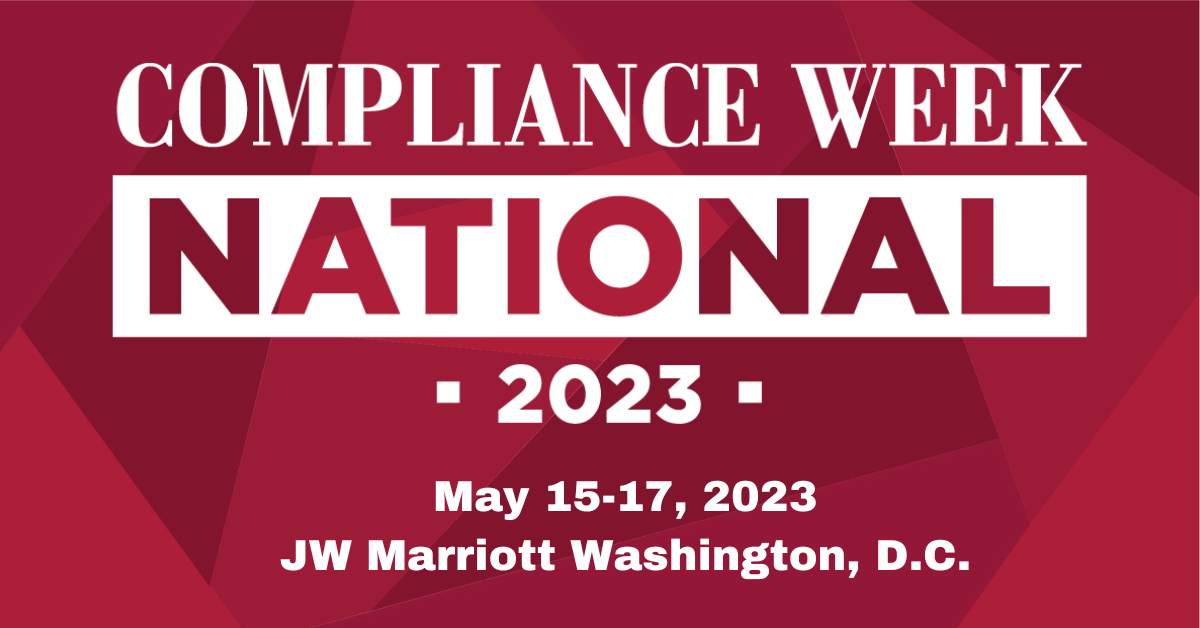
I hope you can join me at Compliance Week 2023. This year’s event will be May 15-17 at the JW Marriott in Washington, DC. The line-up of this year’s event is simply first-rate, with some of the top ethics and compliance practitioners around.

Gain insights and make connections at the industry’s premier cross-industry national compliance event offering knowledge-packed, accredited sessions and take-home advice from the most influential leaders in the compliance community. Back for its 18th year, compliance, ethics, legal, and audit professionals will gather safely face-to-face to benchmark best practices and gain the latest tactics and strategies to enhance their compliance programs. And many others to:

  • Network with your peers, including C-suite executives, legal professionals, HR leaders, and ethics and compliance visionaries.
  • Hear from 75+ respected cross-industry practitioners who are CEOs, CCOs, regulators, federal officials, and practitioners to help inform and shape the strategic direction of your enterprise risk management program.
  • Hear directly from the two SEC Commissioners, gain insights into the agency’s enforcement areas, and walk away with guidance on remaining compliant within emerging areas such as ESG disclosure, third-party risk management, cybersecurity, cryptocurrency, and more.
  • Bring actionable takeaways from your program from various session types, including ESG, Human Trafficking, Board obligations, and many others, for you to listen, learn and share.
  • Compliance Week aims to arm you with information, strategy, and tactics to transform your organization and career by connecting ethics to business performance through process augmentation and data visualization.

I hope you can join me at the event. For information on the event, click here. Listeners of this podcast will receive a discount of $200 by using code TF200 on the link here.
Categories
31 Days to More Effective Compliance Programs

One Month to a More Effective Compliance Program in Training and Communications – Compliance and the Clash of Cultures

One of the more difficult things to predict in the mergers and acquisition context is how the cultures of the two entities will merge. Further, while many mergers claim to be a ‘merger of equals’ the reality is far different as there is always one corporate winner that continues to exist and one corporate loser that simply ceases to exist. This is true across industries and countries; witness the debacle of Daimler Chrysler, the disaster of the HP acquisition of Autonomy, or the slow downhill slide of United Airlines, Inc. after its merger with Continental Airlines.

In the compliance space this clash of cultures is often seen. One company may have a robust compliance program, with a commitment from top management to have a best practices compliance program. The other company may put profits before compliance. Whichever company comes out the winner in the merger, it can certainly mean not only conflict but if the winning entity is not seen as valuing compliance, it may mean investigations and possibly even violations going forward.
Learning how your employees in other countries will approach decision-making and leadership will give you, as the CCO, insight into how they will approach compliance. It will require you to get out into the field to talk with folks. If your company grows organically or through M&A or the JV route, it will need to understand how your new employees will not only think through issues but how they will relate to instructions from the home office in America.

Three key takeaways:

  1. Culture clash through a merger can be extremely negative for a company.
  2. What are the cultures of leadership in your organization?
  3. Learning how your employees approach decision making can provide insight into how the will approach compliance.
Categories
All Things Investigations

All Things Investigations: Episode 27 – Creating and Maintaining an Ethical Culture with Laura Paredes


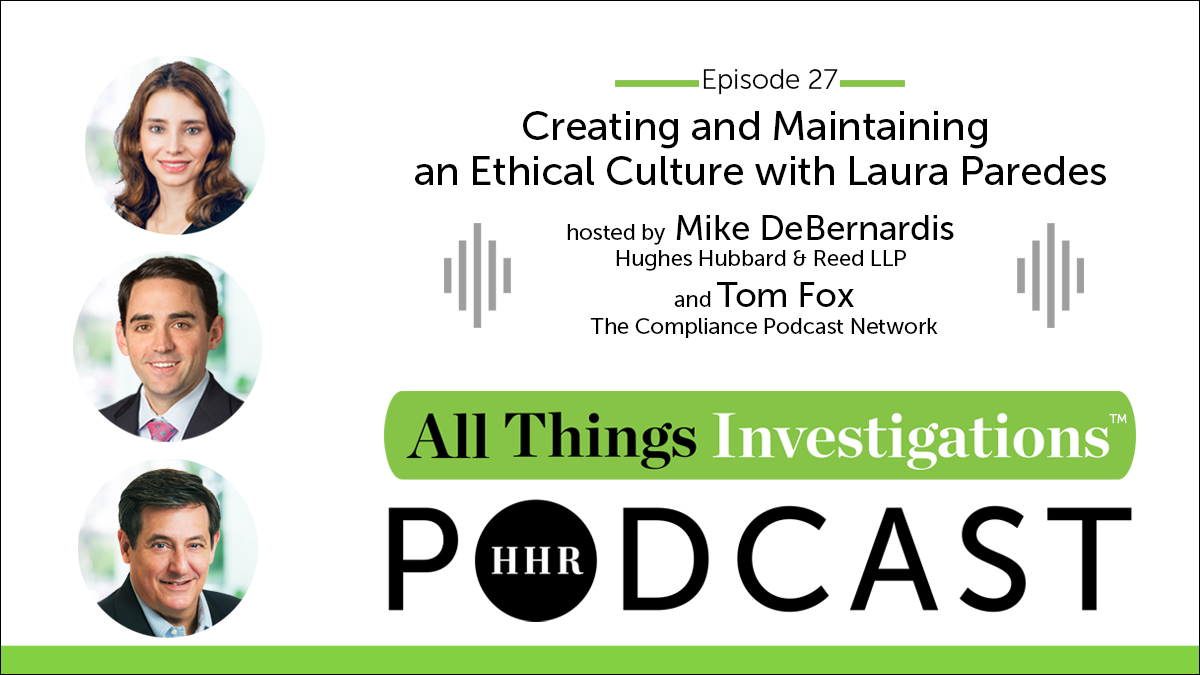
Ethical misconduct can destroy a company’s reputation, result in fines and legal action, and erode trust with stakeholders. However, building an ethical culture is not easy, and compliance officers face many challenges in doing so. Ethical culture is not just about having a set of guidelines or policies in place, but rather, it’s about employees having strong values and principles that guide their decisions, even when no one is looking. In this episode of All Things Investigations, compliance expert Laura Paredes joins hosts Tom Fox and Mike DeBernardis to discuss what ethical culture means, how to achieve it, and signs that a company does or does not have an ethical culture.

Laura Paredes is the Compliance Director for the Americas at Ingram Micro, a Fortune 100 company and global technology distributor. She is a compliance expert with over 15 years of experience in the field, focusing on anti-corruption, anti-bribery, and antitrust compliance. Prior to her current role, Laura worked as a compliance attorney and auditor for leading multinational corporations. She has a law degree from Universidad de Buenos Aires and an LLM in International Business and Economic Law from Georgetown University.

You’ll hear Tom, Mike and Laura discuss:

  • An ethical culture is about employees having strong values and principles that guide their decisions, even when no one is looking.
  • An ethical culture is part of a company’s DNA and should allow employees to make the right decision, even if the rule is not written anywhere.
  • Signs that a company has an ethical culture include:
    • Positive peer pressure, where employees feel free to speak up and raise concerns without fear of retaliation.
    • Leadership plays a crucial role in creating and maintaining an ethical culture by communicating the values of the company and reinforcing them through middle management.
    • Transparency and an open-door policy.
  • Signs that a company does not have an ethical culture include employees being afraid to speak up, wrongdoing being allowed, and lack of accountability.
  • An ethical culture is led by committed leadership and requires institutional justice and fairness.
  • Establishing policies and procedures that are relevant and easy to understand is key, along with constant training and communication to employees.
  • Recognizing and rewarding good conduct can have a positive effect on the culture.
  • It’s important to have a plan for building an ethical culture and to have leadership and the Board of Directors on board with it.
  • Building alliances and working with other departments, such as audit and finance, can be effective in promoting compliance.

KEY QUOTES:

“An ethical culture is about employees having strong values, strong principles that they can apply when they’re going to make a business decision. It’s something that is part of the DNA of the company, and it’s something that will allow them to make the right decision even if the rule is not written anywhere.” – Laura Paredes

“When employees are not afraid to speak up, and they will openly bring concerns up to their managers or to a compliance officer or legal. They will feel free to ask questions they will not feel ashamed of… There is transparency and there is an open door policy and people feel free to speak up without fear of retaliation, that’s a good sign.” – Laura Paredes

“If you can work with an audit, if you can work with finance and share the same tools that they’re using to implement the compliance program, to communicate, to create a culture of compliance, then maybe you can reach more people and you can be more effective.” – Laura Paredes

Resources:

Hughes Hubbard & Reed website

Laura Paredes on LinkedIn

Ingram Micro

Categories
FCPA Compliance Report

FCPA Compliance Report – Candice Tal on Due Diligence: Levels and Evaluation

Welcome to the award-winning FCPA Compliance Report, the longest running podcast in compliance. Join Tom Fox, the host of FCPA Compliance Report, as he speaks with Candice Tal, founder and CEO of Infortal. Get ready to boost your compliance program in this exciting episode of FCPA Compliance Report. In this episode, Tom and Candice discuss the three levels of due diligence typically used to investigate joint venture partners and senior executives and the significance of conducting thorough due diligence. Level one is for low-risk situations, level two is for moderate-risk situations, and level three is for high-risk situations that require deep dark web searches. The key takeaways are to never skimp out on basic due diligence and to consider level three due diligence for high-risk areas or key executives. Don’t miss out on this informative episode of FCPA Compliance Report hosted by Tom Fox and featuring Candice Tal!

 Key Highlights

·      Introduction of Candice Tal

·      What are the 3 levels of due diligence.

·      What is deep dive due diligence.

·      Finding reputational issues.

·      Evaluating due diligence.

Notable Quotes

“Due diligence typically is sorted out into 3 general levels or tiers.”

“If you’re not doing deep dive due diligence, you’re not finding reputational issues.”

“You just can’t find reputational issues on database searches.”

Resources

Candice Tal on LinkedIn

Infortal

Tom Fox

Instagram

Facebook

YouTube

Twitter

LinkedIn

Categories
31 Days to More Effective Compliance Programs

One Month to a More Effective Compliance Program in Training and Communications – Sharing to 360-Degrees of Communication

Why do people share information? The answer to that question has important implications for every compliance practitioner and compliance program. Sharing is a primary method to communicate and connect. This is always a challenge in any far-flung international corporation, particularly for disciplines that can be viewed as home office overhead at best and the Land of No at worst. Work to hone your message through social media. Part of this is based on experimenting with what message to send and how to send it. Another aspect was based upon the Wave (of all things), its development, and coming to fruition in the early 1980s. It took some time for it to become popular, but once it was communicated to enough disparate communications, it took off. “It’s the same thing with social media. On social media, we think something will go viral because the art is beautiful or the science is full of deep analytics, but it takes time to build the community.”

This means that you will need to work to hone your message and continue to plug away to send that message out. The Morgan Stanley declination will always be instructional as one of the reasons the DOJ did not prosecute the company, as they sent out 35 compliance reminders to its workforce over seven years. Social media can be used in the same cost-effective way to get the message of compliance out and to receive information and communications back from your customer base, the company employees.

Three key takeaways:

  1. What makes your employees want to share information?
  2. Facilitate mechanisms that allow sharing with the compliance function.
  3. The Morgan Stanley declination still resonates.

For more information, check out The Compliance Handbook, 4th edition, here.

Categories
31 Days to More Effective Compliance Programs

One Month to a More Effective Compliance Program in Training and Communications – Using Social Media to Innovate in Compliance

I am a huge fan of using social media in your compliance function. But how can you get your arms around how to structure such a program for your company?  After acknowledging that social media focuses on the social aspects of communication, the most important thing to remember is that communication in social media is two-way, both inbound and outbound. It helps to bring your employee base together in an efficient manner to create an environment conducive to compliance for your organization. It also has the benefit of continued engagement. It is more than putting on training or even a set of initiatives; you can continue the conversation and enthusiasm about compliance going forward throughout the year. The authors break this down further into three parts that emphasize 1) the need to listen to and learn from user-generated content, 2) the need to engage and facilitate dialogue with employee innovators, and 3) to find an audience of early adopters to create excitement and collect feedback.

If your goal in the compliance function is to create awareness and publicize your compliance program and initiatives, social media can be a powerful tool. This is so paramount that it should become a core activity of your compliance function. Using social media tools, your compliance function can tell the story of compliance, communicate expectations, and even train. Yet again, it is simply more than a one-way tool. Just as employees are more apt to tell you about a concern immediately or soon after being trained on that issue, they may well communicate directly with you after receiving social media communication on subjects such as managing third-party relationships.
CCOs and compliance practitioners must develop a dedicated compliance strategy around social media in the context of their corporate objectives. It allows you a 360-degree view of compliance, through which you can take input from your employee base and create a compliance experience that your employees will embrace.

 Three key takeaways:

  • Never forget that social media is a two-way communication.
  • Company employees are the customers of the compliance department.
  • As with all compliance issues, assess what works for your company and appropriately tailor your social media approach.

For more information, check out The Compliance Handbook, 4th edition here.

Categories
31 Days to More Effective Compliance Programs

One Month to a More Effective Compliance Program for Training and Communications – Use of Social Media in Compliance

What is the compliance message inside of a corporation, and how is it distributed? In a compliance program, the largest portion of your consumers/customers are your employees. Social media presents some excellent mechanisms to communicate the message of compliance in the future. Many of the applications we use in our communications are free or available at very low cost. Why not take advantage of them and use those same communication tools in your internal compliance marketing efforts going forward?

Louis Sapirman, Vice President and Chief Ethics & Compliance Officer for Panasonic Corporation of North America – Panasonic USA, often discuss integrating social media into compliance. It would be best if you started with the tech-savvy nature of today’s workforce. It is not simply about having a younger workforce but a workforce whose primary tool for communication is social media. If your company is in the services business, it probably means your employee base is using technological tools to deliver business solutions. Finally, consider the data-driven nature of business today, so using technological tools to deliver products and solutions is something your company probably does now. Facebook, LinkedIn, Twitter, and even TikTok can all be utilized.

Finally, never forget the social part of social media. Social media is a more holistic, multiple-sided communication. Not only are you setting out expectations, but also, these tools allow you to receive back communications from your employees. The D&B experience around the name change for its Code of Conduct is but one example. You can also see that if you have several concerns expressed, it could alert you earlier to begin some detection and move toward prevention in your compliance program.

Another approach is to use audio as a part of your compliance communications. Podcasts are a great way to tell a long-form story about your compliance successes and challenges. Ronnie Feldman, the founder of L&E Entertainment, continually reminds us that the engagement of your compliance audience is through the entertainment of your compliance communications. But the key is that the audio format can be a powerful tool for you and a way to reach your employee base that you need to take advantage of. It can be as simple as interviewing employees on the importance of culture and how they use it to guide their decision-making in their daily work. Your imagination only limits you.

 Three key takeaways:

1. Incorporating social media into your compliance communications can pay big dividends.

2. Focus on the ‘social’ part of social media.

3. Consider incorporating podcasts and audio clips into your compliance communications and training.

For more information, check The Compliance Handbook, 3rd Edition available here.

Categories
31 Days to More Effective Compliance Programs

One Month to a More Effective Training and Communications – The D&B Experience in Training and Communications

How did one company and one CCO actively use social media to make the company’s compliance culture more effective? The company was Dun & Bradstreet, Inc. (D&B), and its then CCO, Louis Sapirman, discussed D&B’s integration of social media into compliance with me.
As we advance, these tools can go a long way toward enhancing your compliance program. Recall the declination to prosecute Morgan Stanley received from the DOJ when one of its managing directors had engaged in FCPA violations. One of the reasons cited by the DOJ was 35 email compliance reminders sent over seven years, bolsters the annual FCPA training the recalcitrant managing director received. You can use your archived social media communications as evidence that you have continually communicated your company’s expectations around compliance. It is equally important that these expectations are documented.

Finally, always remember the social part of social media. Social media is a two-way communication. Not only are you setting out expectations, but also, these tools allow you to receive back communications from your employees. The D&B experience around the name change for its Code of Conduct is but one example. If you have several concerns expressed, it could alert you earlier to begin some detection and move toward prevention in your compliance program.

Three key takeaways:

  1. How do 360 degrees of communication work in compliance?
  2. Focus on the ‘social’ part of social media.
  3. Use internal corporate social media to have a conversation.

For more information, check The Compliance Handbook, 3rd Edition available here.

Categories
Compliance Week Conference Podcast

Adam Balfour and Brian McAlhaney on Raising Your Communications and Training

In this episode of the Compliance Week 2023 Speaker Preview Podcasts series, Adam Balfour and Brian McAlhaney from Bridgestone/Firestone discuss their Case Study at Compliance Week 2023,  entitled, “From Training to Learning: How We Use Lessons from Star Wars, Jurassic Park and Top Gun to Help Employees Learn About Ethics and Compliance.”

Some of the issues they will discuss in their presentation are:

  • How one company has re-framed their compliance program pillar of “Training and Communication” to “Learning and Engagement” and hear how your program can benefit from their learnings;
  • Tried and tested tips on adult learning, including using experiences, focusing on the impact on the learner, and more; and
  • How creative, effective, and engaging learning can help enhance your ethics and compliance program brand?

I hope you can join me at Compliance Week 2023. This year’s event will be May 15-17 at the JW Marriott in Washington, DC. The line-up of this year’s event is simply first-rate, with some of the top ethics and compliance practitioners around.

Gain insights and make connections at the industry’s premier cross-industry national compliance event offering knowledge-packed, accredited sessions and take-home advice from the most influential leaders in the compliance community. Back for its 18th year, compliance, ethics, legal, and audit professionals will gather safely face-to-face to benchmark best practices and gain the latest tactics and strategies to enhance their compliance programs. And many others to:

  • Network with your peers, including C-suite executives, legal professionals, HR leaders, and ethics and compliance visionaries.
  • Hear from 75+ respected cross-industry practitioners who are CEOs, CCOs, regulators, federal officials, and practitioners to help inform and shape the strategic direction of your enterprise risk management program.
  • Hear directly from the two SEC Commissioners, gain insights into the agency’s enforcement areas, and walk away with guidance on remaining compliant within emerging areas such as ESG disclosure, third-party risk management, cybersecurity, cryptocurrency, and more.
  • Bring actionable takeaways from your program from various session types, including ESG, Human Trafficking, Board obligations, and many others, for you to listen, learn and share.
  • Compliance Week aims to arm you with information, strategy, and tactics to transform your organization and career by connecting ethics to business performance through process augmentation and data visualization.

I hope you can join me at the event. For information on the event, click here. Listeners of this podcast will receive a discount of $200 by using code TF200 on the link here.
Categories
31 Days to More Effective Compliance Programs

One Month to a More Effective Compliance Program in Training and Communications – Introduction

In this month’s offering of 31 Days to a More Effective Compliance Program, you will learn about training and communication techniques that the CCO can use to provide a well-rounded role as a CCO and facilitate a much more holistic approach to compliance in your organization. Best of all, the techniques discussed are available at little to no cost. You can do things in your method of running the CCO positions and innovations that you can bring to the compliance function in your organization.

A 360-degree view of compliance is an effort to incorporate your compliance identity into a holistic approach so that compliance is always in touch with and visible to your employees. It is about creating a distinctive brand philosophy of compliance centered on the customers of your compliance program (i.e., your employees). It helps to anticipate all the aspects of your employee’s needs around compliance, especially when compliance is perceived as new, something that comes out of the home office, or as the Land of No. It allows you to build a new brand image for your compliance program.

The objective is to build trust for the 360-degree process by determining if the goal was achieved. You can utilize surveys or focus groups to assess the impact on your target audience. Focusing on your customers of compliance allows you to identify gaps and improve the communication process for your compliance program.

Three key takeaways:

  1. Remember the definition of 360 degrees of compliance communications. It is an effort that moves the compliance identity into a holistic approach so compliance is always in touch and visible to your employees.
  2. What is your objective? What are you trying to do with your 360-degree view of compliance communications, and how are you using that mechanism to deliver the objective your compliance program desires?
  3. You need to evaluate if the message has been delivered, has been heard, and is being implemented.

For more information, check The Compliance Handbook, 3rd Edition, available here.