The Roger Ng Foreign Corrupt Practices Act (FCPA) trial has now concluded its testimony phase, the parties have closed and the decision on freedom or not for Ng rests with the jury. The closing arguments highlighted the strengths and weaknesses of both parties’ positions in the trial. As reported by Patricia Hurtado, writing in Bloomberg, the prosecution’s closing assailed Ng’s defense based upon the testimony of Ng’s wife, Hwee Bin Lim, who testified that a “$35.1 million infusion of capital into a shell company she controlled was not a kickback for her husband in the 1MDB scheme, but was from an unrelated, legitimate business transaction.” Luc Cohen, writing in Reuters, said that “Ng’s wife, Hwee Bin Lim, later testified for the defense that the business venture was, in fact, legitimate. She said she invested $6 million in the mid-2000s in a Chinese company owned by the family of Leissner’s wife at the time, and the $35 million was her return on that investment.”
The biggest problem for the prosecution was its star witness Timothy Leissner. From his innocuous “lying a lot” admission, the government had to both depend on Leissner’s testimony and distance itself from it, largely at the same time. In the former category, Cohen wrote that “Leissner said the men (he and Ng) agreed to tell banks a “cover story” that the money was from a legitimate business venture between their wives and that Alixandra Smith, a prosecutor, said in her closing argument that other evidence backed up Leissner’s testimony.”
In the latter category, Matthew Goldstein, writing in the New York Times, said “A federal prosecutor told jurors on Monday that they had received enough evidence to convict a former Goldman Sachs banker for his role in one of the biggest international money laundering and bribery schemes even without the testimony of the government’s star witness.” He went on to note that the prosecutor claimed Leissner had selected moments of truthful testimony, writing “Mr. Leissner did not lie when he testified in federal court in Brooklyn to the key facts of the scheme, which was funded by a series of bond offerings that Goldman arranged for the 1MDB fund.”
The defense assailed Leissner and his testimony in their grueling 6-day cross examination, where Leissner “admitted to lying a lot in life. He was forced to admit to initially lying to federal agents, to his fellow partners at Goldman and to his wives and girlfriends.” At closing, Ng’s attorney “said Mr. Leissner was a man who “will lie if it suits his interest.” He said that, despite what the prosecution had said, without Mr. Leissner’s testimony the government could not connect Mr. Ng to the conspiracy to steal billions from the 1MDB fund. There is no evidence that connects Roger. There is not a dirty email. Not a bad text message.”
Interestingly, in the prosecution’s rebuttal, another prosecutor, Drew Rolle appeared to change tactics to defend and rehabilitate Leissner. Stewart Bishop, writing in Law360 said “Rolle also mounted a last-ditch defense of Leissner. Tim Leissner came in here, took the stand and told you the unvarnished truth,” Rolle said. “It was painful, but that’s what has to happen, because it’s the truth.” When you must try and rehabilitate your story witness on rebuttal, it is never a good sign.
Finally in an interesting twist, Hurtado reported that “The jury in the 1MDB conspiracy case against former Goldman Sachs banker Roger Ng has asked to review testimony from his wife that the defense says is key to its case. After seven weeks of testimony in federal court in Brooklyn, New York, the jurors deciding the fate of Goldman Sachs Group Inc.’s former head of investment banking in Malaysia made the request soon after they began their deliberations on Tuesday afternoon.” Trial lawyers and trial watchers are continually trying to read signs from the jury. It seems to me that this request means that the jury took Ng’s defense to heart through the testimony of his wife about the source of the family’s funds.
We all now have to sit back and wait for the jury to return with its verdict. If the jury comes back with a guilty verdict, it will bolster the Department of Justice’s (DOJ) attempts to hold individual actors culpable for their actions in engaging in FCPA violations and other white collar crime involving corporations. If the jury comes back with a not guilty verdict in the wake of the largest corporate FCPA fine and penalty, against Ng’s former employer Goldman Sachs, it could bode poorly for DOJ attempts to hold individuals accountable in similar cases or even other cases of fraud cases going forward. If there is a not guilty verdict in the Ng and you couple it with the recent not guilty verdict in the prosecution of Mark Forkner, the former chief technical pilot at Boeing responsible for the 737 Max, it may well point to the difficulties of trying to hold employees at large corporations responsible.
Mike Volkov said of the Forkner verdict, “Juries often bring justice to deliberations and verdicts. In the Boeing case, the jurors saw through the government’s lack of fairness – Boeing officials were not charged – only a chief technical pilot was held accountable. The fundamental flaw in this approach is that even assuming that Forkner engaged in misconduct, his actions or failures to act occurred in the context of an organization with colleagues, supervisors and other senior officials ultimately responsible for Boeing’s actions.” He concluded “Forkner’s defense attorney argued to the jury, “This was a massive corporate failure, and Boeing simply needed someone to pin it on.” The jury agreed.”
Tag: DOJ

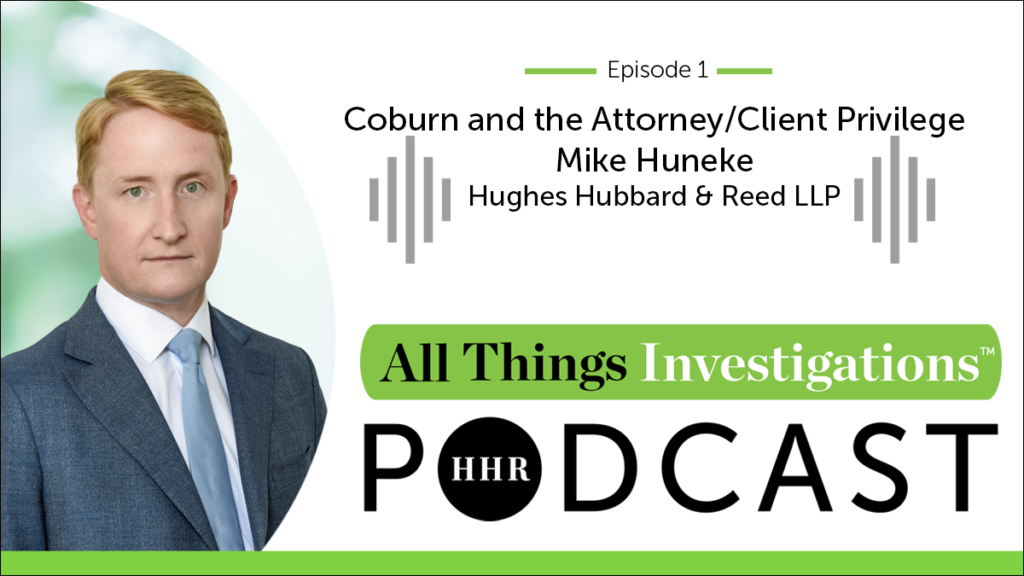
Welcome to the Hughes Hubbard Anti-Corruption & Internal Investigations Practice Group’s podcast All Things Investigations. In this podcast host Tom Fox and members of the Hughes Hubbard Anti-Corruption & Internal Investigations practice group will highlight some of the key legal issues involved in white collar and other investigations, both domestically and internationally. In this first episode, I visit with Mike Huneke on discovery dispute in the US v. Coburn criminal action.
Mike Huneke is a Hughes Hubbard & Reed partner who has spent his career in both Washington, DC and Paris, France. For his entire 17-year career Mike has been practicing in the anti-corruption space, on everything from investigations and government resolutions, acting as “buffer counsel” to companies subject to compliance monitors, third party and M&A due diligence, and proactive risk assessments and second-level compliance reviews. Most recently, Mike and his Hughes Hubbard colleagues were recognized for their role on the Airbus case by Global Investigations Review.
Key areas we discuss on this podcast are:
- Individual defendants are wildcards in matters involving privilege claims in FCPA investigations.
- The dangers of the over-assertion of privilege to the DOJ and to the Courts.
- The false comfort of “oral” disclosures.
- The “personal jurisdiction” discussion by the Court.
- Beware civil discovery in criminal cases.
Resources
Hughes Hubbard & Reed website
Mike Huneke bio
Anti-Corruption and Internal Investigations Practice Group
US v. Coburn, Judge McNulty decision
The Compliance Podcast Network is thrilled to announce its latest podcast, All Things Investigations, a podcast from the law firm Hughes Hubbard & Reed LLP’s Anti-Corruption & Internal Investigations practice group. The group represents many of the premier companies around the world, providing advice on issues spanning the full anti-corruption and compliance spectrum. In this podcast host Tom Fox and members of the Hughes Hubbard Anti-Corruption & Internal Investigations practice group will highlight some of the key legal issues involved in white collar and other investigations, both domestically and internationally. We will tackle topical issues involved in investigations as well as explore how companies can help prevent and detect issues that arise in conducting business on a worldwide basis.
The inaugural episode features partner Mike Huneke, who has spent his career in both Washington, DC and Paris, France. For his entire 17-year career Huneke has been practicing in the anti-corruption space, on everything from investigations and government resolutions, acting as “buffer counsel” to companies subject to compliance monitors, third party and M&A due diligence, and proactive risk assessments and second-level compliance reviews. Most recently, Huneke and his colleagues were recognized for their role on the Airbus case by Global Investigations Review.
The subject of the podcast is the recent US District Court decision by Judge Kevin McNulty in the criminal case of US v. Coburn. McNulty is overseeing the criminal charges against former Cognizant Technology Solutions Corporation (Cognizant) executives Gordon J. Coburn and Steven Schwartz (Coburn; Schwartz or defendants) alleging violations of the Foreign Corrupt Practices Act (FCPA). Defendants had sought discovery from the Department of Justice (DOJ) consisting of materials turned over by counsel for Cognizant (outsourced investigation firm) to the DOJ in the company’s FCPA investigation. The defendants argued that Cognizant waived privilege over a broad category of documents when it disclosed a summary of its investigation findings to DOJ. The waiver, they argued, included “any communications regarding conduct alleged in the indictment and any materials related to Cognizant’s internal investigation.” Cognizant maintained that it did not waive the privilege over the entire internal investigation as the result of simply cooperating with DOJ or disclosing portions of investigative documents.
According to Huneke, Judge McNulty’s decision went back to “first principles. Why are we here? What are we doing? If you are sharing with the United States government privileged information, you have waived privilege by doing so.” That is not particularly controversial or new, but, as Huneke noted, “Judge McNulty then further granted a very broad waiver, a subject matter waiver of the privilege. Not only were interview memorandum from which external counsel read summaries to the government considered to have lost the protection of attorney-client privilege, but all documents supporting those memoranda, cited in those memoranda, drafts, notes or anything else based on which those memorandum were prepared were all ordered by Judge McNulty to be produced.”
It was this second step which Judge McNulty took that garnered much attention in the white-collar defense and FCPA defense bar. While Judge McNulty did not criticize making an oral presentation, he did say that if counsel makes an oral presentation to the DOJ, the underlying basis of that presentation is also not privileged and subject to discovery. Huneke noted, “it underscored there’s no kind of magic secret or magic protection that you get by doing something orally rather than in writing. I think there is a natural preference to maybe have an initial conversation orally with the government. This underscores the importance of reducing it to writing very soon afterwards. I assume that some of the thought behind giving an oral presentation and maybe not reducing it to a writing later is an idea that maybe you have some flexibility afterwards or there’s room to argue. If you are going to waive privilege anyway, it is probably a good practice to document what you think you said. Not only so that you and your client can anticipate what the potential waiver might be, but also to help you later, if you do have to make arguments against individuals who are pleading not guilty and fighting the prosecution about where the waiver line might have been drawn.”
Employees who are individually charged are really the “wild cards” in all of this. Huneke said, “they have nothing to lose at this point. Companies are ongoing concerns for them, the important thing is to resolve the matter and move on and get out.” It could involve the risk of debarment, and the potential impact on their stock price for example. Indicted individuals are often no longer employed. If they were executives there may be a legal or contractual right to advancement of their legal fees. They could well be facing jail time. Huneke concluded, “it is not surprising to see them really throwing the kitchen sink at it in furtherance of their defense. Moreover, they are none too pleased with the perceived infiltration of their legal team by the government or the way, probably in their view, the company turned on them.”
The bottom line is for investigative counsel, whether outsourced or in-house, to understand that their entire investigation, notes, memoranda, ideas and investigations may all be turned over to counsel for defendants if individuals are charged. Huneke emphasized that this ruling does not prevent outside or outsourced counsel from effectively investigating potential FCPA claims or negotiating with the government. If there is a settlement reached, it is “based on full information and everyone having the same information. We would rather the government have more, rather than less information, to make sure we are not accused later, of having not provided something to the DOJ that we should have. It does mean it will create additional burdens on the government to track what information it receives. If the government wishes to take a strict view of its disclosure obligations to then individual defendants, and there will be more documents it needs to carefully track and monitor and make sure it is complying with of those obligations.”
Huneke concluded, “if the DOJ is going to reinstitute the full force of the Yates Memo regarding its prosecution of individuals, it may well create additional cost and a longer tail to the consequence of these things. It could also require, going forward, defense counsel to take a very disciplined and well documented approach with the DOJ.” It certainly does not mean you cannot have informal discussions with the DOJ, but it does mean any document response must be “meticulously detailed, documented, cataloged, including the reasons for any redactions or things held back for privilege otherwise.”
You can check out the full podcast with Mike Huneke on All Things Investigations. To find out more about the Hughes Hubbard Anti-Corruption & Internal Investigations practice group click here. All Things Investigationswill post every other Monday on the Compliance Podcast Network.
On this April Fool’s Day for 2022, Tom and Jay are back to look at some of the week’s top compliance and ethics stories in the Slap Seen ‘Round the World edition.
Stories
- The Slap Seen ‘Round the World and Compliance. Tom in FCPA Compliance and Ethics Blog.
- Will CCOs have to certify compliance? Text of Kenneth Polite speech. Tom and Matt in Compliance into the Weeds. Matt in Radical Compliance.
- Coal exec indicted under the FCPA. Harry Cassin in the FCPA Blog.
- Good bribes. Dick Cassin in the FCPA Blog.
- Why controls are key to compliance. Chris Audet in CCI.
- MarshMac UK sub garners Declination with Disgorgement. Dylan Tokar in WSJ Risk & Compliance Journal.
- ZTE whistleblower feared for his life. Ashley Yablon in CCI.
- Whistleblowing keys. Jan Stampers In Risk and Compliance Matters.
- Fine line between compliance and evasion of OFAC sanctions. Mike Volkov in Corruption Crime and Compliance.
- ISSB delivers sustainability guidelines. IFRS Press Release.
Podcasts and More
- What is the intersection of Sports and Ethics? Each year, Jason Meyer holds Ethics Madness, a discussion of this intersection done during March Madness. This year, Jason engaged Tom for Ethics Madness in the podcast format. It was cross-posted on Jason’s site Eight Mindsets, which he co-hosts with Nicole Rose and on Tom’s site, Greetings and Felicitations.
- Tom has a two part series with Aly McDevitt on her recent Ransomware case study, on Greetings and Felicitations, Part 1 and Part 2.
- Why should you attend Compliance Week 2022? Find out on this episode of From the Editor’s Desk. Listeners get a $200 discount to CW 2022 with the code Fox200. More here.
- Tom visits with longtime MS 150 rider Alan Peterson on The Hill Country Podcast. Donate to the fight against MS here.
- Why should compliance lead corporate ESG? Kristy Grant-Hart explains on the ESG Compliance Podcast.
Compliance into the Weeds is the only weekly podcast which takes a deep dive into a compliance related topic, literally going into the weeds to more fully explore a subject. This week, Matt and Tom take at the recent remarks by DOJ Assistant Attorney General Kenneth Polite on CCO certifications of compliance programs after the conclusion of a DPA. Highlights include:
· Where did this issue come from?
· Is its implementation looming?
· What are the implications for individual CCO liability?
· What about CEO liability for recidivism?
· What are the corporate governance implications?
Resources
Text of Kenneth Polite speech
Attributes of a Toxic Corporate Culture
Corporate culture is finally being acknowledged as a key ingredient in a successful business, particularly one which operates ethically and in compliance. The Department of Justice (DOJ) formally recognized the need to assess corporate culture in the speech by Deputy Attorney General Lisa Monaco to the ABA White Collar Conference in October 2021. But what are some indicia of good culture and more importantly what are some indicia of a toxic culture? A recent article in the MIT Sloan Management Review provided some guidance. In Why Every Leader Needs to Worry About Toxic Culture, Donald Sull, Charles Sull, William Cipolli and Caio Brighenti posited that by pinpointing the elements of toxic culture in a company, its leaders focus on addressing the issues that lead employees to disengage and quit. These ideas have significant importance for the compliance function as it navigates corporate culture, both in assessing and improving it.
Moreover, the Chief Compliance Officer (CCO) and corporate compliance function were identified in the 2020 Update to the Evaluation of Corporate Compliance Programs as the keepers of institutional justice and institutional fairness. This mean recognizing and then preventing a toxic culture from spreading and infecting your entire organization is squarely in the compliance wheelhouse. The article lays out key red flags for every CCO and compliance professional to look for in assessing culture. Finally, for any company with a toxic culture, the chances are much greater to be defrauded by its own employees or to defraud others through bribery and corruption by violating such laws as the Foreign Corrupt Practices Act (FCPA).
The authors identify behaviors that they call “the Toxic Five attributes”, being “disrespectful, noninclusive, unethical, cutthroat, and abusive – poison corporate culture in the eyes of employees. While organizational culture can disappoint employees in many ways, these five elements have by far the largest negative impact on how employees rate their corporate culture and have contributed most to employee attrition throughout the Great Resignation.” As a CCO or compliance professional you need to be on the watch for them and take steps to remedy them if you see or hear about them.
Non-inclusive Behavior
This is about whether your employees are “treated fairly, made to feel welcome, and included in key decisions.” It is “the most powerful predictor of whether employees view their organization’s culture as toxic. It applies to all demographic groups; “gender, race, sexual identity and orientation, disability, and age.” It can be outright discrimination to the equally invidious but more subtle conflicts of interests of nepotism and playing favorites. The topic of non-inclusiveness includes “terms like “cliques,” “clubby,” or “in crowd” that indicate that some employees are being excluded without specifying why.”
Disrespectful Behavior
The authors found that “feeling disrespected at work has the largest negative impact on an employee’s overall rating of their corporate culture of any single topic.” Lack of respect can occur in many areas. The most obvious is the lack of a speak up culture where employees understand it is useless to raise issues to management; whether serious matters such as FCPA violations to more straight-forward ideas such as process improvement. It can also be something as simple as whether or not to return to the office on a fulltime basis and whether management listens to employees about their desires to continue working from home or utilize some type of hybrid working arrangement. The authors noted, “whether you analyze culture at the level of the individual employee or aggregate to the organization as a whole, respect toward employees rises to the top of the list of cultural elements that matter most.”
Ethical Behavior
The authors believe that ethics “is a fundamental aspect of culture that matters at both the organizational and individual levels.” Interestingly, there are several different aspects to ‘ethics’ that every CCO needs to consider. Unethical behavior is “about integrity and ethics within an organization.” It also includes dishonesty, which “employees described dishonest behavior in many ways”, from outright lying to making false promises to shading the truth to simply “sugarcoating.” Under regulatory compliance employees talked about failure to comply with applicable regulations, including failure around safety standards.
Cutthroat Behavior
I found this category fascinating as it included both uncooperative co-workers and the lack of harmonization across organizational silos. This was not simply “friction in coordination” but situations where “employees talked about colleagues actively undermining one another.” It included what the authors termed as a “vivid lexicon to describe their workplace, including “dog-eat-dog” and “Darwinian” and talked about coworkers who “throw one another under the bus,” “stab each other in the back,” or “sabotage one another.””
Abusive Behavior
Having worked in law firms long ago, I understand abusive behavior. The authors called it “sustained hostile behavior toward employees” including such actions as “bullying, yelling, or shouting at employees, belittling or demeaning subordinates, verbally abusing people, and condescending or talking down to employees.” While one would hope such behaviors do not exist in the 21st century, they apparently still do. 0.8% of the employees surveyed for the article described their manager as abusive, however, when employees did mention abusive managers, it significantly depressed a corporate culture.
What CCOs and compliance professionals should try to drive forward is a “culture that is inclusive, respectful, ethical, collaborative, and free from abuse by those in positions of power.” But the authors caution that these are really the “baseline elements of a healthy corporate culture.” Employees want more than the basics and other stakeholders in an organization want companies to have strong official core values. In an interview with LRN’s Susan Divers, she called it the ‘value in values’. From the compliance professional’s perspective in means values like integrity, collaboration, respectful, and DEI.
Oligarch Task Force
The Kitchen reviews the Department of Treasury, DOJ announcement of a multilateral Russian Elites, Proxies, and Oligarchs (REPO) task force.
Will Roger Ng Walk?
One of the most interesting Foreign Corrupt Practices Act (FCPA) criminal trials in sometime is ongoing in New York, that of Roger Ng. The lead up to the trial and in trial reporting efforts have been led by Law360and its lead reporter Stewart Bishop and most of information in this post comes from that site. Unfortunately, it is behind a paywall so if you want to follow it going forward you will have to subscribe. According to Bishop, Ng was charged with conspiring to violate the FCPA and money laundering conspiracy along with his employer Goldman Sachs Group, Inc., its former Southeast Asia chairman Tim Leissner and financier Jho Low. The charges were bribery of “Malaysian and Emirati officials and to circumvent the internal accounting controls of Goldman, which underwrote more than $6 billion in bonds issued by 1MDB in three offerings in 2012 and 2013. Leissner pled guilty over his role in the alleged scheme, while Low has remained abroad, out of reach of U.S. authorities for now.”
The prosecution’s case turns almost exclusively on the testimony of Leissner, one of the most pathological liars ever to grace the witness stand. Indeed, Matthew Goldstein, writing in the New York Times, reported this question by Ng’s defense counsel to Leissner, “Do you think you are good at lying?” Leissner demurred on this question but did admit he had “lied a lot”. Goldstein cited to Rebecca Roiphe, a former prosecutor and a professor at New York Law School who specializes in legal ethics, who related “it could be tricky to rely on such a witness, but “it isn’t a fatal blow.”” She said a prosecutor can argue that a witness is “a horrible person” and “a serial liar” who has had “a come-to-Jesus moment. That can work when you have really bad people who have lied a lot,” she said.””
What do Leissner’s admitted lies consist of? Leissner admitted under cross-examination that he had presented “a bogus divorce decree to his now-estranged wife, the model and fashion designer Kimora Lee Simmons, so that she would marry him eight years ago.” Defense counsel also got Leissner to “recount the many ways he deceived his wives, particularly Ms. Simmons. Mr. Leissner admitted that he had used an email account in the name of his second wife, Judy Chan, to communicate with Ms. Simmons while dating her, and that he was still married to Ms. Chan when he and Ms. Simmons were wed. (Mr. Leissner was also legally married to another woman when he married Ms. Chan.)” Leissner also admitted that some $10MM of his ill-gotten gain from 1MDB was used to “buy a $10 million house for one of his girlfriends (while married) so she would not go to the authorities.”
Of course, Leissner now maintains he is “telling the truth about Mr. Ng, who prosecutors say helped line the pockets of officials in Abu Dhabi and powerful Malaysians close to then Prime Minister Najib Razak.” Leissner testified “Mr. Ng was his primary contact at Goldman, which earned roughly $600 million in fees to arrange the $6.5 billion in bond deals for the fund. “Roger made him one of his clients,” Mr. Leissner said. He testified that Mr. Ng had set up many of the meetings to plan the scheme, including one at Mr. Low’s London apartment during which Mr. Low drew boxes on a piece of paper with the names of all the officials that would get bribes and gifts. For helping arrange the payments, Mr. Leissner said, he raked in more than $80 million. Prosecutors contend that Mr. Ng’s share was $35 million.” Leissner tried to paint Ng as someone very close to Low, even placing Ng “at a star-studded 31st birthday party that Mr. Low arranged for himself in Las Vegas in 2012, although Mr. Ng was not on the guest list.”
But here’s problem No. 1 with this testimony, Ng always worked for and under Leissner during the 1MDB scandal and not the other way round. Leissner admitted under cross that “he — not Mr. Ng — oversaw the payment of most of the bribe money.” As Roiphe later told Goldman, “In a case like this, you hope to avoid a situation where you have a cooperator testifying against someone who is a subordinate.”
Then there is problem No. 2 for the prosecution, which is the government’s claim that Ng received some $35 million in ill-gotten gains from the 1MDB scandal. Ng’s lawyers have responded that any money Ng received, was repayment of a debt one of Leissner’s wives owed Ng’s wife. The prosecution has to show Ng received this money.
As further reported by Bishop, the prosecution concluded its direct case with “An FBI agent on Tuesday outlined how kickbacks allegedly flowed from Malaysian sovereign wealth fund 1MDB to former Goldman Sachs managing director Roger Ng and others.” Bishop wrote the monies allegedly from Chan Leissner’s account, “to another shell company in the name of Ng’s mother-in-law, initially called Silken Waters but later changed to Victoria Square.” Then came another web of shell company transfers into entities controlled by some combination of Ng, his wife, Lim Hwee Bin, and Lim’s mother. Around $300,000 was spent on diamond jewelry, another $20,000 for an hourglass and over $200,000 for the purchase of Bristol Myers Squibb shares, according to the government.” Finally, there was another $3.15 million which went into yet another “account the government couldn’t identify.” Nothing in this adds up to $35 million.
Got all that. Does that money transfer convince you that Ng was the mastermind that Leissner and the government is trying to make him out to be? By putting one of the great liars of all time on the stand as their key witness with only this as the ‘documented’ evidence, the government is risking everything on Leissner’s testimony; that it will be believable and credible and will not taint the government’s case in one juror’s eyes so the government can garner a guilty verdict. Remember, it doesn’t take 12 to acquit, only one.
There is lots of other unbelievable things going on in the Ng trial, but I will save them for another day.
The SEC releases regulations around climate change as Tom take a solo turn to look at some of the week’s top compliance and ethics stories in the Seeing Green edition.
Stories
1. SEC comes out with climate change regs. Andrew Ross Sorkin in NYTimes Dealbook. Matt Kelly in Radical Compliance. Tom and Matt in Compliance into the Weeds.
2. SFO spanked again. Andrew Crowley in MLex.
3. Getting rid of old data critical. Debevoise lawyers in Compliance and Enforcement.
4. The ‘S’ in ESG. Mike Volkov in Corruption Crime and Compliance.
5. FINRA and CCO liability. Matt Kelly in Radical Compliance.
6. IDB debars construction company. Harry Cassin in the FCPA Blog.
7. First ZTE monitorship ends. Jaclyn Jaeger in Compliance Week (sub req’d)
8. DOJ raises stakes. Todd Fishman, Noah Brumfield, Eun Woo Jhang and Elaine Johnston in CCI.
9. Top 6 ESG issues for 2022. Giles Newman in Risk and Compliance Matters.
10. A Privacy Shield replacement on the horizon? Neil Hodge in Compliance Week. (sub req’d)
Podcasts and More
11. In March on The Compliance Life, I visit with Audrey Harris, Managing Director at AMI, formerly CCO at BHP. In Part 1, she discussed her academic background and early professional career. In Episode 2, Audrey moved to the CCO chair at BHP. In Episode 3, she moved back to private practice. In Episode 4, she moves to AMI.
12. Tom has a two part series with Aly McDevitt on her recent Ransomware case study, on Greetings and Felicitations, Part 1 and Part 2.
13. Why should you attend Compliance Week 2022? Find out on this episode of From the Editor’s Desk. Listeners get a $200 discount to CW 2022 with the code Fox200. More here.
14. Tom visits with Pop Hair Art Salon founder, Michele Van Fossen on The Hill Country Podcast.
15. An undergrad degree focusing on ESG? Jules Oringel explains on the ESG Compliance Podcast.
Tom Fox is the Voice of Compliance and can be reached at tfox@tfoxlaw.com. Jay Rosen is Mr. Monitor and can be reached at jrosen@affiliatedmonitors.com.