Categories
Blog

The 30-Day Shadow-AI Amnesty: Turning Hidden Risk into Governance

There is a hard truth that every Chief Compliance Officer and compliance professional needs to confront right now: artificial intelligence is already inside your organization, whether it arrived through formal approval channels or not.

Employees are testing tools independently. Business teams are adopting AI-enabled workflows without waiting for a governance committee to approve them. Vendors are embedding AI into products and services faster than many companies can update their policies. Somewhere inside that mix, decisions are being influenced by systems that may not be documented, reviewed, or governed in any meaningful way. That is the world of Shadow-AI.

It is not necessarily malicious. In many cases, it is simply the predictable result of innovation outpacing governance. But from a compliance perspective, that does not make it any less risky. Under the Department of Justice’s Evaluation of Corporate Compliance Programs, the question is not whether management intended to allow uncontrolled use of AI. The question is whether the company can identify emerging risks, implement controls that address them, encourage internal reporting, and demonstrate that the program works in practice.

That is why the 30-day Shadow-AI Amnesty matters. Properly designed, it is not an admission of failure. It is proof of governance. It is a practical mechanism for surfacing hidden risk, reinforcing a speak-up culture, and creating the operational baseline needed to govern AI over the long term.

You Cannot Govern What You Cannot See

The first challenge with Shadow-AI is visibility. Too many organizations still assume that AI risk begins with approved enterprise systems. That assumption is already outdated. The real risk universe is broader. It includes employees using public generative AI tools for drafts or analysis. It includes business units creating internal automations that affect workflows. It includes third-party applications with embedded AI functionality that have not been separately assessed. It includes pilots that started small and quietly became part of day-to-day decision-making.

This is exactly the sort of problem the ECCP is built to address. The DOJ asks whether a company’s risk assessment is dynamic and updated in light of lessons learned and changing business realities. Shadow-AI embodies the changing business reality. If your risk assessment fails to account for hidden AI use, your compliance program is lagging behind the business.

A 30-day amnesty closes that gap by creating a controlled mechanism to identify what is already happening. It allows the company to convert unknown risk into known risk and known risk into governable risk. In other words, it turns hidden risk into a governance advantage.

Why Amnesty Works Better Than Enforcement at the Start

One of the smartest features of a Shadow-AI Amnesty is that it begins with disclosure rather than punishment. If you want employees to report unapproved AI use, you need to give them a credible reason to come forward. If the first signal from compliance is that disclosure will trigger blame, discipline, or reputational harm, employees will remain silent. The result will be exactly the opposite of what the compliance function needs. This is where the amnesty becomes a culture-and-speak-up control.

The ECCP places significant emphasis on culture, internal reporting, and non-retaliation. Prosecutors are instructed to evaluate whether employees feel comfortable raising concerns and whether the company responds appropriately when they do. A well-structured amnesty aligns directly with those expectations because it tells employees that transparency is valued, that reporting is encouraged, and that remediation matters more than finger-pointing.

That does not mean there are no consequences for reckless or prohibited conduct. It means the organization recognizes that the first step toward control is visibility. The safe-harbor period exists to gather information, assess risk, and bring informal AI activity into a formal governance structure. That is not a weakness. That is smart compliance design.

Designing the Amnesty for Participation

The success of a Shadow-AI Amnesty depends heavily on its design. If the process is burdensome, legalistic, or overly technical, participation will be limited. The design principle should be simple: lower the barrier to disclosure while collecting enough information to support triage.

A short intake process is essential. Employees should be able to disclose a tool, workflow, or use case quickly. The company needs basic information: what the tool is, who owns it, where it is used, what data it touches, what decisions it may influence, and whether any controls already exist. This is not the stage for a full investigation. It is the stage for building inventory and context.

That approach is fully consistent with good governance practice. The NIST AI Risk Management Framework emphasizes understanding context, mapping use cases, and establishing governance for the actual use of AI. ISO/IEC 42001 similarly reflects the principle that effective AI management begins with a defined scope, documented processes, and clear responsibility. You cannot apply either framework if you do not know what systems or uses exist in the first place. The amnesty, then, is not a side exercise. It is the front door to a credible AI governance program.

Triage Is Where Governance Becomes Real

Once disclosures start coming in, the company must shift from intake to triage. This is where design and control become critical. Not every disclosed use of AI presents the same level of risk. Some uses may be low-risk productivity aids. Others may influence hiring, investigations, financial reporting, customer-facing communications, or core operational decisions. The compliance function needs a disciplined way to distinguish between them.

A risk-based triage model should ask a few straightforward questions. Does the AI influence a decision that affects employees, customers, or regulated outcomes? Does it involve sensitive or confidential data? Is there human review, or is the output used automatically? Is the use visible externally? Is it part of a business-critical workflow? What controls exist today?

These are compliance questions. They are also ECCP questions because they go directly to risk assessment, resource allocation, and whether controls are tailored to the realities of the business. This is also where culture and control begin to work together. A company that invites disclosure but fails to triage intelligently will lose credibility. Employees need to see that reporting leads to measured, thoughtful governance, not chaos. The point is not to shut everything down. The point is to classify, prioritize, and respond appropriately.

Culture as a Control

One of the most important themes in the modern compliance conversation is that culture is not soft. Culture is a control. That is especially true with Shadow-AI. In many organizations, the first people to know that a workflow has drifted outside approved channels are the employees using it every day. The first people to spot unreviewed prompts, risky data inputs, or overreliance on AI-generated outputs are often not senior executives or formal governance committees. They are line employees, managers, analysts, and business operators.

If those people do not believe they can report what they see without retaliation or embarrassment, then the organization loses one of its most effective early warning systems. A Shadow-AI Amnesty sends a powerful signal. It says the company would rather know than remain in the dark. It says that governance begins with honesty. It says that disclosure is part of doing the right thing.

Under the ECCP, that matters. A culture that encourages internal reporting and constructive remediation is a hallmark of an effective compliance program. In the AI context, it may be one of the few ways to surface emerging risks before they become control failures, regulatory issues, or public problems.

From Amnesty to Operating Model

The amnesty itself is only the beginning. Its true value lies in what follows. Once the company has a baseline inventory of disclosed AI uses, it should not let that information sit in a spreadsheet and die. The next step is to convert the amnesty into a long-term governance operating model.

That means maintaining a living registry of AI use cases. It means embedding disclosure and review into normal business processes. It means defining approval pathways for higher-risk uses. It means establishing ongoing monitoring to detect performance changes, data drift, and control effectiveness. It means updating policies, training, and communications based on what the company has actually learned from the amnesty.

This is where the governance frameworks become especially useful. NIST AI RMF helps organizations move from mapping and understanding AI uses to governing, measuring, and managing them. ISO/IEC 42001 provides the management-system discipline needed to assign responsibility, document controls, review performance, and drive continual improvement.

In other words, the amnesty is not the solution by itself. It is the catalyst that allows a real operating model to emerge.

Proof of Governance Under the ECCP

Why does this matter so much from an enforcement perspective? Because the amnesty produces evidence. If regulators ask how the company identified AI uses, there is a process. If they ask how risks were assessed, there is a methodology for it. If they ask what was done with high-risk cases, there are records of triage and remediation. If they ask what role culture played, there is a concrete speak-up initiative tied to internal reporting and governance design.

This is exactly what the ECCP is looking for. Not slogans. Not a glossy AI principles deck. Evidence that the company identified a risk, created a mechanism to surface it, encouraged reporting, evaluated what it found, and built controls that match the risk. That is why the 30-day Shadow-AI Amnesty is so important. It transforms governance from assertion into proof.

The Practical Bottom Line

The compliance function does not need to wait for a perfect enterprise AI strategy before acting. In fact, waiting may be the biggest mistake. Shadow-AI is already there. The question is whether your organization is prepared to see it, hear about it, and govern it.

A 30-day amnesty is one of the most practical tools available because it combines two things strong compliance programs need: better visibility and a stronger culture. It surfaces risk while reinforcing speak-up. It creates documentation while improving control design. It gives the company a starting point for long-term governance without pretending the problem can be solved in one month.

In the end, that is what good compliance has always done. It does not deny business reality. It creates the structure that allows the business to move forward with integrity, accountability, and confidence.

Categories
Blog

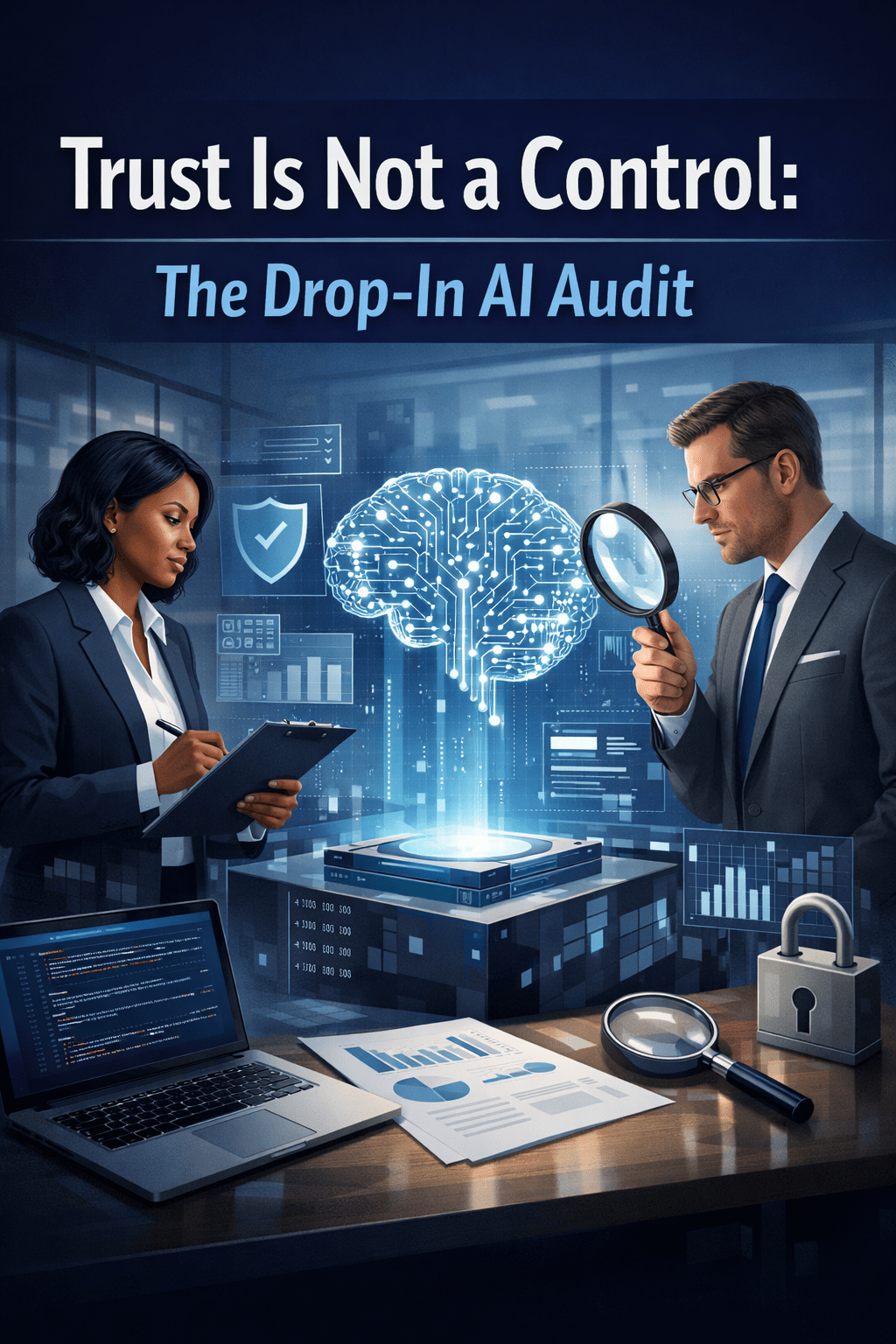
Trust Is Not a Control: The Drop-In AI Audit

There is a hard truth at the center of modern AI governance that every compliance professional needs to confront: trust is not a control. For too long, organizations have approached AI oversight with a familiar but outdated mindset. They collect a vendor certification. They review a policy statement. They ask whether a third party is “aligned” with a recognized framework. Then they move on, assuming the governance box has been checked. In today’s enforcement and risk environment, that approach is no longer good enough.

The Department of Justice has repeatedly made this point in its Evaluation of Corporate Compliance Programs. The DOJ does not ask whether a company has a policy on paper. It asks whether the program is well designed, whether it is applied earnestly and in good faith, and, most importantly, whether it works in practice. That final phrase matters. Works in practice. It is the dividing line between performative governance and effective governance.

That is why every compliance program now needs a drop-in AI audit. It is not simply another diligence exercise. It is a mechanism for proving that governance is real. It is a practical third-party risk tool. And it is one of the clearest ways to operationalize the ECCP in the age of artificial intelligence.

The Problem: Third-Party AI Risk Is Moving Faster Than Oversight

Most companies do not build every AI capability internally. They rely on vendors, service providers, cloud platforms, embedded applications, analytics partners, and other third parties whose tools increasingly shape business processes and compliance outcomes. In many organizations, these third parties now influence investigations, due diligence, monitoring, onboarding, reporting, customer interactions, and internal decision-making. That creates a new class of third-party risk.

The problem is not only whether a vendor has responsible AI language in its contract or whether it can point to a certification. The problem is whether your organization can verify that the relevant controls are functioning as represented in the real-world use case affecting your business. That is where too many compliance programs still fall short.

Under the ECCP, the DOJ asks whether a company’s risk assessment is updated and informed by lessons learned. It asks whether the company has a process for managing risks presented by third parties. It asks whether controls have been tested, whether data is available to compliance personnel, and whether the company can demonstrate continuous improvement. These are not abstract questions. They go directly to how you oversee AI-enabled third parties. If your third-party AI governance begins and ends with a questionnaire and a PDF certification, you do not have evidence of governance. You have evidence of intake.

What a Drop-In Audit Really Does

A drop-in AI audit changes the question from “What does the third party say?” to “What can the third party prove?” That is a profound shift.

The value of the drop-in audit is that it brings compliance discipline directly into third-party AI oversight. Instead of accepting broad claims about safety, control, and alignment, you examine operational evidence. Instead of relying solely on design statements, you test for performance in practice. Instead of treating governance as a one-time approval event, treat it as a repeatable audit process. In that sense, the drop-in audit becomes proof of governance.

It also becomes a far more mature third-party risk tool. You are no longer merely assessing whether a vendor appears sophisticated. You are assessing whether a third party can withstand scrutiny on the questions that matter most: scope, controls, traceability, escalation, and evidence.

And from an ECCP perspective, that is precisely the point. The DOJ has emphasized that compliance programs must move beyond paper design into operational reality. A drop-in audit is one of the few mechanisms that let you do that in a disciplined, documentable way.

From Vendor Oversight to Third-Party Governance

This discipline should not be limited only to classic vendors. The better view is to expand the concept across all third parties that provide, influence, host, or materially shape AI-enabled services. That includes software providers, outsourced service partners, embedded AI functionality in enterprise tools, cloud-based analytics environments, compliance technology vendors, and any external party whose systems affect business-critical decisions or regulated processes.

Risk does not care about the label on the contract. If the third party’s AI affects your organization’s screening, monitoring, investigations, decision support, or disclosures, the compliance risk is real. Your governance process must be equally real. This is why “trust but verify” is no longer just a slogan. It is a design principle for third-party oversight of AI.

The Core Elements of the Drop-In Audit

A strong drop-in audit has three features: sampling, contradiction testing, and escalation.

1. Sampling: Evidence of Operation, Not Merely Design

Sampling is where governance becomes tangible. A company requests specific artifacts tied to actual use cases and actual control operations. This may include scope documents, Statements of Applicability, system documentation, training data summaries, access controls, incident records, runtime logs, or evidence of human review. The point is simple: operational evidence is what matters.

This is where a compliance function moves from hearing about controls to seeing them in action. It is also where internal audit can add real value by testing whether the evidence supports the stated control environment.

2. Contradiction Testing: Where Real Risk Emerges

This is one of the most important and underused concepts in third-party AI oversight. Inconsistencies between claims and reality are where governance failures emerge. If a third party says its certification covers a given service, does the scope document confirm it? If it claims strong incident response, does the record back it up? If it represents strong human oversight, do the runtime traces show meaningful intervention or only theoretical review points?

Contradiction testing is powerful because it goes to credibility. It tests whether the governance narrative matches the operating reality. Under the ECCP, that is exactly the kind of inquiry prosecutors and regulators will care about. It speaks to effectiveness, honesty, and control discipline.

3. Escalation: Governance in Action

Governance without consequences is not governance. A drop-in audit must include clear escalation triggers. Missing evidence, mismatched certification scope, unexplained gaps, unresolved incidents, or inconsistent remediation should not be noted in isolation. They should trigger action.

That action may include enhanced diligence, contractual remediation, independent validation, temporary use restrictions, or deeper audit review. The important point is that the program responds. This is where the drop-in audit becomes operationalizing the ECCP. It demonstrates that the company not only identifies risk but also acts on it.

How the Drop-In Audit Maps to the ECCP

The drop-in audit aligns tightly with the DOJ’s framework for an effective compliance program. Risk assessment is addressed because the audit focuses attention on where AI-enabled third parties create actual operational and control exposure. Policies and procedures are tested because the company does not merely accept them at face value. It assesses whether the stated controls are supported by evidence. Third-party management is strengthened by making oversight continuous, risk-based, and verifiable. Testing and continuous improvement are built into the audit process, which identifies gaps, contradictions, and corrective actions. Investigation and remediation principles are reinforced by documenting, escalating, and using findings to improve the control environment.

Most importantly, the audit answers the ECCP’s central practical question: Does the program work in practice?

How the Drop-In Audit Maps to NIST AI RMF

The NIST AI Risk Management Framework provides a highly useful structure for the drop-in audit, especially through its Govern, Map, Measure, and Manage functions.

  1. Governance is reflected in defined ownership, accountability, and escalation when issues are identified.
  2. A map is reflected in understanding the third party’s actual AI use case, scope, dependencies, and business impact.
  3. The measure is reflected in the use of evidence, runtime observations, contradiction testing, and performance assessment.
  4. Management is reflected in remediation, ongoing oversight, and updates to controls based on audit findings.

In this way, the drop-in audit becomes a practical tool for taking the NIST AI RMF from concept to execution.

How the Drop-In Audit Maps to ISO/IEC 42001

ISO/IEC 42001 adds the management-system discipline that compliance programs need. Its value lies in documented scope, role clarity, control applicability, monitoring, corrective action, and continual improvement. A drop-in audit fits naturally into that structure because it tests whether those elements are visible in operation, not merely stated in documentation.

The Statement of Applicability becomes meaningful when the company verifies that the controls identified there actually correspond to the deployed service. Monitoring becomes meaningful when evidence is examined. Corrective action becomes meaningful when gaps trigger follow-up. Continual improvement becomes meaningful when findings are fed back into governance. That is why the documentation you generate should serve your board, regulators, and internal stakeholders without additional work. Producing evidence that travel is one of the most strategic benefits of this approach.

Why Every Compliance Program Needs This Now

The strategic payoff is straightforward. Strong AI governance is not a drag on innovation. It is what allows innovation to scale with trust. A drop-in audit gives compliance and internal audit a mechanism to test what matters, document their findings, and create evidence that withstands scrutiny. It moves governance from assertion to proof. It transforms third-party diligence into a repeatable, auditable process. It helps ensure that when regulators, boards, or business leaders ask how the company knows its third-party AI governance is working, there is a real answer.

Because, in the end, evidence of governance matters. Not narratives. Not slide decks. Evidence. President Reagan was right in the 1980s, and he is still right today: “Trust but verify.”

Categories
Blog

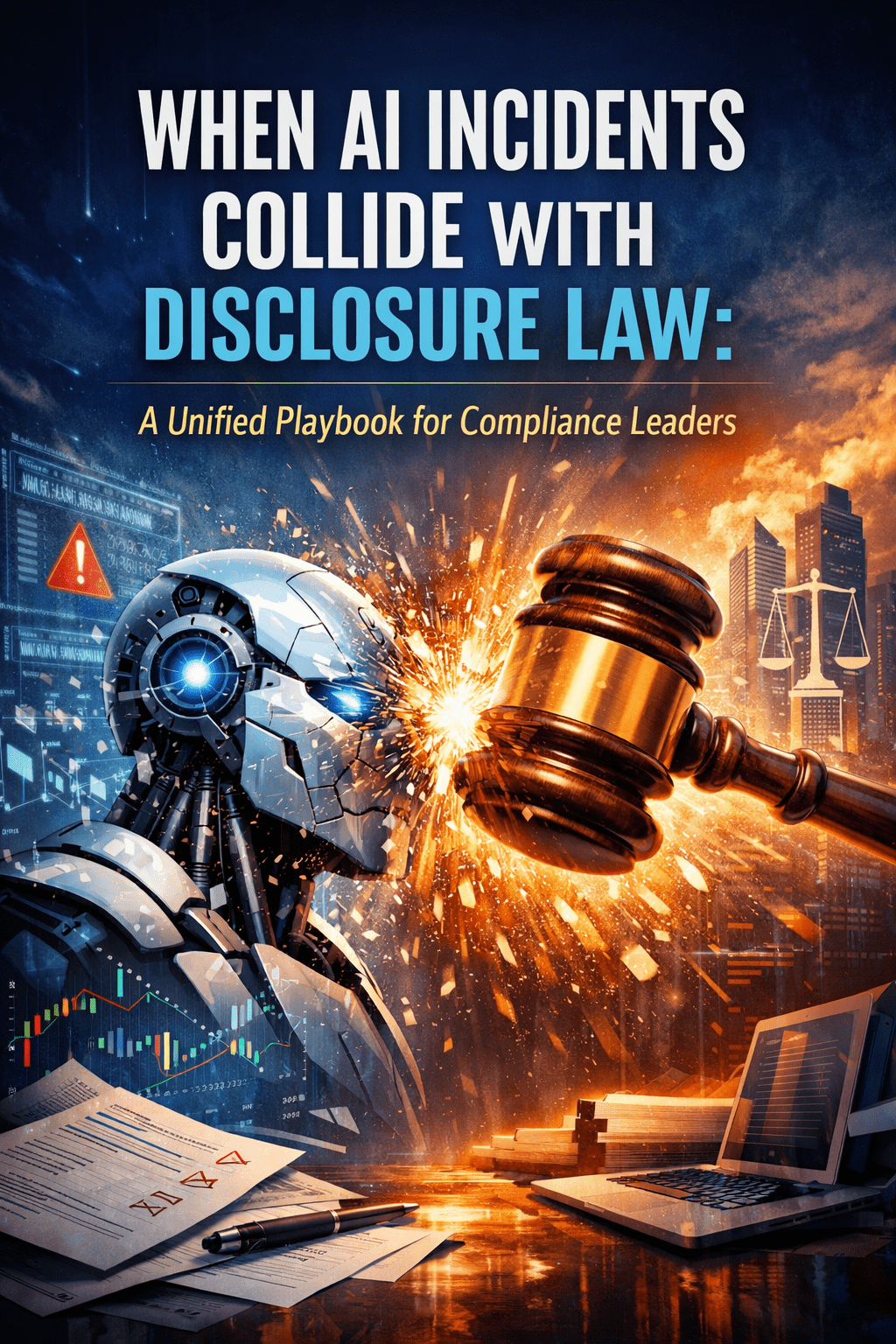
When AI Incidents Collide with Disclosure Law: A Unified Playbook for Compliance Leaders

There was a time when the risk of artificial intelligence could be discussed as a forward-looking innovation issue. That time has passed. AI governance now sits squarely at the intersection of operational risk, regulatory enforcement, and securities disclosure. For compliance professionals, the question is no longer whether AI risk will mature into a board-level issue. It already has.

If your organization deploys high-risk AI systems in the European Union, you face post-market monitoring and serious incident reporting obligations under the EU AI Act. If you are a U.S. issuer, you face potential Form 8-K disclosure obligations under Item 1.05 when a cybersecurity incident becomes material. Add the NIST AI Risk Management Framework for severity evaluation, ISO 42001 governance expectations for evidence and documentation, and the compliance function, which stands at the crossroads of law, technology, and investor transparency.

The challenge is not understanding each framework individually. The challenge is integrating them into one operational escalation model. Today, we consider what that means for the Chief Compliance Officer.

The EU AI Act: Post-Market Monitoring Is Not Optional

The EU AI Act requires providers of high-risk AI systems to implement post-market monitoring systems. This is not a paper exercise. It requires structured, ongoing collection and analysis of performance data, including risks to health, safety, and fundamental rights. Where a “serious incident” occurs, providers must notify the relevant national market surveillance authority without undue delay. A serious incident includes events that result in death, serious harm to health, or a significant infringement of fundamental rights. The obligation is proactive and regulator-facing. Silence is not an option.

This means that if your AI-enabled hiring tool systematically discriminates, or your AI-driven medical device produces dangerous outputs, you may face mandatory reporting obligations in Europe even before your legal team finishes debating causation. The compliance implication is straightforward: you need an operational definition of “serious incident” embedded inside your incident response process. Waiting to interpret the statute after the event is not governance. It is risk exposure.

SEC Item .05: The Four-Business-Day Clock

Across the Atlantic, the Securities and Exchange Commission (SEC) has made its expectations equally clear. Item 1.05 of Form 8-K requires disclosure of material cybersecurity incidents within four business days after the registrant determines the incident is material. Here is where compliance professionals must lean forward: AI incidents can trigger cybersecurity implications. Data exfiltration through model vulnerabilities, adversarial manipulation of training data, or unauthorized system access to AI infrastructure may constitute cybersecurity incidents.

The clock does not start when the breach occurs. It starts when the company determines materiality. That determination must be documented, defensible, and timestamped. If your AI governance framework does not feed into your materiality assessment process, you have a structural weakness. Compliance must ensure that AI incident severity assessments are directly connected to the legal determination of materiality. The board will ask one question: When did you know, and what did you do? You must have an answer supported by contemporaneous documentation.

NIST AI RF: Speaking the Language of Severity

The NIST AI Risk Management Framework provides the operational vocabulary compliance teams need. Govern, Map, Measure, and Manage are not theoretical constructs. They form the backbone of defensible severity assessment. When an AI incident arises, you must evaluate:

  • Scope of affected stakeholders
  • Magnitude of operational disruption
  • Likelihood of recurrence
  • Financial exposure
  • Reputational harm

This impact-likelihood matrix is what transforms noise into signal. It allows the organization to distinguish between model drift requiring retraining and systemic failure requiring regulatory notification. Importantly, severity classification must not be left solely to engineering teams. Compliance, legal, and risk must participate in the evaluation. A purely technical assessment may underestimate regulatory or investor impact.

If the NIST severity rating is high-impact and high-likelihood, escalation must be automatic. There should be no debate about whether the issue reaches executive leadership. Governance means predetermined thresholds, not ad hoc discussions.

ISO 42001: If It Is Not Logged, It Did Not Happen

ISO 42001, the emerging AI management system standard, adds another layer of discipline: documentation. It requires structured governance, defined roles, documented controls, and demonstrable evidence of monitoring and incident handling. For compliance professionals, this is where audit readiness becomes real. When regulators ask for logs, you must produce:

  • Model version identifiers
  • Training data provenance
  • Decision traces and outputs
  • Operator interventions
  • Access logs and export records
  • Timestamps and system configurations

In other words, you need a chain of custody for AI decision-making. Without logging discipline, you will not survive regulatory scrutiny. Worse, you will not survive shareholder litigation. ISO 42001 forces organizations to treat AI systems with the same governance rigor as financial controls under SOX. That alignment should not surprise anyone. Both concern trust in automated decision systems.

One Incident, Multiple Obligations

Consider a practical scenario. A vulnerability in a third-party model component has compromised your AI-driven customer analytics platform. Sensitive customer data is exposed. The compromised system also produced biased credit scores during the attack window. You now face:

  • Potential serious incident reporting under the EU AI Act
  • Cybersecurity disclosure analysis under SEC Item 1.05
  • Data protection obligations under GDPR
  • Internal audit review of governance controls
  • Reputational fallout

If your organization handles each of these as separate tracks, you will lose time and coherence. Instead, you need a unified incident command structure with embedded regulatory triggers. As soon as the issue is identified, you preserve logs. Within 24 hours, severity scoring occurs under NIST criteria. Within 48 hours, the legal team evaluates materiality. By 72 hours, the evidence packet is assembled for board review. The board should receive:

  • Incident timeline
  • Severity classification
  • Regulatory reporting analysis
  • Financial exposure estimate
  • Remediation plan

This is not overkill. This is operational discipline.

The Board’s Oversight Obligation

Boards are increasingly being asked about AI governance. Institutional investors want transparency. Regulators want accountability. Plaintiffs’ lawyers want leverage. Directors should demand:

  1. Clear definitions of serious AI incidents.
  2. Pre-established escalation thresholds.
  3. Integrated disclosure decision protocols.
  4. Evidence preservation policies aligned with ISO standards.
  5. Regular tabletop exercises involving AI scenarios.

If your board has not run an AI incident simulation that includes SEC disclosure timing and EU reporting triggers, it is time to schedule one. Calm leadership during a crisis does not happen spontaneously. It is built through preparation.

The CCO’s Moment

This convergence of AI regulation and securities disclosure creates an opportunity for compliance professionals. The CCO can position the compliance function as the integrator between engineering, legal, cybersecurity, and investor relations. That requires proactive steps:

  • Embed AI into enterprise risk assessments.
  • Update incident response playbooks to include AI-specific triggers.
  • Align AI logging architecture with evidentiary standards.
  • Train leadership on materiality determination for AI incidents.
  • Report AI governance metrics to the board quarterly.

The compliance function should not be reacting to AI innovation. It should be shaping its governance architecture.

Governance Is Strategy

Too many organizations treat AI governance as defensive compliance. That mindset is outdated. Effective governance builds trust. Trust drives adoption. Adoption drives competitive advantage.

A well-documented post-market monitoring system demonstrates operational maturity. A disciplined severity assessment process demonstrates strong internal control. Transparent disclosure builds investor confidence. Conversely, fragmented incident handling erodes credibility. The market will reward companies that demonstrate responsible AI oversight. Regulators will scrutinize those who do not.

Conclusion: Integration Is the Answer

The EU AI Act, SEC Item 1.05, NIST AI RMF, and ISO 42001 are not competing frameworks. They are complementary lenses on the same reality: AI systems create risk that must be monitored, measured, disclosed, and documented.

Compliance leaders who integrate these frameworks into a single escalation and reporting architecture will protect their organizations. Those who treat them as separate checklists will struggle. AI risk is no longer hypothetical. It is operational, regulatory, and financial. The compliance function must be ready before the next incident occurs. Because when it does, the clock will already be ticking.