Categories
Blog

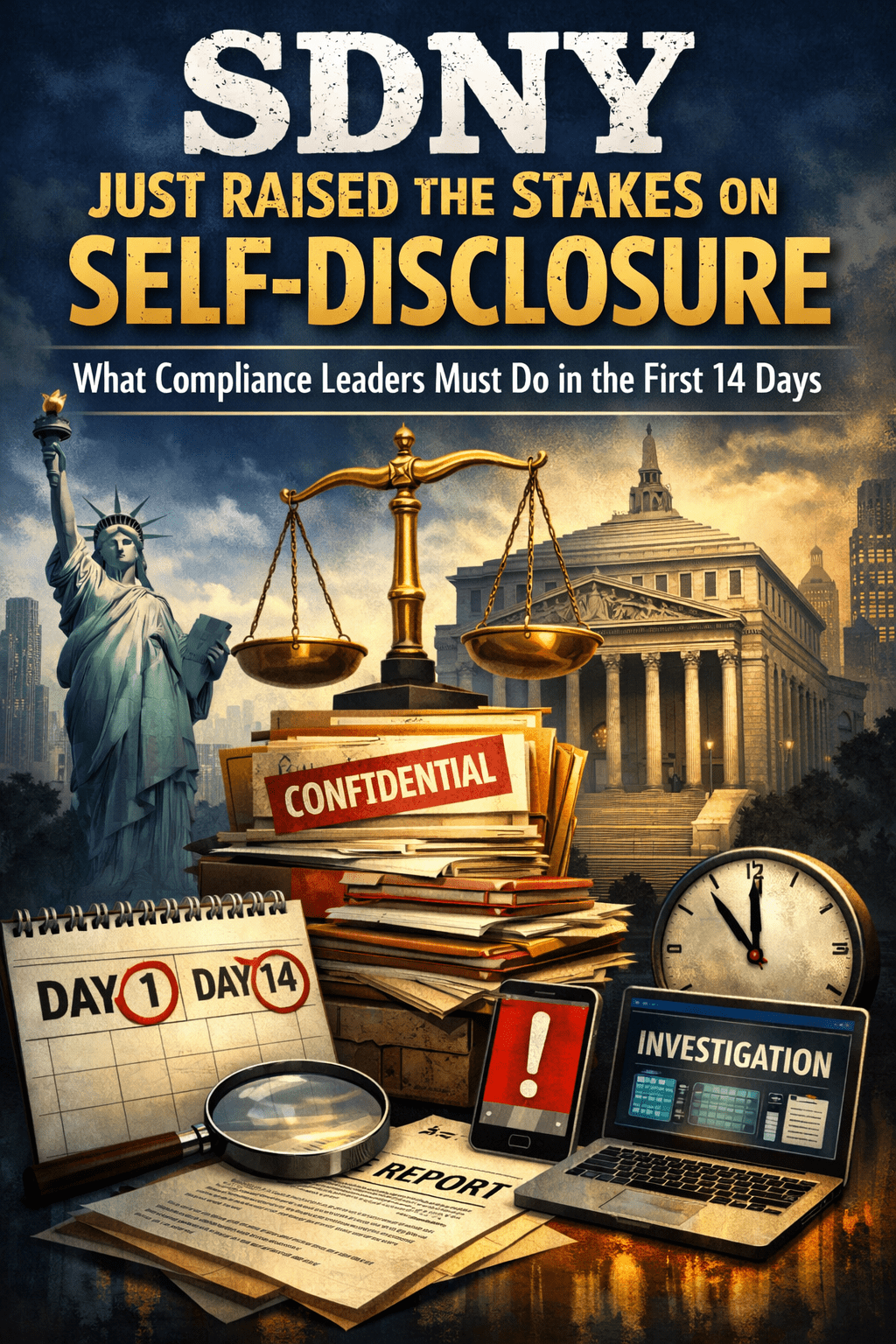
SDNY Just Raised the Stakes on Self-Disclosure: What Compliance Leaders Must Do in the First 14 Days

For years, compliance leaders have worked under a simple reality: if the government learns about a problem from someone else first, you have already lost leverage. The Southern District of New York (SDNY) just sharpened that reality into a clear, public framework. Its Corporate Enforcement and Voluntary Self-Disclosure Program for Financial Crimes, effective February 24, 2026, is not subtle. It is designed to force an earlier decision and reward companies that make it; this means making it fast, transparent, and with meaningful remediation and restitution.

This is not just a fraud prevention or reporting program. It reaches conduct that can show up in any company: accounting games, deceptive disclosures, market-facing misconduct, and the broader universe of financial crime risks that sit adjacent to bribery-and-corruption controls. If you are running a compliance program, you should read this initiative as a warning: even when the underlying misconduct is not charged as “bribery,” the financial-crimes hook is often where prosecutors live. You may think you are managing “corruption risk.” SDNY is telling you it is also “market integrity” and “victim harm” risk.

And SDNY is pairing that message with something rare in enforcement policy: speed. SDNY says qualifying companies “can expect to receive a conditional declination letter within two to three weeks of self-reporting”. That is a flashing sign for CCOs: the window for decision-making just got smaller.

The SDNY is pushing fiduciary duty and stewardship.

Business executives usually talk about self-disclosure as a tactical choice. Compliance professionals have long known better, and now the SDNY frames it as something deeper: governance and duty. The program states that corporate leaders are “fiduciaries” with a “fundamental duty” to ensure integrity and transparency, and it positions voluntary self-disclosure as a core act of good corporate citizenship and stewardship. It will be interesting to see whether this “fundamental duty” to ensure integrity and transparency, and the corporate leaders as ‘fiduciaries’, bring a new level of Caremark scrutiny to Delaware.

That language matters. It is not only prosecutors describing a pathway to leniency. It is prosecutors telling boards and executives what they believe ethical leadership requires when the company discovers misconduct that harms markets, counterparties, customers, or investors. In other words, SDNY is trying to turn self-disclosure into a leadership test.

The Carrot is Real and Designed to Change Behavior

SDNY’s incentives are intentionally strong. If a company meets the program requirements, including timely voluntary self-disclosure, full cooperation, and timely remediation, the SDNY says it will issue a declination and will not prosecute the company. It also states that there will be no criminal fine and that, if the company pays appropriate restitution to victims, SDNY will not require forfeiture. Even more significant for compliance leaders is the following: SDNY says it “generally will not require” an independent compliance monitor for a qualifying company.

Those are meaningful benefits. They are the kind of benefits that can change what a board is willing to authorize in the first two weeks of a crisis. But the benefits only matter if you can move fast enough, gather credible facts, and maintain control of the narrative.

The First 14 Days: what compliance leaders should do now, not later

If SDNY is telling you it can issue a conditional declination letter in “two to three weeks”, then your internal process cannot take three weeks to decide whether you even have a problem. The ethical governance move is to treat the first 14 days as a disciplined sprint, one that protects truth, protects victims, and protects the integrity of your program.

Days 1–2: Triage without spinning

Your first obligation is to stop the bleeding and preserve facts. That means:

  • immediate escalation into a controlled response team (Compliance, Legal, Finance, Internal Audit, IT/security, and, if needed, HR),
  • an evidence preservation hold that includes chat platforms, mobile devices, third-party messaging, deal rooms, and personal email, where permitted, and
  • a decision to ring-fence relevant individuals, accounts, and transactions so you do not create new harm.

Ethically, this is where senior leadership proves it wants the truth, not just a version of it.

Days 3–5: Board notice and decision rights

If you are waiting for “certainty” before you brief the board or a board committee, you are already behind the SDNY clock. The goal is not to accuse. The goal is to establish governance: decision rights, cadence, and oversight. SDNY’s fiduciary framing means this cannot be treated as a management-only event. The board must be positioned to make an informed decision on disclosure, remediation, and restitution as facts develop.

Days 6–10: Outside counsel, scoped investigation, and credibility building

This is when you decide whether to engage outside counsel and forensic support to ensure independence and speed. For SDNY purposes, credibility is currency. The company needs to show it can:

  • Identify the misconduct,
  • identify who was involved,
  • quantify harm, including victims and losses,
  • explain control failures, and
  • demonstrate remediation beyond “we are reviewing policies.”

Remember: SDNY’s program is built around concrete action, self-reporting, cooperation, remediation, and restitution. If your internal processes create delays and ambiguity, you are squandering the very benefits SDNY offers.

Days 11–14: Regulator strategy and the self-disclosure decision

This is the moment of ethical leadership. You will not know everything. You will know enough to determine whether misconduct occurred and whether it falls into a category SDNY will view as market-harming or integrity-compromising. SDNY is offering a structured benefit for early self-reporting, but it is also signaling that waiting for a subpoena is not a strategy.

Five Lessons for the Compliance Professional

Lesson 1: SDNY is reframing self-disclosure as a fiduciary duty rather than optional crisis PR.

The program’s emphasis on leaders as “fiduciaries” with a “fundamental duty” of integrity and transparency is a direct ethical challenge to boards and executives. If your organization treats disclosure solely as a legal risk calculation, SDNY is telling you that you have already missed the governance point.

Lesson 2: Speed is now a moral and operational requirement.

The “two to three weeks” commitment to a conditional declination letter is SDNY saying: “Do not slow-walk the truth.” In compliance terms, timeliness is not merely a matter of efficiency. It is ethical stewardship. Delay increases harm, increases victim loss, and increases the chance that someone else tells your story first.

Lesson 3: Restitution is not a side issue; it is a core ethical outcome.

SDNY’s program explicitly states that paying “appropriate restitution to victims” is central, and it links that to the decision not to pursue forfeiture. Compliance leaders should read this as a directional signal: the government is measuring corporate ethics by whether the company makes harmed parties whole, not merely by whether it updates a policy.

Lesson 4: The benefits are real, but they are earned through cooperation and remediation that changes behavior.

No prosecution, no fine, and generally no monitor are extraordinary incentives. But SDNY is also telling you what it values: companies that step forward, cooperate fully, remediate quickly, and do not play games with facts. Ethically, this is “clean hands” enforcement: if you want mercy, show you deserve it.

Lesson 5: Some conduct is simply disqualifying, and compliance must stop pretending every risk is manageable with process.

SDNY calls out aggravating circumstances that can make a company ineligible for a declination under the program. The list includes conduct tied to terrorism, sanctions evasion, foreign corruption, trafficking, cartels, forced labor, violence, and related financing or laundering. That matters because it draws an ethical boundary: there are categories of wrongdoing so corrosive that the “cooperate and remediate” story is not enough. For CCOs, the lesson is to build escalation protocols that treat these risks as existential and non-negotiable.

A Blunt Wake-up Call: The Cost of Not Self-Reporting is Going Up

SDNY is trying to end the era of corporate hesitation. The program signals that a company’s decision not to self-report will weigh heavily against it when prosecutors later assess resolutions. This is the part compliance leaders must say out loud internally: the old playbook of “let us wait and see” is increasingly incompatible with how prosecutors say they will exercise discretion. If your organization has not pre-built a rapid disclosure decision tree, you are asking to miss the window SDNY is dangling in front of you. You will not get the benefit of a program you were not prepared to use.

Conclusion: Compliance and Ethics that Move at Prosecutorial Speed

The SDNY initiative is not merely a new memo. It is a redefinition of what “responsible corporate conduct” looks like in real time. It asks boards and senior executives to behave like fiduciaries: to choose integrity and transparency early, to protect victims through restitution, and to treat cooperation and remediation as proof that the company is worthy of trust. For the compliance professional, the message is simple and uncomfortable: your program will not be judged by the elegance of your policies. It will be judged by whether your leadership can tell the truth quickly, act with stewardship, and make hard decisions when the facts are incomplete but the duty is clear.
Categories
Compliance Into the Weeds

Compliance into the Weeds: NPAs, Escalation and Ethics in Competing

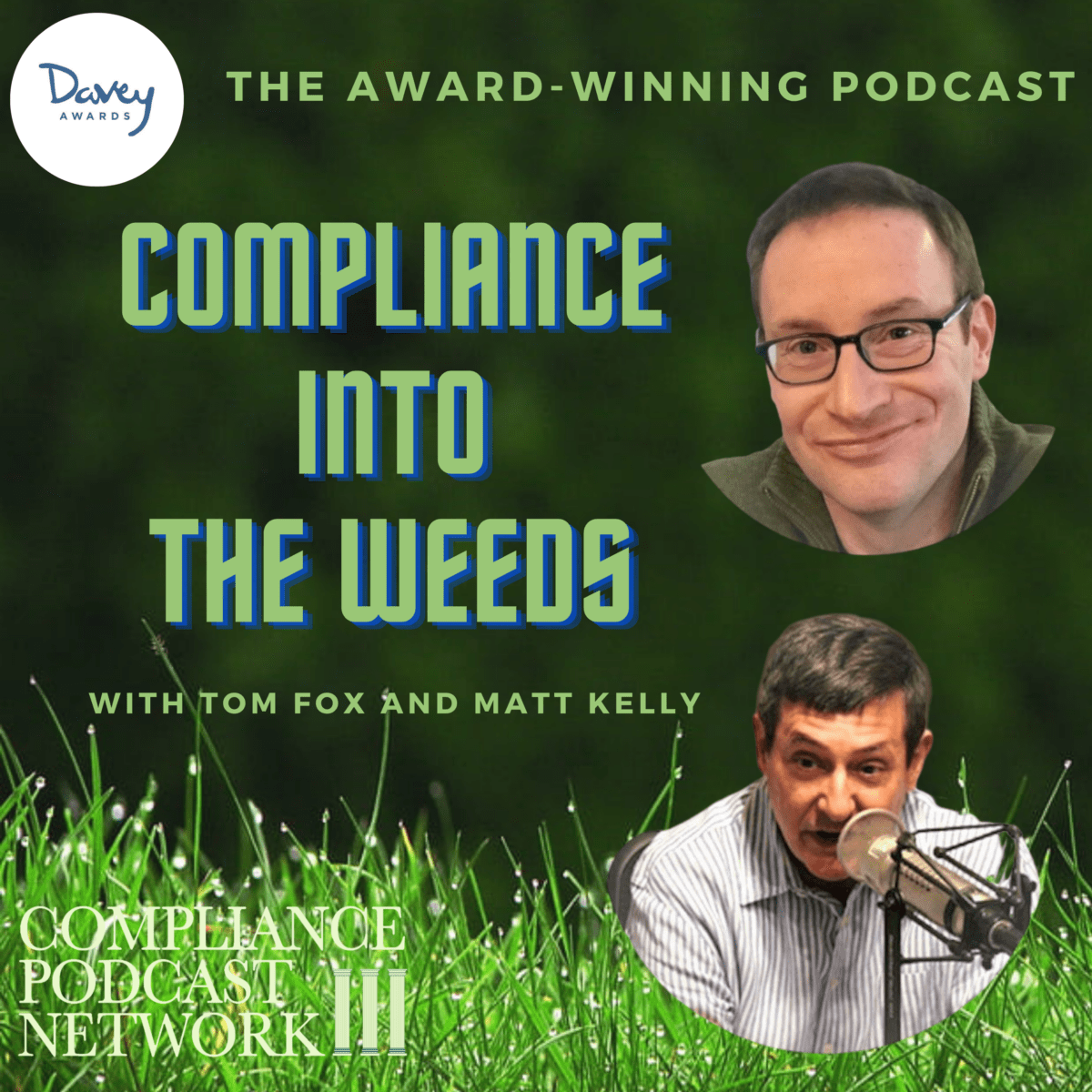
The award-winning Compliance into the Weeds is the only weekly podcast that takes a deep dive into a compliance-related topic, literally going into the weeds to explore it more fully. Looking for some hard-hitting insights on compliance? Look no further than Compliance into the Weeds! In this episode of Compliance into the Weeds, Tom Fox and Matt Kelly look at three recent stories to draw compliance lessons for the future.

They discuss significant developments in compliance, focusing on Jay Clayton’s recent speech regarding FCPA enforcement and the implications for companies. They also analyze a case involving the termination of compliance officers at Scotiabank for failing to escalate concerns about insider trading. The conversation concludes with a reflection on athlete decision-making in the context of injuries and the lessons for corporate compliance practices.

Key highlights:

  • Jay Clayton’s Speech and White Collar Crime Prosecution
  • Compliance Officers and Escalation Failures at Scotiabank
  • Ethics in Sports: Decision-Making and Compliance Lessons

Resources:

Matt in Radical Compliance

Tom

Instagram

Facebook

YouTube

Twitter

LinkedIn

A multi-award-winning podcast, Compliance into the Weeds was most recently honored as one of the Top 25 Regulatory Compliance Podcasts, a Top 10 Business Law Podcast, and a Top 12 Risk Management Podcast. Compliance into the Weeds has been conferred a Davey, a Communicator Award, and a W3 Award, all for podcast excellence.

Categories
Compliance Into the Weeds

Compliance into the Weeds: The End of Self-Disclosure? The Criminal Indictment of Smartmatic

The award-winning Compliance into the Weeds is the only weekly podcast that takes a deep dive into a compliance-related topic, literally going into the weeds to explore a subject more fully. Looking for some hard-hitting insights on compliance? Look no further than Compliance into the Weeds! In this episode of Compliance into the Weeds, Tom Fox and Matt Kelly discuss the rare occurrence of a company, Smartmatic, being added to an existing indictment for FCPA violations.

They explore the unusual circumstances surrounding this case, including the political sensitivity of Smartmatic, its ongoing litigation with Fox News, and the potential implications for corporate voluntary self-disclosure under the current administration. They delve into the changes in DOJ criteria for FCPA prosecutions and raise concerns about selective prosecution and the broader impact on compliance strategies.

Key highlights:

  • Overview of Smart Medic Indictment
  • Political Context and Conspiracy Theories
  • Implications for Compliance and Self-Disclosure
  • Concerns About Selective Prosecution

Resources:

Tom

Instagram

Facebook

YouTube

Twitter

LinkedIn

A multi-award-winning podcast, Compliance into the Weeds was most recently honored as one of the Top 25 Regulatory Compliance Podcasts, a Top 10 Business Law Podcast, and a Top 12 Risk Management Podcast. Compliance into the Weeds has been conferred a Davey, Communicator, and W3 Award, all for podcast excellence.

Categories
FCPA Compliance Report

FCPA Compliance Report – Self-Disclosure on Both Sides of the Atlantic

Join Tom Fox as he welcomes Simon Airey and Caitlin Sheard, partners at McDermott Will & Schulte, and both experts in the fields of investigation and compliance from both sides of the Atlantic. They take a deep dive into issues around self-disclosure on both sides of the Atlantic.

Simon Airey and Caitlin Sheard are leading experts in the field of investigations and compliance, each bringing a nuanced perspective to the complexities of self-reporting to the Department of Justice (DOJ) in the US and the Serious Fraud Office (SFO) in the UK. Simon, a distinguished barrister, underscores the incentives for companies to self-report but cautions that the process is fraught with complexities, particularly in the UK, where court approval is required for deferred prosecution agreements. Caitlin highlights the potential benefits of self-disclosure, such as possible declinations, but notes the associated costs, including time, legal fees, and reputational risks. Both experts emphasize the necessity of strategic planning and legal counsel to navigate the intricacies of international compliance, particularly in light of increasing enforcement activity and evolving legal landscapes.

Key highlights:

  • Incentives for Self-Disclosure in DOJ and SFO
  • Strategic Self-Disclosure Consideration for Legal Cases
  • Cross-Border Self-Disclosure Strategies for Companies
  • Global Challenges in Corporate Self-Disclosure Processes
  • Whistleblower Tips Driving Future FCPA Enforcement

Resources:

 McDermott, Will & Schulte

Simon Airey

Caitlin Sheard

Cross-Atlantic Impact: DOJ and SFO Self-Reporting and Enforcement Priorities

Tom Fox

Instagram

Facebook

YouTube

Twitter

LinkedIn

For more information on the use of AI in Compliance programs, my new book, Upping Your Game, is available. You can purchase a copy of the book on Amazon.com.

Categories
Data Driven Compliance

Data Driven Compliance – Navigating Self-Disclosure Under the FTPF and Updated ECCT

Welcome to Season 2 of the award-winning Data Driven Compliance. In this new season, we will look at the new Failure to Prevent Fraud offense. Join host Tom Fox as we explore this new law and how to comply with it through the lens of data-driven compliance. This podcast is sponsored by konaAI. In this episode of Season 2, Tom is joined by Simon Airey and Caitlyn Sheard, partners at McDermott Will & Schulte LLP, and both experts in the fields of investigation and compliance from both sides of the Atlantic.

We take a deep dive into their recent article, ‘Cross Atlantic Impact, DOJ and SFO, Self-Reporting and Enforcement Priorities,’ exploring the critical topic of self-disclosure in the context of both U.S. and UK jurisdictions. The discussion covers the incentives for self-reporting under the DOJ’s updated policies, the Serious Fraud Office’s new guidance on voluntary disclosure in the UK, and the broadening scope of anti-economic crime laws, including the UK’s significant changes effective from 2023. The conversation highlights the complexities and strategic challenges companies face in making self-disclosure decisions, the emerging enforcement focus on cartels and economic crimes, and the ongoing robust enforcement of anti-corruption laws such as the FCPA and the UK Bribery Act.

Key highlights:

  • Discussion on Self-Disclosure Incentives
  • Challenges and Implications of Self-Disclosure
  • Changes in UK Law and Its Impact
  • Global Self-Disclosure Strategies

Resources:

McDermott Will & Schulte LLP

Simon Airey

Caitlin Sheard

Cross-Atlantic Impact: DOJ and SFO Self-Reporting and Enforcement Priorities

Click here for konaAI White Paper Rethinking Compliance: Practical Steps for Adapting to the UK’s New Fraud Legislation

Connect with Tom Fox on LinkedIn

Categories
FCPA Compliance Report

FCPA Compliance Report – 10 Core Principles for Effective Internal Investigations with Michelle Peirce

Welcome to the award-winning FCPA Compliance Report, the longest-running podcast in compliance. In this episode, Tom Fox welcomes Michelle Peirce from Hinckley Allen, where she co-chairs the White Collar and Government Enforcement Group.

They take a deep dive into Michelle’s article on the 10 Core Principles Common to Internal Investigations, discussing topics such as the importance of understanding the investigation’s purpose, maintaining privilege, the role of an engagement letter, deciding between written reports and verbal summaries, and the significance of billing and internal communications. Michelle also shares her insights from her professional background, including her experience as a special assistant district attorney, and touches on current pressures on compliance tied to self-disclosure to the DOJ. The conversation offers a comprehensive guide for organizations on conducting successful internal investigations.

Key highlights:

  • Role and Challenges in Internal Investigations
  • Core Principles of Internal Investigations
  • Importance of Privilege and Engagement Letters
  • Written vs. Verbal Reports
  • Order and Structure of Investigations
  • Professionalism and Billing in Investigations

Resources:

Michelle Peirce on LinkedIn

Michelle Peirce at Hinckley Allen

10 Core Principles Common to Internal Investigations

Tom Fox

Instagram

Facebook

YouTube

Twitter

LinkedIn

For more information on the use of AI in compliance programs, my new book is Upping Your Game. You can purchase a copy of the book on Amazon.com.

Categories
Blog

The Updated CEP: Is Real Credit Finally Here?

Matthew R. Galeotti, Head of the Criminal Division at the U.S. Department of Justice (DOJ), recently delivered a speech at SIFMA’s Anti-Money Laundering and Financial Crimes Conference. Contemporaneously, the DOJ issued a Memo (the Galeotti Memo) entitled Focus, Fairness, and Efficiency in the Fight Against White-Collar Crime. I have explored both in previous blog posts. Today, I want to review the Corporate Enforcement and Voluntary Self-Disclosure Policy (CEP) updates. It provides a roadmap for how companies can earn leniency when they self-report wrongdoing. And in an increasingly unforgiving regulatory landscape, that roadmap is worth its weight in gold.

Under the CEP, a company that voluntarily self-discloses, fully cooperates, and timely remediates can qualify for a declination of prosecution, provided there are no aggravating circumstances. This is the reaffirmation of a multi-year DOJ effort to garner more self-disclosures. It gives compliance professionals something real to bring to the C-suite: if we invest in robust compliance and proactively address issues, we can avoid criminal prosecution altogether.

What if aggravating factors exist, such as senior-level involvement or prior misconduct? If the company cooperates and remediates in good faith, the policy still provides for reduced penalties, non-prosecution agreements, and shorter resolution terms. In other words, the DOJ offers a “near miss” safety net for companies that fall short of full eligibility but act responsibly.

The takeaway is clear: Compliance is not just a cost center but a value driver. The CEP recognizes that companies should be rewarded for coming forward, cooperating, and fixing problems. That means compliance professionals must build systems that detect misconduct early, encourage internal reporting, and enable swift action. When a crisis hits, your response will not just shape your company’s future; it may be the difference between a decline and a prosecution.

Voluntary Self-Disclosure

The DOJ’s Criminal Division strongly encourages companies to voluntarily self-disclose potential misconduct as early as possible, even before completing an internal investigation. To qualify under the CEP, a disclosure must meet several key criteria: it must be made to the Criminal Division (or in good faith to another DOJ component involved in the resolution), concern previously unknown misconduct, not be required by any existing legal obligation, and occur before any imminent threat of disclosure or government investigation arises. Additionally, the disclosure must be made within a “reasonably prompt” timeframe, with the company bearing the burden of proving timeliness.

The DOJ proposes a limited exception for the new Corporate Whistleblower Awards Pilot Program. Suppose a whistleblower reports misconduct internally and to the DOJ. In that case, a company may still qualify for the presumption of declination, but only if it self-discloses to the DOJ within 120 days of the internal report and meets all other voluntary disclosure conditions.

This guidance underscores the urgency and importance of real-time reporting mechanisms, strong internal controls, and rapid compliance response protocols. Timely self-disclosure is not just encouraged; it is now a strategic imperative in mitigating enforcement risk.

What is Full Cooperation?

To earn full cooperation credit under the CEP, a company must go beyond the general requirements of the Principles of Federal Prosecution of Business Organizations (Justice Manual 9-28.000) and meet six key obligations:

  1. Disclosure of All Relevant Facts: A company must share all non-privileged, relevant facts it knows, including facts about individuals responsible for the misconduct, regardless of their rank, whether internal or external to the company.
  2. Timely and Specific Information Sharing: This includes facts obtained through any internal investigation, updates during that investigation, and specific attributions of facts to sources. The company must also clearly identify all involved parties.
  3. Proactive Cooperation: Companies must voluntarily disclose relevant facts, even if prosecutors do not specifically request them. They are also expected to alert the DOJ to any avenues of obtaining evidence not in the company’s possession but known to them.
  4. Preservation and Disclosure of Documents: Relevant documents, including overseas ones, must be preserved, collected, and produced. Companies must detail such documents’ origin, custodians, and locations; facilitate third-party productions; and provide necessary translations. The company must prove the restriction if foreign law prevents disclosure and suggest viable alternatives.
  5. De-confliction: Companies must avoid actions that might interfere with DOJ investigations. If requested, they must delay certain investigative steps, such as employee interviews, for a narrowly tailored period to protect DOJ priorities.
  6. Availability of Individuals for Interviews: Subject to constitutional protections, companies must make current and former employees (including those overseas) available for DOJ interviews and facilitate third-party interviews where possible.

These standards ensure that cooperation is meaningful, timely, and valuable to the DOJ’s efforts, rewarding companies that truly support investigations with favorable outcomes under the CEP.

Timely and Appropriate Remediation

Under the CEP, timely and appropriate remediation is a non-negotiable component of earning cooperation credit and potentially avoiding prosecution. And for compliance professionals, it is a clarion call to action. First, the company must conduct a root cause analysis, a genuine examination of what went wrong, why, and how to prevent it from happening again. It’s not about blaming a few bad apples but addressing systemic issues that allowed the misconduct to take root. Did a cultural blind spot develop in a high-risk market? Was there a breakdown in oversight or a failure to escalate red flags? The DOJ expects thoughtful answers and corrective action.

Second, the company must demonstrate an effective compliance and ethics program tailored to its risk profile, business model, and resources. That means more than having policies on the books. DOJ evaluators are looking at leadership’s commitment, compliance’s access to the board, compensation tied to ethical performance, and real-time testing of program effectiveness. Box-checking won’t cut it.

Third, accountability is key. Companies must appropriately discipline wrongdoers, including those who failed in their supervisory duties, and ensure they retain and safeguard business records, including communications on personal devices and ephemeral apps.

Finally, remediation includes showing that the company understands the seriousness of the misconduct and is proactively reducing future risk. This is about culture, not cosmetics.

In short, remediation is proof of your values in action. It is the difference between performative compliance and real commitment. Suppose you’re building a credible compliance program in today’s enforcement environment. In that case, remediation must be embedded in your DNA because the DOJ is watching, and your organization’s future may depend on how you respond.

Providing Cooperation Credit

Finally, there is the cooperation credit. Hopefully, we have finally moved past the Kenneth Polite formulation of super, double-secret, undefined “we know it when we see it” cooperation. Cooperation credit here will be earned through demonstrable, high-quality, timely actions. Cooperation is assessed on a sliding scale based on how extensively and effectively a company supports the government’s investigation. Once a company meets the minimum threshold for cooperation, prosecutors evaluate factors such as scope, quantity, quality, timing, and the overall impact of the cooperation provided.

Importantly, cooperation credit starts at zero and increases only with meaningful contributions, and there is no presumption of full credit. The DOJ now distinguishes between cooperation levels by varying the starting point within the U.S. Sentencing Guidelines fine range, and the percentage of fine reduction awarded. Companies that delay cooperation may significantly reduce their potential credit.

Waiver of attorney-client privilege or work product protections is not required to receive cooperation credit. If a company claims its financial condition limits its ability to cooperate, it must provide supporting documentation. The DOJ will carefully evaluate any such claims. Ultimately, the message is clear: to earn meaningful credit, cooperation must be real, proactive, and sustained. But at least it is now defined and not “We know it when we see it.”

Resources:

CRM White Collar Enforcement Plan

Revised CEP

CRM Monitor Memo

Categories
Blog

A New Era of White-Collar Enforcement

Matthew R. Galeotti, Head of the Criminal Division at the U.S. Department of Justice (DOJ), recently delivered a speech at SIFMA’s Anti-Money Laundering and Financial Crimes Conference. Galeotti outlined crucial changes in the DOJ’s approach to corporate enforcement. For compliance professionals, it was the first major speech by a DOJ representative touching on issues important to the corporate compliance community. It represents a paradigm shift that requires immediate attention, reflection, and strategic recalibration.

As compliance professionals, our mission goes beyond merely ensuring adherence to rules and regulations; it is about aligning ethical conduct with business excellence. Galeotti’s remarks clearly state that the DOJ recognizes compliance teams as indispensable allies in maintaining integrity and national security. Today, I want to explore the key insights and crucial lessons learned from Galeotti’s landmark address for compliance professionals.

Proactivity in Self-Disclosure is Paramount

The Criminal Division’s revised Corporate Enforcement and Voluntary Self-Disclosure Policy (CEP) underscores a clear incentive structure. Companies that voluntarily self-disclose, fully cooperate, timely remediate, and demonstrate no aggravating circumstances will not merely be presumed eligible but will definitively qualify for a declination. As Galeotti emphasized, “Self-disclosure is key to receiving the most generous benefits the Criminal Division can offer.”

The days of companies hesitating to self-disclose due to uncertainty about consequences are (hopefully) numbered. Compliance programs must prioritize internal monitoring and foster a culture where issues surface rapidly, are transparently addressed, and are communicated proactively to authorities. The DOJ now promises more certainty, with the carrot being a declination, not ambiguity. For compliance teams, the action is clear: establish robust internal reporting mechanisms and ensure swift escalation processes.

DOJ Clarifies Incentives for Partial or Late Disclosures

The revised policy also addresses a longstanding area of anxiety. What happens when a company comes forward after the DOJ has initiated an inquiry or self-discloses late? Galeotti clarified that even companies that disclose “not quickly enough” are eligible for significant benefits, including a Non-Prosecution Agreement (NPA) of fewer than three years, up to a 75% fine reduction, and no monitor requirement.

Compliance professionals should seize this clarity to advocate internally for transparency, even if belated. Organizations must understand that delayed disclosure still carries significant benefits compared to complete silence. This new clarity enhances the compliance professional’s ability to negotiate internally, ensuring corporate leaders understand the tangible benefits of transparency, even under challenging circumstances.

Expect a Narrower and More Focused DOJ Enforcement

Galeotti explicitly intended to shift the Criminal Division’s focus to the priorities of administrative enforcement. These schemes harm individual Americans, defraud government programs, and exploit financial systems to facilitate international crime. The DOJ now pledges to target resources precisely rather than spreading them thin through overly broad or protracted investigations. Galeotti succinctly encapsulated the rationale: “Excessive enforcement and unfocused corporate investigations stymie innovation, limit prosperity, and reduce efficiency.”

This presents an opportunity for compliance programs to fine-tune their internal risk assessments and investigative frameworks. Compliance professionals must ensure internal investigative resources are equally precise and strategic, aligning clearly with the DOJ’s focus areas. In short, avoid distraction; concentrate your vigilance on risks that matter most to regulators.

Reconsideration of Corporate Monitorships

One of the most consequential announcements is the reconsideration of the DOJ’s policy on corporate monitorships. Galeotti recognized that monitors can sometimes impose excessive financial and operational costs. Going forward, monitorships will be narrower in scope, tightly tailored, and deployed selectively only when benefits outweigh costs.

This is welcome news for compliance professionals, as corporate monitorship can be an unpleasant experience for a corporation and a compliance function. This change empowers compliance teams to advocate for internal investment in compliance improvements over external oversight. Compliance leaders should proactively develop internally led remediation and monitoring plans to demonstrate to regulators that the company has comprehensive capabilities to ensure compliance without burdensome external monitoring.

However, when a monitor is necessary, compliance professionals now have clear factors to prepare for DOJ review, including the severity of the underlying conduct, existing regulatory oversight, efficacy and maturity of compliance programs, and a demonstrated culture of compliance. Companies must document continuous improvement efforts clearly and transparently, making a strong case that external monitoring is redundant.

Corporate Whistleblower Programs Elevated in Importance

Lastly, Galeotti underscored the DOJ’s expanded whistleblower program, adding specific priority areas for whistleblower tips, including procurement fraud, trade and tariff violations, immigration violations, and sanction violations supporting terrorist groups or transnational criminal organizations.

The clear lesson here is the criticality of robust internal whistleblower programs. Compliance professionals must champion strong, accessible, secure, and confidential internal whistleblower policies to encourage employees to report concerns internally first. Organizations that fail to nurture internal reporting channels may receive external regulator attention first. Whistleblower programs should no longer be viewed solely as legal necessities; they must be strategic initiatives central to corporate integrity and national security.

A Call to Action for Compliance Professionals

Galeotti’s address represents a clear change in the DOJ’s approach. Compliance professionals have long desired a regulatory environment that rewards proactive transparency and practical self-governance, and the DOJ now offers this.

However, clarity and pragmatism from the DOJ require reciprocal clarity and pragmatism within corporate compliance programs. Compliance leaders must leverage these new DOJ policies to advocate internally for stronger compliance investments, clearer internal communication channels, and faster reporting protocols.

The DOJ’s message to compliance professionals is clear: You are our frontline partners in protecting integrity and national security. Self-reporting, effective remediation, and robust internal compliance structures will not merely shield your company from punitive enforcement; they represent pathways to tangible benefits and increased corporate resilience.

As compliance evangelists, we must seize this moment. Strengthen your internal mechanisms, streamline your reporting protocols, and reaffirm to your organizations that compliance excellence is not merely defensive but strategically beneficial.

Matthew Galeotti’s remarks provide the road map; it is incumbent on the compliance community to lead the way forward.

We will explore the attendant policy releases announced with the publication of Galeotti’s speech. Over the remainder of the week, we will consider the following:

CRM White Collar Enforcement Plan

Revised CEP

CRM Monitor Memo

Categories
FCPA Compliance Report

FCPA Compliance Report: Exploring DOJ’s New Whistleblower Incentive Program with Mary Inman

Welcome to the award-winning FCPA Compliance Report, the longest running podcast in compliance. In this edition of the FCPA Compliance Report, Tom Fox welcomes back Mary Inman, Partner at Whistleblower Partners LLC, to discuss the new DOJ Whistleblower Incentive Program.

Tom and Mary discuss the DOJ’s New Whistleblower Incentive Program’s aim to fill gaps in existing reward programs and its focus areas, including financial institution violations, foreign and domestic corruption, and healthcare offenses. Mary highlights some criticisms of the program, such as lack of a reward floor and the cap on rewards, and the potential challenges and impacts on corporate compliance. They also talk about the interplay between whistleblowers, DOJ, and corporate investigations, and the potential for adaptation of the program based on stakeholder feedback.

Highlights in this Episode:

  • DOJ Whistleblower Incentive Program Overview
  • Four Focus Areas of the New Program
  • Challenges and Criticisms of the Program
  • Concerns About Reward Mechanisms
  • Race to DOJ: Whistleblowers vs. Corporations
  • Implications for Corporate Compliance

Resources:

Mary Inman on LinkedIn

Whistleblower Partners

Tom Fox

Instagram

Facebook

YouTube

Twitter

LinkedIn

For more information on the Ethico ROI Calculator and a free White Paper on the ROI of Compliance, click here.

Categories
Compliance Into the Weeds

Compliance into the Weeds: The DOJ Whistleblower Incentive Program

The award winning, Compliance into the Weeds is the only weekly podcast which takes a deep dive into a compliance-related topic, literally going into the weeds to more fully explore a subject.

Looking for some hard-hitting insights on compliance? Look no further than Compliance into the Weeds!

In this episode, Tom Fox and Matt Kelly take a deep dive into the recently announced Department of Justice (DOJ) Whistleblower Incentive Program.

Last week, the DOJ announced a whistleblower pilot program, offering monetary rewards to whistleblowers who report corporate misconduct. Whistleblowers can receive up to 30% of the net proceeds of a settlement resulting from their tip. The program covers various types of corporate crime, including bribery, healthcare fraud, and Foreign Corrupt Practices Act (FCPA) violations.

This program puts pressure on compliance programs to quickly investigate and address reported misconduct. It also raises questions about how whistleblowers will be rewarded in cases where there is a declination or non-prosecution agreement. The SEC case involving a whistleblower award highlights the importance of handling whistleblower reports effectively.

Key Highlights:

  • DOJ Announces Whistleblower Pilot Program
  • Covering Various Types of Corporate Misconduct
  • Tension Between Self-Reporting and Whistleblower Reporting
  • Recent SEC whistleblower award as a cautionary tale

Resources:

Matt in Radical Compliance 

Tom

Instagram

Facebook

YouTube

Twitter

LinkedIn