Categories
FCPA Compliance Report

FCPA Compliance Report – The Role of Culture and Data in Fraud Risk Management: A Conversation with Vincent Walden

Welcome to the award-winning FCPA Compliance Report, the longest-running podcast in compliance. This is a very special episode. Today, Tom Fox cross-posts an episode from the BCG Podcast. In it, host Hanjo Siebert visits with konaAI CEO Vince Walden. They discuss the critical role of data and culture in achieving effective compliance, exploring the importance of interdepartmental collaboration, the evolving compliance landscape, and real-world examples of fraud detection. Walden emphasizes that while strategy is important, a strong organizational culture is essential for successful execution. He explains how data serves as a transparency agent and outlines the need for a collective approach to managing fraud risk. Listen in to gain insights into the challenges and best practices in modern compliance.

Key highlights:

  • The Importance of Transaction Monitoring
  • Challenges in Fraud Risk Management
  • Collaborative Approaches to Compliance
  • konaAI Role in Modern Compliance
  • Real-World Fraud Cases and Lessons Learned
  • The Impact of Business Culture on Fraud Prevention
  • Fostering a Culture of Transparency

Resources:

Vince Walden on LinkedIn

konaAI

Original Podcast Recording

Tom Fox

Instagram

Facebook

YouTube

Twitter

LinkedIn

For more information on the use of AI in Compliance programs, see my new book, Upping Your Game. You can purchase a copy of the book on Amazon.com.

Categories
FCPA Compliance Report

FCPA Compliance Report – Upping Your Game in Compliance

Welcome to the award-winning FCPA Compliance Report, the longest-running podcast in compliance. This is a very special episode. This podcast comes from a webinar hosted by KonaAI on Tom Fox’s latest book, Ûpping Your Game. On this webinar, Tom is joined by Vince Walden, CEO of konaAI; Hemma Lomax, Deputy General Counsel, Vice President, Global Head of Ethics and Compliance at Docusign; and Carl Hahn and Matt Galvin, both from Gentic Global Advisors PLLC.

The discussion revolves around compliance, with thought leaders delving into how organizations can enhance their performance by utilizing emerging technologies and compliance strategies. The conversation begins with a focus on the transformative role of AI in compliance, highlighting its ability to support continuous monitoring, predictive analytics, and embedding compliance into day-to-day business operations. The panel emphasizes the rise of “compliance as a service” and the growing need to prioritize user experience, particularly in third-party risk management and digital transformations. The panel addresses key challenges, such as overcoming resistance from business process owners, and emphasizes the importance of using data strategically to drive better compliance outcomes. The panel introduces the concept of the “Office of Unlock” as a collaborative model to break down silos and promote agility. They also discuss change management, AI governance, and tailoring compliance communications to specific audiences. The episode concludes with practical advice for compliance officers and a forward-looking discussion on aligning compliance programs with evolving organizational and regulatory landscapes.

Key highlights:

  • Upping Your Game
  • Embedded Compliance
  • What’s the business value?
  • What steps should you take right now

Resources:

Hemma Lomax on LinkedIn

Vince Walden on LinkedIn

Matt Galvin on LinkedIn

Carl Hahn on LinkedIn

KonaAI

Gentic Global Advisors

Tom Fox

Instagram

Facebook

YouTube

Twitter

LinkedIn

For more information on the use of AI in compliance programs, see Tom Fox’s new book, Upping Your Game. You can purchase a copy of the book on Amazon.com.

Categories
Blog

Who Owns Transactions and Controls Monitoring? Lessons for Compliance Professionals

In his recent article, Who Owns Transaction and Controls Monitoring? published in Fraud Magazine, author Vince Walden explored the challenges of assigning responsibility for transaction and control monitoring within organizations. He emphasized the risks of assuming “someone else” is responsible for fraud detection and prevention, particularly within high-risk areas like accounts payable, accounts receivable, and employee expenses. This issue is both a wake-up call and a call to action for corporate compliance professionals. Here are the key lessons from the article and how compliance professionals can implement them in their programs.

Establish Ownership of Fraud Risk Management

One of the central themes is the importance of clearly assigning responsibility for fraud risk management across the organization. Walden cited the Fraud Risk Management Guide’s recommendation that one executive-level member of management be assigned ultimate responsibility for the fraud risk program. This clarity is essential to ensuring accountability and effectiveness.

You can establish this critical element by appointing a dedicated executive to lead your effort. Identify a senior executive sponsor, such as the Chief Compliance Officer (CCO) or Chief Risk Officer (CRO), to oversee the fraud risk management program. This individual should have a comprehensive understanding of fraud risks and process-level controls. The next move is to formalize a governance framework by creating a fraud risk management committee that includes leaders from compliance, finance, HR, IT, internal audit, and other key departments. Ensure this committee meets regularly to review risks and oversee fraud prevention initiatives.

Embrace a Multidisciplinary Approach

Walden highlighted the value of a committee-based, multidisciplinary approach to fraud risk. This structure fosters collaboration and ensures that diverse perspectives are brought to bear on identifying and mitigating fraud risks. Engage multiple stakeholders across multiple corporate functions. Bring together representatives from functions such as internal audit, compliance, legal, finance, and IT to collaborate on fraud detection and prevention strategies. Next, develop cross-functional training to provide fraud awareness training tailored to the unique responsibilities of each department, ensuring that everyone understands their role in mitigating fraud risks.

Align with the Three Lines Model

The “Three Lines Model,” updated by The Institute of Internal Auditors (IIA), provides a framework for distributing fraud risk management responsibilities. Walden underscores the importance of leveraging this model to enhance accountability and effectiveness. The three lines are:

  • First Line. Operational managers and staff should focus on implementing fraud prevention controls in daily processes.
  • Second Line. Compliance and risk management professionals should provide oversight, monitor emerging risks, and design advanced fraud detection tools.
  • Third Line. Internal audits should independently assess the effectiveness of fraud prevention and detection efforts.

The key is effective collaboration. You must ensure seamless communication and coordination among the three lines to prevent gaps in oversight.

Leverage Data and Technology

Walden emphasized the critical role of data-driven monitoring in ineffective fraud prevention. He noted that relying solely on internally generated data, such as surveys, is insufficient. Instead, organizations must analyze transactional data from enterprise systems and external sources. There will be a need for some investment, as you will need to deploy advanced compliance analytics platforms that can process data from enterprise resource planning (ERP) systems, accounting software, and third-party due diligence systems. Implement tools that provide real-time insights into transactional data, identifying unusual patterns or red flags indicative of fraud. Develop in-house expertise by training compliance teams to analyze and interpret complex datasets, enabling them to identify fraud risks proactively.

 Cultivate a Culture of Accountability

Fraud prevention is most effective when it is embedded within the organizational culture. Walden noted that visible and engaged leadership is critical to fostering such a culture. Once again, the fundamental ‘Tone at the Top’ must be set. Senior leaders should regularly communicate their commitment to ethical behavior and fraud prevention. This could include messages from the CEO or board-level discussions on fraud risk. Public recognition should be given to your organization’s Fraud Champions. The Department of Justice’s recommendations on monetary awards under anti-corruption compliance are equally valid in the anti-fraud realm, as you should reward employees who identify and report fraud risks, reinforcing the importance of vigilance and accountability. In training, fraud awareness should be integrated into onboarding by making fraud prevention a core part of employee onboarding and ongoing professional development.

Ensure Proactive Monitoring and Response

Walden stressed that fraud risk management cannot be reactive. Compliance professionals must take a proactive approach, using data and technology to monitor risks continuously. It begins and continues with regular fraud risk assessments to identify high-risk areas and prioritize monitoring efforts. Using these timely fraud risk assessments, develop a robust risk management response plan to ensure your organization has clear protocols for investigating and addressing suspected fraud, including escalation procedures and communication plans.

Final Thoughts

Walden’s insights powerfully remind us that fraud risk management is a shared responsibility. Compliance professionals can play a pivotal role in protecting their organizations from fraud and other risks by adopting a multidisciplinary approach, leveraging data-driven tools, and fostering a culture of accountability.

To be effective, these strategies must be implemented thoughtfully and consistently. Start by assessing your current fraud risk management framework and identifying gaps. Then, build on these lessons to create a program that meets regulatory expectations and strengthens your organization’s resilience against fraud. As Walden succinctly puts it: “If it isn’t you, an anti-fraud professional, who monitors and oversees high-risk transactions, then who should it be?” This is a question every compliance professional must ponder and address proactively.

Categories
FCPA Compliance Report

FCPA Compliance Report: Vince Walden on Leveraging Data Analytics for Effective Compliance Monitoring

Welcome to the award-winning FCPA Compliance Report, the longest running podcast in compliance.

In this edition of the FCPA Compliance Report, Tom Fox welcomes back Vince Walden, founder of KonaAI. Vince reports on the 2024 Update to the Evaluation of Corporate Compliance Programs. (Today’s episode is a cross-posting from Data Driven Compliance.)

Walden, a distinguished expert in compliance data analytics, actively participates in industry forums such as the Society of Corporate Compliance and Ethics annual summit in Grapevine, Texas. He advocates for compliance professionals to have ample access to relevant data sources, enabling them to monitor and test policies, controls, and transactions effectively. Walden stresses the importance of AI developers being vigilant about potential biases and public harm, aligning with the Department of Justice’s stance on accountability. He advises compliance practitioners to collaborate with internal audit and finance teams to ensure they have the necessary transactional data for comprehensive risk assessments, highlighting successful, cost-effective implementations like those at Albemarle as models for gradual, data-driven compliance program adoption.

Highlights in this Episode

  • Data-Driven Compliance for Cost Savings
  • Enhancing Compliance through Advanced Data Analysis
  • Identifying High-Risk Areas for Data Analytics
  • Proactive Risk Mitigation through Real-Time Monitoring
  • ROI-driven Compliance Programs with Data Analytics

Resources

Vince Walden on LinkedIn

KonaAI

Tom Fox

Instagram

Facebook

YouTube

Twitter

LinkedIn

For more information on the Ethico Toolkit for Middle Managers, available at no charge by clicking here.

Categories
Data Driven Compliance

Data-Driven Compliance: The DOJ Mandate on Transforming Compliance Through Data Analytics and AI with Vince Walden

Are you struggling to keep up with the ever-changing compliance programs in your business? Look no further than the award-winning Data Driven Compliance podcast, hosted by Tom Fox, is a podcast featuring an in-depth conversation around the uses of data and data analytics in compliance programs. Data Driven Compliance is back with another exciting episode. Today, Vince Walden, founder of KonaAI, the sponsor of this podcast, returns to talk about the recent speech by Nicole Argentieri and the release of the 2024 Update to the Evaluation of Corporate Compliance Programs (ECCP).

Walden shares insights from the Nicole Argentieri’s keynote and ECCP update, emphasizing the DOJ’s focus on data access in compliance. We explore the importance of utilizing both compliance and business data for effective fraud and risk management. Walden underscores the necessity for compliance professionals to collaborate with internal audit and finance departments, advocating for a risk-based approach to data analytics and continuous controls monitoring. The discussion also delves into leveraging AI and machine learning to improve compliance efficacy and overall business operations, arguing for the proportional allocation of resources to match the company’s sophistication level.

Key Highlights:

  • DOJ’s Focus on Data Access
  • Understanding Compliance Data Analytics
  • Training Compliance Officers on Data
  • Implementing Continuous Controls Monitoring
  • Cost Savings and ROI in Compliance
  • Proportionate Resource Allocation
  • Documentation and Transparency

Resources:

Vince Walden on LinkedIn

KonaAI

Tom Fox 

Connect with me on the following sites:

Instagram

Facebook

YouTube

Twitter

LinkedIn

Categories
Compliance Week Conference Podcast

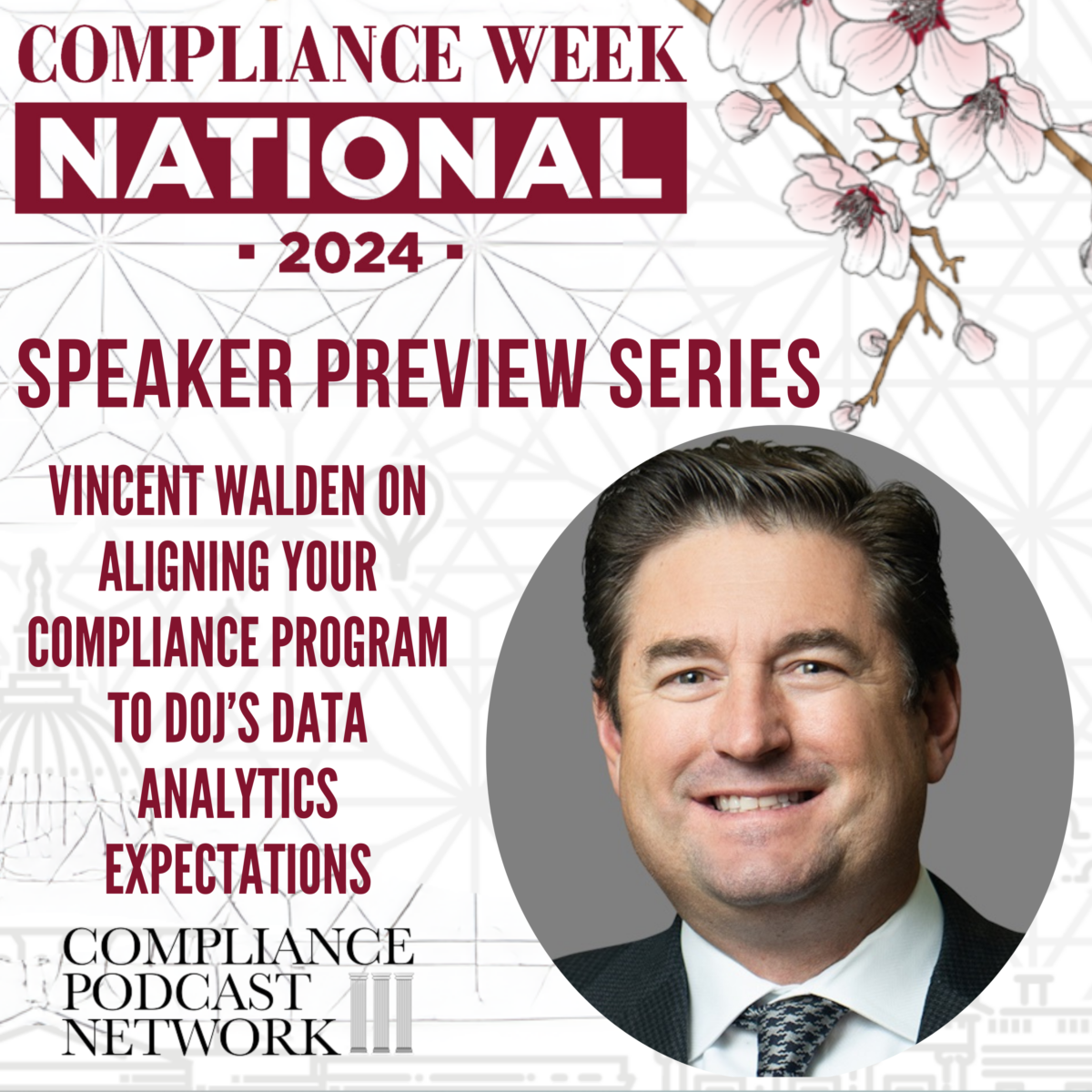
Compliance Week 2024 Speaker Preview Podcast – Vince Walden on the Latest in DOJ Data Analytics Expectations

In this episode of the Compliance Week 2024 Speaker Preview Podcasts series, Vince Walden discusses his panel at Compliance Week 2024, “Aligning your Compliance Program to DOJ’s Data Analytics Expectations.” Some of the issues he will discuss in this podcast and his presentation are:

  • The latest words from the DOJ on data analytics
  • How will the DOJ use data analytics going forward?
  • Seeing old friends and learning about new best practices at Compliance Week 2024

I hope you can join me at Compliance Week 2024. This year’s event will be held April 2-4 at the Westin Washington, DC, Downtown. The line-up is first-rate, with some top ethics and compliance practitioners around.

Gain insights and make connections at the industry’s premier cross-industry national compliance event, offering knowledge-packed, accredited sessions and take-home advice from the most influential leaders in the compliance community. Back for its 19th year, join 500+ compliance, ethics, legal, and audit professionals who gather to benchmark best practices and gain the latest tactics and strategies to enhance their compliance programs. Compliance, ethics, legal, and audit professionals will gather safely face-to-face to benchmark best practices and gain the latest tactics and strategies to enhance their compliance programs, among many others, to:

  • Network with your peers, including C-suite executives, legal professionals, HR leaders, and ethics and compliance visionaries.
  • Hear from 80+ respected cross-industry practitioners, including CEOs, CCOs, regulators, federal officials, and practitioners, to help inform and shape the strategic direction of your enterprise risk management program.
  • Hear directly from panels on leadership, fraud detection, confronting regulatory change, abiding by cross-border rules and regulations, and the always-favorite fireside chats.
  • Bring actionable takeaways from various session types, including cyber, AI, Compliance, Board obligations, data-driven compliance, and many others, to your program for you to listen, learn, and share.
  • Compliance Week aims to arm you with information, strategy, and tactics to transform your organization and career by connecting ethics to business performance through process augmentation and data visualization.

I hope you can join me at the event. For information on the event, click here. As an extra benefit to listeners of this podcast, Compliance Week is offering a $200 discount on the registration price. Enter the discount code TFOX2024 for $200 off.

The Compliance Podcast Network produces the Compliance Week 2024 Preview Podcast series. Compliance Week sponsors this series.

Categories
Data Driven Compliance

Data Driven Compliance: The Journeys of Albemarle and ABB to Data-Driven Compliance, Part 2

Are you struggling to keep up with the ever-changing compliance programs in your business? Look no further than the award-winning Data-Driven Compliance podcast, hosted by Tom Fox. This podcast features an in-depth conversation around the uses of data and data analytics in compliance programs. Data-Driven Compliance is back with another exciting episode. In this special second part of a two-part podcast, I co-host with Vince Walden, CEO of KonaAI, to visit with our guests Andrew McBride, Chief Risk Officer at Albemarle, and Tapan Debnath, Head of Integrity, Regulatory Affairs, and Data Privacy—Process Automation at ABB, on their respective companies’ journeys to data-driven compliance.

Debnath’s perspective on the challenges and strategies in compliance data analytics is centered on the need for clear goals, defined processes, and the importance of early planning and resource allocation. He sees compliance data analytics as a journey rather than a project, encouraging organizations to start with imperfect data and refine their processes over time. On the other hand, McBride’s perspective is focused on prioritization, resource allocation, and audience-driven decision-making. He emphasizes the iterative nature of data analytics projects and believes that a successful ethics and compliance program does not necessarily require a large data analytics team, but rather the right roles and support from the IT function. Join Tom Fox and Vince Walden as they delve deeper into these insights with Tapan Debnath and Andrew McBride on this episode of Data-Driven Compliance.

Key Highlights:

  • Navigating Data Privacy Laws Across Jurisdictions
  • Strategic Steps in Ethics and Compliance Analytics
  • Unlocking AI’s Potential in Compliance Analytics
  • Actionable Insights from Data Analytics
  • Leveraging Documentation for Enhanced Compliance and Risk Mitigation

Resources:

Vince Walden on LinkedIn

KonaAI

Tom Fox 

Connect with me on the following sites:

Instagram

Facebook

YouTube

Twitter

Categories
Blog

The DOJ on the Need for Compliance Program Data Analytics

The Department of Justice (DOJ) is increasingly utilizing data analytics for proactive enforcement, signaling a significant shift in their approach to combating white-collar crime. This move reflects the recognition of data analytics as a crucial component of compliance programs, extending beyond historical reporting to transactional details and third-party interactions.

Recently, Acting Principal Deputy Assistant Attorney General Nicole M. Argentieri Delivered remarks at the 39th International Conference on the Foreign Corrupt Practices Act (FCPA). She stated, “the Criminal Division has long been an innovator in using data to enhance its investigations and prosecutions. I am proud to announce that we are taking that experience and expertise with data analysis and applying these tools to our FCPA investigations. Through investments in personnel, we have improved our ability to harness and analyze available data — both public and non-public — to identify potential wrongdoing involving foreign corruption. This approach has already generated successful FCPA investigations and prosecutions.” 

In this week’s episode of “Data Driven Compliance,” host Tom Fox and Vince Walden, discussed the importance of data analytics in the DOJ’s enforcement efforts was discussed. Matt Galvin, an expert leading the DOJ’s data analytics initiative, highlighted the proactive use of data to generate cases related to the FCPA and emphasized that this is just the beginning.

The DOJ expects companies to adopt a similar data-driven approach to compliance. Vince Walden, cited to the Argentieri speech where she stated, “just as we are upping our game when it comes to data analytics, we expect companies to do the same.” This expectation extends beyond simply tracking trainings, policies, and investigations. The DOJ’s focus is on monitoring third parties throughout the lifespan of the relationship, not just during the onboarding process.

Walden emphasized that while due diligence and background checks are essential, the real risk of fraud occurs during the actual business transactions with third parties. Therefore, companies need to go beyond initial checks and continuously monitor high-risk vendors, contract terms, and other relevant data sources. By mapping risks to data sources and implementing effective tests, companies can identify and prioritize risky transactions.

The increasing accessibility and cost-effectiveness of data analytics have made it a viable option for companies of all sizes. It can help companies demonstrate effective compliance programs, uncover hidden financial irregularities, and improve overall efficiency. The importance of continuous data analysis in compliance programs was highlighted by the Bank of America enforcement action by the Consumer Financial Protection Bureau (CFPB).

The DOJ’s use of data analytics is not limited to public data available from public companies. They are also leveraging private information, which could potentially include information obtained during investigations within specific industries. The DOJ has made significant investments in technology and resources to enhance their enforcement capabilities, taking inspiration from techniques used in the healthcare division to combat fraud.

However, implementing a data-driven compliance program comes with its own set of challenges. There is still confusion among the compliance community regarding what data analytics entails and how it should be applied. Walden stressed the need for a process-oriented approach rather than treating it as a one-time project. Data analytics should be integrated into the compliance program as a continuous business process, similar to third-party due diligence.

The DOJ’s increasing use of data analytics for proactive enforcement has far-reaching implications. Companies must recognize the importance of adopting a data-driven approach to compliance and invest in the necessary resources and technology. By doing so, they can not only meet the DOJ’s expectations but also improve the effectiveness of their compliance programs and mitigate the risk of fraud.

The DOJ’s increasing use of data analytics for proactive enforcement signifies a significant shift in their approach to combating white-collar crime. Companies must embrace this data-driven approach to compliance, continuously monitor high-risk transactions, and invest in the necessary resources and technology. By doing so, they can demonstrate effective compliance programs, uncover hidden financial irregularities, and improve overall efficiency.

For the full podcast episode, click here.

Categories
Data Driven Compliance

Data Driven Compliance: Current Trends and Innovations

Do you need help keeping up with your business’s ever-changing compliance programs? Look no further than Tom Fox’s award-winning Data-Driven Compliance podcast, which features an in-depth discussion about the uses of data and data analytics in compliance programs. Data-Driven Compliance is back with another exciting episode. Today, we take things differently by posting a webinar sponsored by KonaAI entitled “Data Driven Compliance: Current Trends and Innovations.” Vince Walden hosted Tom Fox and Rayne Towns.

Tom Fox and Rayne Towns are seasoned professionals in the field of compliance. Fox is a leading authority in the industry and the Compliance Podcast Network’s founder. Towns are Nokia’s global head of ethics and compliance, risk, and monitoring. Fox thinks that risk management and fraud prevention strategies based on data are the next steps in the compliance field. He stresses how important data analytics are for making compliance programs work better. He also acknowledges the need for human interpretation and utilization of the data.

On the other hand, Towns sees data-driven compliance strategies to strengthen and improve the compliance program’s effectiveness, using data analytics to identify and address gaps in the compliance program. She also emphasizes the importance of prioritizing and starting with solving specific problems when implementing data analytics. Join Vince Walden, Tom Fox, and Rayne Towns on this Data Driven Compliance podcast episode to learn more about their perspectives on data-driven risk management and fraud prevention compliance strategies.

Highlights Include:

  • Transforming Compliance Through Data Analytics
  • Effective Strategies in Compliance and Risk Management
  • The Role of Data Analytics in M&A Compliance
  • Leveraging diverse data sources for risk assessment
  • Managing Risks: Vendors, Customers, and Employees
  • Strengthening Compliance Programs Through Team Collaboration
  • The Power of Generative AI in Compliance
  • Enhancing Compliance Programs with Predictive Models
  • Factors Influencing Budget Approvals and Getting Budget

 Resources:

KonaAI

 Tom Fox 

Connect with me on the following sites:

Threads

Instagram

Facebook

YouTube

Twitter

LinkedIn

Categories
Blog

Data Driven Compliance: Current Trends and Innovations

Data-driven compliance strategies have become a game-changer in risk management and fraud prevention. I recently had the opportunity to participate in a KonaAi-sponsored webinar entitled “Data Driven Compliance: Current Trends and Innovations.” The event was hosted by Vince Walden and featured Rayne Towns, the Global Head of Risk and Monitoring at Nokia.

I view data-driven compliance strategies in risk management and fraud prevention as an evolution of the compliance profession. It can be seen in the importance of data analytics in improving the effectiveness of compliance programs. There is and will always be the need for human interpretation and utilization of the data. Towns see data-driven compliance strategies as a way to strengthen and improve the compliance program’s effectiveness, using data analytics to identify and address gaps in the compliance program. She also emphasizes the importance of prioritizing and starting with solving specific problems when implementing data analytics. Vince Walden joined in with his perspective on data-driven compliance strategies in risk management and fraud prevention.

Data driven compliance is one more in the evolution of the compliance profession, one more step. Fortunately, we have evolved from when compliance was very much legal driven by lawyers. And over time, most compliance professionals (and equally importantly, the DOJ and SEC) began to view compliance as a business process. As a business process, it can be measured, it can be studied, it can be monitored, and it can be approved based on that information.

We began with the importance of data analytics in compliance programs. The shift towards data-driven compliance has transformed the profession from solely legal-driven to a measurable and improvable business process. This shift has been recognized by the Department of Justice (DOJ) and the Securities and Exchange Commission (SEC). The SEC first called out the use of data analytics, as it did in the Order concluding the Key Energy FCPA enforcement action. Most recently, the Albemarle FCPA resolution specifically called out the company’s use of data analytics in its remediation program, which occurred during the pendency of its FCPA resolution process.

In 2016, the Securities and Exchange Commission called out data analytics in an enforcement action for the first time. It was the Key Energy FCPA enforcement action, where they suggested data analytics would have shown or demonstrated a range of values outside the norm for certain gifts, travel, and entertainment for the company. This demonstrated that regulatory thinking evolved as well. Now, data analytics has become a critical element to improve the business process of compliance. Data driven compliance allows you to measure it, monitor it, and improve it all in a documented fashion so that if a regulator ever comes knocking, you can demonstrate to them not only the effectiveness of your compliance program but also how you are moving your compliance regime forward based on solid data and analysis.

AB InBev was one of the first companies to successfully implement data-driven compliance strategies, moving from detection to prevention of issues. This shift has resulted in cost savings and improved risk management for the company. Equally significant was the company’s public discussion of the BrewRight program and how it evolved into a broader business process tool.

The DOJ always telegraphs what is important to them. Starting 2020 with the 2020 Update to the Evaluation of Corporate Compliance Programs, they said the CCO must have access to all data across an organization. You may have data silos, but a CCO must be able to punch through all of those data silos. It is a natural progression from 2020 to this Albemarle FCPA enforcement action, where the DOJ clearly stated that the company’s data analytics program allowed them to move forward with the remediation.

Moreover, the critical part was that Albemarle was not required to have a monitor. To avoid having a monitor required under the resolution required two things. One, an effective compliance program, but two, testing of it. And the DOJ has made very clear those requirements. Albemarle had an effective compliance program, but more importantly, they have monitored it and tested it through their data analytics program. Their compliance function’s actions saved the company millions. And it tells the rest of us what the DOJ will look for in a compliance program going forward.

Data analytics plays a crucial role in various aspects of compliance, including M&A due diligence and risk assessment. By leveraging external data sources, compliance professionals can gain valuable insights into potential risks associated with vendors, customers, and employees. This information allows them to make informed decisions and mitigate risks effectively.

Compliance professionals must be aware of the importance of data-driven compliance strategies’ impact on decision-making. Using data analytics, compliance professionals can measure, monitor, and improve compliance programs in a documented fashion. This demonstrates the compliance program’s effectiveness and enables organizations to adjust and adapt more quickly to changing regulatory requirements.

However, implementing data-driven compliance strategies comes with its own challenges. Balancing the tradeoffs between automation and manual processes is one such challenge. While automation can streamline compliance processes and identify gaps, manual touches are sometimes necessary. Data analytics can help identify these gaps and drive accountability and training efforts.

There is great potential for new technologies like generative AI and machine learning to enhance compliance programs. These technologies can make compliance processes more efficient and enable better decision-making. For example, generative AI can guide users through dashboards and provide valuable insights, making compliance tasks easier and more effective.

Budget approvals are another crucial consideration for organizations when implementing data-driven compliance strategies. CFOs prioritize keeping the business out of legal risks and fines, fraud prevention and recoveries, and improved internal controls. Data analytics is not just a “nice-to-have” but a “must-have” for organizations. Those that do not embrace data analytics or fail to move towards it are at risk.

In conclusion, data-driven compliance strategies have revolutionized the compliance profession. Organizations can measure, monitor, and improve compliance programs by leveraging data analytics, resulting in cost savings, improved risk management, and better decision-making. While there are challenges associated with implementing data-driven compliance strategies, the benefits far outweigh the tradeoffs. Compliance professionals must embrace data analytics as a critical element of their compliance programs to stay ahead in an ever-evolving regulatory landscape.