Welcome to the Daily Compliance News. Each day, Tom Fox, the Voice of Compliance brings to you compliance-related stories to start your day. Sit back, enjoy a cup of morning coffee, and listen in to the Daily Compliance News. All, from the Compliance Podcast Network. Each day we consider four stories from the business world, compliance, ethics, risk management, leadership, or general interest for the compliance professional.
Tag: Wells Fargo
Welcome to the Daily Compliance News. Each day, Tom Fox, the Voice of Compliance, brings you compliance-related stories to start your day. Sit back, enjoy a cup of morning coffee, and listen to the Daily Compliance News. All from the Compliance Podcast Network. Each day we consider four stories from the business world, compliance, ethics, risk management, leadership, or general interest for the compliance professional.
Stories we are following in today’s edition:

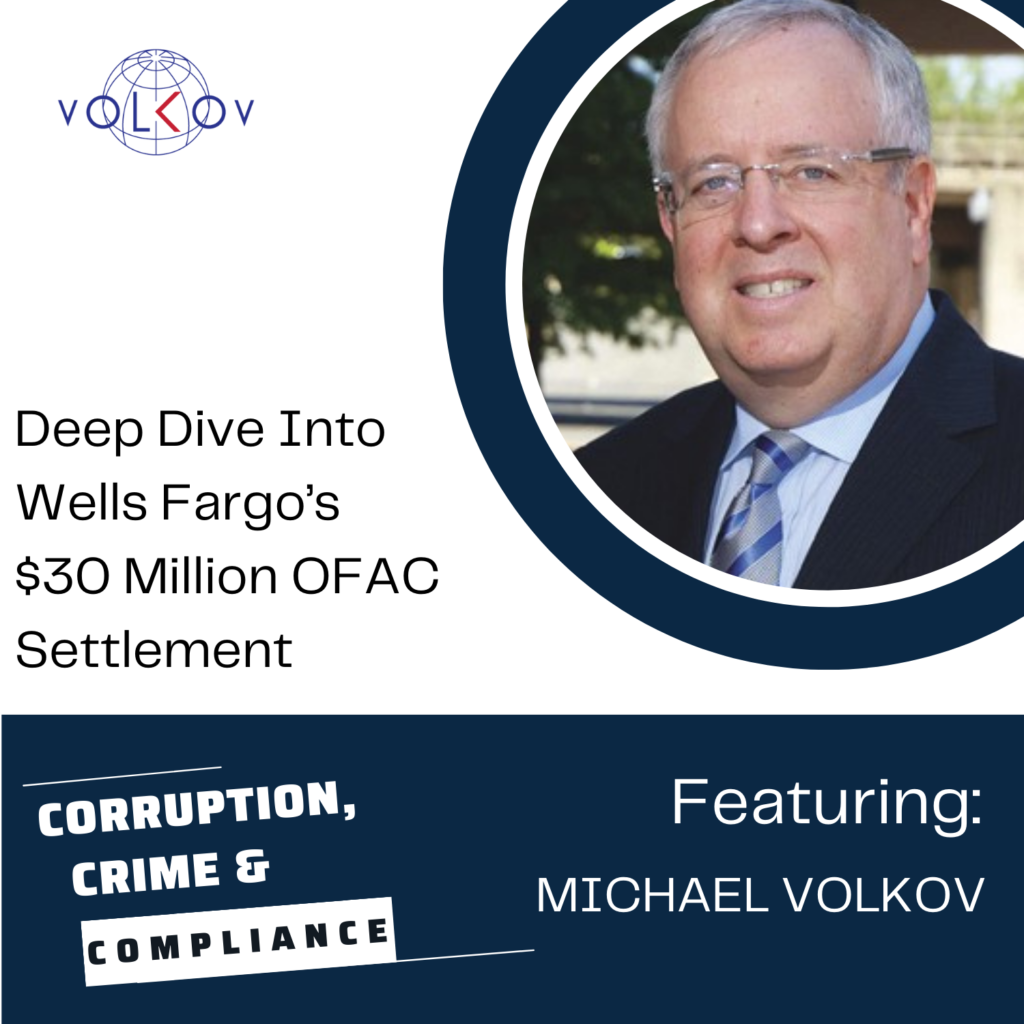
Wells Fargo has settled with OFAC for $30 million for sanctions violations that occurred during a seven-year period from 2008 to 2015. The violations stemmed from its acquisition of Wachovia Bank, which had a trade relationship with a European bank that conducted transactions involving sanctioned entities and individuals. Despite concerns raised internally, Wells Fargo failed to exercise caution or care in identifying and preventing such transactions. The case serves as a reminder of the importance of corporate culture of ethics and compliance. In this episode of Corruption, Crime, and Compliance, Michael Volkov takes a deeper dive into the issue and outlines the missteps that occurred; he also gives practical advice for companies to avoid the same mistakes.
You’ll hear him discuss these key ideas in this episode:
- Wells Fargo has a lengthy record of misconduct and failures to remediate. Its latest enforcement action involves a $30 million settlement with OFAC for sanctions violations that occurred from 2008 to 2015. These violations include three separate OFAC sanctions involving Iran, Sudan, and Syria.
- Wells Fargo provided the European bank with trade finance software that was customized and used to conduct transactions that involved sanctioned entities and individuals, despite concerns raised internally on several occasions.
- OFAC found that “Wells Fargo demonstrated reckless disregard for US sanctions requirements …and failed to exercise a minimal degree of caution or care in failing to identify and prevent such transactions for seven years after it acquired Wachovia…”
- Wells Fargo’s conduct highlights the importance of corporate culture of ethics and compliance.
- Companies must have proper oversight when pursuing new business opportunities or preserving existing business relationships, and must promptly investigate and address sanctions compliance risks when raised internally, even in non-core business lines.
- Comprehensive due diligence regarding potential sanctions risks is necessary when one entity acquires another through merger or acquisition.
- Aside from this part of Wells Fargo’s operations, the overall bank had a strong sanctions compliance program.
- If Wells Fargo had invested in a culture of compliance, it could have turned around its organization with wholesale change and a real commitment to embedding, monitoring, and remediating its culture as needed.
- The case serves as a reminder that companies must have a speak-up culture and respond to concerns as they are raised, as well as the importance of corporate culture, ethics, and compliance.
KEY QUOTES:
“If Wells Fargo had reduced its outside legal consulting and professional expenditures by half and took the money to invest and implement a culture of compliance, you can rest assured that Wells Fargo would be able to turn around its organization.” – Michael Volkov
“Moreover, when sanctions compliance risks are raised internally, including concerns arising from smaller, non-core business lines, companies should promptly seek to thoroughly investigate and address those risks.” – Michael Volkov
“Wells Fargo’s conduct here, when exposed and considered, is not just inexplicable, but reminds all of us on the importance of corporate culture of ethics and compliance.” – Michael Volkov
Resources:
What happens when two top compliance commentators get together? They talk compliance, of course. Join Kristy Grant-Hart and Tom Fox for their new podcast, 2 Gurus Talk Compliance! But it is not simply Kristy and Tom talking about compliance. In this podcast series, Kristy and Tom also review other top commentators in compliance. In this podcast, we discuss the recent jail time for a Wells Fargo executive, the UK government’s plan to enforcement of anti-corruption and AML violations, due diligence before acquiring a company, and the recent charges against the co-founder of FTX. They also touch on the shift towards valuing a healthier relationship with work and the potential of the Metaverse in the compliance industry. Tune in to hear Tom and Kristy break down the latest compliance news and provide valuable insight into the industry that will keep you ahead of the curve.
Highlights Include
· Corporate Ethics and Compliance
· The Wells Fargo Scandal and Criminal Accountability
· Uncertainty surrounding CCO certification
· UK Government’s Fight Against Corporate Crimes
· COVID and the Future of Work
· The Importance of Due Diligence in Acquisitions
· Move into the compliance profession
· Indictment of Samuel Bankman Fried
Notable Quotes
1. “If you buy a company engaging in bribery corruption, you’re not responsible for that. But when you take title and ownership, they are not engaging in broader corruption. It is you are engaging in broader corruption.”
2. “I just think that flat banning of CHAT GPD is taking away hugely useful business tools to the Italian business sector.”
3. “It is incredibly rare for a bank officer to be held criminally accountable.
4. I think we’ll start to see that now move from becoming an extraordinary practice to a best practice to a regular practice to table stakes.
Resources
2. Why have workers given up the office
4. Getting your first job in compliance
5. SBF and the FCPA
6. Carrie Tolstedt pleads guilty
7. UK to invest in economic crime enforcement
8. What is happening to the Metaverse
9. Flutter settles FCPA enforcement action
Connect with Kristy Grant-Hart on LinkedIn
Connect with Tom Fox on Linkedin
Welcome to the Daily Compliance News. Each day, Tom Fox, the Voice of Compliance, brings you compliance-related stories to start your day. Sit back, enjoy a cup of morning coffee, and listen to the Daily Compliance News. All from the Compliance Podcast Network. Each day we consider four stories from the business world, compliance, ethics, risk management, leadership, or general interest for the compliance professional.
Stories we are following in today’s edition of Daily Compliance News:
Welcome to the Daily Compliance News. Each day, Tom Fox, the Voice of Compliance, brings you four compliance-related stories to start your day. Sit back, enjoy a cup of morning coffee and listen to the Daily Compliance News. All from the Compliance Podcast Network. Stories we are following in today’s edition of Daily Compliance News:
The award-winning, Compliance into the Weeds is the only weekly podcast that takes a deep dive into a compliance-related topic, literally going into the weeds to explore a subject more. In this episode, we continue the ongoing saga of Wells Fargo and its fraudulent accounts scandal. Recently an administrative law judge has affirmed that three former audit and risk management executives at Wells Fargo should face millions in penalties for their sloppy oversight during the bank’s fake-account scandal in the 2010s. The defendants were Claudia Russ Anderson, former group risk officer for Wells Fargo’s community banking division; David Julian, former chief auditor; and Paul McLinko, former executive audit director.
Some of the highlights include:
· The background facts.
· Will the fallout from the Wells Fargo fake accounts scandal ever end? (Hint-When, our Sun, goes supernova.)
· What is failure to provide a credible challenge?
· Why are these execs trying to defend their inaction?
· Why a clear line of authority is needed in compliance.
· A root cause analysis is a basic Hallmark of an effective compliance program. Why was it separately called out?
· What are the lessons learned for compliance?
Resources
Matt Kelly in Radical Compliance