Categories
10 For 10

10 For 10: Top Compliance Stories For the Week Ending June 12, 2025

Welcome to 10 For 10, the podcast which brings you the week’s Top 10 compliance stories in one podcast each week. Tom Fox, the Voice of Compliance brings to you, the compliance professional, the compliance stories you need to be aware of to end your busy week. Sit back, and in 10 minutes hear about the stories every compliance professional should be aware of from the prior week. Every Saturday, 10 For 10 highlights the most important news, insights, and analysis for the compliance professional, all curated by the Voice of Compliance, Tom Fox. Get your weekly filling of compliance stories with 10 for 10, a podcast produced by the Compliance Podcast Network.

You can check out the Daily Compliance News for four curated compliance and ethics related stories each day, here.

Connect with Tom 

Instagram

Facebook

YouTube

Twitter

LinkedIn

You can purchase a copy of my new book, Upping Your Game, on Amazon.com

Categories
FCPA Compliance Report

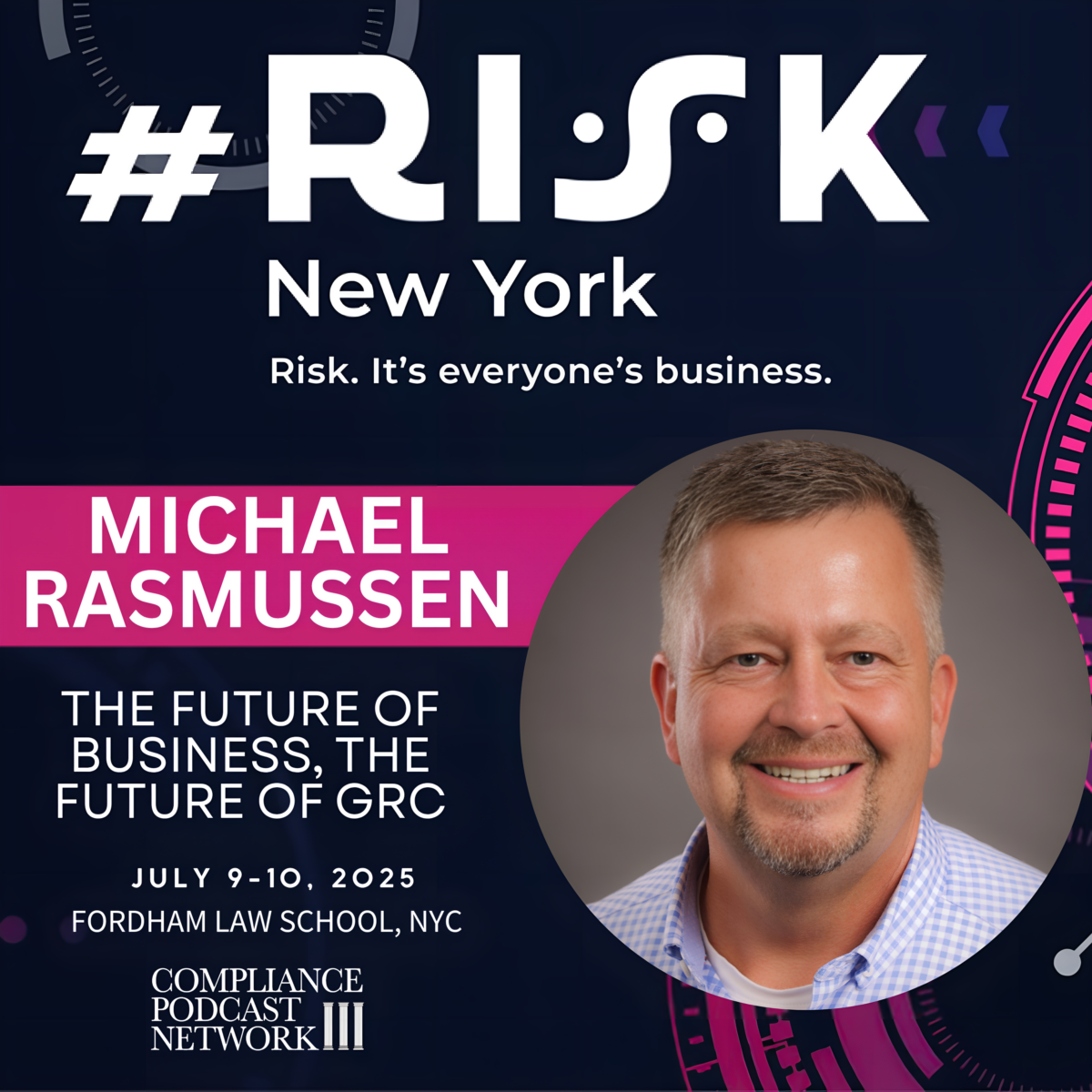
#Risk New York Speaker Series – Exploring the Future of GRC with Michael Rasmussen

Join Tom Fox and hundreds of other GRC professionals in the city that never sleeps, New York City, on July 9 & 10 for one of the top conferences around, #Risk New York. The current US landscape, shaped by evolving policies, rapid advancements in AI, and shifting global dynamics, demands adaptive strategies and cross-functional collaboration.

At #RISK New York, you will master the New Regulatory Reality by getting ahead of US regulatory shifts and their impact. Conquer AI and Tech Risk by Safeguarding Your Organization in an AI-Driven World and Understanding the Implications of Major Tech Investments. Navigate Financial and Crypto Volatility by Protecting Your Assets and Exploring Solutions in a Dynamic Market. Strengthen Your GRC Framework by Leveraging Governance, Risk, and Compliance for Strategic Advantage. Protect Digital Trust by addressing challenges in cybersecurity and data privacy and combating misinformation. All while meeting with the country’s top #Risk management professionals.

In this episode, Tom Fox welcomes Michael Rasmussen, a renowned expert in Governance, Risk Management, and Compliance (GRC), often referred to as the ‘father of GRC.’ Michael shares insights into his contributions to the field, including his work with the SEG GRC Capability Model. The conversation highlights Michael’s anticipated presentation on ‘The Future of GRC’ at the upcoming risk conference in New York City. Drawing inspiration from Star Trek (TOS, and how can you not love that?), Michael emphasizes the importance of managing business risks effectively. The discussion also touches on the benefits of face-to-face interactions and networking opportunities at such conferences.

Resources:

#Risk Conference Series

#RiskNYC—Tickets and Information

Michael Rasmussen on LinkedIn

Categories
Everything Compliance

Everything Compliance: Episode 155, To Tesla and Beyond Edition

Welcome to this edition of the award-winning Everything Compliance. In this episode, we have the quartet of Matt Kelly, Jonathan Marks, Jonathan Armstrong, and special guest panelist Hemma Lomax, all hosted by Tom Fox, the Compliance Evangelist.

  1. Hemma Lomax examines the customers of a compliance program and introduces us to the terms EX and CX. She shouts out to AI for podcasters.
  2. Matt Kelly delves into Google’s compliance spending announcement and asks why the company does not have a Chief Compliance Officer. He both shouts out and rants about Marjorie Taylor Greene and her reading list.
  3. Jonathan Marks gives us a primer on corporate governance. He shouts out the quiet compliance professionals who do the day-to-day spadework of compliance.
  4. Jonathan Armstrong takes a deep dive into the finances of Tesla and its profitability. He shouts out to Operation Spider’s Web.
  5. Tom Fox highlights Wells Fargo’s compliance remediation, the Fed’s asset cap placed on Wells Fargo, and its subsequent removal.

The members of Everything Compliance are:

Tom Fox, the Voice of Compliance, is the host, producer, and sometimes panelist of Everything Compliance. He can be reached at tfox@tfoxlaw.com. The award-winning Everything Compliance is part of the Compliance Podcast Network.

Categories
Compliance Tip of the Day

Compliance Tip of the Day – Code of Conduct as an Internal Control

Welcome to “Compliance Tip of the Day,” the podcast that brings you daily insights and practical advice on navigating the ever-evolving landscape of compliance and regulatory requirements. Whether you’re a seasoned compliance professional or just starting your journey, our goal is to provide you with bite-sized, actionable tips to help you stay ahead in your compliance efforts. Join us as we explore the latest industry trends, share best practices, and demystify complex compliance issues to keep your organization on the right side of the law. Tune in daily for your dose of compliance wisdom, and let’s make compliance a little less daunting, one tip at a time.

How does your Code of Conduct act as an internal control?

For more information on this topic, refer to The Compliance Handbook: A Guide to Operationalizing Your Compliance Program, 6th edition, recently released by LexisNexis. It is available here.

Categories
Daily Compliance News

Daily Compliance News: June 12, 2025, The Brutal Truth Edition

Welcome to the Daily Compliance News. Each day, Tom Fox, the Voice of Compliance, brings you compliance-related stories to start your day. Sit back, enjoy a cup of morning coffee, and listen in to the Daily Compliance News. All from the Compliance Podcast Network. Each day, we consider four stories from the business world: compliance, ethics, risk management, leadership, and general interest, all of which are relevant to the compliance professional.

Top stories include:

  • 4 questions to ask employees. (WSJ)
  • The Brutal Truth About Layoffs in 2025. (FT )
  • The CITGO auction date has been extended (yet again). (Reuters)
  • Rubio is pressing the DOJ to investigate Harvard. (NYT)
Categories
Blog

Wells Fargo, Risk Management and Reputational Recovery – Part 1: The Penalty

On June 3, 2025, the Federal Reserve lifted its unprecedented $2 trillion asset cap on Wells Fargo, marking the symbolic end to one of the most consequential compliance enforcement actions in modern U.S. banking history. For the compliance and risk management community, this moment is not a victory lap—it is a case study of how compliance failures cascade, reputational risk becomes operationally tangible, and regulatory patience has its limits.

Over the next two blog posts, I want to explore what happened, why it mattered, and what lessons every compliance professional should carry forward. These blog posts are based on two primary articles. The First Wells Fargo Is Allowed to Grow Again After 7 Years Under Asset-Cap Penalty, by Gina Heeb in the Wall Street Journal. The second is “Wells Fargo Asset Cap Lifted by Fed, Paving Way for Growth” by Yizhu Wang in Bloomberg. The final is an op-ed piece in Bloomberg, entitled “Wells Fargo’s Asset Cap Has Been a Good Punishment,” by Paul Davies.

The Scandal That Shook the System

The Wells Fargo saga began with a simple, albeit stunning, revelation: employees had opened millions of unauthorized deposit and credit card accounts to meet aggressive internal sales goals. Between 2009 and 2016, over 3.5 million accounts were opened without the customer’s consent. Many of these accounts generated fees, tarnishing customer relationships and shaking public trust in one of the most storied names in American banking.

As the crisis deepened, it was not just a case of bad apples. It was a system-wide failure of controls, risk oversight, and a corporate culture that incentivized misconduct. The sales quotas that fueled the behavior were directly tied to compensation and job security, creating a high-pressure environment where fraud became a means of survival.

Regulators acted swiftly. In 2016, Wells Fargo was fined $185 million. In 2018, the Federal Reserve took the rare and dramatic step of capping the bank’s total assets at approximately $2 trillion, essentially freezing its ability to grow until it could demonstrate a wholesale overhaul of its risk management and governance practices.

The Asset Cap: Punishment with Purpose

We need to be clear: this was not just a penalty. It was a structural constraint that directly impacted Wells Fargo’s ability to operate and compete in its core business. The $2 trillion asset cap imposed by the Federal Reserve in 2018 did not simply send a signal; it built a wall. It limited Wells Fargo’s ability to grow its balance sheet, take on new deposits, issue new loans, and expand into revenue-generating business lines, such as investment banking, trading, and wealth management. Unlike traditional enforcement actions, which often result in fines or deferred prosecution agreements, the asset cap attacked the bank’s future potential, not just its past misdeeds.

In short, it was a period of growth stagnation. For a publicly traded institution that relies on growth to attract investors, increase shareholder value, and maintain market position, such a freeze is devastating.

The restriction forced the bank into a defensive crouch. Instead of competing for market share or innovating with new financial products, Wells Fargo was compelled to pour resources into compliance remediation and cultural rehabilitation. According to public filings and internal estimates, the bank spent more than $2.5 billion above its 2018 baseline to maintain the risk, control, and compliance infrastructure needed to satisfy dozens of consent orders. This included the hiring of more than 10,000 employees dedicated to risk and regulatory functions—a remarkable mobilization of resources that most firms would struggle to afford.

As Davies aptly observed, “The asset cap has become a feared punishment for banks in the U.S.; they will want to avoid it at all costs.” And banks should. Because it not only restricts current operations, it sends a clear signal to markets, analysts, and regulators: this institution is not yet trusted to grow.

However, here’s the twist: in the case of Wells Fargo, it did work.

The asset cap’s forced pause compelled the bank to undertake a comprehensive review of its governance and culture. Under the leadership of CEO Charlie Scharf, who joined BNY Mellon in 2019 and previously held senior roles at Visa and JPMorgan, Wells Fargo began the arduous but necessary work of rebuilding. Scharf wasted no time restructuring the risk and compliance functions, streamlining reporting lines, and replacing much of the leadership team that had presided over the bank’s previous failures. Perhaps most importantly, he made compliance the focal point of executive decision-making, beginning every operating committee meeting with a thorough review of regulatory progress.

In effect, the asset cap did not simply punish Wells Fargo; it saved the bank from itself. It forced the kind of systemic, sustainable change that no fine or press release could have achieved. Wells Fargo emerged leaner, more disciplined, and more compliant. In many ways, it became a model for what the Federal Reserve, the Department of Justice (DOJ), and numerous other regulatory agencies now expect. Not simply accountability but a demonstrable and lasting commitment to cultural transformation.

This is remediation before reward. It is tone at the top in action. And for compliance professionals everywhere, it is proof that when structural enforcement is coupled with leadership willing to change, reform is not only possible but, as Theranos might say, “inevitable.”

Why It Worked: Enforcement as a Governance Driver

For corporate compliance professionals, Wells Fargo is more than a cautionary tale. It is proof that regulatory enforcement, when aligned with structural consequences, can drive actual change. The asset cap was not a mere symbolic gesture. It constrained Wells Fargo’s operations at its core, limiting everything from loan issuance to deposit intake to investment banking expansion.

Even more significantly, it reshaped how the bank’s board and senior executives prioritized compliance. For years, every operating committee meeting began with updates on regulatory matters. This became the bank’s daily bread.

The message is clear: when enforcement bites into business, executives listen.

Join us tomorrow as we delve into Part 2, where we examine lessons learned for the compliance professional.


Categories
Hill Country Authors

Hill Country Authors Podcast – Unveiling Camptown: Charles Swenson’s Journey Through Forgotten Texas History

Welcome to a new season of the award-winning Hill Country Authors Podcast, sponsored by Stoney Creek Publishing. In this podcast, Hill Country resident Tom Fox visits with authors who live in and writes up the Texas Hill Country. In this episode, Tom Fox visits Charles Swenson, a passionate historian and author of Voices of Camptown.’

Swenson delves into the rich history of Camptown, a freedmen’s colony established in Brenham, Texas, following the Civil War. He explains his involvement in uncovering this lost community’s legacy, spurred by the discovery of the overgrown Camptown Cemetery. Swenson shares insights into the lives of the African American families who once resided there, their struggles during Reconstruction, and their achievements despite the adversities of Jim Crow. He also emphasizes the crucial role of education and the significant contributions of military veterans to these communities. Swenson’s research methods and collaboration with the Brenham Heritage Museum, along with local individuals like Eddie Harrison, highlight a neglected chapter of Texas history that he is dedicated to preserving. The episode closes with information on how listeners can learn more about Swenson’s work and his upcoming book.

Key highlights:

  • Discovering Camptown: A Historical Overview
  • Uncovering Camptown Cemetery
  • Research and Stories from the Past
  • The Importance of Historical Designation
  • Educational and Community Impact
  • Writing Process and Publication Journey

Resources:

Charles Swenson’s on Stoney Creek Publishing

Voices of Camptown on Texas A&M University Press

Stoney Creek Publishing Website

Podcast Cover Art

Nancy Huffman Fine Art

Tom Fox

Instagram

Facebook

YouTube

Twitter

LinkedIn