Categories
The Ethics Experts

Episode 226 – Fabiana Klajner Leschziner

In this episode of The Ethics Experts, Nick welcomes Fabiana Klajner Leschziner.

Fabiana is the Embraer Chief Compliance and Governance Officer since January 2025. From June 2016 to December 2024, she was the Executive Vice President, General Counsel & Chief Compliance Officer of the Company. Prior to joining Embraer, she worked at DuPont in Brazil from September 2002 to June 2016 as Legal Director for Brazil and the Andean Region, responsible for the legal aspects of all businesses of DuPont in Brazil and Colombia, Venezuela, Peru, Ecuador and Bolivia. From June 1998 to December 2001, Fabiana was an associate at Davis Polk & Wardwell in New York.

Fabiana graduated from the University of São Paulo School of Law in 1993 and has an LL.M degree from Cornell Law School, Ithaca, USA, 1998. She specialized in corporate law, corporate finance, capital markets, antitrust, international trade and compliance.

Categories
Corruption, Crime and Compliance

Cadence Systems Pays $140 Million for Trade Violations and Pleads Guilty to Criminal Export Control Conspiracy

What happens when a company tries to outsmart the system – and gets caught red-handed by the DOJ in a $140 million export control scheme tied to Chinese military supercomputers?

In this episode, Michael dives into the DOJ’s criminal enforcement action against Cadence Design Systems – a case that marks yet another major step in the DOJ’s rapidly unfolding trade enforcement strategy. We’re no longer in the FCPA era. This is a whole new ballgame, where national security and trade compliance have collided, and companies that haven’t adjusted are already behind.

You’ll hear him discuss:

  • Why Cadence’s plea deal – not a DPA or NPA – is such a big deal
  • How the DOJ and BIS coordinated to secure over $140 million in criminal and civil penalties
  • The simple, sloppy scheme that involved fake names, hidden aliases, and blatant attempts to skirt export controls
  • Why partial cooperation didn’t earn Cadence a full credit reduction – and what they failed to do
  • The shocking compliance gap: only one export control officer handling global risk
  • What this case signals about the DOJ’s growing focus on national security and semiconductor enforcement
  • Why ethics, due diligence, and transaction monitoring are still your best defense
  • How companies can avoid getting blindsided by embracing the new trade enforcement landscape

Resources

Michael Volkov on LinkedIn | Twitter

The Volkov Law Group

Categories
AI Today in 5

AI Today in 5: August 11, 2025, The ACHILLES Project Episode

Welcome to AI Today in 5, the newest addition to the Compliance Podcast Network. Each day, Tom Fox will bring you 5 stories about AI to start your day. Sit back, enjoy a cup of morning coffee, and listen in to the AI Today In 5. All, from the Compliance Podcast Network. Each day, we consider five stories from the business world, compliance, ethics, risk management, leadership, or general interest about AI.

  • Will the ACHILLES Project simplify AI regs in the EU? (InnovationNewsNetwork)
  • AI – data privacy and governance in pharma. (EPR)
  • Compliance risks with AI integration. (InsuranceBusinessMag)
  • GenAI for tax and customs compliance. (IMF)
  • Will GenAI end ‘check the box’ compliance? (CCI)

For more information on the use of AI in compliance programs, see Tom Fox’s new book, Upping Your Game. You can purchase a copy of the book on Amazon.com.

Categories
FCPA Compliance Report

FCPA Compliance Report – Episode 770 – Integrating ESG in Global Outsourcing: Insights from Inge Zwick

Welcome to the award-winning FCPA Compliance Report, the longest-running podcast in compliance. In this episode, Tom Fox welcomes Inge Zwick, ESG lead at Emapta Global, to discuss how the global outsourcing company integrates environmental, social, and governance (ESG) practices into its operations.

Inge explains Emapta Global’s presence, compliance strategies, and the importance of ESG in improving business efficiency. The conversation delves into the regional differences in ESG priorities and provides insights into how Emapta meets diverse client expectations across the globe. Inge also shares her passion for ESG, strategies for embedding ESG in corporate culture, and the benefits of ESG as a business differentiator. The episode concludes with practical takeaways for integrating ESG authentically into outsourcing models.

Key highlights:

  • Inge’s Journey into ESG Leadership
  • Understanding ESG Frameworks
  • Regional Differences in ESG Practices
  • Implementing ESG Across Global Markets
  • ESG as a Business Differentiator
  • Embedding ESG into Corporate Culture

Resources:

Connect with Inge Zwick

Connect with Emapta Global

 Tom Fox

Instagram

Facebook

YouTube

Twitter

LinkedIn

For more information on the use of AI in compliance programs, Tom Fox’s new book is Upping Your Game. You can purchase a copy of the book on Amazon.com.

Categories
Adventures in Compliance

Adventures in Compliance: The Novels – The Valley of Fear, Sherlock Holmes’ Investigative Techniques for Today’s Challenges

In this new season of Adventures in Compliance, host Tom Fox takes a deep dive into the Sherlock Holmes novels. Over this season, Tom will take a deep dive into each novel over a four-part series. The four novels we will consider from the ethics and compliance perspective are A Study in Scarlet, The Sign of Four, The Hound of the Baskervilles, and The Valley of Fear. For the month of August, we conclude this Season with a deep dive into the least well-known of the Sherlock Holmes novels, The Valley of Fear.

In Part 2, Timothy and Fiona return to continue our exploration of The Valley of Fear, where we delve into five key investigative lessons from Sherlock Holmes. Discover how Holmes’ methods of questioning initial facts, emphasizing collaborative efforts, maintaining patience, keeping a big-picture perspective, and communicating findings effectively can be applied to modern corporate and personal challenges. Learn to approach information gathering with meticulous scrutiny and uncover bigger truths hidden in the details.

Key highlights:

  • Sherlock Holmes’ Relevance Today
  • Lesson 1: Question Everything
  • Lesson 2: Investigative Cooperation
  • Lesson 3: Patience and Persistence
  • Lesson 4: Big Picture Perspective
  • Lesson 5: Effective Communication

Resources:

The New Annotated Sherlock Holmes

Sherlock Holmes FAQ by Dave Thompson

Connect with Tom Fox

Instagram

Facebook

YouTube

Twitter

LinkedIn

Categories
Trekking Through Compliance

Trekking Through Compliance: Episode 71 – Surviving the Unknown: Risk Management Lessons from “That Which Survives”

In compliance, risk management is more than a checklist. It is the ongoing discipline of identifying threats, assessing their potential impact, and implementing measures to mitigate or neutralize them before they cause harm.

Few Star Trek episodes illustrate the escalating consequences of underestimated risks as effectively as That Which Survives. In it, the Enterprise crew encounters a seemingly lifeless planet guarded by Losira, an alien projection who can kill with a single touch. Her purpose is to protect the planet’s secrets, but her method is indiscriminate, deadly, and poorly aligned to the situation at hand.

For compliance professionals, this episode offers five important lessons on anticipating, assessing, and responding to risks, both known and unknown, within an organization.

Lesson 1: Identify Risks Before Engaging in New Ventures

Illustrated By: The Enterprise arrives at an uncharted planet. Within moments, a mysterious woman materializes and kills a crew member simply by touching him.

Compliance Lesson. Too often, companies rush into new markets, partnerships, or projects without conducting a thorough risk assessment. This can expose the organization to sanctions violations, corruption risks, cybersecurity vulnerabilities, or operational failures.

Lesson 2: Understand That Some Risks Are Intelligent and Adaptive

Illustrated By: Losira targets specific individuals and adapts her approach to their vulnerabilities.

Compliance Lesson. Not all risks are static. Fraudsters change tactics, cyber threats evolve, and corrupt third parties find new ways to conceal misconduct. A compliance program must anticipate that some risks will actively seek to bypass controls.

Lesson 3: Don’t Dismiss Low-Probability, High-Impact Threats

Illustrated By: At first, the crew assumes Losira’s appearances are isolated incidents, but they quickly realize she poses an existential threat.

Compliance Lesson. Rare events, such as a single high-value bribery transaction, a lone rogue employee, or a targeted cyberattack, can have catastrophic consequences. Organizations sometimes underprepare for these scenarios because they seem unlikely.

Lesson 4: Risk Mitigation Requires Cross-Functional Coordination

Illustrated By: The landing party on the planet and the Enterprise crew in orbit are each facing threats from Losira, but their survival depends on sharing information and coordinating responses. Without clear communication, both groups would be doomed.

Compliance Lesson. Compliance cannot manage risk in isolation. It must work with legal, internal audit, operations, IT, and HR to identify threats and implement controls.

Lesson 5: Address the Root Cause, Not Just the Symptoms

Illustrated By: The crew eventually discovers that Losira is an automated defense mechanism left behind by an extinct race. Once the crew understands her origin and purpose, they can neutralize the threat.

Compliance Lesson. In risk management, addressing surface-level problems without finding the underlying cause only delays future incidents. Compliance should integrate root cause analysis into all investigations.

Final ComplianceLog Reflections

That Which Survives is more than a suspense episode; it is a cautionary tale about the dangers of underestimating risk. Losira was not inherently evil; she was a misunderstood, unexamined part of an environment the crew did not fully assess before engagement.

The compliance officer’s mandate is to ensure the company doesn’t make the same mistake: to scan for threats before beaming in, to adapt to risks that evolve, to prepare for unlikely but devastating events, to coordinate across the enterprise, and to address the root cause when problems arise. Risk management is not just about surviving; it is about ensuring that your organization thrives in any environment, whether it’s an unexplored planet or a rapidly changing market.

Resources:

⁠⁠Excruciatingly Detailed Plot Summary by Eric W. Weisstein⁠⁠

⁠⁠MissionLogPodcast.com⁠⁠

⁠⁠Memory Alpha

Categories
Compliance Tip of the Day

Compliance Tip of the Day – The ROI of Compliance

Welcome to “Compliance Tip of the Day,” the podcast where we bring you daily insights and practical advice on navigating the ever-evolving landscape of compliance and regulatory requirements. Whether you’re a seasoned compliance professional or just starting your journey, we aim to provide you with bite-sized, actionable tips to help you stay on top of your compliance game. Join us as we explore the latest industry trends, share best practices, and demystify complex compliance issues to keep your organization on the right side of the law. Tune in daily for your dose of compliance wisdom, and let’s make compliance a little less daunting, one tip at a time.

Today, we begin a multipart look at thinking through the ROI of your compliance program.

For more on this topic, check out The Compliance Handbook, a Guide to Operationalizing Your Compliance Program, 6th edition, which LexisNexis recently released. It is available here.

Categories
Blog

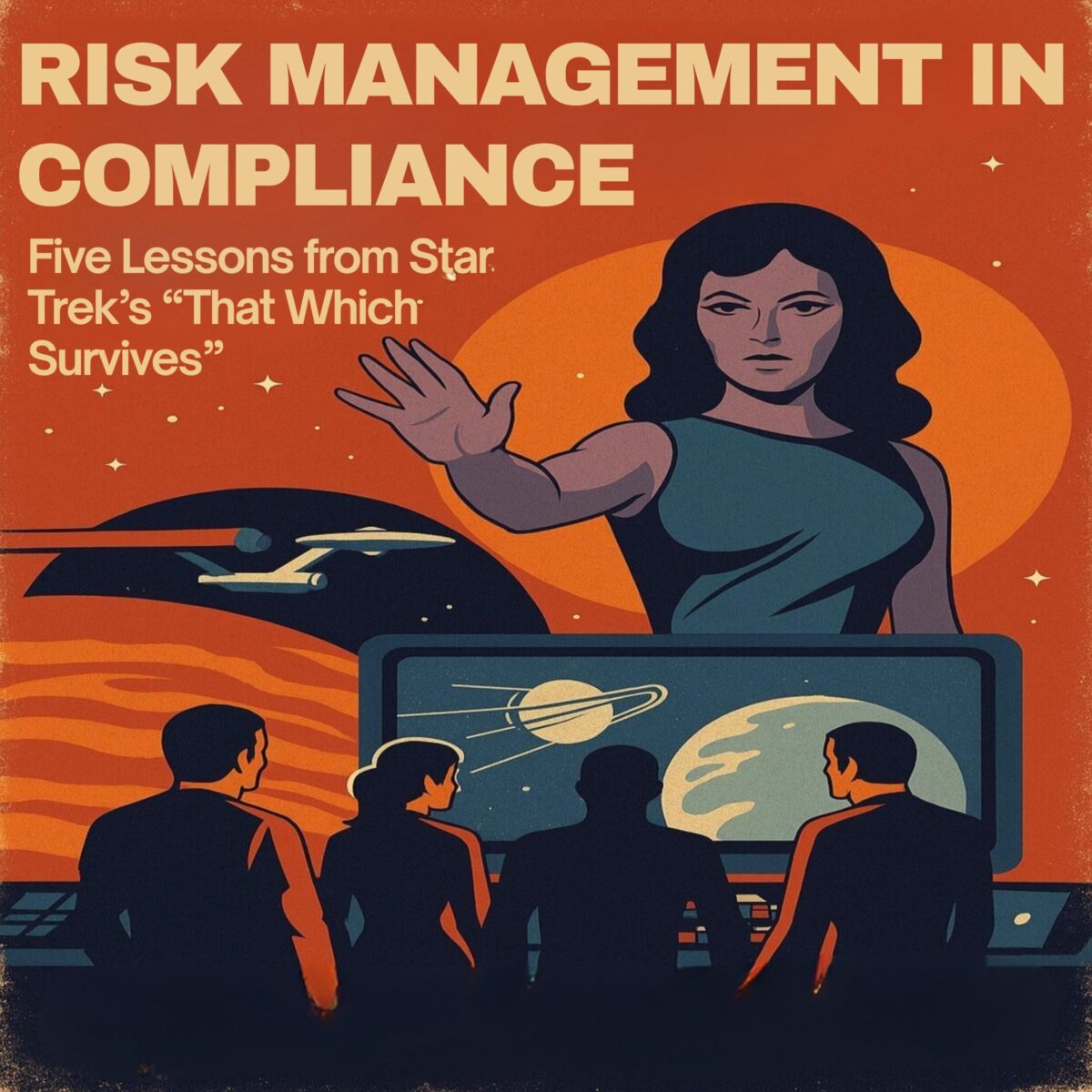
Risk Management in Compliance: Five Lessons from Star Trek’s That Which Survives

In compliance, risk management is more than a checklist. It is the ongoing discipline of identifying threats, assessing their potential impact, and implementing measures to mitigate or neutralize them before they cause harm.

Few Star Trek episodes illustrate the escalating consequences of underestimated risks as effectively as That Which Survives. In it, the Enterprise crew encounters a seemingly lifeless planet guarded by Losira, an alien projection who can kill with a single touch. Her purpose is to protect the planet’s secrets, but her method is indiscriminate, deadly, and poorly aligned to the situation at hand.

For compliance professionals, this episode offers five important lessons on anticipating, assessing, and responding to risks, both known and unknown, within an organization.

Lesson 1: Identify Risks Before Engaging in New Ventures

Illustrated By: The Enterprise arrives at an uncharted planet, scans it briefly, and beams down a landing party. Within moments, a mysterious woman materializes and kills a crew member simply by touching him.

Compliance Lesson. Too often, companies rush into new markets, partnerships, or projects without conducting a thorough risk assessment. This can expose the organization to sanctions violations, corruption risks, cybersecurity vulnerabilities, or operational failures. Compliance should lead or be deeply involved in pre-engagement risk assessments. Before “beaming down” into a new business environment, map potential threats—regulatory, operational, reputational—and identify safeguards. Skipping this step can lead to preventable harm and costly remediation.

Lesson 2: Understand That Some Risks Are Intelligent and Adaptive

Illustrated By: Losira’s ability to appear anywhere, both on the planet and aboard the Enterprise, shows she is not a passive hazard. She targets specific individuals and adapts her approach to their vulnerabilities.

Compliance Lesson. Not all risks are static. Fraudsters change tactics, cyber threats evolve, and corrupt third parties find new ways to conceal misconduct. A compliance program must anticipate that some risks will actively seek to bypass controls. Build adaptive monitoring into your compliance systems. Use continuous transaction monitoring, real-time alerts, and data analytics to detect changes in patterns. A one-time risk assessment is not enough—ongoing vigilance is essential.

Lesson 3: Don’t Dismiss Low-Probability, High-Impact Threats

Illustrated By: At first, the crew assumes Losira’s appearances are isolated incidents, but they quickly realize she poses an existential threat. Even though she is only one individual, her capabilities could destroy the Enterprise if not addressed.

Compliance Lesson. Rare events, such as a single high-value bribery transaction, a lone rogue employee, or a targeted cyberattack, can have catastrophic consequences. Organizations sometimes underprepare for these scenarios because they seem unlikely. Compliance departments should incorporate low-probability, high-impact risks into the risk register. Conduct tabletop exercises to simulate rare but potentially devastating events, ensuring the organization has both prevention and response plans in place.

Lesson 4: Risk Mitigation Requires Cross-Functional Coordination

Illustrated By: The landing party on the planet and the Enterprise crew in orbit are each facing threats from Losira, but their survival depends on sharing information and coordinating responses. Without clear communication, both groups would be doomed.

Compliance Lesson. Compliance cannot manage risk in isolation. It must work with legal, internal audit, operations, IT, and HR to identify threats and implement controls. Silos breed blind spots, and blind spots breed crises. Establish cross-functional risk committees or working groups. Ensure that incident reporting and escalation procedures are well understood across departments. Make compliance the hub of a collaborative risk network, not a separate spoke.

Lesson 5: Address the Root Cause, Not Just the Symptoms

Illustrated By: The crew eventually discovers that Losira is an automated defense mechanism left behind by an extinct race. She’s not malicious—she’s simply executing a program without context or adaptability. Once the crew understands her origin and purpose, they can neutralize the threat.

Compliance Lesson. In risk management, addressing surface-level problems without finding the underlying cause only delays future incidents. For example, punishing an employee for violating a policy without examining why the policy was ignored leaves the organization vulnerable to repeat violations. Compliance should integrate root cause analysis into all investigations. Whether it’s a process flaw, cultural issue, or oversight gap, solving the real problem is the only way to reduce recurrence.

The Enterprise as a Risk Management Model

Captain Kirk and his crew succeed not because they are lucky, but because they adapt quickly, share intelligence, and dig deeper to understand the nature of the threat. These are precisely the attributes a corporate compliance department needs to lead risk management:

  • Proactive assessment before engagement.
  • Adaptive controls that respond to evolving risks.
  • Preparation for rare but high-impact events.
  • Collaboration across organizational functions.
  • Root cause remediation for lasting solutions.

Practical Compliance Takeaways

From That Which Survives, compliance professionals can draw these operational insights:

  1. Integrate Compliance Early—Risk management starts before contracts are signed or operations begin, not after.
  2. Invest in Technology—Data analytics, AI monitoring, and continuous auditing tools make adaptive risk management possible.
  3. Conduct Scenario Planning—Practice responding to “Losira-like” threats: targeted, intelligent, and hard to predict.
  4. Build Risk Alliances—Partner with all departments to create a unified threat picture.
  5. Close the Loop—Use each incident to strengthen your program against future threats.

Final ComplianceLog Reflections

That Which Survives is more than a suspense episode; it is a cautionary tale about the dangers of underestimating risk. Losira was not inherently evil; she was a misunderstood, unexamined part of an environment the crew did not fully assess before engagement.

The compliance officer’s mandate is to ensure the company doesn’t make the same mistake: to scan for threats before beaming in, to adapt to risks that evolve, to prepare for unlikely but devastating events, to coordinate across the enterprise, and to address the root cause when problems arise.

In other words, risk management is not just about surviving; it is about ensuring that your organization thrives in any environment, whether it’s an unexplored planet or a rapidly changing market.

Resources:

⁠⁠Excruciatingly Detailed Plot Summary by Eric W. Weisstein⁠⁠

⁠⁠MissionLogPodcast.com⁠⁠

⁠⁠Memory Alpha

Categories
Daily Compliance News

Daily Compliance News: August 11, 2025, The Boss Doesn’t Work Edition

Welcome to the Daily Compliance News. Each day, Tom Fox, the Voice of Compliance, brings you compliance-related stories to start your day. Sit back, enjoy a cup of morning coffee, and listen in to the Daily Compliance News. All, from the Compliance Podcast Network. Each day, we consider four stories from the business world, compliance, ethics, risk management, leadership, or general interest for the compliance professional.

Top stories include:

  • Piston’s Malik Beasley is facing gambling allegations. (NYPost)
  • The US wants Nigerians to comply with visa obligations. (ChannelsTV)
  • What happens when the boss doesn’t work? (NYT)
  • How about a secure workplace to facilitate compliance? (KXAN)

You can donate to flood relief for victims of the Kerr County flooding by going to the Hill Country Flood Relief here.

Categories
Blog

Rethinking Training and Communications: Insights from Rethink Compliance’s 2025 Benchmarking Survey

In compliance, training, and communications are not simply program components; they are the lifeblood of an effective ethics and compliance (E&C) function. They inform, reinforce, and ultimately drive the behaviors we want to see across the enterprise. When done right, they help employees identify, prevent, and report misconduct. When done poorly, they are a wasted opportunity, ticking a box without changing behavior.

Rethink Compliance’s 2025 Training & Communications Benchmarking Survey provides a rich snapshot of where corporate compliance programs stand today and where they can improve. With over 220 respondents spanning industries from healthcare to technology, manufacturing to financial services, and more than 30% of them based outside North America, the findings offer a broad, representative view of the E&C landscape.

The study shows both encouraging progress and persistent gaps. Most organizations (83%) train all employees on core E&C responsibilities, but only 46.6% deliver risk-specific training tailored to job roles or exposure. Board training is becoming more common, with non-participation dropping from 35% in 2021 to 20% in 2025. Third-party training is also on the rise, from 37% in 2021 to 56% in 2025, especially in highly regulated sectors.

The format and length of training are shifting, too. Courses between 5 and 40 minutes remain most popular, but microlearning, generally defined as quick, 1–4 minute bursts of content, is gaining traction among the highest-performing programs. Engagement tools like real-life scenarios, quizzes, and humor are more widely used, and there is a growing emphasis on mobile compatibility and responsive design.

Analytics are also maturing. While completion rates remain the most-tracked metric (87%), more organizations are analyzing knowledge retention, cultural indicators, and employee feedback. The percentage of respondents finding training analytics “extremely valuable” has jumped from 16.8% in 2021 to 23% in 2025. However, resource constraints remain a significant governance challenge, with 60% of respondents citing limited budget as their biggest obstacle.

From this data, five key takeaways emerge for compliance professionals seeking to strengthen their training and communication strategies.

1. Targeting is the New Baseline

Broad training coverage is good; targeted training is better. The survey confirms that Achievers, who rate their programs as most effective, invest in risk-specific, role-based training. They tailor content to the realities of senior leaders, people managers, high-risk employees, and boards. This approach aligns with regulatory guidance, which emphasizes relevance as a key measure of program quality. If your compliance training treats everyone the same, you are missing an opportunity to drive behavior where the risk is greatest. Targeting also improves retention, as employees are more engaged when the content speaks directly to their work challenges. For example, anti-bribery training for a field sales team should look very different from privacy training for IT administrators. By segmenting your audience and designing accordingly, you not only meet enforcement expectations but also increase the likelihood that training will lead to action when it matters.

2. Onboarding is Prime Real Estate for Compliance Culture

The survey shows that 67% of organizations provide E&C training during onboarding, with another 28% doing so within the first six months. These early days are when the cultural tone is set, expectations are established, and new hires decide whether compliance is truly valued or just lip service. The same applies to third parties, whose actions can create as much liability as your employees’. With third-party training rising sharply to 56% adoption, the momentum is clear. By embedding compliance messaging and expectations into the onboarding journey for both employees and high-risk partners, you lay a foundation that can be reinforced over time. This early investment pays dividends: employees start their tenure with clarity on what is expected, and third parties understand from the outset that compliance is part of doing business with you. Miss this window, and you risk leaving both groups to learn norms through observation, a risky proposition if informal culture undermines formal policy.

3. Shorter, More Engaging Content Delivers More Impact

One of the strongest trends in the survey is the move toward concise, high-impact content. While 5–40 minute courses are still the norm, microlearning, short, focused modules lasting 1–4 minutes, is increasingly popular among high-performing programs. Achievers are also more likely to integrate real-life scenarios into training, which is not surprising given that regulators encourage the use of relatable examples. The reason is simple: employees have limited attention, and training competes with their daily responsibilities. Shorter formats, paired with interactive elements like quizzes or opinion polls, can be reinforced year-round through compliance communications. Instead of one long annual course, consider a blended approach: core concepts delivered upfront, with microlearning refreshers pushed throughout the year. This keeps compliance top of mind and allows you to respond to emerging risks quickly with targeted, bite-sized updates.

4. Data Analytics is a Strategic Advantage—If You Use It Well

Data is abundant in compliance training; insight is not. The survey shows progress, with more organizations finding analytics “extremely valuable” and using them to inform program improvements. Yet too many still stop at completion rates. The most effective programs go deeper into tracking knowledge retention, cultural indicators, engagement metrics, and device usage. Embedding survey questions into training can yield valuable cultural data without adding to survey fatigue. This is more than an administrative exercise; analytics can justify budget requests, demonstrate ROI to leadership, and identify which parts of your program need strengthening. For example, if analytics show that completion is high but post-training assessments reveal weak understanding in a critical risk area, you have the evidence required to redesign the content. Regulators increasingly expect to see not just that training occurred, but that it was effective. Using analytics strategically can turn your training program from a cost center into a business asset.

5. Governance, Resources, and Vendor Partnerships Define Success

Training quality and sustainability depend on governance. The survey found that 60% of organizations have a dedicated E&C training role or team, with Achievers far more likely to have such resources than Strivers. Without clear ownership, training competes with other priorities and suffers in quality. Budget constraints remain the top challenge, cited by 60% of respondents, making it critical to leverage every available efficiency from interdepartmental collaboration to smart vendor partnerships. On the vendor side, most organizations use a blend of in-house and external content, with customization playing an important role in effectiveness. Achievers report higher satisfaction with vendors, likely because they select partners who understand their industry risks and culture. The lesson here is that governance is not just about oversight; it’s about making strategic decisions on staffing, budgeting, and partnerships that elevate your training from adequate to excellent.

The 2025 Rethink Compliance Benchmarking Survey makes it clear: training and communications are evolving toward precision, efficiency, and measurable impact. The challenge for compliance leaders is to align governance, content, delivery, and analytics into a program that not only checks regulatory boxes but also changes behavior. Those who embrace targeting, onboarding, engagement, data, and strong governance will be best positioned to turn training into a true driver of ethical culture.