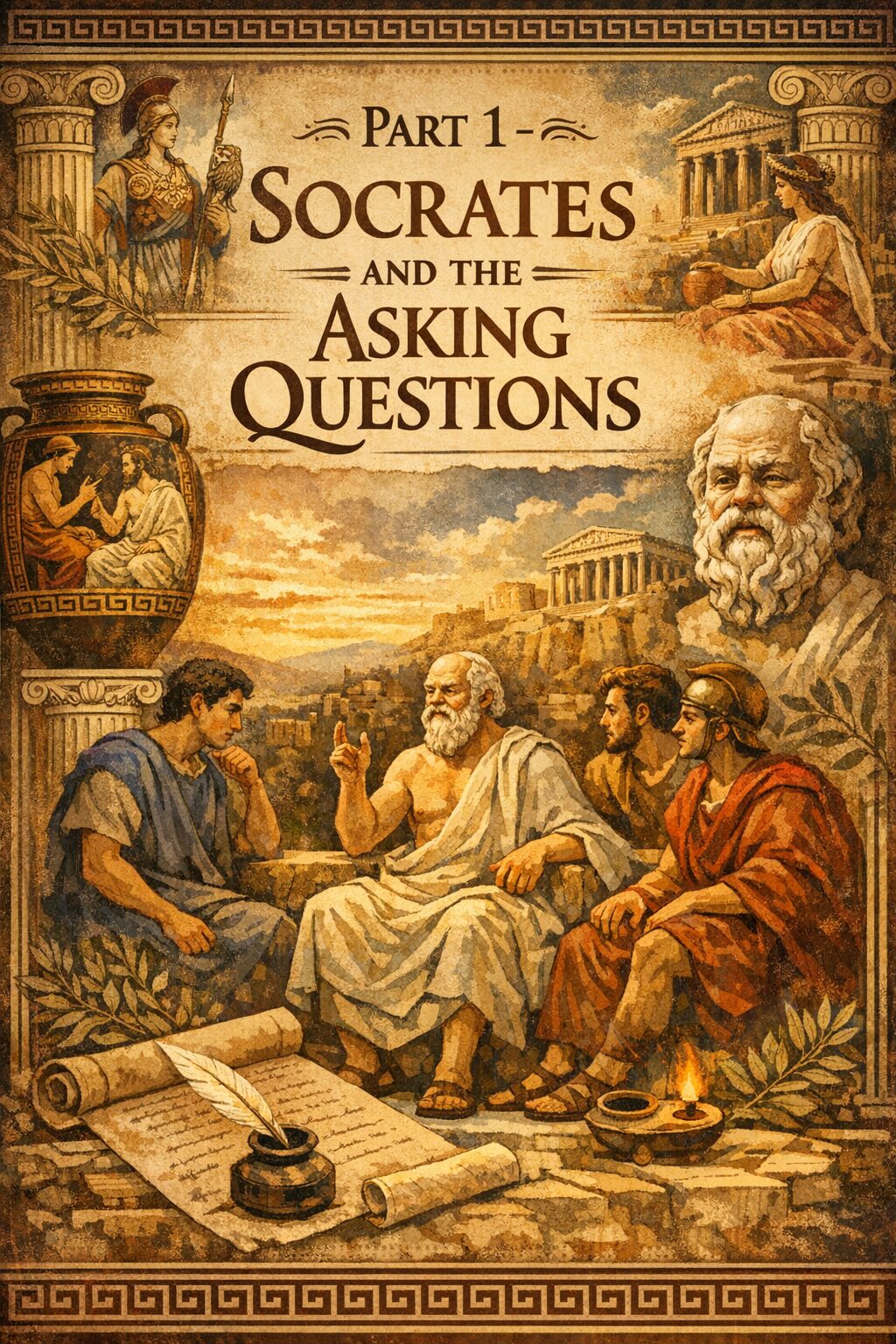
I have long wanted to trace the origins of the modern corporate compliance organization back to the ancient Greek philosophers, drawing lessons for compliance and ethics in 2026 and beyond. Today, I begin a five-part series where I do just that. In this series, we will consider Socrates, Plato, Aristotle, Pythagoras, and Euclid. We start with Socrates.
Socrates left no writings of his own. What he left was a method. He believed wisdom began with recognizing what one did not know and then relentlessly testing assumptions through disciplined questioning. That approach maps directly onto the daily work of the compliance professional. Risk assessments, investigations, root cause analysis, culture reviews, and even board reporting all rise or fall based on the quality of the questions asked.
Every effective compliance program begins with a question. Not a policy. Not a control. Not a dashboard. A question. That insight alone makes Socrates the right place to start any serious discussion about the influence of ancient Greek philosophy on modern corporate compliance and ethics programs.
The Department of Justice’s Evaluation of Corporate Compliance Programs (ECCP) does not use the word “Socratic,” but its expectations are unmistakably aligned with Socratic inquiry. Prosecutors repeatedly ask whether a company understands its risks, tests its assumptions, challenges its controls, and adapts when reality changes. A compliance program that does not ask hard questions is not mature. It is merely quiet. Indeed, Hui Chen, the author of the original ECCP, has said that a key purpose of the ECCP was to get compliance professionals to ‘ask questions’.
Ethical Inquiry as a Compliance Obligation
Socrates believed that unexamined beliefs were dangerous. He challenged Athenian leaders not because he enjoyed disruption, but because false confidence creates harm. In a corporate setting, the same risk exists when executives assume that a policy equals compliance or that training completion equals ethical behavior.
- Is the corporation’s compliance program well designed?
- Is the program being applied earnestly and in good faith? In other words, is the program adequately resourced and empowered to function effectively?
- Does the corporation’s compliance program work in practice?
These questions are fundamentally Socratic. It demands inquiry into how the business actually operates, where pressure points exist, and how misconduct could realistically occur. A compliance function that accepts management narratives at face value fails this test.
Daily compliance operations depend on this discipline. When reviewing third-party relationships, a Socratic compliance officer does not ask whether due diligence was performed. They ask whether it was sufficient, whether red flags were rationalized, and whether business incentives distorted judgment. That is inquiry, not administration.
Challenging Assumptions Without Becoming the Enemy
Socrates was executed because his questioning made powerful people uncomfortable. Compliance professionals face a less dramatic, but no less real, version of that tension. The role requires challenging assumptions, even when doing so slows deals, complicates reporting lines, or disrupts revenue projections.
The ECCP specifically evaluates whether a corporate compliance function has sufficient staff to audit, document, analyze, and utilize the results of the corporation’s compliance efforts. Prosecutors should also determine “whether the corporation’s employees are adequately informed about the compliance program and are convinced of the corporation’s commitment to it. Does the company’s culture of compliance, including awareness among employees that any criminal conduct, including the conduct underlying the investigation, will not be tolerated.”
Those structural questions exist because DOJ understands that inquiry without protection is performative. If compliance professionals cannot safely ask uncomfortable questions, the program is cosmetic.
In daily operations, this plays out in subtle ways. Does compliance have the authority to pause a transaction? Can investigators follow evidence wherever it leads? Are audit findings welcomed or explained away? A Socratic approach demands that compliance leaders test these realities rather than assume the answer.
The Socratic Method in Investigations and Root Cause Analysis
Socrates did not accept the first answer offered. He pushed deeper, often exposing contradictions or incomplete reasoning. That approach is directly applicable to investigations and root cause analysis. The ECCP places significant emphasis on whether companies understand why misconduct occurred and whether remediation addresses underlying causes. Too many investigations stop at identifying who violated a policy. Echoing Jonathan Marks, Socratic investigation asks why the violation made sense to the individual at the time. What pressures existed? What incentives misaligned behavior? What controls failed or were bypassed?
This type of inquiry requires patience and courage. It also involves trust from leadership. Findings may implicate management decisions, cultural signals, or compensation structures. Socrates reminds us that truth-seeking is rarely comfortable, but it is essential to ethical improvement.
Culture Is Revealed by the Questions You Allow
Socrates believed that a society’s health could be measured by its openness to questioning. The same is true for corporate culture. The questions employees feel safe asking reveal more than any values statement. The ECCP now explicitly asks companies to explain how they measure and address culture. The ECCP states, “Prosecutors should also assess how the company has leveraged its data to gain insights into the effectiveness of its compliance program and otherwise sought to promote an organizational culture that encourages ethical conduct and a commitment to compliance with the law.” Surveys, hotline data, and exit interviews are tools, but they are meaningless without inquiry. Key questions include: Are employees encouraged to speak up? Are concerns investigated thoroughly? Are outcomes communicated? Is retaliation punished?
In daily compliance practice, this means listening as much as enforcing. A Socratic compliance program does not treat employee concerns as noise to be managed. It treats them as data points to be explored. The quality of questions asked in response to a report often determines whether trust is strengthened or destroyed.
5 Key Takeaways for the Compliance Professional
1. Effective compliance begins with inquiry, not documentation.
A compliance program does not become effective simply because policies exist or training is completed. Effectiveness begins when compliance professionals consistently ask how misconduct could realistically occur within their organization. This requires challenging business assumptions, pressure points, and incentive structures. The ECCP repeatedly emphasizes the importance of understanding risk in context, which is impossible without disciplined questioning. A Socratic approach positions inquiry as an operational obligation, not an intellectual exercise, ensuring the program remains dynamic, responsive, and grounded in reality rather than formalism.
2. Risk assessments are living Socratic exercises, not static reports.
Too many organizations treat risk assessments as periodic documentation rather than ongoing inquiry. A Socratic risk assessment tests assumptions continuously as business models, geographies, and incentives evolve. Compliance professionals should revisit risk hypotheses, ask whether controls still function as intended, and challenge comfort-driven conclusions. Under the ECCP, regulators expect risk assessments to inform program design and resource allocation. Socratic inquiry ensures risk assessments remain relevant, credible, and capable of identifying emerging threats before they mature into enforcement issues.
3. Investigations must pursue understanding, not merely attribution.
Identifying who violated a policy is rarely sufficient to prevent recurrence. A Socratic investigation asks why the misconduct occurred, what pressures or incentives influenced behavior, and how organizational systems failed. This aligns directly with the ECCP’s focus on root cause analysis and remediation. When compliance professionals ask deeper questions, investigations become tools for program improvement rather than disciplinary endpoints. This approach strengthens controls, enhances credibility with regulators, and reduces the likelihood of repeat misconduct driven by unresolved systemic weaknesses.
4. Speak-up culture is defined by response quality, not hotline volume.
Organizations often measure speak-up culture by the number of reports received, but Socrates teaches that the real measure lies in how questions are received and addressed. Employees quickly learn whether raising concerns leads to thoughtful inquiry or defensive dismissal. The ECCP evaluates whether companies encourage reporting, protect against retaliation, and communicate outcomes appropriately. A Socratic compliance function listens carefully, asks clarifying questions, and treats concerns as signals worth examining. That discipline builds trust and reinforces ethical accountability across the organization.
5. Socratic questioning requires independence, authority, and protection.
Inquiry without authority is performative. Socrates paid the ultimate price for challenging power, but modern compliance professionals should not. The ECCP explicitly assesses whether compliance functions have sufficient independence, resources, and access to leadership. Without these safeguards, difficult questions go unasked or unanswered. A Socratic compliance program empowers professionals to challenge decisions, pause transactions, and escalate concerns without fear of retaliation. That structural support transforms ethical inquiry from individual courage into institutional practice.
From Socrates to Plato: From Inquiry to Structure
Socrates gives us the starting point. He teaches the compliance professional how to think, question, and resist complacency. But inquiry alone is not enough. Questions must eventually lead to structure, governance, and systems that translate insight into action.
That transition sets the stage for Plato. Where Socrates focuses on method, Plato focuses on design. The movement from Socrates to Plato mirrors the evolution of a compliance program itself, from asking whether risks exist to building governance structures capable of addressing them. In that sense, Socrates is the conscience of the compliance function. He reminds us that effectiveness begins with intellectual honesty and ethical curiosity. Without those traits, even the most sophisticated compliance architecture will rest on shaky ground.
Join us tomorrow for Part 2 and learn about Plato’s role in today’s compliance and ethics programs.