For more than two decades, corporate compliance programs have been built around one central organizing principle: enforcement. Where regulators go, compliance resources follow. When the Department of Justice prioritizes anticorruption, companies invest in FCPA controls. When regulators turn to privacy, cybersecurity, or AML, compliance budgets pivot accordingly. This enforcement-driven approach has shaped the modern compliance profession.
Yet, as Veronica Root Martinez persuasively argues in her recent working paper, Purpose-Driven Compliance, this dominant model may be fundamentally flawed, certainly in the era of Trump. Despite unprecedented investments in compliance infrastructure, corporate misconduct persists. Repeat offenders remain common. Penalties grew larger, but behavior did not meaningfully improve. For compliance professionals, this raises an uncomfortable question: are we optimizing for the wrong objective?
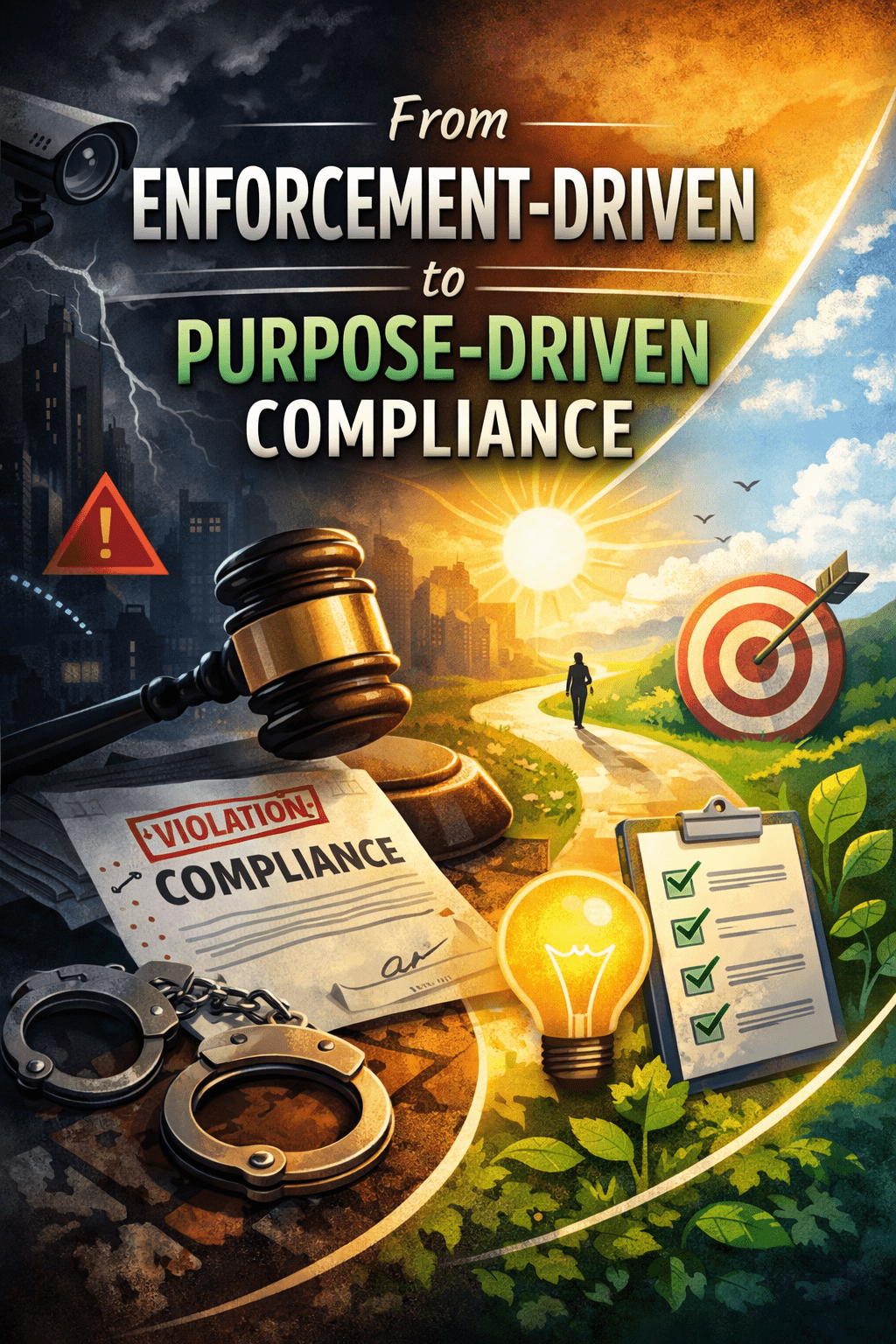
Martinez’s answer is both challenging and clarifying. Compliance programs should not be primarily designed to satisfy enforcement authorities or to maximize mitigation credit after failure. Instead, they should be anchored in the organization’s own purpose, business risks, and ethical standards. In short, it is time to move from enforcement-driven compliance to purpose-driven compliance.
The Limits of Enforcement-Driven Compliance
The enforcement-driven model rests on two assumptions. First, that enforcement priorities reflect a company’s most significant risks. Second, that imperfect compliance is inevitable and acceptable so long as the organization can demonstrate good-faith efforts. Martinez brings both under scrutiny.
Regulatory priorities often lag behind real business risks. Enforcement agencies focus on certain categories of misconduct because they are visible, politically salient, or historically entrenched. But the risks that most threaten an organization’s mission may lie elsewhere. Martinez highlights how firms can become over-invested in compliance areas that attract enforcement attention while under-investing in mission-critical risks to their operations.
The second assumption, that some level of misconduct is acceptable, is even more troubling. Behavioral ethics research suggests that tolerating small violations creates conditions for larger ones. When leaders frame misconduct as statistically insignificant or “within expectations,” they risk normalizing behavior that undermines culture, trust, and ultimately performance. Wells Fargo’s infamous “1% problem” illustrates this danger. Senior leadership took comfort in the idea that only a small fraction of employees were engaging in misconduct, failing to appreciate that those numbers reflected only the misconduct that had been detected.
An enforcement-driven mindset encourages this type of thinking. If the organization is sanctioned, then low detection rates look like success. But if the question is whether the organization is living up to its own purpose and values, the same data tell a very different story. This is not the broken windows theory of enforcement, but something else.
The Cost of Treating Compliance as a Cost of Doing Business
Another weakness of enforcement-driven compliance is that it can turn sanctions into a predictable line item. As firms grow larger and penalties are discounted through cooperation credit, fines risk being internalized as a cost of doing business. Empirical work cited by Martinez suggests that large, repeat offenders often pay penalties that are small relative to their assets and revenues. In that environment, enforcement loses much of its deterrent effect.
For compliance professionals, this dynamic creates a structural tension. Programs may be technically “effective” under DOJ guidance while still failing to prevent misconduct that harms customers, employees, and communities. The distinction between standards of review and standards of conduct becomes critical. Meeting the government’s expectations for leniency is not the same as meeting the organization’s ethical obligations to itself and its stakeholders.
What Is Purpose-Driven Compliance?
Purpose-driven compliance begins with a simple but powerful shift in perspective. Instead of asking, “What does the regulator expect?” the organization asks, “What risks threaten our ability to achieve our purpose and what standards of conduct are required to address them?” Martinez defines purpose-driven compliance as programs directed by three elements: the firm’s purpose, the inherent risks associated with pursuing that purpose, and the ethical standards the organization sets for itself. This approach does not reject enforcement frameworks; rather, it treats them as a floor, not a ceiling.
In practical terms, purpose-driven compliance requires leadership to articulate why the organization exists and how misconduct undermines that mission. For a bank, this may mean focusing on customer trust and market integrity. For a pharmaceutical company, it may mean prioritizing patient safety and scientific integrity. For a university, it may mean safeguarding academic freedom and institutional trust. For a summer camp, it means protecting the campers from flash floods and other storms.
Once the purpose is clearly defined, compliance risk assessments become more meaningful. Risks are evaluated not only by enforcement exposure but by their potential to compromise the organization’s core objectives. This reframing helps compliance leaders resist the temptation to chase regulatory trends at the expense of mission-critical risks.
Moving Beyond Mitigation to Aspirational Standards
A key insight in Martinez’s work is that firms often confuse mitigation with excellence. Compliance programs are designed to minimize penalties rather than to maximize ethical performance. Purpose-driven compliance challenges that mindset by encouraging organizations to adopt high, ethical, and aspirational standards of conduct.
This does not mean pursuing perfection through draconian controls or internal criminalization. Martinez rightly warns against overdeterrence and strict liability regimes that incentivize concealment rather than transparency. Instead, purpose-driven compliance emphasizes ethical framing, employee voice, and organizational learning. Compliance should never be Dr. No, sitting in the Department of Business Non-Development.
The examples of Wells Fargo and Novartis are instructive. Both organizations suffered repeated compliance failures under enforcement-driven regimes. Their subsequent reforms went beyond addressing the specific violations that triggered enforcement. They re-examined culture, leadership incentives, and ethical expectations. In Novartis’s case, tying bonuses to ethical performance and co-creating a new code of ethics signaled a shift from box-checking to values anchored in purpose.
Why Purpose-Driven Compliance Matters for the Modern CCO
For today’s chief compliance officer, Martinez believes purpose-driven compliance offers three critical benefits.
First, it creates durability. Enforcement priorities shift with administrations. Indeed, this Administration has signaled a cutback in white-collar enforcement by offering essentially get-out-of-jail-free cards to companies that self-disclose early. This underscores the importance of compliance programs. A compliance program anchored solely in regulatory expectations will always be reactive. Purpose-driven programs are more stable because they are tied to the organization’s identity rather than external politics.
Second, it improves the quality of compliance metrics. Measuring effectiveness against internal standards allows organizations to ask harder questions about culture, decision-making, and root causes. Not every initiative will succeed, but a willingness to acknowledge failure is itself a sign of program maturity.
Third, it enhances credibility with boards and senior leadership. When compliance is framed as a strategic partner in achieving the organization’s mission, rather than as a defensive function, it earns a more meaningful seat at the table.
Conclusion
Compliance has never been more sophisticated, expensive, or visible. Yet sophistication alone does not guarantee effectiveness. Martinez’s Purpose-Driven Compliance challenges compliance professionals to rethink the foundations of their programs. Enforcement-driven compliance has taken us far, but it cannot take us far enough.
The next evolution of compliance requires organizations to define their own standards of conduct, grounded in purpose, risk, and ethics. That shift is not easy. It requires courage from compliance leaders and commitment from boards and executives. But if compliance is truly about preventing harm and sustaining trust, purpose-driven compliance is not optional. It is essential.