AI is not simply a technology deployment question. It is a corporate governance challenge that requires board attention, compliance discipline, and operational oversight. For Chief Compliance Officers and board members, the task is not merely to encourage innovation, but to ensure that innovation is governed, monitored, and aligned with business values and risk tolerance.
Artificial intelligence has moved from pilot projects and innovation labs into the bloodstream of the modern corporation. It now touches customer service, finance, procurement, HR, sales, third-party management, internal reporting, and strategic decision-making. That expansion is why AI can no longer be treated as a narrow IT issue. It is a governance issue. More particularly, it is a governance issue with compliance implications at every lifecycle stage.
For compliance professionals, that means AI is not simply about whether a model works. It is about whether the organization has built the structures, accountability, and culture to use AI responsibly. For boards, it means AI oversight can no longer be delegated away with a cursory quarterly update. The board must understand not only where AI is being used, but whether the company’s governance architecture is fit for purpose.
This is the first post in a series examining the five most important corporate governance issues around AI. They are not exotic or theoretical. They are the same types of governance challenges compliance professionals have seen before in other contexts: ownership, control design, data integrity, monitoring, and culture. AI raises the stakes and accelerates the timeline.
1. Board Oversight and Accountability
The first challenge is the most fundamental: who is actually in charge?
One of the great failures in governance is diffuse accountability. When everyone has some responsibility, no one has real responsibility. AI governance suffers from this problem in many organizations. Legal is concerned about liability. IT is focused on systems. Security is focused on cyber risk. Privacy is focused on data usage. Compliance is focused on controls and conduct. Business leaders are focused on speed and competitive advantage. The board hears fragments from all of them, but may not receive a coherent picture.
That is a dangerous place to be. AI governance begins with clear ownership. The board should know who is accountable for enterprise AI governance, how decisions are escalated, and how high-risk use cases are reviewed. A company does not need bureaucracy for its own sake, but it does need clarity.
This is where the Department of Justice’s Evaluation of Corporate Compliance Programs remains instructive, even if AI is not its exclusive focus. The ECCP repeatedly asks whether compliance is well designed, adequately resourced, empowered to function effectively, and tested in practice. Those same questions apply directly to AI governance. If accountability for AI is vague, if compliance is not in the room, or if oversight is not documented, governance will be performative rather than operational.
2. Strategy Outrunning Governance
The second challenge is one many companies know all too well: innovation is sprinting ahead while governance is still tying its shoes.
Business teams are under enormous pressure to deploy AI quickly. Senior leadership hears daily that AI can deliver efficiency, productivity, growth, and competitive advantage. Vendors promise transformation. Employees experiment informally. In that environment, governance can be cast as friction.
But good governance is not the enemy of innovation. It is what keeps innovation from becoming unmanaged exposure.
The central question here is simple: has the company defined the rules of the road before putting AI into production? In practical terms, has it determined which use cases are permissible, which require enhanced review, which are prohibited, and which must go to the board or a designated committee? Has it established approval criteria, documentation standards, and stop/go decision points?
The NIST AI Risk Management Framework is especially helpful on this point because it treats AI governance as an ongoing management discipline rather than a one-time sign-off. Its emphasis on Govern, Map, Measure, and Manage is a powerful reminder that strategy and governance must move together. ISO/IEC 42001 brings similar discipline by framing AI management systems around structure, accountability, controls, and continual improvement.
The lesson for compliance professionals is clear: if the business has a faster process for buying or launching AI than for reviewing risks and governance, it has already fallen behind.
3. Data Governance, Privacy, and Model Integrity
The third challenge is the quality and integrity of what goes into, and comes out of, AI systems.
AI does not operate in a vacuum. It depends on data, assumptions, training inputs, prompts, workflows, and human interaction. That means weaknesses in data governance are not side issues. They are central governance risks. Poor data lineage, unvalidated data sources, confidentiality breaches, inadequate access controls, and bias in training data can all create downstream failures that become legal, reputational, regulatory, and operational events.
For boards, the temptation is to hear “AI” and think about futuristic questions. But the more immediate concern is often much more familiar. Does management know where the data came from? Does the company understand whether sensitive or proprietary information is being exposed? Are outputs accurate enough for the intended use? Are the controls around data usage consistent with privacy obligations and internal policy?
This is where AI governance intersects with traditional compliance disciplines in a very real way. Privacy, information governance, records management, cybersecurity, and internal controls all converge here. A system that produces impressive outputs but relies on flawed or unauthorized data is not a governance success. It is a governance failure waiting to be discovered.
ISO 42001 is particularly useful because it forces organizations to think in systems terms. It is not merely about the model itself; it is about the management environment surrounding it. That is exactly how boards and CCOs should think about model integrity.
4. Ongoing Monitoring and the “Day Two” Problem
The fourth challenge is the one that too many organizations underestimate: governance after deployment. A great many companies put substantial effort into approving an AI use case, but far less into monitoring it once it is live. Yet this is where some of the greatest risks emerge. Models drift. Employees use tools for new purposes. Controls that looked solid on paper weaken in practice. Reviewers become overloaded. Risk profiles change. Regulators evolve their expectations. The use case expands far beyond its original design.
That is why AI governance must include what I call the “Day Two” problem. What happens after launch? This is once again a place where the ECCP offers a useful lens. The DOJ does not ask merely whether a policy exists. It asks whether it works in practice, whether it is tested, and whether lessons learned are incorporated back into the program. AI governance should be held to the same standard. If the company has no way to monitor performance, investigate anomalies, log incidents, revalidate assumptions, or update controls, then it lacks effective AI governance. It has an approval memo.
The board should be asking for reporting that goes beyond usage metrics or efficiency gains. It should want to know about incidents, exception trends, control failures, validation results, and remediation efforts. In other words, governance must be dynamic because AI risk is dynamic.
5. Culture, Speak-Up, and Human Judgment
The fifth challenge may be the most overlooked, yet it is often the earliest warning system a company has: culture. Employees will usually see AI failures before leadership does. They will spot the odd output, the customer complaint, the biased result, the misuse of a tool, the shortcut around a control, or the inaccurate summary that could trigger a bad decision. The question is whether they will say something.
This is why AI governance is not solely about structure and policy. It is also about whether the organization has a culture that encourages people to raise concerns. Do employees understand that AI-related problems are reportable? Do they know where to raise them? Are managers trained to respond properly? Are anti-retaliation protections reinforced in this context?
Human judgment also matters because AI does not eliminate accountability. If anything, it heightens the need for judgment. A machine-generated output can create a false sense of confidence, especially when it arrives quickly and sounds authoritative. Boards and CCOs must resist that temptation. Human oversight is not a ceremonial step. It is an essential governance control.
The strongest AI governance programs will be the ones that connect structure with culture. They will not merely create committees and frameworks. They will create an environment where people trust the system enough to challenge it.
The Governance Road Ahead
For CCOs and boards, the governance challenge around AI is not mysterious. It is demanding, but it is not mysterious. The questions are recognizable. Who owns it? What are the rules? Can we trust the data? Are we monitoring the system over time? Will people speak up when something goes wrong?
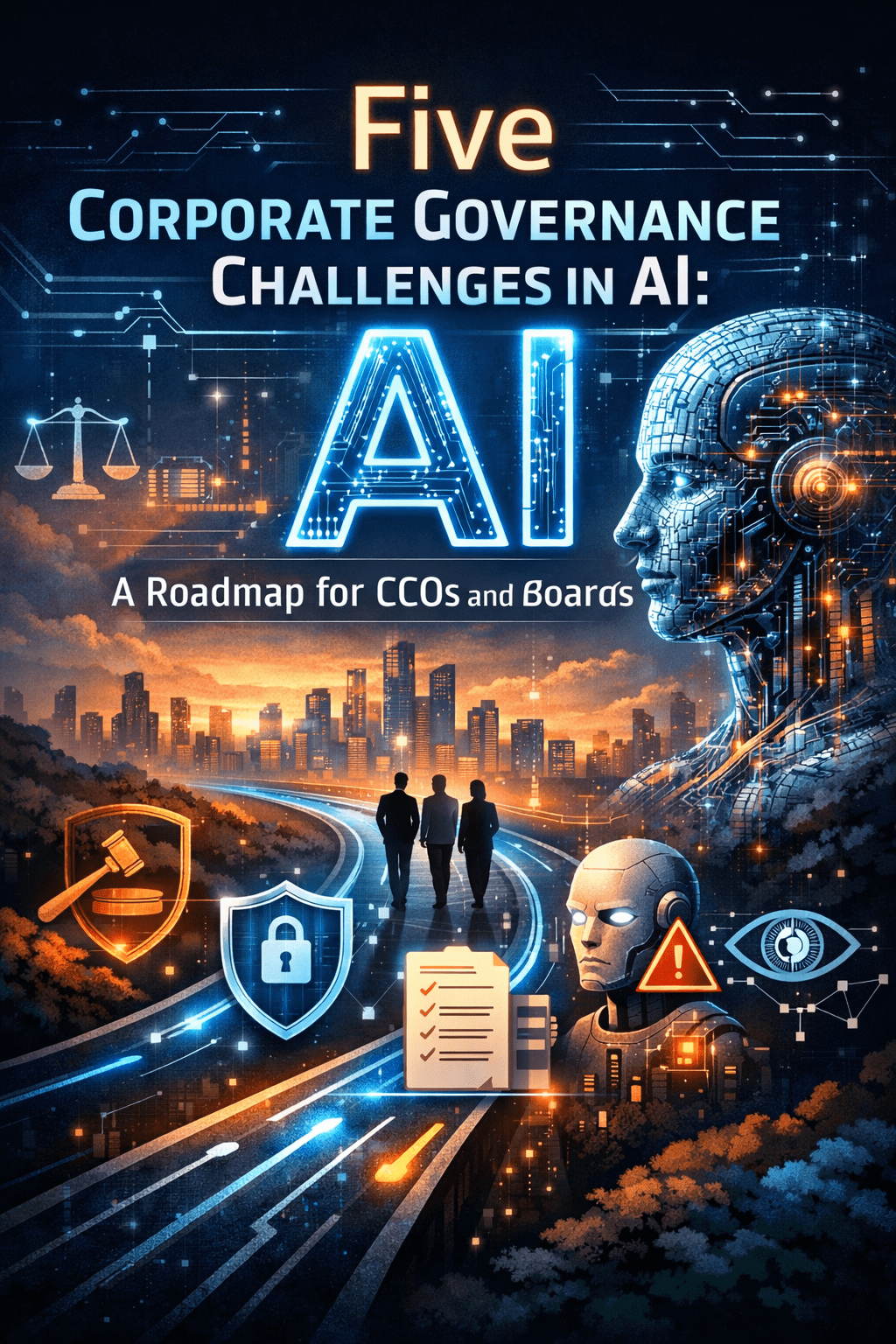
These five issues form the roadmap for the series ahead. In the coming posts, I will take up each one in turn and explore what it means in practice for modern compliance programs and board oversight. Because if there is one lesson here, it is this: AI governance is not about admiring the technology. It is about governing the enterprise that uses it.
Join us tomorrow, where we review board oversight and accountability, because that is where every effective AI governance program either starts strong or starts to fail.