Categories
Blog

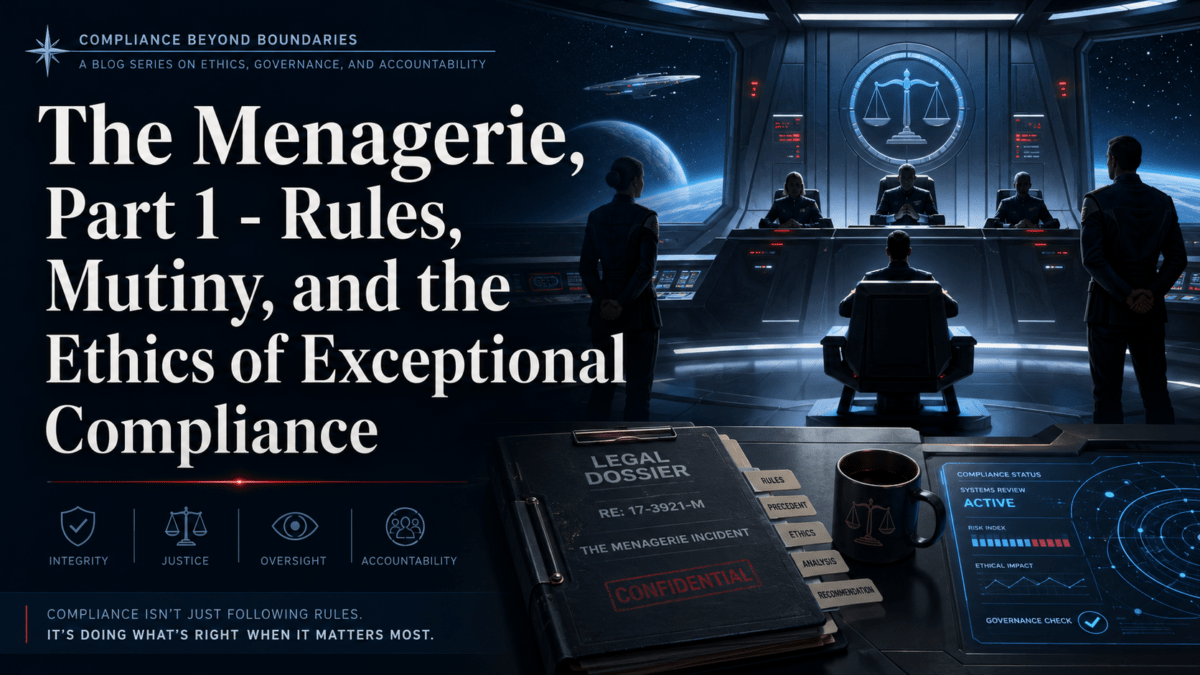
The Menagerie, Part 1 – Rules, Mutiny, and the Ethics of Exceptional Compliance

Show Summary

In this article, we beam down into one of the most compelling courtroom dramas in Star Trek canon—The Menagerie, Part 1. This two-part saga is not just a creative reuse of Star Trek’s unaired original pilot (The Cage) but a deep dive into the themes of loyalty, risk, duty, and the tension between rigid compliance and ethical decision-making. When Mr. Spock commandeers the Enterprise in direct violation of Starfleet orders, fabricates communications, and defies his captain, all to bring his former commander, the incapacitated Christopher Pike, to the forbidden planet Talos IV, it sets up one of the most dramatic ethical showdowns in Starfleet history.

In today’s blog post, we examine how this episode provides rich material for compliance professionals, particularly those navigating the delicate balance between adhering to policy and upholding higher principles. We break down five core compliance lessons and link each to specific incidents in the episode that bring them to life. Along the way, we will also consider how compliance leaders can apply these lessons to build more ethical, resilient, and human-centered organizations.

1. Ethical Mutiny: When Breaking the Rules Is the Right Thing to Do

Illustrated by Spock, hijacks the Enterprise by falsifying voice commands from Captain Kirk, overrides ship controls, and charts a course to Talos IV, a planet placed under the most severe travel prohibition in Starfleet history.

This opening act is one of the most jarring in Star Trek’s history. Spock, the emblem of logic and duty, commits mutiny. And he does not hide it. After allowing Kirk and Commodore Mendez to catch up to the Enterprise, he turns himself in and demands a court-martial.

Compliance Lesson:

Doing the right thing for an individual or stakeholder may technically violate internal policy or even law. While compliance is generally rooted in the enforcement of established rules, the ethical dimension of compliance leadership sometimes calls for courage, the kind Spock displays.

For example, think of the whistleblower who exposes illegal conduct despite violating a non-disclosure agreement. Or the compliance officer who bypasses a sluggish internal protocol to alert regulators of an imminent safety risk. These are modern-day echoes of Spock’s actions.

What matters most in these scenarios is intent, proportionality, and documentation. If you break protocol to serve a higher ethical obligation, make your reasoning transparent, and be prepared to accept scrutiny. Spock did just that, and compliance professionals can learn from his model.

2. Informed Consent and the Rights of the Vulnerable

Illustrated by Captain Pike, now confined to a life-support chair following a catastrophic accident, is capable of communicating only through blinking lights, one blink for “yes,” two for “no.” Despite this profound disability, Spock makes decisions on his behalf, presumably with his blessing, to bring him to Talos IV.

Compliance Lesson:

One of the most overlooked yet essential aspects of modern compliance is ensuring that all individuals, regardless of ability or role, have the opportunity to provide informed consent. Too often, we see vulnerable populations—such as individuals with disabilities, language barriers, or economic dependence—marginalized in decision-making processes.

In Spock’s case, we are left to infer that Pike approved of the plan. However, the lack of transparency and documented consent raises important questions. In corporate settings, this would be akin to assuming a disabled or junior employee is on board with a high-risk strategy without fully briefing them or securing a formal agreement.

The key takeaway for compliance professionals is to consistently seek and document informed consent, particularly when an individual’s ability to communicate or resist is compromised. It’s not just about legal risk—it’s about human dignity.

3. Due Process and Transparency in Internal Investigations

Illustrated by Spock’s court-martial, it begins aboard the Enterprise, with Commodore Mendez presiding. Instead of denying the charges, Spock cooperates fully and presents a surprising defense—video footage from a previous classified mission to Talos IV.

Compliance Lesson:

Investigations must be conducted fairly, transparently, and supported by evidence. What makes this incident so interesting is that Spock does not simply confess; he insists on a formal process to air the whole truth. He respects Starfleet’s legal structure and uses it not to avoid punishment but to contextualize his actions.

This approach mirrors what strong compliance programs should look like: not about covering up or avoiding accountability, but about using internal mechanisms, such as hearings, audits, and investigations, to surface the truth rather than suppress it. Always remember that compliance is the guardian of institutional justice and institutional fairness.

Moreover, it emphasizes the importance of allowing investigations to run their course. By submitting himself to judgment, Spock reinforces trust in the system, even as he challenges its rigidity. Competent compliance officers will recognize that transparency and integrity go hand in hand—even during a breach.

4. Data Use, Privacy, and Chain of Custody

Illustrated by: The footage Spock presents to the court-martial board is revealed to be an unauthorized transmission from Talos IV, one of the most tightly controlled sources of information in the galaxy. The footage itself is emotionally charged and deeply personal, raising questions about how it was obtained and used.

Compliance Lesson:

This is a prime example of modern data privacy risks. In today’s world, this would be akin to accessing and sharing confidential patient or employee data without formal approval, even if done with good intent. For compliance professionals, the lesson is clear: the ethical use of data requires a secure chain of custody, limited access, and an articulated purpose. Even benevolent motives, such as restoring dignity to a suffering colleague, do not justify breaching established data protections. If the situation is exceptional, escalation to legal or ethics committees is essential.

5. Leadership Accountability and Ethical Stewardship

Illustrated by Kirk being blindsided by Spock’s actions and struggling with the realization that someone he trusts deeply has broken the chain of command. Yet, Kirk doesn’t retaliate in anger. He allows the investigation to proceed, listens to the evidence, and reflects carefully before responding.

Compliance Lesson:

This is a case study in mature leadership. Compliance leaders are often put in the uncomfortable position of adjudicating actions by trusted colleagues. Emotional responses, especially when loyalty is called into question, can cloud judgment. Kirk’s restraint is a model for those faced with internal breaches by high performers or close allies. Accountability does not mean vengeance; it means ensuring the rules apply equally and fairly, even when your friends are involved. Ethical stewardship encompasses empathy, clarity, and responsibility.

Final ComplianceLog Reflections

The Menagerie, Part 1, is not just a legal drama in space; rather, it is a parable about leading with principle in the face of policy. Spock’s decision to violate orders in the service of a higher ethical goal challenges us to ask, “What do we do when the rules are wrong?” When does policy block compassion? When does protocol punish empathy? Compliance professionals are uniquely positioned at this crossroads every day. And while very few of us will hijack a starship in the name of justice, we will all face situations that test whether we are rule followers or ethical leaders. Let Spock’s courage and Kirk’s humility remind us that compliance is not about blind enforcement. It is about ethical discernment, moral courage, and doing right by people, even when it means breaking the mold.

Resources:

Excruciatingly Detailed Plot Summary by Eric W. Weisstein
MissionLogPodcast.com

Memory Alpha

Categories
Hill Country Hustlers

Hill Country Hustlers: Taxes, Civic Service, and Helotes Growth with IRS Veteran Ed Villanueva

Host Zachary Green interviews Ed Villanueva, a Helotes-based tax accountant and consultant with over 40 years of experience, including five years at the IRS, where he received extensive training and gained insight into issues not covered in college.

Ed explains moving into private practice after partnering with a retired IRS manager, promoting services through San Antonio radio, and building a firm that provides year-round help with IRS debt, notices, audits, occasional criminal investigation matters, and business services like bookkeeping, payroll, and tax planning, alongside two annual tax seasons tied to filing and extensions. He also discusses serving 10 years on the Helotes city council and as mayor pro tem, Helotes’ limited commercial zoning and higher household incomes, and efforts to create a buffer around the city limits to protect future revenue opportunities and city services. He closes by describing E. Villanueva & Associates, Inc., which has been in Helotes since 1991, emphasizing small-firm personal service and free initial consultations.

Key highlights:

  • Meet Ed Villanueva
  • Inside the IRS
  • Starting the Firm
  • Radio and Podcasting
  • Civic Service in Helotes
  • Year-Round Tax Work
  • Helotes Business Challenges
  • Planning Growth and Revenue
  • What Helotes Wants Next

Resources:

Zach Green on LinkedIn

Edward Villanueva on LinkedIn

Ed Villanueva & Associates, Inc.

Categories
Daily Compliance News

Daily Compliance News: June 11, 2026, The DeBanking Edition

Welcome to the Daily Compliance News. Each day, Tom Fox, the Voice of Compliance, brings you compliance-related stories to start your day. Sit back, enjoy a cup of morning coffee, and listen in to the Daily Compliance News. All, from the Compliance Podcast Network. Each day, we consider four stories from the business world, compliance, ethics, risk management, leadership, or general interest for the compliance professional.

Top stories include:

  • Malaysia drops probe into ABC chief. (SCMP)
  • An Air Canada pilot flies for 17 years without a proper license. (NYT)
  • DOJ investigating big banks for ‘debanking’. (WSJ)
  • 7 charged in Hong Kong for the fire that killed 168 people. (FT)

To learn about the intersection of Sherlock Holmes and the modern compliance professional, check out Tom’s latest book, The Game is Afoot-What Sherlock Holmes Teaches About Risk, Ethics and Investigations on Amazon.com.

Categories
Everything Compliance

Everything Compliance: New Season – The Government Misfires Edition

Welcome to a revamped Everything Compliance! We have a new host, Adam Turteltaub, and a new panelist, Rebecca Walker, who joins returning regulars Matt Kelly, Jonathan Armstrong, and Karen Moore for the next iteration of Everything Compliance.

  • Jonathan Armstrong discusses BP’s leadership upheaval, shareholder ESG concerns, and recurring governance and tone-at-the-top issues, highlighting UK directors’ duties under Section 172 of the Companies Act.
  • Karen Moore reviews IBM’s $17M DOJ False Claims Act settlement tied to alleged DEI-related practices, outlining the recent enforcement scaffolding, key alleged program elements, and ongoing risks beyond the settlement.
  • Matt Kelly summarizes DOJ remarks on “algorithmic antitrust” risk, citing the RealPage litigation and warning that shared AI pricing tools can constitute cartel behavior, with heightened whistleblower incentives.
  • Rebecca Walker explains the EU’s April 21, 2026, anti-corruption directive, which harmonizes offenses across 27 member states, including private bribery and “trading in influence,” large turnover-based penalties, and expected national transposition. The episode closes with brief shout-outs, rants, and themes of compliance culture.

The members of Everything Compliance are:

The award-winning Everything Compliance is a part of the Compliance Podcast Network.

Categories
AI Today in 5

AI Today in 5: June 11, 2026, The OpenAI & Compliance Edition

Welcome to AI Today in 5, the newest addition to the Compliance Podcast Network. Each day, Tom Fox will bring you 5 stories about AI to start your day. Sit back, enjoy a cup of morning coffee, and listen in to AI Today In 5. All, from the Compliance Podcast Network. Each day, we consider five stories from the business world, compliance, ethics, risk management, leadership, or general interest about AI.

Top AI stories include:

  1. Luxembourg and trusted financial data. (FinTechGlobal)
  2. AI governance grows at an uneven pace. (PlanAdviser)
  3. AI and spend management. (FinTechMagazine)
  4. The next changes in banking will not be in tech. (The Financial Brand)
  5. OpenAI funds start up for compliance. (Bloomberg)

For more information on the use of AI in compliance programs, Tom Fox’s new book, Upping Your Game, is available. You can purchase a copy of the book on ⁠Amazon.com⁠.

To learn about the intersection of Sherlock Holmes and the modern compliance professional, check out Tom’s latest book, The Game is Afoot-What Sherlock Holmes Teaches About Risk, Ethics and Investigations on ⁠Amazon.com⁠.

Categories
Blog

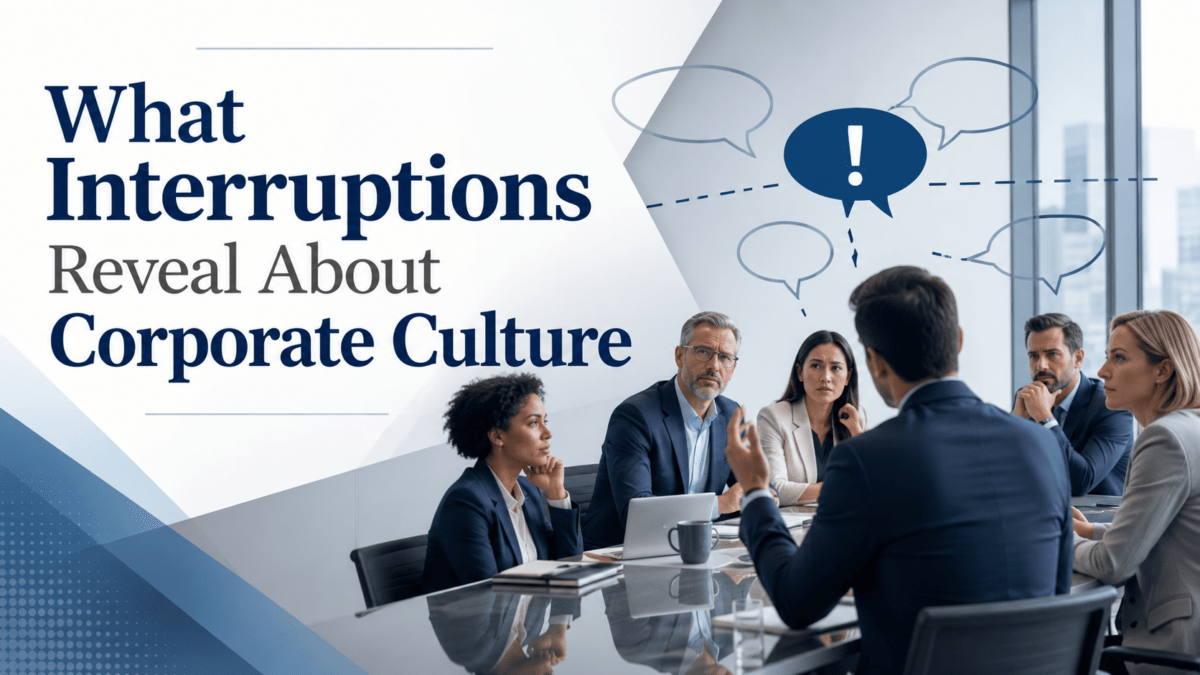
What Interruptions Reveal About Corporate Culture

Every Chief Compliance Officer talks about culture. Every company claims to value ethics, integrity, respect, inclusion, and speak-up behavior. Those words appear in codes of conduct, CEO messages, training decks, town halls, leadership offsites, and annual ethics campaigns. Yet culture is not built into the code of conduct. It is revealed in the meeting.

That is the central lesson of Research: What Interruptions Reveal About Company Culture by William Degbey, Benjamin Laker, Baniyelme Zoogah, Sanjay Kumar Singh, and Ghulam Murtaza. The authors argue that workplace culture is shaped less by formal statements and engagement programs than by everyday interaction patterns, especially interruptions in meetings. Their research found that interruptions, redirections, and moments where employees were spoken over were not merely interpersonal annoyances. They were signals of whose voice carried weight in the room.

For the CCO, that finding should land with force. A company can have a beautifully written value of “speak up.” Still, if employees learn in ordinary meetings that certain people are cut off, ignored, or not credited for their ideas, the real culture is not to speak up. It is speak-only-if-you-have-power. That is a compliance issue.

Culture Is What Happens Before the Hotline

Compliance professionals often think about speak-up culture in terms of hotline reports, investigation data, employee surveys, and anti-retaliation policies. Those are important. The DOJ’s Evaluation of Corporate Compliance Programs (ECCP) asks whether a company has a trusted reporting mechanism, whether employees feel comfortable using it, whether reporting is encouraged or chilled, and whether employees can raise concerns without fear of retaliation.

But by the time an employee reaches the hotline, the culture has already taught that person a great deal. It has taught them that if management listens. It has taught them whether disagreement is welcome. It has taught them whether bad news is punished. It has taught them whether junior employees can challenge senior leaders. It has taught them whether women, employees from underrepresented groups, remote employees, finance staff, compliance staff, or local market employees are taken seriously.

The author’s most important compliance lesson is that interruptions are cultural data. They are small, repeated, observable signals that show whether the company’s stated values are protected in daily business interactions or suspended when authority, speed, revenue, or hierarchy enters the room.

Why This Matters to Ethics and Integrity

Ethics and integrity depend on voice. Employees must be willing to raise concerns, ask questions, challenge assumptions, and slow down decisions when something does not look right. If the organization’s meeting culture teaches employees that unfinished concerns can be interrupted, redirected, or appropriated, then the company is training people not to speak.

The authors found that many senior leaders interpreted interruptions as signs of efficiency and engagement. They saw energetic cross-talk as evidence of a productive culture. Yet the follow-up study found that others experienced the same conduct as exclusionary and predictable. Interruptions were disproportionately directed at women and employees from underrepresented racial and ethnic groups. In the follow-up study, 19 of 27 interviewees described women being interrupted more frequently than men; all seven Black women interviewed described early-stage interruptions, and five said others later resurfaced their ideas without attribution.

For compliance, that is not simply an inclusion issue, though it certainly is. It is also a risk-detection issue. If certain voices are routinely cut off, then certain risks will be underreported. If certain employees must speak faster, more defensively, or only when explicitly invited, the company loses early warning signals. If some ideas are accepted only when repeated by someone with greater status, then the company is not evaluating risk on its merits. It is evaluating risk through hierarchy. That is how ethical blind spots form.

The Silent Cost of Being Interrupted

One of the most powerful findings in the article is that interruptions changed employee behavior. Twenty-one of the 27 participants in the follow-up study said they changed how they contributed to meetings. Some spoke faster or more defensively. Some pre-structured arguments to avoid being cut off. Some waited for explicit permission to speak. Others stopped contributing unless necessary. That is exactly what a CCO should worry about.

A healthy compliance culture does not require employees to perform perfectly polished courage. It gives employees room to raise half-formed concerns, ask awkward questions, and test whether something feels wrong before they have built a legal brief around it. Many compliance issues begin as fragments: “Something about this consultant does not feel right.” “The customer is asking for unusual documentation.” “The timing of this payment seems odd.” “Why are we routing this through that entity? ”I am not sure the data use matches what we told customers.” Those are early-stage compliance signals. They need space.

If the meeting culture rewards only fast, polished, confident speech, then employees who need time to frame a concern may never get the chance. The authors note that faster and more confident-sounding speech was often treated as more authoritative. In comparison, slower or less forceful speech was treated as incomplete and therefore easier to interrupt. For a CCO, the lesson is clear: do not build a compliance program that only works for the loudest person in the room.

From Tone at the Top to Conduct in the Room

Compliance professionals have long emphasized “tone at the top.” That remains important. But this article reminds us that tone at the top is incomplete unless it becomes conduct in the room.

The DOJ expects companies to demonstrate that compliance policies and procedures are integrated into operations and that a culture of compliance is embedded in day-to-day activities. That is precisely where meeting behavior matters. Meetings are where risk appetite becomes real. They are where employees learn whether the company actually values integrity when there is a deal to close, a target to hit, or a senior executive to satisfy.

A CCO should, therefore, ask:

What happens when ethics enters the meeting?

Does the room slow down?

Does the leader protect the person raising the concern?

Does someone capture the issue and assign a follow-up?

Does the business discuss controls and alternatives?

Or does the concern get interrupted, minimized, joked away, or pushed offline?

The answers will tell you more about culture than a slogan.

Reading Interruptions as Compliance Data

The authors recommend that leaders stop treating interruptions as isolated incidents and begin reading them as data. It suggests observing who gets interrupted, when the interruption occurs, and what happens to the idea afterward. Is the idea acknowledged? Is it dropped? Is it later picked up without credit? That framework can be directly adapted into a compliance culture assessment.

A CCO can ask compliance, internal audit, HR, or an outside facilitator to observe selected meetings where risk decisions are made. These might include third-party approval committees, deal review meetings, product governance meetings, investigations triage meetings, M&A diligence sessions, safety committees, privacy reviews, or regional leadership calls.

The observer should not simply count who speaks. This is not about policing manners. It is about understanding whether the company’s ethical culture allows risk information to travel upward and across the organization.

Slow the Meeting to Surface the Risk

The article warns that speed and forced momentum can amplify inequality. Faster conversations often favor those who already feel entitled to the floor. Those who anticipate interruption compress their thinking, hesitate, or wait for a clear opening. The authors recommend slowing the interaction: let people finish, pause before responding, reinforce the norm when someone is cut off, and rotate facilitation. This is deeply relevant to compliance.

Many corporate failures occur not because no one saw the risk, but because the organization moved past it too quickly. The payment had to go out. The distributor had to be approved. The quarter had to close. The launch date had to be met. The customer had to be retained. In that environment, “speed” can become a cultural value that overwhelms integrity. A CCO should help leaders build an “integrity pause” into decision-making.

Protect the Contribution, Not the Ego

The article also makes an important distinction. Calling out interrupters or turning every interruption into a lesson on etiquette often does not work. It can escalate the moment and personalize the issue. The better approach is to protect the contribution directly. The authors suggest short interventions such as “Let them finish,” “I want to hear the rest of that point,” and “Let’s come back to the idea that was just interrupted.” This is practical guidance for CCOs and compliance professionals.

When someone raises a compliance concern and is interrupted, the compliance professional does not need to accuse anyone of bad intent. This helps to create psychological safety around risk information. They tell the room that compliance concerns are not interruptions to business. They are part of doing business properly.

The CCO as Culture Observer

A CCO cannot improve culture solely by issuing policies. Policies matter, but culture is reinforced through repeated behavior. The DOJ guidance recognizes that policies and procedures must give effect to ethical norms and be integrated into day-to-day operations. That means the CCO must look beyond policy architecture and ask how people actually behave when decisions are being made.

Not every interruption is retaliation. Not every fast-paced meeting is unethical. Not every dominant speaker is a compliance risk. But patterns matter. Repeated interruption of certain people, functions, geographies, or types of concerns is cultural data. A CCO should treat it as such.

Turning the Article into a Compliance Playbook

A practical CCO response could include five steps.

  1. Add meeting behavior to the culture assessment. Ask employees whether they can finish raising concerns in meetings, whether leaders invite dissent, whether objections to risk are credited, and whether certain voices are routinely ignored.
  2. Observe high-risk meetings. Select a sample of decision-making forums and map interruptions, credit, follow-up, and closure. The goal is not surveillance. The goal is to understand whether the company’s values show up when risk is discussed.
  3. Train leaders on protecting concerns. Leadership training should include simple phrases or the preservation of unfinished risk points. A manager does not need to become a compliance expert to say, “Let’s hear the rest of that concern.”
  4. Build structured dissent into key decisions. For high-risk approvals, require a final risk round before the decision. Ask compliance, finance, legal, HR, internal audit, cybersecurity, or local-market leaders whether they see an unresolved issue.
  5. Report cultural signals to the board. Boards should hear more than hotline statistics. They should understand whether the organization’s meeting culture supports candor, dissent, and ethical escalation.

Improving Corporate Culture Around Ethics and Integrity

The broader message for compliance professionals is that ethics and integrity must become observable behaviors. Employees should see integrity in how meetings are run, how concerns are handled, how dissent is credited, how leaders respond to uncertainty, and how the company treats people who slow down a decision for the right reason.

The bottom line is straightforward. The words on the wall do not prove a culture of ethics and integrity. It is proven by who gets to speak, who gets heard, and what happens when someone raises a concern that slows the room down. For the CCO, the lesson from this article is powerful: look at the meetings. That is where the culture is already speaking.

Categories
Trekking Through Compliance

Trekking Through Compliance: Episode 11 – Compliance Lessons from Menagerie, Part 1

In this episode of Trekking Through Compliance, we consider the episode The Menagerie (Part One), which aired on November 17, 1966, Star Date 3012.4.

Story Synopsis

This was the original pilot episode presented to NBC. Set in 2267, the Enterprise arrives at Starbase 11 in response to a subspace call Spock reported receiving from the former captain of the Enterprise, Christopher Pike, under whom Spock had served. Pike cannot move or communicate except by answering yes/no questions with a device operated by his brainwaves. Pike refuses to communicate with anyone except Spock.

Spock, meanwhile, commandeers the Enterprise using falsified recordings of Kirk’s voice and orders the ship to depart under the computer’s control. After several hours, upon learning from the computer that the shuttlecraft lacks enough fuel to return to the starbase, Spock brings them aboard and surrenders, confessing to mutiny. Mendez convenes a hearing, at which Spock requests an immediate court-martial, which requires the presence of three command officers. The tribunal begins, and Spock offers, as his testimony, what appears to be video footage of the Enterprise’s earlier visit to Talos IV in 2254.

In 2267, the scene is interrupted by a message from Starfleet Command, revealing that the images they have been viewing were transmitted from Talos IV. Mendez is placed in command of the Enterprise, but Spock begs Kirk to see the rest of the transmission.

Key highlights:

1. Ethical Mutiny—When Following the Rules Would Break the Mission

🖖 Illustrated by: Spock falsifying orders and commandeering the Enterprise to take Pike to Talos IV.

Spock’s act is textbook mutiny—yet deeply principled. He disobeys protocol to serve the well-being of a former captain who can no longer speak for himself. This parallels real-world dilemmas in which compliance officers must advocate for doing the right thing, even when it contradicts rigid procedures.

2. Whistleblowing with Intent—The Value of Transparent Testimony

🖖 Illustrated by: Spock turning himself in and requesting a formal court-martial to reveal the truth.

Rather than flee or hide from his actions, Spock insists on full transparency, even when the consequences may include imprisonment or execution. Compliance professionals must champion this level of courageous transparency, especially in internal reporting environments.

3. Disability Rights and Inclusion—The Silent Voice Must Still Be Heard

🖖 Illustrated by: Captain Pike communicating only via a blinking light system—yes or no responses.

Despite his physical limitations, Pike’s agency and dignity are respected—especially by Spock. Compliance officers should consider how their programs support employees with disabilities, from accessible reporting channels to inclusive policy design.

4. Data Privacy and Consent—Who Has the Right to Reveal Personal History?

🖖 Illustrated by: Spock transmitting footage of Pike’s original mission to Talos IV as part of his defense.

The court is shown deeply personal footage without Pike’s verbal consent. Companies must walk a fine line between disclosure and discretion, particularly when reputations or protected personal information are involved.

5. Navigating Conflicts Between Law and Ethics—The Role of Judgment in Compliance

🖖 Illustrated by: Spock knowingly violating Starfleet’s highest general order to save Pike from a life of suffering.

Talos IV is strictly off-limits. Spock knows this. Yet he also knows that Talos IV is the only place where Pike can live in peace and happiness. The best compliance leaders prepare teams to apply judgment, not just rules, when navigating moral gray zones.

Final Starlog Reflections

“The Menagerie, Part 1” is one of the most powerful episodes in Star Trek canon, not for its action, but for its ethical implications. It reminds us that sometimes the greatest compliance hero is not the one who follows every rule but the one who understands when rules must bend to protect justice, human dignity, and long-term integrity.

Compliance is not about obedience; it’s about stewardship. Spock may have committed mutiny, but he also modeled moral courage, transparent reporting, and respect for the voiceless. And in that, he speaks volumes to us all.

Resources:

Excruciatingly Detailed Plot Summary by Eric W. Weisstein
MissionLogPodcast.com

Memory Alpha