Categories
Business Integrity Innovations

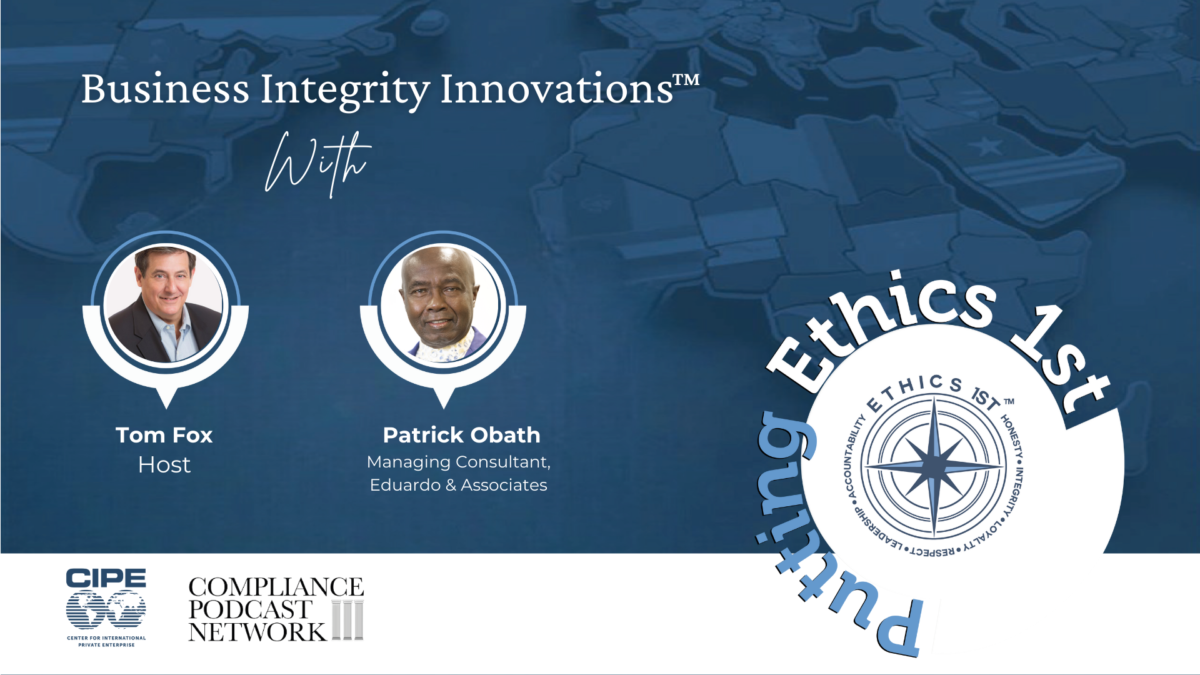
Business Integrity Innovations – West Meets Africa: Business Integrity and Leadership with Patrick Obath

Business Integrity Innovations is brought to you by the Center for International Private Enterprise (CIPE) and the Compliance Podcast Network (CPN). This podcast is inspired by Ethics 1st, a multi-stakeholder initiative led by CIPE that creates pathways for accountable and sustainable investment in Africa. Companies can use Ethics 1st to standardize their business practices, develop sound corporate governance systems, and demonstrate their commitment to compliance and business ethics.

In this episode, host Tom Fox interviews Patrick Obath, a former CEO of Shell East Africa, who is now active in the business community as a coach and leader. Obath discusses his extensive career, his role in advocating for business associations in Kenya through the Kenya Private Sector Alliance (KEPSA), and strategies to improve corporate governance and financing for businesses. He emphasizes the importance of ethical behavior, combating the perception of corruption, and the necessity of robust compliance frameworks. The conversation also touches on the significance of leadership development, leveraging experiences from multinational corporations, and future challenges for business integrity in Kenya and other African markets.

Key Highlights: 

  • Business Advocacy and Corporate Governance in Kenya
  • The Role of Business Integrity
  • Compliance Standards and Anti-Bribery Efforts
  • Leadership Development and Training
  • Future Challenges and Opportunities in Business Integrity

Resources:

CIPE

KEPSA

Patrick Obath on Linkedin

Categories
Daily Compliance News

Daily Compliance News: August 29, 2024 – The Getting Ahead at Work Edition

Welcome to the Daily Compliance News. Each day, Tom Fox, the Voice of Compliance, brings you compliance-related stories to start your day. Sit back, enjoy a cup of morning coffee, and listen to the Daily Compliance News. All from the Compliance Podcast Network.

Each day, we consider four stories from the business world: compliance, ethics, risk management, leadership, or general interest for the compliance professional.

In today’s edition of Daily Compliance News:

  • GenZ guide for getting ahead at work. (WaPo)
  • A whistleblower lawyer who used fake AI cases says no harm, no foul. (Reuters)
  • Criminal convictions in Switzerland for 1MDB scandal. (Reuters)
  • Treasury loosens AML requirements for financial advisors, real estate agents. (WSJ)

For more information on the Ethico ROI Calculator and a free White Paper on the ROI of Compliance, click here.

Categories
Everything Compliance

Everything Compliance: Episode 139, The Bank of America Episode

In this episode, we take up the recent imbroglio surrounding the Bank of America and its toxic workplace culture of 100+ hour work weeks. We have the full quintet of Matt Kelly, Jonathan Armstrong, Karen Woody, Jonathan Marks, and Karen Moore; all hosted by Tom Fox.

  1. Matt Kelly mines the matter for compliance lessons learned. He shouts out the GOP speakers at the recently concluded Democratic National Convention who bucked their party for the good of the nation.
  2. Jonathan Marks explores how internal controls were in place but not completely disregarded. He shouts out to researchers at the University of Pennsylvania for its work in CAR T cell therapy to treat certain types of cancer.
  3. Karen Moore considers the matter from the perspective of the Board of Directors and what their role should be. She shouts out to her students in the new semester of her class at Fordham Law School.
  4. Karen Woody takes a deep dive into the district court’s recent dismissal of the SEC complaint against Solar Winds. She shouts out the persons who ran the Democratic National Convention for a great Convention.
  5. Jonathan Armstrong reviews the entire matter from his UK perspective. He rants about Elon Musk and hate speech on X.
  6. Tom Fox shouts out to Rick Springfield and his hit song Jessie’s Girl as one of the two most well-known and sung songs from the 1980’s.

The members of the Everything Compliance are:

  • Karen Woody – Is one of the top academic experts on the SEC. Woody can be reached at kwoody@wlu.edu
  • Matt Kelly – Founder and CEO of Radical Compliance. Kelly can be reached at mkelly@radicalcompliance.com
  • Jonathan Armstrong –is our UK colleague and an experienced data privacy/data protection lawyer in London. He can be reached at his new law firm Jonathan.Armstrong@puntersouthall.law
  • Jonathan Marks can be reached at jtmarks@gmail.com
  • Karen Moore can be reached at Kmoore51@fordham.edu

The host and producer, rantor (and sometime panelist) of Everything Compliance is Tom Fox the Voice of Compliance. He can be reached at tfox@tfoxlaw.com. Everything Compliance is a part of the award-winning Compliance Podcast Network.

Categories
Magnificent 7 Rides Again

The Magnificent 7 Rides Again: Elaine Capers on Artistic Inspirations from West Texas

Welcome to The Magnificent 7 Rides Again, a captivating podcast series that delves into the vibrant world of seven talented female artists painting amidst the breathtaking landscapes, wildlife and vistas of the Texas Hill Country. Join us as we explore their creative journeys, uncover the inspirations behind their work, and celebrate their unique perspectives on art and life.

In this series, we will dive deep into the heart of the Texas Hill Country, where sweeping vistas and rugged beauty serve as the backdrop for artistic expression. Each episode will feature intimate conversations with these remarkable women, offering insights into their creative processes, the challenges they face, and the stories that shape their art.

In this episode, Tom interviews artist Elaine Capers. Elaine shares her journey into art, starting from her childhood in Fort Stockton, Texas, and her experiences with pastels and watercolors at the Annie Riggs Museum. She discusses the inspiration behind her work, often rooted in the rugged and desolate beauty of West Texas, particularly the Davis Mountains and Trans Pecos region. Elaine talks about the significance of primary colors in her palette and how they help her capture the essence of West Texas landscapes. Additionally, she reflects on her involvement with ‘The Magnificent Seven,’ a group exhibition at the Kerr Arts and Cultural Center in Kerrville. Elaine also highlights her interactions with young art enthusiasts and her purpose as an artist. The episode delves into the local art scene in Kerr County and Elaine’s expectations for the upcoming show.

Key Highlights:

  • The Influence of West Texas
  • The Colors of the Pecos Mountains
  • Elaine’s Purpose and Passion for Art
  • Inspiring the Next Generation
  • The Local Art Scene in Kerr County

Resources:

Elaine Capers on Instagram

Texas Hill Country Podcast Network

The Hill Country Artists Facebook Page

Categories
Blog

Bank of America’s Corporate Culture Crisis: Part 4 – A Tale of Metrics and Misalignment: Lessons for Compliance Professionals

Compliance professionals constantly seek to understand how systemic issues within corporate hierarchies can lead to severe consequences. The recent revelations about Bank of America’s (BoA) persistent workplace culture problems are a powerful reminder of compliance’s critical role in safeguarding employees and the organization.

This week, I will explore the BoA failure around workplace culture from various perspectives articulated by the Everything Compliance gang, including Karen Woody, Jonathan Armstrong, Matt Kelly, Karen Moore, and Jonathan Marks. This exploration will include the failure of internal controls, failures by the Board and senior management, culture failures around highly driven, self-selecting employees, and the cultural miasma that is BoA from a perspective from across the pond. In Part 4, we consider a misconnection of metrics. This issue is not merely a question of productivity but a fundamental concern about corporate culture, ethics, and long-term sustainability.

In corporate governance and compliance, aligning business metrics and ethical obligations often defines a company’s culture’s success or failure. The recent Wall Street Journal (WSJ) article about BoA and its investment banking metrics sheds light on a crucial disconnect that compliance professionals must address: the disparity between business performance indicators and employee well-being.

At the heart of the issue is the nature of the metrics used to evaluate success in different industries. In investment banking, the primary focus is often on closing deals. The logic is straightforward: deals drive revenue, and revenue drives the bottom line. This singular focus on deal-making creates an environment where the end justifies the means, potentially overlooking the toll it takes on employees.

Conversely, in law firms, the metric of success is often billable hours. Lawyers are compensated and promoted based on the number of hours they bill, which can lead to a different, yet equally problematic, set of behaviors. Over-inflating hours or working excessive hours becomes the norm because that is the path to career advancement.

Both systems create perverse incentives: investment bankers might underreport hours to avoid raising HR flags, while lawyers might overreport hours to enhance their career prospects. These behaviors highlight a crucial point for compliance professionals: the metrics set at the top of an organization inevitably shape the behavior throughout the company.

One of the first steps in addressing these issues is understanding the available data and how it is used. Compliance professionals must ask themselves, “What data do we have, and how can it be used to monitor and manage risks effectively?” By focusing solely on deal closure, companies are potentially neglecting data related to employee well-being, such as hours worked or stress levels.

In contrast, law firms have systems that track the minutiae of an employee’s workday, from time spent on tasks to keystrokes made during document review. This data is invaluable for billing clients and identifying patterns that may indicate overwork or burnout. Compliance professionals in investment banking could learn from this approach, using technology to track hours worked or monitor workload distribution, ensuring that employees are kept within reasonable limits.

The core issue is more alignment between business metrics and corporate culture risks. Compliance professionals must ensure senior management acknowledges overwork as a significant risk and takes proactive steps to monitor and mitigate it. This involves tracking the traditional success metrics and implementing metrics that reflect the company’s values and culture.

For example, if overwork is recognized as a risk, metrics such as average hours worked, employee turnover rates, and employee satisfaction surveys should be regularly monitored and reported. This dual approach allows a company to pursue business success while ensuring its corporate culture remains healthy and sustainable.

The responsibility of aligning these metrics rests not solely with middle management, compliance officers, or senior management; it extends to the board of directors. The board’s oversight role is crucial in ensuring that the company’s culture is preserved in pursuing financial success. For boards everywhere, the recent scrutiny BoA received in the WSJ article serves as a lesson.

Board members must go beyond the surface level of management reports and delve into the realities of the workplace culture. This requires more than attending board meetings in luxurious settings and listening to pre-prepared presentations. It involves engaging directly with employees at all levels, understanding their challenges, and prioritizing their well-being.

A practical approach could involve the board requiring regular reports on employee well-being metrics, mandating internal audits focused on workplace culture, or even conducting anonymous employee surveys to get an unfiltered view of the corporate environment.

An effective compliance program also hinges on creating a culture where employees feel safe to voice their concerns. A speak-up culture is essential in identifying issues before they escalate into major risks. Management and the board should encourage employees to report inconsistencies between policy and practice and take these reports seriously.

For instance, if employees consistently report working beyond reasonable hours, this should trigger an investigation and subsequent action from the board. Such feedback mechanisms help identify risks and reinforce the company’s commitment to ethical practices.

Lastly, when issues do arise—such as the tragic death of a young employee in the Bank of America case—the board should conduct a root cause analysis. This analysis should not be limited to the immediate cause but should explore deeper systemic issues that may have contributed to the incident.

A comprehensive root cause analysis might reveal that the focus on deal closure at the expense of employee well-being is not an isolated issue but indicative of a broader cultural problem. The board could use this analysis to implement changes across the organization, ensuring that similar incidents do not occur in the future.

The lessons are clear: the metrics that companies use to measure success are powerful drivers of behavior. The challenge for compliance professionals is ensuring that these metrics align with business goals, ethical standards, and employee well-being. This requires a proactive approach, leveraging data to monitor business performance and corporate culture. It also requires a board that is engaged, informed, and committed to understanding the realities of the workplace.

In the end, compliance is not just about preventing legal and compliance risks but about fostering a corporate culture that values integrity, transparency, and the well-being of all employees. By aligning metrics with these values, companies can achieve sustainable success that benefits their bottom line and people.

Categories
Compliance Tip of the Day

Compliance Tip of the Day: Asking Questions for Compliance

Welcome to “Compliance Tip of the Day,” the podcast where we bring you daily insights and practical advice on navigating the ever-evolving landscape of compliance and regulatory requirements.

Whether you’re a seasoned compliance professional or just starting your journey, our aim is to provide you with bite-sized, actionable tips to help you stay on top of your compliance game.

Join us as we explore the latest industry trends, share best practices, and demystify complex compliance issues to keep your organization on the right side of the law.

Tune in daily for your dose of compliance wisdom, and let’s make compliance a little less daunting, one tip at a time.

In this episode, we consider the technique of asking questions to improve both culture and compliance at your organization.

For more information on the Ethico ROI Calculator and a free White Paper on the ROI of Compliance, click here.

To check out The Compliance Handbook, 5th edition, click here.

Categories
Daily Compliance News

Daily Compliance News: August 28, 2024 – The $100MM Podcast Deal Edition

Welcome to the Daily Compliance News. Each day, Tom Fox, the Voice of Compliance, brings you compliance-related stories to start your day. Sit back, enjoy a cup of morning coffee, and listen to the Daily Compliance News. All from the Compliance Podcast Network.

Each day, we consider four stories from the business world: compliance, ethics, risk management, leadership, or general interest for the compliance professional.

In today’s edition of Daily Compliance News:

  • Nordea Bank to pay $35MM for AML violations. (WSJ)
  • South Africa investigating $7bn worth of corruption at state-owned enterprises. (Toronto Star)
  • Top Chilean lawyer indicted on corruption charges. (FT)
  • Mexico wants to have elected judges. What could go wrong? (See: Texas). (Bloomberg)

For more information on the Ethico ROI Calculator and a free White Paper on the ROI of Compliance, click here.

Categories
Compliance Into the Weeds

Compliance into the Weeds: Does a CCO Need to be a Lawyer?

The award winning, Compliance into the Weeds is the only weekly podcast which takes a deep dive into a compliance related topic, literally going into the weeds to more fully explore a subject. Looking for some hard-hitting insights on compliance? Look no further than Compliance into the Weeds!

In this episode, Tom Fox and Matt Kelly take a deep dive into the question of whether a law degree is necessary for Chief Compliance Officers (CCOs).

Tom and Matt begin with a discussion of a recent compensation survey by Barker Gilmore that reveals CCOs with law degrees earn significantly more than their counterparts without JDs. They explore historical and practical reasons for this pay disparity and debate the actual necessity of a law degree for fulfilling modern compliance functions. Additionally, they identify key skills and functions essential for effective compliance and consider alternative career paths and educational backgrounds suited for aspiring compliance professionals.

Key Highlights:

  • The Value of a Law Degree for Compliance Officers
  • Breaking Down the Pay Disparity
  • Modern Compliance Demands
  • Career Paths and Skills for Compliance Officers

Resources

Matt in Radical Compliance

Tom 

Instagram

Facebook

YouTube

Twitter

LinkedIn

Categories
Blog

Bank of America’s Corporate Culture Crisis: Part 3 – The Role of Internal Controls

Compliance professionals constantly seek to understand how systemic issues within corporate hierarchies can lead to severe consequences. The recent revelations about Bank of America’s (BoA) persistent workplace culture problems are a powerful reminder of compliance’s critical role in safeguarding employees and the organization.

This week, I will explore the BoA failure around workplace culture from various perspectives articulated by the Everything Compliance gang, including Karen Woody, Jonathan Armstrong, Matt Kelly, Karen Moore, and Jonathan Marks. This exploration will include the failure of internal controls, failures by the Board and senior management, culture failures around highly driven, self-selecting employees, and the cultural miasma that is BoA from a perspective from across the pond. In Part 3, we will consider the role of internal controls.

Internal controls are often seen as the backbone of an organization’s ability to operate efficiently, ethically, and within the bounds of the law. They serve as the safety net that catches errors deters fraud, and ensures that policies are not just theoretical but are put into practice. However, the recent revelations in the Wall Street Journal (WSJ) surrounding the culture of overwork at a major financial institution, where junior bankers were expected to work excessively long hours, shine a spotlight on a critical failure in internal controls—not in their design, but in their execution and monitoring. This blog post will explore the lessons compliance professionals can learn from this situation, focusing on implementing, actively managing, and enforcing internal controls.

Understanding the Control Environment

The control environment is at the heart of any robust internal control system. This includes the corporate culture, employee attitudes toward internal controls, and the tone set by senior management. It’s the foundation upon which all other aspects of internal control are built. When the control environment is weak or toxic, as in the situation under discussion, the entire control structure can crumble.

In this case, BoA had ostensibly implemented controls to prevent overwork—junior bankers were required to self-report their working hours. If they exceeded a certain threshold, this would trigger a review by HR. However, this control was ineffective because those responsible for enforcing it did not take it seriously. Managers instructed their subordinates not to report excessive hours, bypassing control entirely. Additionally, think about the basic conflict of interest (READ: Absurdity) in having the person the control was supposed to monitor input the information for the control to activate.

For the compliance professional, this emphasizes that your control environment is only as strong as the commitment of those enforcing it. Senior management must set the tone and ensure that it resonates throughout the organization. When internal controls are ignored or undermined, it’s often a sign that the control environment is flawed.

The Role of Monitoring and Remediation

Internal controls are not static; they require ongoing monitoring and, when necessary, fine-tuning or remediation. In the BoA situation, the institution needed to adequately monitor the effectiveness of its controls. Even after the tragic death of a junior banker, which should have been a clear signal that the controls in place were not working, there was no significant overhaul or improvement in the control environment.

Monitoring is a critical component of internal control, as it allows an organization to detect weaknesses and address them before they lead to significant issues. In this case, the failure to monitor and remediate allowed a toxic culture to persist for years, ultimately leading to repeated tragedies.

For the compliance professional, the lesson is clear: regular monitoring of internal controls is essential. When weaknesses are identified, they must be addressed promptly and effectively. A failure to remediate control weaknesses leaves an organization vulnerable to risks and can signal to employees that the controls—and the culture—are not taken seriously.

The Flaws of Self-Reporting as a Control

One of the most striking aspects of this case is the reliance on self-reporting as a key control mechanism. While self-reporting can be helpful, it is far from foolproof, especially in environments with significant pressure to conform to unrealistic expectations. In this instance, the control requiring junior bankers to self-report their hours was ineffective because the reporting was neither enforced nor monitored.

The problem with self-reporting as a control is that it places the onus on the individuals being controlled, which can create a conflict of interest. Employees may feel pressured to underreport or falsify their time to meet expectations or avoid repercussions. With independent verification and oversight, self-reporting is likely to be reliable.

For the compliance professional, the starkness of the lesson could not be more profound. Self-reporting should not be relied upon as the sole or primary control in a high-risk environment. It should be supplemented with independent verification methods, such as automated time tracking, regular audits, or cross-referencing with other data sources. This approach ensures that the data collected is accurate and that controls are truly effective.

Automation and Technology in Internal Controls

Given BoA’s size and sophistication, it is somewhat perplexing that more robust, automated controls were not implemented. In today’s technologically advanced world, numerous tools can automatically track employee hours, monitor for signs of overwork, and flag potential issues for review. These tools can remove the burden of self-reporting and provide more accurate, real-time data.

For example, many organizations use software that tracks employee computer activity, monitors login and logout times, and even tracks time spent on specific tasks. This data can then be used to identify patterns of overwork and take proactive measures to prevent burnout or health issues.

For the compliance professional, it is a direct lesson that leveraging technology can significantly enhance the effectiveness of internal controls. Automated systems can provide continuous monitoring, reduce the risk of human error, and offer objective data that can be used to identify and address potential issues before they escalate.

The Importance of a Holistic Approach

Finally, every compliance professional must recognize that internal controls cannot operate in a vacuum. Internal controls must be part of a broader, holistic approach to risk management and compliance. This includes fostering a strong ethical culture, regularly training employees at all levels, and ensuring transparent, accessible channels for reporting concerns.

With BoA, the failure was not just in the specific control related to work hours—it was a systemic failure across the organization. The culture of overwork was allowed to persist because the control environment was weak, monitoring was inadequate, and there was no serious commitment to remediation.

This final lesson learned for the compliance professional is that internal controls are just one piece of the puzzle. To be truly effective, they must be integrated into a comprehensive risk management framework that includes strong ethical leadership, ongoing education, and a commitment to continuous improvement. 

Internal Controls as a Reflection of Corporate Culture

The tragic situation at BoA is a stark reminder of the critical importance of internal controls in maintaining compliance and a healthy and sustainable corporate culture. Internal controls are more than checkboxes—they reflect an organization’s values and priorities. When controls are ignored or undermined, they send a message that compliance, and by extension, employee well-being, is not a priority.

For compliance professionals, the key takeaway is clear: internal controls must be actively managed, monitored, and enforced. They must be part of a broader effort to create a culture of integrity and accountability. Perhaps most importantly, they must be seen as a dynamic system that requires constant attention and adjustment to remain effective. In a world where pressure on employees is greater than ever, robust internal controls are not just a regulatory requirement but a moral imperative.


Categories
Compliance Tip of the Day

Compliance Tip of the Day: Communicating Across Cultural Boundaries

Welcome to “Compliance Tip of the Day,” the podcast where we bring you daily insights and practical advice on navigating the ever-evolving landscape of compliance and regulatory requirements.

Whether you’re a seasoned compliance professional or just starting your journey, our aim is to provide you with bite-sized, actionable tips to help you stay on top of your compliance game.

Join us as we explore the latest industry trends, share best practices, and demystify complex compliance issues to keep your organization on the right side of the law.

Tune in daily for your dose of compliance wisdom, and let’s make compliance a little less daunting, one tip at a time.

In this episode, we consider how to break through the internal cultural boundaries in your organization by creating cultural bridges.

For more information on the Ethico ROI Calculator and a free White Paper on the ROI of Compliance, click here.

To check out The Compliance Handbook, 5th edition, click here.