Categories
Compliance Tip of the Day

Compliance Tip of the Day: Bank of America, Culture and Internal Controls

Welcome to “Compliance Tip of the Day,” the podcast where we bring you daily insights and practical advice on navigating the ever-evolving landscape of compliance and regulatory requirements.

Whether you’re a seasoned compliance professional or just starting your journey, our aim is to provide you with bite-sized, actionable tips to help you stay on top of your compliance game.

Join us as we explore the latest industry trends, share best practices, and demystify complex compliance issues to keep your organization on the right side of the law.

Tune in daily for your dose of compliance wisdom, and let’s make compliance a little less daunting, one tip at a time.

Today we look at the recent report from the WSJ on Bank of America managers instructing junior employees to lie about the hours they work to avoid the 80-hour limit.

For more information on the Ethico ROI Calculator and a free White Paper on the ROI of Compliance, click here.

To check out The Compliance Handbook, 5th edition, click here.

Categories
Adventures in Compliance

Adventures in Compliance: The Last Bow Stories – Pattern Recognition Lessons from The Adventure of The Dying Detective

Welcome to a review of all the Sherlock Holmes stories which are collected in the work, “The Last Bow“. It is a collection of eight detective stories written by Sir Arthur Conan Doyle, from 1908 to 1917. The collection spans some of the most intriguing cases and mysteries that Holmes and his loyal friend Dr. John Watson tackle.

Today we take up The Adventure of the Dying Detective, which appeared in Strand Magazine in December 1913, as we consider investigative lessons for compliance professionals from The Adventure of the Dying Detective.

Drawing parallels between Sherlock Holmes’ detective methods and compliance strategies, Fox highlights crucial lessons such as attention to detail, recognizing patterns, understanding human behavior, effective timing, and staying ahead of challenges. Using Holmes’ investigative tactics as a model, Fox provides practical advice for compliance professionals on detecting and preventing risks. The podcast encourages listeners to subscribe, review, and engage in discussions about Holmes’ stories and their relevance to compliance.

Key Highlights:

  • The Plot Unfolds: Holmes’ Illness
  • The Confrontation with Culverton Smith
  • Holmes’ Ruse Revealed
  • Compliance Lessons from Holmes
  • Pattern Recognition Lessons for Compliance Professionals

 Resources:

The New Annotated Sherlock Holmes

Sherlock Holmes FAQ

Connect with Tom Fox

Instagram

Facebook

YouTube

Twitter

LinkedIn

For more information on Ethico and a free White Paper on top compliance issues in 2024, click here.

Categories
Daily Compliance News

Daily Compliance News: August 19, 2024 – The Workplace Assassin Edition

Welcome to the Daily Compliance News. Each day, Tom Fox, the Voice of Compliance, brings you compliance-related stories to start your day. Sit back, enjoy a cup of morning coffee and listen to the Daily Compliance News. All from the Compliance Podcast Network.

Each day, we consider four stories from the business world: compliance, ethics, risk management, leadership, or general interest for the compliance professional.

In today’s edition of Daily Compliance News:

  • What to do about workplace assassins? (NYT)
  • SEC censorship? (FT)
  • Santos is expected to plead guilty. (WSJ)
  • Putin was shocked to find corruption in Russia. (Newsweek)

For more information on the Ethico ROI Calculator and a free White Paper on the ROI of Compliance, click here.

Categories
Corruption, Crime and Compliance

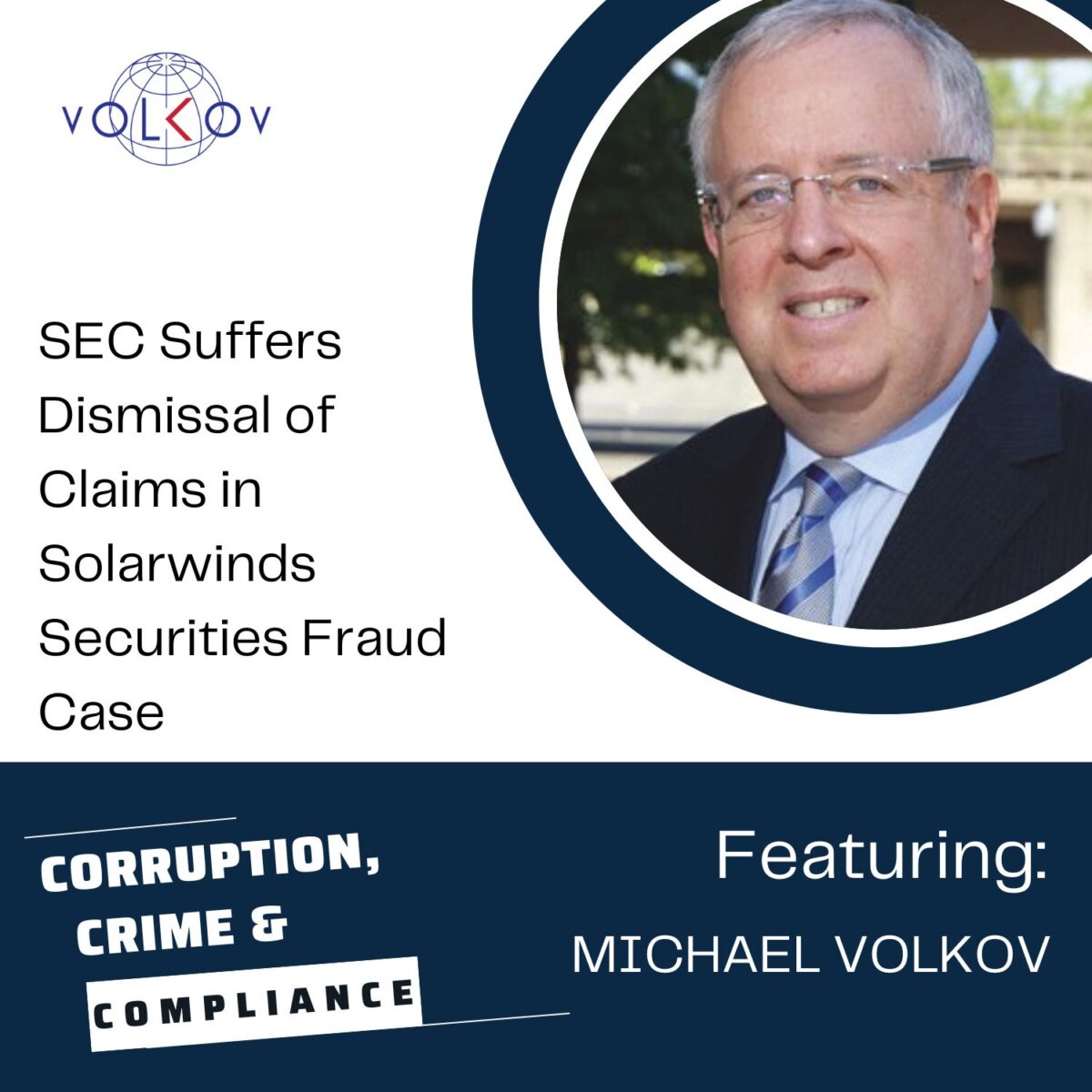
SEC Suffers Dismissal of Claims in Solarwinds Securities Fraud Case

A New York federal district judge handed down a significant decision dismissing much of the SEC’s securities fraud enforcement action against SolarWinds arising from its claims relating to SolarWinds’ cybersecurity policies and disclosure of a significant cyberattack against the SolarWinds’ network.

In this episode of Corruption, Crime, and Compliance, Michael Volkov discusses the significant dismissal of most of the SEC’s securities fraud claims against SolarWinds by a New York federal district court.

The case highlights the ongoing challenges in balancing cybersecurity disclosures with regulatory requirements and the implications this ruling might have for future SEC enforcement actions.

You’ll hear him discuss:

  • Judge’s Decision: The court ruled that the SEC’s claims were overly reliant on hindsight and speculation, particularly regarding SolarWinds’ early-stage disclosure during the investigation of cyber incidents.
  • Pre- and Post-Sunburst Disclosures: While the court upheld charges related to SolarWinds’ pre-Sunburst cybersecurity statements, it dismissed the SEC’s claims about the company’s post-Sunburst disclosures, finding them not misleading under the circumstances.
  • Internal Controls vs. Cybersecurity: The court rejected the SEC’s attempt to apply internal accounting controls provisions to cybersecurity policies, marking a significant limitation on the SEC’s enforcement scope.
  • Implications for SEC’s Approach: This decision contradicts the SEC’s previous stance in cases like R.R. Donnelly, potentially influencing future SEC actions regarding cybersecurity and internal controls.
  • Broader Impact: The ruling may affect how cybersecurity risks are reported and how companies manage their disclosure obligations, particularly in light of potential appeals and further litigation by the SEC.

Resources:

Michael Volkov on LinkedIn | Twitter

The Volkov Law Group

Categories
Blog

Lessons on Incentives and Discipline from Star Trek: Mirror Mirror

Last month, I wrote a blog post on the tone at the top, exemplified in Star Trek’s Original Series episode, Devil in the Dark. Based on the response, some passionate Star Trek fans are out there. I decided to write a series of blog posts exploring Star Trek: The Original Series episodes as guides to the Hallmarks of an Effective Compliance program set out in the FCPA Resources Guide, 2nd edition. Today, I will continue my two-week series by looking at the following Hallmarks of an Effective Compliance Program laid out by the Department of Justice (DOJ) and Securities and Exchange Commission (SEC) in the FCPA Resources Guide, 2nd edition. Today, we look at lessons on financial incentives and disciplinary measures in a best practices compliance program from the episode Mirror Mirror.

The episode Mirror, Mirror offers a unique and insightful perspective on the importance of financial incentives and disciplinary measures in shaping organizational culture. Through the lens of a parallel universe where the Federation’s values are inverted, this episode provides valuable lessons for compliance professionals on how incentives and disciplinary measures can influence behavior and promote ethical standards.

In Mirror, Mirror, Captain Kirk, Dr. McCoy, Scotty, and Uhura are accidentally transported to a parallel universe due to a transporter malfunction. A brutal Terran Empire stands for the United Federation of Planets in this “mirror universe.” Here, officers advance through assassination, and disobedience is met with severe punishment. The stark contrast between this universe and the ethical Federation highlights the significance of well-structured incentives and disciplinary measures in fostering a culture of compliance.

Lesson 1. The Role of Incentives in Promoting Ethical Behavior

Incentives motivate employees to adhere to compliance standards and ethical behavior. The episode illustrates the impact of perverse incentives and how they can drive unethical actions. You must work to align your financial and non-financial incentives with your organization’s ethical values. Businesses should design incentive structures that promote compliance and ethical behavior. This can include recognition programs, bonuses for ethical conduct, and career advancement opportunities for those who demonstrate integrity. Celebrating and rewarding employees who adhere to compliance standards reinforces the importance of ethical behavior and encourages others to follow suit.

Through this episode’s ‘mirror’ structure, we can use examples of perverse incentives to gain insight into the incentives that will work in 2024.  In the mirror universe, officers are incentivized to commit acts of violence and treachery to earn promotions and power. This system rewards unethical behavior and creates a toxic environment of fear and mistrust. Now, contrast these actions with the universe, which encompasses the United Federation of Planets (UFP) and promotes values of cooperation, integrity, and mutual respect. This contrast emphasizes aligning incentives with ethical standards to foster a positive organizational culture.

Lesson 2. Fair and Consistent Discipline

Disciplinary measures are essential for maintaining accountability and addressing non-compliance. However, they must be implemented fairly and consistently to avoid creating a culture of fear. Every compliance function must ensure that disciplinary actions are consistent, fair, and proportionate to the severity of the violation. This approach helps maintain trust in the compliance program and encourages accountability. Moreover, it creates an environment where employees feel comfortable reporting non-compliance without fear of retaliation. This requires clear communication about the disciplinary process and assurance of confidentiality.

Once again, in the alternative universe our Enterprise crew finds itself in, we can learn from the converse of that from the UFP. In the mirror universe, there is severe punishment, and discipline is maintained through fear and harsh punishment. As a result, people develop a toxic culture where self-preservation takes precedence over commitment to moral behavior. Our universe’s Enterprise’s approach to discipline emphasizes accountability and correction rather than punishment, illustrating how fair disciplinary measures can support a healthy compliance culture.

Lesson 3. The Influence of Leadership on Incentives and Discipline

Leadership is critical in shaping the effectiveness of incentives and disciplinary measures. Leaders set the tone for organizational culture and can influence employee behavior through actions and decisions. Top management should lead by example.  Business leaders should model ethical behavior and demonstrate a commitment to compliance through their actions and decisions. This sets a positive example for employees and reinforces the organization’s values. In addition to leading by example, the C-Suite and Board of Directors should actively support compliance initiatives, including developing and promoting incentive and disciplinary systems that align with ethical standards.

In both universes, Captain Kirk’s leadership style is a key factor in influencing the behavior of his crew. In the prime universe, his commitment to ethical standards and fair treatment promotes a culture of integrity. In the mirror universe, the universe’s leadership at all levels encourages treachery and violence, demonstrating how leaders can perpetuate a toxic culture through negative incentives and harsh discipline.

Lesson 4. Designing Effective Incentive and Disciplinary Systems

To create a culture of compliance, organizations must carefully design their incentive and disciplinary systems to align with ethical standards and organizational values. First and foremost, your incentives and discipline must align with your organizational values and goals. This helps reinforce the importance of compliance and ethical behavior. When it comes to incentives, they are not simply financial but non-financial incentives. Your organization should offer a variety of incentives, such as financial rewards, recognition programs, and career development opportunities, to appeal to different motivations and preferences.

To design appropriate incentives and discipline, you should start with clear and transparent policies governing the incentive and disciplinary program. These policies should be well-defined, communicated, and easily accessible to all employees. This includes the specific rewarded or penalized behaviors, the criteria for determining appropriate incentives or disciplinary actions, and the appeal and review processes.

Lesson 5. Continuous Monitoring and Improvement

Your compliance team should continuously solicit employee feedback on the effectiveness and fairness of the incentive and disciplinary programs. This is a part of any Speak Up culture, as you want to encourage open communication channels for employees to raise concerns or suggest improvements. Metrics are a part of every system used to track the program’s performance, including incident rates, consistency and fairness of disciplinary actions, and employee satisfaction and trust in the program. Benchmarking against industry trends can also be a critical piece of information.

Always remember that unintended consequences can negatively impact every compliance program. Therefore, you should proactively identify and address any unintended consequences or perverse incentives that may arise from the program. Finally, adjust and improve your program to mitigate potential negative impacts on employee behavior or organizational objectives.

Mirror, Mirror provides a powerful illustration of the impact of incentives and disciplinary measures on organizational culture. By learning from the stark contrasts between the mirror and the prime universe, compliance professionals can design systems that promote ethical behavior and foster a culture of compliance. Incorporating these lessons into your compliance strategy can help ensure that your organization is prepared to navigate the complexities of today’s regulatory environment while upholding the highest ethical standards. As the episode demonstrates, the right incentives and disciplinary measures can make all the difference in creating a positive and compliant organizational culture.

Join us tomorrow as we consider the lessons from the Star Trek episode The Omega Glory on dealing with third parties.


Categories
Trekking Through Compliance

Trekking Through Compliance – Episode 79 – Compliance Leadership Lesson from Turnabout Intruder

In this episode of Trekking Through Compliance, we consider the episode Turnabout Intruder, which aired on June 3, 1969, with a Star Date of 5298.5.

After receiving a distress call from a science party on Camus II exploring the ruins of a dead civilization, the Enterprise rushes to assist. All party members appear dead except the leader, Dr. Janice Lester, and the medical officer, Dr. Arthur Coleman. According to Dr. Coleman, Lester is suffering from some unknown sort of radiation poisoning.

However, when the rest of the Enterprise landing party goes to aid a dying science party member and leaves Kirk and Lester alone, she activates an alien device she has discovered and exchanges bodies with Kirk. Lester complains to Kirk about the pain of being a woman because of jealousy and a persecution complex. Lester-as-Kirk orders everyone to be beamed about and takes over the role of Kirk.

Lester-as-Kirk removes Bones as a chief medical officer and installs Dr. Coleman, a former starship doctor who has been found incompetent by the Starfleet Surgeon General, in his place. Dr. Coleman attempts to prevent Kirk (in Dr. Lester’s body) from interacting with the crew by sedating her, but she escapes to the sick bay to talk to Bones and Spock. However, McCoy has also ordered a physical examination for Lester-as-Kirk. He proceeds to knock Kirk-as-Lester out and orders her to be put in isolation and incommunicado.

Spock suspects something amiss and speaks to (the honest) Kirk in solitary confinement. Spock does a Vulcan mind probe at Kirk’s request and discovers the truth. Lester-as-Kirk and security personnel stop Spock when he tries to flee with the sincere Kirk. This leads to a court-martial trial for Spock. Spock puts Kirk (in Lester’s body) on the stand and testifies that Kirk’s mind is in her body.

In the meantime, Sulu and Chekov refuse to obey Lester-as-Kirk’s orders, and Kirk and Lester experience a temporary reversion of minds. To prevent a reversion, Coleman informs Lester-as-Kirk that Lester must be killed. However, Coleman is too late to carry out the task, and Kirk’s and Lester’s minds revert to their appropriate bodies.

Commentary

The episode involves Dr. Janice Lester trading bodies with Captain Kirk to seize control of the Enterprise, leading to ethical and leadership dilemmas. Key compliance and leadership lessons discussed include the importance of empathy, accountability, ethical decision-making, building trust, and the dangers of unchecked power. The episode notes continuity issues within the Star Trek universe and provides insights into leadership from a compliance perspective.

Key Highlights

  • Story Synopsis: Turnabout Intruder
  • Fun Facts and Continuity Issues
  • Compliance Leadership Lessons from Turnabout Intruder
  • Final Reflections and Upcoming Series

Resources

Excruciatingly Detailed Plot Summary by Eric W. Weisstein

MissionLogPodcast.com

Memory Alpha


Categories
Sunday Book Review

Sunday Book Review: August 18, 2024 New Books on Leadership Edition

In the Sunday Book Review, Tom Fox considers books that would interest the compliance professional, the business executive, or anyone who might be curious.

It could be books about business, compliance, history, leadership, current events or anything else that might interest me.

In today’s edition of the Sunday Book Review, we look at four new books on leadership for the compliance professional.

  • Elevate Your Excellence: The Power of Doing Ordinary Things Extraordinarily Well by Dave Anderson
  • Thinking At The Speed Of Bias: How To Shift Our Unconscious Filters by Sara Taylor
  • Becoming a Leader Worth Following: A Practical Guide for Leading Self, Teams, and Organizations by Mike Easley
  • How To Have a Good Day: Harness the Power of Behavioral Science to Transform Your Working Life by Caroline Web

For more information on Ethico and a free White Paper on ROI for your compliance program, click here.

Categories
Trekking Through Compliance

Trekking Through Compliance – Episode 78 – Pattern Recognition Lessons for Compliance from All Our Yesterdays

In this episode of Trekking Through Compliance, we consider the episode All Our Yesterdays, which aired on March 14, 1969, with Star Date 5943.7

In this episode, Captain Kirk, Spock, and Dr. McCoy visit the planet Sarpeidon, whose sun is about to go supernova. They discover that the planet’s inhabitants have all disappeared, except for a librarian named Mr. Atoz, who oversees a complex time travel system called the Atavachron.

The Atavachron allows the planet’s population to escape into different periods of Sarpeidon’s history, where they can live safely. Mr. Atoz mistakenly believes the Enterprise crew are Sarpeidons looking to travel back in time and urges them to hurry through the portal. Kirk ends up in a medieval era, while Spock and McCoy are transported to an ice age.

In the medieval period, Kirk encounters a woman accused of witchcraft and realizes the danger of being trapped in the past. Meanwhile, Spock and McCoy meet Zarabeth, a woman exiled to the Ice Age. Due to the time period’s influence, Spock begins to revert to the more emotional behavior of his ancient Vulcan ancestors, leading to unexpected romantic feelings for Zarabeth. McCoy tries to convince Spock to return to their own time, reminding him of the mission’s urgency.

Back in the present, Kirk manages to return to the library and locates the portal through which Spock and McCoy traveled. He helps them return to their original time, but not without some emotional turmoil, especially for Spock, who must leave Zarabeth behind.

The crew finally makes it back to the Enterprise just before the star explodes, reflecting on the lives they encountered and the paths they did not take. “All Our Yesterdays explores themes of love, sacrifice, and the allure of escaping into an idealized past, showcasing the emotional depth and complexity of the series’ characters.

Commentary

The story features the Enterprise crew traveling back in time to evacuate a planet before its sun goes supernova, leading to unintended consequences. Tom Fox explores how this episode offers valuable insights for compliance professionals in areas such as data integrity, understanding causality, identifying emerging trends, proactive risk mitigation, and the importance of historical context. By learning these lessons, compliance professionals can enhance their ability to navigate the complexities of data analysis and pattern recognition. The episode also touches upon unique aspects like physiological limitations on time travel and the mental changes experienced by travelers.

Key Highlights

  • Story Synopsis
  • Kirk’s Time Travel Dilemma
  • Spock and McCoy in the Ice Age
  • Fun Facts and Continuity Issues
  • Pattern Recognition Lessons from ‘All Our Yesterdays’

Resources

Excruciatingly Detailed Plot Summary by Eric W. Weisstein

MissionLogPodcast.com

Memory Alpha

Categories
Trekking Through Compliance

Trekking Through Compliance – Episode 77 – Due Diligence Lessons from The Savage Curtain

In this episode of Trekking Through Compliance, we consider the episode The Savage Curtain, which aired on March 7, 1969, with a start date of 5906.4.

While scanning planet Excalbia, Spock detects strange readings that indicate the presence of carbon cycle life forms. The subsequent appearance of Abraham Lincoln on the viewing screen and his transportation to the Enterprise demonstrates that whatever intelligence resides on the planet can read minds and manipulate matter. Shortly before beaming Lincoln aboard, Spock reports sensors showing an object resembling a living rock with claws at the same position.

On board, Lincoln appears to be human with knowledge of technology from the mid-1800s but is strangely also aware of the Vulcan philosophy. When Kirk accepts Lincoln’s invitation for Spock and him to beam down to a patch of Earth-type environment on the planet, they encounter Surak, the father of Vulcan civilization. A piece of rock suddenly becomes animated and informs them that the planet’s inhabitants are experimenting to discover which of the opposing human philosophies is stronger: good or evil. To carry out their experiment, the rock creatures pit Lincoln, Surak, Kirk, and Spock against Genghis Khan, Colonel Green, Zora, and Kahless the Klingon in a battle to the death.

Green appears to parlay with Surak but sends his associates to sneak up on him. They then attempt to trick Kirk’s party into rescuing him when he (apparently) screams out in pain. Lincoln attempts to sneak into Green’s camp, but this action is unexpected. As he discovers that Surak is already dead, Lincoln is speared from behind. Col. Green’s party then attacks Spock and Kirk. Spock kills Col. Green, and the others are forced to flee. The rock creatures discover that evil is defeated when directly confronted by good, and Spock, Kirk, and the Enterprise are released.

Commentary

The plot revolves around the crew of the Enterprise encountering legendary historical figures, such as Abraham Lincoln and Surak, who are pitted against infamous tyrants like Genghis Khan and Colonel Green in an ethical battle orchestrated by rock creatures. The episode delves into the complexities of good versus evil and offers valuable lessons for compliance professionals. Key compliance takeaways include understanding the context of business ventures, identifying hidden risks, prioritizing ethical considerations, and ensuring transparency and accountability throughout the due diligence process.

Key Highlights

  • Key Plot Points and Characters
  • Fun Facts and Continuity Issues
  • Ethical Lessons from ‘The Savage Curtain’
  • Compliance Takeaways

Resources

Excruciatingly Detailed Plot Summary by Eric W. Weisstein

MissionLogPodcast.com

Memory Alpha

Categories
10 For 10

10 For 10: Top Compliance Stories For The Week Ending August 17, 2024

Welcome to 10 For 10, the podcast that brings you the week’s top 10 compliance stories in one episode each week.

Tom Fox, the Voice of Compliance, presents the stories every compliance professional needs to know as you wrap up your busy week. In just 10 minutes, sit back and catch up on the key compliance stories from the prior week.

Every Saturday, 10 For 10 highlights the most important news, insights, and analysis for compliance professionals, all curated by the Voice of Compliance, Tom Fox. Get your weekly dose of compliance stories with 10 For 10, a podcast produced by the Compliance Podcast Network.

  • DOJ defends itself from Boeing victims’ families’ objections.  (Law360)
  • Boeing puts work output before employee health and safety. (WSJ)
  • A new CCO salary survey is out. (WSJ)
  • More fines for failure to monitor employee text messaging. (WSJ)
  • Boeing and the cost of culture failure. (NYT)
  • Smartmatic execs accused of FCPA violations in The Philippines. (NYT)
  • SFO files charges against 2 additional Glencore traders. (FT)
  • Ukraine detains Deputy MoE in corruption scandal. (Reuters)
  • French ABC efforts led to the most successful Olympics since 1984. (The Conversation)
  • Mozambique official found guilty in tuna boat corruption case. (Bloomberg)

For more information on the Ethico ROI Calculator and a free White Paper on the ROI of Compliance, click here.

You can check out the Daily Compliance News for four curated compliance and ethics related stories each day, here.

Connect with Tom 

Instagram

Facebook

YouTube

Twitter

LinkedIn