Categories
Sunday Book Review

Sunday Book Review: July 30, 2023 – The On Writing True Crime Edition

In the Sunday Book Review, I consider books that would interest the compliance professional, the business executive or anyone who might be curious. It could be books about business, compliance, history, leadership, current events or anything else that might interest me. In today’s edition of the Sunday Book Review, I continue my summer exploration of books on crime. Today, some top books which illustrate the draft of writing true crime.

  • Midnight in the Garden of Good and Evil by John Berendt
  • The Shadow of Death by Philip Ginsburg
  • The Wrong Man by James Neff
  • Couple Found Slain by Mikita Brottman

Resource

James Renner: 5 Books That Changed the Way I Write True Crime in CrimeReads.com

Categories
10 For 10

10 For 10: Top Compliance Stories For the Week Ending July 29, 2023

Welcome to 10 For 10, the podcast which brings you the week’s Top 10 compliance stories in one podcast each week. Tom Fox, the Voice of Compliance brings to you, the compliance professional, the compliance stories you need to be aware of to end your busy week. Sit back, and in 10 minutes hear about the stories every compliance professional should be aware of from the prior week. Every Saturday, 10 For 10 highlights the most important news, insights, and analysis for the compliance professional, all curated by the Voice of Compliance, Tom Fox. Get your weekly filling of compliance stories with 10 for 10, a podcast produced by the Compliance Podcast Network.

  • Zelensky warns about corruption. (FT)
  • Ukraine tackles corruption. (EuroNews)
  • New cyber disclosure rules go into effect. (AP)
  • Najib deposed in 1MDB case. (Bloomberg)
  • Cognizant investigation not outsourced. (WSJ)
  • DWS closes in on settling greenwashing charges. (FT)
  • Prosecutors want SBF jailed pre-trial. (WSJ)
  • DOJ revamps Crypto enforcement team. (WSJ)
  • Altice co-founder denies corruption. (Reuters)
  • US consultancies struggle in China after raids. (FT)

You can check out the Daily Compliance News for four curated compliance and ethics related stories each day, here.

Connect with Tom 

Instagram

Facebook

YouTube

Twitter

LinkedIn

Categories
Kerrville Weekly News Roundup

Kerrville Weekly News Roundup: July 29, 2023

Welcome to the Kerrville Weekly News Roundup. Each week, veteran podcaster Tom Fox and his colleagues Andrew Gay and Gilbert Paiz get together to go over a couple of their favorite stories from the past week from Kerrville and the greater Hill Country. Sit back, enjoy a cup of morning coffee and listen in to get a wrap up of the Kerrville Weekly News. We each consider two of our favorite stories and talk about the upcoming weekend’s events which will enjoy or participate in this weekend.

In this episode, Tom, Gilbert and Andrew discuss the following stories which caught their attention over the past week.

  • Tom notes the trial date set for Harvey Bellew for his potential removal from office and shouts to the construction of the new county animal shelter. This weekend he will be nursing one of his pooches who had knew surgery this week.
  • Andrew discusses hospitality business in Kerrville and the Kerrville Visitors and Conventions Bureau which it supports. He reminds people that August 1 is the deadline for Leadership Kerr County Class 2023-24 (registration and information). Andrew is looking forward to seeing Oppenheimer this weekend.
  • Gilbert shouts out to the Back to School Bash and says he is tired of the Anti-LGBTQ protested outside the Library. He says he is staying inside this weekend.

Resources

Tom Fox on LinkedIn

Gilbert Paiz on LinkedIn

Andrew Gay on LinkedIn

Texas Hill Country Podcast Network

Categories
31 Days to More Effective Compliance Programs

One Month to More Effective Reporting and Investigations – Miranda Warnings for Employees?

Must an investigator warn an employee that concealing information from company lawyers conducting an internal FCPA investigation could be a federal crime? Even if the company attorneys provided the now standard corporate attorney Upjohn warning? Does a company attorney asking questions morph into a de facto federal agent during an internal company investigation regarding alleged FCPA violations and is the attorney thereby required to provide a Miranda warning to employees during said investigation?

Employees who are subject to being interviewed or otherwise required to cooperate in an internal investigation may find themselves on the sharp horns of a dilemma requiring either (1) cooperating with the internal investigation or (2) losing their jobs for failure to cooperate by providing documents, testimony or other evidence. Many U.S. businesses mandate full employee cooperation with internal investigations or those handled by outside counsel on behalf of a corporation. These requirements can exert a coercive force, “often inducing employees to act contrary to their personal legal interests in favor of candidly disclosing wrongdoing to corporate counsel.” Moreover, such a corporate policy may permit a company to claim to the government a spirit of cooperation in the hopes of avoiding prosecution in addition to increasing the chances of earning meaningful credit under the U.S. Sentencing Guidelines or the FCPA Corporate Enforcement Policy.

Three key takeaways:

  1. Make sure you provide an Upjohn warning.
  2. If an employee demands counsel to represent them during an internal investigation, who bears the cost?
  3. Always check state law requirements around internal investigations.
Categories
Compliance and AI

Compliance and AI – Gordon Firemark on AI & ChatGPT for Podcasters

What is the role of Artificial Intelligence in compliance? What about Machine Learning? Are you using ChatGPT? These questions are but three of the many questions we will explore in this exciting new podcast series, Compliance and AI. Hosted by Tom Fox, the award-winning Voice of Compliance, this podcast will look at how AI will impact compliance programs into the next decade and beyond. If you want to find out why the future is now, join Tom Fox on this journey to the frontiers of AI.

AI is becoming increasingly prevalent in the creative industry, and with it comes a range of legal implications. Tom Fox and Gordon Firemark recently discussed the legal implications of AI and how it can be used to create deceptive and misleading content on their podcast, Absolutely!

Tom and Gordon believe that creatives should be fairly compensated for their work and that children should be taught about the business side of art. As Tom puts it, “If someone creates something of value, they should receive fair compensation for it.” They also advocate for exposing children to different ideas and lifestyles.

AI has the potential to create deep fake videos and audio, which can be difficult to distinguish from the real thing. This technology has the potential to be used to create deceptive and misleading content, which could have legal implications. For instance, the Federal Trade Commission has rules and other regulations that come into play when dealing with false advertising issues at a state level.

Additionally, intellectual property issues can arise when AI is used to summarize a book, as the courts and Copyright Office have stated that AI-generated material is not copyrightable. The recent Supreme Court ruling in the Andy Warhol Foundation versus Lynn Goldsmith case found that the use of the photograph was not transformative enough and was commercial in nature, thus the photographer had a valid copyright claim.

Tom and Gordon are both planning to attend Podcast Movement in Denver in late August. Gordon and another podcasting attorney named Lindsay Bowen will be presenting together on either a contract tear down or a mock negotiation of a deal for creatives. The panel will discuss common legal issues that need to be negotiated and worked out in those kinds of deals.

AI is a powerful and effective tool, but it is important to be aware of the potential legal implications that come with it. Creatives should be fairly compensated for their work and children should be exposed to different ideas and lifestyles. For more information on AI and the legal implications, make sure to check out Tom and Gordon’s presentation at Podcast Movement in Denver.

Key Highlights

·      AI and Chat GPT

·      AI and Copyright Issues

·      Fair Compensation for Creatives

·      Legal Issues in Art

Resources

Gordon Firemark on LinkedIn

Firemark Law Firm

Tom Fox

Instagram

Facebook

YouTube

Twitter

LinkedIn

Categories
Daily Compliance News

Daily Compliance News: July 28, 2023 – The New Cyber Disclosure Rules Edition

Welcome to the Daily Compliance News. Each day, Tom Fox, the Voice of Compliance brings to you compliance-related stories to start your day. Sit back, enjoy a cup of morning coffee, and listen in to the Daily Compliance News. All, from the Compliance Podcast Network. Each day we consider four stories from the business world, compliance, ethics, risk management, leadership, or general interest for the compliance professional.

  • Zelensky warns about corruption. (FT)
  • New cyber disclosure rules go into effect. (AP)
  • Najib deposed in 1MDB case. (Bloomberg)
  • Cognizant investigation not outsourced. (WSJ)
Categories
Blog

Credit Risk Scoring to Promote Ethical Sourcing

What is the role of credit risk in complying with laws such as the Canadian Fighting Against Forced Labor and Child Labor in Supply Chains Act, the US UFLPA, the UK Modern Slavery Act and the German Supply Chain Act. I recently visited with two folks from Creditsafe on this issue; Steve Carpenter country manager for Credit Safe Canada and Ragini Bahalla, head of content and PR for Creditsafe, focusing on the North America region are here to ease your worries. They discussed how Credit Safe has successfully integrated these two elements to provide a comprehensive view of potential suppliers. Steve, with his rich experience of working with credit managers and Ragini, with her deep understanding of supply chain practices, brought a wealth of knowledge to this discussion.

The new Canadian legislation is known as the Modern Slavery Act, but is officially titled “Fighting Against Forced Labor and Child Labor in Supply Chains Act.”; comes into effect on January 1, 2024. The legislation has a broad scope, as it will apply to a wide range of entities and industries that produce, sell, or distribute goods in or import goods into Canada. Sean Stephenson has said, “The legislation is roughly based on another piece of legislation we have in Canada that was adopted a few years ago called the Extractive Sector Transparency Act, that’s focused specifically on the extractive sector, …But it’s much broader in nature. It’s not specific to the extractive sector. It applies to essentially any business formation.”

Despite the legislation’s primarily reporting nature, it is different from an actual diligence standard. There is a need for convergence in anti-slavery laws globally, which calls for a balance between compliance and alignment in disclosure across jurisdictions. However there are some unique features of the Canadian Act, such as its focus on child labor and specific liabilities for companies and directors for false and misleading statements.

Imagine running a North American company that could potentially lead the way in combatting forced labor and child labor globally. This is the potential power you hold as a Compliance professional when you integrate credit risk services into ethical sourcing. Starting this process might seem daunting, but the benefits it brings to your company and the society are immeasurable. Not only will it ensure that your organization stays on the right side of the law, but it also fortifies your brand reputation and safeguards your bottom line.

Here are five key steps for a program for robust forced labor, human trafficking and modern slavery compliance:

  • Understand the Legal Landscape: Familiarize yourself with the laws and regulations related to ethical sourcing and forced labor in your country and relevant international jurisdictions.
  • Assess Existing Risk Management Infrastructure: Review your company’s current credit risk services and note areas that could be improved or integrated with ethical sourcing efforts.
  • Engage Stakeholders Across the Organization: Collaborate with finance, supply chain, compliance, and other relevant departments to ensure a unified approach to ethical sourcing and compliance.
  • Integrate Ethical Sourcing Into Credit Risk Services: Work with your credit risk service provider to include data related to ethical sourcing. This might involve financial statements, ownership information, and other relevant data.
  • Monitor and Improve: Regularly review your program.

Understand the Legal Landscape. In the ever-changing regulatory landscape, understanding laws related to ethical sourcing and labor production has grown vital for businesses across the globe. This is especially important for professionals dealing with compliance in North American companies. Recent laws introduced in various countries aim to eradicating forced labor and child labor from the supply chains, necessitating businesses to know their obligations. You must familiar with these laws and international jurisdictions that you do business in can benefit your company by allowing you to implement appropriate measures for ensuring ethical sourcing while minimizing the risk of non-compliance.

Carpenter emphasized on the criticality of understanding the legislative landscape. He referred to the Canadian legislation and how it impacts businesses in goods industries. The bill, similar to laws already in place in countries like the UK, Germany, and US, necessitates a rigorous compliance check for businesses to ensure their supply chains are free from forced labor and child labor practices. Canada’s efforts to catch up with these countries and the potential expansion of this legislation to cover smaller companies means big changes are afoot for Canadian companies.   Understanding and complying with the legal measures meant to combat unethical labor practices is not just a legal necessity, it’s a moral obligation and a strategic necessity for businesses. Ethical sourcing is an arena that consumers today are keenly conscious of and willingly make purchasing decisions based on this. Companies taking a proactive stance in understanding these laws will safeguard their reputation, maintain customer trust, and avoid the potentially devastating financial and business impact of non-compliance. Furthermore, they could contribute to a global movement towards eradicating forced labor and child labor, paving the way for ethical supply chain practices.

 Integrate Ethical Sourcing Into Credit Risk Services. In our rapidly globalizing world, the integration of credit risk services into ethical sourcing efforts is quickly becoming a cornerstone for compliance strategies. Ethical sourcing, which prioritizes responsible practices in supply chains, can help a company avoid both potential legal and financial consequences and also the damage to consumer trust that can stem from unethical labor practices. By using a company’s credit risk data – which can provide important insights into a company’s financial health, relationships with suppliers, and other crucial business aspects – businesses can get a more complete picture of a company’s performance and practices.

When combined with ethical sourcing practices, credit risk data can help illuminate potential gaps and issues in a company’s supply chain that could pose significant legal and financial risk.  Bahalla emphasized the importance of understanding a company’s financial health in order to assess a supplier’s ethical sourcing compliance. According to Carpenter, credit risk services provide information such as financial statements, ownership information, and credit scores – all crucial data that can flag potential issues. In addition, Bahalla added that using these data coupled with ethical sourcing practices would provide a better-rounded view on a company’s operations, allowing a more comprehensive evaluation of potential suppliers.

Integral to this is the collaboration between various departments within a company, such as finance, credit, supply chain, and compliance. The increasing concern over irresponsible labor practices and the potential risk they pose for businesses make the integration of credit risk into ethical sourcing efforts a critical step for companies. By combining financial data with a comprehensive ethical sourcing strategy, businesses can gain a deeper understanding of their suppliers and their practices. This can help companies avoid potential legal troubles and reputational damage, as well as build and maintain trust with consumers. Moreover, the collaboration of different sectors within the business helps to foster a unified approach to compliance with ethical sourcing laws, making for a more effective and efficient strategy.

Understanding the financial health of a supplier can help identify potential vulnerabilities and mitigate risk, demonstrating the role that credit risk services play in optimizing ethical sourcing efforts. As businesses operate in an increasingly interconnected world, the need to effectively navigate complex global supply chains while preserving ethical practices becomes paramount.

Assess Existing Risk Management Infrastructure.  Understanding and effectively managing the intersection of credit risk services and ethical sourcing demands a comprehensive assessment of existing risk management infrastructure. At the forefront of this evaluation is identifying areas of overlap, gaps, and potential for integration of tools and processes used within credit services and those deployed to maintain ethical supply chains. A seamless integration of these two critical aspects greatly enhances the efficacy of compliance checks, ensuring both fiscal health and ethical integrity. Yet, this intricate process opens a broader conversation about risk, credit management, ethical sourcing, and regulatory demands.

The underlying idea is simple but powerful. When assessing potential suppliers, having a comprehensive view of both their financial strength and ethical practices can facilitate more informed decisions. But, according to Steve, this is not just about upscaling services; it’s about looking towards the future where ethical sourcing holds equal the weight of fiscal health in business transactions. This transition calls for an internal alignment especially with key departments like finance, credit, supply chain, and compliance, thus ensuring a holistic approach to ethical sourcing and regulatory compliance.  The integration of credit risk services and ethical sourcing is not simply about meeting immediate business needs; it’s also about future-proofing your organization.

The enforcement of new laws, such as Canada’s Forced Labor legislation, emphasizes this. These laws signify a shift in the corporate landscape, where ethical sourcing practices are held in equal regards to fiscal health. Furthermore, with potential reputational damage and loss of customer trust hinged on the observance of responsible sourcing practices, the imperativeness of the integration is clearer than ever. This is a progressive stride towards mitigating both financial and ethical risks, ultimately driving businesses towards better global practices. It is not just beneficial in avoiding penalties or preserving image, but central to building sustainable businesses underpinned by sound credit risk management and unwavering commitment to ethical sourcing.

There’s never been a more crucial time for compliance professionals in North American companies to focus on ethical sourcing. The consequences of inaction, both legal and reputational, can be devastating. The outlined steps in this post offer a practical guide to integrate credit risk services into ethical sourcing efforts, ensuring you’re not only protecting your company from credit risks but also championing ethical business practices. Understanding the legal landscape, reviewing your risk management infrastructure, fostering interdepartmental collaboration.

For more information on the new Canadian law, head over to the Compliance Podcast Network and listen to Gwen Hassan’s podcast with Sean Stephenson on the award-winning Hidden Traffic podcast.


Categories
Pawtastic Friends - The Paw Talk

Pawtastic Friends – The Paw Talk – Honey, Bryce and Leon

Welcome to Pawtastic Friends-The Paw Talk. In this podcast, host Tom Fox will visit with Michael and Melissa Novelli, co-founders of Pawtastic Friends as well as those who work with them at Pawtastic Friends. Michael and Melissa are dedicated to helping shelter and rescue dogs in the Las Vegas area become more adaptable, through enrichment training and activities such as yoga and aquatics training, as well as obedience and agility. This podcast is sure to tug on your heart strings, just listen to how sweet this one dog is! Tune in now to hear more from Michael and Melissa Novelli as they discuss their passion for helping pups in need. Get ready for an exciting episode of Pawtastic Friends – The Paw Talk!

Adopting a dog is a rewarding experience that brings joy and companionship but requires thoughtful planning and preparation. In the recent podcast episode of ‘Building Dog Confidence’, Tom Fox, Michael and Melissa Novelli discussed how to create a strong bond between a dog and its owner, as well as the importance of taking precautions to keep dogs safe in hot weather. They highlighted the benefits of enrichment training, puzzles, and treats for building dog confidence, as well as the dangers of pouring cold water on an overheated dog. Additionally, they mentioned the nonprofit organization, Pawtastic Friends, which helps people find the right dog for them and provides resources to help care for their pet. Finally, they discussed the importance of nosework in helping to keep dogs’ minds sharp.

This episode of “Pawtastic Friends-The Paw Talk” is a must-listen for anyone who loves dogs and believes in providing them with a happy and healthy life. You’ll be moved by the stories of these amazing pups and inspired by Mike and Melissa’s dedication to finding them their perfect home. Don’t miss out on the opportunity to make a difference in the life of a dog in need. Tune in now!

Dogs Featured 

·      Honey

·      Bryce

·      Leon

Quotes

“She’s petite in size. She’s a black. Pity. She was at a different boarding facility and just was not doing well. So they moved her over to where we walk, and the volunteers get her out. And she instantly came alive. Loves the volunteers. She loves to walk. She rides great in the car. She is just this amazing dog.”

“It’s the little victories and the encouraging words that cheer him on, like, hey, good job, buddy. Good job. Next week. Maybe he makes it halfway off, and then before you know it, the trainers are sending us videos and pictures like, oh, my God, he went over the a-frame. So it’s the little victories that are the big picture and win the war.”

“Leave your dogs at home. They’ll be fine for an hour or two. You don’t need to take your dogs everywhere, especially when it’s hot, because one bad instance of you taking your dog out could be fatal. It could be really fatal.”

“We always encourage people to go to our website and help out. We are a nonprofit organization, so they can go to Podasticfriends.com.”

Resources

Pawtastic Friends

Categories
Hidden Traffic Podcast

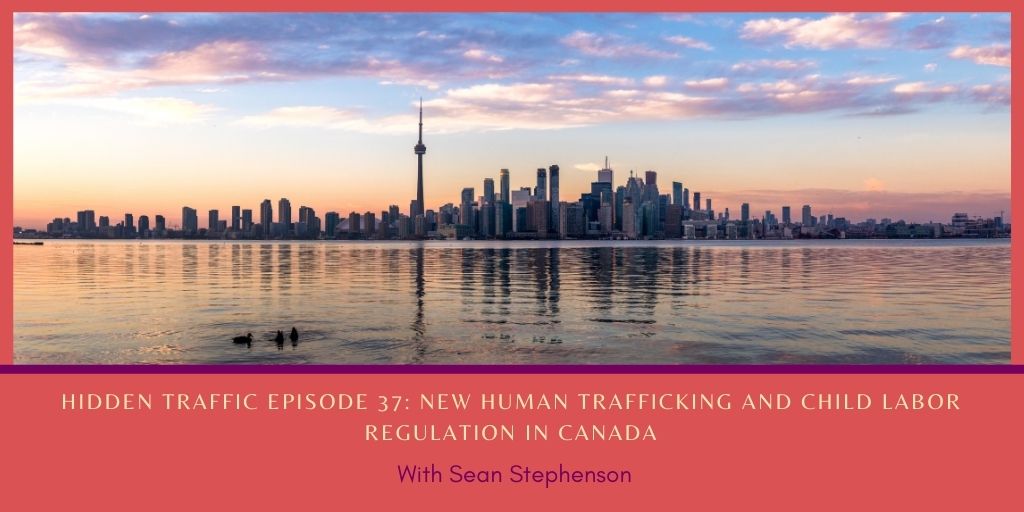
New Human Trafficking and Child Labor Regulation in Canada with Sean Stephenson

The global landscape of human trafficking and forced labor is evolving, and no country is immune. In this episode of Hidden Traffic, Gwen Hassan sits down with Sean Stephenson, an accomplished attorney based in Toronto. Sean works for the multinational law firm Dentons, and has extensive experience in trade and investment. The growing concern for supply chain integrity forms a significant part of his work, with particular emphasis on human trafficking, forced labor, and child labor. Together, he and Gwen delve into the new Canadian law aimed at preventing human trafficking, forced labor, and child labor within supply chains. Their conversation also provides insights into the practices of various multinational companies and explores the need for coherence in the anti-slavery reporting and measures across different jurisdictions.

The new Canadian legislation is known as the Modern Slavery Act, but is officially titled “Fighting Against Forced Labor and Child Labor in Supply Chains Act.” This law is set to come into effect on January 1, 2024. Sean underscores the legislation’s scope, noting that it will apply to a wide range of entities and industries that produce, sell, or distribute goods in or import goods into Canada. Sean clarifies, “The legislation is roughly based on another piece of legislation we have in Canada that was adopted a few years ago called the Extractive Sector Transparency Act, that’s focused specifically on the extractive sector, …But it’s much broader in nature. It’s not specific to the extractive sector. It applies to essentially any business formation.”


Despite the legislation’s primarily reporting nature, Sean distinguishes it from an actual diligence standard. He emphasizes the need for convergence in anti-slavery laws globally, which calls for a balance between compliance and alignment in disclosure across jurisdictions. However, he points out some unique features of the Canadian Act, such as its focus on child labor and specific liabilities for companies and directors for false and misleading statements.


Both Gwen and Sean believe in the Act’s potential to drive meaningful change in business practices related to human trafficking, forced labor, and child labor. 


Sean sheds light on the operations and mandate of the Canadian Ombudsperson for Responsible Enterprise (CORE). CORE is an arm of the Canadian federal government, focusing on promoting the implementation of the UN and the OECD guidelines on multinational enterprises. The organization targets three specific areas: garment business, mining, and oil and gas. “Anyone can submit complaints to the CORE about business activities of Canadian businesses, either inside Canada or abroad”, Sean explains. He distinguishes CORE’s investigative powers, which are funded by the Canadian government, from those of a non-governmental organization. Gwen likens its investigative powers to those of a regulatory authority.


Sean points out that CORE cannot force document production but can accept and facilitate discussions around complaints. While CORE can’t directly impose penalties, they can recommend fines and referrals to law enforcement. Gwen highlights the potential reputational damage these investigations can pose for companies, and they both agree on the importance of proactive measures in mitigating these risks.


For companies seeking to comply with the CORE and other modern slavery regulations, Sean suggests starting with a thorough risk assessment, creating comprehensive supplier codes of conduct, and gradually building out compliance measures. He and Gwen emphasize the importance of proactive, transparent efforts in supply chain management, including the wider benefits beyond compliance, such as evaluating the overall health of suppliers. While enforcement in Canada has been less, businesses should still stay vigilant about international guidance to avoid potential issues.


Resources

Sean Stephenson on LinkedIn | Twitter

Dentons 

Canada’s Forced Labour and Child Labour Reporting Legislation: What You Need to Know  

The CORE of the matter: An overview of the Canadian Ombudsperson for Responsible Enterprise (CORE) and its relevance to Canadian businesses operating abroad

Categories
31 Days to More Effective Compliance Programs Uncategorized

One Month to More Effective Reporting and Investigations – Board Investigations

In their article, “Successful Board Investigations”, David Bayless and Tammy Albarrán, offered seven considerations to facilitate a successful Board investigation.

  • Consider whether you need independent outside counsel.
  • Consider hiring an experienced investigator to lead the internal investigation.
  • Consider the need to retain outside experts.
  • Analyze potential conflicts of interest at the outset and during the investigation.
  • Carefully evaluate whistleblower allegations.
  • Request regular updates from outside counsel, without limiting the investigation.
  • Consider whether an oral report at the conclusion of the investigation is sufficient.

The authors conclude their piece by stating, “By keeping in mind the issues addressed above, the Board will be better prepared for the investigation and readily able to exercise good judgment throughout the review. A well-conducted investigation by the Board may spare the company further disruption and costs associated with follow-on investigations by the regulators, or at the very least minimize the company’s exposure.”

Three key takeaways:

  1. Retain the right counsel. Consider conflicts and appearance.
  2. Carefully evaluate all whistleblower allegations and reject retaliation.
  3. Consider receiving oral reports on an ongoing basis and one lengthy oral report at the end of the investigation.