Categories
#RiskNYC Speaker Series

#Risk New York Speaker Series-The Future of AI Governance in GRC with Matt Kelly

Join myself and hundreds of other GRC professionals in the city that never sleeps, New York City on July 9 & 10 for one of the top conferences around #Risk New York. current US landscape – shaped by evolving policies, rapid AI advancements, and shifting global dynamics – demands adaptive strategies and cross-functional collaboration.

At #RISK New York you will master the New Regulatory Reality by Getting ahead of US regulatory shifts and their impact. Conquer AI & Tech Risk by Safeguarding your organization in an AI-driven world and understand the implications of major tech investments. Navigate Financial & Crypto Volatility by Protecting assets and explore solutions in a dynamic market. Strengthen Your GRC Framework by Leverage governance, risk, and compliance for strategic advantage. Protect Digital Trust by Addressing challenges in cybersecurity, data privacy, and combating misinformation. All while meeting with the country’s top #Risk management professionals.

In this episode, Tom Fox talks with Matt Kelly, about his presentation on the importance of understanding how AI can be productively adopted within enterprises and the ethical challenges it presents, such as discrimination and data validity. Matt also talks about the importance of AI governance and offers a teaser of his upcoming presentation on this topic. Matt expresses his eagerness to engage with other GRC professionals at the upcoming conference to exchange ideas and discuss emerging risks in third-party and vendor risk management.

Resources

#Risk Conference Series

#RiskNYC-Tickets and Information

Matt Kelly on Linkedin

Categories
Sunday Book Review

Sunday Book Review: June 22, 2025, The Books on the Declaration of Independence Edition

In the Sunday Book Review, Tom Fox considers books that would interest compliance professionals, business executives, or anyone curious about the subject. It could be books about business, compliance, history, leadership, current events, or any other topic that might interest Tom.

Today, we begin a look at America’s holiday (and my favorite holiday—the Fourth of July). This week, we start a two-part series examining the Declaration of Independence and the history of July 4th. Today, we read five books on the Declaration of Independence, and next week, we will review four books on July 4th. ⁠

  1. Inventing America by Garry Wills
  2. Signing Their Lives Away  by Denise Kiernan and Joseph D’Agnese
  3. Declaration: The Nine Tumultuous Weeks When America Became Independent, May 1-July 4, 1776, by William Hogeland
  4. 1776 by David McCullough
  5. Declaration of Independence


The Sunday Book Review was recently honored as one of the Top 100 Book Podcasts.

Categories
Trekking Through Compliance

Trekking Through Compliance – Episode 21: Compliance Lessons from Tomorrow is Yesterday

Show Summary

As compliance professionals, we often deal with risks not just of what is known but of what could happen: the unknown impact of an overlooked third-party relationship, a lack of controls in an emerging market, or a cultural blind spot that results in reputational fallout. In “Tomorrow Is Yesterday,” the crew must tread carefully to avoid disrupting the timeline, and in doing so, they offer lessons on ethics, documentation, information handling, and more. Let’s break it down: each lesson begins with a scene from the episode, followed by a compliance insight that today’s professionals can apply.

Lesson 1: Every Action Has Ripple Effects

Illustrated By: When the Enterprise accidentally enters Earth’s atmosphere in the 1960s, it is detected by U.S. military radar. An Air Force pilot, Captain Christopher, is scrambled to intercept. The crew beams him aboard to save his life when his aircraft is destroyed—but now, they’ve interfered with the timeline.

Lesson 2: Don’t Underestimate the Importance of Containment

Illustrated By: Captain Christopher now knows too much. He’s seen a starship, spoken with its crew, and witnessed 23rd-century technology. Spock warns that releasing him could change the course of Earth’s future. The crew must now decide whether to detain him, erase his memory, or seek an alternative solution.

Lesson 3: Documentation and Traceability Are Critical

Illustrated by: As the crew works to reverse their time jump, they must carefully reconstruct a plan to erase all evidence of their presence in the past. They go so far as to recover physical recordings and tamper with computer logs to restore the timeline to its original state.

Lesson 4: Ethics Must Guide Decision-Making Under Uncertainty

Illustrated By: Faced with conflicting outcomes—if they return Captain Christopher to Earth, he may reveal classified knowledge; if they don’t, they alter his family line—Kirk and Spock must weigh ethical considerations against practical risks. Ultimately, they learn that Christopher’s unborn son will play a pivotal role in Earth’s future space exploration, so they must return him.

Lesson 5: Cross-Functional Collaboration Enhances Compliance Outcomes

Illustrated By: To return to their time and restore the timeline, the crew must coordinate multiple systems across engineering, science, navigation, and command. Mr. Scott recalibrates the engines, Spock calculates gravitational trajectories, and Sulu pilots the ship at precisely the right moment.

Lesson 6: Time Is of the Essence

Illustrated By: As the Earth’s gravitational pull begins to reassert itself, the Enterprise must execute its time-warp escape with split-second precision. A single delay could strand them in the 20th century or, worse, destroy the ship.

Compliance Lesson:

Conclusion: Compliance for the Future—Rooted in Responsibility

“Tomorrow Is Yesterday” reminds us that ethical conduct isn’t just about navigating today’s rules but also about understanding the impact of our actions on tomorrow. For the crew of the Enterprise, that meant carefully extracting themselves from history without doing damage. For compliance professionals, it means building systems and cultures that consider not only legal obligations but also ethical consequences, unintended impacts, and the interconnectedness of our global environment.

Let’s not just manage compliance; let’s lead it ethically, collaboratively, and with a focus on the future.

Resources:

Excruciatingly Detailed Plot Summary by Eric W. Weisstein

MissionLogPodcast.com

Memory Alpha

Categories
Blog

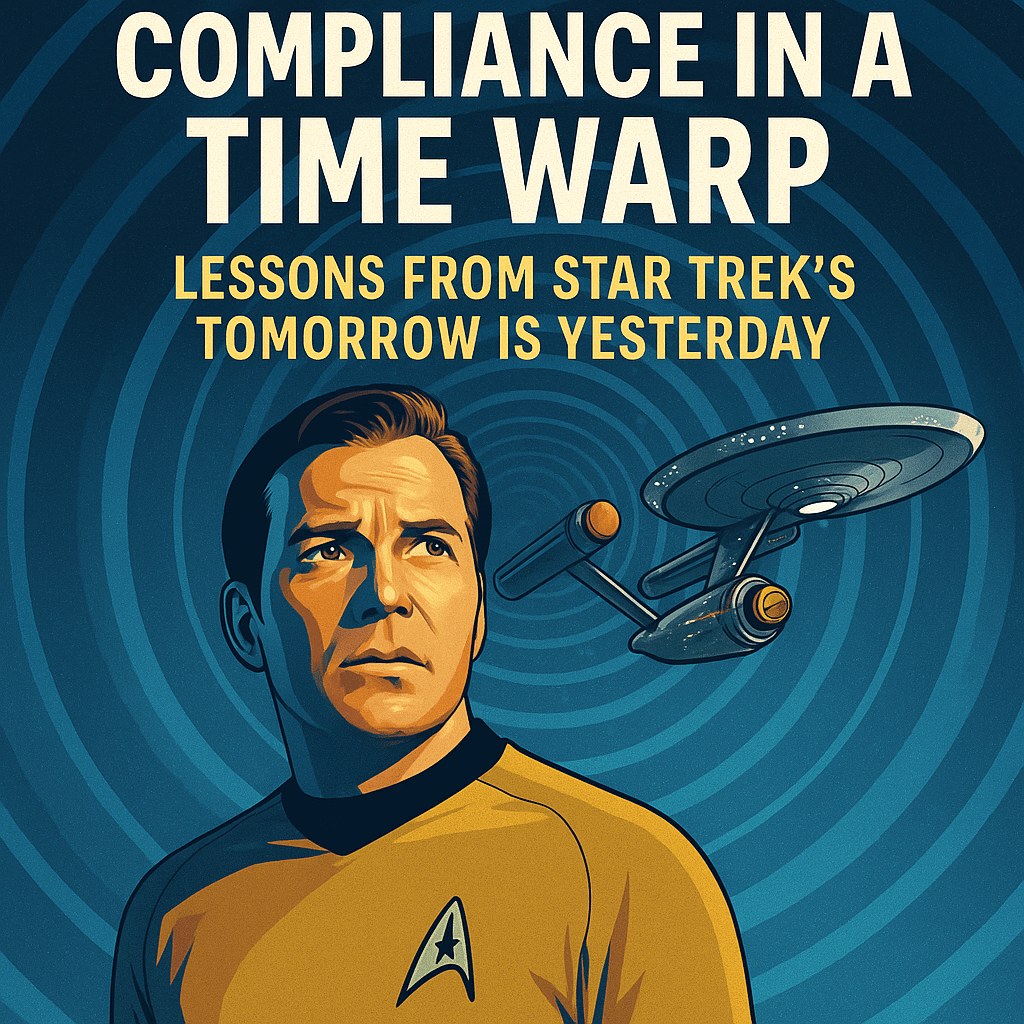
Compliance in a Time Warp: Lessons from Star Trek’s Tomorrow Is Yesterday

Show Summary

In the ever-expanding universe of Star Trek: The Original Series, the episode “Tomorrow Is Yesterday” offers an unexpected bounty of compliance insights. On its surface, the story is a classic time-travel romp: the USS Enterprise is accidentally flung back to 1960s Earth, intercepted by a U.S. Air Force jet, and must find a way to return to the 23rd century without altering the course of history. But below the sci-fi action lies a deeper commentary on responsibility, decision-making, and the unforeseen consequences of even well-intentioned actions, making it a surprising compliance masterclass in disguise.

As compliance professionals, we often deal with risks not just of what is known but of what could happen: the unknown impact of an overlooked third-party relationship, a lack of controls in an emerging market, or a cultural blind spot that results in reputational fallout. In “Tomorrow Is Yesterday,” the crew must tread carefully to avoid disrupting the timeline, and in doing so, they offer lessons on ethics, documentation, information handling, and more. Let’s break it down: each lesson begins with a scene from the episode, followed by a compliance insight that today’s professionals can apply.

Lesson 1: Every Action Has Ripple Effects

Illustrated By: When the Enterprise accidentally ends up in the Earth’s atmosphere in the 1960s, it is detected by U.S. military radar. An Air Force pilot, Captain Christopher, is scrambled to intercept. The crew beams him aboard to save his life when his aircraft is destroyed—but now, they’ve interfered with the timeline.

Compliance Lesson:

This scene serves as a powerful reminder that even minor actions can have significant consequences when not carefully considered. In compliance, well-meaning decisions made under pressure, such as rushing a vendor through onboarding or bypassing standard procedures to hit a deadline, can trigger cascading problems. A missing due diligence step today might become tomorrow’s enforcement action.

The key takeaway is that compliance must always be mindful of unintended consequences. Strong controls and decision-making frameworks help teams slow down just enough to assess risks before acting. Preventing compliance failures often comes down to building in that pause, the moment of reflection before action.

Lesson 2: Do not Underestimate the Importance of Containment

Illustrated By: Captain Christopher now knows too much. He’s seen a starship, spoken with its crew, and witnessed 23rd-century technology. Spock warns that releasing him could change the course of Earth’s future. The crew must now decide whether to detain him, erase his memory, or seek an alternative solution.

Compliance Lesson:

When sensitive information is accidentally exposed, whether it is confidential business data, personal employee details, or insider information, containment becomes the first and most crucial response step. Like the Enterprise crew managing the fallout of their accidental encounter, compliance professionals must act quickly and decisively to limit exposure.

This lesson is especially critical in the era of data privacy regulations, such as GDPR and CCPA. Companies must have protocols in place to isolate breaches, report them within the required timeframes, and prevent further spread. Your compliance team should conduct tabletop exercises that simulate this kind of scenario, where exposure has already occurred, and now it is about mitigating the damage.

Lesson 3: Documentation and Traceability Are Critical

Illustrated by: As the crew works to reverse their time jump, they must carefully reconstruct a plan to erase all evidence of their presence in the past. They go so far as to recover physical recordings and tamper with computer logs to restore the timeline to its original state.

Compliance Lesson:

This scene underscores the importance of meticulous recordkeeping. While the Enterprise crew is in a rare situation of removing data for the good of the universe, in the corporate world, proper documentation is essential to ensure traceability, accountability, and auditability. Without documentation, there is no proof of process, no evidence of decisions, and no way to defend against accusations or demonstrate compliance.

Whether you are conducting due diligence, implementing a policy, or investigating a report, thorough documentation serves as the foundation of defensible compliance. Ensure that every step is captured, from the decision to engage a third party to the delivery and recording of employee training.

Lesson 4: Ethics Must Guide Decision-Making Under Uncertainty

Illustrated By: Faced with conflicting outcomes, if they return Captain Christopher to Earth, he may reveal classified knowledge; if they don’t, they alter his family line. Kirk and Spock must weigh ethical considerations against practical risks. Ultimately, they learn that Christopher’s unborn son will become pivotal to Earth’s future space exploration, so they must return him.

Compliance Lesson:

When policies do not offer a clear answer, ethical judgment must guide your decision-making. In many situations, especially those involving gray areas or new technologies, compliance teams are left to interpret principles rather than rules. That’s where a well-structured code of ethics becomes essential.

Training should teach employees not only what the law says but also how to apply ethical reasoning when there is no perfect option. Ethical leadership, modeled by those at the top, also reinforces that it’s not just about staying within bounds but rather about doing the right thing even when the stakes are high.

Lesson 5: Cross-Functional Collaboration Enhances Compliance Outcomes

Illustrated By: To return to their time and restore the timeline, the crew must coordinate multiple systems across engineering, science, navigation, and command. Mr. Scott recalibrates the engines, Spock calculates gravitational trajectories, and Sulu pilots the ship at precisely the right moment.

Compliance Lesson:

Compliance cannot operate in a silo. Like the crew of the Enterprise, compliance teams must work across various departments—such as legal, IT, HR, operations, and more—to execute effective risk mitigation. Whether you’re launching a third-party review process, addressing a whistleblower complaint, or updating privacy policies, your success depends on collaboration.

This involves building trust, facilitating effective communication, and aligning incentives across various functions. Consider forming cross-functional compliance working groups to stay informed about emerging risks and ensure shared ownership of compliance outcomes.

Lesson 6: Time Is of the Essence

Illustrated By: As the Earth’s gravitational pull begins to reassert itself, the Enterprise must execute its time-warp escape with split-second precision. A single delay could strand them in the 20th century or, worse, destroy the ship.

Compliance Lesson:

Timing can be the difference between a manageable issue and a full-blown crisis. Regulatory deadlines, investigation windows, and breach notification requirements all operate on strict timelines. Compliance professionals must be equipped to respond swiftly and decisively, particularly in crises.

Establishing a rapid-response protocol with clearly defined roles and pre-approved escalation paths is critical. Regularly review these protocols through simulated drills and update them based on lessons learned from real-world experiences. Like the crew navigating their return through time, your team must be prepared to act quickly when risk strikes.

Conclusion: Compliance for the Future—Rooted in Responsibility

“Tomorrow Is Yesterday” reminds us that ethical conduct isn’t just about navigating today’s rules but also about understanding the impact of our actions on tomorrow. For the crew of the Enterprise, that meant carefully extracting themselves from history without doing damage. For compliance professionals, it means building systems and cultures that consider not only legal obligations but also ethical consequences, unintended impacts, and the interconnectedness of our global environment.

In an era of accelerating technology, geopolitical shifts, and complex regulatory changes, these lessons are more relevant than ever. Whether it’s responding to a data breach, managing an FCPA risk, or updating your training protocols, ask yourself, “What ripple effects could this create? Are we prepared? Are we acting with integrity? ”

To boldly go where no compliance program has gone before, we must learn from the past, act responsibly in the present, and remain ever-mindful of the future. So, let’s not just manage compliance—let’s lead it ethically, collaboratively, and with a focus on the future.

Resources:

Excruciatingly Detailed Plot Summary by Eric W. Weisstein

MissionLogPodcast.com

Memory Alpha

Categories
Trekking Through Compliance

Trekking Through Compliance – Episode 20: Compliance Training Lessons from Return of the Archons

Show Summary

One of the most underrated and allegorically rich episodes from The Original Series is “Return of the Archons.” On its face, it’s a tale about a mind-controlling computer and a seemingly idyllic society. But dig deeper, and you’ll find rich insights about what happens when training fails, communication becomes dogma, and critical thinking is suppressed. In short, it’s a compliance case study in a sci-fi wrapper.

In “Return of the Archons,” the crew of the Enterprise visits Beta III, a planet where the population is under the control of a mysterious figure named Landru. Society there values “peace, tranquility, and the good of the body,” but at the cost of individuality, freedom, and inquiry. The result? A culture of complacency that tolerates no questioning of authority and rewards blind obedience. Sound familiar? For compliance professionals, this episode offers a cautionary tale about the dangers of compliance in form but not in spirit. Let’s unpack the key lessons, each grounded in a scene from the show, followed by a compliance communication or training takeaway.

Lesson 1: Beware of a Culture of Blind Obedience

Illustrated By: As Captain Kirk and Mr. Spock observe the citizens of Beta III, they are struck by the eerie passivity of the people. Everyone is polite, deferential, and expressionless. When asked about Landru, they recite phrases like “It is the will of Landru” or “You are not of the body.” No one can explain what these phrases mean—they repeat them unthinkingly.

Lesson 2: Suppressing Dissent Undermines a Speak-Up Culture

Illustrated By: When Kirk and his team attempt to discuss their concerns with the townspeople, they are met with horror. One man panics and calls the lawgivers, who arrive to silence and “absorb” those who question Landru. Dissent is not only discouraged—it’s physically erased from society.

Lesson 3: Over-Automation Can Lead to Ethical Stagnation

Illustrated By: It’s eventually revealed that Landru is not a man but a computer programmed centuries earlier to maintain peace and harmony. Over time, the machine’s rigid logic has smothered innovation, growth, and individuality, enforcing compliance through force and fear rather than moral reasoning.

Lesson 4: Training Must Be Periodic, Relevant, and Culturally Engaging

Illustrated By: Beta III’s citizens haven’t had new information in generations. Their understanding of Landru and the laws is based on repetitive, ritualistic reinforcement. There’s no evolution, no adaptation—just the same messages, over and over.

Lesson 5: Effective Communication Is Two-Way, Not Top-Down

Illustrated By: The citizens of Beta III receive messages from Landru through lawgivers who deliver proclamations but never answer questions. There is no dialogue, no exchange of ideas—just declarations from on high.

Lesson 6: Culture Is the Foundation of Ethical Behavior

Illustrated By: Kirk and Spock recognize that Beta III is not simply a society with a malfunctioning leader; it is a society built on fear and conformity. Their solution isn’t just to turn off Landru. It’s to encourage the people to reclaim their humanity, their voices, and their ability to choose.


Final ComplianceLog Reflections: You Are of the Body (of Compliance)

As compliance professionals, we must ensure that our training and communication efforts do not replicate the world of Landru. Instead, we must foster curiosity, encourage questions, empower whistleblowers, refresh our content, and build culture from the ground up. So the next time you hear a compliance slogan repeated like a mantra, ask yourself: Are we creating engaged, ethical employees, or are we just building another Beta III? Let’s boldly go where no training program has gone before and bring our people with us.

Resources:

Excruciatingly Detailed Plot Summary by Eric W. Weisstein

MissionLogPodcast.com

Memory Alpha

Categories
Blog

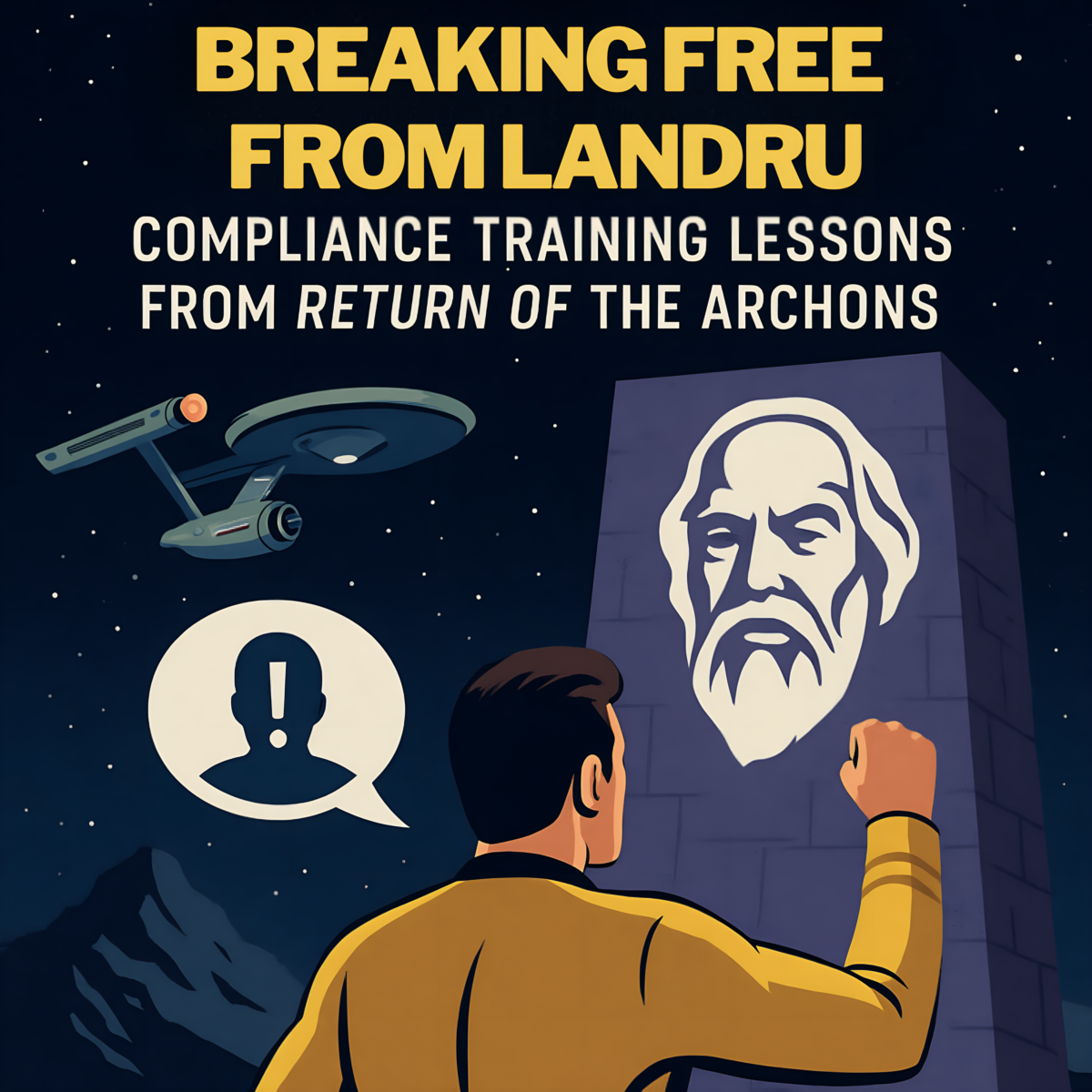
Breaking Free from Landru: Compliance Training Lessons from Return of the Archons

Show Summary

As a corporate compliance professional, I often say that sometimes the most profound lessons in ethics, culture, and communication don’t come from law books or boardroom memos—they come from Star Trek. One of the most underrated and allegorically rich episodes from The Original Series is “Return of the Archons.” On its face, it’s a tale about a mind-controlling computer and a seemingly idyllic society. But dig deeper, and you’ll find rich insights about what happens when training fails, communication becomes dogma, and critical thinking is suppressed. In short, it’s a compliance case study in a sci-fi wrapper.

In “Return of the Archons,” the crew of the Enterprise visits Beta III, a planet where the population is under the control of a mysterious figure named Landru. Society there values “peace, tranquility, and the good of the body,” but at the cost of individuality, freedom, and inquiry. The result? A dangerously complacent culture where questioning authority is considered a crime and blind obedience is rewarded. Sound familiar? For compliance professionals, this episode offers a cautionary tale about the dangers of compliance in form but not in spirit. Let’s unpack the key lessons, each grounded in a scene from the show, followed by a compliance communication or training takeaway.

Lesson 1: Beware of a Culture of Blind Obedience

Illustrated By: As Captain Kirk and Mr. Spock observe the citizens of Beta III, they are struck by the eerie passivity of the people. Everyone is polite, deferential, and expressionless. When asked about Landru, they recite phrases like “It is the will of Landru” or “You are not of the body.” No one can explain what these phrases mean—they repeat them unthinkingly.

Compliance Lesson:

This is what happens when employees are trained to follow the rules but are never taught why the rules matter. Compliance training that relies on rote memorization or check-the-box methodologies may ensure short-term adherence, but it builds a culture of passive compliance. Employees may be able to recite the Code of Conduct, but they often fail to recognize a genuine ethical dilemma when it arises.

Effective compliance training must go beyond slogans. It must teach critical thinking, situational awareness, and ethical reasoning. Employees should be empowered to ask questions, raise concerns, and challenge improper behavior, rather than simply following procedures blindly.

Lesson 2: Suppressing Dissent Undermines a Speak-Up Culture

Illustrated By: When Kirk and his team attempt to discuss their concerns with the townspeople, they are met with horror. One man panics and calls the lawgivers, who arrive to silence and “absorb” those who question Landru. Dissent is not only discouraged—it’s physically erased from society.

Compliance Lesson:

This is a culture of compliance where whistleblowing is viewed as heresy. If employees believe that speaking up will result in retaliation, social ostracization, or career harm, they will stay silent. And when that happens, misconduct festers.

Compliance training must make clear that the company values openness and will protect those who raise concerns. That message should be communicated consistently, reinforced in tone from the top, and modeled by leadership. Reporting mechanisms must be well publicized, easily accessible, and regularly tested for usability and effectiveness. Moreover, training must frame speaking up as not just permissible but essential to ethical corporate citizenship.

Lesson 3: Over-Automation Can Lead to Ethical Stagnation

Illustrated By: It’s eventually revealed that Landru is not a man but a computer programmed centuries earlier to maintain peace and harmony. Over time, the machine’s rigid logic has smothered innovation, growth, and individuality, enforcing compliance through force and fear rather than moral reasoning.

Compliance Lesson:

Automated compliance tools, such as monitoring software, AI risk scoring, and e-learning modules, are powerful and necessary. But they must not replace human judgment. When compliance becomes entirely algorithmic, it loses context, nuance, and moral intent. Worse, it risks becoming a machine-driven bureaucracy where the letter of the law is followed, but the spirit of the law is forgotten.

To avoid this, compliance communication must emphasize the rationale behind certain rules and procedures. Training should include real-world scenarios and dilemmas, encouraging discussion about the gray areas. Compliance professionals should foster spaces where ethics are debated, not dictated. Technology should be a support tool, not the enforcer of unquestioning obedience.

Lesson 4: Training Must Be Periodic, Relevant, and Culturally Engaging

Illustrated By: Beta III’s citizens haven’t had new information in generations. Their understanding of Landru and the laws is based on repetitive, ritualistic reinforcement. There’s no evolution, no adaptation, just the same messages over and over.

Compliance Lesson:

If your training materials have not changed since 2017, or if your annual code-of-conduct course is a 60-minute video with the same five questions at the end, you are simply Beta III. Stale training is ineffective training.

Modern compliance training must be dynamic. Use fresh content, current case studies, and engaging delivery methods (e.g., gamification, short videos, mobile-friendly platforms). Tailor training to employee roles and geographies. Include cultural context and industry-specific risks. Training should reflect not only what the law says but also what the business does. And most importantly, revisit it periodically; compliance culture must be a living conversation, not a forgotten file.

Lesson 5: Effective Communication Is Two-Way, Not Top-Down

Illustrated By: The citizens of Beta III receive messages from Landru through lawgivers who deliver proclamations but never answer questions. There is no dialogue, no exchange of ideas—just declarations from on high.

Compliance Lesson:

This is a textbook example of failed compliance communication. A top-down, one-way communication strategy might check disclosure boxes, but it does not build understanding. Effective compliance communication is a dialogue. It includes listening as much as it includes talking.

Compliance professionals should build feedback loops, whether through employee surveys, town hall Q&As, or informal listening sessions. Allow employees to ask questions, share concerns, and help shape compliance messaging. Communicate often, transparently, and in plain language. Avoid legalese. Speak to people, not to them.

Lesson 6: Culture Is the Foundation of Ethical Behavior

Illustrated By: Kirk and Spock recognize that Beta III is not simply a society with a malfunctioning leader; it is a society built on fear and conformity. Their solution isn’t just to turn off Landru. It’s to encourage the people to reclaim their humanity, their voices, and their ability to choose.

Compliance Lesson:

This is the ultimate lesson of “Return of the Archons”: Compliance cannot be imposed from above. It must be cultivated from within. Training and communication are essential tools for building a deeper culture, one where employees genuinely embrace compliance because they believe in it, not because they’re forced to.

Culture-building requires sustained effort. It involves reinforcing values through leadership examples, recognizing ethical behavior, correcting missteps transparently, and integrating ethics into the daily workflow. Culture is the soil from which compliance grows. Without it, your program is just window dressing.

Final ComplianceLog Reflections: You Are of the Body (of Compliance)

“Return of the Archons” may seem like an abstract sci-fi tale, but it carries vital messages for compliance officers. It shows what happens when a society stops asking questions, stops thinking critically, and stops caring about why the rules exist. It warns us of a world where compliance is no longer about ethics but about fear, automation, and suppression.

As compliance professionals, we must ensure that our training and communication efforts do not replicate the world of Landru. Instead, we must foster curiosity, encourage questions, empower whistleblowers, refresh our content, and build culture from the ground up. So the next time you hear a compliance slogan repeated like a mantra, ask yourself: Are we creating engaged, ethical employees, or are we just building another Beta III? Let’s boldly go where no training program has gone before and bring our people with us.

Resources:

Excruciatingly Detailed Plot Summary by Eric W. Weisstein

MissionLogPodcast.com

Memory Alpha
Categories
10 For 10

10 For 10: Top Compliance Stories For the Week Ending June 21, 2025

Welcome to 10 For 10, the podcast that brings you the week’s Top 10 compliance stories in one podcast each week. Tom Fox, the Voice of Compliance, brings you the compliance stories that compliance professionals need to be aware of to end your busy week. Sit back, and in 10 minutes, hear about the stories every compliance professional should be aware of from the prior week. Every Saturday, 10 For 10 highlights the most important news, insights, and analysis for the compliance professional, all curated by the Voice of Compliance, Tom Fox. Get your weekly filling of compliance stories with 10 for 10, a podcast produced by the Compliance Podcast Network.

  • EU Advisor backs $4.7bn Google fine. (WSJ)
  • An Interpol official has been arrested for corruption related to Red Notices. (NYT)
  • Who mourns the death of the business card? (WSJ)
  • Mike Madigan was sentenced to 7.5 years in prison. (NYT)
  • The DOJ whistleblower program focuses on healthcare fraud. (Reuters)
  • Congolese customs officer beatified for anti-corruption. (AP)
  • JBS hits the US stock exchange. (FT)
  • MyPillow Founder Mike Lindell was ordered to pay $2.3MM for defamation. (NYT)
  • IMF to assess corruption in Kenya. (Bloomberg)
  • Families of Boeing victims file formal objections. (Reuters)

You can check out the Daily Compliance News for four curated compliance and ethics-related stories each day here.

Connect with Tom 

Instagram

Facebook

YouTube

Twitter

LinkedIn

You can purchase a copy of my new book, Upping Your Game, on Amazon.com

Categories
Kerrville Weekly News Roundup

Kerrville Weekly News Roundup: June 21, 2025

Welcome to the Kerrville Weekly News Roundup. Each week, veteran podcaster Tom Fox and his colleagues, Andrew Gay and Gilbert Paiz, get together to go over a couple of their favorite stories from the past week from Kerrville and the greater Hill Country. Sit back, enjoy a cup of morning coffee, and listen in to get a wrap-up of the Kerrville Weekly News. We each consider two of our favorite stories and discuss the upcoming weekend’s events that we will enjoy or participate in.

In this episode, Tom and Andrew are joined by our latest co-host, Zach Green, to look at some of the stories that caught their attention over the past week.

Stories include:

  • Car Accident kills Navy enlistee
  • Furr Ball announces date and theme for 2025
  • Schreiner University announces capital campaign
  • Schreiner University summer Artist Camp with MOWA

Resources:

Tom Fox on LinkedIn

Gilbert Paiz on LinkedIn

Andrew Gay on LinkedIn

Zach Green on LinkedIn

Texas Hill Country Podcast Network

The Lead

Kerrville Daily Times

Fredericksburg Standard

Categories
2 Gurus Talk Compliance

2 Gurus Talk Compliance – Episode 54 – The FCPA is Back On Edition

What happens when two top compliance commentators get together? They talk compliance, of course. Join Tom Fox and Kristy Grant-Hart in 2 Gurus Talk Compliance as they discuss the latest compliance issues in this week’s episode!

Stories this week include:

  • DOJ’s New FCPA Playbook: ‘Time to get to work’ – Ropes & Gray
  • Thought from the Compliance in AI Conference—Kristy attended
  • Building brands with culture—Fast Company
  • How to Say No at Work—Wall Street Journal
  • Fake cop pulls over real cop on I-4, gets arrested, authorities say—WESH 2
  • What does the crash mean for Boeing? (⁠BBC⁠)
  • The CITGO auction date has been extended (yet again). (⁠Reuters⁠)
  • Rubio is pressing OFAC to investigate Harvard. ⁠(NYT⁠)
  • Brad Bondi loses the DC Bar election. (⁠Reuters⁠)
  • The EU levies fresh sanctions on the Nord pipeline. (NYT⁠)

Resources:

Kristy Grant-Hart on LinkedIn

Prove Your Worth

Tom

Instagram

Facebook

YouTube

Twitter

LinkedIn

Categories
Reel Creators of the Texas Hill Country

Reel Creators of the Texas Hill Country: The Intersection of Filmmaking, Politics, and Leadership with Tyler Mann

Welcome to Reel Creators of the Texas Hill Country, where we dive deep into the heart of filmmaking in one of America’s most unique and captivating landscapes. From rolling hills and rustic towns to thriving cities and hidden gems, the Texas Hill Country offers endless inspiration for filmmakers, and we’re here to uncover every aspect of it. In this podcast, we’ll meet the passionate directors, cinematographers, screenwriters, and crews who bring their creative visions to life in this storied region. Join us as we explore the challenges, rewards, and unique stories that make filmmaking here an art of its own. Whether you’re a seasoned pro or simply curious about the world behind the camera, Reel Creators of the Texas Hill Country promises to be your all-access pass to the vibrant filmmaking community of the Hill Country and beyond.

In this episode, I interview Tyler Mann, a movie director known for his debut feature film, ‘I Voted.’ Tyler shares his journey into filmmaking, from childhood stop-motion videos to studying at the University of Texas at Arlington. They delve into the inspiration behind ‘I Voted,’ a politically charged film set during a tense presidential election, and discuss the challenges and rewards of making the movie. Tyler emphasizes the importance of self-awareness, collaboration, and creative integrity in filmmaking, sharing insights from his on-set experiences. He also offers advice for aspiring filmmakers and talks about the film’s reception on the festival circuit.

Key highlights:

  • Tyler Mann’s Filmmaking Journey
  • The Intersection of Film, Politics, and Leadership
  • Inspiration Behind ‘I Voted’
  • Challenges and Rewards of Filmmaking
  • Advice for Aspiring Filmmakers

Resources:

Ruined Man Productions Website

Ruined Man Productions on Facebook

I Voted The Movie

Tyler Mann on LinkedIn

Tyler Mann on Facebook

Texas Hill Country Podcast Network