Categories
Blog

Will Trump Suspend FCPA Enforcement in Venezuela?

Now that I have your attention with this clickbait title, I want to explore today what the Venezuelan imbroglio may mean for compliance professionals and energy companies who are looking at either entering the Venezuelan market or, in many cases, re-entering it after the not invasion (since it was not a military action authorized by Congress); not a police action (that the Korean War takes the moniker); but the capture of President Maduro and his wife to purloin Venezuela’s oil. As noted by New York Times (NYT) columnist Thomas Friedman today, “It is now clear that Trump’s priority in capturing President Nicolás Maduro of Venezuela was not to make that country safe for the restoration of democracy but to make it safe for the restoration of American oil companies’ dominance over Venezuelan oil extraction.”

But there are multiple obstacles to the US getting to and removing Venezuelan oil. As the Wall Street Journal (WSJ) noted, “But getting foreign companies to flock back to Venezuela will be a massive challenge. Chevron is the only major U.S. oil company and the country’s largest foreign investor. Other oil executives will be forced to gauge the stability on the ground in a country where the industry has fallen into disarray after more than two decades of mismanagement and corruption.” Economically, it may make little to no sense.

Corruption and PDVSA

But from the compliance perspective, there is the issue of corruption. As I wrote back in 2017, “Of all the stench from corruption, not much is more odious than that from the Venezuelan state oil company Petróleos de Venezuela SA (PDVSA). Whether it is shaking down contractors for Rolex watches to schedule a meeting, requiring a bribe to get payments on outstanding invoices, or simply good old-fashioned cash to get on a bid list, PDVSA is perceived to be one of the most institutionally corrupt energy companies around.”

How President Trump plans to get the Venezuelan oil out of the country is not known at this point. But unless he orders US energy companies to put boots on the ground to rebuild PdVSA’s decrepit infrastructure, those same companies will have to deal with the same corrupt PdVSA officials.

In the context of Venezuela’s reopening to Western energy investment, President Trump’s decision to pause enforcement of the Foreign Corrupt Practices Act (FCPA) reflected a broader strategic pivot toward what his administration calls economic competitiveness and national security. His Executive Order issued in early 2025 directed the Department of Justice (DOJ) to halt new FCPA investigations for at least 180 days while it reviewed enforcement priorities on the premise that strict anti-bribery enforcement, as it has traditionally been applied, “impedes U.S. foreign policy objectives” and disadvantages American companies relative to global competitors. The policy rationale was that, in markets perceived as corrupt or opaque, rigorous FCPA enforcement has historically dissuaded US firms from competing effectively, particularly against foreign rivals who do not face the same legal constraints. This argument, which resonated with a strand of populist economic nationalism, frames FCPA enforcement as a barrier to energy companies securing strategic resources, such as Venezuelan oil, rather than as a purely ethical safeguard.

From a compliance professional’s lens, this recalibration had two implications. On one hand, it might reduce the immediacy of DOJ scrutiny for conduct in jurisdictions like Venezuela, where corruption risk is endemic. On the other hand, the suspension does not abolish the law; FCPA remains on the books, and enforcement priorities can flip with the political winds or through congressional action. Moreover, the suspension could embolden local partners or intermediaries to push for irregular payments under the assumption that US enforcement is weak, creating significant red-flag risks for energy companies seeking to operationalize robust controls aligned with the DOJ’s Evaluation of Corporate Compliance Programs (ECCP) standards. Even under a relaxed enforcement regime, a strong compliance program grounded in the ECCP’s emphasis on risk-based design, continuous monitoring, and senior-management accountability remains a critical commercial and legal hedge.

Compliance Going Forward

One of the most important takeaways for compliance professionals confronting Venezuela is the necessary shift from reflexive risk avoidance to disciplined risk management. Mike DeBernardis told me that the modern compliance mandate “is no longer to say ‘no’ when risk is high; it is to say ‘yes, if’ the risk can be identified, structured, and controlled.” This is not a philosophical shift. It is explicitly embedded in the ECCP, which does not reward companies for avoiding difficult markets but instead evaluates how effectively they manage risk in precisely those environments.

In the Venezuelan energy context, this means compliance must be deeply embedded in the business strategy from the outset. Compliance professionals must fully understand the proposed energy project, including its commercial objectives, operational footprint, and timelines. They must map every anticipated interaction with the Venezuelan state, particularly with state-owned enterprises, regulators, customs authorities, and security services.

From there, compliance professionals must identify where corruption pressure is most likely to arise, not in theory but in practice, based on how the business will actually operate. Only then can bespoke controls be designed to address those specific risks. The ECCP repeatedly emphasizes that effective compliance programs are well-designed, adequately resourced, and genuinely empowered. This is where compliance earns its seat at the strategy table. If compliance is engaged only after contracts are signed and capital committed, its ability to influence outcomes is sharply diminished, and the program is far more likely to fail under real-world pressure.

If initial program design is the foundation, continuous monitoring is the load-bearing structure. Energy operations in Venezuela will not tolerate static compliance approaches built around annual certifications or periodic check-the-box reviews. The ECCP explicitly asks whether companies test the effectiveness of their controls and whether they respond promptly and meaningfully to issues as they arise. In a high-risk jurisdiction like Venezuela, corruption risk will evolve rapidly as political conditions, counterparties, and regulatory expectations shift. Compliance programs must therefore be dynamic.

This requires live monitoring of payments, invoices, and reimbursements, particularly those involving third parties and state-linked entities. It requires regular compliance check-ins with project teams operating on the ground and under real-time pressure. It also requires targeted audits that focus narrowly on high-risk transactions rather than broad, generic reviews that miss the point. When red flags appear, swift remediation is essential, including the authority to pause transactions or relationships when necessary. Friction with the business is inevitable in this environment. Under the ECCP, however, that friction is not evidence of failure. It is evidence of independence, effectiveness, and seriousness of purpose.

For energy companies, Venezuela may well be worth the risk. The size of the opportunity, particularly in hydrocarbons, may make disengagement an increasingly unrealistic option. For compliance professionals, however, the mandate is clear and unforgiving. Programs must be designed with the assumption that pressure will occur, that shortcuts will be suggested, and that local counterparts may view compliance as negotiable.

Effective programs anticipate misconduct rather than react to it, and they are built to withstand scrutiny not only from local stakeholders but also from US enforcement authorities looking back months or years later. This requires compliance professionals to think and act as strategic risk managers, not policy custodians. They must insist on visibility into business decisions, demand resources commensurate with risk, and maintain the authority to intervene when necessary.

In the Venezuelan context, success will not be defined by the absence of issues but by how quickly and credibly the organization detects and addresses them. That approach is not merely about satisfying regulatory expectations. It is about protecting the company’s people, assets, and reputation in one of the most challenging operating environments in the world. That is not just compliance. That is strategic risk management at its purest and most demanding.
Categories
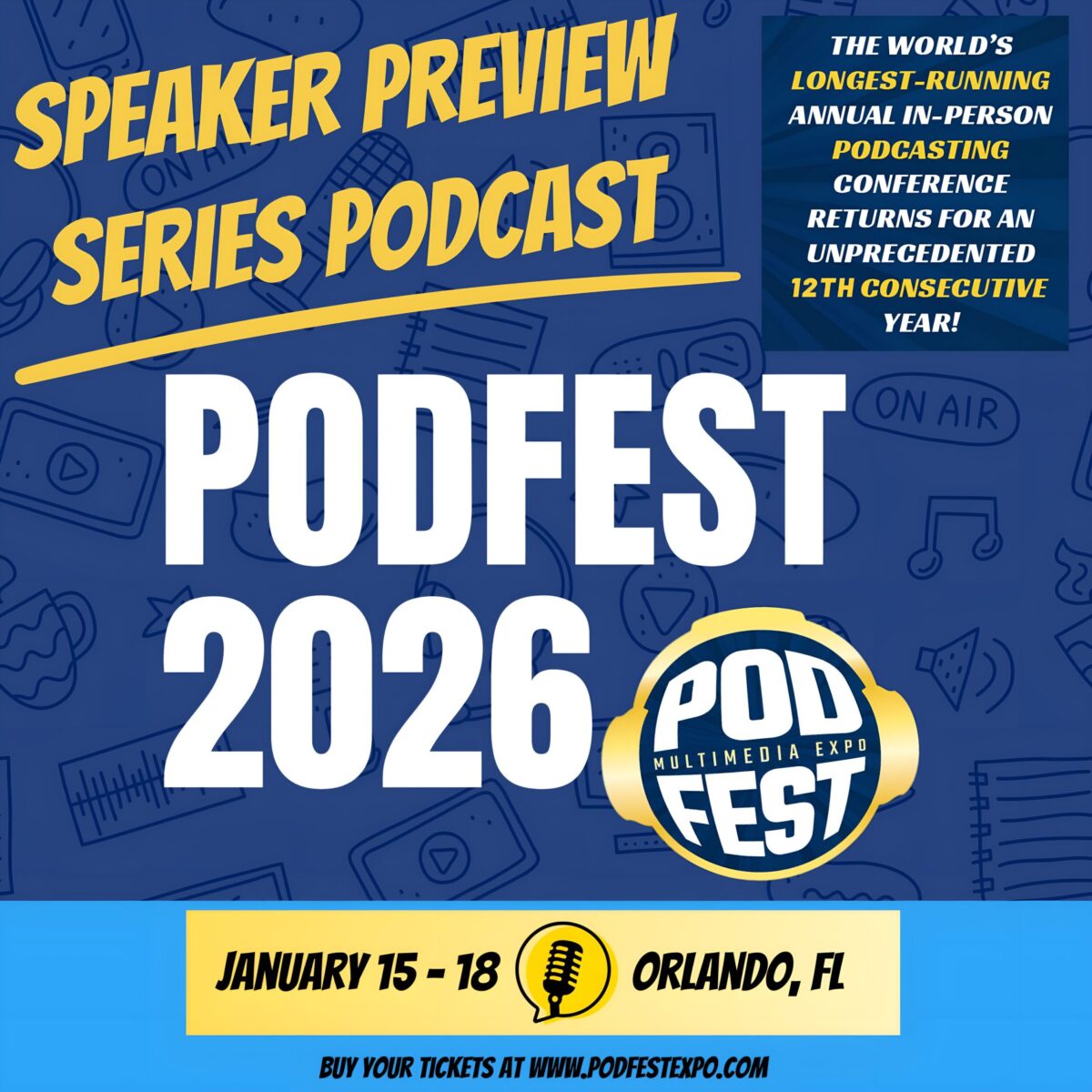
PodFest Expo 2026 Speaker Series Preview

Podfest Expo 2026 Speaker Preview Series: Julia Levine on How to Get New Listeners in Your Sleep

In this episode of the Podfest Expo 2026 Speaker Preview Podcasts series, Tom Fox visits with Julia Levine, AKA The Podcast Teacher, and discusses her presentation at Podfest Expo 2026 on How To Get New Listeners in Your Sleep. Some of the highlights in this podcast are:

  • Julia’s role in the world of podcasting.
  • Her presentation on how to garner more listeners.
  • What she hopes to get out of PodFest Expo 2026 and why you should attend.

I hope you can join us at Podfest Expo 2026, hosted by Podfest Global. This year’s event will be the 12th anniversary and will be held January 15-18, at the RENAISSANCE ORLANDO AT SEAWORLD® in Orlando, Florida. The lineup of this year’s event is simply first-rate, with some of the top names in podcasting.

Podfest Expo is a community of people interested in and passionate about sharing their voices and messages with the world through powerful audio and video mediums. We’re proud to unite as many people as possible to learn, get inspired, and grow better together.

Podfest Expo is so much more than just a conference. While we pride ourselves on featuring the most engaging speakers, exciting topics, and in-depth content, what sets the Podfest Expo event apart from all others is the tight-knit community we’ve been building since 2013. You don’t just attend a Podfest event—you become part of the Podfest family.

Whether you’re new to podcasting or a veteran podcaster looking to innovate and improve your podcast, our easy-to-understand Conference Topics allow you to customize a daily agenda based on what you’re most interested in learning. No matter your skill level or experience, Podfest Expo 2026 has plenty to offer!

Please join us at the event. For information on the event, click here. As an extra benefit for listeners of this podcast, Podfest Expo is offering 10% off any ticket level. Enter the discount code Fox2026 or visit this link.

Podfest Expo 2026 is a production of Podfest Global, which is the sponsor of this podcast series.

Categories
31 Days to More Effective Compliance Programs

31 Days to a More Effective Compliance Program: Day 8 – Building Effective Compliance Through Payroll

Welcome to 31 Days to a More Effective Compliance Program. Over this 31-day series in January 2026, Tom Fox will post a key component of a best-practice compliance program each day. By the end of January, you will have enough information to create, design, or enhance a compliance program. Each podcast will be short, at 6-8 minutes, with three key takeaways that you can implement at little or no cost to help update your compliance program. I hope you will join each day in January for this exploration of best practices in compliance.  Today, day 8, we discuss operationalizing a compliance program through payroll.

Key highlights:

  • Payroll should be at the forefront of any effort to prevent, detect, and remediate anti-corruption compliance issues.
  • Key compliance program components for payroll.
  • Watch for Offshore payments.

Resources:

Listeners to this podcast can receive a 20% discount on The Compliance Handbook, 6th edition, by clicking here.

Categories
AI Today in 5

AI Today in 5: January 8, 2026, The 6 Qs for AI in 2026 Edition

Welcome to AI Today in 5, the newest addition to the Compliance Podcast Network. Each day, Tom Fox will bring you 5 stories about AI to start your day. Sit back, enjoy a cup of morning coffee, and listen in to the AI Today In 5. All, from the Compliance Podcast Network. Each day, we consider four stories from the business world, compliance, ethics, risk management, leadership, or general interest about AI.

Top AI stories include:

  1. How AI can transform federal IT compliance. (Executive Biz)
  2. How AI is remaking reg compliance. (The Financial Revolutionist)
  3. Continuous tuning of transaction monitoring in AML. (FinTech Global)
  4. Compliance, credit, and Agentic AI. (FinTech Magazine)
  5. Six AI questions to ask (and answer) in 2026. (Bloomberg)

For more information on the use of AI in Compliance programs, my new book, Upping Your Game, is available. You can purchase a copy of the book on Amazon.com.

Categories
PodFest Expo 2026 Speaker Series Preview

Podfest Expo 2026 Speaker Preview Series: Wendy Shore on Growing Your Pod Through LinkedIn

In this episode of the Podfest Expo 2026 Speaker Preview Podcasts series, Tom Fox visits with Wendy Shore, a LinkedIn growth specialist, and discusses her panel at Podfest Expo 2026 on Growing Your Podcast with LinkedIn. Some of the highlights in this podcast are:

  • Wendy’s role in podcasting.
  • Her presentation on growing your audience through LinkedIn.
  • What she hopes to get out of PodFest Expo 2026 and why you should attend.

I hope you can join us at Podfest Expo 2026, hosted by Podfest Global. This year’s event will be the 12th anniversary and will be held January 15-18, at the RENAISSANCE ORLANDO AT SEAWORLD® in Orlando, Florida. The lineup of this year’s event is simply first-rate, with some of the top names in podcasting.

Podfest Expo is a community of people interested in and passionate about sharing their voices and messages with the world through powerful audio and video mediums. We’re proud to unite as many people as possible to learn, get inspired, and grow better together.

Podfest Expo is so much more than just a conference. While we pride ourselves on featuring the most engaging speakers, exciting topics, and in-depth content, what sets the Podfest Expo event apart from all others is the tight-knit community we’ve been building since 2013. You don’t just attend a Podfest event—you become part of the Podfest family.

Whether you’re new to podcasting or a veteran podcaster looking to innovate and improve your podcast, our easy-to-understand Conference Topics allow you to customize a daily agenda based on what you’re most interested in learning. No matter your skill level or experience, Podfest Expo 2026 has plenty to offer!

Please join us at the event. For information on the event, click here. As an extra benefit for listeners of this podcast, Podfest Expo is offering 10% off any ticket level. Enter the discount code Fox2026 or visit this link.

Podfest Expo 2026 is a production of Podfest Global, which is the sponsor of this podcast series.

Categories
Daily Compliance News

Daily Compliance News: January 8, 2026, The Sneaker Fraud Edition

Welcome to the Daily Compliance News. Each day, Tom Fox, the Voice of Compliance, brings you compliance-related stories to start your day. Sit back, enjoy a cup of morning coffee, and listen in to the Daily Compliance News. All, from the Compliance Podcast Network. Each day, we consider four stories from the business world, compliance, ethics, risk management, leadership, or general interest for the compliance professional.

Top stories include:

  • Energy companies say Venezuela owes them billions. (NYT)
  • Sneaker fraud leads to a 70-month prison sentence. (DW)
  • More brand-creator partnerships. (Forbes)
  • Pilot of blown-door aircraft sues Boeing. (BI)
Categories
It's art

It’s Art, Let’s Talk About It – The Artistic Journey of Walt Gonske: From New Jersey to Taos

The Museum of Western Art is dedicated to excellence in the collection, preservation, and promotion of Western Heritage and the education and cultural enrichment of our diverse audiences. The Museum serves as a bridge between the past and the present, ensuring the legacy of the American West is preserved for future generations.  Western Art is as engaging and important as ever. In this award-winning podcast series, Museum Executive Director Darrell Beauchamp welcomes artist Walt Gonske to discuss his extensive journey in the art world.

Their conversation covers his early days of drawing comic book characters, his six-year art school experience, and his career in men’s fashion illustration in New York City. Walt shares the pivotal moment when he decided to move from New York to Taos, New Mexico, where he embraced the local art scene. He explains the origins of his fascination with the northern New Mexico churches and camposantos, which became a significant theme in his work. Walt describes his innovative ‘Paint Mobile,’ a mobile studio allowing him to paint on location comfortably. Throughout the discussion, Walt also offers advice to young artists, emphasizing the importance of painting from life and of continuous practice. The episode also highlights the exhibition of Walt’s ‘Church Series’ at the Museum of Western Art and discusses the significance and development of these works.

Resources:

Museum of Western Art

Darrell Beauchamp on LinkedIn

Categories
Blog

Podcasting for Business and Compliance Professionals

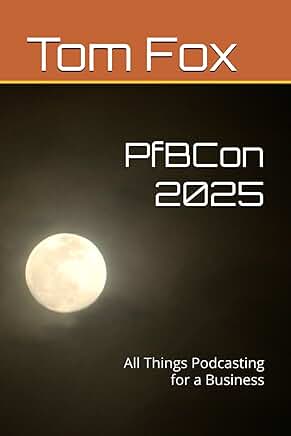
Podcasting for business has finally grown up. In November, I held the Podcasting for Business Conference. Today, I am thrilled to announce my latest book, PfBCon—All Things Podcasting for a Business, summarizing all the presentations from the event.

For years, podcasting was treated as either a hobby or a marketing gimmick. That era is over. As my book makes clear, podcasting has matured into a serious business discipline, with defined frameworks, repeatable strategies, and measurable outcomes. If you are a podcaster, this book gives you the blueprint to stop guessing and start designing shows that actually work. But here is the pivot that matters most to me as a compliance professional.

Everything in this book applies directly to how modern compliance teams communicate, influence, and lead inside their organizations. Podcasting is no longer just an external branding tool. It is one of the most underutilized internal communications platforms available to compliance leaders today. The same structures that help business podcasters build trust, authority, and engagement externally can be deployed with even greater impact inside a company.

Podcasting for Business Is About Intentional Design

One of the book’s core lessons is that podcasting for business is not about “having a podcast.” It is about designing a communication tool around a specific business objective. Megan Dougherty’s work on podcast value, math, and business podcast blueprints is the intellectual backbone of the book, and it is where compliance professionals should start paying attention.

Every effective business podcast answers three questions:

  1. Why does this show exist?
  2. What business outcome is it designed to support?
  3. How will success be measured?

That framing is instantly familiar to anyone who has built or run a compliance program. Policies, training, investigations, and reporting mechanisms are not judged on activity; they are judged on effectiveness. Podcasting, when done correctly, fits squarely within that same logic. This is where podcasters often stop reading and where compliance professionals should start.

Use Case #1: Internal Compliance Communications

Most compliance failures are not caused by a lack of rules. They are caused by a lack of understanding, relevance, and trust. Traditional internal compliance communications struggle because they are static, legalistic, and one-directional. A policy memo does not invite engagement. A slide deck does not create a connection. Annual training does not reinforce daily decision-making. A well-designed internal compliance podcast does all three.

What PfBCon—All Things Podcasting for a Business demonstrates repeatedly is that voice matters. Audio creates familiarity. Regular cadence creates expectation. Conversation creates meaning. An internal compliance podcast can:

  • Reinforce tone from the top in a consistent, human way;
  • Translate policies into real-world scenarios that employees actually recognize; and
  • Normalize conversations about risk, ethics, and accountability.

Short, focused episodes, ten to fifteen minutes, can be integrated into the rhythm of work without disrupting it. They can feature compliance leaders, business unit heads, internal audit, HR, or even anonymized case discussions drawn from real issues the organization has faced. This is not about entertainment. It is about embedding compliance into daily operations, exactly what regulators expect and what the DOJ’s Evaluation of Corporate Compliance Programs has emphasized year after year.

The book’s insistence on intentional design is the key. An internal compliance podcast should not be a dumping ground for announcements. It should have a defined purpose: education, reinforcement, or escalation awareness. When designed with that clarity, it becomes one of the most effective internal communication tools a compliance team can deploy.

Use Case #2: Speak-Up and Ethics Messaging

If there is one area where compliance communications consistently fall short, it is the speak-up culture. Hotlines are measured. Policies are posted. Training is delivered. And yet employees still hesitate to raise concerns. Why? Because a speak-up culture is not built by mechanisms. It is built on stories, responses, and trust.

Several contributors in the book, particularly those focused on branded podcasting and relationship-driven content, make a point that resonates deeply for compliance: people engage when they hear how others think, respond, and learn, not when they are told what to do. An internal ethics podcast can change the speak-up equation by:

  • Explaining what happens after a report is made;
  • Demystifying investigations without breaching confidentiality;
  • Reinforcing non-retaliation through lived examples, not slogans, and
  • Showing how issues raised by employees led to real improvements.

This is where the conversational format is essential. Speak-up culture is emotional, not procedural. Audio allows compliance leaders to speak plainly, acknowledge complexity, and show accountability. It humanizes the compliance function in a way no policy document ever will.

The book’s emphasis on authenticity and consistency is critical here. A single episode does not build trust. A pattern of honest, steady communication does. That is exactly how successful business podcasts build loyal audiences and exactly how compliance teams can build credible speak-up cultures.

Use Case #3: Board and Senior Management Engagement

Board oversight of compliance has never been more important or more challenging. Boards are inundated with dashboards, reports, and slide decks. What they often lack is context. They see metrics, but they do not always hear the thinking behind the program. One of the most overlooked applications of podcasting for compliance is as a board-level communication tool.

This does not mean publishing a public podcast for directors. It means using audio strategically to supplement traditional reporting. Short, periodic recordings can:

  • Provide narrative context around compliance risks.
  • Explain why certain metrics moved up or down.
  • Highlight emerging risks before they appear in dashboards; and
  • Reinforce management’s ownership of compliance, not just delegation.

As the book makes clear, podcasting excels at explaining why, not just what. For boards and senior executives, that is invaluable. It allows compliance leaders to communicate judgment, foresight, and alignment with business strategy in a format that fits how leaders consume information.

This is not theoretical. Several contributors discussed podcasting as a credibility and authority tool. In compliance, credibility with the board is everything. Audio, used thoughtfully, can strengthen that relationship rather than replace formal reporting.

Why This Book Matters for Compliance Professionals

PfBCon—All Things Podcasting for a Business is not a compliance book. That is precisely why compliance professionals should read it. It provides something that compliance guidance often lacks: operational communication frameworks. It explains how to design content that people listen to, how to maintain consistency, and how to align communication with organizational objectives.

For podcasters, this book is a roadmap out of randomness. For compliance professionals, it is a blueprint for modernizing how we communicate ethics, risk, and accountability. If compliance is expected to be proactive, embedded, and influential, then compliance communications must evolve as well. Podcasting, done with intent, is one of the most powerful ways to do that.

Final Thought and Call to Action

Podcasting for business is not about chasing downloads. Compliance communications are not about checking boxes. Both are about trust, clarity, and sustained engagement. If you are a podcaster who wants structure, discipline, and results, this book delivers. If you are a compliance professional looking for new ways to reach employees, strengthen speak-up culture, and engage senior leadership, this book will challenge how you think about communication.

I hope you will purchase and read PfBCon—All Things Podcasting for a Business. It is not just a guide for podcasters. It is a playbook for anyone serious about using communication as a strategic business and compliance tool. You can purchase the book here on Amazon.com.

Categories
Great Women in Compliance

Great Women in Compliance: Both Sides of the Desk: Managing Layoffs & Thriving Through Them

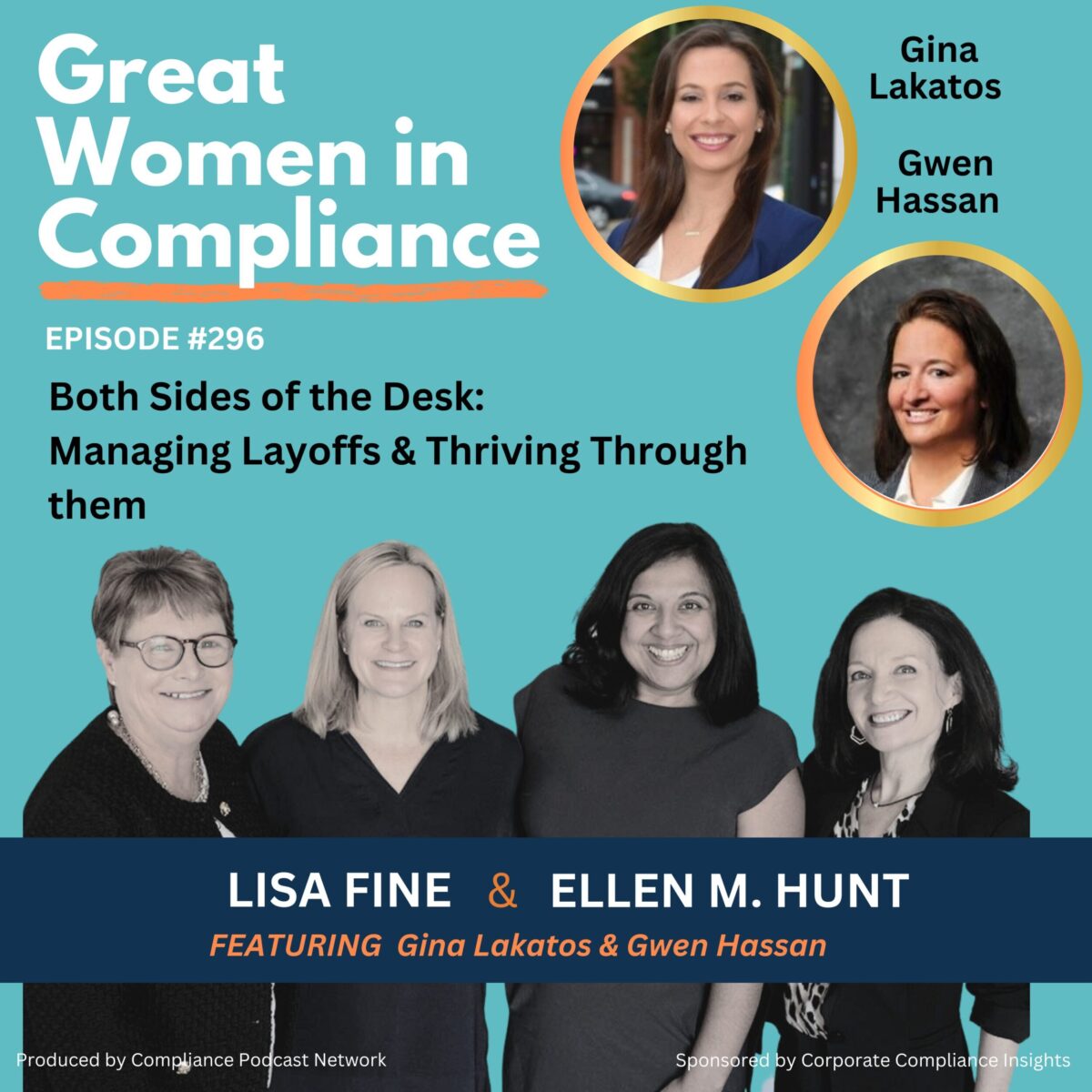
Layoffs, no matter which side of the desk you are on, are one of the most difficult realities of the workplace. For leaders, they demand empathy, clarity, and responsibility. For employees, they can bring shock, uncertainty, and the need to rebuild. In this episode, Lisa Fina and Ellen Hunt invited Gina Lakatos and Gwen Hassan to explore what it means to manage layoffs with integrity and how individuals can survive and even thrive in the aftermath.

Our conversation focused on the human experience of layoffs: the decisions, emotions, mistakes, and opportunities that shape what comes next.

🔍 What We Cover

  • Compassion and clarity matter on both sides of the desk
  • Why the corporate math of layoffs is not a judgment of value or performance
  • How leaders can communicate with clarity, empathy, and respect
  • Acknowledging the emotional impact of layoffs on those who remain
  • Practical strategies for thriving after job loss: mindset, skills, and next steps

Layoffs may close one chapter—but they don’t have to define your story. This episode offers insight, empathy, and actionable guidance for navigating one of work’s hardest realities with dignity and resilience.

Categories
31 Days to More Effective Compliance Programs

31 Days to a More Effective Compliance Program: Day 7 – Clawbacks and Holdbacks

Welcome to 31 Days to a More Effective Compliance Program. Over this 31-day series in January 2026, Tom Fox will post a key component of a best-practice compliance program each day. By the end of January, you will have enough information to create, design, or enhance a compliance program. Each podcast will be short, at 6-8 minutes, with three key takeaways that you can implement at little or no cost to help update your compliance program. I hope you will join each day in January for this exploration of best practices in compliance. Today, on Day 7, we explore the critical insights from the DOJ Clawback and Holdback Program for compliance professionals.

Key highlights:

  • Integrating Compliance into Compensation
  • Financial Accountability Emphasis
  • DOJ’s Commitment to Individual Accountability
  • Continuous Evaluation and Improvement

Resources:

Listeners to this podcast can receive a 20% discount on The Compliance Handbook, 6th edition, by clicking here.