Categories
Blog

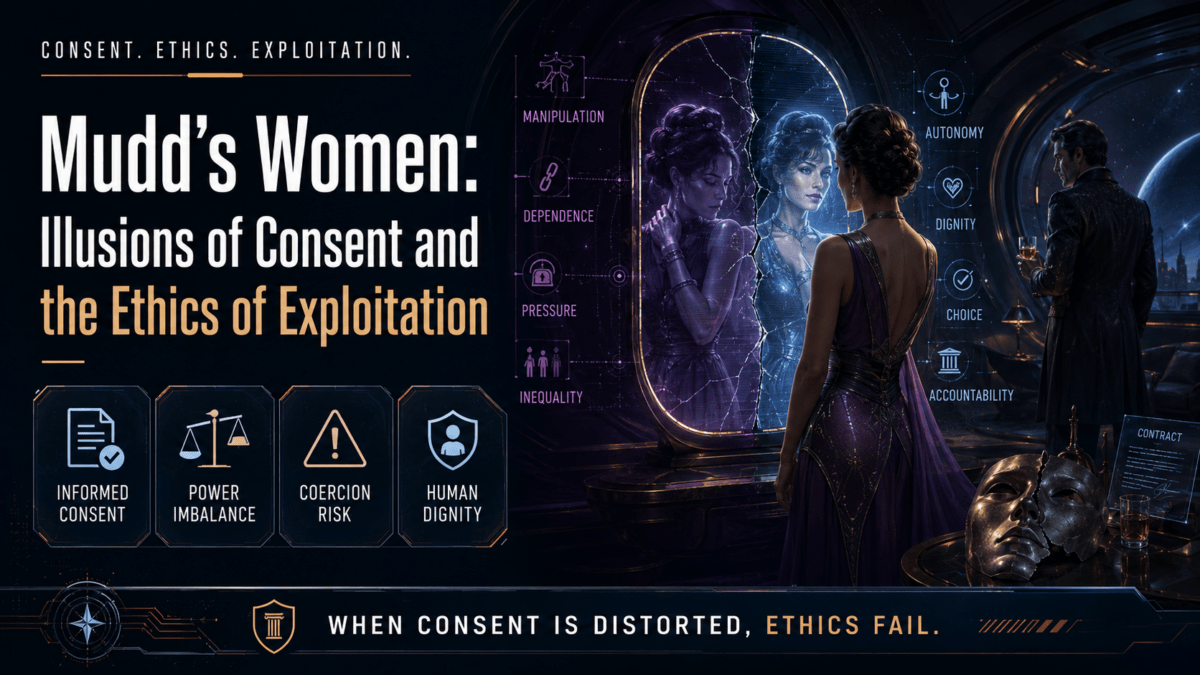
Mudd’s Women: Illusions of Consent and the Ethics of Exploitation

In this eye-opening blog post of Trekking Through Compliance, we examine Mudd’s Women, one of the earliest and most ethically provocative episodes of Star Trek. While Harcourt Fenton Mudd provides his usual comic bluster, the underlying story is a disturbing metaphor for human trafficking. The three women he transports appear glamorous, but they are victims of manipulation, economic coercion, and chemical dependency, all tactics that mirror modern trafficking schemes.

I review the key compliance lessons by breaking down how this episode reflects red flags in trafficking risk. From the illusion of choice to abusive power dynamics and the responsibility of organizations to prevent exploitation in their supply chains, Mudd’s Women provides a surprisingly timely framework for modern compliance professionals.

Key Highlights and Human Trafficking Case Illustrations

1. Illusion of Consent—When “Choice” is Conditioned by Coercion

Illustrated by: The women believing they must take the Venus drug to be desirable and accepted.

The women in this episode appear to be making choices, but those choices are shaped by manipulation, desperation, and dependency. The Venus drug becomes a stand-in for traffickers’ tools: debt bondage, false promises, or immigration threats. Compliance officers must recognize that surface-level consent does not equal genuine autonomy when coercion lurks beneath.

2. Economic Exploitation—Vulnerability Creates Risk

Illustrated by: The miners’ willingness to trade vital resources for the women, commodifying human beings.

The deal Mudd brokers—exchanging women for lithium crystals—lays bare the dynamics of commodification. In today’s terms, this is a form of transactional trafficking. Vulnerable individuals are offered to influential economic players in exchange for profit. Companies operating in high-risk jurisdictions or industries must vet third-party recruiters and labor brokers with exceptional diligence

3. Deception and Misrepresentation—The Role of Fraud in Trafficking 

Illustrated by: Mudd’s concealment of the Venus drug and misrepresentation of the women’s condition to both the women and the miners.

Human trafficking often begins with lies. Whether it’s a promise of employment, education, or escape, traffickers rely on fraud to lure victims. Mudd’s entire operation is built on deceit. A strong compliance program includes rigorous due diligence processes to detect falsified credentials, labor contract inconsistencies, and red flags in vendor onboarding.

4. Victim Support and Recognition—Beyond Enforcement to Empathy

Illustrated by: Kirk’s ultimate compassion toward Evie and her rediscovery of her inner strength without the drug.

While the episode ends with Mudd in custody, the more powerful moment is Evie realizing her self-worth independent of manipulation. This reflects a crucial compliance principle: anti-trafficking programs must prioritize survivor-centered support. This entails creating ethical exit strategies, ensuring access to justice and care, and cultivating environments where individuals are not reliant on exploitative systems to survive.

5. The Responsibility to Intervene—Compliance Can’t Be a Bystander 

Illustrated by: Kirk’s decision to arrest Mudd and expose the drug deception despite the miners’ interest in continuing the transaction.

Kirk could have turned a blind eye, but he doesn’t. This is the model for corporate action: when exploitation is found, the response must be swift and straightforward. Compliance programs must include escalation pathways and partnerships with law enforcement and NGOs to act decisively when trafficking risks emerge.

Final ComplianceLog Reflections

Mudd’s Women may begin with lighthearted charm, but it ends with one of the most haunting portraits of exploitation in Star Trek. Beneath the fantasy is a cautionary tale of deception, dependency, and commodification, the core ingredients of human trafficking today. For compliance professionals, this episode serves as a call to action: look deeper, build proactive detection systems, and empower vulnerable individuals throughout your value chain.

Resources:

Excruciatingly Detailed Plot Summary by Eric W. Weisstein

MissionLogPodcast.com

Memory Alpha

Categories
Trekking Through Compliance

Trekking Through Compliance: Episode 6 – Human Trafficking Lessons from Mudd’s Women

In this episode of Trekking Through Compliance, we consider the episode Mudd’s Women, which aired on October 13, 1966, Star Date 1329.1. In this eye-opening episode of Trekking Through Compliance, we examine Mudd’s Women, one of the earliest and most ethically provocative episodes of Star Trek. While Harcourt Fenton Mudd provides his usual comic bluster, the underlying story is a disturbing metaphor for human trafficking. The three women he transports appear glamorous, but they are victims of manipulation, economic coercion, and chemical dependency—all tactics that mirror modern trafficking schemes. From the illusion of choice to abusive power dynamics and the responsibility of organizations to prevent exploitation in their supply chains, Mudd’s Women provides a surprisingly timely framework for modern compliance professionals.

Story

Harry Mudd attempts to evade the Enterprise with his small Class J cargo ship and leads it into an asteroid field. The Enterprise extends its shields over Harvey’s ship, burning out three of its four lithium crystals. The crew of the Enterprise becomes fascinated with the three beautiful women Mudd has been transporting.

As a result of the destruction of three of its lithium crystals, the Enterprise is forced to divert to Rigel 12 to obtain new crystals. Mudd makes his bargain with the lithium miners on the planet. At Mudd’s prompting, the miners offer Kirk lithium only in exchange for Mudd’s freedom and the release of the three women. Kirk learns the women’s beauty secret: Mudd has been providing them with the Venus drug. Kirk beams down to collect the lithium from Childress while providing Evie with red gelatin that she believes is the Venus drug. Evie once again believes she is beautiful and unintentionally reveals her natural inner beauty. In the end, Kirk gets his lithium, Evie remains with Childress, and Mudd is taken into custody.

Key highlights:

1. Illusion of Consent—When “Choice” is Conditioned by Coercion

🖖Illustrated by: The women believing they must take the Venus drug to be desirable and accepted.

The women in this episode appear to be making choices—but those choices are shaped by manipulation, desperation, and dependency. The Venus drug becomes a stand-in for traffickers’ tools: debt bondage, false promises, or immigration threats. Compliance officers must recognize that surface-level consent does not equal genuine autonomy when coercion lurks beneath.

2. Economic Exploitation—Vulnerability Creates Risk

🖖Illustrated by: The miners’ willingness to trade vital resources for the women, commodifying human beings.

The deal Mudd brokers—exchanging women for lithium crystals—lays bare the dynamics of commodification. In today’s terms, this is a form of transactional trafficking. Vulnerable individuals are offered to influential economic players in exchange for profit. Companies operating in high-risk jurisdictions or industries must thoroughly vet third-party recruiters and labor brokers.

3. Deception and Misrepresentation—The Role of Fraud in Trafficking

🖖Illustrated by: Mudd’s concealment of the Venus drug and misrepresentation of the women’s condition to both the women and the miners.

Human trafficking often begins with lies. Whether it’s a promise of employment, education, or escape, traffickers rely on fraud to lure victims. Mudd’s entire operation is built on deceit. A strong compliance program includes rigorous due diligence processes to detect falsified credentials, labor contract inconsistencies, and red flags in vendor onboarding.

4. Victim Support and Recognition—Beyond Enforcement to Empathy

🖖Illustrated by: Kirk’s ultimate compassion toward Evie and her rediscovery of her inner strength without the drug.

While the episode ends with Mudd in custody, the more powerful moment is Evie realizing her self-worth independent of manipulation. This reflects a crucial compliance principle: anti-trafficking programs must prioritize survivor-centered support. This means creating ethical exit strategies, providing access to justice and care, and fostering environments where individuals are not dependent on exploitative systems to survive.

5. The Responsibility to Intervene—Compliance Can’t Be a Bystander

🖖Illustrated by: Kirk’s decision to arrest Mudd and expose the drug deception despite the miners’ interest in continuing the transaction.

Kirk could have turned a blind eye—but he doesn’t. This is the model for corporate action: when exploitation is found, the response must be swift and straightforward. Compliance programs must include escalation pathways and partnerships with law enforcement and NGOs to act decisively when trafficking risks emerge.

Final StarLog Reflections

Mudd’s Women may begin with lighthearted charm, but it ends with one of the most haunting portraits of exploitation in Star Trek. Beneath the fantasy is a cautionary tale of deception, dependency, and commodification—core ingredients of human trafficking today.

For compliance professionals, this episode serves as a call to action: look deeper, build proactive detection systems, and empower vulnerable individuals throughout your value chain.

Resources:

Excruciatingly Detailed Plot Summary by Eric W. Weisstein

MissionLogPodcast.com

Memory Alpha

Fiona is an AI-generated voice

Categories
Blog

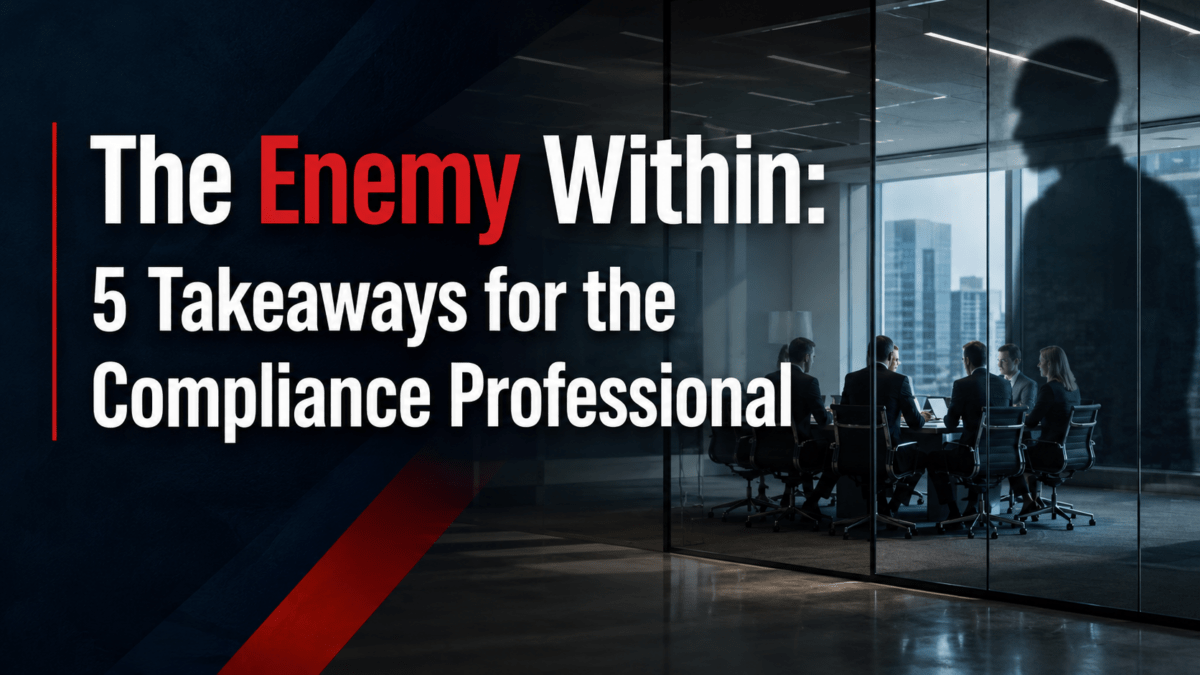
The Enemy Within: 5 Takeaways for the Compliance Professional

In this article, we examine “The Enemy Within,” which aired on October 6, 1966, at Start Date 1672.1.

One of the most psychologically compelling episodes of Star Trek to date: “The Enemy Within.” A transporter malfunction splits Captain Kirk into two versions of himself—one good, one evil—each representing different aspects of leadership, impulse, and integrity. As the crew struggles to respond to the fractured captain, we are given a front-row seat to the ethical breakdowns and Me Too-era lessons still resonant today. We examine five key compliance takeaways from this tale of divided identity, linking them directly to scenes aboard the Enterprise that illustrate what happens when power is unmoored from principle and when both technical and ethical control systems fail.

Compliance Takeaways

1. The Dangers of Unchecked Power—When ‘Authority’ Becomes Assault

🖖 Illustrated by: Evil Kirk attacking Yeoman Janice Rand in her quarters.

One of the most disturbing moments in early Trek canon, this assault serves as a stark warning about the abuse of power. Evil Kirk resembles the captain and carries his authority, but lacks a conscience. It’s a Me Too moment that reveals the need for every organization to install guardrails—even around its most powerful figures. Compliance must include mechanisms to protect the vulnerable from those who misuse rank or influence.

2. Ethical Decision-Making Requires Wholeness—The Fragmented Leader Can’t Lead.

🖖 Illustrated by: Good Kirk losing decisiveness and compassion, becoming indecisive.

As “good” Kirk weakens, Spock and McCoy realize that without the aggressive, assertive part of his personality, the captain cannot lead. This reinforces the idea that ethical leadership is not about being soft—it’s about balance. Compliance leaders need the courage to act and the heart to guide. Ethical strength is integrative, not binary.

3. Crisis Response and Chain of Command—When Leadership Wavers, Chaos Breeds

🖖 Illustrated by: Evil Kirk taking the bridge and ordering the ship away from orbit.

With no one certain which Kirk is in control, the crew becomes vulnerable to manipulation. This episode serves as a cautionary tale about the importance of clarity in the chain of command and protocols for handling leadership incapacitation. In corporate compliance, crisis scenarios must anticipate rogue actors with access to decision-making tools.

4. Investigating Allegations—Belief, Process, and Support Matter

🖖 Illustrated by: Spock and McCoy interviewing Rand after her assault.

Their interview is subtle but painful. The tension of believing victims, navigating hierarchical power structures, and confronting uncomfortable truths is deeply relevant today. A strong compliance program ensures that all allegations are taken seriously, investigated professionally, and addressed with empathy and integrity.

5. Reintegration and Remediation—Restoring What Was Broken

🖖 Illustrated by: The merging of good and evil Kirk through a restored transporter.

Rebuilding trust—and a unified identity—requires technology, trust, and time. Just as Kirk must reabsorb the parts of himself to lead again, organizations recovering from misconduct must integrate the lessons learned into their culture, policies, and leadership. The end goal isn’t punishment alone—it’s the restoration of ethical function.

Final Starlog Reflections

The Enemy Within is more than a science fiction tale. It’s a mirror to every compliance program, showing us how quickly things unravel when power is unrestrained, when voices are ignored, and when organizations fail to integrate strength with morality. It’s also a hopeful reminder that even fractured systems can be repaired—if we face the truth with clarity and courage.

Resources:

⁠Excruciatingly Detailed Plot Summary by Eric W. Weisstein⁠

MissionLogPodcast.com

⁠Memory Alpha⁠

Categories
AI Today in 5

AI Today in 5: June 5, 2026, The Tech Review, Not Political Review Edition

Welcome to AI Today in 5, the newest addition to the Compliance Podcast Network. Each day, Tom Fox will bring you 5 stories about AI to start your day. Sit back, enjoy a cup of morning coffee, and listen in to the AI Today In 5. All, from the Compliance Podcast Network. Each day, we consider five stories from the business world, compliance, ethics, risk management, leadership, or general interest about AI.

Top AI stories include:

  1. Smaller banks are missing out on financial crime prevention tools. (FinTechGlobal)
  2. Source of training data for central AI risk. (The National Law Review)
  3. GEICO pays a fine for AI-based policy cancellation due to insufficient notice. (ClarkHill)
  4. Managing AI regulatory complexity. (KPMG)
  5. OpenAI wants a tech review, not political considerations from the Administration. (CSO Online)

For more information on the use of AI in compliance programs, Tom Fox’s new book, Upping Your Game, is available. You can purchase a copy of the book on Amazon.com.

To learn about the intersection of Sherlock Holmes and the modern compliance professional, check out Tom’s latest book, The Game is Afoot-What Sherlock Holmes Teaches About Risk, Ethics and Investigations on Amazon.com.

Categories
Trekking Through Compliance

Trekking Through Compliance: Episode 5 – Compliance Lessons from The Enemy Within

In this episode of Trekking Through Compliance, we consider The Enemy Within, which aired on October 6, 1966, Star Date 1672.1.

While gathering specimens on planet Alpha 177 (whose night temperature reaches -120 degrees), the transporter malfunctions, stranding the remaining 4-man landing party (including Sulu) on the planet; Kirk beams up. Kirk is split into two alter-egos: the evil one (hostility, lust, violence), which arrives unnoticed a few minutes after the good Kirk (compassion, love, tenderness), after the crew has left the transporter room.

The evil Kirk enters Yeoman Janice Rand’s quarters and lies in wait for her. She scratches him when he attacks her. She fights him off, and soon after that, the good Kirk shows signs of losing both his decisiveness and ability to command. This leads to a gut-wrenching scene where Spock and McCoy interview Rand about the attack.

Spock and Scotty rig the transporter to run off the impulse engines and successfully fix the transporter. He is overpowered when the good Kirk tries to bring the evil Kirk to the transporter. The evil Kirk goes to the bridge and orders the Enterprise to leave orbit, but the good Kirk follows him there. Kirk eventually returns to normal when the transporter is modified and used to fuse his two parts. The landing party is also beamed back up, suffering from frostbite, but nothing worse.

Commentary

This episode explores the duality of Captain Kirk’s personality after a transporter malfunction splits him into two alter egos. The podcast discusses the episode’s themes and their relevance to modern compliance lessons, such as the duality of human nature, the importance of a unified identity, effective leadership in crisis, monitoring and internal controls, addressing ethical dilemmas, and fostering psychological safety. It also touches upon the cultural changes highlighted by the Me Too movement compared to the 1960s portrayal of gender issues. The episode strongly encourages viewers to rewatch it through a contemporary lens and apply its lessons to real-world compliance challenges, underscoring the importance of this approach.

Key highlights:

  • Plot Summary: The Enemy Within
  • Me Too Lessons and Ethical Reflections
  • Compliance Lessons from The Enemy Within

Resources:

⁠Excruciatingly Detailed Plot Summary by Eric W. Weisstein⁠

MissionLogPodcast.com

⁠Memory Alpha⁠

Categories
AI in Healthcare

AI in Healthcare: Five Healthcare AI Stories You Need to Know This Week – June 5, 2026

Welcome to AI in Healthcare in 5 Stories. This podcast is a Weekly Briefing of the five most important AI developments shaping healthcare, medicine, and life sciences. Each week, Tom Fox breaks down the latest stories on clinical innovation, regulation, privacy, compliance, patient safety, and operational transformation through a practical, business-focused lens. Designed for healthcare compliance professionals, executives, legal teams, clinicians, and industry leaders, the podcast moves beyond headlines to explain what each development means in the real world.

The top five stories for the week ending June 5, 2026, include:

  1. Mayo Clinic partners with Microsoft for AI in healthcare. (Microsoft)
  2. AI certification in healthcare. (Fierce Healthcare)
  3. Colorado enacts AI guardrails for healthcare. (CoHouseDems)
  4. Putting people at the center of AI in healthcare. (BDO USA)
  5. 6 top worries for AI in healthcare. (HealthExec)

For more information on the use of AI in Compliance programs, Tom Fox’s new book, Upping Your Game, is available. You can purchase a copy of the book on Amazon.com.

To learn about the intersection of Sherlock Holmes and the modern compliance professional, check out Tom’s latest book, The Game is Afoot-What Sherlock Holmes Teaches About Risk, Ethics and Investigations on Amazon.com.

Categories
AI in Financial Services in 5 Stories

AI in Financial Services in 5 Stories – Week Ending June 5, 2026

Welcome to AI in Financial Services in 5 Stories. A practical weekly roundup of the five most important AI developments affecting banking, insurance, payments, asset management, and fintech. Each Friday, Tom Fox will break down the top stories that matter most through the lenses of compliance, risk management, governance, and business strategy. Designed for compliance professionals, executives, legal teams, and financial services leaders, it goes beyond headlines to explain why each development matters in a highly regulated industry. The result is a concise weekly briefing that helps listeners stay current on AI innovation while asking sharper questions about oversight, accountability, and trust.

This week’s stories include:

  1. Smaller banks are missing out on financial crime prevention tools. (FinTech Global)
  2. Top AI and Fintech firms for 2026. (Forbes)
  3. Goldman CEO on running a bank in the age of AI. (Bloomberg)
  4. AI is breaking the old banking hiring model. (techcabal)
  5. AI cyber risk is the highest risk in banking. (FT)

For more information on the use of AI in Compliance programs, Tom Fox’s new book, Upping Your Game, is available. You can purchase a copy of the book on Amazon.com.

To learn about the intersection of Sherlock Holmes and the modern compliance professional, check out Tom’s latest book, The Game is Afoot-What Sherlock Holmes Teaches About Risk, Ethics and Investigations on Amazon.com.

Categories
Daily Compliance News

Daily Compliance News: June 5, 2026, The Profit Disgorgement Edition

Welcome to the Daily Compliance News. Each day, Tom Fox, the Voice of Compliance, brings you compliance-related stories to start your day. Sit back, enjoy a cup of morning coffee, and listen in to the Daily Compliance News. All, from the Compliance Podcast Network. Each day, we consider four stories from the business world, compliance, ethics, risk management, leadership, or general interest for the compliance professional.

Top stories include:

  • Sanctions gaps and ABC governance risks.  (JustSecurity)
  • SCt upholds SEC right to profit disgorgement. (NYT)
  • Top AI leaders call for a fight against Biological Weapons. (WSJ)
  • Gen Z in the office. (FT)

To learn about the intersection of Sherlock Holmes and the modern compliance professional, check out Tom’s latest book, The Game is Afoot-What Sherlock Holmes Teaches About Risk, Ethics and Investigations on Amazon.com.

Categories
Blog

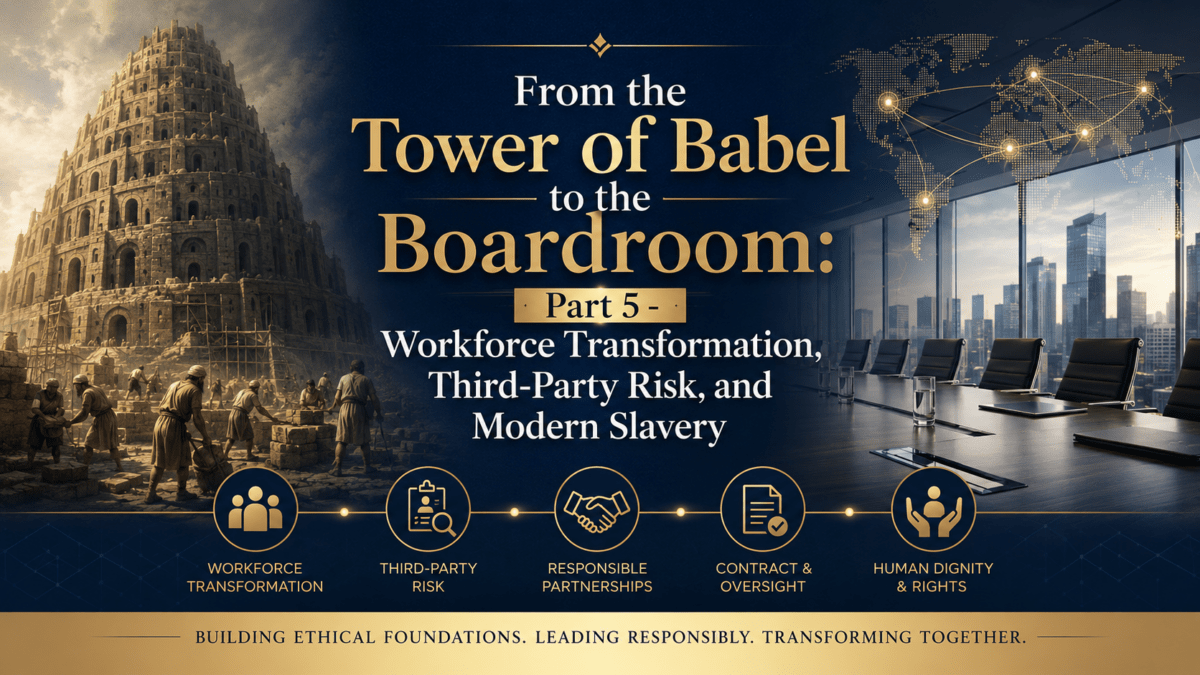
From the Tower of Babel to the Boardroom: Part 5 – Workforce Transformation, Third-Party Risk, and Modern Slavery

Artificial intelligence often appears frictionless. A prompt goes in. An answer comes out. A report is summarized. A risk score is generated. A customer interaction is automated. A compliance analyst receives a faster answer. A business process becomes more efficient. Yet there is nothing frictionless about AI.

Behind every AI tool sits a human supply chain. Some workers label data, moderate content, train models, build infrastructure, mine minerals, assemble devices, maintain data centers, write code, manage vendors, and absorb the consequences when automation changes the nature of work. There are third parties, subcontractors, cloud providers, data brokers, model developers, implementation consultants, and business users. There are people whose labor, data, dignity, and livelihoods may be affected long before the board ever sees an AI dashboard. Now we turn to the human supply chain of AI: workforce transformation, third-party risk, and modern slavery.

The Magnifica Humanitas Lesson: AI Is Never Disembodied

Magnifica Humanitas makes a powerful point for compliance professionals: AI is not immaterial or magical. Pope Leo states, “Nothing in the world of AI is immaterial or magical.” That is a moral statement, but it is also a governance statement. The Encyclical explains that AI depends on natural resources, energy infrastructure, digital platforms, and human labor, including data labeling, model training, content moderation, and the extraction of materials needed for devices and microprocessors (Magnifica Humanitas, ¶173).

That is a direct compliance lesson. The risk does not begin when the company deploys an AI tool. The risk begins when the company selects the vendor, approves the use case, provides data, accepts contractual terms, relies on outputs, and fails to ask who and what sits behind the technology. The Encyclical is equally direct that digital systems can amplify hidden forms of exploitation and that supply chains supporting the technology industry should become transparent so competitive advantage is not built on hidden exploitation (Magnifica Humanitas, ¶179).

The document also speaks directly to work. It teaches that work is not simply an instrument, but a setting in which people develop, contribute, cooperate, support their families, and build together (Magnifica Humanitas, ¶148-149). It warns that AI can improve productivity while also de-skilling workers, subjecting them to automated surveillance, forcing them to adapt to the pace of machines, and eroding their agency (Magnifica Humanitas, ¶150). For the CCO, this means AI governance is not only about model risk. It is also about people’s risk.

From Encyclical Principle to Corporate Governance Requirement

The bridge from Magnifica Humanitas to corporate governance is straightforward. Pope Leo calls for human-centred technology, social criteria for innovation, verifiable measures to protect employment, retraining, worker participation, and a corporate commitment to include the quality and dignity of work among the indicators of success (Magnifica Humanitas, ¶156). In corporate governance language, that means AI adoption should include workforce impact assessment, role-based training, human review, bias testing, privacy controls, speak-up protections, and board reporting.

The Encyclical also calls for preventive ethical verification, or due diligence, across the digital economy, with priority given to worker protection, the fight against forced labor, and assessment of the social impact of data-driven business models (Magnifica Humanitas, ¶179). For compliance professionals, that is third-party risk management. It means vendor due diligence, subcontractor transparency, audit rights, data provenance, labor standards, modern slavery review, incident reporting, and ongoing monitoring.

This is where the moral language of Magnifica Humanitas becomes the operating language of compliance. Human dignity becomes human rights due diligence. Shared responsibility becomes cross-functional governance. Transparency becomes supply chain visibility. Accountability includes naming owners, documentation, monitoring, testing, challenge, and remediation.

Workforce Transformation Is a Compliance Issue

AI will change work. That is not speculation. It is already changing how employees draft, analyze, monitor, investigate, review, report, and decide. The question is whether companies will manage this transformation with governance, transparency, and care, or allow automation to wash through the workforce as a cost-reduction exercise.

Compliance should not attempt to own a workforce strategy. That belongs with management, HR, legal, finance, and business leadership. But compliance should have a voice because workforce transformation creates culture risk, speak-up risk, retaliation risk, discrimination risk, privacy risk, monitoring risk, and internal controls risk. The Encyclical warns that innovation pursued solely for cost reduction and profit can produce job insecurity, inequality, and social instability (Magnifica Humanitas, ¶151).

A company using AI to evaluate employees, monitor productivity, screen applicants, assess performance, recommend discipline, or allocate opportunities should ask hard questions. What data is being used? Has the tool been tested for bias? Are employees informed? Can individuals challenge errors? Is human review required? Are managers trained not to over-rely on AI outputs? Is the tool increasing fairness, or simply making questionable decisions faster?

AI adoption should also include change management. Employees need training on approved AI use, prohibited data inputs, required human review, and escalation of concerns. They also need assurance that raising concerns about AI will not be punished. The DOJ’s Evaluation of Corporate Compliance Programs (ECCP) asks whether companies train employees on emerging technologies such as AI and whether companies have controls to monitor AI trustworthiness, reliability, intended use, human decision-making, and accountability. That is not only a technology expectation. It is a cultural expectation.

Third-Party AI Risk Is Not Ordinary Vendor Risk

AI vendors are not ordinary vendors when they touch sensitive data, influence consequential decisions, support compliance processes, provide core infrastructure, or rely on opaque subcontracting chains. A company may believe it is buying software. In reality, it may be acquiring a new decision system, a new data processor, a new compliance dependency, and a new supply chain exposure.

Magnifica Humanitas warns that major economic and technological actors can exercise de facto power over data, expertise, access, visibility, and opportunity. It calls for transparency, accountability, meaningful participation, independent checks, algorithmic transparency, equitable data access, and avenues for recourse (Magnifica Humanitas, ¶71-72). For the CCO, that is a vendor governance mandate.

The ECCP already provides the compliance architecture. A well-designed compliance program should apply risk-based due diligence to third-party relationships, understand the business rationale, assess the risks posed, include appropriate contract terms, monitor third parties through updated due diligence, training, audits, and certifications, and use data to evaluate vendor risk during the relationship. Apply that directly to AI vendors.

The company should know what the AI tool does, what data it uses, whether company data will train or improve the model, where data is stored, who has access, what subcontractors are involved, whether outputs are explainable, what human review is required, how incidents are reported, and whether the vendor can support audit rights. The company should also ask whether the vendor uses third parties for data labeling, content moderation, model evaluation, or technical support, and what labor standards apply to those providers.

An AI vendor questionnaire should not stop at cybersecurity and privacy. It should cover human rights, labor standards, modern slavery risk, data provenance, subcontractor transparency, model governance, incident reporting, auditability, and exit rights.

Modern Slavery Risk in the AI Supply Chain

The risk of modern slavery may seem far removed from enterprise AI adoption. It is not. Magnifica Humanitas challenges that assumption by reminding us that the digital economy depends on physical infrastructure, extracted resources, hidden labor, and vulnerable workers. It specifically identifies data labeling, model training, content moderation, resource extraction, and trafficking-enabled misuse of digital platforms as part of the moral challenge of AI (Magnifica Humanitas, ¶173).

For compliance professionals, the lesson is straightforward. AI supply chain risk should be folded into third-party risk management and human rights due diligence. The company should not assume that because an AI provider has a sophisticated interface, the underlying chain is clean. Procurement and compliance should ask who performs outsourced labeling, testing, moderation, data enrichment, and support work. They should assess whether workers are paid fairly, protected from exposure to harmful content, free from coercion, and supported by appropriate safeguards.

This is especially important where vendors rely on lower-cost labor markets, opaque subcontracting, high-volume content review, or resource extraction. The issue is not whether every AI vendor is high risk. The issue is whether the company has a defensible process to identify which vendors, services, geographies, and labor practices require enhanced review.

The Encyclical makes this corporate obligation unusually concrete: supply chains underpinning the technology industry and digital economy should become more transparent; companies and investors should adopt clear due diligence criteria; and digital platforms should cooperate to prevent communication, payment, and profiling tools from becoming channels for recruitment and control of victims (Magnifica Humanitas, ¶179). A modern AI third-party program should therefore include labor and human rights due diligence at onboarding, contractual commitments, audit rights, subcontractor approval rights, certifications, incident reporting, and ongoing monitoring.

Frameworks for Governing the Human Supply Chain

NIST and ISO/IEC provide a practical structure for this work. NIST’s Generative AI Profile calls for acceptable use policies that address proprietary and open-source AI technologies, data, contractors, consultants, and other third-party personnel. It also identifies the need to document generative AI value-chain risks, plan for failures or incidents involving third-party data or systems, and continuously monitor third-party AI systems in deployment.

ISO/IEC 42001 provides a management-system approach for organizations that develop, provide, or use AI-based products or services. It supplies the governance discipline compliance professionals understand: policy, roles, risk assessment, controls, monitoring, performance evaluation, corrective action, and continual improvement.

COSO adds the internal controls discipline. COSO’s GenAI guidance emphasizes that generative AI is moving into operations and boardrooms faster than traditional governance models anticipated, and that risks such as cyber exposure, prompt manipulation, opaque reasoning, model drift, and configuration changes can jeopardize operations, reporting, and compliance if not addressed through robust internal controls.

Together, these frameworks point to the same conclusion. AI supply chain governance must be documented, controlled, monitored, tested, and improved.

Board Oversight: The Human Cost Must Be Visible

Boards do not need to manage AI vendors. They do need to oversee the systems management used to identify, assess, monitor, and remediate material AI risks. Under Caremark principles, directors must make a good-faith effort to oversee company operations. The board’s obligation is not technical mastery. It is a reporting and monitoring system that shows management has responded to the Encyclical’s accountability and due diligence mandate.

For AI, the board should ask whether management has visibility into the human supply chain. Which AI vendors are critical? Which tools affect employees, customers, suppliers, or compliance decisions? Which vendors use subcontractors? Which AI tools rely on sensitive data? What labor and human rights risks have been identified? What workforce impacts are expected? What retraining is planned? What AI-related incidents have occurred? What open remediation items remain?

Magnifica Humanitas closes this portion of its analysis with a shared responsibility principle: innovation must be guided by institutions, businesses, intermediary organizations, educational communities, and citizens so that it serves integral human development rather than becoming a source of exclusion and dominance (Magnifica Humanitas, ¶180-181). The board failure will not be that the directors did not understand every model parameter. The failure would be failing to ask whether management has a reasonable system to govern AI’s human, third-party, and supply chain impacts.

5 Lessons for the CCO
  1. Map the human supply chain. The company should know the vendors, subcontractors, data sources, infrastructure providers, and outsourced labor that support material AI tools.
  2. Treat high-impact AI vendors as high-risk third parties. AI vendors that touch sensitive data, support consequential decisions, or affect compliance processes require enhanced due diligence, contractual protections, and ongoing monitoring.
  3. Build human rights and modern slavery risk into AI due diligence. Vendor reviews should address labor practices, subcontractors, content moderation, data labeling, resource extraction, worker protections, and geographic risk.
  4. Govern workforce transformation. AI adoption should include training, retraining, human review, transparency, privacy protections, bias testing, and speak-up channels for employee concerns.
  5. Report evidence to the board. Boards need visibility into AI vendor risk, workforce impact, supply chain exposure, incidents, remediation, and control testing.
Conclusion: From Babel to Responsible Reconstruction

The AI age will reward companies that innovate. But it will also test whether those companies can govern innovation with discipline, transparency, responsibility, and human primacy. The lesson of Magnifica Humanitas is that AI must remain at the service of the human person. That includes the employee whose job is changing, the worker hidden in the supply chain, the community affected by resource extraction, the customer subject to an automated decision, and the board charged with oversight.

This five-part series began with the Tower of Babel and the boardroom. Babel was power without humility. Nehemiah was rebuilding with responsibility. For the modern compliance professional, that is the AI governance choice. Pope Leo frames the alternative as progress that serves people or progress that subjects them to the mentality of power (Magnifica Humanitas, ¶129). We can allow AI to grow through hidden use, opaque vendors, weak controls, synthetic trust, and invisible human cost. Or we can build an AI governance program grounded in risk assessment, controls, accountability, transparency, human review, third-party diligence, workforce care, and board reporting.

The next step is to convert these five lessons into a practical board-ready AI governance checklist. That checklist should give directors, CCOs, general counsel, audit leaders, risk leaders, and CEOs a structured way to ask the right questions, demand the right evidence, and govern AI before AI governs the enterprise.


Categories
Blog

The Naked Time: Ethics Unmasked – What Happens When Compliance Breaks Down

Show Summary

Today, we beam aboard the Enterprise as it orbits PSI 2000, a dying planet and ground zero for one of the most revealing episodes in the Star Trek canon. When a mysterious contagion strips away the crew’s inhibitions, what follows is a masterclass in the importance of ethical behavior, self-control, and leadership under pressure. This episode, “The Naked Time,” is not simply a sci-fi drama; rather, it is a vivid case study of what happens when a culture of compliance fails, and chaos creeps onto the bridge. Today, we consider nine ethical and compliance lessons from this wild yet insightful episode, tying each one to critical incidents aboard the Enterprise that every compliance officer should be aware of.

Key Highlights and Star Trek Case Studies:

1. The Importance of Self-Control—Emotion Is Not a Governance Strategy

🖖 Illustrated by: Spock breaking down in tears after being infected, paralyzed by emotional conflict.

Even the most disciplined individuals can falter without a strong foundation. Spock’s loss of composure reminds us that ethical leadership requires internal strength and consistency. Compliance begins with individuals having the discipline to adhere to their values, even in the face of stress.

2. Accountability—There Are No Passengers on the Bridge

🖖 Illustrated by: Kirk’s descent into paranoia and doubt, undermining his command authority.

As the contagion spreads, Kirk becomes increasingly unstable, underscoring the risks that arise when leaders fail to hold themselves accountable. In any compliance crisis, leadership must model accountability, or the entire control structure may collapse.

3. Transparency—Hidden Failures Breed Organizational Chaos

🖖 Illustrated by: The landing party’s mishandling of infection protocols.

The contamination spreads due to a failure to report or recognize the risk. A culture of silence allows small mistakes to spiral into organizational shortcomings. Transparency isn’t optional; it’s a requirement for risk containment.

4. Respect for Others—Ethics Are About Boundaries

🖖 Illustrated by: Nurse Chapel’s emotional outburst to Spock and Sulu’s delusional antics on the bridge.

Personal boundaries break down during the episode, resulting in wildly inappropriate behavior. Respect for coworkers and professional conduct is foundational. Without it, trust and compliance vanish.

5. Ethical Leadership—Who Leads When the Leaders Falter?

🖖 Illustrated by: Riley seizing control of engineering and broadcasting Irish ballads across the ship.

In the absence of strong leadership, bad actors or well-meaning fools will fill the vacuum. Riley’s mutiny-through-microphone demonstrates that ethical lapses at the top invite misrule from below.

6. Decision-Making Under Pressure—Testing the Limits of Command

🖖 Illustrated by: The desperate antimatter mix to save the ship from planetary destruction.

Forced into a life-or-death scenario, the crew turns to an untested formula. Sometimes, compliance demands fast and decisive action—but that action must be informed, not reckless. The crisis is the moment when decision-making discipline matters most.

7. Understanding Human Vulnerabilities—Culture Requires Compassion

🖖 Illustrated by: Every crew member exhibiting different emotional vulnerabilities when infected.

From Spock’s guilt to Kirk’s isolation, the infection exposes everyone’s core fears. A good compliance culture recognizes that ethics is human and supports systems that help people do the right thing, even when they feel they are wrong.

8. The Consequences of Ethical Lapses—Small Failures, Big Fallout

🖖 Illustrated by: The initial failure to follow decontamination protocols that leads to a near-catastrophe.

One dropped protocol leads to a ship-wide crisis. Even minor ethical lapses can have a cascading effect. This is why rigorous compliance training and clear procedures are non-negotiable.

9. A Commitment to Ethical Standards—Rebuilding After Crisis

🖖 Illustrated by: The final moments where Bones delivers the antidote and the ship resets to pre-incident time.

Recovery is possible, but it requires decisive intervention and reflection. The crew is given a second chance. In compliance, remediation, and culture change can turn failure into a foundation if lessons are learned and systems are strengthened.

Final ComplianceLog Reflections

The Naked Time” is a wild and unforgettable reminder that when compliance fails, chaos reigns, but also that every ethical failure presents an opportunity to learn, rebuild, and recommit. It is a cautionary tale wrapped in fencing sabres, teardrops, and space-time distortion, and it is more relevant today than ever.

Resources:

Excruciatingly Detailed Plot Summary by Eric W. Weisstein

MissionLogPodcast.com

Memory Alpha