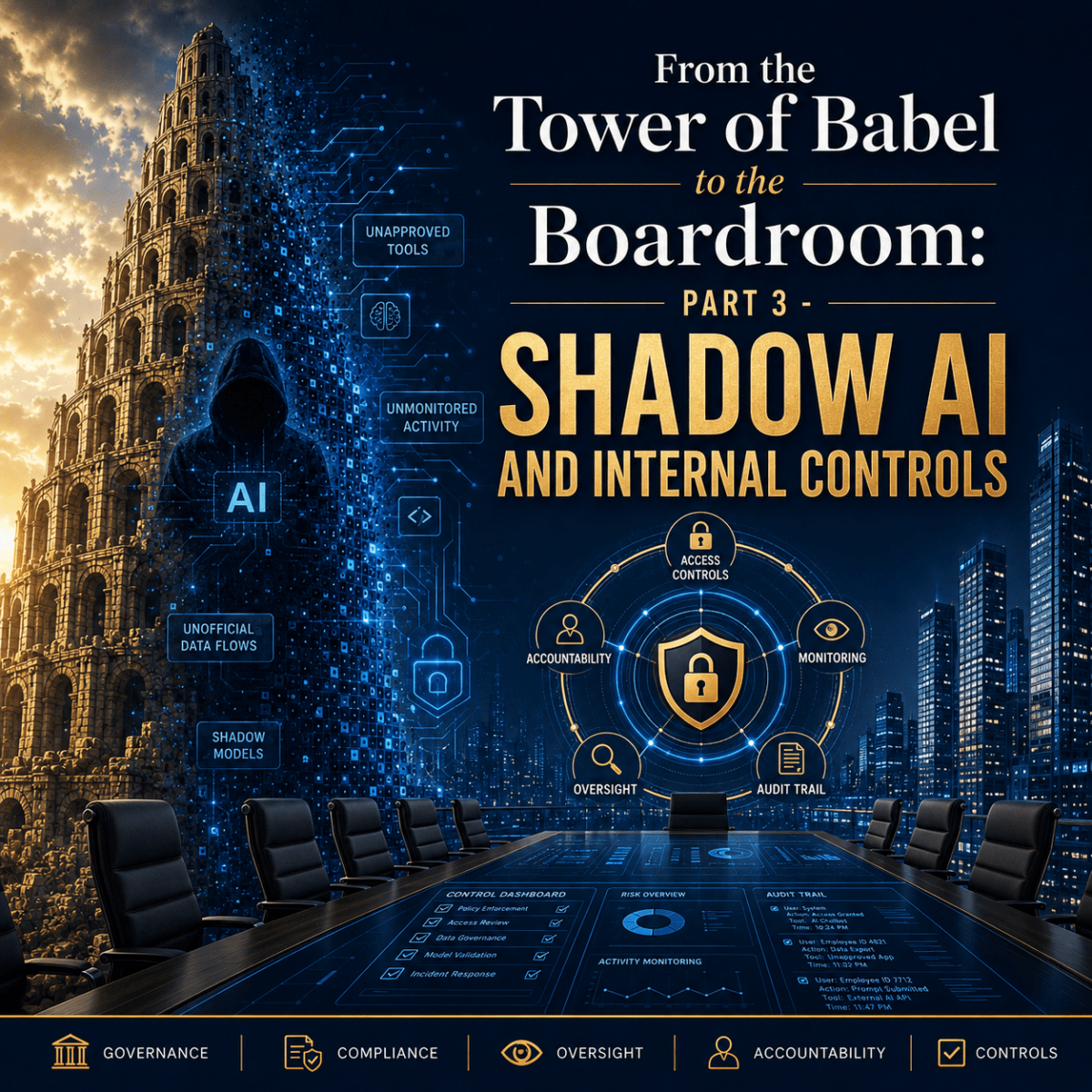
Shadow AI is the internal-controls problem of the artificial-intelligence age.
It is not hard to understand why employees use AI tools without waiting for formal approval. These tools are fast, accessible, practical, and often embedded into platforms employees already use. A business development professional may use AI to draft a proposal. A lawyer may use it to summarize a contract. A finance employee may use it to analyze a spreadsheet. A compliance analyst may use it to review due diligence materials. A manager may use it to draft performance feedback. The use case may be productive. The intent may be benign. The risk may still be real.
That is the compliance challenge. Shadow AI is not simply unauthorized technology use. It is ungoverned decision support, unapproved data transfer, undocumented reliance, uncontrolled output, and untested automation. It poses risks to confidentiality, privilege, privacy, intellectual property, cybersecurity, employment decisions, books and records, third-party management, investigations, and board reporting. Most importantly, it creates a visibility gap. The company cannot govern what it cannot see.
In the first post in this series, we used Magnifica Humanitas to frame the choice between Babel and Nehemiah. In the second post, we moved from principle to program design and argued that AI governance should be embedded in the compliance program. Now we turn to the first practical test: whether the company can convert hidden AI use into governed AI use.
The Magnifica Humanitas Lesson: Opaque Power Is a Governance Risk
Magnifica Humanitas warns that technology is never neutral in practice because it takes on the characteristics of those who devise, finance, regulate, and use it (Magnifica Humanitas, para. 9). For a corporate audience, that is the first lesson of shadow AI. When employees use AI outside approved channels, the company may not know which technology is being used, what data is being transferred, what outputs are being relied on, or what assumptions are being embedded in business decisions.
The Encyclical also warns that control over platforms, infrastructure, data, and computing power can become concentrated, opaque, and difficult to oversee (Magnifica Humanitas, para. 95). Inside a company, shadow AI creates a similar problem on a smaller but very practical scale. Power shifts away from approved systems, documented workflows, and accountable owners toward individual employees’ practices that may be invisible to legal, compliance, privacy, cybersecurity, internal audit, and the board.
Pope Leo also identifies three risks in private AI use that map directly to employee behavior: the ease of getting results, the impression of objectivity, and the simulation of human communication. He warns that these features can encourage overreliance, ready-made answers, and weakened judgment (Magnifica Humanitas, para. 100). That is exactly why shadow AI matters. The risk is not only that employees use the wrong tool. The greater risk is that employees begin to rely on AI outputs without understanding the assumptions, limitations, data sources, or error rates that underpin them.
From Encyclical Principle to Internal Control Requirement
The corporate translation is straightforward: if AI is never merely technical when it affects rights, opportunities, status, freedom, reputation, or work, then shadow AI cannot be treated as a minor IT exception (Magnifica Humanitas, para. 102). It is a governance issue. It is a control issue. It is a compliance issue.
Magnifica Humanitas says responsibility must be clearly defined at every stage, including those who design, develop, use, and rely on AI for concrete decisions. Accountability requires the ability to identify who must account for decisions, justify them, monitor them, challenge them, and remedy harm (Magnifica Humanitas, para. 105). In corporate language, that means AI use cases need owners, approvals, controls, escalation paths, incident processes, documentation, and remediation.
The Encyclical also cautions that abstract ethics are not enough. Responsible AI requires rigorous evaluation, independent oversight, informed users, and safeguards capable of governing AI’s effects (Magnifica Humanitas, para. 106). For the CCO, that is the bridge between principles and controls. Shadow AI must be made visible, classified by risk, controlled at the data layer, reviewed by accountable humans, tested by independent functions, and reported to the board.
Shadow AI Is a Control Environment Issue
A company may have an AI policy and still have a shadow AI problem. A policy tells employees what is expected of them. A control tells the company whether the expectation is working.
This is where COSO becomes essential. COSO has warned that generative AI is moving into daily operations faster than traditional governance models anticipated and that internal control must be applied to risks such as uncontrolled adoption, opaque reasoning, prompt manipulation, model drift, cyber exposure, and configuration change. That is the heart of the matter. A memo from legal does not solve the shadow AI problem. It is solved through the control environment.
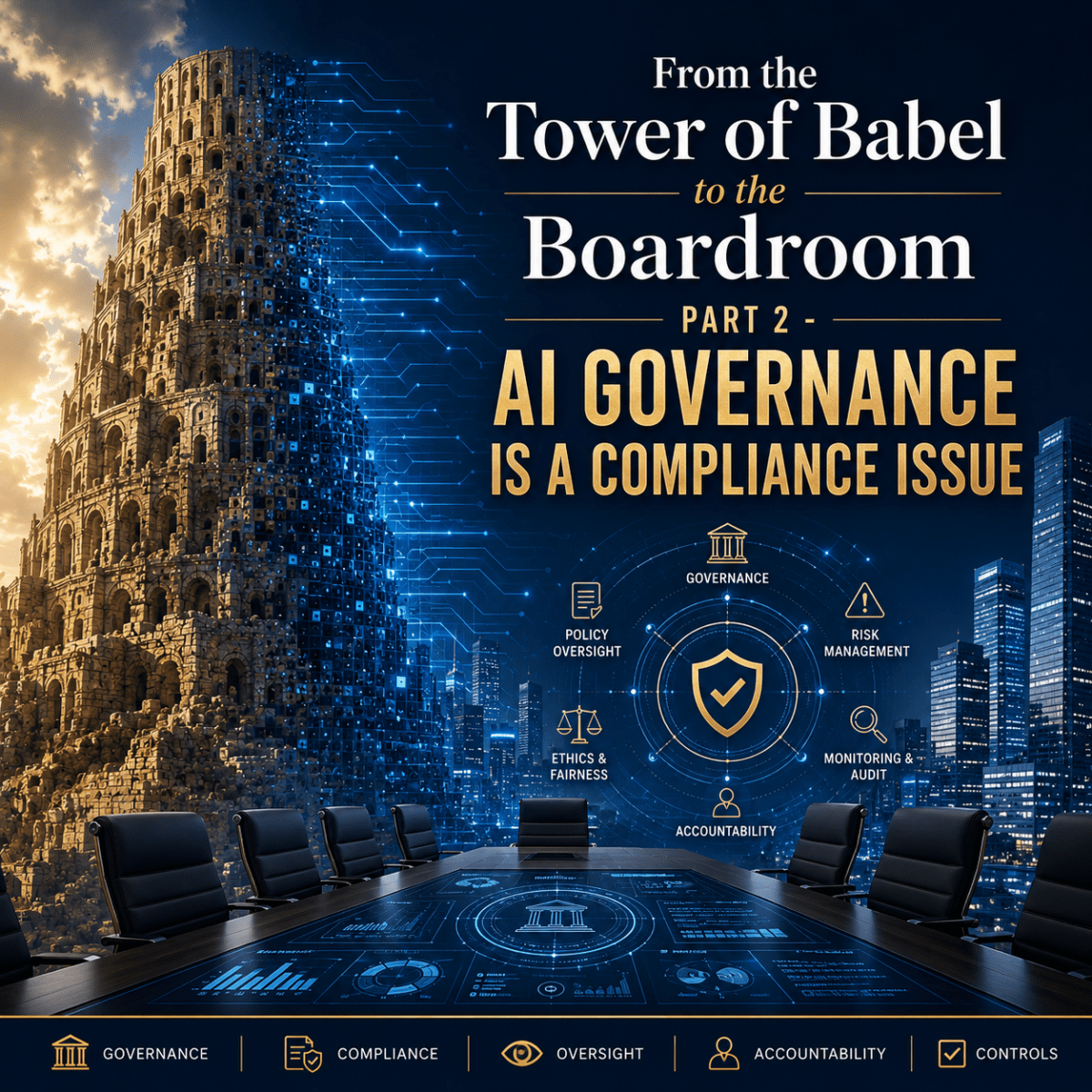
The company needs to define leadership expectations, conduct risk assessments, establish control activities, ensure information and communication, and implement monitoring. Those are not technology terms. They are governance terms. The CCO should work with legal, IT, cybersecurity, privacy, HR, procurement, internal audit, and the business to create a practical AI control structure. The first line should own the business use case. The second line should set standards, review risk, and monitor compliance. The third line should test design and operating effectiveness. The board should receive reports showing whether the system is working.
The DOJ ECCP Question
The DOJ’s Evaluation of Corporate Compliance Programs (ECCP) now asks how companies identify and manage emerging risks, including new technologies such as AI. It asks how companies govern AI in commercial operations and in the compliance program, how they monitor reliability and trustworthiness, how they limit AI to intended uses, how they preserve human decision-making, how accountability is assigned, and how employees are trained.
That logic tracks closely with Magnifica Humanitas. Pope Leo supplies the accountability mandate; the DOJ supplies the compliance program test. If responsibility must be defined and harm must be capable of challenge and remediation, then the company must be able to show that AI tools are known, approved, monitored, limited to intended uses, and subject to human oversight (Magnifica Humanitas, para. 105).
A company with uncontrolled shadow AI has a predictable compliance problem. It may not be able to show that it has identified an AI risk. It may not be possible to demonstrate that employees were effectively trained. It may not be possible to show that AI tools are limited to intended uses. It may not be possible to demonstrate that human review is in place for consequential decisions. It may not be able to show that compliance has visibility into AI use. For the CCO, the question is direct: can we explain how AI is actually being used in the company or only how we hope it is?
From Prohibition to Governed Use
The wrong response to shadow AI is a blanket prohibition that employees ignore. AI is here to stay. Employees will use it because it saves time and improves work product. The better response is governed adoption.
The company should begin with an AI use-case inventory. This should capture approved tools, embedded AI in existing platforms, vendor-provided AI, internally developed AI, pilot projects, and employee use of public tools. It should identify the business owner, purpose, data used, vendor involved, risk rating, approval status, required human review, and applicable controls.
Next, the company should create a clear classification model. Low-risk uses, such as drafting generic internal communications, may require basic training and disclosure. Medium-risk uses, such as summarizing non-sensitive business materials, may require approved tools and data restrictions. High-risk uses, such as employment decisions, customer eligibility, financial reporting, investigations, regulated communications, or third-party risk scoring, should require formal review, documented controls, human oversight, and periodic testing.
NIST’s AI Risk Management Framework provides useful architecture through its Govern, Map, Measure, and Manage functions. ISO/IEC 42001 provides the management-system approach, including policies, responsibilities, risk management, transparency, monitoring, performance evaluation, corrective action, and continual improvement. For shadow AI, these frameworks point to the same conclusion as the Encyclical: move from ad hoc use to structured accountability.
The Controls That Matter
A defensible shadow AI control program should include several core elements.
First, the company needs an approved tools list and a prohibited tools list. Employees should know what is permitted, what is restricted, and what is banned.
Second, the company needs data controls. Employees should not place confidential information, personal data, trade secrets, privileged information, customer data, source code, or sensitive business information into unapproved AI tools. Magnifica Humanitas warns that data and digital infrastructure can become new forms of power when control is concentrated and opaque (Magnifica Humanitas, paras. 108-109). Data governance is therefore not an administrative detail. It is the foundation of responsible AI controls.
Third, the company needs approval workflows for high-risk use cases. The higher the risk, the more formal the review should be.
Fourth, the company needs human review and recourse. AI should support judgment, not replace it. For consequential decisions, a person must remain accountable, and affected individuals should have a channel to challenge errors. This reflects the Encyclical’s insistence that decisions should be capable of justification, monitoring, challenge, and remedy (Magnifica Humanitas, para. 105).
Fifth, the company needs to be monitored and tested. Internal audit should be able to test whether employees are following the policy, whether approved tools are operating within scope, and whether exceptions are remediated.
Finally, the company needs an AI incident process. Employees should know how to report accidental data disclosure, hallucinated output, inappropriate reliance, biased output, suspected vendor misuse, or unauthorized AI use. The goal should not be punishment first. The goal should be visibility, correction, and learning.
5 Lessons for the CCO
- Govern what employees actually use, not merely what policy permits. The first step is visibility. Create a process for employees and business units to disclose AI use without fear that each disclosure will trigger disciplinary action.
- Control data before it leaves the enterprise. The most immediate shadow AI risk is often data leakage. Define prohibited data categories, approved tools for sensitive information, and vendor restrictions on model training or reuse.
- Assign accountability at every stage. Every material AI use case should have a business owner, a risk owner, a control owner, an approval status, a review cycle, and an escalation path.
- Require human review and recourse for consequential uses. AI can assist, summarize, flag, and recommend. It should not replace accountable human judgment where rights, opportunities, employment, reputation, or legal obligations are involved.
- Test, remediate, and report evidence. AI governance must generate proof. Monitor usage, test controls, track incidents, remediate exceptions, and report meaningful metrics to the board.
Conclusion: Hidden Use Must Become Governed Use
Shadow AI is the modern Babel inside the corporation. It may look productive, efficient, and innovative. Yet if it operates without transparency, accountability, controls, or human judgment, it creates a structure the company does not understand and cannot govern.
Magnifica Humanitas reminds us that technology must remain at the service of the human person and not become a system of invisible control (Magnifica Humanitas, para. 171). That principle becomes real in the compliance program through internal controls. CCOs should help the company transition from hidden use to governed use.
In the next post, we will move from the hidden use of AI to the broader question of trust. We will examine AI, Truth, and Corporate Trust, and consider how synthetic content, misinformation, deepfakes, false documentation, and AI-generated narratives create a new compliance risk for boards, management, and the CCO.