Categories
Compliance Into the Weeds

Compliance into the Weeds: The Dark Side of AI in Employee Training

The award-winning Compliance into the Weeds is the only weekly podcast that takes a deep dive into a compliance-related topic, literally going into the weeds to explore a subject more fully. Looking for some hard-hitting insights on compliance? Look no further than Compliance into the Weeds! In this episode of Compliance into the Weeds, Tom Fox and Matt Kelly discuss emerging concerns surrounding AI, particularly ChatGPT, in the realm of employee training.

Their discussion centers on the potential use of AI, specifically ChatGPT’s newest ‘Agent Mode’, to administer compliance training courses on behalf of employees, which could potentially enable them to cheat. They debate the implications of this capability, touching on the historical context of cheating, the effectiveness of current training methods, and the need for new internal controls and strategies to adapt to these technological advancements. They also contemplate the future of training, potentially evolving into AI-driven bots that provide on-the-spot, micro-learning modules. The episode encourages compliance officers to thoroughly vet their training vendors to ensure measures are in place to prevent AI-enabled cheating.

Key highlights:

  • The Dark Side of AI in Compliance Training
  • AI’s Impact on Employee Training
  • AI’s Role in Training and Compliance
  • Future of AI in Corporate Training
  • Challenges and Considerations

Resources:

Matt Kelly in Radical Compliance

Tom

Instagram

Facebook

YouTube

Twitter

LinkedIn

A multi-award-winning podcast, Compliance into the Weeds was most recently honored as one of the Top 25 Regulatory Compliance Podcasts, a Top 10 Business Law Podcast, and a Top 12 Risk Management Podcast. Compliance into the Weeds has been conferred a Davey, Communicator, and W3 Awards for podcast excellence.

Categories
Blog

Rethinking Training and Communications: Insights from Rethink Compliance’s 2025 Benchmarking Survey

In compliance, training, and communications are not simply program components; they are the lifeblood of an effective ethics and compliance (E&C) function. They inform, reinforce, and ultimately drive the behaviors we want to see across the enterprise. When done right, they help employees identify, prevent, and report misconduct. When done poorly, they are a wasted opportunity, ticking a box without changing behavior.

Rethink Compliance’s 2025 Training & Communications Benchmarking Survey provides a rich snapshot of where corporate compliance programs stand today and where they can improve. With over 220 respondents spanning industries from healthcare to technology, manufacturing to financial services, and more than 30% of them based outside North America, the findings offer a broad, representative view of the E&C landscape.

The study shows both encouraging progress and persistent gaps. Most organizations (83%) train all employees on core E&C responsibilities, but only 46.6% deliver risk-specific training tailored to job roles or exposure. Board training is becoming more common, with non-participation dropping from 35% in 2021 to 20% in 2025. Third-party training is also on the rise, from 37% in 2021 to 56% in 2025, especially in highly regulated sectors.

The format and length of training are shifting, too. Courses between 5 and 40 minutes remain most popular, but microlearning, generally defined as quick, 1–4 minute bursts of content, is gaining traction among the highest-performing programs. Engagement tools like real-life scenarios, quizzes, and humor are more widely used, and there is a growing emphasis on mobile compatibility and responsive design.

Analytics are also maturing. While completion rates remain the most-tracked metric (87%), more organizations are analyzing knowledge retention, cultural indicators, and employee feedback. The percentage of respondents finding training analytics “extremely valuable” has jumped from 16.8% in 2021 to 23% in 2025. However, resource constraints remain a significant governance challenge, with 60% of respondents citing limited budget as their biggest obstacle.

From this data, five key takeaways emerge for compliance professionals seeking to strengthen their training and communication strategies.

1. Targeting is the New Baseline

Broad training coverage is good; targeted training is better. The survey confirms that Achievers, who rate their programs as most effective, invest in risk-specific, role-based training. They tailor content to the realities of senior leaders, people managers, high-risk employees, and boards. This approach aligns with regulatory guidance, which emphasizes relevance as a key measure of program quality. If your compliance training treats everyone the same, you are missing an opportunity to drive behavior where the risk is greatest. Targeting also improves retention, as employees are more engaged when the content speaks directly to their work challenges. For example, anti-bribery training for a field sales team should look very different from privacy training for IT administrators. By segmenting your audience and designing accordingly, you not only meet enforcement expectations but also increase the likelihood that training will lead to action when it matters.

2. Onboarding is Prime Real Estate for Compliance Culture

The survey shows that 67% of organizations provide E&C training during onboarding, with another 28% doing so within the first six months. These early days are when the cultural tone is set, expectations are established, and new hires decide whether compliance is truly valued or just lip service. The same applies to third parties, whose actions can create as much liability as your employees’. With third-party training rising sharply to 56% adoption, the momentum is clear. By embedding compliance messaging and expectations into the onboarding journey for both employees and high-risk partners, you lay a foundation that can be reinforced over time. This early investment pays dividends: employees start their tenure with clarity on what is expected, and third parties understand from the outset that compliance is part of doing business with you. Miss this window, and you risk leaving both groups to learn norms through observation, a risky proposition if informal culture undermines formal policy.

3. Shorter, More Engaging Content Delivers More Impact

One of the strongest trends in the survey is the move toward concise, high-impact content. While 5–40 minute courses are still the norm, microlearning, short, focused modules lasting 1–4 minutes, is increasingly popular among high-performing programs. Achievers are also more likely to integrate real-life scenarios into training, which is not surprising given that regulators encourage the use of relatable examples. The reason is simple: employees have limited attention, and training competes with their daily responsibilities. Shorter formats, paired with interactive elements like quizzes or opinion polls, can be reinforced year-round through compliance communications. Instead of one long annual course, consider a blended approach: core concepts delivered upfront, with microlearning refreshers pushed throughout the year. This keeps compliance top of mind and allows you to respond to emerging risks quickly with targeted, bite-sized updates.

4. Data Analytics is a Strategic Advantage—If You Use It Well

Data is abundant in compliance training; insight is not. The survey shows progress, with more organizations finding analytics “extremely valuable” and using them to inform program improvements. Yet too many still stop at completion rates. The most effective programs go deeper into tracking knowledge retention, cultural indicators, engagement metrics, and device usage. Embedding survey questions into training can yield valuable cultural data without adding to survey fatigue. This is more than an administrative exercise; analytics can justify budget requests, demonstrate ROI to leadership, and identify which parts of your program need strengthening. For example, if analytics show that completion is high but post-training assessments reveal weak understanding in a critical risk area, you have the evidence required to redesign the content. Regulators increasingly expect to see not just that training occurred, but that it was effective. Using analytics strategically can turn your training program from a cost center into a business asset.

5. Governance, Resources, and Vendor Partnerships Define Success

Training quality and sustainability depend on governance. The survey found that 60% of organizations have a dedicated E&C training role or team, with Achievers far more likely to have such resources than Strivers. Without clear ownership, training competes with other priorities and suffers in quality. Budget constraints remain the top challenge, cited by 60% of respondents, making it critical to leverage every available efficiency from interdepartmental collaboration to smart vendor partnerships. On the vendor side, most organizations use a blend of in-house and external content, with customization playing an important role in effectiveness. Achievers report higher satisfaction with vendors, likely because they select partners who understand their industry risks and culture. The lesson here is that governance is not just about oversight; it’s about making strategic decisions on staffing, budgeting, and partnerships that elevate your training from adequate to excellent.

The 2025 Rethink Compliance Benchmarking Survey makes it clear: training and communications are evolving toward precision, efficiency, and measurable impact. The challenge for compliance leaders is to align governance, content, delivery, and analytics into a program that not only checks regulatory boxes but also changes behavior. Those who embrace targeting, onboarding, engagement, data, and strong governance will be best positioned to turn training into a true driver of ethical culture.

Categories
Trekking Through Compliance

Trekking Through Compliance: Episode 62 – Awakening Compliance: How ‘For the World is Hollow and I Have Touched the Sky’ Illuminates Training Best Practices

One episode, “For the World is Hollow and I Have Touched the Sky,” offers a wealth of insights for designing and delivering effective compliance training. This is more than just an adventure; it is a story about the perils of ignorance, the need for transparency, and the transformative power of knowledge, all core tenets of modern compliance.

Lesson 1: Question Dogma—Don’t Train to the Test

Illustrated By: The Yonadan society follows rigid rules set by the Oracle. No one asks “why,” and those who do—like the man who claims, “For the world is hollow and I have touched the sky”—are ”punished or silenced.

Compliance Lesson: All too often, organizations approach compliance training as a box-checking exercise, focused solely on rote memorization of policies or procedures. Just as the Yonadans lived in a society where questioning was forbidden, employees may come to see compliance as a set of rigid “dos and don’ts” instead of a dynamic process that welcomes curiosity and improvement.

Lesson 2: Reveal the Big Picture—Context Matters

Illustrated By: The people of Yonada do not realize they are living on a generational ship, believing instead that their enclosed environment is the entire world. Only by discovering the truth can they make choices that affect their fate and survival.

Compliance Lesson: If your training never explains the “why” behind your policies and never reveals the big picture, you risk creating a workforce that follows the rules blindly or, worse, resents them.

Lesson 3: Foster Psychological Safety—Mistakes are Learning Opportunities

Illustrated By: The Oracle enforces its rules with fear and punishment. The Yonadans are afraid to admit mistakes or challenge the status quo, leading to a stagnant society unable to adapt or improve.

Compliance Lesson: A fear-driven compliance culture is doomed to fail. Employees will hide mistakes, avoid speaking up, and resist engaging with training. Psychological safety, the ability to ask questions or admit errors without fear of retribution, is foundational for any successful compliance program.

Lesson 4: Adapt Training for Changing Risks—Update and Refresh

Illustrated By: The threat facing Yonada is new—their world-ship is heading toward disaster. The Oracle’s unchanging edicts are no match for this new risk, and the society’s inability to adapt puts everyone in jeopardy.

Compliance Lesson: Compliance risks are not static. If your training program never evolves, you risk leaving your organization unprepared for the compliance challenges of tomorrow.

Lesson 5: Leadership Engagement is Critical—Lead from the Front

Illustrated By: Dr. McCoy, Captain Kirk, and Mr. Spock do not simply observe the Yonadans from a distance. They intervene, ask questions, and critically, help Natira and others find the courage to seek the truth and lead change from within.

Compliance Lesson: Leadership’s visible commitment to compliance is the strongest signal to employees that these issues matter.

Final ComplianceLog Reflections

“For the World is Hollow and I Have Touched the Sky” is a cautionary tale about the dangers of blind obedience and the critical importance of knowledge, context, and leadership. Compliance professionals have a unique role as navigators, helping their organizations see beyond the walls of their “worlds,” challenge assumptions, and build a culture where doing the right thing is second nature. By making compliance training meaningful, adaptive, and inclusive, you’ll ensure that your organization not only avoids the fate of Yonada but instead truly “touches the sky.”

Resources:

⁠⁠Excruciatingly Detailed Plot Summary by Eric W. Weisstein⁠⁠

⁠⁠MissionLogPodcast.com⁠⁠

⁠⁠Memory Alpha

Categories
Innovation in Compliance

Innovation in Compliance – The Future of Compliance Training: AI, Adaptive Learning, and Cultural Integration

Innovation comes in many areas, and compliance professionals must be ready for and embrace it. Join Tom Fox, the Voice of Compliance, as he visits with top innovative minds, thinkers, and creators in the award-winning Innovation in Compliance podcast. Today, we begin a 3-part podcast series sponsored by Diligent with Jessica Czeczuga, Danile Zmak, and Amanda Carty. In Part 1, Tom is joined by Jessica Czeczuga, Principal Instruction Design Instructor at Diligent about the future of compliance training.

Tom and Jessica to explore the future of compliance training, covering key challenges such as cybersecurity and data privacy. They discuss the transformative role of AI in creating adaptive, targeted training and the importance of continuous and varied communication methods to drive home compliance messages. Jessica emphasizes the need for a comprehensive compliance education strategy, integrating training, communication, and culture, tailored to the diverse ways different generations consume information.

Key highlights:

  • Future of Compliance Training
  • Adaptive Learning and AI
  • Targeted Training Examples
  • Generational Differences in Training Delivery
  • Importance of Compliance Culture


Resources:

⁠Jessical Czeczuga on LinkedIn⁠

⁠Diligent⁠


Tom Fox

⁠Instagram⁠

⁠Facebook⁠

⁠YouTube⁠

⁠Twitter⁠

⁠LinkedIn

Categories
Trekking Through Compliance

Trekking Through Compliance: Episode 56 – Rewiring the Enterprise: What Spock’s Brain Teaches Us About Compliance Training

Few episodes of Star Trek: The Original Series are as infamous or as misunderstood as “Spock’s Brain.” Dismissed by many as campy science fiction, the episode nevertheless offers a wealth of practical insights for today’s compliance professionals, especially those responsible for developing, maintaining, and delivering effective compliance training programs.

Let’s boldly go where few compliance trainers have gone before and extract five key compliance training lessons from the Enterprise’s wild quest to retrieve Spock’s missing brain. Along the way, we will see that even the quirkiest stories can teach us how to build smarter, more resilient compliance cultures.

1. When the Unimaginable Strikes, Training Must Enable Action, Not Panic

Illustrated By: The crew awakens to chaos. Spock is incapacitated. The bridge officers, stunned and confused, look to Kirk for leadership.

Compliance Lesson: The actual test of a compliance training program is not how well it’s received during routine times, but how effectively it empowers employees to act decisively under pressure.

2. You Can’t Train for Every Event, But You Can Teach Problem-Solving

Illustrated By: There is no manual for “what to do when someone steals your first officer’s brain.”

Compliance Lesson: No training program can anticipate every possible scenario. What you can train, however, is a culture of problem-solving, adaptability, and continuous learning.

3. Communication Bridges the Knowledge Gap

Illustrated By: The landing party discovers a society split in two: the technologically advanced women who control the planet’s systems, and the men, who live in primitive conditions below.

Compliance Lesson: The episode’s iconic “teaching helmet” is a comical take on knowledge transfer, but it highlights a real challenge: bridging the gap between compliance expertise and employee understanding.

4. Just-in-Time Training—When You Need It Most

Illustrated By: Faced with the daunting task of reattaching Spock’s brain, Dr. McCoy uses the teaching helmet to acquire the necessary surgical skills.

Compliance Lesson: The best compliance programs recognize this and provide “just-in-time” resources, such as quick-reference guides, FAQs, and on-demand training, for when employees need to act.

5. Teamwork and Psychological Safety Are the Real Secret Sauce

Illustrated By: With Spock’s brain reconnected, he awakens mid-surgery and begins to talk McCoy through the final steps.

Compliance Lesson: Effective compliance training fosters a similar sense of psychological safety.

Final ComplianceLog Reflections

Spock’s Brain” may not win any awards for scientific realism or dramatic subtlety, but its outlandish premise serves as a powerful allegory for the daily realities of corporate compliance training. Unexpected risks will arise. Knowledge will lapse. Sometimes, you will need to act with incomplete information and under enormous pressure.

The crew of the Enterprise prevails not because they followed a script, but because they were trained, through experience, teamwork, and relentless problem-solving, to adapt and respond to the unknown. The same should be true of your compliance training program.

A training program inspired by the lessons of “Spock’s Brain” will not only teach the rules but empower employees to act ethically and effectively when it matters most. And that, ultimately, is how we boldly go forward together.

Resources:

⁠⁠Excruciatingly Detailed Plot Summary by Eric W. Weisstein⁠⁠

⁠⁠MissionLogPodcast.com⁠⁠

⁠⁠Memory Alpha

Categories
Blog

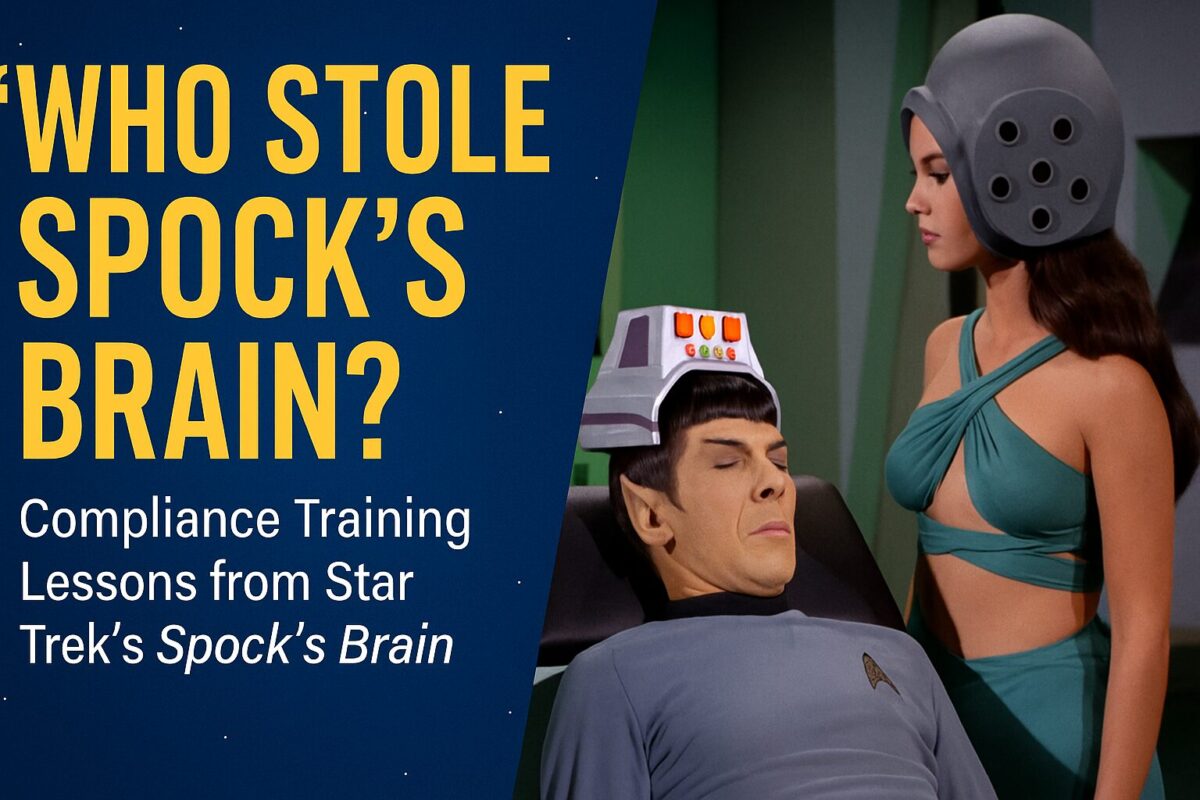
“Who Stole Spock’s Brain?” – Compliance Training Lessons from Star Trek’s Spock’s Brain

Few episodes of Star Trek: The Original Series are as infamous or as misunderstood as “Spock’s Brain.” Dismissed by many as campy science fiction, the episode nevertheless offers a wealth of practical insights for today’s compliance professionals, especially those responsible for developing, maintaining, and delivering effective compliance training programs.

Let’s boldly go where few compliance trainers have gone before and extract some valuable lessons from the Enterprise’s wild quest to retrieve Spock’s missing brain. Along the way, we will see that even the quirkiest stories can teach us how to build smarter, more resilient compliance cultures.

Setting the Stage: When the Unthinkable Happens

For those who have not watched or have not watched recently, “Spock’s Brain” begins with an incident straight out of the compliance professional’s nightmare file: an inexplicable event with catastrophic implications. An unknown intruder boards the Enterprise, incapacitates the crew, and removes Spock’s brain, leaving his body alive but inert.

Captain Kirk, Dr. McCoy, and the rest of the crew must race against time, using every available tool and resource to recover Spock’s brain before it’s too late. What unfolds is a bizarre odyssey that is part rescue mission, part leadership crucible, and, as we’ll see, a perfect metaphor for the compliance training journey.

Today, we consider five key compliance training lessons, each illustrated by a memorable scene from “Spock’s Brain.”

1. When the Unimaginable Strikes, Training Must Enable Action, Not Panic

Illustrated By: The crew awakens to chaos. Spock is incapacitated. The bridge officers, stunned and confused, look to Kirk for leadership.

Compliance Lesson: The unexpected will happen in business. Whether it’s a major regulatory change, a data breach, or a sudden ethics scandal, the initial reaction is often confusion and panic. The true test of a compliance training program is not how well it’s received during routine times, but how effectively it empowers employees to act decisively under pressure.

What should you do? Compliance training must move beyond rote memorization or check-the-box exercises. Instead, it should equip employees with the critical thinking, ethical reasoning, and procedural knowledge they need to respond effectively when the “unimaginable” occurs. Scenario-based training, simulations, and live drills can help build this kind of resilience. In short, training is about readiness, not just awareness.

2. You Can’t Train for Every Event, But You Can Teach Problem-Solving

Illustrated By: Lacking any clear leads, Kirk, McCoy, and Scotty piece together clues using technology, logic, and their collective expertise. There is no manual for “what to do when someone steals your first officer’s brain.”

Compliance Lesson: No training program can anticipate every possible scenario. Regulatory changes, market disruptions, and new types of misconduct are always around the corner. What you can train, however, is a culture of problem-solving, adaptability, and continuous learning.

What should you do? Modern compliance training should focus on building core competencies: How do we spot red flags? How do we escalate issues? Who do we call for help? By emphasizing principles over prescriptive checklists, you empower employees to adapt and innovate—even when they find themselves, metaphorically, searching for a missing piece of the puzzle.

3. Communication Bridges the Knowledge Gap

Illustrated By: The landing party discovers a society split in two: the technologically advanced women who control the planet’s systems, and the men, who live in primitive conditions below. The women possess “the knowledge,” delivered via a helmet-like teaching device, which bestows instant expertise but only temporarily.

Compliance Lesson: The episode’s iconic “teaching helmet” is a comical take on knowledge transfer, but it highlights a real challenge: bridging the gap between compliance expertise and employee understanding. Compliance training can’t simply “download” knowledge into employees’ minds; it requires communication, repetition, and reinforcement.

What should you do? Effective compliance programs use plain language, relatable stories, and multi-modal training (videos, workshops, microlearning) to make complex requirements understandable. And like the helmet, real-world learning is most powerful when it’s immediately relevant to employees’ jobs; just-in-time training, delivered at the point of need, can bridge gaps more effectively than annual courses.

4. Just-in-Time Training—When You Need It Most

Illustrated By: Faced with the daunting task of reattaching Spock’s brain, Dr. McCoy uses the teaching helmet to acquire the necessary surgical skills. He gains instant, but fleeting, expertise enough to attempt the operation, but not enough to complete it without help.

Compliance Lesson: Compliance knowledge, like McCoy’s surgical skills, is often perishable. Employees may learn something in training but forget it when months have passed or when stress levels are high. The best compliance programs recognize this and provide “just-in-time” resources, such as quick-reference guides, FAQs, and on-demand training, for when employees need to take action.

What should you do? Consider building a compliance “knowledge base” accessible to all employees, with short, targeted modules or “how-to” videos for high-risk tasks. Reinforce training with periodic reminders and prompts. And don’t be afraid to re-train in the moment; support employees when they’re “in the operating room,” not just once a year.

5. Teamwork and Psychological Safety Are the Real Secret Sauce

Illustrated By: With Spock’s brain reconnected, he awakens mid-surgery and begins to talk McCoy through the final steps. Kirk, McCoy, and Spock work together seamlessly, overcoming their limitations by relying on each other’s strengths.

Compliance Lesson: The ultimate success of the mission does not rest on the brilliance of any one individual. It is the product of a team that trusts each other, communicates openly, and isn’t afraid to admit when they’re out of their depth. Effective compliance training fosters a similar sense of psychological safety.

What should you do? Employees should feel safe asking questions, raising concerns, and admitting knowledge gaps. Training should encourage discussion and feedback, rather than relying solely on one-way lectures. When compliance becomes a shared journey, employees support each other, fill in knowledge gaps, and ultimately make better decisions, especially when the stakes are high.

Final ComplianceLog Reflections

Spock’s Brain” may not win any awards for scientific realism or dramatic subtlety, but its outlandish premise serves as a powerful allegory for the daily realities of corporate compliance training. Unexpected risks will arise. Knowledge will lapse. Sometimes, you will need to act with incomplete information and under enormous pressure.

The crew of the Enterprise prevails not because they followed a script, but because they were trained, through experience, teamwork, and relentless problem-solving, to adapt and respond to the unknown. The same should be true of your compliance training program.

The world of compliance, like the universe of Star Trek, is full of strange new worlds and unexpected dangers. As compliance professionals, we can learn much from Kirk, McCoy, and Spock, not just about courage and leadership, but about how to prepare our crews for whatever lies ahead.

A training program inspired by the lessons of “Spock’s Brain” will not only teach the rules but empower employees to act ethically and effectively when it matters most. And that, ultimately, is how we boldly go forward together.

Resources:

⁠⁠Excruciatingly Detailed Plot Summary by Eric W. Weisstein⁠⁠

⁠⁠MissionLogPodcast.com⁠⁠

⁠⁠Memory Alpha

Categories
Trekking Through Compliance

Trekking Through Compliance: Episode 44 – Furry Lessons: The Case for Humor in Compliance Training, from The Trouble with Tribbles

If you ask any Star Trek fan to name a classic episode that brings a smile to their face, you’re likely to hear a chorus of “The Trouble with Tribbles! ” The episode, famous for its furry creatures and lighthearted spirit, stands out not just as a fan favorite but as a masterclass in the effective use of humor to deliver meaningful lessons, something all compliance professionals can learn from when it comes to training and engagement.

Why does this matter for compliance? Too often, compliance training is seen as dry, mandatory, and, for even the most well-intentioned teams, something to be “gotten through” rather than truly absorbed. Here are five key training lessons, each tied to a classic scene, that show why humor belongs in your compliance toolbox.

Lesson 1: Humor Lowers Defenses—Use It to Open the Door to Learning

Illustrated By: The first appearance of Tribbles in the Enterprise rec room, as Lieutenant Uhura and crew are charmed by the adorable creatures, leading to laughter and playful banter. Humor, at its core, is a universal icebreaker. In this scene, the crew’s initial reaction to the Tribbles—coos, smiles, and gentle teasing—sets the tone for a more relaxed and open environment. No one is bracing for a lecture; they’re engaged, curious, and, most importantly, willing to participate.

Compliance Lesson: Start your training with humor, an anecdote, a funny compliance video, or a self-deprecating story about compliance “gone wrong.” This isn’t about making light of serious subjects but about lowering barriers and inviting employees to engage. When people laugh, they are not defensive; they are receptive. Set the tone early, and the message will go farther.

Lesson 2: Humor Makes the Message Memorable—Embed It in Your Key Points

Illustrated By: Kirk’s deadpan reaction as he opens a storage compartment, only to be buried under an avalanche of Tribbles. Few moments in compliance (or television history) are as iconic as Captain Kirk being engulfed by a cascade of Tribbles. Why does this stick in our collective memory? Because it’s funny, unexpected, and visually memorable.

Compliance Lesson: Tie humor directly to your key training points. Whether it’s a short skit, a humorous meme, or a role-play gone slightly sideways, link your core compliance lesson to a moment of levity. Employees are more likely to remember “that time the manager dressed up as a ‘compliance villain’” than another slide about policy violations. Humor etches learning into memory.

Lesson 3: Humor Builds Camaraderie—Make Compliance a Team Effort

Illustrated By: The barroom brawl between the Enterprise crew and Klingons, sparked by good-natured ribbing and escalating into comic chaos. This classic scene is not just slapstick; rather, it is a reminder that shared laughter unites a team. The brawl, though farcical, reveals camaraderie and loyalty among the crew.

Compliance Lesson: Use humor to create shared experiences during training; try team quizzes, compliance-themed games, or humorous competitions. When employees laugh together, they build bonds, and those bonds foster a culture where compliance is everyone’s responsibility. Humor turns compliance from an individual burden into a collective mission.

Lesson 4: Humor Allows for Safe Failure—Encourage Experimentation and Questions

Illustrated By: Scotty sheepishly admitting to Captain Kirk that he started the fight with the Klingons, not to defend the Captain’s honor, but the Enterprise’s. When Kirk questions his crew after the barroom incident, Scotty’s honest (and hilarious) confession, delivered with perfect comic timing, creates a safe space for truth. The crew knows they can speak candidly, even about mistakes.

Compliance Lesson: Use humor to create an environment where mistakes are learning opportunities, not sources of shame. Incorporate funny compliance “fails” into your sessions and invite employees to share their own stories, anonymously or otherwise. When the cost of failure is laughter (not punishment), people are more willing to ask questions, admit confusion, and truly learn.

Lesson 5: Humor Reveals Hidden Risks—Spotting Problems Before They Multiply

Illustrated By: Dr. McCoy’s revelation that Tribbles are born pregnant, and their exponential population growth threatens the Enterprise’s operations. The Tribbles’ explosive reproduction is played for laughs, but it serves as a brilliant metaphor for how small issues, if left unchecked, can spiral into major crises. The crew’s laughter quickly gives way to action as the true scope of the problem emerges.

Compliance Lesson: Inject humor into hypothetical scenarios that illustrate how minor compliance lapses can escalate—think of the “snowball effect” as the “Tribble effect.” By making risk tangible (and a little bit funny), you highlight the importance of vigilance and early intervention. Employees will be more likely to remember the “Tribbles in the grain” than an abstract risk chart.

Final ComplianceLog Reflections

Too often, compliance training is a solemn, check-the-box affair. But “The Trouble with Tribbles” reminds us that humor is not the enemy of seriousness; it is an ally. Humor can make difficult topics more approachable, encourage open conversation, and ultimately drive better learning outcomes.

Captain Kirk didn’t solve the Tribble crisis with a stern lecture; he solved it by staying nimble, engaging his crew, and responding with creativity—qualities every compliance professional should embrace. When training is infused with laughter, employees lean in. When they lean in, they learn.

So, the next time you design a compliance training session, ask yourself: Where can I find the “Tribbles”? Where can I use humor to open minds, break down silos, and make the message stick? You’ll find that laughter, much like Tribbles, spreads quickly, multiplies engagement, and leaves your organization stronger (and perhaps a little furrier) than before.

Resources:

Excruciatingly Detailed Plot Summary by Eric W. Weisstein

MissionLogPodcast.com

Memory Alpha

Categories
Adventures in Compliance

Adventures in Compliance: The Sign of Four – Holmes Revealed: Communication and Training Insights

In this new season of Adventures in Compliance, we take a deep dive into the Sherlock Holmes novels. Today, we conclude our four-part exploration of the novel The Sign of Four with a deep dive into communication and training lessons for the compliance professional. Timothy and Fiona dissect Holmes’ meticulous methods of deduction, uncovering essential strategies for clear, effective, and engaging communication. Key topics include forensic clarity, varied reinforcement, tailored messaging, the importance of transparency, setting clear expectations, interactive training techniques, and crisis communication preparedness. Learn how these principles can enhance your professional interactions and build a more resilient, informed culture within your organization.

Highlights include:

  • Exploring Sherlock Holmes’ Communication Lessons
  • Forensic Clarity in Communication
  • The Power of Repetition and Reinforcement
  • Tailoring Messages for Different Audiences
  • Building Trust Through Transparency
  • Setting Clear Expectations

Resources:

The New Annotated Sherlock Holmes

Sherlock Holmes FAQ by Dave Thompson

Connect with Tom Fox

Instagram

Facebook

YouTube

Twitter

LinkedIn

Categories
Trekking Through Compliance

Trekking Through Compliance – Episode 20: Compliance Training Lessons from Return of the Archons

Show Summary

One of the most underrated and allegorically rich episodes from The Original Series is “Return of the Archons.” On its face, it’s a tale about a mind-controlling computer and a seemingly idyllic society. But dig deeper, and you’ll find rich insights about what happens when training fails, communication becomes dogma, and critical thinking is suppressed. In short, it’s a compliance case study in a sci-fi wrapper.

In “Return of the Archons,” the crew of the Enterprise visits Beta III, a planet where the population is under the control of a mysterious figure named Landru. Society there values “peace, tranquility, and the good of the body,” but at the cost of individuality, freedom, and inquiry. The result? A culture of complacency that tolerates no questioning of authority and rewards blind obedience. Sound familiar? For compliance professionals, this episode offers a cautionary tale about the dangers of compliance in form but not in spirit. Let’s unpack the key lessons, each grounded in a scene from the show, followed by a compliance communication or training takeaway.

Lesson 1: Beware of a Culture of Blind Obedience

Illustrated By: As Captain Kirk and Mr. Spock observe the citizens of Beta III, they are struck by the eerie passivity of the people. Everyone is polite, deferential, and expressionless. When asked about Landru, they recite phrases like “It is the will of Landru” or “You are not of the body.” No one can explain what these phrases mean—they repeat them unthinkingly.

Lesson 2: Suppressing Dissent Undermines a Speak-Up Culture

Illustrated By: When Kirk and his team attempt to discuss their concerns with the townspeople, they are met with horror. One man panics and calls the lawgivers, who arrive to silence and “absorb” those who question Landru. Dissent is not only discouraged—it’s physically erased from society.

Lesson 3: Over-Automation Can Lead to Ethical Stagnation

Illustrated By: It’s eventually revealed that Landru is not a man but a computer programmed centuries earlier to maintain peace and harmony. Over time, the machine’s rigid logic has smothered innovation, growth, and individuality, enforcing compliance through force and fear rather than moral reasoning.

Lesson 4: Training Must Be Periodic, Relevant, and Culturally Engaging

Illustrated By: Beta III’s citizens haven’t had new information in generations. Their understanding of Landru and the laws is based on repetitive, ritualistic reinforcement. There’s no evolution, no adaptation—just the same messages, over and over.

Lesson 5: Effective Communication Is Two-Way, Not Top-Down

Illustrated By: The citizens of Beta III receive messages from Landru through lawgivers who deliver proclamations but never answer questions. There is no dialogue, no exchange of ideas—just declarations from on high.

Lesson 6: Culture Is the Foundation of Ethical Behavior

Illustrated By: Kirk and Spock recognize that Beta III is not simply a society with a malfunctioning leader; it is a society built on fear and conformity. Their solution isn’t just to turn off Landru. It’s to encourage the people to reclaim their humanity, their voices, and their ability to choose.


Final ComplianceLog Reflections: You Are of the Body (of Compliance)

As compliance professionals, we must ensure that our training and communication efforts do not replicate the world of Landru. Instead, we must foster curiosity, encourage questions, empower whistleblowers, refresh our content, and build culture from the ground up. So the next time you hear a compliance slogan repeated like a mantra, ask yourself: Are we creating engaged, ethical employees, or are we just building another Beta III? Let’s boldly go where no training program has gone before and bring our people with us.

Resources:

Excruciatingly Detailed Plot Summary by Eric W. Weisstein

MissionLogPodcast.com

Memory Alpha

Categories
Creativity and Compliance

Creativity and Compliance – Overcoming Conservatism in Compliance Education with Creativity

Where does creativity fit into compliance? In more places than you think. Problem-solving, accountability, communication, and connection – they all take creativity. Join Tom Fox and Ronnie Feldman on Creativity and Compliance, part of the award-winning Compliance Podcast Network.

Ronnie’s company, Learnings and Entertainment, utilizes the entertainment devices people use to consume information in their everyday, non-work lives and applies it to important topics around compliance and ethics. It is not only about being funny. It is about changing the tone of your compliance communications and messaging to make your compliance program, policies, and resources more accessible.

In this episode of Creativity and Compliance, Tom Fox and Ronnie Feldman tackle the challenge of integrating creative, engaging methods into compliance training within conservative institutions. Drawing examples from financial giants, they discuss how these organizations have successfully implemented entertaining and effective training strategies. Addressing common concerns such as risk aversion, cost, and effectiveness, the hosts advocate for shorter, more frequent, and varied training formats. They highlight that creativity in compliance training not only captures attention but also enhances engagement and memory retention. The episode concludes with a call to action for compliance professionals to consider what they have to lose by trying new approaches.

Key highlights:

  • Overcoming Conservatism in Creative Compliance
  • Addressing Risk-Averse Concerns
  • Short, Fun, and Frequent Training
  • Variety in Compliance Training
  • User Experience and Engagement

Resources: 

Ronnie

  • Compliance Confessionsinspired by “Mean Tweets,” these 90-second commercials address misconceptions and excuses to promote speak-up culture and the E&C team as positive and helpful.
  • E&C Training Jams – a soulful singer banters about ethics & compliance, explaining policies, sharing examples, and debunking excuses. 
  • Tales from the Hotline – Real speak-up-themed stories about workplace behavior gone wrong.
  • Workplace Tonight Show! E&C meets SNL Weekend Update to explain corporate risk topics and why employees should care.
  • 60-Second Communication & Awareness Shorts – A variety of short, customizable, music and multimedia, quick-hitter “commercials” promoting integrity, compliance, speaking up, and the E&C team as helpful advisors and coaches.
  • Custom Live & Digital Programing – Custom creative programming that balances the seriousness of the subject matter with a more engaging delivery. After all, you can’t bore people into learning.

 Tom

Instagram

Facebook

YouTube

Twitter

LinkedIn

Creativity and Compliance was recently honored as one of the Top 35 Podcasts on Creativity by Feedspot.