Categories
Blog

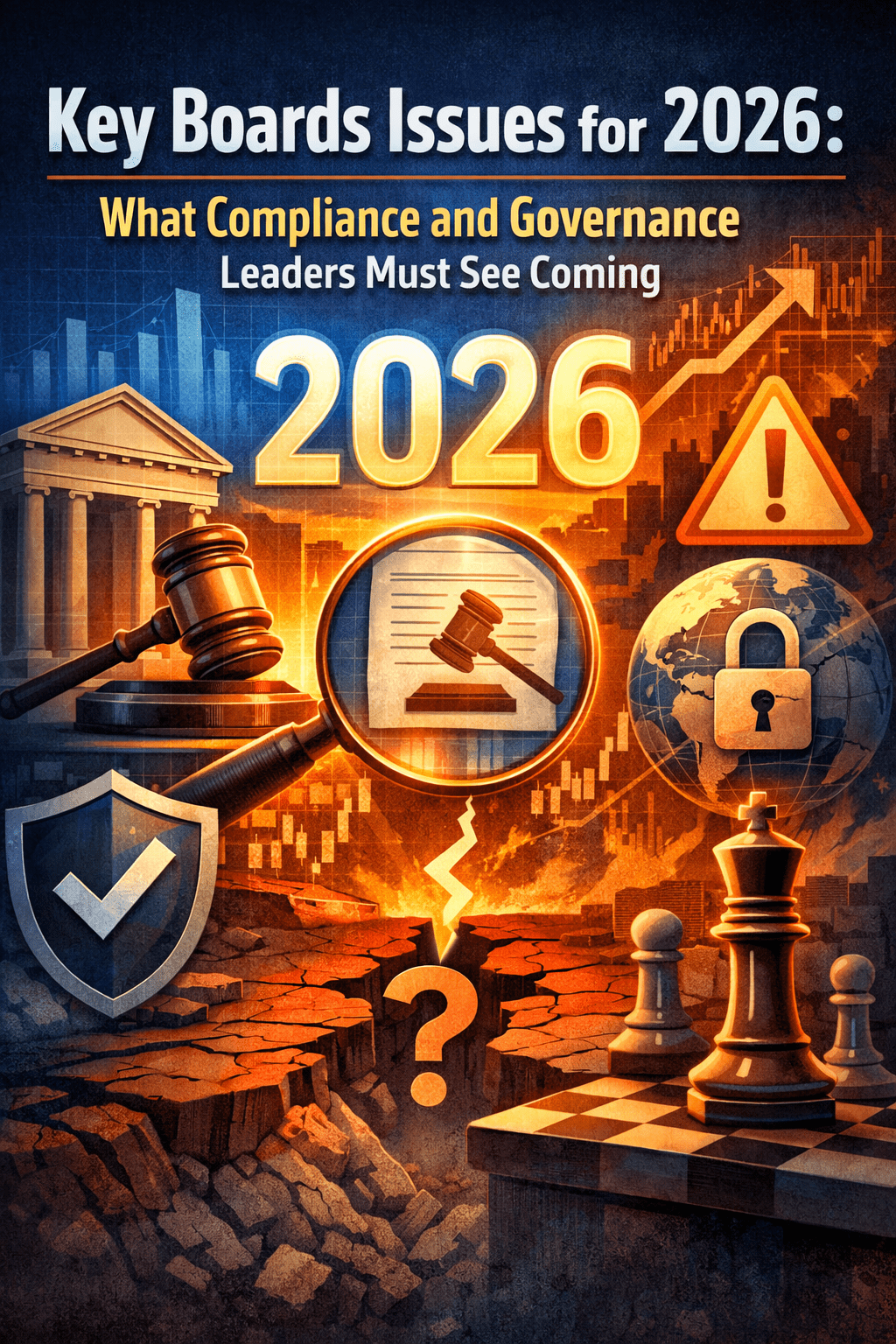
Key Boards Issues for 2026: What Compliance and Governance Leaders Must See Coming

Boards entering 2026 are doing so in an environment defined not by stability, but by volatility. Regulatory priorities are shifting rapidly, geopolitical risk is reshaping markets, technology is accelerating faster than governance frameworks can keep pace, and long-standing assumptions about shareholder engagement and corporate oversight are being tested. In this environment, the role of compliance is no longer reactive or advisory at the margins. It is structural.

The Thoughts for Boards: Key Issues for 2026 memorandum from the law firm of Wachtell, Lipton, Rosen & Katz, which appeared in the Harvard Law School Forum on Corporate Governance, provides a valuable roadmap for boards navigating this uncertainty. For compliance professionals, however, the document does something more important: it reveals where governance risk is quietly migrating. The challenge for compliance leaders is not simply to track these developments, but to translate them into oversight, controls, and strategic guidance that boards can use going forward.

A More Permissive SEC Does Not Mean Less Risk

One of the most striking developments outlined in the memorandum is the SEC’s recalibration of its role. From easing reporting burdens to stepping back from adjudication of shareholder proposals under Rule 14a-8, the Commission is signaling greater deference to companies in deciding how and when to engage with shareholders. At first glance, this appears to reduce regulatory pressure. In reality, it shifts risk inward.

When regulators retreat, discretion moves to boards and management. Predictable SEC processes no longer mediate decisions about disclosure cadence, shareholder engagement, and proposal exclusion. They are governance judgments that will be evaluated ex post by investors, courts, activists, and the media. For compliance professionals, this means fewer bright lines and more gray zones.

The potential move toward semi-annual reporting is a prime example. While it may reduce short-termism, it also alters internal disclosure controls, forecasting discipline, and market expectations. Compliance must ensure that reduced frequency does not translate into reduced rigor. Less reporting does not mean less accountability.

DEI and ESG: From Public Messaging to Quiet Risk Management

The memorandum describes sustained political and regulatory pushback against DEI and ESG initiatives, including executive orders, revised SEC guidance, and heightened scrutiny of shareholder proposals. Yet it also notes an important countervailing force: institutional investors have not abandoned interest in these areas. They have become quieter. This creates a compliance paradox.

On one hand, public signaling around DEI and ESG may expose companies to political and regulatory risk. On the other hand, abandoning these initiatives entirely risks alienating long-term shareholders, employees, and business partners. The compliance function sits at the center of this tension. In 2026, DEI and ESG will increasingly be treated less as branding exercises and more as internal governance risks. Compliance leaders should focus on process integrity, consistency, and documentation rather than rhetoric. The question is no longer whether a company “supports” DEI or ESG, but whether its practices align with its stated values and risk disclosures.

Tone at the top matters here more than ever. Boards must understand that silence does not equal neutrality. How a company governs these issues internally will determine its exposure externally.

Government as Shareholder: A New Governance Reality

Perhaps the most underappreciated development highlighted in the memorandum is the Trump Administration’s growing role as an equity holder in public companies deemed critical to national security. These investments vary widely in form, from passive economic stakes to golden shares with veto rights over strategic decisions. For compliance and governance professionals, this raises novel questions.

Government ownership blurs traditional distinctions between regulator and shareholder. It introduces new stakeholders with potentially divergent objectives, including national security, industrial policy, and geopolitical strategy. Even when governance rights are limited, the mere presence of the government on the cap table can alter decision-making dynamics and investor perceptions.

Compliance must be prepared to advise boards on conflicts of interest, disclosure obligations, and fiduciary duties in this new context. The risk is not simply regulatory; it is structural. Companies operating in sensitive sectors must assume that government involvement is no longer exceptional but potentially recurring.

AI Oversight Moves from Optional to Mandatory

Artificial intelligence dominated board agendas in 2025, and there is no indication that attention will diminish in 2026. The memorandum correctly emphasizes that AI is no longer confined to technology companies. It is embedded in products, operations, compliance monitoring, and decision-making across industries. For boards, the oversight challenge is acute. AI introduces opacity, speed, and scale that traditional governance frameworks were not designed to manage. For compliance officers, this creates both opportunity and risk.

AI is increasingly used within compliance itself, from transaction monitoring to proxy voting analytics. But the use of AI does not eliminate accountability. Boards will still be expected to understand how AI systems function, what risks they create, and how those risks are mitigated.

This is why board-level AI literacy is becoming a governance imperative. Compliance leaders should be proactive in helping boards understand AI not as a technical novelty, but as a risk multiplier. Data governance, model bias, explainability, and third-party reliance must all be incorporated into enterprise risk management frameworks.

Crypto and Digital Assets: Strategy First, Compliance Always

The memorandum highlights a friendlier regulatory environment for crypto-assets, alongside growing corporate interest in crypto treasury strategies and asset tokenization. This combination is dangerous if misunderstood. Regulatory friendliness is not regulatory clarity. Crypto engagement introduces risks related to custody, valuation, sanctions, AML, cybersecurity, and financial reporting. Boards that view crypto as a strategic opportunity without fully appreciating these risks are exposing the company to significant downside.

Compliance must insist on strategic discipline. Why is the company engaging with crypto? What problem is it solving? How does it align with the business model? Without clear answers, crypto becomes speculation rather than strategy. In 2026, compliance officers should expect to spend more time explaining why not to move quickly than how to move fast.

Shareholder Engagement Is Becoming More Fragmented, Not Less Important

The memorandum’s discussion of shareholder engagement reflects a fundamental shift. Institutional investors are splintering their stewardship approaches. Retail investors are more organized and more volatile. Proxy advisors are under regulatory and political attack. The result is unpredictability.

Boards can no longer rely on a small set of proxy advisor recommendations or institutional voting norms. Engagement must become more targeted, more frequent, and more informed. Compliance plays a critical role here by ensuring that engagement practices remain consistent with disclosure rules, insider trading controls, and governance policies.

The rise of retail activism and meme-stock dynamics also creates reputational risk that traditional governance tools were not designed to address. Social media is now a governance arena. Compliance must help boards understand that investor relations, communications, and risk management are increasingly inseparable.

Delaware Still Matters, Even as Alternatives Emerge

Finally, the memorandum addresses trends toward reincorporation in Texas and Nevada, as well as Delaware’s legislative response. While high-profile moves grab headlines, the underlying message is continuity rather than disruption. For most public companies, Delaware remains the default for a reason: predictability. Reincorporation carries costs, risks, and uncertainty that often outweigh perceived benefits. Compliance professionals should ensure that boards approach these decisions with discipline rather than reaction to political or cultural trends. Governance arbitrage is rarely a substitute for governance quality.

Conclusion: Compliance as Governance Infrastructure

The overarching lesson from the Key Issues for 2026 memorandum is that governance risk is becoming more diffuse, not less. Regulatory pullbacks, technological acceleration, geopolitical intervention, and fragmented shareholder bases all point to one conclusion: boards will be expected to exercise more judgment with fewer guardrails. As with all things under this Trump Administration, another key concept is volatility. That places compliance at the center of corporate governance.

In 2026, effective compliance will not be measured solely by the absence of enforcement actions. It will be measured by whether boards can navigate volatility and ambiguity without losing coherence, integrity, or trust. Compliance professionals who understand this shift will be indispensable partners in long-term value creation.
Categories
2 Gurus Talk Compliance

2 Gurus Talk Compliance – Episode 49 – The Depression Episode

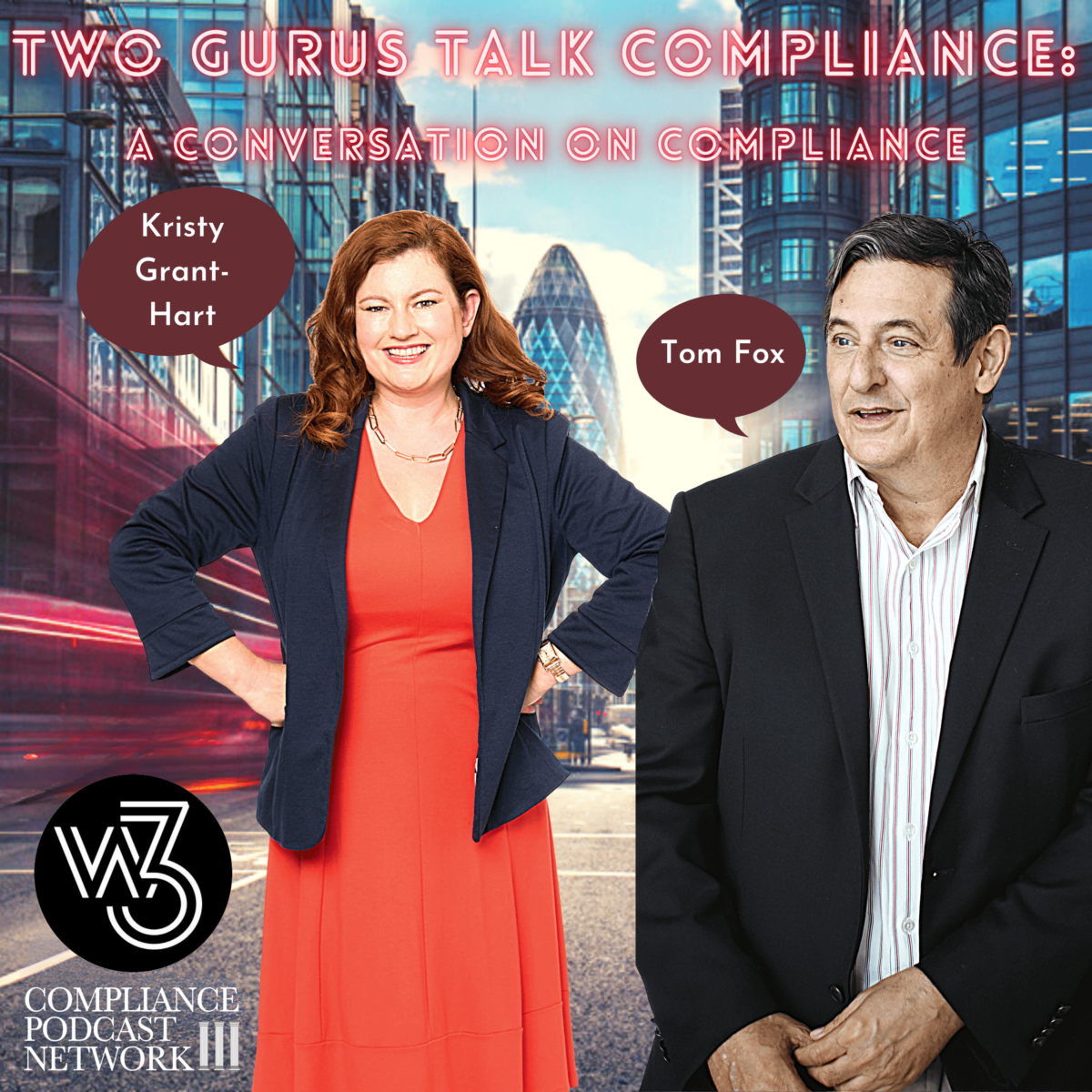
What happens when two top compliance commentators get together? They talk compliance, of course. Join Tom Fox and Kristy Grant-Hart in 2 Gurus Talk Compliance as they discuss the latest compliance issues in this week’s episode!


Stories This Week Include:

  • Rivals pounce on Paul Weiss lawyers. (NYT)
  • The court dismissed the FCPA case against Cognizant Technologies defendants. (Law360)
  • Boeing sued for wrongful death of whistleblower. (WSJ)
  • US presses French companies to stop DEI. (NYT)
  • Disney is under investigation for DEI. (BBC)
  • The Charlie Javice Verdict: A Wake-Up Call For Fintechs And Banking – (Forbes)
  • The Brave New World — Due Diligence to Identify Cartels and TCOs – (Volkov Blog)
  • Nuggets From Navex on Internal Reporting – (Radical Compliance)
  • The Five Things You Shouldn’t Tell ChatGPT – (WSJ)
  • Florida man points a gun at the man at a karaoke bar after getting ‘upset’ about the music: police – (Fox 35 Orlando)

Resources:

Kristy Grant-Hart on LinkedIn

Prove Your Worth

Tom

Instagram

Facebook

YouTube

Twitter

LinkedIn

Categories
Daily Compliance News

Daily Compliance News: March 31, 2025 the Mickey Mouse Under Investigation Edition

Welcome to the Daily Compliance News. Each day, Tom Fox, the Voice of Compliance brings to you compliance related stories to start your day. Sit back, enjoy a cup of morning coffee and listen in to the Daily Compliance News. All, from the Compliance Podcast Network. Each day we consider four stories from the business world, compliance, ethics, risk management, leadership or general interest for the compliance professional.

  • Charlie Javice found guilty. (WSJ)
  • Chinese ABC investigator caught up in corruption probe.  (South China Morning Post)
  • US presses French companies to stop DEI.  (NYT)
  • Disney under investigation for DEI. (BBC)
Categories
Daily Compliance News

Daily Compliance News: March 25, 2025, The AI Skills Edition

Welcome to the Daily Compliance News. Each day, Tom Fox, the Voice of Compliance, brings you compliance-related stories to start your day. Sit back, enjoy a cup of morning coffee, and listen to the Daily Compliance News—all from the Compliance Podcast Network. Each day, we consider four stories from the business world: compliance, ethics, risk management, leadership, or general interest for the compliance professional.

Top stories include:

  • Target DEI flip-flop costs. (Bloomberg)
  • 4 words to shut down office dramas.  (Forbes)
  • Nadine Menendez: From Under the Bus to ‘Mon Amor”. (Bloomberg)
  • 7 AI skills managers must master. (FT)
Categories
Daily Compliance News

Daily Compliance News: March 21, 2025, The Fired Edition

Welcome to the Daily Compliance News. Each day, Tom Fox, the Voice of Compliance, brings you compliance-related stories to start your day. Sit back, enjoy a cup of morning coffee, and listen to the Daily Compliance News—all from the Compliance Podcast Network. Each day, we consider four stories from the business world: compliance, ethics, risk management, leadership, or general interest for the compliance professional.

Top stories include:

  • Cognizant counsel fired after Trump’s order. (Law360) sub req’d
  • Is self-disclosure now a gamble? (Law360) sub req’d
  • Unilever fires activist CEO of Ben & Jerry’s. (BBC)
  • Is an all-white military coming? (Air Force Times)
Categories
Everything Compliance

Everything Compliance: Episode 151, The What is Illegal DEI Edition

Welcome to this edition of the award-winning Everything Compliance. In this episode, we have the quartet of Matt Kelly, Karen Woody, and Karen Moore, all hosted by Tom Fox, the Compliance Evangelist. They all look at various issues for compliance professionals under the current administration.

  1. Karen Moore, what is ‘illegal DEI’? She shouts out to federal employees who have been summarily terminated.
  2. Matt Kelly considers the work of DOGE at the SEC. He shouts out to James Harrison, whose plasma contains a rare antibody known as anti-D, which is used to make injections that protect unborn babies from hemolytic disease of the newborn.
  3. Karen Woody asks whether the trial of the Cognizant Technology executives will ever occur. She shouts out to Georgetown Law Dean Will Treanor, who shut down the illegal harassment of the school by the interim US Attorney for the District of Columbia.
  4. Tom Fox shouts out to the Quebecoise for embracing their Canadian-ness and all those north of the border who are responding to Trump’s bullying with ‘Elbows Up’.

The members of Everything Compliance are:

The host and producer, rantor (and sometime panelist) of Everything Compliance is Tom Fox, the Voice of Compliance. He can be reached at tfox@tfoxlaw.com. Everything Compliance is a part of the award-winning Compliance Podcast Network.

Categories
Daily Compliance News

Daily Compliance News: February 26, 2025, The Corrupt World Edition

Welcome to the Daily Compliance News. Each day, Tom Fox, the Voice of Compliance, brings you compliance-related stories to start your day. Sit back, enjoy a cup of morning coffee, and listen in to the Daily Compliance News—all from the Compliance Podcast Network. Each day, we consider four stories from the business world: compliance, ethics, risk management, leadership, or general interest for the compliance professional.

Top stories include:

  • Meta faces a lawsuit for using cheap foreign workers. (Reuters)
  • Why world corruption hurts America. (Foreign Affairs)
  • Coinbase says the SEC will drop the lawsuit. (CNN)
  • Leveling, not raising. (WaPo)

For more information on the Ethico Toolkit for Middle Managers, available at no charge, click here.

Check out the FCPA Survival Guide on Amazon.com.

Categories
Everything Compliance

Everything Compliance: Episode 150, The Musk On Edition

Welcome to this edition of the award-winning Everything Compliance. In this episode, Matt Kelly, Jonathan Armstrong, Jonathan Marks, Karen Woody, and Karen Moore join the full gang to examine various issues for compliance professionals under the incoming administration.

  1. Jonathan Armstrong looks at the car crash coming for DeepSeek in the EU. He shouts out to Peter Mandelson, the new UK Ambassador to the United States.
  2. Karen Moore looks at the reframing of DEI. She shouts out about the film on September 5.
  3. Matt Kelly considers the Bondi Memo on changes in DOJ enforcement focus and mentions Alexei Navalny’s memoir.
  4. Karen Woody examines the new SEC Crypto Taskforce and mentions the award-winning play Hadestown.
  5. Jonathan Marks provides a tutorial on the role of internal audit on export controls. He also shouts out to his hometown team, the Philadelphia Eagles (now the Super Bowl-winning Philadelphia Eagles).
  6. Tom Fox shouts out to (conspiracy) Bill Simmons for opining that the Dallas Maverick’s trade of Luka Doncic was a ploy to force the state of Texas to allow gambling in this state.

The members of Everything Compliance are:

The host and producer, rantor (and sometime panelist) of Everything Compliance is Tom Fox, the Voice of Compliance. He can be reached at tfox@tfoxlaw.com. Everything Compliance is a part of the award-winning Compliance Podcast Network.

For more information on the Ethico Toolkit for Middle Managers, available at no charge, by clicking here.

Categories
2 Gurus Talk Compliance

2 Gurus Talk Compliance – The Snow in Florida Edition

What happens when two top compliance commentators get together? They talk compliance, of course. Join Tom Fox and Kristy Grant-Hart in 2 Gurus Talk Compliance as they discuss the latest compliance issues in this week’s episode!

Stories This Week Include:

  • DEI-reframing, not retreating.  (FT) and WVA replaces DEI with “Dept. of Engagement and Compliance”.  (12WBOY)
  • Trafigura and ex-COO were convicted of bribery.  (Bloomberg)
  • How Binance is ensuring compliance. (CoinPedia)
  • The CCO Departure Bonus.  (Cosmos)
  • Serbians are done with corruption.  (The Guardian)
  • Wells Fargo banks on (Not) risky business. (PYMNTS)
  • Crackdown on Tariff Exemption Snares U.S. E-Commerce Retailers (WSJ)
  • An investing revolution is coming. The U.S. isn’t ready for it. (The Washington Post)
  • The Sanctions Year in Review: DOJ Takes First Steps to Enforce “The New FCPA” While OFAC’s Enforcement Actions Decline (Volkov)
  • Fewer Americans Are Quitting Their Jobs (WSJ)
  • 1 arrested after snowballs thrown at Florida police officers, officials say (Fox 35 Orlando)

Resources:

Kristy Grant-Hart on LinkedIn

Spark Consulting

Prove Your Worth

Tom

Instagram

Facebook

YouTube

Twitter

LinkedIn

Categories
Great Women in Compliance

Great Women in Compliance – GWIC X Everything Compliance

Welcome to the Great Women in Compliance podcast on the Compliance Podcast Network, sponsored by Corporate Compliance Insights. Today’s episode is a special episode cross-posted with Everything Compliance.

In this episode, host Kristy Grant-Hart joins Everything Compliance panelists Karen Moore and Karen Woody to team up with the Great Women in Compliance regulars Hemma Lomax and Lisa Fine to dissect current issues in the compliance landscape. They look into the implications of the U.S. Constitution’s 10th Amendment on state rights amidst federal executive action, affecting data privacy and ESG regulations. The panel also explores the shifting terrain of DEI programs under recent executive orders, shedding light on both opportunities and challenges for compliance officers in advocating for ethical practices and maintaining organizational morale during these turbulent times, considering the role of the SEC going forward and the current chaos coming out of Washington. The episode concludes with their signature rants and raves, highlighting frustrations and positive notes from the compliance field.

  • Karen Woody on change to require SEC Commission approval to launch investigations.
  • Karen Moore on the importance of the 10th
  • Lisa Fine on morale, destruction, and confusion.
  • Hemma Lomax on change management and employee engagement.
  • Rants and Raves

You can join the LinkedIn podcast community Or the Great Women in Compliance podcast community here.