Categories
Regulatory Ramblings

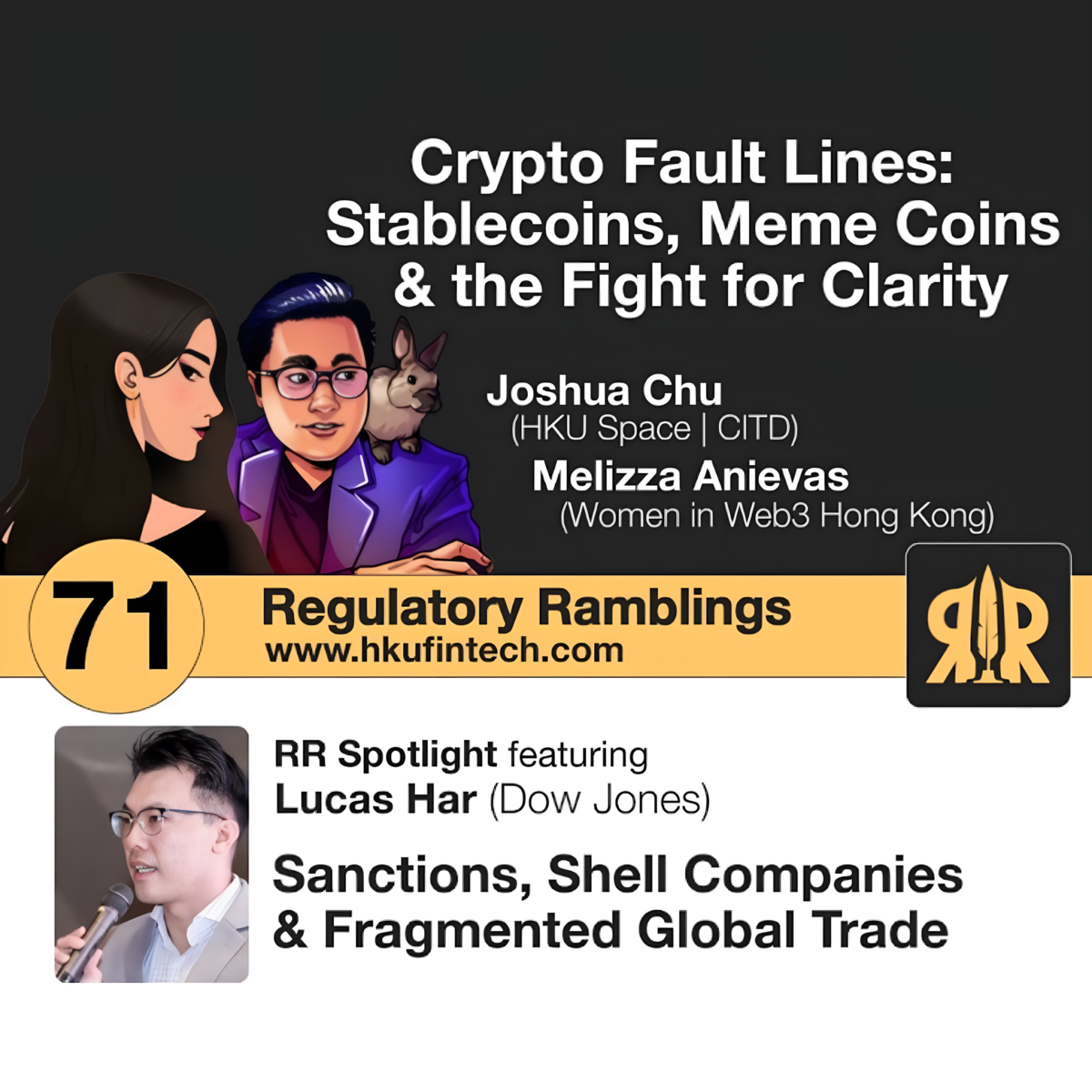
Regulatory Ramblings: Episode 71 – Crypto Fault Lines: Stablecoins, Meme Coins & the Fight for Clarity PLUS: Sanctions, Shell Companies & Fragmented Global Trade

This episode begins with a brief spotlight chat with Lucas Har from Dow Jones in Singapore, discussing trade compliance, sanctions, dual-use goods, and supply chain risk, particularly in the context of the currently strained US-China trade relationship following the recent increase in US tariffs on China and Hong Kong.

We then proceed to a discussion with Hong Kong-based Joshua Chu and Melizza Anievas to explore Hong Kong’s recently enacted Stablecoin Ordinance, including the distinction between meme coins and stablecoins, as well as the ever-evolving global landscape for virtual assets in light of recent regulatory developments in the US.

On May 21, 2025, the Hong Kong Legislative Council passed the Stablecoins Ordinance, creating a formal licensing regime for fiat-referenced stablecoin (FRS) issuers. While local in implementation, the regulatory milestone decisively places Hong Kong at the forefront of a broader Asian effort to shape the future of legitimate, rules-based decentralized finance (DeFi) and tokenized financial infrastructure.

The move came just one day after the US Senate passed the GENIUS Act. Against this backdrop, Hong Kong’s move added momentum to global harmonization efforts on stablecoin regulation, directing the policy debate more towards developing trustworthy digital asset ecosystems with practical, real-world utility and functionality.

The territory’s new framework requires all issuers promoting fiat-backed stablecoins to the general public locally to be licensed by the Hong Kong Monetary Authority (HKMA)—the city’s banking regulator and de facto central bank.

Additionally, issuers must hold reserves in either cash or high-quality, highly liquid assets, such as short-term government securities. Stablecoins must be redeemable at par value at any time. Issuers must regularly disclose their reserve holdings and undergo audits. AML/CFT compliance and risk controls are also required.

This regulatory clarity is paired with active development. For example, Hong Kong’s Stablecoin Sandbox, launched last year, has enabled companies such as Standard Chartered, Animoca Brands, and JD Coinlink to test real-world use cases across payments, capital markets, and trade finance. Ultimately, it reflects a coordinated effort to turn policy into practical rails for tokenized activity.

Joshua Chu

Joshua Chu is a prominent Hong Kong lawyer specializing in fintech and crypto matters, as well as a prolific writer. His opinion and insights are much sought after by the local press and correspondents of major foreign news organizations operating in the city. You can often hear him at his most candid on the radio at RTHK.

Joshua is also co-chair of the Hong Kong Web 3 Association and legal advisor to the Hong Kong Blockchain Association.


Melizza Anievas

Melizza Anievas is a co-founder and executive director of Women in Web3 Hong Kong. Under her leadership, Women in Web3 Hong Kong has grown to over 1,500 members and secured over HK$300,000 in sponsorships within a year, establishing working relationships with notable partners such as Google Cloud Hong Kong, The Sandbox, and Animoca Brands. A Web3 veteran since 2019, Melizza excels at devising growth-driven strategies and operating hyper-growth businesses.


Lucas Har

Lucas Har is based in Singapore and has been with Dow Jones Risk & Compliance for nearly a decade. He began his career with a focus on Anti-Money Laundering (AML) and Counter-Terrorism Financing (CTF) research across a diverse portfolio of Asia-Pacific jurisdictions.

Later, Lucas took on a leadership role overseeing the company’s content curation team, where he was responsible for news curation and monitoring adverse media.

In his current position, he manages the firm’s global trade compliance product suite, spearheading innovation and strategic growth.

He has also extensively engaged with financial institutions, corporations, and regulators across multiple regional jurisdictions, fostering discussions on export control compliance and further strengthening Dow Jones’s expertise in such an increasingly vital and complex area.

Discussion:

As our guests flesh out, several common threads emerge linking the two segments of today’s episode. The first is that of regulatory fragmentation across jurisdictions such as the US, mainland China, Hong Kong, and the EU.

There is also the issue of extraterritorial overreach and competition, particularly between China’s export rules and US crypto laws, as well as a global push for clarity in fast-moving, high-risk sectors, including the international trade of goods and virtual assets more broadly. Simply put, the heavy geopolitical undertones in both export control and digital asset regulation cannot be avoided, as they cast a shadow on the role of trust and credibility, or the lack thereof, in navigating both trade and cryptocurrency systems.

With that in mind, the podcast begins with Regulatory Ramblings host Ajay Shamdasani asking Lucas about the evolving regulatory landscape shaping international trade and its implications for Hong Kong businesses, as well as the impact of mainland China’s new export control regulations on dual-use goods.

Lucas shares what legal and compliance specialists need to know about the regulatory hurdles the firms they serve must adhere to, including sanctions and export control regulations, as well as best practices for enhancing due diligence procedures to mitigate trade-related risks.

Following that, Joshua and Melizza share their thoughts on what the new stablecoin ordinance will mean for Hong Kong, as well as the importance of recent US regulations. Securities and Exchange Commission clarifications on meme coins and their potential impact on legal, risk, and compliance strategies for developers and investors.

The three of them go on to discuss the key operational and regulatory challenges stablecoin issuers face under Hong Kong’s new licensing regime and how the US GENIUS and STABLE Acts might reshape the US stablecoin market and influence global regulatory approaches.

Indeed, something worth asking—and which Joshua and Melizza do not shy away from commenting on⁠ — is whether the relatively ‘light touch’ regulation of meme coins encourages innovation or exposes investors to undue risk.

The conversation concludes with a chat about how projects can effectively balance innovation with regulatory compliance amid differing US and APAC frameworks. Most memorable is how Melizza distinguishes between Web 3.0 and Web3.

Useful links in this episode:

You might also be interested in:

Connect with RR Podcast at:

LinkedIn: https://hk.linkedin.com/company/hkufintech 
Facebook: https://www.facebook.com/hkufintech.fb/
Instagram: https://www.instagram.com/hkufintech/ 
Twitter: https://twitter.com/HKUFinTech 
Threads: https://www.threads.net/@hkufintech
Website: https://www.hkufintech.com/regulatoryramblings 

Connect with the Compliance Podcast Network at:

LinkedIn: https://www.linkedin.com/company/compliance-podcast-network/
Facebook: https://www.facebook.com/compliancepodcastnetwork/
YouTube: https://www.youtube.com/@CompliancePodcastNetwork
Twitter: https://twitter.com/tfoxlaw
Instagram: https://www.instagram.com/voiceofcompliance/
Website: https://compliancepodcastnetwork.net

Categories
Red Flags Rising

Red Flags Rising: S01 E14 – Getting a Grip on U.S. Export Controls Guidance

Mike and Brent unpack the May 13, 2025, due diligence guidance from the U.S. Bureau of Industry & Security. They describe what happened on May 13 (00:00), the guidance from BIS on General Prohibition 10 and Huawei Ascend chips (03:34), the related BIS policy statement (04:13), and then focus on the BIS “Industry Guidance to Prevent Diversion of Advanced Computing Integrated Circuits” (04:47), specifically the underlying U.S. national security concerns (05:50), relevant key takeaways from Episode 13’s special guest Dana W. White (06:51), the significance of the Industry Guidance’s reference to the WMD and military-intelligence catch-all provisions (08:29), the historical pre-1993 “KYC Guidance” cross-referenced by BIS in the new Industry Guidance (11:53), how the historical “KYC Guidance” is often misunderstood through selective quotation devoid of relevant context (13:34), the new “red flags” identified in the May 13, 2025 Industry Guidance (16:10), the key takeaways of the Industry Guidance (17:55), a warning about over-reliance on the Industry Guidance’s statement about existing end-use certificates (18:47), and the practical implications of the Industry Guidance for trade compliance teams (19:36). They then conclude with the next installment of Brent Carlson’s “Managing Up” (21:26).

Resources:

BIS May 15, 2025 Industry Guidance

Brent LinkedIn

Mike LinkedIn

Mike & Brent’s “Fresh Looks” Series

Categories
Red Flags Rising

Red Flags Rising: S01 E11 – Point-Counterpoint – U.S. Export Controls Policy

Mike & Brent return with a point-counterpoint episode on U.S. export control policy. After discussing the latest news about U.S. AI export controls (01:03), they discuss the points and counterpoints related to whether we should have export controls at all (04:57), the relevance of the national security justifications offered by the U.S. Department of Commerce in promulgating its regulations (06:52), the lessons of Ukraine battlefield recoveries (09:59), the views of Anthropic’s CEO, Dario Amodei, on risk and how to push any industry to a more-compliance mindset (rather than acquiesce to the race to the bottom) (10:44), why Brent shouldn’t talk about the old days of corruption (12:08), and how not only the export controls’ design but also their enforcement by government and compliance efforts by industry are all relevant factors to consider in assessing export controls’ effectiveness (14:53). They conclude with the latest installment of Brent’s “Managing-Up” segment (23:04).

Resources:

Brent LinkedIn

Mike LinkedIn

Mike & Brent’s “Fresh Looks” Series

Categories
Compliance Into the Weeds

Compliance into the Weeds: USRA Declination Case Study: Self-Disclosure Best Practices

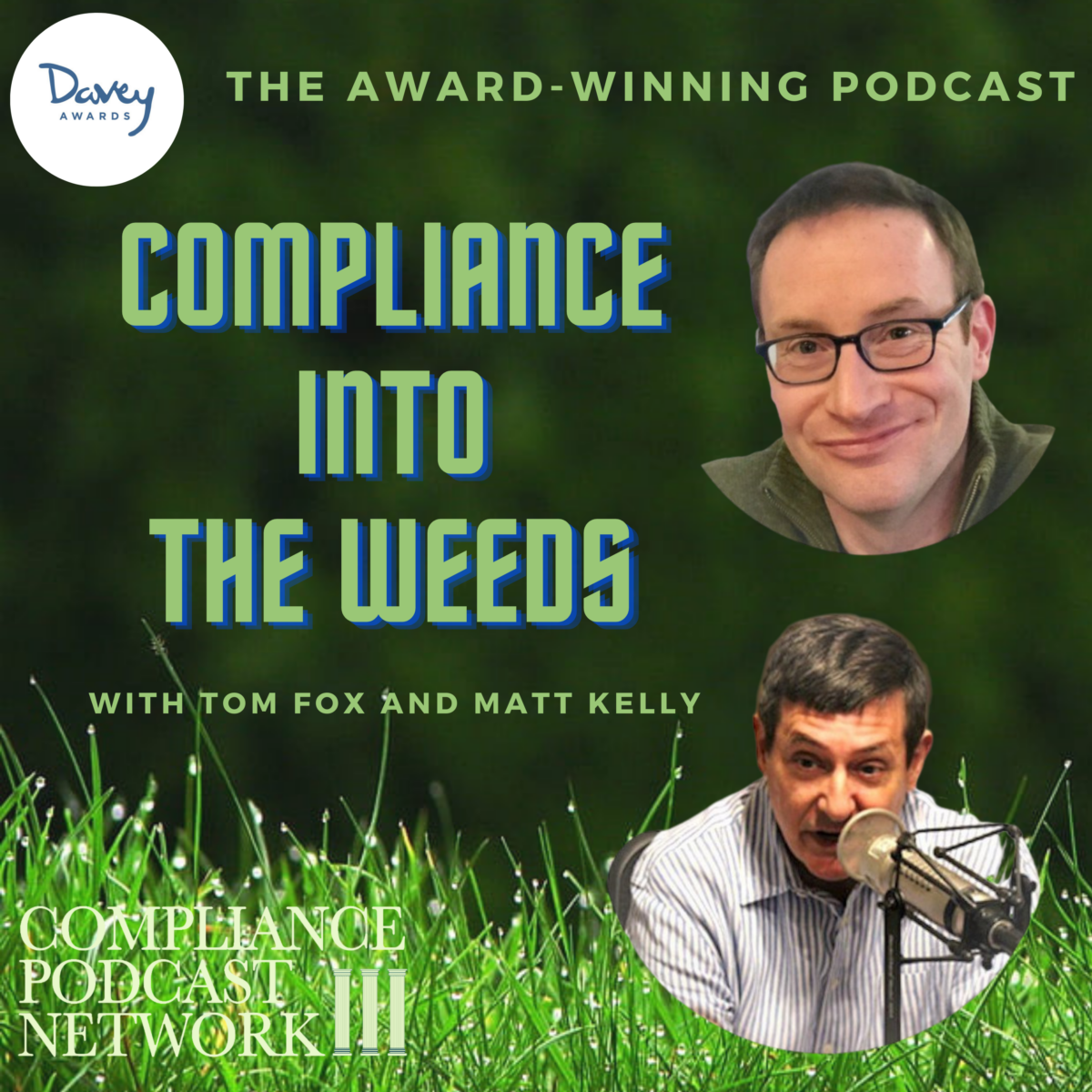
The award-winning Compliance into the Weeds is the only weekly podcast that takes a deep dive into a compliance-related topic, literally going into the weeds to explore a subject more fully. Are you looking for some hard-hitting insights on compliance? Look no further than Compliance into the Weeds! In this Compliance into the Weeds episode, Tom Fox and Matt Kelly take a deep dive into the declination recently given by the DOJ to the Universities Space Research Association (USRA).

In this episode, Tom and Matt dive deeply into a recent decline issued by the Department of Justice (DOJ) to the University Space Research Association (USRA). The discussion focuses on the organization’s exemplary behavior in self-disclosure and cooperation during an investigation into an employee’s misconduct. This misconduct included unauthorized export of software to Beijing University. The hosts highlight the case as a textbook example of effective compliance practices, self-reporting, and cooperation with regulators. They also explore the DOJ’s guidelines on self-disclosure and the importance of internal controls in high-risk areas.

Key highlights:

  • Case Overview: USRA Declination
  • DOJ Press Release Insights
  • Details of the Misconduct
  • USRA’s Response and Cooperation

Resources:

DOJ Press Release on Universities Space Research Association Declination

Tom

Instagram

Facebook

YouTube

Twitter

LinkedIn

Compliance into the Weeds was recently honored as one of a Top 25 Regulatory Compliance Podcast and a Top 10 Business Law Podcast, and a Top 12 Risk Management Podcast.

Categories
Red Flags Rising

Red Flags Rising: S01 E09 – Tariffs: Navigating Uncertainty & Mitigating Enforcement Risk

Mike & Brent jump into tariffs to focus on practical strategies to navigate these uncertain times and mitigate the risk of future enforcement actions. Specifically, they discuss what longer-term geopolitical trends help businesses to plot a strategy despite being whipsawed by tariff news each day (01:57), a recent and helpful Foreign Affairs article, by Emily Kilcrease and Geoffrey Gertz of the Center for a New American Security (03:21), the recent book “Chokepoints: American Power in the Age of Economic Warfare” by Edward Fishman and his description of the “impossible triad” between economic interdependence, economic security, and geopolitical competition (04:21), relevant historical background on the rise of China after the Second World War and its current oversupply problem (04:54), how severe pressures on businesses in both the U.S. and China will create white collar compliance risks today and enforcement risks tomorrow (07:42), customs evasion enforcement risk under the U.S. False Claim Act (FCA) and the FCA’s definition of “knowledge” (08:06), the importance of dynamic assessments of customs evasion risks (11:25), potential fines and penalties from U.S. Customs & Border Protection (CBP) and U.S. Department of Justice (DOJ) enforcement (12:54), a deeper dive into the FCA’s “knowledge” standard and its similarities to the “high probability” standard under the U.S. Export Administration Regulations (EAR) (16:14), and practical strategies for companies trying to manage these risks (17:50). Then they conclude with another installment, back by increasing popular demand, of Brent Carlson’s “Managing-Up” segment (20:39).

Resources:

Geoffrey Gertz & Emily Kilcrease, “A World Safe for Prosperity How America Can Foster Economic Security,” Foreign Affairs Magazine

Edward Fishman, “Chokepoints: American Power in the Age of Economic Warfare”

Brent LinkedIn

Mike LinkedIn

Mike & Brent’s “Fresh Looks” Series

Categories
Red Flags Rising

Red Flags Rising: S01 E08 – Responding to Congressional Inquiries

Mike & Brent react to recent media reports of several congressional committees demanding information from U.S. companies. They revisit their March 14, 2024, NYU PCCE blog post, “”Expect Some Illumination”: A Fresh Look at U.S. Congressional Hearings in the Era of Sanctions and Export Controls as the New FCPA” (01:21), then discuss common pitfalls to avoid when providing information to Congress, including the importance of thinking critically about how your data could be interpreted and used by Congress (02:28), how information provided by Congress can be shared across the U.S. federal government (03:38), the danger of being distracted by political theater (04:13), the value of having a “red team” (or “blue team,” depending on your political leanings) vet your data with hostile eyes before sending data to Congress (06:48), anticipating and preempting difficult questions that the data might raise (08:06), keeping in mind the geopolitical context (09:05), ensuring that investor relations and communications coordinate with legal and compliance regarding public statements (10:30), and the oversight role of boards of directors (12:49). They conclude with another installment, still by popular demand, of Brent Carlson’s “Managing Up” (14:05).

Resources: 

Mike & Brent’s Prior NYU PCCE Post

Brent LinkedIn

Mike LinkedIn

Mike & Brent’s “Fresh Looks” Series

Categories
Red Flags Rising

Red Flags Rising: S01 E07 – Clarity from Chaos: U.S. Export Controls Enforcement Signals & What to Do About Them

Mike & Brent connect the dots between the Administration’s signals regarding U.S. export control enforcement, recent media reports, and how trade compliance teams can best prepare for what comes next. They discuss the overall climate of uncertainty (01:03), an April 8, 2025 report by Reuters about a potential large U.S. export controls fine in the works (01:35), how companies can best respond to a counterparty being put on the U.S. Bureau of Industry & Security’s “Entity List” (05:47), how to respond to U.S. government outreach or administrative subpoenas (07:27), an April 10, 2025 report by Export Compliance Daily about a potential uptick in administrative subpoenas (11:39), their prior “Fresh Looks” post on responding to government inquiries (13:51), and conclude with another installment of Brent Carlson’s “Managing-Up” (17:38).

Resources: 

Reuters article: Karen Freifeld, “Exclusive: TSMC could face $1 billion or more fine from US probe, sources say,” Reuters (Apr. 8, 2025)

Export Compliance Daily: Ian Cohen, “Gov’t May Be Issuing More Export Control-Related Subpoenas, Industry Lawyer Says,” ECD (Apr. 10, 2025) (subscription required)

Brent LinkedIn

Mike LinkedIn

Mike & Brent’s “Fresh Looks” Series

Categories
Red Flags Rising

Red Flags Rising: S01 E04 – FRESH LOOKS: Export Controls Penalties

In Episode 4, Mike and Brent revisit another of their prior “Fresh Looks” posts on the NYU Law School’s Program on Corporate Compliance & Enforcement (“PCCE”) blog. This one concerns export control penalties and what to make of recent statements attributed to Commerce Secretary Howard Lutnick and Undersecretary Jeffrey Kessler. Mike and Brent discuss the context for the original November 14, 2023, post (00:30), how historical FCPA penalties compared to U.S. export controls penalties prior to the April 2023 Seagate resolution (01:26), what current official statements and enforcement trends mean for c-suites and boards (02:59), a recent Export Compliance Daily article regarding internal BIS discussions about enforcement priorities (04:57), how to prepare (07:23) for high probability-based enforcement (08:52), the role of the DOJ’s National Security Division (11:01), and conclude with Brent Carlson’s “Managing Up” segment (12:30).

Resources:

Brent LinkedIn

Mike LinkedIn

Mike & Brent’s “Fresh Looks” Series

Categories
FCPA Compliance Report

FCPA Compliance Report – Navigating the Complexities of FTO Designations and Compliance in Mexico and Latin America

Welcome to the award-winning FCPA Compliance Report, the longest-running podcast on compliance. In this episode, Tom welcomes Tim O’Toole and Matt Ellis from Miller & Chevalier Chartered to discuss the significant implications of President Trump’s executive order designating Mexican drug cartels as foreign terrorist organizations (FTOs).

Tim and Matt elaborate on the heightened compliance risks and operational challenges now faced by companies operating in these regions. The conversation delves into the legal distinctions between Specially Designated Nationals (SDNs) and FTOs, the broad-ranging impact on industries such as agriculture and logistics, and the urgent need for robust risk assessment strategies to mitigate civil and criminal liabilities under U.S. law. They also explore the broader Latin American context and potential collateral consequences for U.S. and Latin American companies amid anticipations of increased regulatory scrutiny and enforcement actions. The discussion concludes with timely observations on recent U.S. Treasury directives aimed at curbing cartel money laundering activities, showcasing the lengths the administration is willing to go to combat these criminal enterprises.

Key highlights:

  • Executive Order and FTO Designation
  • Heightened Risks for Companies in Mexico
  • Complexities of Cartel Influence in Mexico
  • Risk Management Strategies for Companies
  • Broader Implications for Latin America
  • Potential Weaponization of FTO Designation
  • Corporate Compliance and Human Rights

Resources:

Designation of Cartels as FTOs Creates Heightened Risks for Companies Operating in Latin America

Miller & Chevalier

Tim O’Toole

Matt Ellis

Tom Fox

Instagram

Facebook

YouTube

Twitter

LinkedIn

Categories
2 Gurus Talk Compliance

2 Gurus Talk Compliance – Episode 47 – The Chaos Edition

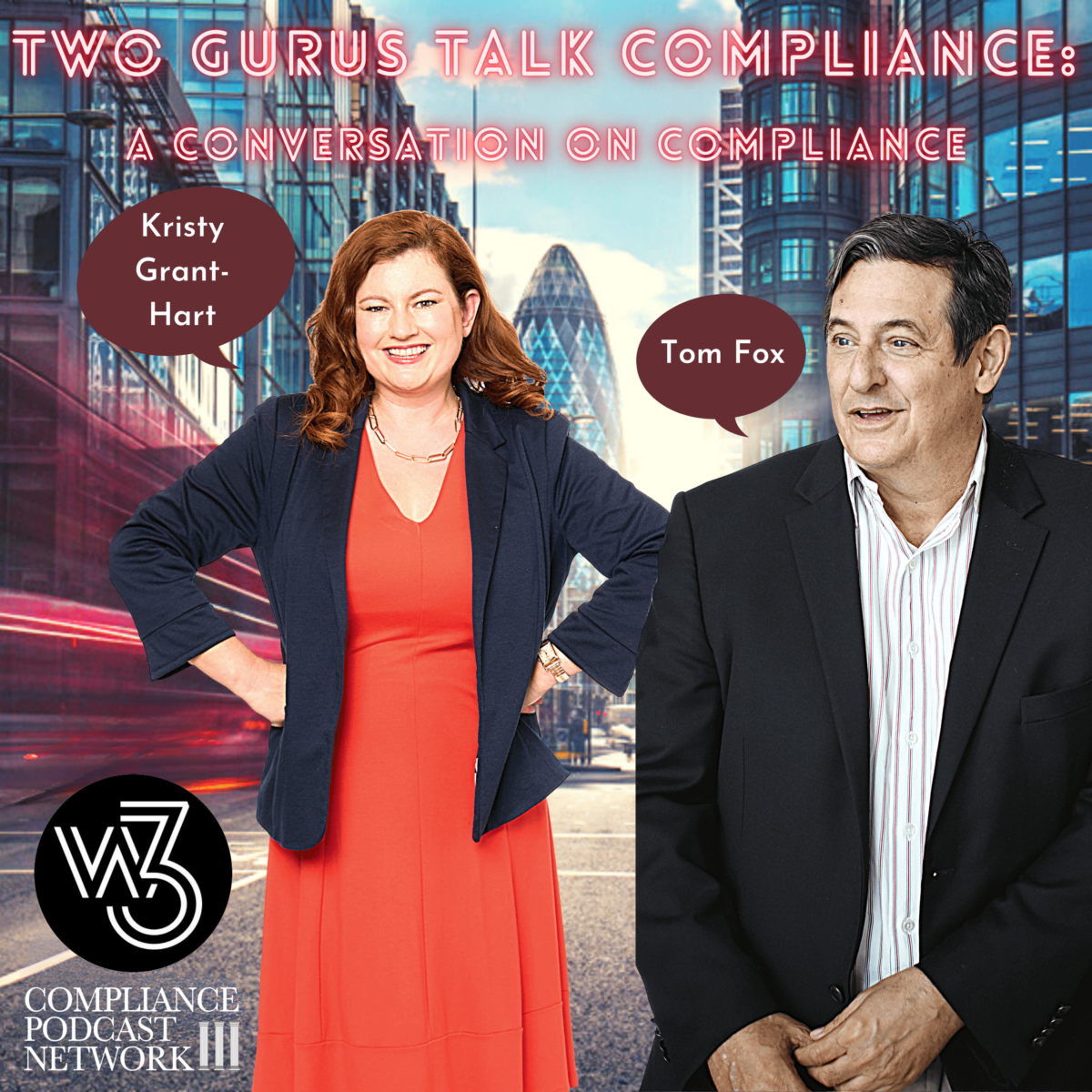
What happens when two top compliance commentators get together? They talk compliance, of course. Join Tom Fox and Kristy Grant-Hart in 2 Gurus Talk Compliance as they discuss the latest compliance issues in this week’s episode!

Stories this week include:

  • Who are we? (Radical Compliance)
  • 9th Circuit upholds Holmes’s conviction. (Reuters)
  • Leveling, not raising. (WaPo)
  • Who wants to go back to Russia? (NYT)
  • Trump revoked Chevron’s license to do business in Venezuela. (WSJ)
  • Two Tech Executives Face Trial Under a Bribery Law Trump Has Put on Hold. (WSJ)
  • Kroger’s CEO resigned abruptly after an investigation into personal conduct. (WaPo)
  • CFTC Offers New Incentives for Companies to Report Their Wrongdoing. (WSJ)
  • 5 steps to take to get a promotion in 2025. (Fast Company)
  • A Florida man poses as an immigration officer at Orlando apartments to check for undocumented residents. (Fox 35 Orlando)


Resources:

Kristy Grant-Hart on LinkedIn

Prove Your Worth

Tom

Instagram

Facebook

YouTube

Twitter

LinkedIn